by Tom Gurney
Tom Gurney BSc (Hons) is an art history expert with over 20 years experience
Page created on September 3, 2026 / Page updated on September 13, 2026
Email: tomgurney1@gmail.com / Phone: +44 7429 011000
Reading Grain, Construction and Colour in Wood Sculpture
Grain beneath the surface
Wood sculpture begins with a living material that continues to reveal direction, density and change after it is cut. Carving removes material, but grain influences how edges, projections and hollows can be sustained. Sculptors may work a single block, join sections, hollow a form, add fibre or metal, and cover the surface with paint, gilding, oil or inlay. “Wooden” is therefore only the start of an accurate description.[1][2]
This page explains historical technique through surviving objects. It does not offer carving steps, tool advice, finishes, pest treatment or conservation procedures. Those depend on species, object condition and professional safety knowledge.
At a Glance
- Graindirection and density influence how edges, hollows and projections can be sustained.
- Constructiona sculpture may be carved from one block, hollowed, joined or built with attached materials.
- Surfacepaint, gilding, oil and inlay may be integral to the intended appearance rather than later additions.
- Settingshrine, container, architecture, handling and ceremony can shape how a wooden object was encountered.
- Survivalloss, decay and removed coatings can make today's exposed wood a partial record of the original work.
Contents
- Reading Grain, Construction and Colour in Wood Sculpture
- Five questions for a wooden sculpture
- Species and grain are part of form
- One block, joined parts and hollow forms
- Carving mass, edge and silhouette
- Paint, gilding and inlay
- Tool marks and surface evidence
- Setting, handling and survival
- How to read wood sculpture
- Sculpture reference pages
- Watch Wood Sculpture in Process and Context
Five questions for a wooden sculpture
Species and grain are part of form
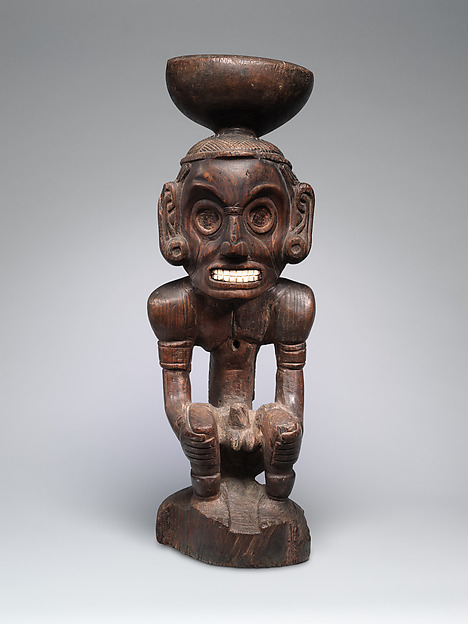
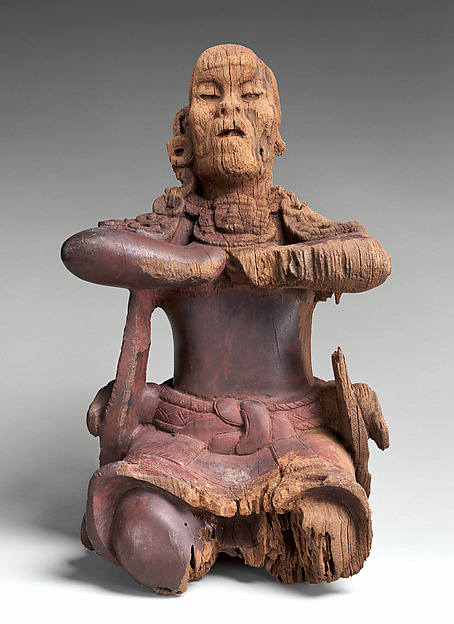
Wood is directional. Growth rings and fibres create grain that can support a long flowing cut in one direction and resist or split under pressure in another. Different species vary in colour, density and figure, but there is no universal best carving wood. Artists select from locally available, culturally significant and materially suitable timbers.[1]
The Taíno Zemí cohoba stand, made about 1000 CE, is carved from guaiacum, an exceptionally dense Caribbean wood, with shell details.[6] Its crouching spiritual figure supports a shallow dish. Substance, bodily pose and ritual purpose are inseparable; the object is not merely a technical display of a hard species.
A Maya Mirror-bearer of 410–650 CE uses Cordia wood, commonly called bocote, with red hematite.[7] The small figure leans beneath the missing reflective element. Its compact body works with the support role, while the lost mirror reminds us that the wood once belonged to a larger material arrangement.
One block, joined parts and hollow forms
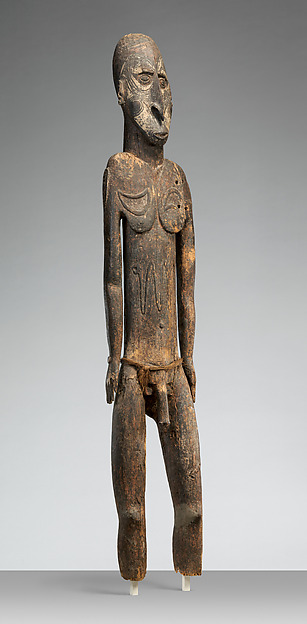
A wood sculpture may appear continuous without having one construction history. Some figures are carved from a single block; others join arms, attributes, bases or separately worked sections. Large wooden figures may be hollowed to reduce weight and movement, but a viewer should rely on technical records rather than infer hidden construction from appearance alone.[1]
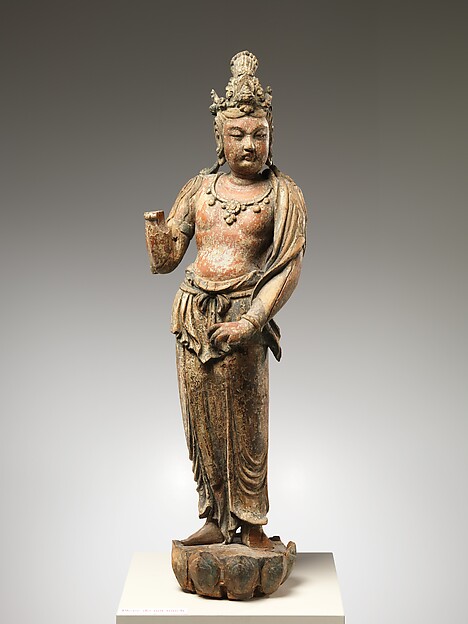
The Chinese Bodhisattva Avalokiteshvara (Guanyin) is dated 1282 and identified as single-block willow construction with traces of pigment.[4] The seated body, cascading drapery and jewellery are organised within the block, while losses and exposed wood disclose only part of the original coloured presence.
By contrast, the nineteenth-century or earlier Sawos Ancestor Figure combines wood, paint, fibre and ferrous metal.[11] Attachments extend the carved body and add movement, texture and social meaning. Construction is not a compromise to be hidden; it is the method by which several materials act together.
Carving mass, edge and silhouette
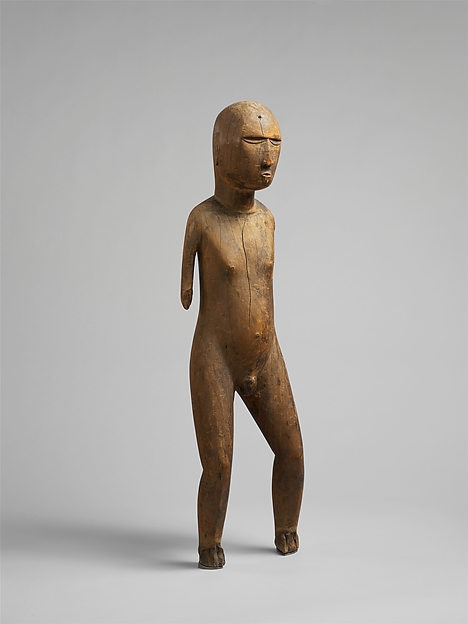
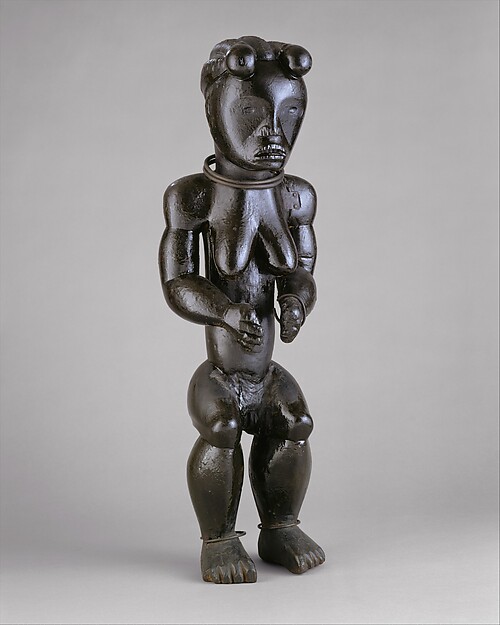
Subtractive carving continually negotiates between projection and support. A wrist, headdress or extended limb must remain connected strongly enough to the mass, while deep hollows and undercut edges create shadow. The final silhouette can preserve the broad shape of a trunk or transform it through multiple views.
The early nineteenth-century Mangarevan Tiki (male figure) concentrates the body into a compact stance.[10] Bent knees and hands held near the torso maintain a strong core. Smooth transitions and the large head make the figure legible without fragile extensions. Its form should be understood within Mangarevan art, not described through the old and misleading language of “primitive” carving.
The Okak-Fang Eyema byeri, a nineteenth-century reliquary guardian, uses a similarly concentrated human form for a different cultural role.[8] Rounded masses, flexed limbs and an enlarged head carry visual authority. Copper-alloy details and palm oil alter the dark wooden surface, so the effect cannot be reduced to silhouette alone.
Paint, gilding and inlay
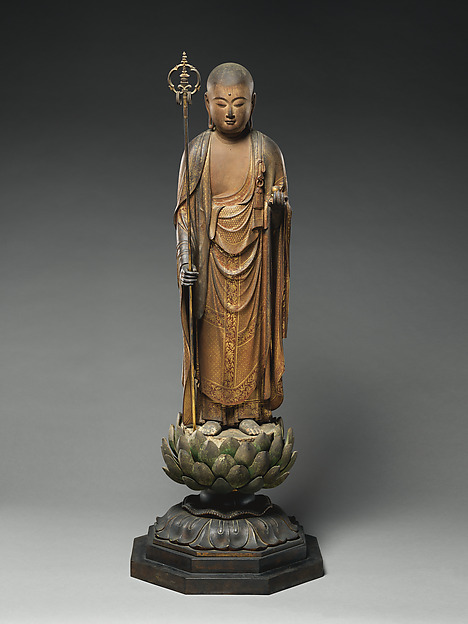
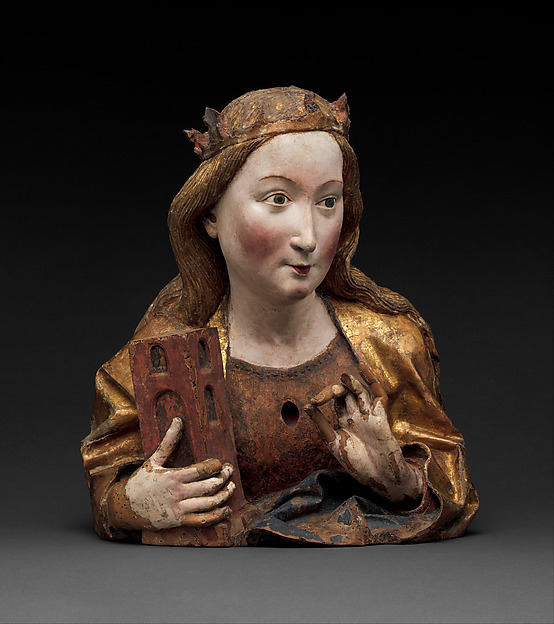
Many historical wood sculptures were made to be coloured. A preparation layer can smooth grain and receive pigment or gilding; metal leaf catches light; inlaid eyes or jewellery sharpen a face. When coatings are lost, exposed brown wood may look “natural” to modern viewers while misrepresenting the intended object.[1]
Intan's Japanese Bodhisattva Jizō, dated 1291, is carved from hinoki cypress and includes polychrome pigments, gold paint, cut gold leaf and rock-crystal eyes.[5] The surface system distinguishes robe, flesh, jewellery and gaze. Carving gives the volumes, but colour and reflection complete their devotional address.
Niclaus Gerhaert von Leyden's Reliquary Bust of Saint Barbara, about 1465, is walnut with paint and gilding.[9] The face, veil, crown and clothing move between carved depth and coloured detail. Surviving and missing finish have to be read together; bare passages do not prove that the sculptor sought an unpainted appearance.
The Taíno stand's shell and the Fang guardian's copper-alloy elements offer other ways to make wood interact with light. Inlay and attachment can focus attention on eyes, openings and ritual functions.
Tool marks and surface evidence
Facets, grooves, cuts and polished areas may reveal stages of carving. Yet visible marks can come from original making, deliberate finish, wear, later alteration or loss of a coating. A smooth face beside sharply cut hair may be an intentional contrast; a rough area may once have been hidden by gesso, textile or an attached part.
Close looking works best with the object record. The willow Guanyin's single-block construction is documented; the Jizō's hinoki, gold and crystal are specified; the Saint Barbara bust's walnut and finish are recorded. Technique should follow evidence rather than romantic assumptions about direct carving.[4][5][9]
The back, base and underside can be as informative as the face when a museum supplies those views. They may show the original block boundary, a hollow, dowel holes, an attachment point or an unfinished surface once hidden by architecture. These are not defects automatically meant for display; they record how the sculpture occupied a setting. Front and back may also receive different degrees of finish because the intended sightlines differed. A figure carved for a niche, shrine or container answers another viewing pattern from a small object meant to be turned in the hand. Technique and viewpoint should therefore be considered together.
Setting, handling and survival
Wood is organic and responds to environmental change differently from stone or metal. Splitting, insect activity, lost joins, worn paint and structural movement affect what survives.[3] This is a reason for cautious museum care, not an invitation to treat an object with household products or improvised repairs.
Setting also changes interpretation. Jizō and Guanyin were devotional figures; the byeri guarded ancestral relics; the zemí stand supported a substance within Taíno ritual; a Sawos ancestor figure carried attachments. Museum isolation can clarify carving but mute relationships with shrine, container, architecture, movement or ceremony.
Survival is selective. Fire, humidity, reuse and decay remove wooden art unevenly, while stone and metal often dominate survey histories. A surviving wooden figure may therefore represent a much larger lost tradition.
How to read wood sculpture
- Identify the recorded species when possible. Willow, hinoki, guaiacum, walnut and bocote do not behave or signify identically.
- Trace the grain and mass. Notice where contours follow the block and where projections need support.
- Look for construction. Joined parts, hollow cavities, cores and attachments require documentary confirmation.
- Read the full surface. Paint, gold, oil, shell, metal and crystal may be integral.
- Distinguish loss from intention. Exposed grain can result from missing finish.
- Ask what is absent. A mirror, relic, fibre attachment or architectural setting may once have completed the work.
- Use cultural attribution precisely. Name Intan, Niclaus Gerhaert, Taíno, Maya, Okak-Fang, Mangarevan and Sawos makers as the records allow.
Wood sculpture is never simply form cut from a neutral block. Grain limits and guides carving; construction expands the body; colour reorganises the surface; setting supplies function. The most useful technique history keeps all four in view.
Watch: Wood Sculpture in Process and Context
Choose a V&A reconstruction of virtuoso limewood carving, a Met close reading of an Egyptian wooden figure, or Historic England's account of conserving Grinling Gibbons carving.
Recreating Grinling Gibbons' Limewood Cravat
Follow a modern reconstruction to see how grain direction, undercutting and fragile projection shape the reading of a celebrated limewood carving.
Watch on YouTubeFrequently Asked Questions
Growth rings and fibres give wood direction. Grain can influence how edges, hollows and projections are supported, although species and individual blocks behave differently.
No. Many were painted, gilded, oiled or inlaid. Exposed grain may be intentional, but it can also result from lost surface layers.
Some are documented as single-block works; others join sections, are hollowed, or combine wood with fibre, metal, shell, crystal and other materials.
A brown wooden surface may be the result of lost pigment, gilding, preparation layers or attachments. Museum technical records can help distinguish original appearance from later change.
Start with visible evidence such as grain, joins, tool marks and coatings, then consult the museum or collection record. Do not infer hidden construction or attempt practical tests on an object.
Discussion
Which feature most changes how you read a wooden sculpture: grain, block construction, silhouette, surviving colour, attachments or its original ritual and architectural setting?
Reader Insights
Visible grain may record an intended surface—or the loss of paint, gilding and preparation layers.
A single block, joined limb, hollow body or attached fibre can shape pose, movement and cultural function.
Shrine, reliquary, container, architecture and ceremony can matter as much as the isolated museum view.
Join the Conversation
Share one precise observation or a useful museum example below.
References
- Victoria and Albert Museum, “Sculpture techniques.” https://www.vam.ac.uk/articles/sculpture-techniques
- National Gallery of Art, “Explore the Basics of Sculpture.” https://www.nga.gov/educational-resources/explore-basics-sculpture
- Metropolitan Museum of Art, The Care and Handling of Art Objects. https://resources.metmuseum.org/resources/metpublications/pdf/The_Care_and_Handling_of_Art_Objects_Practices_in_The_Metropolitan_Museum_of_Art_2019.pdf
- Metropolitan Museum of Art, “Bodhisattva Avalokiteshvara (Guanyin),” object 2014.260. https://www.metmuseum.org/art/collection/search/61658
- Metropolitan Museum of Art, “The Bodhisattva Jizō,” object 2012.29.1. https://www.metmuseum.org/art/collection/search/76084
- Metropolitan Museum of Art, “Zemí cohoba stand,” object 1979.206.380. https://www.metmuseum.org/art/collection/search/312602
- Metropolitan Museum of Art, “Mirror-bearer,” object 1979.206.1211. https://www.metmuseum.org/art/collection/search/313256
- Metropolitan Museum of Art, “Eyema byeri (reliquary guardian figure),” object 1979.206.229. https://www.metmuseum.org/art/collection/search/310870
- Metropolitan Museum of Art, “Reliquary Bust of Saint Barbara,” object 2021.41. https://www.metmuseum.org/art/collection/search/464128
- Metropolitan Museum of Art, “Tiki (male figure),” object 1978.412.767. https://www.metmuseum.org/art/collection/search/313654
- Metropolitan Museum of Art, “Ancestor Figure,” object 1979.206.1388. https://www.metmuseum.org/art/collection/search/313780