by Tom Gurney
Tom Gurney BSc (Hons) is an art history expert with over 20 years experience
Page created on September 3, 2026 / Page updated on September 13, 2026
Email: tomgurney1@gmail.com / Phone: +44 7429 011000
How Acid-Bitten Lines and Burin-Cut Grooves Leave Different Evidence
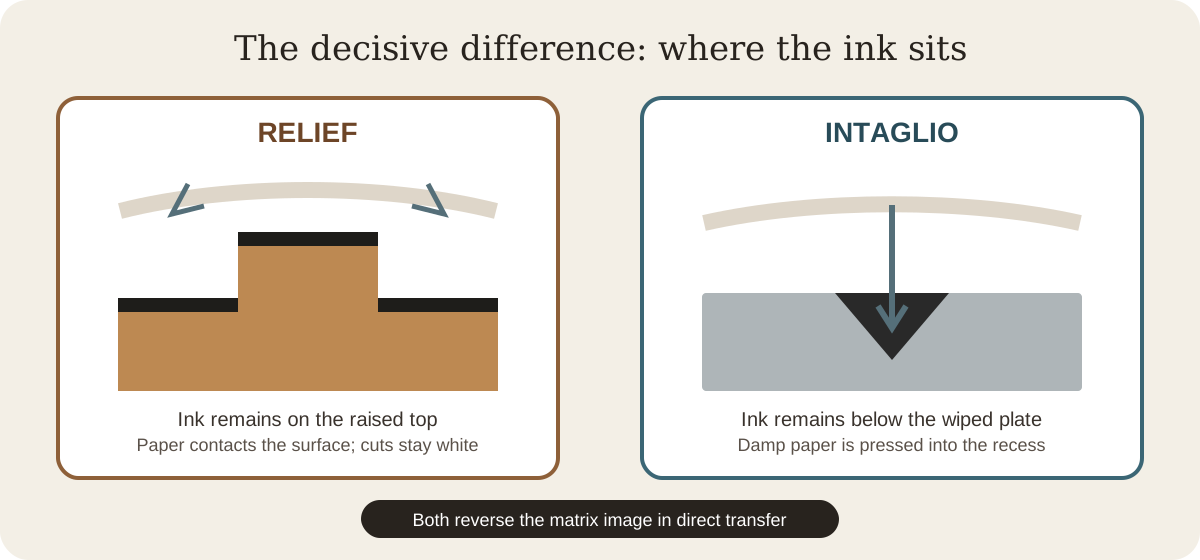
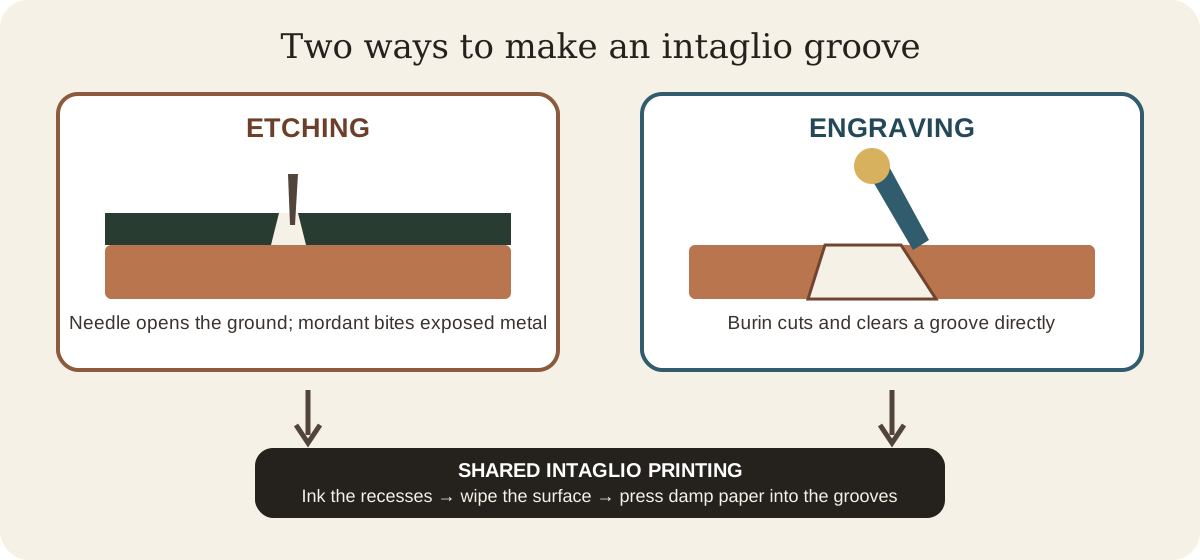
Etching uses a mordant to bite lines into metal exposed through a resistant ground. Engraving uses a burin to cut grooves directly into bare metal. Once the plate exists, both are printed as intaglio: ink is packed into recessed marks, the surface is wiped, and damp paper is pressed into the grooves to lift the ink.[1][3][4][5]
The decisive difference is therefore how the recess is made, not whether the finished print looks loose or formal. Etched lines can be regular; engraved lines can be delicate; and artists frequently combine both with drypoint or tonal methods. A complete museum medium line is stronger evidence than style alone.[6]
At a Glance
- Shared familyboth print ink held below the plate surface as intaglio.
- Etchinga needle opens resistant ground and mordant bites the exposed metal.
- Engravinga V-shaped burin removes metal directly from a polished plate.
- Best evidencethe full museum medium line, supported by line structure and magnification.
- Key warningdrypoint, aquatint and mixed plates make style alone unreliable.
Process Comparison: Etching and Engraving
| Feature | Etching | Engraving |
|---|---|---|
| How the line enters metal | Mordant bites exposed areas | Burin removes a sliver mechanically |
| Plate preparation | Acid-resistant ground coats the plate | Bare, polished plate |
| Drawing tool | Needle opens the ground with light pressure | V-shaped burin is pushed through metal |
| Line control | Bite time, exposed width and stopping-out affect depth | Burin angle, pressure and turn affect width and depth |
| Common tendency | Freely drawn, relatively even-width line | Swelling and tapering line, controlled parallel hatch |
| Shared printing | Recesses hold ink; surface is wiped; damp paper enters lines under pressure | Same |
| Frequent companions | Aquatint, drypoint, engraving | Etching, drypoint |
| Identification warning | Drawn appearance does not prove acid use | Formal hatching does not prove burin use |
The word acid is common in introductory descriptions, but mordant is the more general technical term for the substance that corrodes exposed metal. Formulas and safety practices vary by metal and period. This page explains identification and history, not workshop chemistry.
Plate choice affects the working sequence without redefining the medium. Institutional demonstrations name iron, copper and zinc for etching, while copper and zinc are common engraving plates. Before either process, polishing removes scratches that could trap ink and print accidentally. An etcher then covers that prepared surface evenly with wax or varnish ground; an engraver keeps it bare so only intentional burin cuts interrupt the polish.[1][11]
Ground is more than a passive coating. It must resist the mordant yet open cleanly under a blunt needle. A skipped pinhole or damaged patch exposes metal unintentionally, producing the scattered corrosion called foul bite. Conversely, a line that is not opened fully may bite weakly or not at all. These contingencies explain why an etched line is chemically made but still depends on exact hand preparation before the plate enters a bath.
How an etched plate is made
The printmaker polishes a metal plate and covers it with a ground that resists the chosen mordant. A needle scratches through that coating to reveal metal. Ideally the point opens the ground without cutting a printing groove itself. The plate is then immersed, flooded or locally treated so the mordant attacks only exposed lines.[1][2][3]
Time affects the bite. Longer exposure generally produces deeper and broader recesses capable of holding more ink. The printmaker can remove the plate, protect lines that are deep enough with fresh ground—stopping out—and return other lines to the bath. This staged biting allows different strengths on one plate.[1][6]
After biting, the ground is removed. The plate is inked and wiped so pigment remains mainly below the surface. Dampened paper and heavy roller pressure draw that ink from the recesses. Direct contact reverses the plate image, and the plate edges may emboss a rectangular plate mark.[3]
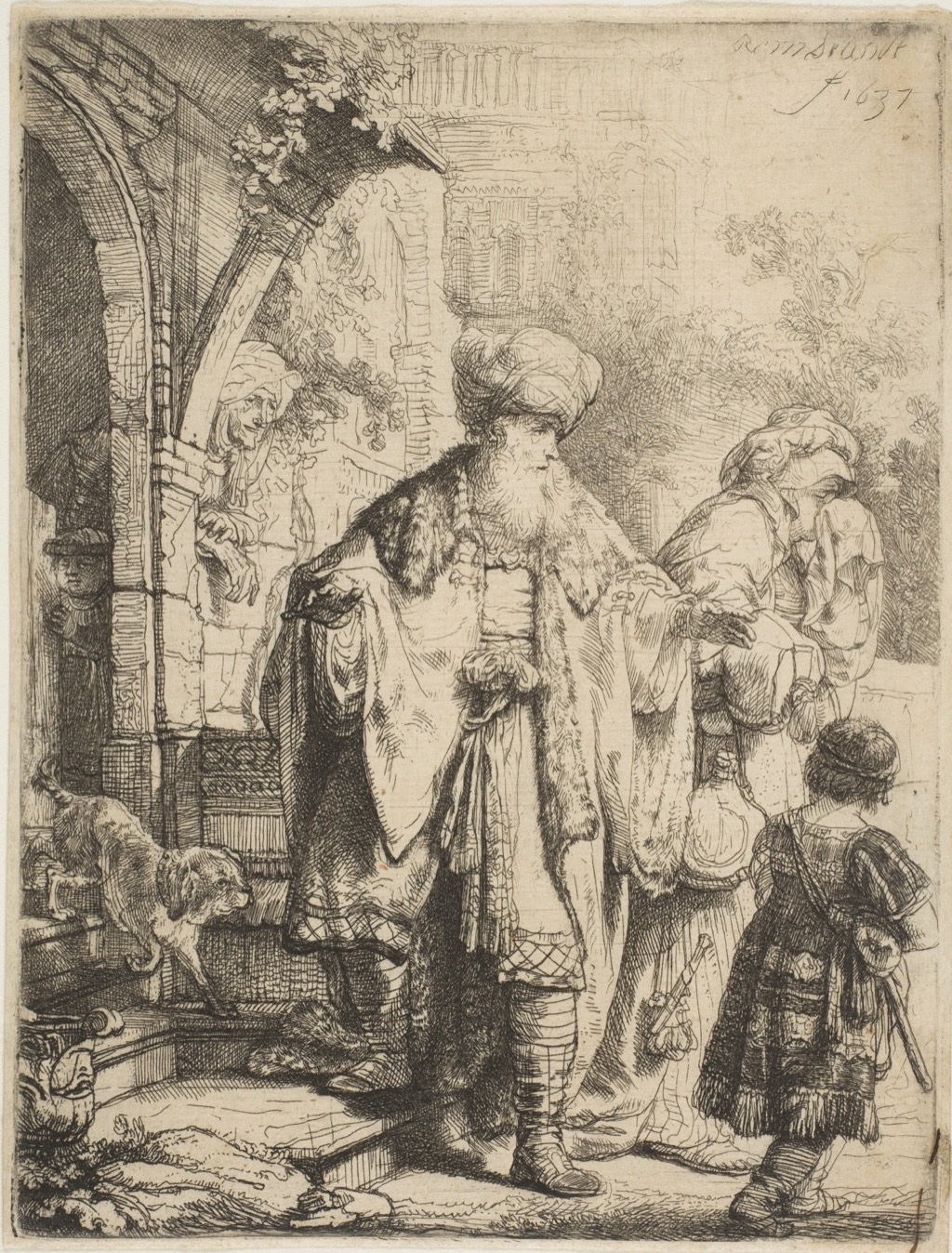
Rembrandt's etchings demonstrate why artists valued the method as a form of drawing. Abraham Casting Out Hagar and Ishmael of 1637 is catalogued by the Metropolitan Museum of Art simply as etching. Fine outlines, quick foliage, crosshatching and open paper can coexist because the needle moves through ground more readily than a burin ploughs bare copper.[7]
How an engraving is cut
An engraver holds a burin—also called a graver—with its sharpened V-shaped tip against the plate and pushes it forward. The tool scoops a controlled furrow and raises a metal shaving ahead of the point. Turning the plate and adjusting angle and force change the groove. A cleanly cut channel can widen, deepen and taper with continuous control.[5]
The classic burin is a steel shaft ending in a bevelled, often diamond-shaped point set into a rounded wooden handle. The handle rests against the palm while fingers guide the shaft close to the plate. For curves, the plate can turn on a sandbag or cushion instead of forcing the tool through an awkward arc. Burins of different sizes establish different potential widths; pressure and angle refine the result.[11]
That resistance encourages deliberate planning. Parallel and crossed hatching model tone; curved strokes describe volume; short flicks and dots can break transitions. Yet “precise” must not become “expressionless.” The hand still chooses every route through the metal, and great engravings exploit the burin's particular rhythm.
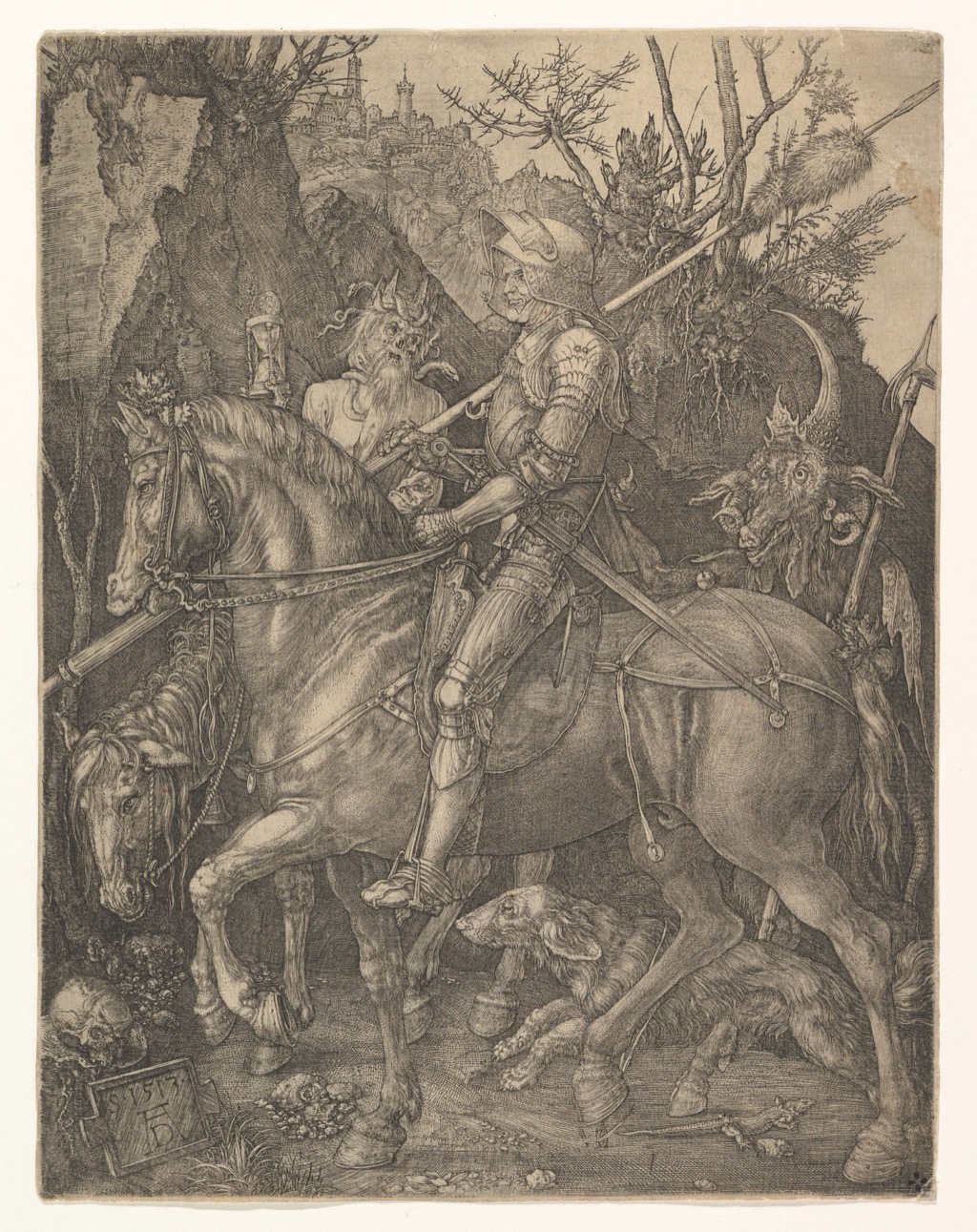
Albrecht Dürer's prints brought engraved line to exceptional density. In Knight, Death, and the Devil of 1513, interlocking hatch systems separate armour, hide, stone, hair and distant architecture. Lines swell, taper and change interval to create tone without printed colour. The Met catalogues the sheet as engraving.[9]
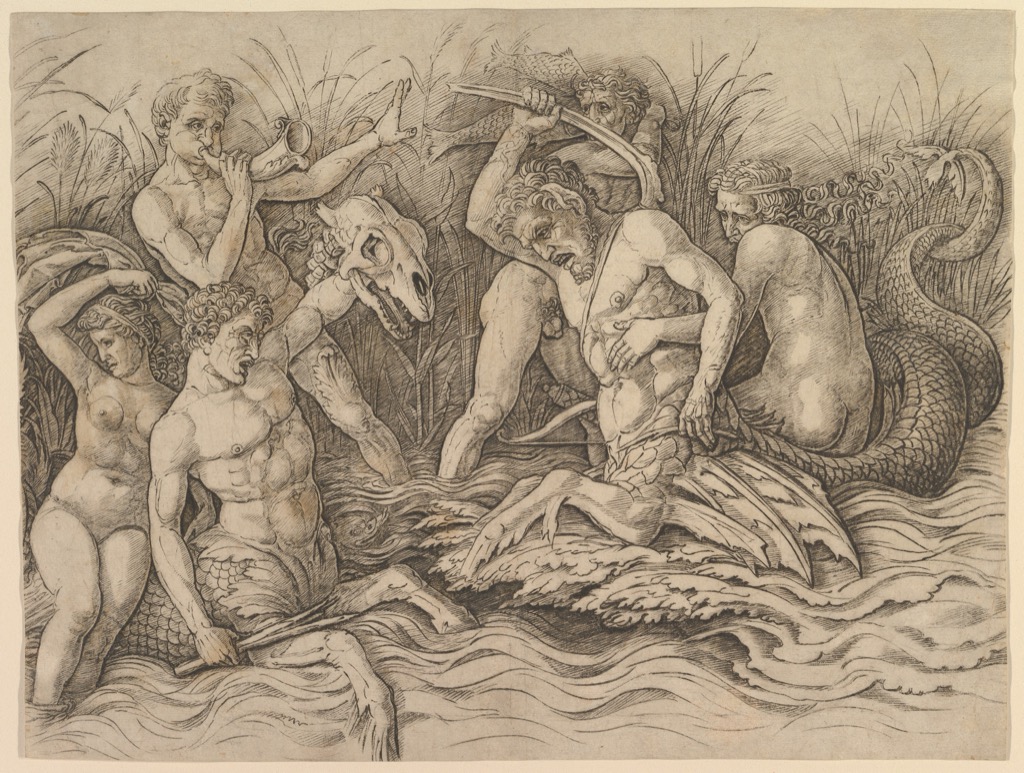
Andrea Mantegna's Battle of the Sea Gods predates Dürer's print. Its graded parallel strokes follow muscular bodies and churning water, proving that early engraving could translate both sculptural mass and violent motion. The Met identifies Mantegna as one of the first Italian painters to use engraving for original designs.[10]
What etching and engraving share
Both belong to intaglio because the printable ink sits below the plate surface. The printer forces ink into the marks, wipes the top, lays damp paper over the plate and uses strong pressure. Paper fibres enter the grooves and emerge carrying ink. Under magnification, the printed line may stand slightly proud of the sheet.[4][6]
The shared printing sequence explains why plate mark, reversed image and raised ink do not separate etching from engraving. Those clues distinguish intaglio from many relief or planographic processes, but the plate-making evidence must decide the closer comparison.
Wiping also affects tone. A plate can be wiped clean around the grooves or retain a film of surface ink. Paper, pressure, ink and plate wear alter impressions even when the matrix is unchanged. These printing variables do not convert engraving into etching or vice versa.
The practical sequence is graduated rather than a single wipe. Ink is spread across the entire plate and encouraged into every recess. Card, cloth or another flexible tab removes the first excess; heavily starched open-weave cloth called tarlatan continues the work without pulling all ink from the lines. Final hand wiping can clear highlights selectively, while a consciously retained film creates plate tone. Two impressions from one state may therefore differ in atmosphere even though every groove is identical.[1][11]
On the press bed, the plate lies ink-side up beneath dampened paper. Felt blankets distribute and soften roller pressure as the stack passes between cylinders. Moist fibres become flexible enough to enter the incisions, take their ink and mould around the bevelled plate edge. The resulting relief belongs to paper and ink rather than to the drawn style: the image reverses, inked lines may stand slightly proud, and a plate mark may frame the composition.[1][11]
Drypoint is not another name for engraving
Drypoint also scratches bare metal directly, but its point displaces metal and raises a rough burr along the furrow. That burr holds ink and often prints a soft, velvety edge. A burin aims to clear a clean groove; drypoint values the displaced ridge. The burr wears quickly under pressure, so early impressions can appear richer than later ones.[3][5]
Because both are direct methods, simplified glossaries sometimes place drypoint beside engraving. They remain distinct tools and mark structures. A scraped line whose burr has been removed may be difficult to distinguish visually from fine engraving, another reason to consult the record.[6]
Mixed plates and honest catalogue language
Artists combine processes because each solves a different visual problem. Etching quickly establishes a freely drawn design. Engraving can deepen or clarify selected lines. Drypoint adds burr-softened darkness. Aquatint creates bitten tone rather than line.
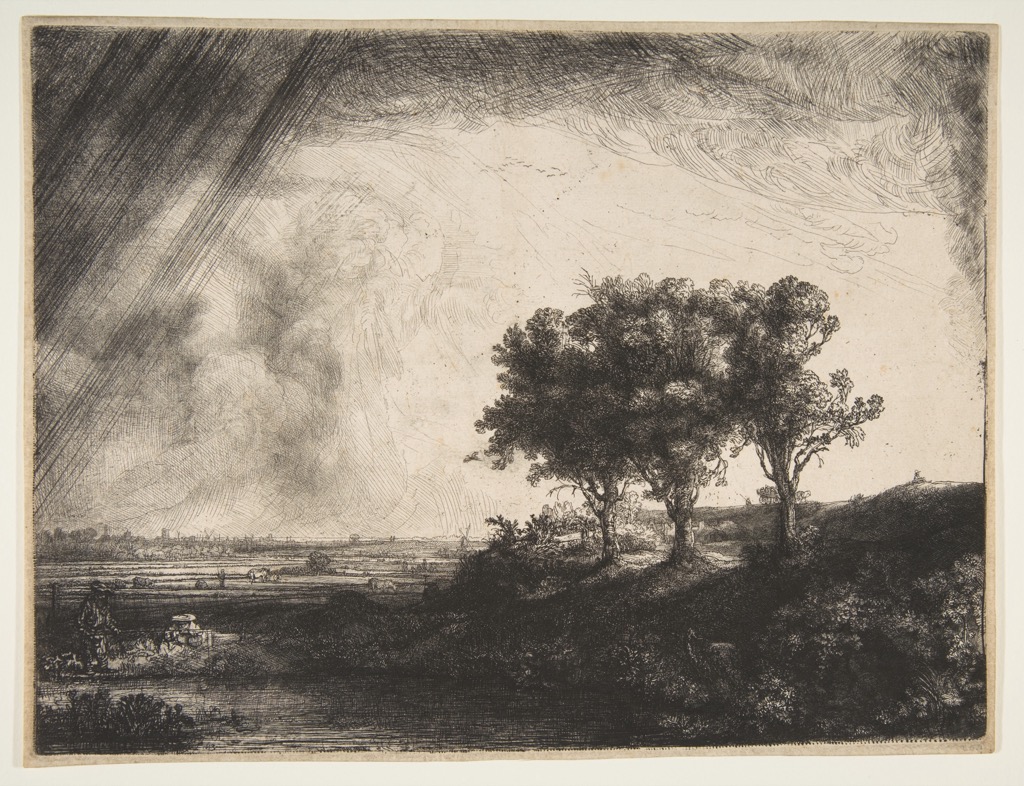
Rembrandt's The Three Trees is catalogued as etching, engraving and drypoint. The storm, illuminated distance and dense foreground depend on varied depths, precise additions, burr and plate tone. Calling the entire sheet merely an etching hides useful information; calling it engraving would be equally incomplete.[8]
A title or historical inventory may use “engraving” broadly for an intaglio print. Older collector language can describe manner rather than mechanism. Modern catalogues often revise these attributions through close study. Repeat the full current medium line, and qualify uncertainty rather than inventing precision.
How to identify etching and engraving
- Begin with the object record. A catalogue may identify mixtures invisible in a normal photograph.
- Inspect line endings. Engraved furrows often swell and taper as burin pressure changes; etched lines may end more evenly.
- Compare curves. Burin turns are controlled by tool and plate movement; etching can follow spontaneous drawing more readily.
- Study hatching. Highly ordered parallel systems often support engraving, but etched imitation is possible.
- Look for bite character. Under magnification, etched edges may reveal irregular corrosion; printing and wear can obscure it.
- Separate drypoint softness. A velvety halo can come from burr, not from acid or a clean burin groove.
- Treat the plate mark as a family clue. It supports intaglio but not one member of the family.
- Expect combinations and states. Later work on the plate can change both medium and appearance.
Screen images flatten paper relief and ink thickness. A confident identification should combine catalogue evidence, magnification and comparison with known impressions.
Historical development
Engraving emerged in fifteenth-century Europe from metalworking and goldsmith traditions. Cutting decoration into metal supplied tools and skills that could be redirected toward printable plates. Mantegna used the new medium for ambitious independent designs, while Dürer made it central to an international artistic reputation.[2][10]
Etching developed from practices associated with armour decoration. A resistant ground and corrosive bath made it possible to draw into a coating instead of pushing a burin through hard metal. Early iron plates gave way in many workshops to copper, whose surface and predictable bite suited detailed printing.[1][2]
The ease of moving a needle through ground attracted painters and draftsmen. Rembrandt used etching as a foundation, then adjusted plates through repeated states and combined it with drypoint and engraving. Later artists, including Goya and Whistler, extended the process while specialist printers managed biting, wiping and pressure.
Neither process replaced the other. Their conjunction is part of intaglio history. The useful comparison is not easy versus difficult or expressive versus mechanical; it is chemical incision versus direct burin cutting, followed by a shared demanding printing stage.
For the position of intaglio among other printmaking techniques, see the cluster hub.
Watch Etching and Engraving Build an Intaglio Line
Choose a complete etching sequence, a burin demonstration, or the V&A's artist-led account.
How to Make an Etching
Follow ground preparation, drawing, biting, inking and printing as one continuous etching sequence.
Watch on YouTubeFrequently Asked Questions
In broad everyday language, people sometimes call any incised print an engraving. Technically, etching and engraving are separate intaglio processes: mordant bites an etching, while a burin cuts an engraving.
Its main job is to open the resistant ground and expose metal. The mordant then creates the printable recess. Pressing hard enough to scratch the plate can introduce drypoint-like direct marks.
Fine-art intaglio engraving conventionally refers to burin-cut grooves. Catalogue terms such as line engraving clarify this. Modern laser and industrial meanings are separate from the process discussed here.
Heavy press pressure pushes damp paper around the plate edges. The resulting embossed rectangle can survive around the image, unless the sheet is trimmed or the mark is otherwise concealed.
Neither automatically. Groove depth and width, ink, wiping, pressure and mixtures determine darkness. Bite time affects etched grooves; burin angle and force affect engraved ones.
Yes. An artist or specialist can etch the main design and strengthen or change selected passages with a burin. Museum records commonly list the combination.
Discussion
Which visible clue on this page most clearly separates a mordant-bitten line from a burin-cut groove—and where does a mixed plate defeat that shortcut?
Reader Insights
Museum catalogues can identify mixtures that a normal screen image cannot reveal.
Etching and engraving create recesses differently but share the demanding intaglio inking, wiping and pressure sequence.
Its displaced burr can print a velvety edge that differs from both a bitten line and a clean burin groove.
Join the Conversation
Share one precise observation or a useful museum example below.
References
- Metropolitan Museum of Art, “Etching,” 21 December 2018. View source
- Metropolitan Museum of Art, “The Printed Image in the West: Etching.” View source
- Victoria and Albert Museum, “What is print?” Updated 17 April 2024. View source
- Museum of Modern Art, “German Expressionism: Intaglio.” View source
- National Gallery of Art, Gemini G.E.L.: Recent Prints and Sculpture, glossary. View source
- Metropolitan Museum of Art, How Prints Look. View source
- Metropolitan Museum of Art, Rembrandt, Abraham Casting Out Hagar and Ishmael, 1637, etching, object 1983.1140.1. View source
- Metropolitan Museum of Art, Rembrandt, The Three Trees, 1643, etching, engraving and drypoint, object 29.107.31. View source
- Metropolitan Museum of Art, Albrecht Dürer, Knight, Death, and the Devil, 1513, engraving, object 66.521.95. View source
- Metropolitan Museum of Art, Andrea Mantegna, Battle of the Sea Gods (right portion), before 1481, engraving, object 1984.1201.4. View source
- Metropolitan Museum of Art, “Engraving,” 21 December 2018. View source