by Tom Gurney
Tom Gurney BSc (Hons) is an art history expert with over 20 years experience
Page created on September 3, 2026 / Page updated on September 13, 2026
Email: tomgurney1@gmail.com / Phone: +44 7429 011000
How a Singular Impression Differs from a Variable Printed Series
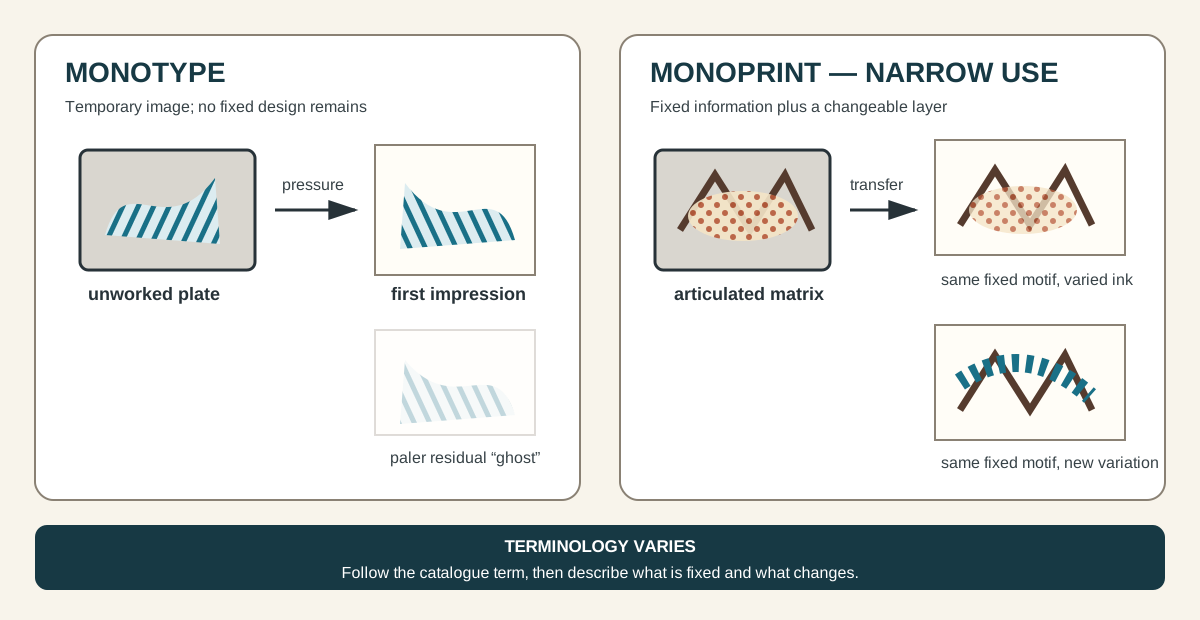
A monotype and a monoprint are both printed works designed to be unique or deliberately variable. The most useful modern distinction lies in the matrix. A monotype is made from a temporary image on an unworked surface, so no fixed design remains to print again. A monoprint, in the narrower sense, combines changeable ink, colour or handwork with some repeatable information in an etched plate, block, stencil or other matrix.
That answer needs a warning attached: museums, workshops and artists do not use the two words uniformly. National Galleries of Scotland says they are often interchangeable, while the National Gallery of Art defines a monoprint broadly as a unique impression. A catalogue may therefore call a work a monoprint where another source might prefer monotype, or describe “monotype wiping” applied to an etched plate.[1][2] The safest practice is to retain the holding institution's term and then ask what, physically, was fixed and what changed.
At a Glance
- Monotypethe image is worked so that one principal impression is normally unique.
- Monoprinta repeatable matrix is combined with variable colour, wiping, stencils or additions.
- Ghosta lighter second pull may remain after the main monotype impression.
- Catalogue termsusage varies, so object records and the artist's procedure carry more weight than labels alone.
- Key distinctionunique image on a matrix versus variation built around a repeatable element.
Process Comparison: Monotype and Monoprint
| Question | Monotype | Monoprint under the narrow distinction |
|---|---|---|
| What is on the matrix? | A temporary image in ink or paint on an unarticulated surface | Fixed information plus changeable inking, colour, collage or handwork |
| Can the principal design be repeated? | Not from the plate as prepared; it must be made again | Some structure can recur, but each finished impression is intentionally different |
| Is the result unique? | Yes; normally one strong impression | Yes or deliberately variable within a related group |
| Can there be another pull? | A paler ghost may remain after the first pull | Further impressions can share the fixed matrix information while varying in other respects |
| Typical matrix | Smooth metal, acrylic, glass or another nonabsorbent plate | Etched plate, relief block, stencil, screen or another articulated matrix |
| Useful visual clue | Painterly, wiped or transferred marks with no stable line system | A recurring line, contour or stencil shape combined with visibly variable colour or handling |
| Catalogue caution | Sometimes labelled “monoprint” | Sometimes described only by its component processes |
The table describes a practical distinction, not a test that can overrule an object record. The words alone rarely reveal every layer of a print's making.
How a monotype is made
A monotype begins with an image that exists temporarily on a smooth surface. The artist applies ink or paint to a metal plate, acrylic sheet, glass or another surface that will release the material under pressure. Damp paper is laid over the image, and a press or hand pressure transfers most of that material to the sheet. Direct transfer normally reverses the composition.[3][7]
The process may be additive, sometimes called light-field: the artist begins with a relatively clean plate and builds the image with brushes, rollers, daubers or other tools. It may be subtractive, or dark-field: the artist inks the plate as a field and then removes material with cloth, brush handles, fingers or solvent to recover lights. Those labels describe starting points rather than sealed categories. MoMA's technical account of Edgar Degas notes that artists can move between adding and removing ink on the same plate.[4]
Pressure is not a neutral copying step. It flattens and redistributes the ink, joins it to the paper's fibres and can produce edges or textures unlike marks placed directly on the sheet. The artist must anticipate reversal, material loss and the way damp paper receives different thicknesses of ink. Until the pull, the image remains workable; after it, most of its substance has left the plate.
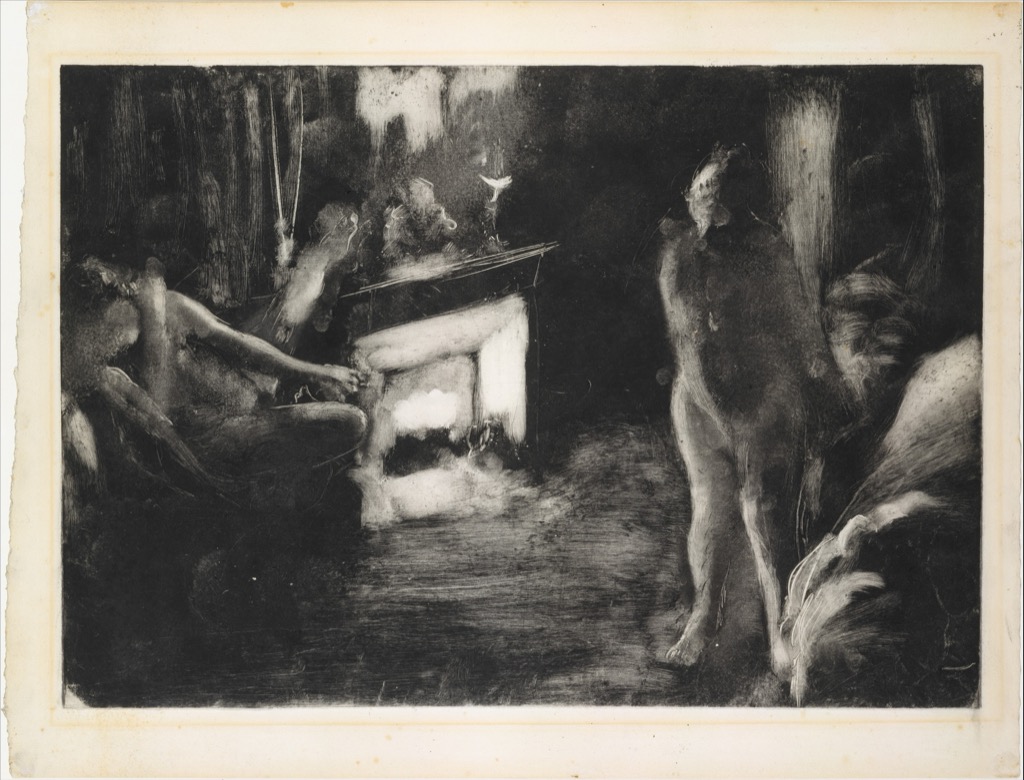
Edgar Degas exploited that instability in The Fireside, about 1876–77. The Metropolitan Museum of Art catalogues the work as a monotype in black ink on heavy laid paper. Broad darkness was manipulated into bodies, a bright fireplace and abrupt highlights. The result does not read like a mechanically repeatable drawing: light is recovered through wiping and scraping, while smeared mid-tones record the movement of ink.[4][10]
How a monoprint differs
Under the narrow modern distinction, a monoprint has a fixed component that survives the pull. It might be an etched network of recessed lines, the raised face of a relief block, a stable stencil, or another articulated matrix. The artist then changes colour, wiping, placement, paper, pressure, collage or hand-applied additions so each impression becomes an individual work.
The repeatable component need not dominate the image. It only needs to carry some fixed information from one pull to another. Conversely, repeating a loose motif by eye does not create a repeatable matrix: several separately painted monotype plates may form a coherent series while remaining technically independent.
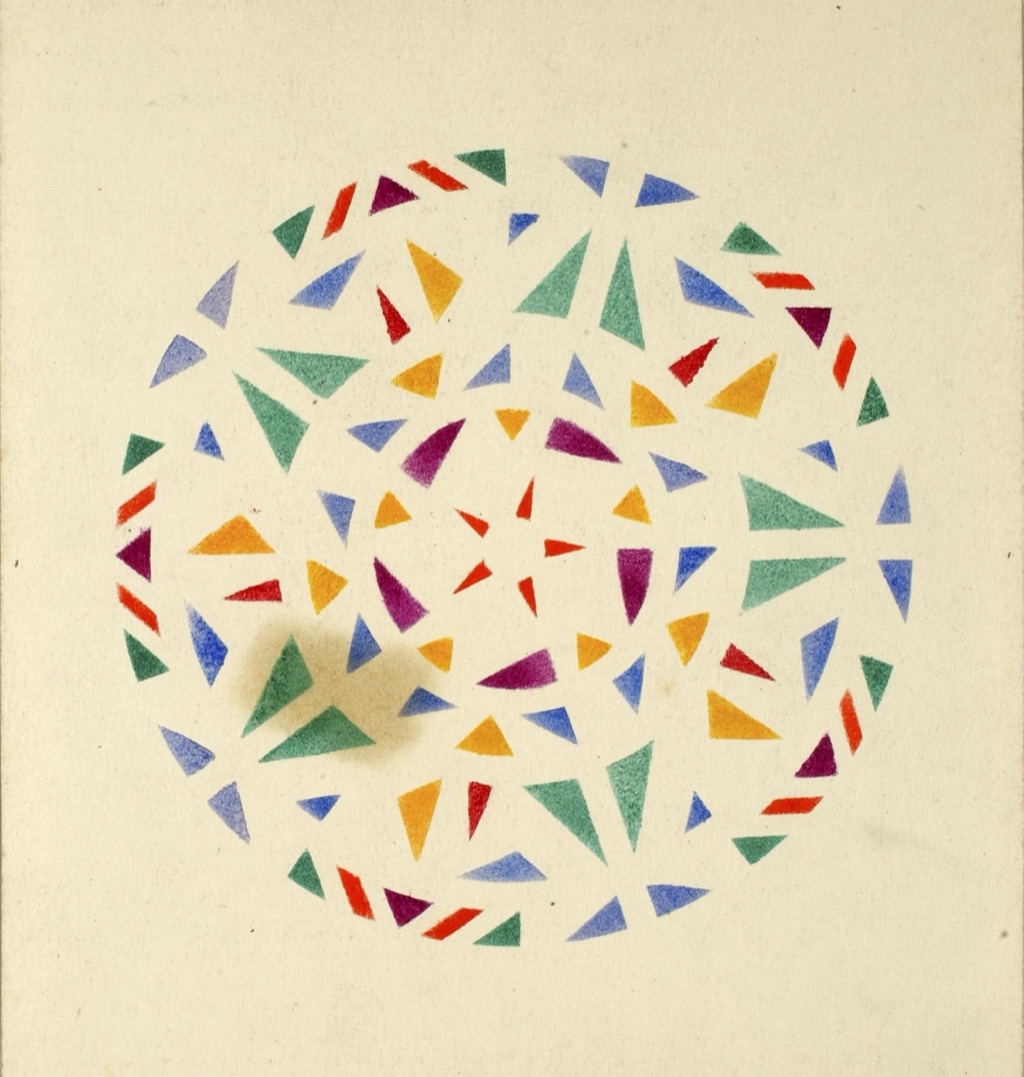
Jay Van Everen's Untitled, about 1920, is catalogued by the Smithsonian American Art Museum as a colour stencil monoprint. Its coloured triangular units demonstrate why a stencil is a useful example. Openings can impose a recurring shape, while colour, placement, sequence and density remain available for variation. The museum's term belongs in the caption; the visible stencil logic helps explain what it means.[13]
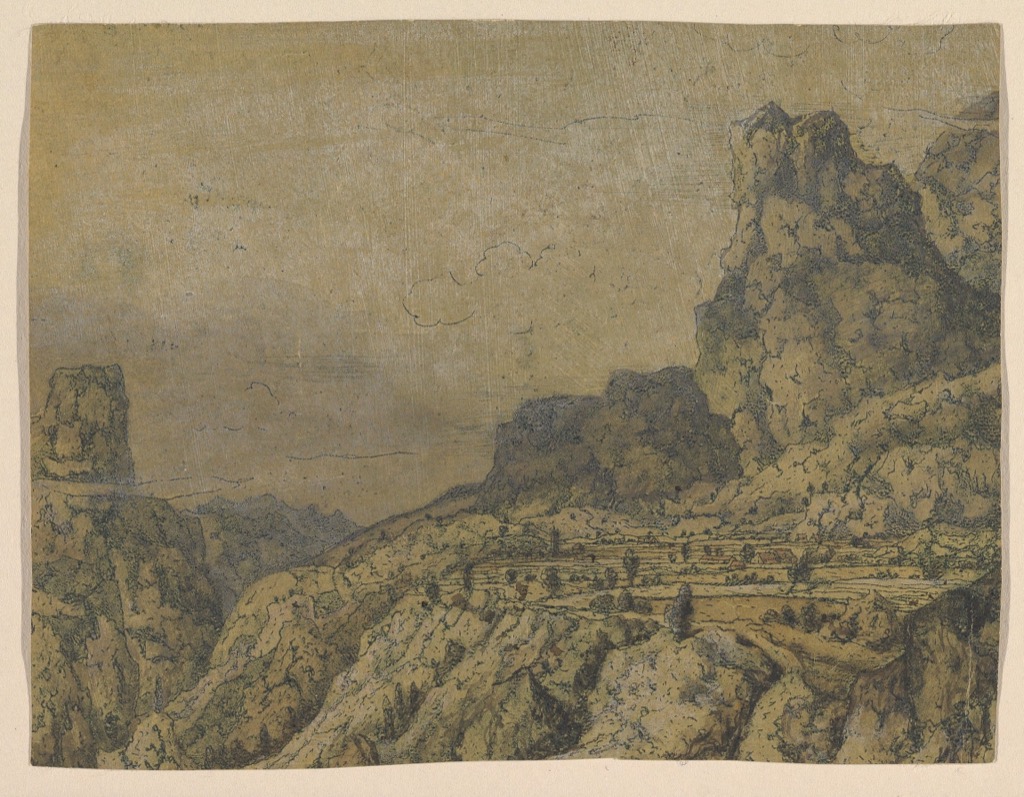
Hercules Segers offers an older and more complex model. The Met describes Mountain Valley with a Plateau, about 1625–30, as line etching, drypoint and metal punch printed in blue-green on a yellow-green ground, then coloured with a brush. It is the second state of two. The etched mountain structure is fixed information, yet coloured ink, prepared paper and brushwork individualise the impression. The Met does not title the object a monoprint, so neither should we; it nevertheless demonstrates the physical relationship that the narrow definition tries to name.[8][12]
Why the terminology varies
“Monotype” has a relatively precise process history: a temporary image on a plate produces a singular transferred work. “Monoprint” has been used both as an umbrella for unique printed images and as the narrower name for variation built over repeatable matrix information. Institutions inherit different cataloguing traditions, artists choose their own medium descriptions, and compound processes resist a single label.
National Galleries of Scotland acknowledges interchangeability and also records a distinction in which monoprint can denote a series of similar works while monotype denotes a one-off.[2] The National Gallery of Art's educational glossary uses monoprint broadly for an impression made only once. On the same page, an object may be described through combined operations, such as etching with monotype wiping.[1] These are not errors that a reader must correct. They are evidence that terminology follows practice imperfectly.
Use this sequence when terms conflict:
- Record the catalogue term exactly.
- Identify whether the matrix is unworked or contains fixed lines, relief or stencil information.
- Separate printed structure from variable ink, paper, colour and later handwork.
- Check whether related impressions exist and whether they share a matrix, a state or only a subject.
- Describe the evidence before assigning a narrower modern label.
This approach is more informative than treating “monoprint” as an automatic correction whenever a catalogue uses “monotype” broadly, or vice versa.
Does a monotype really produce only one print?
A monotype normally yields one strong impression, but that phrase is more accurate than “the plate can be printed only once.” Some ink may remain. A second sheet can pick up the residue, producing a lighter ghost impression. The ghost is materially related to the first pull but is not an identical duplicate: tones weaken, edges break and any further manipulation changes the residual image again.[3][7]
Artists can treat that remainder as a beginning rather than a failed copy. They may strengthen it with pastel, drawing or paint, or rework the plate before another transfer. A first pull and a ghost can therefore become two distinct works. Their relationship does not turn the temporary image into a stable edition matrix.
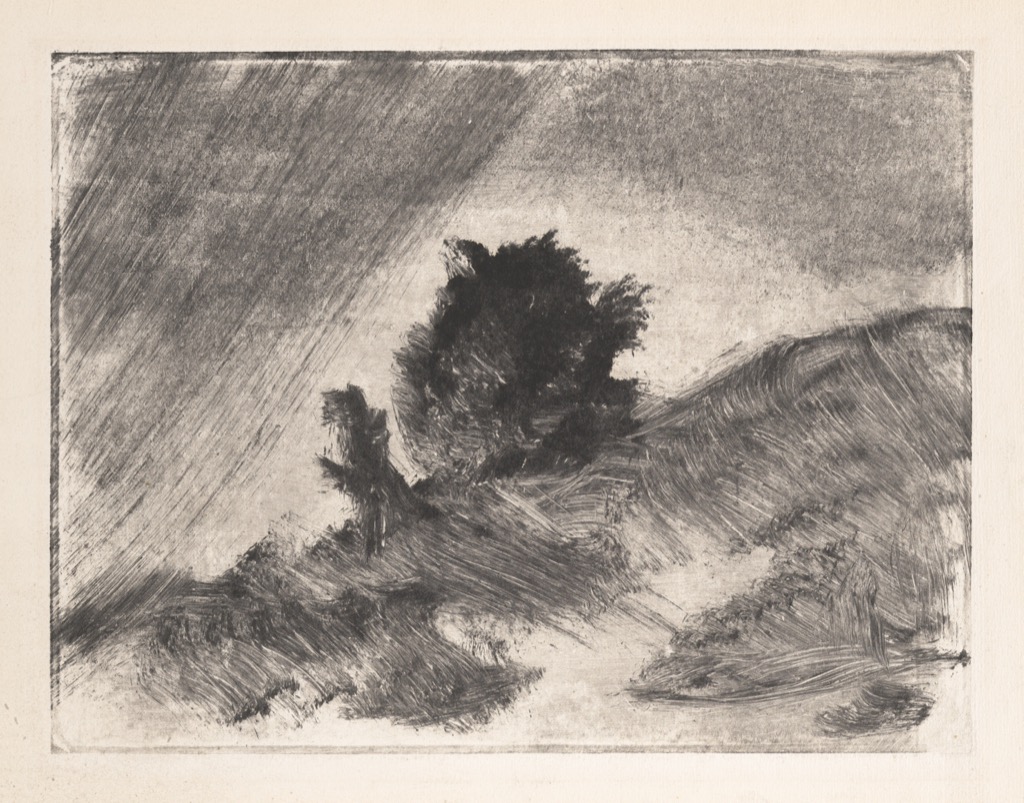
Degas's Landscape of about 1877–79 shows an unincised plate used to create wind, rain and a central clump of trees through streaked black ink. The Met identifies it simply as monotype. Its marks imply dragging, wiping and redistribution; the plate carried no permanent network capable of rebuilding those relationships after transfer.[9]
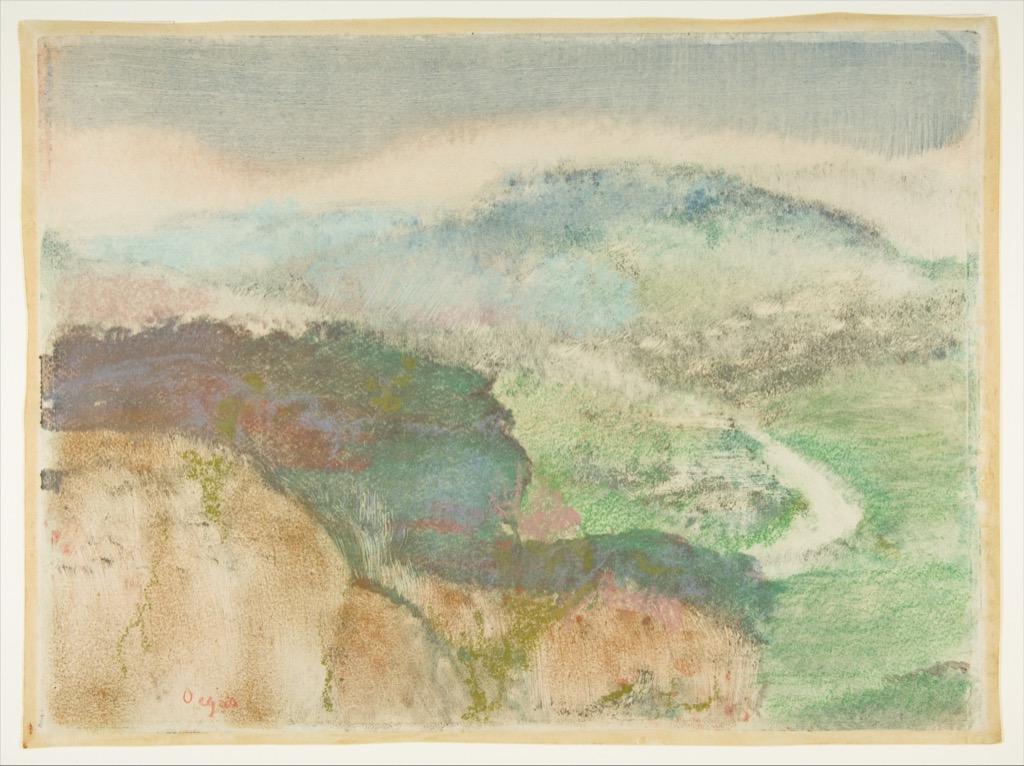
His colour Landscape of 1892 extends the problem. The Met catalogues it as “monotype in oil colors, heightened with pastel.” The printed layer is already unique, and pastel then changes the surface directly. A medium line like this records sequence: transfer first, later dry colour above it. It is not evidence for a conventional edition.[11]
Unique print, variable edition, state and series
Several terms that sound similar answer different questions.
An impression is one sheet taken from a matrix. An edition is a defined group of impressions, whether or not every sheet looks perfectly alike. A variable edition deliberately allows colour, wiping or another feature to change across that group. A state exists when the matrix itself is physically altered: a new etched line or cut changes what the plate can print. A series is broader still; works may share a subject or programme without sharing one matrix.
That means uniqueness is not established by an edition number alone. “1/1” declares one issued impression but does not reveal whether the matrix contained fixed information. “1/10 varied” may describe a group in which a stable structure and intentional differences coexist. Historical monotypes may be unnumbered. A ghost and first pull may be catalogued separately. Documentation and physical evidence must work together.
Segers's “second state of two” refers to a change in the etched matrix, not to the number of impressions printed. His variable colour and handwork then distinguish this particular sheet within that state.[12] Keeping state and impression separate prevents one of the most common reading errors.
How to identify the process
Visual clues can suggest a process, but they rarely settle terminology on their own.
- Look for a fixed skeleton. Repeated etched contours, relief shapes or stencil boundaries across related sheets support the narrow monoprint idea.
- Look for transferred painterly handling. Wiped light, rolled tone, dragged ink, fingerprints and compressed brushwork can indicate monotype, especially when no permanent line system is present.
- Find the plate edge. A plate mark can show that pressure was used, but it does not distinguish an unworked monotype plate from an etched monoprint plate.
- Compare related impressions. Ask what stays in the same place and what changes. A recurring contour may come from the matrix; colour and surface wiping may not.
- Separate print from handwork. Pastel, paint or drawing above a printed base can make each sheet unique without changing the process used for the base.
- Expect reversal. A directly transferred image commonly reverses the plate, although counterproofing or multi-stage transfer can change orientation.
- Read the whole medium line. “Monotype,” “stencil monoprint,” “etching with monotype wiping” and “monotype heightened with pastel” convey different technical sequences.
A reproduction viewed on screen may conceal plate marks, paper relief and ink thickness. Start from a trusted record and use visual inspection to test it, not to replace it.
A short history of singular printed impressions
The Metropolitan Museum's historical survey dates the earliest monotypes to the 1640s, when Giovanni Benedetto Castiglione drew into ink spread on unincised metal plates.[6] The principle was simple, but the result occupied an unusual position between drawing, painting and a print tradition associated with multiples.
Segers had already challenged uniformity in etching by varying coloured inks, prepared supports and brush additions. His example later mattered to Rembrandt, whose etchings also demonstrate how wiping, paper and plate changes can make impressions differ without erasing their shared matrix.[8]
Degas transformed monotype into a sustained field of experiment in the late nineteenth century. The revival of artist etching had renewed interest in expressive hand-inking just as photographic and industrial reproduction expanded. Degas treated the plate as a place for drawing, wiping, pressure, accident and revision, not merely as a carrier for multiples.[5] His practice made it especially clear that a printed transfer can be both direct and unrepeatable.
Twentieth-century artists adopted stencils, screens, relief blocks and combined processes in ways that made “monoprint” increasingly useful for works sharing a structure but refusing uniform results. That history explains the vocabulary's overlap: artists did not wait for definitions to become stable before combining repeatable and unrepeatable actions.
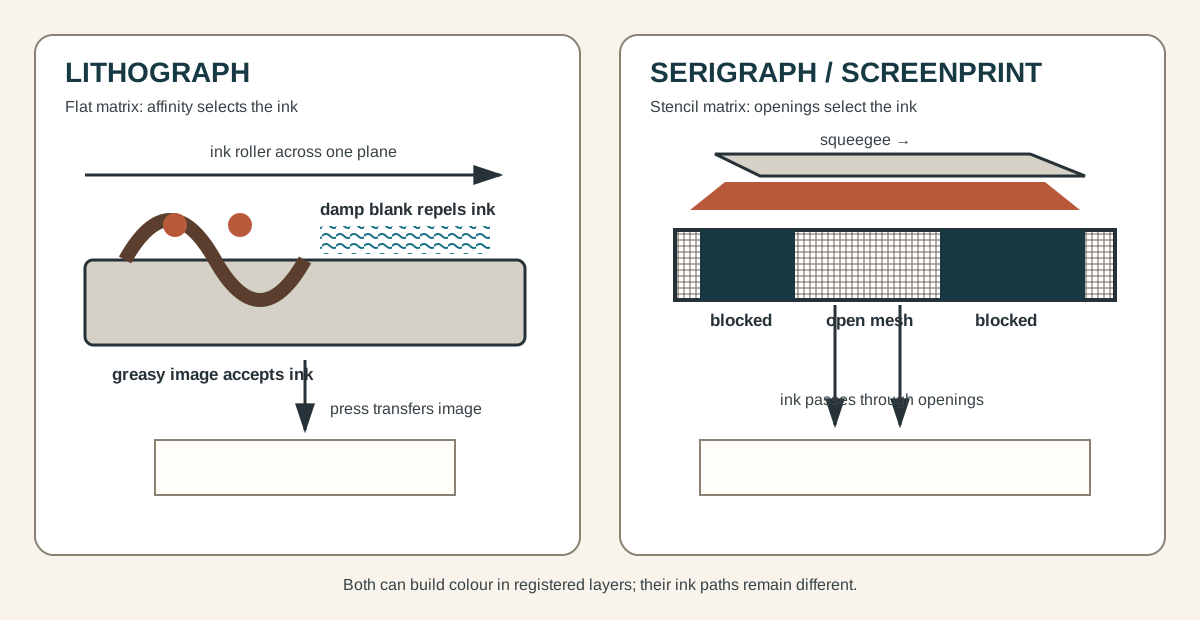
For the wider relationship between relief, intaglio, lithography, screenprinting and monotype, see the guide to printmaking techniques.
Watch Unique and Variable Impressions Take Shape
Choose a National Galleries monoprint guide, a university monotype demonstration, or MoMA's account of Degas's experiments.
Printmaking Techniques & Processes: Monoprint
See how a variable printed image develops through direct work on the matrix.
Watch on YouTubeFrequently Asked Questions
Neither is automatically “more unique.” A monotype normally comes from a wholly temporary image. A monoprint under the narrow distinction contains repeatable matrix information but makes each finished impression intentionally individual. Both can be one-of-a-kind works.
No. A ghost is a paler pull from ink left after the first monotype impression. It lacks some of the first pull's material and may be reworked, so it is related but not identical.
It can be catalogued, numbered as one of a related series, or marked 1/1, but the notation does not create a repeatable matrix. Read the process record as well as the number.
It depends on how the plate was used and on the maker's terminology. A wholly temporary ink image with no fixed repeatable element fits monotype under the narrow definition. Reusable stencils or blocks can introduce monoprint logic, but many studios use “gel print” or “monoprint” broadly.
It can make one impression unique, but historical catalogues may still call the object an etching, woodcut or lithograph with hand colouring. Describe both the fixed printed process and the later colour instead of forcing a new label.
Ask what survives on the matrix. If no fixed design remains after the temporary image transfers, monotype is the useful term. If a fixed structure can recur while other elements vary, monoprint is useful—provided the catalogue's own terminology is also reported.
Discussion
Which example makes singularity most visible—and where does a repeated matrix remain legible beneath variable colour, wiping or added work?
Reader Insights
The decisive issue is whether a stable matrix carries a repeatable element, not whether every impression looks different.
A second lighter pull does not make the first monotype an edition in the ordinary sense.
Institutions and artists use the terms differently, so describe the recorded procedure before imposing a neat binary.
Join the Conversation
Share one precise observation or a useful museum example below.
References
- National Gallery of Art, “Printmaking Basics.” View source
- National Galleries of Scotland, “Monoprint.” View source
- Museum of Modern Art, “Lasting Impressions: The Monotype Medium from Edgar Degas to Elizabeth Peyton,” 27 May 2016. View source
- Museum of Modern Art, “Degas in Process: Why Monotype?” 26 May 2016. View source
- Museum of Modern Art, Degas: A Strange New Beauty, preview. View source
- Metropolitan Museum of Art and Museum of Fine Arts, Boston, The Painterly Print: Monotypes from the Seventeenth to the Twentieth Century, 1980. View source
- Metropolitan Museum of Art, How Prints Look. View source
- Metropolitan Museum of Art, “Hercules Segers: An Imaginist in a Land of Realists,” 2017. View source
- Metropolitan Museum of Art, Edgar Degas, Landscape, ca. 1877–79, monotype, object 2024.387. View source
- Metropolitan Museum of Art, Edgar Degas, The Fireside, ca. 1876–77, monotype, object 68.670. View source
- Metropolitan Museum of Art, Edgar Degas, Landscape, 1892, monotype in oil colours heightened with pastel, object 1972.636. View source
- Metropolitan Museum of Art, Hercules Segers, Mountain Valley with a Plateau, ca. 1625–30, etching, drypoint, metal punch, coloured ground and brush colour, object 23.57.3. View source
- Smithsonian American Art Museum, Jay Van Everen, Untitled, ca. 1920, colour stencil monoprint, object 1970.265.8. View source