by Tom Gurney
Tom Gurney BSc (Hons) is an art history expert with over 20 years experience
Page created on September 3, 2026 / Page updated on September 13, 2026
Email: tomgurney1@gmail.com / Phone: +44 7429 011000
How a Flat Stone and a Stencilled Mesh Produce Very Different Prints
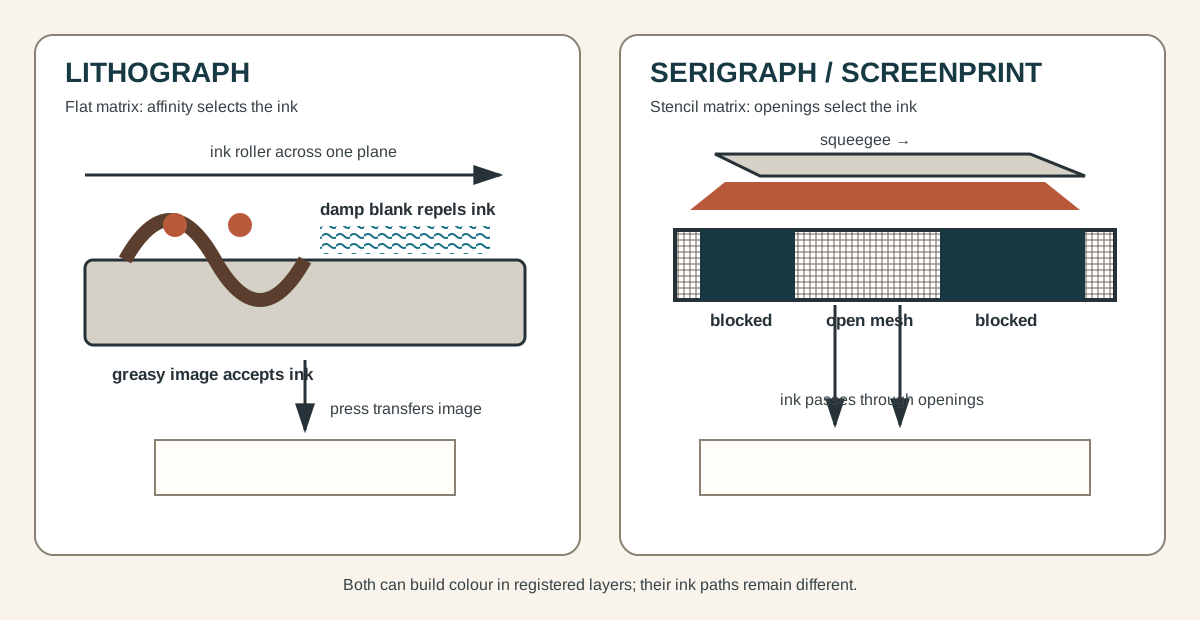
A lithograph prints from selected image areas on a prepared flat stone or metal plate. A serigraph is a screenprint: a squeegee pushes ink through open parts of a stencilled mesh onto paper. Lithography controls where oily ink adheres through the opposition of grease and water; serigraphy controls where ink passes through physical openings. They can produce similarly bold colour, but their matrices and transfer mechanics are fundamentally different.[1][3][4][5]
Serigraph, screenprint and silkscreen normally name the same process family. The word serigraph was promoted in American fine-art contexts near the end of the 1930s to separate artists' screenprints from commercial uses. It does not imply a special ink path or a higher-quality version of screenprinting.[4]
At a Glance
- Lithographya planographic process based on the separation of greasy image and water-receptive blank areas.
- Serigraphyscreenprinting that pushes ink through open mesh while a stencil blocks other areas.
- Matrixtraditionally stone or plate for lithography; framed mesh for serigraphy.
- Colourusually requires separately prepared matrices or screens and careful registration.
- Key warningoffset reproductions and photomechanical screens require catalogue evidence, not surface guesswork alone.
Process Comparison: Lithograph and Serigraph
| Feature | Lithograph | Serigraph / screenprint |
|---|---|---|
| Matrix | Prepared limestone or metal plate | Mesh stretched across a frame with a stencil |
| Image principle | Greasy image areas accept oily ink; damp nonimage areas repel it | Open mesh passes ink; blocked mesh stops it |
| Transfer | Paper meets the inked matrix under a lithographic press | Squeegee pressure drives ink through mesh onto the sheet below |
| Surface relationship | Image and nonimage areas remain essentially on one plane | Stencil openings sit above the support |
| Characteristic possibilities | Crayon grain, tusche wash, drawn line, subtle tonal variation | Flat films, crisp stencil edges, opaque layers, mesh or photographic detail |
| Colour | Commonly one stone or plate per colour | Commonly one screen or stencil per colour |
| Naming variation | Stone lithograph, plate lithograph, colour lithograph | Screenprint, silkscreen, serigraph |
| Main caution | Not every lithograph is a reproduction or offset print | Not every screenprint uses silk or looks commercially uniform |
Institutional classification is not perfectly uniform. The V&A groups lithography and screenprinting among flat-surface processes in its introduction, while the National Gallery of Art and MoMA explain screenprint primarily as stencil printing. “Planographic versus stencil” is the clearest comparison of the actual ink path, not a claim that every museum arranges its taxonomy identically.[1][3][4]
How lithography separates image from blank surface
Traditional artist lithography starts on a smoothly prepared limestone. Metal plates, usually zinc or aluminium, can serve the same broad process. The artist draws with a greasy crayon, pencil or liquid tusche. The marks may retain the grain of the stone, spread like a wash or form clean linear contours.[1][3]
Processing chemically establishes two behaviours on the same plane. The drawn image remains receptive to greasy printing ink. Blank areas are made receptive to water. During printing, the printer keeps the matrix damp: water occupies the nonimage regions and repels oily ink, while an inked roller deposits colour on the greasy image. Paper and stone or plate then pass through a lithographic press.[1]
The stone is not simply coated with paint and stamped. Water balance, roller pressure, ink consistency and repeated processing all matter. If blank areas begin to accept ink, they can scum; if image areas lose receptivity, detail weakens. The process depends on controlling a chemical boundary across an apparently level surface.
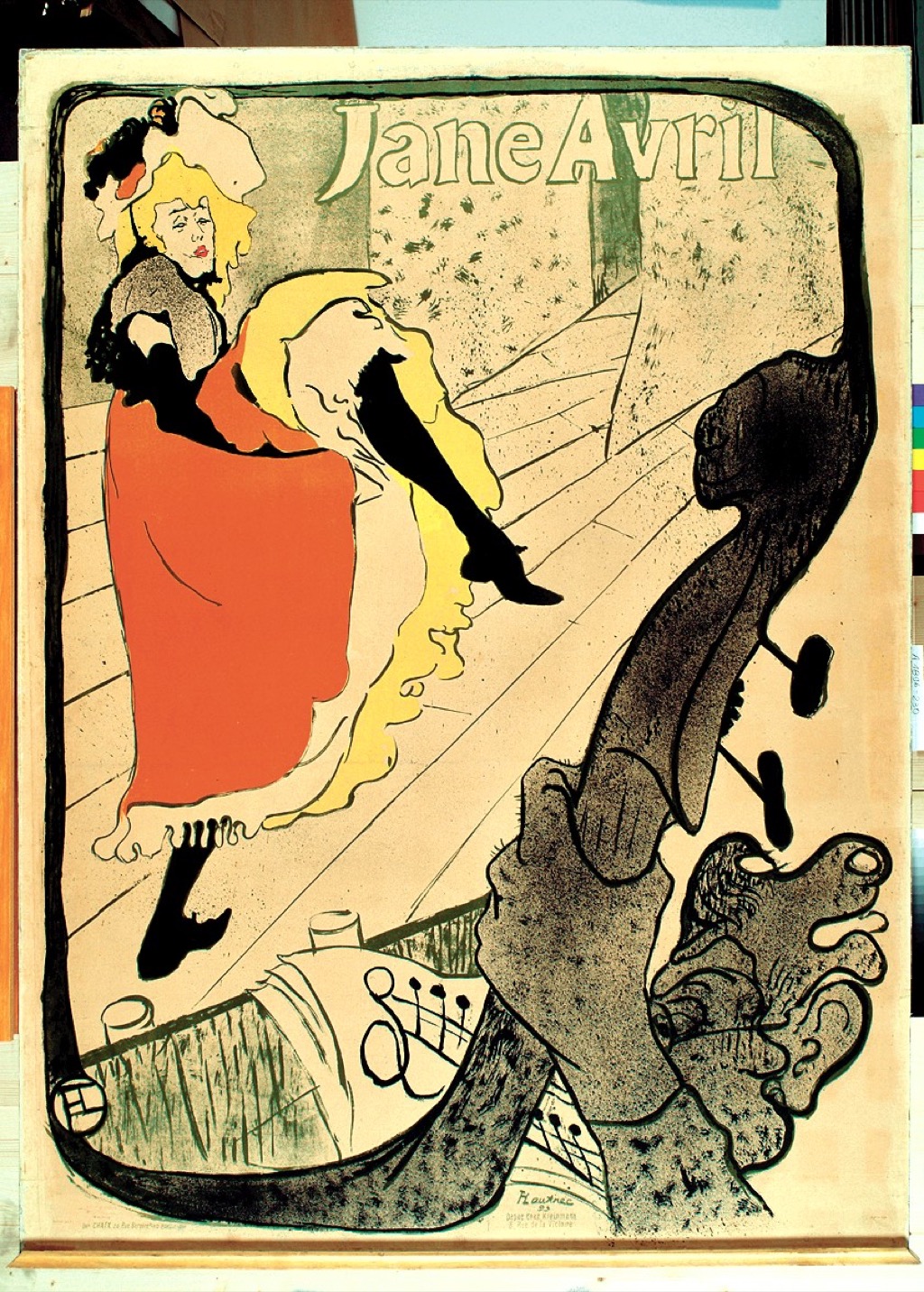
Henri de Toulouse-Lautrec's Jane Avril of 1893 demonstrates colour lithography at public scale. The Metropolitan Museum of Art records five colours and explains that several stones carried the separate inks. Black contour, orange, yellow and green belong to registered layers rather than one pre-mixed surface image.[6]
How a serigraph passes ink through mesh
A screen consists of fine mesh stretched taut across a frame. Historically that mesh could be silk; modern screens commonly use synthetic fabric. A stencil blocks selected mesh openings while leaving others permeable. Ink sits on the upper side, and a rubber-edged squeegee travels across the screen. Its pressure fills open mesh and deposits ink on the paper or other support underneath.[1][3][4]
This is a direct stencil action. No grease-water separation is required, and a lithographic press is unnecessary. A screen must be lifted between pulls, and registration devices hold the next sheet in a consistent place. For a multicolour image, printers normally prepare separate stencils or screens and align successive layers.
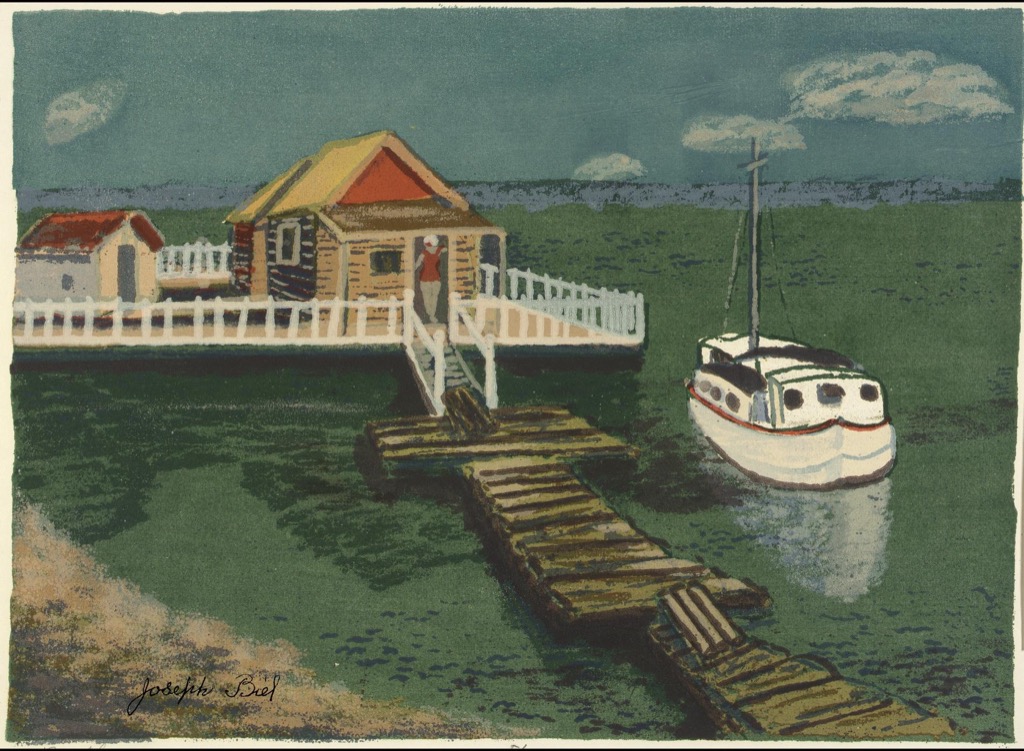
Joseph Biel's Boathouse, catalogued by the Smithsonian American Art Museum as a screenprint on paper, shows overlapping areas of blue-green water, pale architecture, red roof and dark accents. The image includes texture, but its colour zones and edged deposits remain compatible with layered stencils.[8]
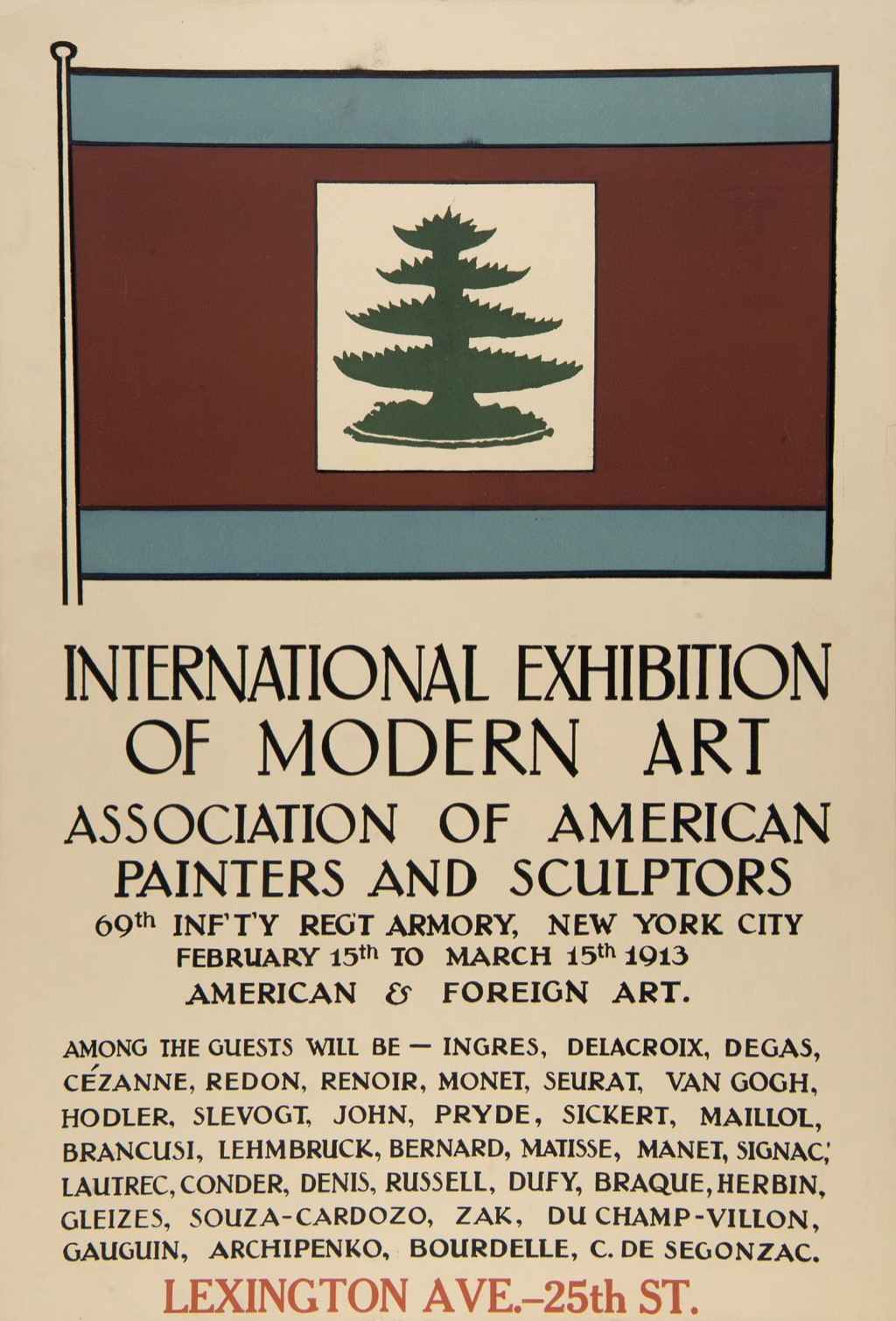
The Smithsonian's Poster from the Armory Show, about 1913, is catalogued as letterpress and screenprint. Its typography and image are not all attributed to one process: letterpress carries part of the design while screenprinted colour creates the flag-like field and evergreen emblem. Mixed medium lines matter because a screenprint layer does not make every visible mark screenprinted.[9]
Is serigraph different from screenprint or silkscreen?
In ordinary museum and workshop usage, no. Screenprint describes the mechanism directly. Silkscreen recalls the traditional fabric, even though synthetic mesh may replace silk. Serigraph combines Latin and Greek roots associated with silk and writing, and gained currency as artists sought a term distinct from commercial screen work.[4]
The new label helped frame screenprinting as fine art, but it did not change how ink reached the sheet. A catalogue's choice can reflect period, institution or artist preference. Search all three terms when researching an object, then reproduce the institution's medium line rather than modernising it silently.
Calling a print a serigraph also does not certify that the artist personally pulled it. Fine-art printmaking is often collaborative. A named printer or workshop may prepare screens, mix ink and register colours under the artist's direction. Lithography is equally collaborative, especially when a specialist printer processes stones and manages colour separations.[2]
Colour, marks and registration
Both processes can build complex colour one layer at a time. The visual difference is therefore not “soft monochrome lithograph versus bright multicolour serigraph.” Instead, ask how each layer was created and deposited.
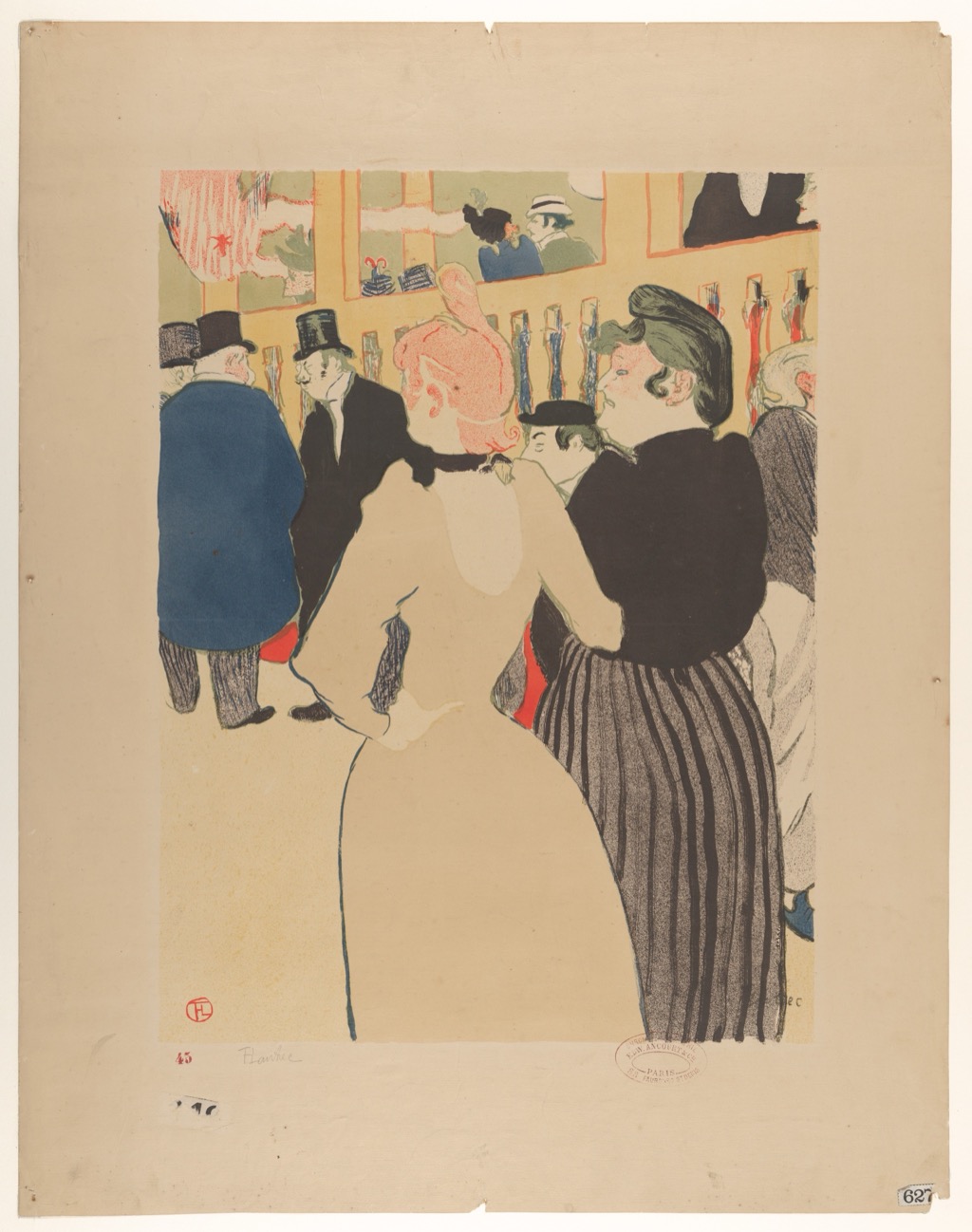
Lithographic crayon can preserve granular drawing; tusche can produce fluid wash and spatter; scraping can recover lights. Toulouse-Lautrec's At the Moulin Rouge: La Goulue and Her Sister is a six-colour lithograph, second state of two. It combines broad beige, blue and black shapes with red drawn accents and delicate textures. Its flat passages resemble effects possible in stencil printing, while its crayon-like lines disclose lithographic vocabulary.[7]
Screen ink can form a relatively even film with decisive edges, yet mesh count, ink viscosity, stencil type and substrate change the result. Hand-cut stencils encourage simple boundaries; photo-stencils can carry tiny dots, tonal screens and photographic information. A deliberately distressed screen can imitate wear, grain or drawing.
Registration marks or small colour shifts reveal multiple passes but not the matrix type. Several lithographic stones and several screens both demand alignment. A halo at an edge can result from misregistration in either process. Magnification may reveal crayon grain or a mesh-related deposit, but a reliable attribution still begins with documentation.
How to tell a lithograph from a serigraph
- Read the full catalogue record. Note printer, workshop, number of colours and combined processes.
- Study drawn texture. Lithographic crayon often carries a granular, pressure-sensitive line; tusche can resemble ink wash.
- Inspect the ink film. Screenprinted colour may look opaque and sit distinctly on the sheet, although this varies with ink and support.
- Follow edges. Crisp stencil boundaries support screenprint; freely drawn contours and tonal grain support lithography, but neither clue is conclusive alone.
- Use magnification. Look for mesh-related texture, photographic halftone, stone grain or layered deposits.
- Do not rely on colour count. Both methods can be monochrome or multicolour.
- Check the sheet under raking light. Surface ink and paper texture can become clearer, but neither method usually leaves the deep plate mark associated with intaglio.
- Expect mixtures. A work can combine lithograph and screenprint, or screenprint with letterpress, offset or hand colouring.
Digital reproductions can flatten ink thickness and disguise grain. Identification from a thumbnail should remain provisional.
Original print, reproduction and offset confusion
Lithography was historically important for both artists' originals and reproductive publishing. The process name alone cannot tell you which role a particular sheet served. An artist may draw directly for the stone; a technician may transfer an existing design; or a modern commercial image may use offset lithography. Object purpose and production history resolve the distinction.
Offset lithography introduces an intermediate rubber blanket: the plate prints to the blanket, which then prints to paper. It shares chemical ancestry with lithography but differs from the direct artist-stone description used here. A poster described simply as “lithographic” needs a reliable record before being assigned to either production path.
Screenprinting likewise crosses fine art, posters, textiles and commercial production. A serigraph can be an original work conceived for its screens; a screenprinted reproduction can translate an existing image. The fine-art label does not replace provenance.
Historical development
Alois Senefelder developed lithography around 1798. Its ability to preserve the movement of drawing and to print text and image encouraged artistic, musical and commercial use. Metal plates and transfer methods broadened production, while nineteenth-century artists and poster designers exploited large-scale colour.
Toulouse-Lautrec's prints reveal how designer, printer and publisher could collaborate. In At the Moulin Rouge, Edward Ancourt printed and Boussod, Valadon and Company published the sheet. Such credits are technical history, not administrative detail.[7]
Screenprinting grew from older stencil practices and commercial applications. MoMA notes that American artists adopted it in the 1930s and that “serigraph” was devised by the end of that decade. Its commercial associations later attracted artists because flat surfaces and repeatable media imagery could be used knowingly rather than concealed.[4]
The two histories eventually overlap. Artists and workshops can combine lithographic drawing with screenprinted blocks, choosing each matrix for what it contributes. Difference does not imply rivalry: one process selects ink chemically across a flat matrix; the other directs ink physically through a stencil.
For the broader families of print processes, see Printmaking Techniques. For Toulouse-Lautrec's wider graphic work, see Henri de Toulouse-Lautrec prints.
Watch Flat-Matrix and Screen Printing in Practice
Choose a stone-lithography sequence, MoMA's screenprint tutorial, or Tate's layered Warhol demonstration.
How to Make a Lithographic Print
See drawing, chemical preparation, dampening, rolling and printing on a lithographic stone.
Watch on YouTubeFrequently Asked Questions
Yes in normal art usage. Serigraph is a fine-art term for screenprint; silkscreen is another historical name. All use blocked and open areas of mesh to control where a squeegee deposits ink.
No. Limestone is traditional, but prepared zinc or aluminium plates are also used. The essential principle is selective affinity for greasy ink and water on a flat matrix.
Neither has a guaranteed palette. Screenprinting readily lays down opaque films, while colour lithography can also be intense. Ink, paper, layering and printing decisions determine the result.
No lithographic or intaglio press is required. The squeegee supplies the local pressure that moves ink through open mesh.
Yes. Workshops can print lithographic layers and screenprinted layers on the same sheet. The catalogue should name both processes.
Often one prepared stone or plate per lithographic colour and one screen per screenprinted colour, but transfer strategies and reduction or reworking methods can alter that count.
Discussion
Which example most clearly reveals its matrix through the printed surface—and which would be hardest to identify without the catalogue medium line?
Reader Insights
Lithography works across one plane; screenprinting controls which parts of a mesh remain open.
Separate stones, plates or screens usually require planned layering and registration.
Fine-art lithographs and serigraphs can both present broad, even colour while remaining original prints.
Join the Conversation
Share one precise observation or a useful museum example below.
References
- National Gallery of Art, “Printmaking Basics.” View source
- National Gallery of Art, “All About Prints.” View source
- Victoria and Albert Museum, “What is print?” Updated 17 April 2024. View source
- Museum of Modern Art, “What Is a Print?” brochure, screenprint section. View source
- Museum of Modern Art, “What Is a Print?” View source
- Metropolitan Museum of Art, Henri de Toulouse-Lautrec, Jane Avril, 1893, five-colour lithograph, object 32.88.15. View source
- Metropolitan Museum of Art, Toulouse-Lautrec, At the Moulin Rouge: La Goulue and Her Sister, 1892, six-colour lithograph, object 41.12.18. View source
- Smithsonian American Art Museum, Joseph Biel, Boathouse, n.d., screenprint on paper, object 1977.32.9. View source
- Smithsonian American Art Museum, Poster from the Armory Show, ca. 1913, letterpress and screenprint, object 1994.70. View source