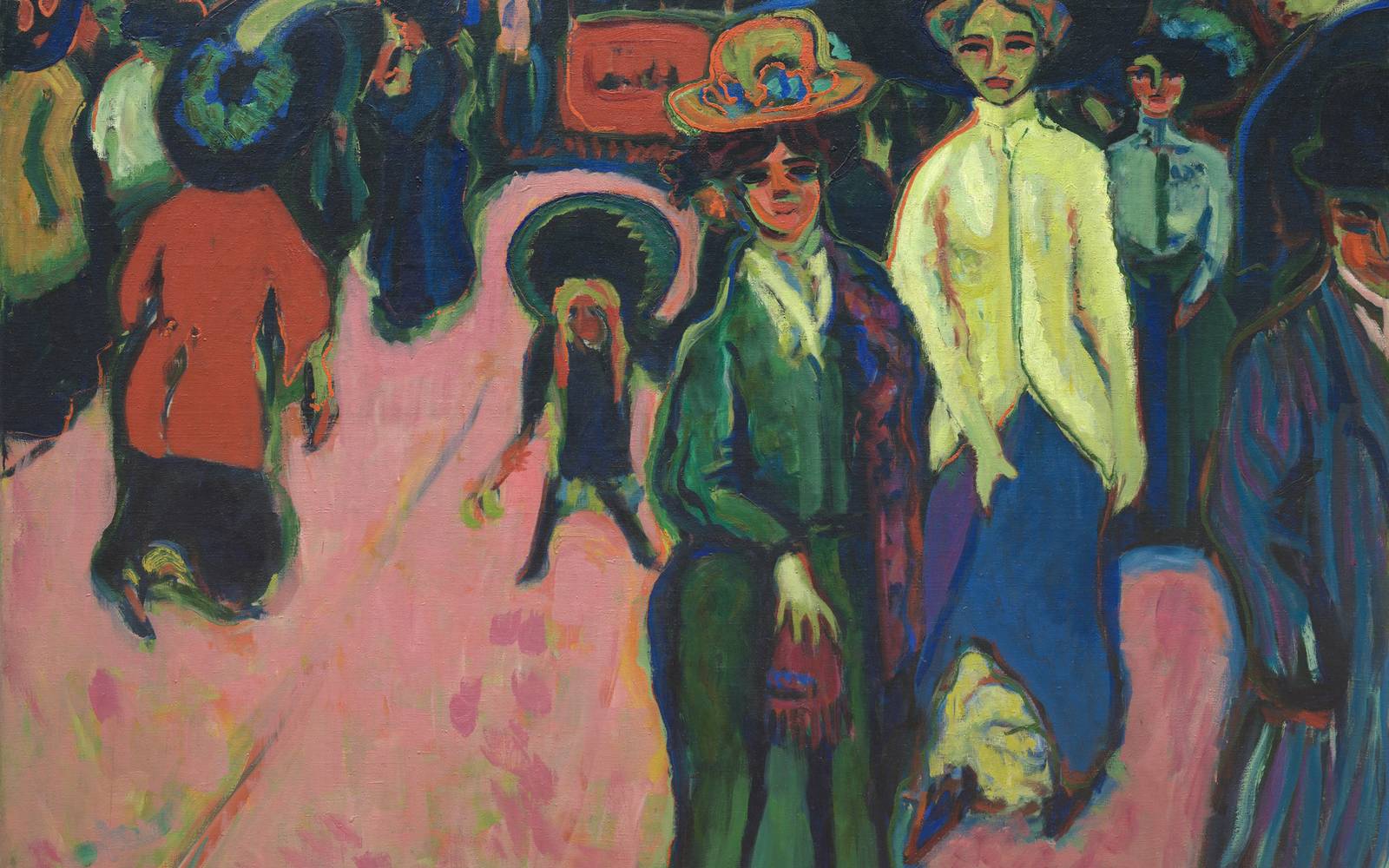
Image reference: Ernst Ludwig Kirchner’s Street, Dresden.
At a Glance
- Core period1905–13
- Principal centresDresden and Berlin
- FoundersErnst Ludwig Kirchner, Erich Heckel, Karl Schmidt-Rottluff and Fritz Bleyl
- Major later membersMax Pechstein, Otto Mueller and, briefly, Emil Nolde
- Important mediapainting, woodcut, etching, lithography, drawing, sculpture, furniture and textiles
- Recurring subjectsstudio life, portraits, bathers, landscape, cabaret, circus and the modern street
- Organisational featuresactive and passive membership, collective exhibitions and annual print portfolios
- Essential contextyouth culture, German museum collecting, colonialism, urbanisation and the reform of art and life
Contents
- Where it fits
- Four architecture students
- A programme cut in wood
- Four stages
- Artists to know
- Woodcut and identity
- Moritzburg
- Colonial context
- Essential works
- Artist directory
Where Die Brücke fits
Ernst Ludwig Kirchner
Principal Brücke phaseErich Heckel
Principal Brücke phaseKarl Schmidt-Rottluff
Principal Brücke phaseFritz Bleyl
Principal Brücke phaseMax Pechstein
Principal Brücke phaseOtto Mueller
Principal Brücke phaseEmil Nolde
Principal Brücke phaseCuno Amiet
Principal Brücke phaseDie Brücke was an artists’ association built around a promise: young people could make a different art by working and living differently. Four architecture students founded the group in Dresden on 7 June 1905. Eight years later, after new members, shared studios, summer working trips, exhibitions and arguments, it dissolved in Berlin on 27 May 1913.[1] Its organised life was brief, but its woodcuts, angular figures, charged landscapes and uneasy city streets became central to the history of modern art.
The German name means “the Bridge.” It did not describe a finished style. It pointed forward, toward an art the members hoped would connect creative freedom with a new generation.[2] The founding quartet brought together Kirchner and Bleyl with Heckel and Schmidt-Rottluff. Max Pechstein, Otto Mueller and Emil Nolde later became important members, although Nolde participated for only a short time. Other affiliations made the network unexpectedly international.
Die Brücke belongs within German Expressionism, but the two terms are not synonyms. Expressionism is the larger historical field that also contains the Munich artists around Der Blaue Reiter, independent painters and printmakers, and developments after the group had ended. Die Brücke was a particular association with membership rules, supporters, portfolios and a documented beginning and end.[3]
Its members wanted directness, yet directness was something they made. A rough edge could be consciously cut into wood. A rapidly drawn figure could emerge from repeated sessions. A street painting might be revised and given an earlier date years later. Their art rewards its energy, but it becomes richer when spontaneity is understood as a disciplined artistic effect rather than an absence of thought.
Four architecture students in Dresden
The founders met through architectural study at the Dresden Technical University. None had followed the standard route through a painting academy. That position encouraged their self-image as outsiders, but it did not mean they lacked training. Architecture taught perspective, spatial construction, lettering, materials and the relation between an object and its setting. Those skills later surfaced in carved furniture, designed studios and carefully engineered compositions.
Ernst Ludwig Kirchner became the association’s most forceful self-mythologist. Heckel was an effective organiser, Schmidt-Rottluff helped define its identity, and Bleyl was an accomplished designer and printmaker. Later histories often allow Bleyl to vanish after the founding scene because he left the group in 1907 for teaching and family life. A Brücke-Museum exhibition devoted to 1905 restores him as a genuine fourth founder and shows how early collective identity was created through invitations and graphic design, not simply through famous paintings.[5]
Heckel’s administrative labour was equally important. He rented an empty shop that served as a studio, managed subscribers, organised exhibitions and maintained correspondence. At the same time, he developed a distinct practice in painting, drawing and print. Group history is therefore not only the history of ideas; it is the history of finding rooms, moving works, contacting collectors and keeping an association functioning.[7]
Schmidt-Rottluff is credited with proposing the name. He and Heckel shared interests and working places, including the North Sea coast, but their art soon diverged. Schmidt-Rottluff’s broad colour planes and forceful woodcuts became increasingly monumental. His later career also makes clear that a membership history does not end when a group dissolves.[8]
The association’s initial declaration spoke for a generation that wanted freedom in work and life. Its ambition was broad enough to attract different temperaments. The bridge was a direction of travel, not a narrow recipe.
A programme cut in wood
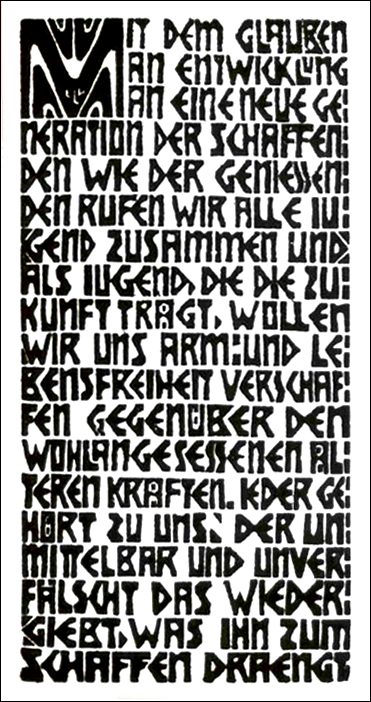
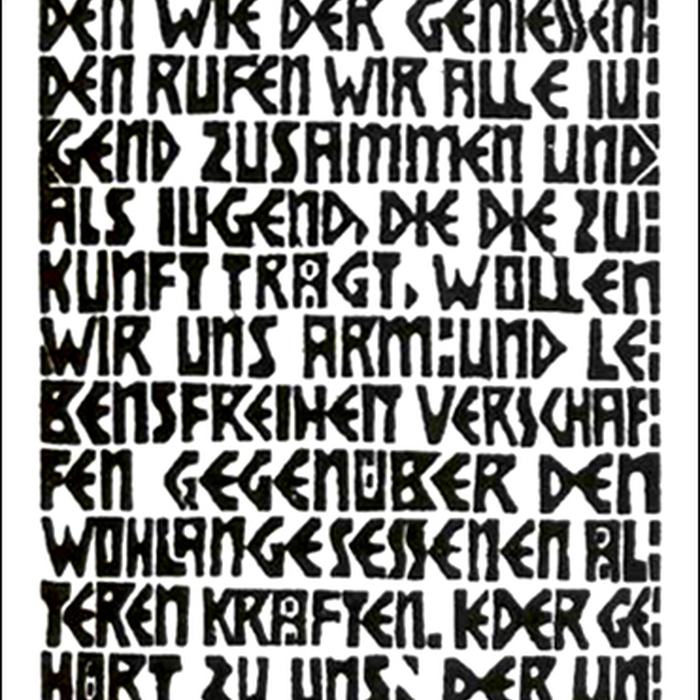
In 1906 Kirchner designed and cut the group’s programme into a woodblock. The surviving sheet is small, but it performs several tasks at once. Its compact declaration calls together young people who embody the future and asks for freedom from established powers. A nude figure occupies the sheet beside the words. Lettering, image and the marks of cutting form one object rather than a manifesto illustrated after the fact.[11]
The medium matters. Every word had to be considered as a reversed shape before printing. Lines swell or narrow according to the tool and the grain. The declaration of freedom is physically constrained by a resistant block. That tension—liberation achieved through material discipline—runs through Brücke art.
The programme also circulated. It was shown at exhibitions and given to passive members, allowing a statement made by a small Dresden circle to travel. Modern movements did not spread through paintings alone. Invitations, catalogues, posters, annual portfolios and letters created publics. German Expressionist print collections reveal how woodcut, lithography and etching became both experimental fields and organisational instruments.[4]
The first public exhibition took place not in a prestigious museum but in the showroom of the Karl Max Seifert lamp factory in Dresden in 1906. That unlikely venue suited artists working outside established institutions. It also joined pictures to designed objects and commercial display, anticipating the way the group would treat studios and interiors as active environments.
Follow Die Brücke through four stages
–06
Formation, manifesto and a public identity
Four architecture students establish an association in Dresden, build a shared graphic language and cut their call to a new generation into wood.
–09
Expansion, shared practice and landscapes
Rapid life drawing, print exchange, studios and summer work around Dresden turn collective method into a mobile visual language.
–11
Collective maturity and the move toward Berlin
Portraits, posters, interiors and increasingly individual styles show the group at its most visible as members and networks shift toward the capital.
–13
Conflict, expulsion and dissolution
Independent ambitions, Pechstein’s expulsion and rejection of Kirchner’s proposed chronicle reveal tensions that end the formal association in Berlin.
How the association worked
Die Brücke distinguished active from passive membership. Active members were artists invited into the working association. Passive members paid a subscription and received an annual portfolio of original prints. The arrangement created income, loyalty and a collecting community while giving supporters a tangible share in the group.[12]
This structure complicates the familiar image of a few rebels creating in isolation. The association depended on people who bought, wrote, hosted, printed and introduced. Hamburg art historian Gustav Schiefler and Rosa Schapire were especially committed passive members. They exchanged letters with artists, assembled work and helped establish reputations.[13]
Schapire’s role deserves more than the old label of enthusiast. She was a Jewish, feminist art historian in a profession whose universities and museums largely excluded women. She wrote about the group, translated, organised, collected and developed a particularly close relationship with Schmidt-Rottluff. Her scholarship and networks made the art visible in circles the painters could not have reached alone.[14]
Membership was also a strategy of expansion. Pechstein, a trained decorative painter, joined in 1906 after meeting Heckel. His professional contacts and later move to Berlin opened different opportunities, including private decoration and stained-glass design.[9] Cuno Amiet’s membership in Switzerland offered international exchange and access to another exhibition world.[49] Invitations to Kees van Dongen, Akseli Gallen-Kallela and other foreign artists show that “German” did not mean culturally sealed.
Not all affiliations were substantial. A name on a list may conceal brief contact, limited participation or rejection. Henri Matisse was invited but did not join. The group’s membership record should be read as a map of ambition and networking, not proof that every named artist shared one programme.
Brücke artists to know
Ernst Ludwig Kirchner
Kirchner developed the group’s programme, shared drawing practices, street imagery and much of its later mythology. His work needs both formal and documentary scrutiny.
Erich Heckel
Heckel secured rooms, managed supporters and exhibitions, and developed an increasingly individual language in painting, drawing and woodcut.
Karl Schmidt-Rottluff
Schmidt-Rottluff proposed the association’s name and made broad colour planes and forceful prints central to its identity.
Max Pechstein
Pechstein brought professional decorative experience and important exhibition networks before his independent showing led to expulsion in 1912.
Otto Mueller
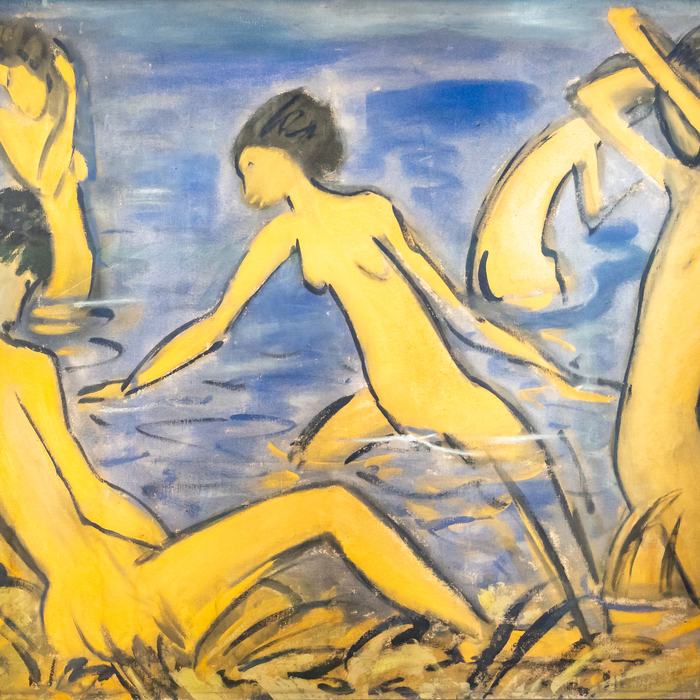
Mueller joined later and brought a quieter palette, distemper technique and sustained treatment of bodies within landscape.
Fritz Bleyl
Bleyl’s early invitations and designs helped establish the group publicly before he left in 1907 for teaching and family life.
Sources without a single family tree
The Brücke artists encountered an unusually broad range of art. In late 1905, Dresden hosted an exhibition of fifty works by Vincent van Gogh. His colour, brushwork and biography as an artist who seemed to have worked beyond polite approval supplied both formal ideas and a model of independence.[23] The younger artists did not simply imitate him. They adapted his example to a collective enterprise.
Edvard Munch offered psychologically charged figures, simplified contour and a print practice in which recurring motifs changed across media. Paul Gauguin demonstrated how colour and outline could depart from local appearance. Lucas Cranach and Albrecht Dürer made old German woodcut feel contemporary rather than antiquarian. African and Oceanic objects entered the artists’ visual world through ethnographic collections, but, as later sections explain, those encounters were structured by empire. MoMA’s account of early Expressionist influences is useful precisely because it presents several intersecting sources instead of one line of descent.[24]
Fauvism emerged in France at almost the same moment. Both formations used strong, non-natural colour and challenged academic finish, and Pechstein and Van Dongen helped establish points of contact. Yet the French group formed around exhibitions and critical naming, while Die Brücke built a membership association with a manifesto and portfolios. French scholarship places them as parallel centres of modern colour rather than versions of the same movement.[25]
The comparison helps define expression. Colour in a Brücke work may intensify a face, dislocate a landscape or make a street feel electrically unstable. It does not operate as a fixed code in which red always means danger or blue always means melancholy. Its force depends on adjacency, scale, subject and material.
Woodcut as material and identity
No medium better embodies Die Brücke than woodcut. It carried associations with early German printmaking, but it was not chosen merely to revive a national past. A block demanded reduction. The artist had to decide what would print and what would remain paper, how a contour would survive cutting, and whether the wood’s own structure would be concealed or displayed.
The group often allowed grain, knots and irregular resistance to participate in the image. These features can make a print look urgent, but urgency was designed. A knife or gouge produces different edges; pressure, ink and paper alter the impression. Städel research describes wood not as a passive carrier but as matter whose properties could redirect the image.[16]
Woodcut also connected separate activities. The same sensibility appears in carved sculpture, chair backs, frames, furniture and lettering. A figure could be cut on a block, carved in the round and painted on a wall. A Städel exhibition on the “secret of matter” places prints beside sculptures to show how the artists tested the physical character of wood across categories.[15]
Printing introduced collaboration. An artist could cut a block and print it personally, but larger circulation involved paper, ink, pressure, publishers and sometimes specialist workshops. Lithography used a flat stone or plate and could support broad tonal or coloured passages; etching drew through a resistant ground before acid bit the line; drypoint raised a burr that printed soft darkness. MoMA’s technical study makes these differences visible rather than gathering every multiple under the generic word “print.”[17]
Publishers and portfolio systems turned experiments into an economy. Annual sheets rewarded subscribers and encouraged members to represent one another. Catalogues and postcards advertised exhibitions. Editioned works could travel farther than a unique canvas, though a small subscription circle was not the same as a mass public.[18]
Periodicals enlarged that public sphere. They carried reproductions, criticism and arguments, linking a Dresden association to debates about art, literature and modern life. Page layout placed experimental images beside commercial and editorial material. A movement existed through this traffic as well as through studio fellowship.[19]
Studios as total environments
Brücke studios were not neutral rooms. Photographs show patterned textiles, carved furniture, murals, screens, sculptures, paintings and objects acquired from outside Europe. The artists constructed surroundings that opposed the furnished bourgeois interior while simultaneously turning alternative life into a carefully staged image.[20]
Kirchner’s studios became especially elaborate. A chair, curtain or carved bed could serve practical use, frame a photograph and recur inside a painting. Models and visitors appeared among these objects, blurring boundaries between living, working and performing. The environment announced that art should shape everyday experience.
Architecture mattered here. The former students understood how bodies occupy rooms and how walls, furniture and openings organise movement. Their rejection of academic painting did not erase construction; it redirected it into spaces meant to look unconstrained.
Photography helped produce the record. Emy Frisch, later Emy Schmidt-Rottluff, was an accomplished photographer and may have helped Kirchner learn the camera. She documented artworks and interiors, yet conventional accounts long treated her only as the painter’s wife. Research into her apartment and archive shows how photographs preserved objects, relationships and spatial arrangements that have since disappeared.[21]
Recent exhibitions have also reconsidered craft. Erna Schilling, Emy Schmidt-Rottluff, Ada Nolde and textile maker Lise Gujer contributed to garments, cushions, embroidery, woven designs and interiors associated with the artists. Not every object can be assigned securely, and participation did not make the group gender-equal. It does reveal that the celebrated total environment depended on more makers than the active-members list records.[22]
The studio therefore contained a productive contradiction. It was a place for refusing social decorum and a stage on which freedom was advertised. It supported experiment while preserving inequalities between male artist, female partner, adult and child, collector and collected culture.
Landscapes made in company
Die Brücke is often divided between city and nature: anxious streets on one side, liberated bathers on the other. The works are less tidy. Rural sites were reached through trains, tourism and modern leisure. City studios contained carved versions of an imagined nature. Bathing scenes could be painted on the reverse of an urban canvas. The two worlds defined one another.
Heckel and Schmidt-Rottluff worked around Dangast and Oldenburg on the North Sea. Pechstein sought the Baltic landscape at Nidden; Kirchner later worked on Fehmarn. Each place produced different structures. In Schmidt-Rottluff’s Autumn Landscape in Oldenburg, fields and trees are built from broad, intensified zones rather than topographical detail. Spanish museum scholarship frames the northern journey as a search for Arcadia away from Dresden, while noting that the members pursued separate geographic “paradises.”[30]
Moritzburg, near Dresden, offered the most concentrated period of communal work. In the summers of 1909 and 1910, artists, partners and models visited the lakes. They drew and painted bathers, woods and each other. A postcard of bathers sent to Rosa Schapire connects apparent rural immediacy to the membership network that preserved and received it.[27]
The 1910 season was especially important. Otto Mueller joined the association, the artists exhibited through the Neue Secession, and Moritzburg became a shared laboratory.[26] Kirchner, Heckel and Pechstein could work synchronously before related subjects, comparing solutions without producing identical pictures. Städel scholarship calls this a contest among equals: proximity sharpened difference.[29]
A portfolio print such as Three Bathers at the Moritzburg Lakes translates the outdoor session into etching and drypoint. The scene is not raw nature transferred directly to paper. It passes through a plate, acid, ink and edition before reaching passive members.[28] Collective life and material mediation were inseparable.
Figures and landscape often exchange qualities. A body may become a triangular colour shape; branches take on gestural energy; water is a band rather than receding space. The artists aimed to shorten the distance between perception and mark, but the picture still orders bodies, edges and intervals.
Moritzburg and the problem of freedom
The group described lakeside nudity, rapid drawing and relaxed companionship as escape from restrictive bourgeois convention. That aspiration was sincere. It also created a mythology in which “natural” life could obscure who held authority.
Adults chose when and how to depict models. Male artists controlled most surviving images and narratives. Female companions helped make the trips possible and participated in them, but their voices are less often preserved. Some models were children from working-class Dresden. Freedom cannot be assumed equally distributed merely because clothing and academic posing disappeared.
This does not make formal attention irrelevant. Pechstein’s paintings from the 1910 trip use compressed surfaces and vivid oppositions; Kirchner’s drawings seek continuous motion; Heckel often emphasises elongated rhythm. But responsible looking asks who is being converted into a sign of artistic renewal.
The mythology also affects landscape. Calling Moritzburg untouched nature erases roads, nearby communities and the social organisation required for leisure. The artists constructed an Arcadia within modern Germany. Its value lies partly in seeing that construction at work.
Fränzi and the ethics of looking
Franziska Fehrmann, known as Fränzi, was born in 1900 and came from Dresden’s working-class Friedrichstadt district. She was approximately eight when she began appearing in Brücke works in 1909. Current Brücke-Museum research places her among at least twelve working-class children who modelled for the artists.[31]
Earlier histories transformed Fränzi into an emblem of unspoiled youth. That language serves the adult artists’ ideal more readily than the child. The surviving record does not permit confident reconstruction of consent, supervision or payment. Her age and the unequal power of the studio must therefore remain visible.
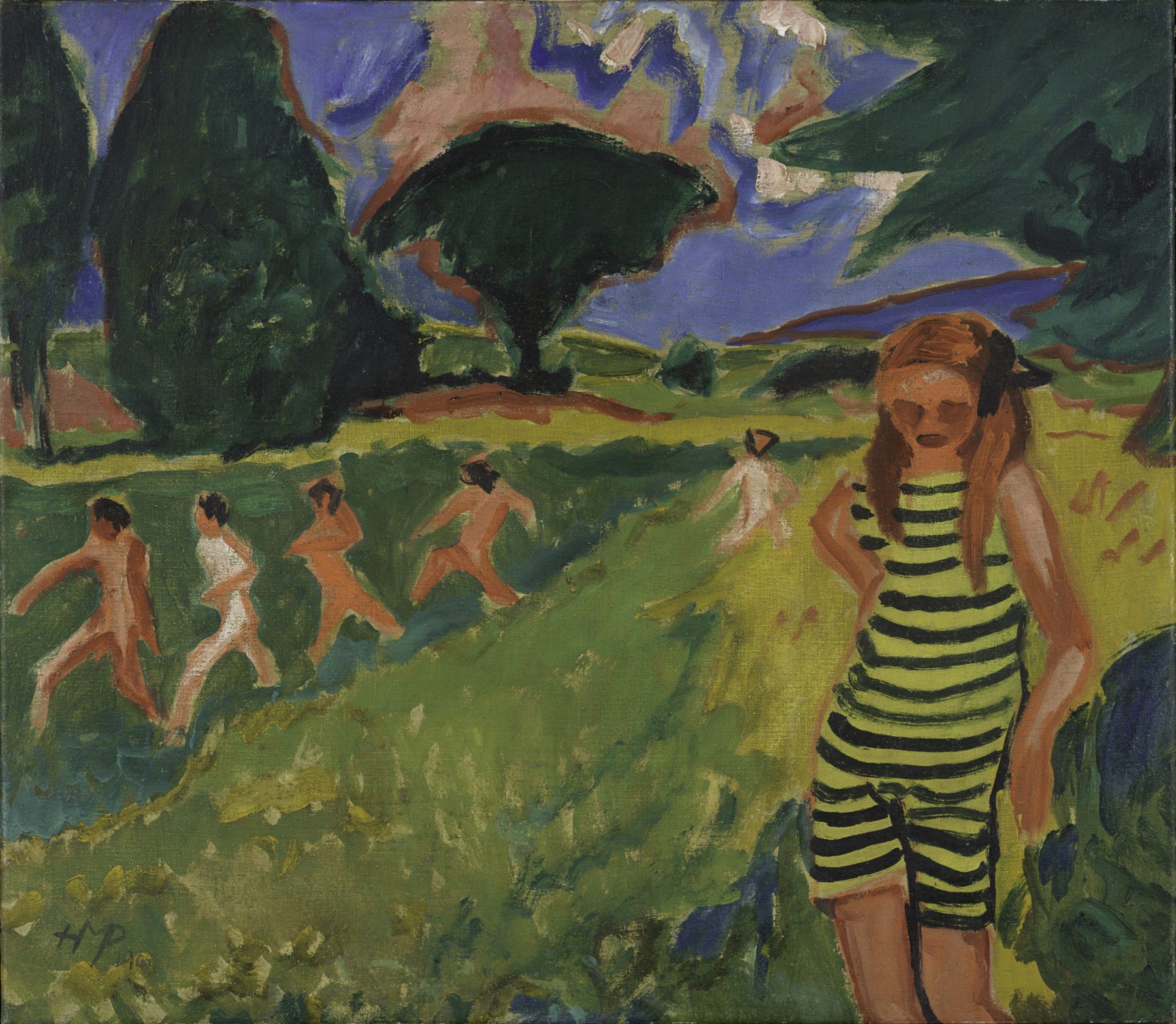
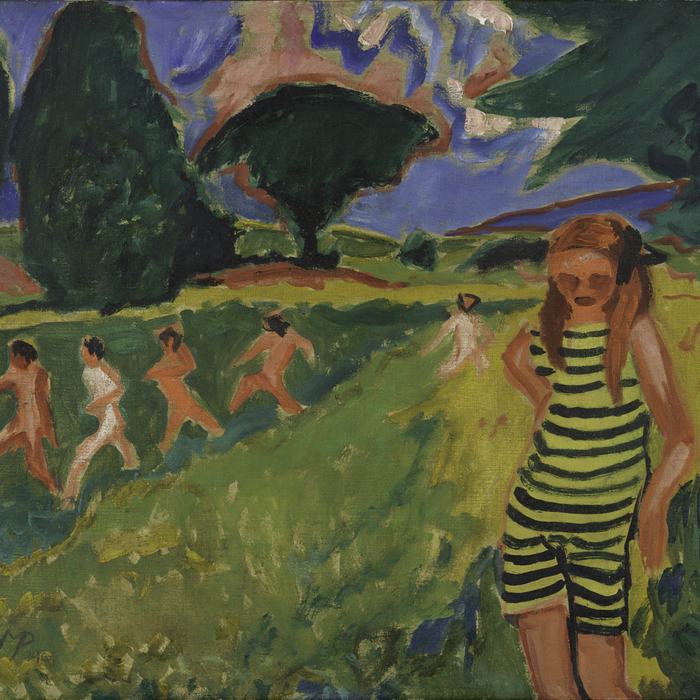
Pechstein’s The Yellow-Black Jersey belongs to the six-week 1910 stay near Moritzburg. Fränzi’s dress creates a patterned wedge against simplified surroundings. Colour does not describe a calm individual psychology; it makes the small body structurally emphatic. The painting was made on a support used on both sides, evidence of a fast and economical working campaign.[32]
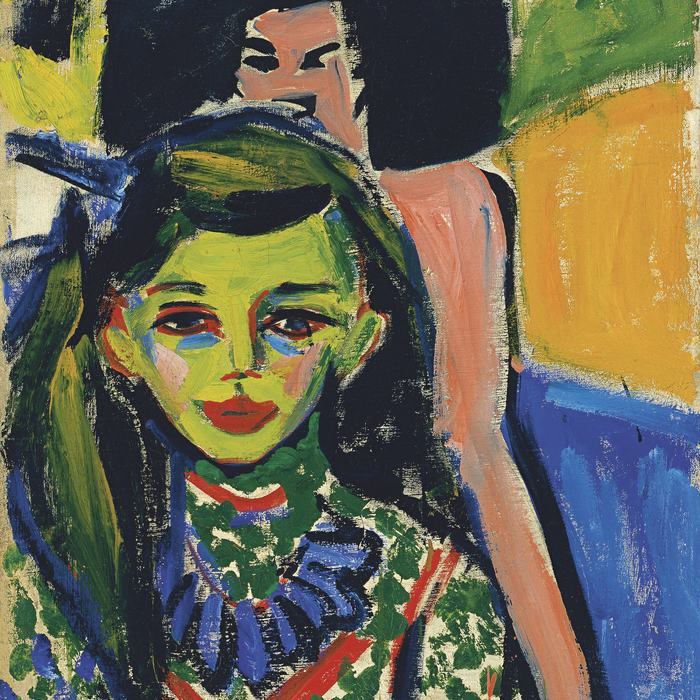
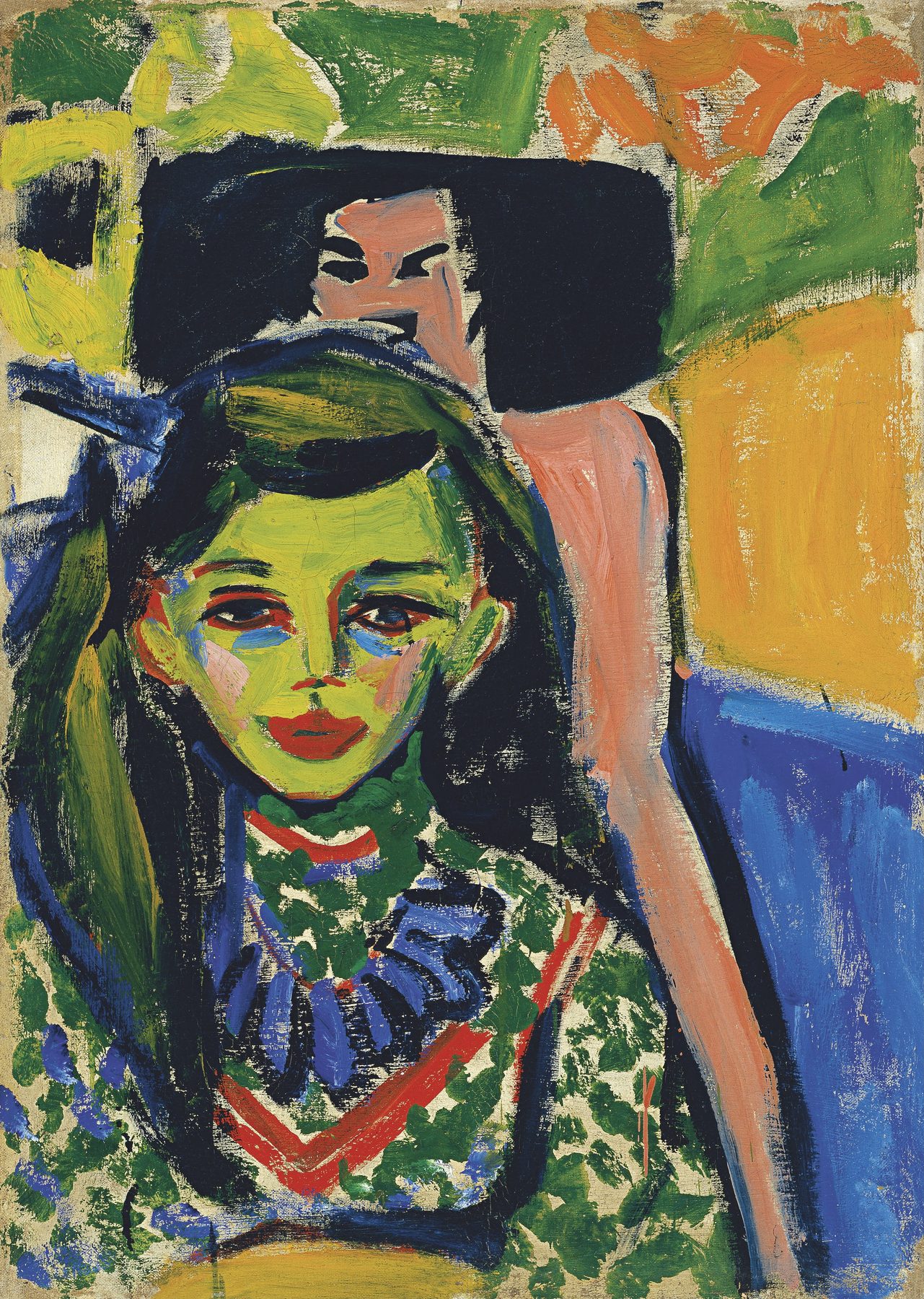
Kirchner’s Fränzi before a Carved Chair places the girl’s sharply simplified head against a chair back bearing a nude female figure. Orange-red skin, dark hair and green furniture refuse naturalistic colour. The confrontation between child, carved adult body and studio object is formally powerful and ethically uncomfortable. A Spanish Thyssen record identifies both her working-class origin and her recurring role across the group’s portraits.[33]
These facts change interpretation. Angularity is not simply a stylistic breakthrough; it acts upon the likeness of a particular child. The chair is not generic “tribal” decoration; it belongs to an environment where adult artists gathered objects and bodies into a modernist vocabulary. Naming Fränzi does not repair the imbalance, but it prevents her from disappearing into the category of model.
The same method should apply elsewhere. Who is called dancer, girl, native or nude? Who receives a surname and biography? What does the title preserve or erase? Ethical context need not close down vision. It gives visual choices historical consequence.
Women around the studios
Women participated as partners, photographers, textile makers, performers, supporters and models, although Die Brücke’s active core remained male. Erna Schilling, whom Kirchner met in Berlin, helped shape his domestic and studio life and appears throughout his work. Her patterned dresses and textiles are part of the visual language commonly attributed to him alone.
Emy Frisch’s photographs preserved Schmidt-Rottluff’s works and rooms. Rosa Schapire gave intellectual and institutional support. Other women travelled, hosted, sewed, posed or managed daily life. These activities differed in status and cannot be merged into an invented collective authorship. They can be described accurately instead of being compressed into “muse.”
The camera deserves particular attention. A photograph seems documentary, yet studio photographs were framed and selected. Textiles, sculptures and bodies were arranged within them. When later histories use those images as transparent evidence of liberated life, they repeat the performance without examining it.
Gender also shaped professional visibility. A male architecture student could become an avant-garde painter; a trained woman might encounter barriers to academic employment or be remembered under a marital name. Schapire’s career shows those constraints directly. Craft scholarship shows them materially, in objects whose execution belonged partly to women whose individual contribution is difficult to recover.
Colonial collections and “primitive” modernism
Older accounts often say that Brücke artists were inspired by “primitive art.” The phrase collapses distinct cultures into a European fantasy of origin. It also conceals how objects and people became available to German artists during colonial rule.
Dresden and Berlin ethnographic museums displayed works from Africa and Oceania with limited attention to named makers, local meanings or conditions of removal. The artists studied these collections, including Benin objects. They also encountered colonial exhibitions and racist displays in which living people were presented as specimens. Only Nolde and Pechstein travelled to German colonies, but imperial institutions shaped the visual field for every member.[34]
Schmidt-Rottluff assembled roughly one hundred objects from colonial contexts. Present provenance research investigates where they came from, how they were acquired and what information was lost as they moved into his possession.[35] The collection formed part of his domestic and studio world; it was not an abstract influence floating free of ownership.
Nolde joined Die Brücke briefly in 1906. He later travelled on a colonial medical expedition to the German Pacific. His membership is significant, but his career cannot be made representative of the whole association. Nor can his later story be reduced to Nazi persecution. Although the regime confiscated more of his works than those of any other artist, he was antisemitic, joined the Nazi Party and continued to seek recognition from it.[10]
Pechstein travelled to Palau in 1914, shortly before Japanese forces seized the German colony. His images and later accounts sought a life beyond Europe while remaining entangled with colonial access. Danish research on Kirchner and Nolde reconnects Expressionist borrowing to racial thought and European oppression rather than treating other cultures as a neutral store of forms.[36]
This reassessment does not require denying visual encounter. It asks better questions. Which object was seen, and in what institution? Did the artist know its maker or purpose? Was a body presented as a contemporary person or as evidence of an imagined past? How did a European work gain value while its source was anonymised?
The Brücke-Museum, SMK and Stedelijk have collaborated on exhibitions that bring these questions into public interpretation.[37] Their work changes the movement’s story from one of fearless formal borrowing to one in which invention, admiration, possession and racial hierarchy coexist.
Street, Dresden and constructed immediacy
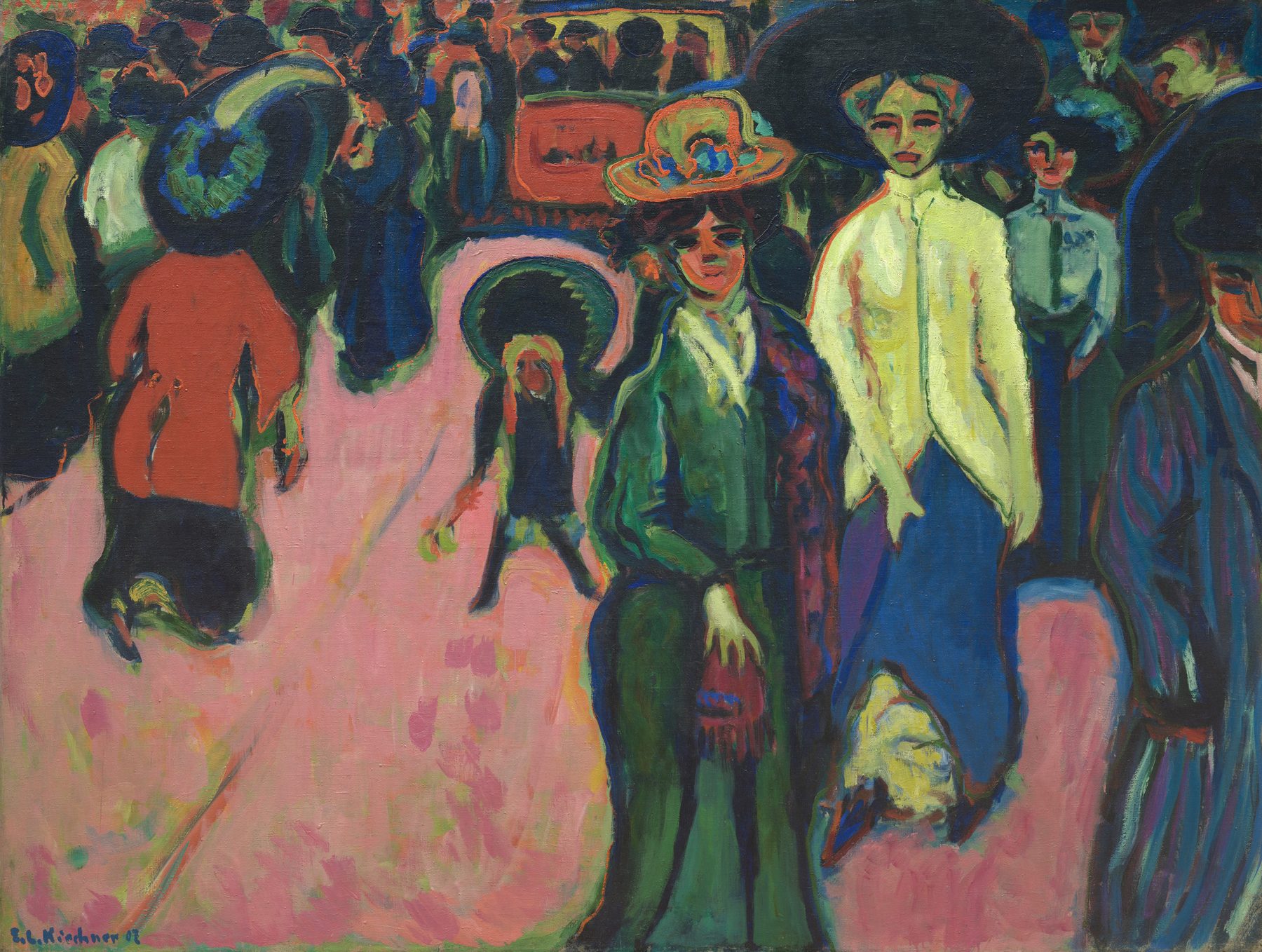
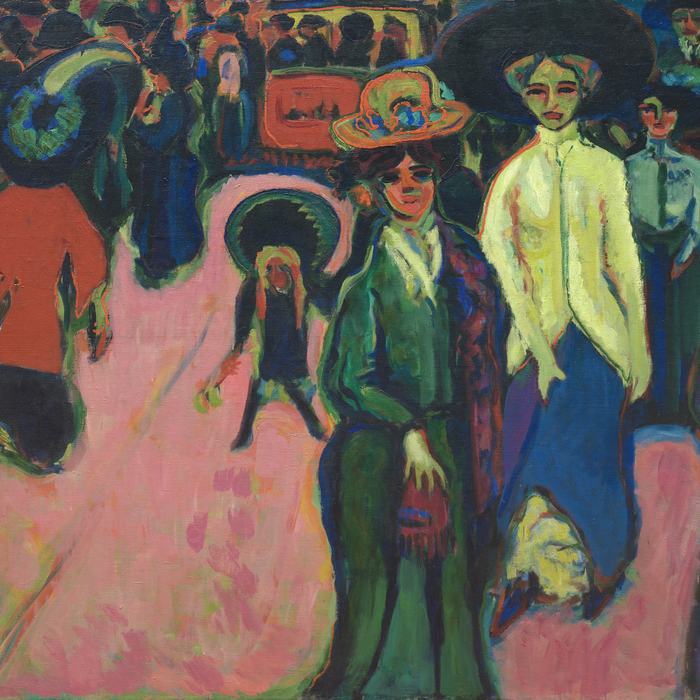
Kirchner’s Street, Dresden appears to catch a crowd in a single nervous instant. Women in long dresses move toward the viewer. A small girl occupies the centre, her face a pale green mask. Pink roadway presses upward while a trolley blocks depth. Cropping and repeated eyes make public space feel both crowded and emotionally disconnected.
The painting’s history overturns the idea of one spontaneous outburst. Kirchner painted it in 1908, later reworked it in 1919 and marked it with the earlier date 1907. On the reverse is a scene of nude bathers.[38] City and nature literally share one support, and the supposedly immediate street was reconsidered more than a decade later.
That does not make its tension false. It shows how tension was built. Figures align like cuts in a block; colour detaches faces from ordinary flesh; the trolley denies an easy route into depth. The child’s central position supplies an unstable scale, caught among adults yet isolated from them.
Dresden was not merely a preliminary phase before Berlin. Its streetcars, shopfronts and exhibition culture already belonged to modern urban life. The nearby lakes did not oppose the city so much as offer another stage on which the artists could test bodies and colour.
Essential works of Die Brücke
Program of the Artists’ Group Brücke
Ernst Ludwig Kirchner · 1906 · Lettering, figure, cutting and declaration make the group’s promise of freedom into a single printed object.
Street, Dresden
Ernst Ludwig Kirchner · 1908 · An apparently immediate street view is organised through opposing figures, tilted space and a surface Kirchner later revised.
Fränzi in Front of a Carved Chair
Ernst Ludwig Kirchner · 1910 · A celebrated portrait whose force must be considered alongside Franziska Fehrmann’s age and unequal position as a model.
The Yellow-Black Jersey
Max Pechstein · 1910 · Pattern, tilted space and confronting colour turn a studio sitter into a deliberately constructed modern image.
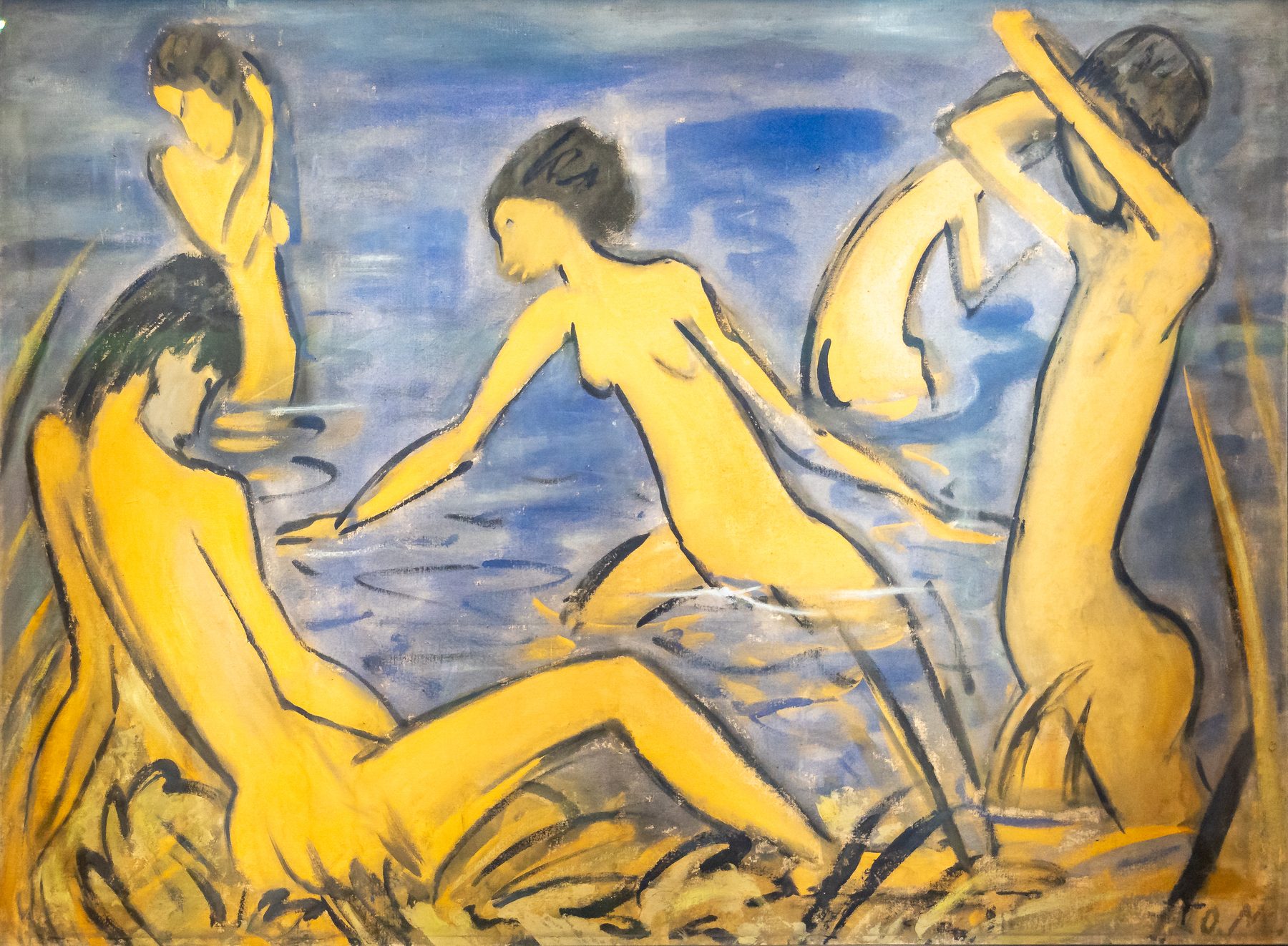
Bathers
Otto Mueller · 1913 · Mueller’s restrained palette and distemper-like surface give the group’s recurring bather subject a distinct material presence.
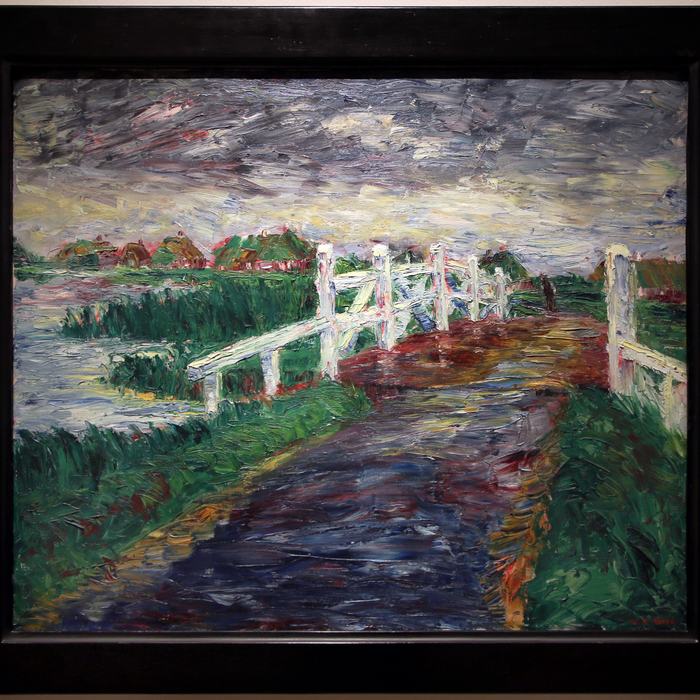
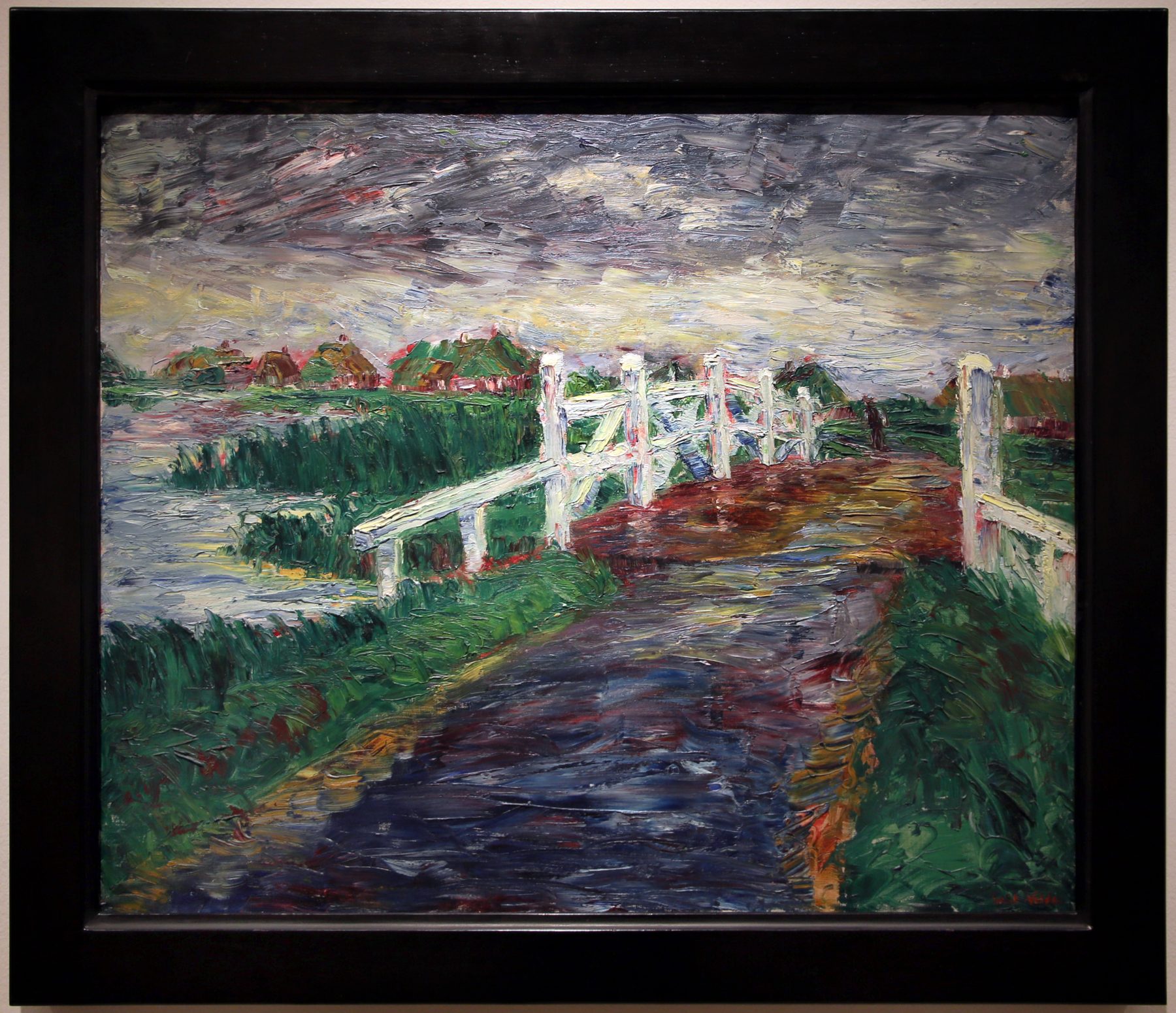
Bridge over the Marsh
Emil Nolde · 1910 · Nolde’s brief association complicates any single Brücke style; charged colour transforms an ordinary marsh crossing.
Erich Heckel and Dodo in the Studio
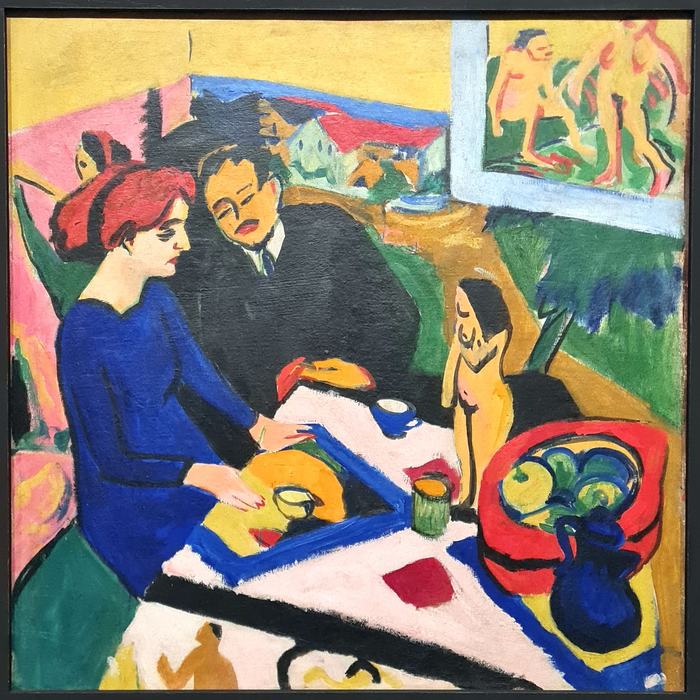
Ernst Ludwig Kirchner · 1910–11 · The painted studio behaves as an environment made from people, pictures, furniture and the group’s shared social life.
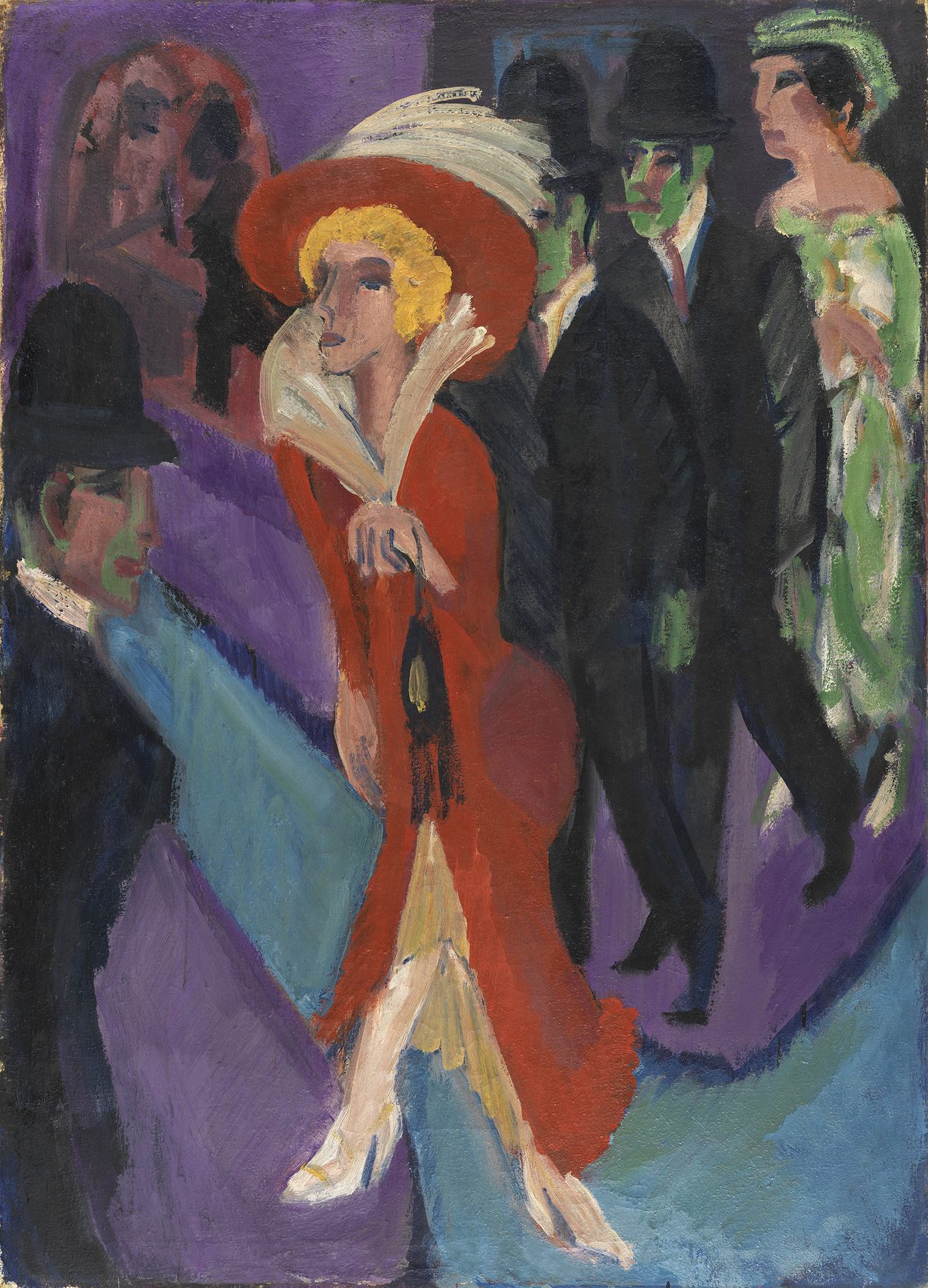
Street with Red Streetwalker
Ernst Ludwig Kirchner · 1914–25 · Kirchner’s Berlin street language stretches beyond the group’s 1913 dissolution into a sharper image of metropolitan strain.
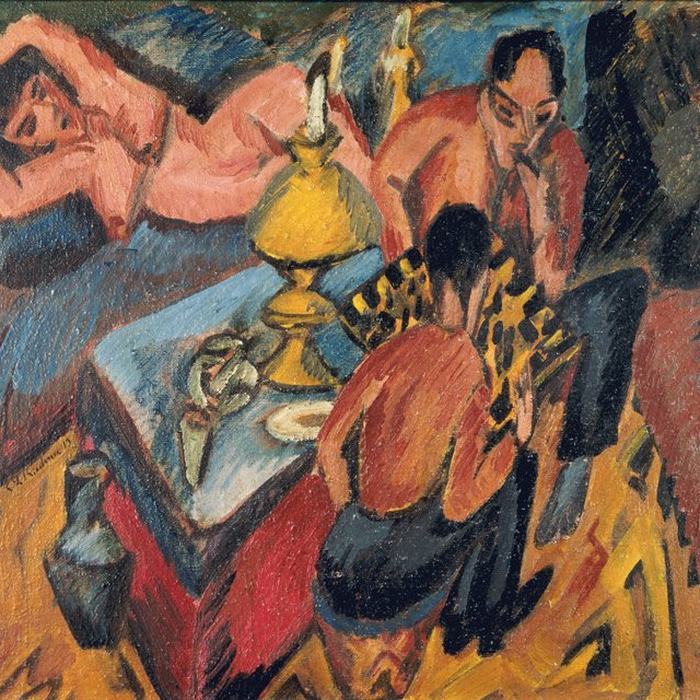
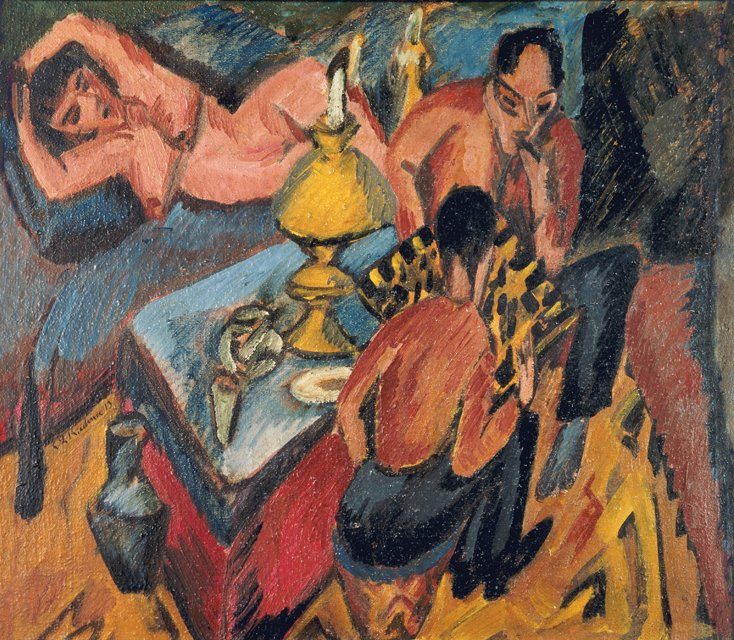
Erich Heckel and Otto Mueller Playing Chess
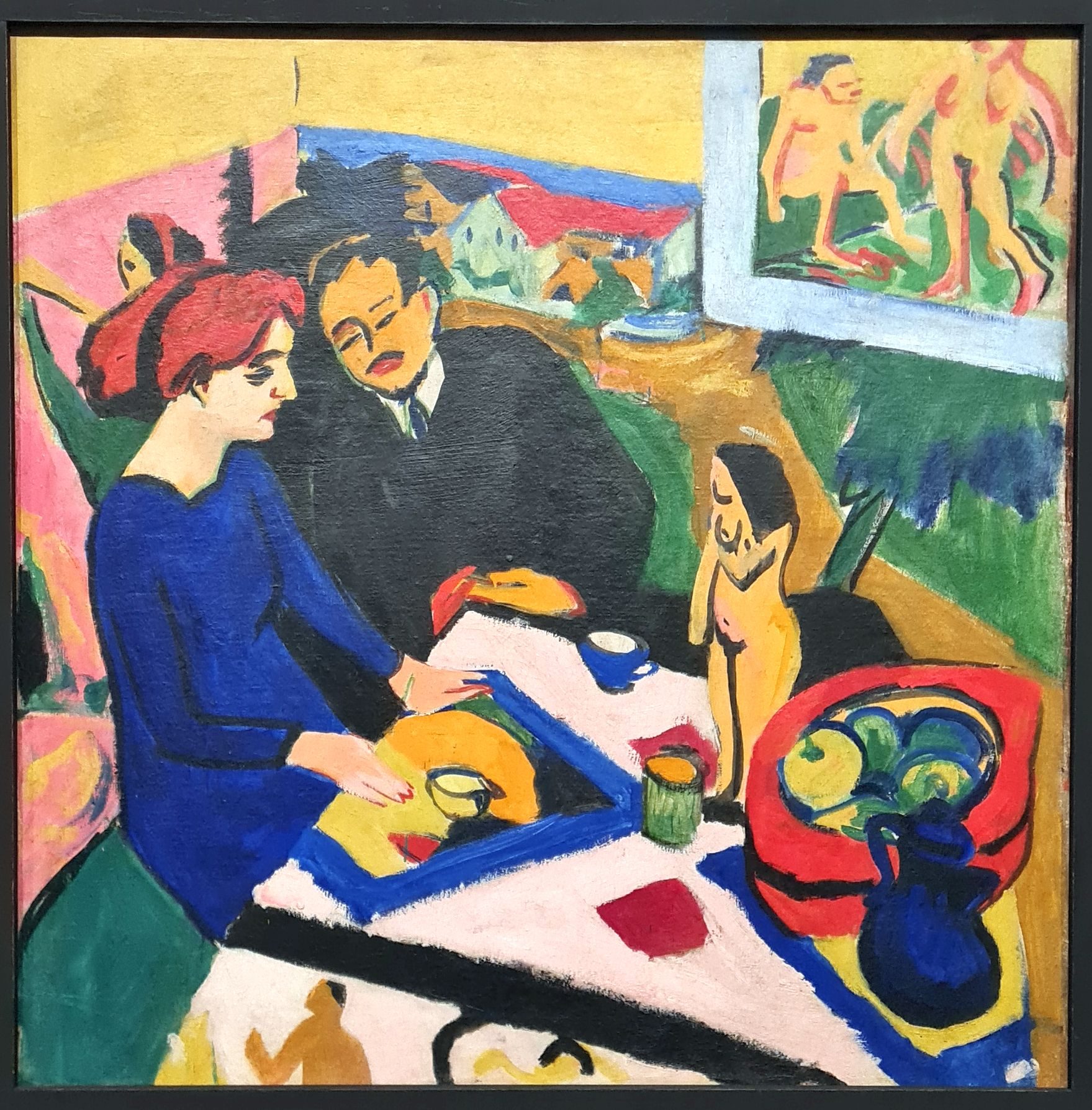
Ernst Ludwig Kirchner · 1913 · A small group portrait makes friendship and fellowship visible at the very moment the association was coming apart.
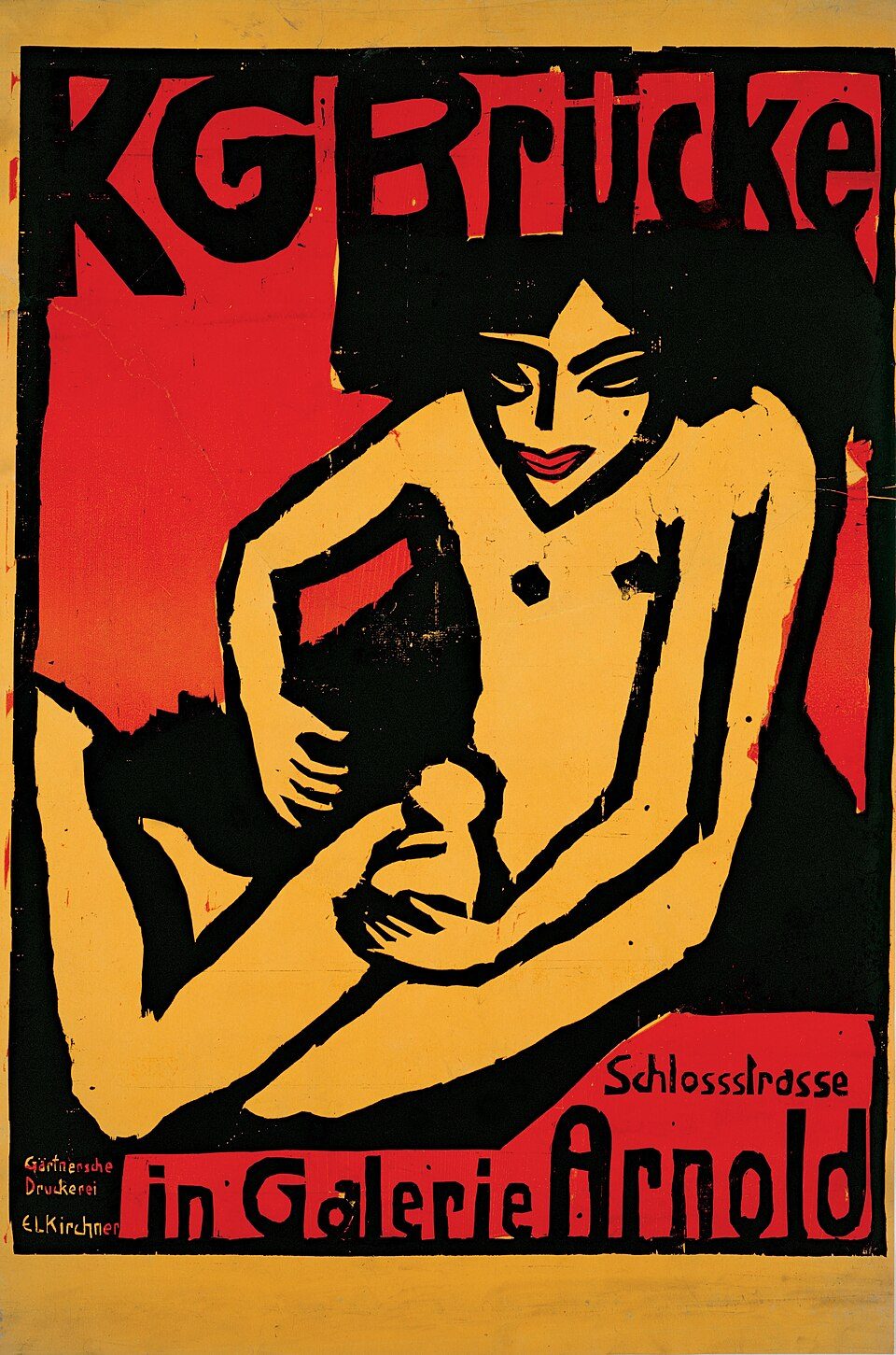
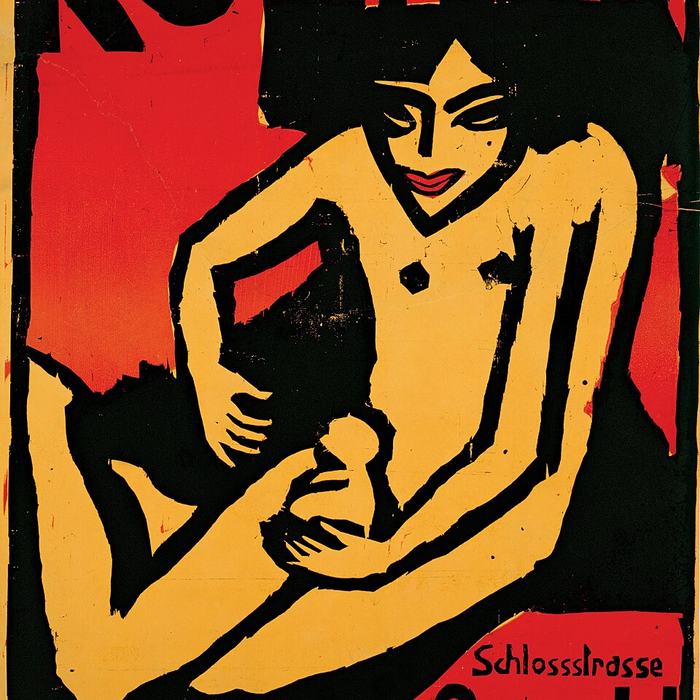
Poster for the Die Brücke Exhibition at Galerie Arnold
Ernst Ludwig Kirchner · 1910 · A public exhibition poster shows how print, display and organisation carried Brücke identity beyond the studio.
Berlin: fashion, velocity and strain
Several members moved their centre of work to Berlin around 1911. Pechstein had gone first; Kirchner and Heckel followed, and Schmidt-Rottluff increasingly worked there. The capital offered a larger art market, new exhibition networks, cinema, cabaret, circus, dance and dense street life. It also made individual career competition harder to contain.[42]
The city pictures do not provide neutral reports. Prostitutes and fashionable pedestrians become highly coded figures. Hats, feathered collars, narrow waists and turned profiles signal the economy of looking. Men hover at edges or appear as dark verticals. MoMA’s city-life research locates such scenes within rapid metropolitan change and the artists’ interest in entertainment as well as alienation.[39]
In Kirchner’s drawing Berlin Street Scene, diagonal lines make the pavement unstable. Bodies seem to pass and collide without secure contact. A drawing can look swift while depending on the artist’s repeated study of fashion, gait and spatial compression.[40]
Street with Red Streetwalker makes one woman blaze against acidic green and dark companions. Her body is angular and elongated; the picture’s colour declares presence while the social category in its title confines her. The viewer meets a person rendered as an urban type, an ambiguity that should not be resolved into either pure empathy or simple condemnation.[41]
Berlin also altered line and palette differently for each member. Kirchner’s forms sharpened; Heckel’s portraits could become more introspective; Mueller retained a softer, chalkier treatment of figures and landscape; Schmidt-Rottluff moved toward weighty simplification. The move did not create one mature Brücke style. It exposed how far the members had separated.
Why Die Brücke dissolved
Collective identity always competed with individual recognition. Pechstein achieved wider success in Berlin and exhibited independently with the Berlin Secession in 1912, contrary to group expectations. He was expelled. His departure removed an artist who had supplied both strong work and important professional connections.[44]
The final rupture came through the proposed Chronik KG Brücke. Kirchner drafted a retrospective history and designed its visual presentation. Other members believed that he exaggerated his own priority and subordinated their contributions. The chronicle that was meant to secure the association’s legacy instead revealed incompatible memories of authorship.[43]
On 27 May 1913, the remaining members formally dissolved Die Brücke. The decision was not proof that the project had failed. Eight years of working together had created careers, print networks, collectors and a recognisable public identity. But its demand for loyalty had become difficult to reconcile with divergent art and competition.
The dissolution also demonstrates why “Expressionism” cannot be bounded by 1913. The wider movement continued through painting, print, literature, theatre, dance and film. In Munich, artists around Wassily Kandinsky and Der Blaue Reiter had pursued different relations among colour, music, spirituality and abstraction. Die Brücke was one powerful structure within that larger history, not its complete institutional form.
War, dictatorship and different political choices
The First World War transformed every career. Pechstein served and later joined the revolutionary Novembergruppe. Kirchner volunteered for military training, experienced a breakdown and eventually settled in Switzerland. His Artillerymen compresses nude soldiers into a supervised communal bath, turning his military experience into an image of exposed, regimented bodies. The painting’s later unlawful Nazi-era sale and eventual restitution demonstrate that an artwork acquires political history after leaving the studio.[50]
The National Socialist campaign against “degenerate art” confiscated extraordinary numbers of works from German museums. Brücke-Museum research records 1,082 works by Nolde, 762 by Schmidt-Rottluff, 760 by Heckel, 706 by Kirchner, 509 by Pechstein and 404 by Mueller among the seizures.[45] These totals partly reflect how enthusiastically Weimar museums had collected Expressionism.
Confiscation damaged livelihoods, scattered collections and helped define later narratives of persecuted modernism. Yet an attack on art does not establish that its maker resisted the regime. The former members occupied different political and moral positions. Some withdrew, adapted or faced professional prohibitions; Nolde remained committed to Nazi ideology despite official rejection of his art. The Brücke-Museum’s Escape into Art? research explicitly separates artistic persecution from political opposition.[46]
Kirchner died in Switzerland in 1938. The causes and circumstances of his death belong to his individual biography rather than a symbolic ending for the association. Heckel, Pechstein and Schmidt-Rottluff survived the dictatorship and participated in postwar cultural reconstruction. Their later self-presentation influenced which memories of 1905–13 entered museums.
The museum and the making of a canon
In 1964 Schmidt-Rottluff proposed a museum devoted to Die Brücke and promised a major gift to Berlin. The Brücke-Museum opened in 1967, with donations from Schmidt-Rottluff and Heckel forming its core.[47] It preserved an exceptional concentration of work and made the group’s history accessible.
An artist-founded museum also shapes a canon. Surviving members could influence selection, attribution and narrative. Kirchner’s energetic self-history, Bleyl’s relative disappearance, the treatment of passive members and the anonymous status of models all affected what counted as central.
Current research treats the museum itself as historical evidence. Provenance projects follow objects through Nazi seizure, forced sale, colonial collecting and later restitution. Exhibitions reconsider gendered craft labour and the terminology used for non-European sources. The institution’s research programme makes revision a responsibility rather than a threat to admiration.[48]
Die Brücke’s importance does not depend on preserving the group’s own myths unchanged. Its art becomes more compelling when collective invention is seen beside administration, patronage, inequality and later memory. The bridge was never one clean span from old art to new. It was assembled from relationships, materials and contested histories.
How to look at Brücke art
- Identify the material. A woodcut, etching, lithograph, oil painting and carved object produce different kinds of edge. Do not call all roughness spontaneous.
- Look for construction beneath speed. Repetition, revision, a false date or a photograph may reveal how immediacy was produced.
- Follow colour relationally. Ask what a red does beside green, or how a face changes when skin becomes yellow or pink, rather than assigning a fixed emotion.
- Reconstruct the social setting. Was the work made in a shared shop studio, at Moritzburg, on the coast or in Berlin? Who else was present?
- Name the represented person. If a model is known, age, class, work and relationship matter. Anonymity may be a historical effect, not an original condition.
- Question the word “primitive.” Find the specific object, community and colonial route whenever evidence permits.
- Check both sides and later states. Brücke artists reused supports, altered prints and revised paintings. The object may contain more than its most familiar image.
- Ask how it reached you. A passive-member portfolio, museum acquisition, Nazi confiscation, artist gift or restitution can shape present meaning.
Where to see Die Brücke
- Brücke-Museum, Berlin: the most concentrated collection, with changing exhibitions that critically examine the association, its networks and its colonial contexts.
- Albertinum, Staatliche Kunstsammlungen Dresden: essential for understanding the city in which the group formed and its place within Dresden modernism.
- Städel Museum, Frankfurt: particularly strong for woodcut, sculpture and comparative study of material.
- Museum Folkwang, Essen: a major German Expressionist collection shaped by early modern museum patronage.
- Museum of Modern Art, New York: important paintings and prints, including Street, Dresden, supported by a substantial online German Expressionism resource.
- Neue Galerie New York: German and Austrian modernism in a focused setting that clarifies the group’s wider cultural field.
- Kirchner Museum Davos: the leading destination for Kirchner’s Swiss years, archives and changing interpretation of his career beyond 1913.
- Museo Nacional Thyssen-Bornemisza, Madrid: useful comparative holdings by Kirchner, Pechstein and Schmidt-Rottluff, with strong Spanish-language research.
Displays change, and works on paper are especially sensitive to light. Check current galleries and exhibition schedules before travelling.
Where to see Die Brücke
Works on paper are light-sensitive and not all paintings remain on view. Check current displays before travelling.
- 01
Brücke-Museum
Berlin, Germany
The defining collection and research centre for the group, built from donations by its artists and continually reframed through current scholarship.
Group history and concentrated holdingsVisit collection website - 02
Albertinum, Staatliche Kunstsammlungen Dresden
Dresden, Germany
Dresden collections restore the urban and museum setting in which the association formed and developed its early practice.
Dresden contextVisit collection website - 03
Städel Museum
Frankfurt, Germany
Paintings, prints and technical research make woodcut, matter and the movement’s sources especially legible.
Prints, materials and scholarshipVisit collection website - 04
Museum Folkwang
Essen, Germany
An important German modern-art collection with works that place the association within wider Expressionist and pre-war networks.
German modernism in contextVisit collection website - 05
Museum of Modern Art
New York, USA
Its German Expressionism research site, print holdings and Street, Dresden connect a major painting to publishing and urban themes.
Street, Dresden and printsVisit collection website - 06
Neue Galerie New York
New York, USA
A focused collection of German and Austrian modernism that clarifies the group’s position alongside parallel Expressionist developments.
German Expressionist contextVisit collection website - 07
Kirchner Museum Davos
Davos, Switzerland
The largest focused route through Kirchner’s long career reveals both his Brücke years and the self-history he constructed later.
Kirchner before and after the groupVisit collection website - 08
Museo Nacional Thyssen-Bornemisza
Madrid, Spain
Strong works by Kirchner, Pechstein, Schmidt-Rottluff and Nolde support close comparison across artists and changing affiliations.
Portrait, landscape and cityVisit collection website
Suggested books
- Reinhold Heller, Brücke. A focused introduction to the association, its members and visual development.
- Jill Lloyd, German Expressionism: Primitivism and Modernity. Essential for examining how modernist ideas of the “primitive” were constructed.
- Magdalena M. Moeller, The Brücke Group. A collection-led study by a scholar closely associated with the Brücke-Museum.
- Shulamith Behr, Expressionism. A concise way to place Die Brücke inside the wider international and interdisciplinary field.
- Aya Soika, Meike Hoffmann and Lisa Marei Schmidt, eds., Escape into Art? The Brücke Painters in the Nazi Period. A corrective to simple stories of modern artists as automatic political resisters.
Major artists associated with Die Brücke
| Name | Nationality | Key Works |
|---|---|---|
| Akseli Gallen-Kallela | Finnish | varying international affiliation |
| Bohumil Kubišta | Czech | varying international affiliation |
| Cuno Amiet | Swiss | international exchange and Swiss exhibition networks |
| Emil Nolde | German-Danish | Bridge over the Marsh · brief membership |
| Erich Heckel | German | portrait, landscape and woodcut |
| Ernst Ludwig Kirchner | German | Street, Dresden · Fränzi in Front of a Carved Chair |
| Franz Nölken | German | varying association with the group |
| Fritz Bleyl | German | early invitations and graphic design |
| Karl Schmidt-Rottluff | German | Autumn Landscape in Oldenburg · woodcuts |
| Kees van Dongen | Dutch-French | international affiliation and Fauvist exchange |
| Max Pechstein | German | The Yellow-Black Jersey · painting and decorative work |
| Otto Mueller | German | Bathers · landscapes and distemper paintings |
Frequently Asked Questions
It means “the Bridge.” Schmidt-Rottluff is generally credited with proposing the name. The bridge represented movement toward a future art and a new generation, not a bridge between two fixed styles.
Kirchner, Heckel, Schmidt-Rottluff and Bleyl founded it in Dresden on 7 June 1905. They were architecture students rather than academy-trained painters. The group moved its centre toward Berlin around 1911 and dissolved there in May 1913.
No. Die Brücke was one organised association within German Expressionism. The larger term also includes Der Blaue Reiter, independent artists and activity after 1913 across visual art and other media.
The four founders were Kirchner, Heckel, Schmidt-Rottluff and Bleyl. Pechstein and Mueller became major later members. Nolde joined briefly. Amiet, Van Dongen and several other international artists had varying affiliations.
Bleyl left in 1907 and pursued teaching and family life rather than the same public avant-garde career. Later narratives concentrated on members with larger surviving bodies of work, but his role in the founding and early graphic identity was substantial.
Woodcut joined the group to an admired German print tradition while offering an emphatically material modern language. Grain and cutting encouraged simplified shapes. Blocks could produce programmes, portraits, portfolios and exhibition graphics, connecting experiment to circulation.
They valued rapid drawing and visible energy, but spontaneity should not be confused with a lack of preparation. Works were repeated, printed, revised and sometimes redated. Architecture, photography and shared observation supplied substantial structures beneath the quick mark.
Members and companions worked around the lakes near Dresden, especially in 1909–10. They drew and painted bathers and landscape in company. The trips encouraged comparison and experiment, but their later image as unrestricted natural freedom must be balanced against unequal relations involving women and child models.
Franziska Fehrmann was a working-class Dresden child born in 1900. She began modelling for the group at about eight and appears in works by Kirchner, Pechstein and Heckel. Her identity and age are essential to ethical interpretation of those images.
The artists studied non-European objects in ethnographic museums, saw colonial exhibitions and, in the cases of Nolde and Pechstein, travelled in German colonial territories. These encounters were made possible by imperial systems that removed objects, anonymised makers and racialised living people.
Individual careers and artistic differences weakened collective discipline. Pechstein was expelled in 1912 after exhibiting independently. In 1913, other members rejected Kirchner’s proposed chronicle because it elevated his role. The association then formally dissolved.
Their work was heavily confiscated and condemned as “degenerate,” but their personal political positions differed. Artistic persecution does not automatically mean political resistance. Nolde, in particular, supported Nazi ideology even while the regime rejected his art.
Discussion
Which Brücke work most changes when its social history is restored: a woodcut understood through its material, a Moritzburg bather connected to a named model, or a studio scene reconsidered through colonial objects and women’s labour? Share the work you would choose and the detail that altered your reading.
Reader Insights
Ask whether a rough edge comes from wood, brush, paper or deliberate revision, and how that physical choice shapes the image.
Name the sitter, organiser, subscriber or collaborator where evidence permits and consider who controlled the representation.
Compare the work’s date and documented setting with the later story of spontaneity, freedom and fellowship.
Join the Conversation
Which Brücke work changes most when its material and social history are restored?
References
- Künstlergruppe Brücke, Brücke-Museum (German; consulted in German), View Source
- Brücke, Städel Museum (German; consulted in German), View Source
- Brücke, MoMA, View Source
- German Expressionist Prints, National Gallery of Art, View Source
- 1905 Fritz Bleyl und der Beginn der Brücke, Brücke-Museum (German; consulted in German), View Source
- Ernst Ludwig Kirchner, Brücke-Museum (German; consulted in German), View Source
- Erich Heckel, Brücke-Museum (German; consulted in German), View Source
- Karl Schmidt-Rottluff, Brücke-Museum (German; consulted in German), View Source
- Pechstein Max, Museo Nacional Thyssen-Bornemisza (Spanish; consulted in Spanish), View Source
- Emil Nolde, Brücke-Museum (German; consulted in German), View Source
- Programm der Künstlergruppe Brücke, Städel Museum (German; consulted in German), View Source
- Künstler, Brücke-Museum (German; consulted in German), View Source
- Freundschaft, Brücke-Museum (German; consulted in German), View Source
- Die Kunsthistorikerin Rosa Schapire, Brücke-Museum (German; consulted in German), View Source
- Das Geheimnis der Materie, Städel Museum (German; consulted in German), View Source
- Revolution in Holz, Städel Museum (German; consulted in German), View Source
- Techniques, MoMA, View Source
- Publishers, MoMA, View Source
- Periodicals, MoMA, View Source
- Atelier, Brücke-Museum (German; consulted in German), View Source
- Wohnung von Emy und Karl Schmidt-Rottluff, Brücke-Museum (German; consulted in German), View Source
- Kunst Hand Werk Brücke, Brücke-Museum (German; consulted in German), View Source
- Van Goghiana Van Goghs Einfluss auf die Brücke, Städel Museum (German; consulted in German), View Source
- Early Influences, MoMA, View Source
- Le fauvisme et ses influences sur l'art moderne, Centre Pompidou (French; consulted in French), View Source
- 1910 Brücke Kunst und Leben, Brücke-Museum (German; consulted in German), View Source
- Badende an den Moritzburger Teichen, Brücke-Museum (German; consulted in German), View Source
- Drei Badende an den Moritzburger Teichen, Brücke-Museum (German; consulted in German), View Source
- Masterworks in Dialogue, Städel Museum, View Source
- Paisaje de otoño en Oldenburg, Museo Nacional Thyssen-Bornemisza (Spanish; consulted in Spanish), View Source
- Artisten, Brücke-Museum (German; consulted in German), View Source
- Das gelbschwarze Trikot, Brücke-Museum (German; consulted in German), View Source
- Fränzi ante una silla tallada, Museo Nacional Thyssen-Bornemisza (Spanish; consulted in Spanish), View Source
- Whose Expression Die Künstler der Brücke im kolonialen Kontext, Brücke-Museum (German; consulted in German), View Source
- Karl Schmidt-Rottluffs Sammlung von Objekten aus kolonialen Kontexten, Brücke-Museum (German; consulted in German), View Source
- Kirchner og Nolde Ekspressionisme Kolonialisme, Statens Museum for Kunst (Danish; consulted in Danish), View Source
- New exhibition Kirchner and Nolde Up for discussion, Statens Museum for Kunst, View Source
- Street Dresden, MoMA, View Source
- City Life, MoMA, View Source
- Berliner Straßenszene, Städel Museum (German; consulted in German), View Source
- Street with Red Streetwalker, Museo Nacional Thyssen-Bornemisza, View Source
- 1913 Die Brücke und Berlin, Brücke-Museum (German; consulted in German), View Source
- 1913, Brücke-Museum (German; consulted in German), View Source
- Max Pechstein, MoMA, View Source
- Die Brücke Künstler und die nationalsozialistische Aktion Entartete Kunst, Brücke-Museum (German; consulted in German), View Source
- Escape into Art The Brücke Painters in the Nazi Period, Brücke-Museum, View Source
- Ein Künstlermuseum, Brücke-Museum (German and English; consulted in German and English), View Source
- Forschung, Brücke-Museum (German; consulted in German), View Source
- Cuno Amiet, Brücke-Museum (German; consulted in German), View Source
- Expressionist Masterpiece with Dramatic History at SMK, Statens Museum for Kunst, View Source
- Die Brücke image records, Wikimedia Commons: Program of the Artists’ Group Brücke (Public domain / free of known restrictions; Wikimedia Commons), Street, Dresden (Public domain; Museum of Modern Art / Wikimedia Commons), Fränzi in Front of a Carved Chair (Public domain; Google Art Project / Wikimedia Commons), The Yellow-Black Jersey (Public domain; Brücke-Museum / Wikimedia Commons), Bathers (Public domain artwork; CC BY-SA photograph; Wuselig / Wikimedia Commons), Bridge over the Marsh (CC BY-SA 4.0; Francesco Bini / Wikimedia Commons), Erich Heckel and Dodo in the Studio (Public domain artwork; CC BY-SA photograph; Derbrauni / Wikimedia Commons), Street with Red Streetwalker (Public domain artwork; CC BY-SA photograph; Museo Thyssen-Bornemisza / Wikimedia Commons), Erich Heckel and Otto Mueller Playing Chess (Public domain; Brücke-Museum / Wikimedia Commons), Poster for the Die Brücke Exhibition at Galerie Arnold (Public domain; Google Art Project / Wikimedia Commons).