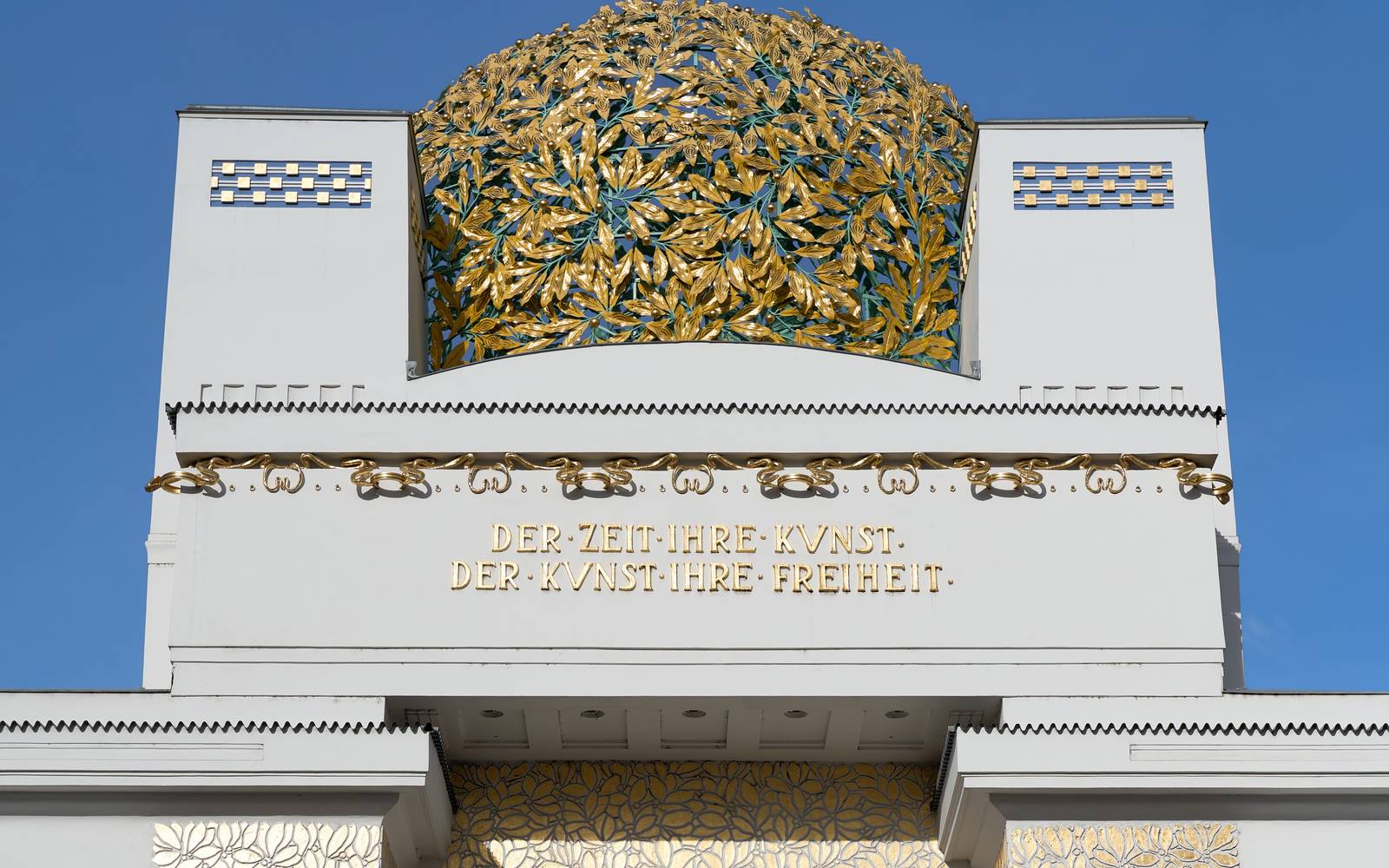
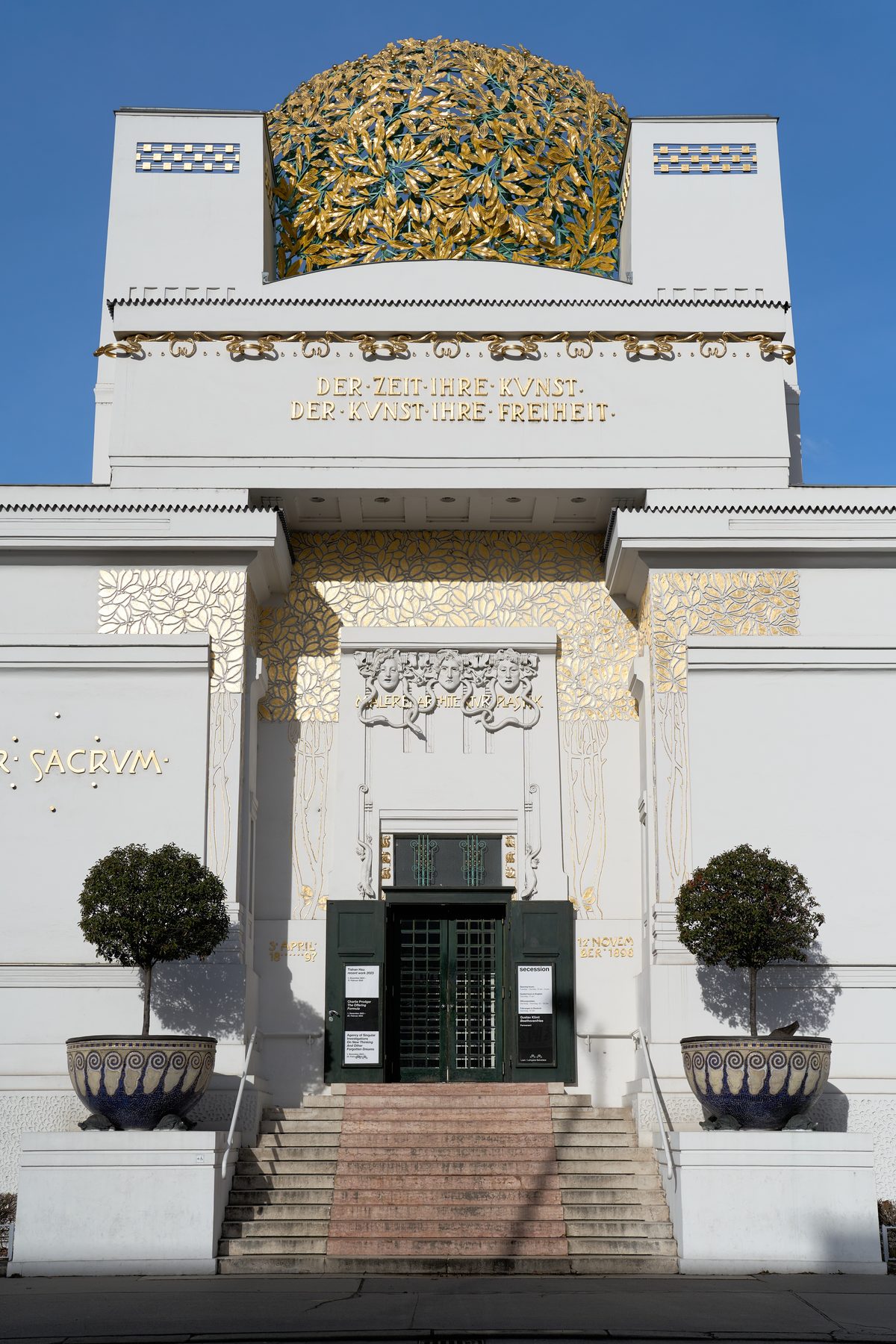
Image reference: the Secession Building in Vienna by Joseph Maria Olbrich.
At a Glance
- Core period1897–1905, from the association's foundation to the departure of the Klimt group
- PlaceVienna, then the capital of Austria-Hungary
- Organisation*Vereinigung bildender Künstler Österreichs—Secession*, an artist-run exhibition association
- First presidentGustav Klimt
- Important membersKlimt, Koloman Moser, Josef Hoffmann, Joseph Maria Olbrich, Carl Moll, Josef Engelhart, Alfred Roller, Max Kurzweil, Ernst Stöhr and Wilhelm List
- Key platformsindependent exhibitions, Olbrich's Secession building and the journal *Ver Sacrum*
- Known forSymbolist painting, graphic design, total environments, international exhibitions and a new status for the applied arts
- Related termsSecessionsstil, Jugendstil, Art Nouveau, Viennese Modernism and *Gesamtkunstwerk*
- Important distinctionthe Wiener Werkstätte was a separate production enterprise founded in 1903
- After 1905the original association continued; Klimt and his allies pursued different exhibition projects
Contents
- Where it fits
- What it was
- Olbrich's building
- Posters and Ver Sacrum
- Four stages
- Artists and designers
- Beethoven Exhibition
- Women and exclusions
- Essential works
- Where to see it
Where the Vienna Secession fits
Gustav Klimt
Principal activityKoloman Moser
Principal activityJosef Hoffmann
Principal activityJoseph Maria Olbrich
Principal activityCarl Moll
Principal activityJosef Engelhart
Principal activityAlfred Roller
Principal activityElena Luksch-Makowsky
Principal activityThe Vienna Secession changed art not by imposing one style but by giving artists control over how new work reached the public. Founded in 1897, the association brought painters, sculptors, architects and designers together around independent exhibitions. It commissioned its own building, published an adventurous journal, invited modern artists from across Europe and treated posters, frames, furniture, lettering and rooms as parts of the artistic experience. Its members could disagree about almost everything except the need for change.
That distinction matters. “Vienna Secession” can mean the artists' association, the exhibitions it organised or the wider visual language often called Secession style. These overlap, but they are not interchangeable. Gustav Klimt's Symbolist paintings, Koloman Moser's grids, Josef Hoffmann's furniture, Joseph Maria Olbrich's architecture and Carl Moll's landscapes do not look like products of one hand. What joined them was an institution built to make experiment possible.[1] [2]
What was the Vienna Secession?
The word “secession” described a withdrawal. During the 1890s, artists in several European cities broke from established associations whose juries, exhibitions and commercial practices seemed unable to accommodate modern art. The Munich Secession, founded in 1892, gave Vienna an immediate example; Franz von Stuck's mythic, erotic Symbolism also demonstrated that a challenge to academic convention could attract a large public.[14] The Berlin Secession followed in 1898. These groups knew of one another, exchanged artists and used the shared name without forming a single movement.[48]
In Vienna, the conflict centred on the Künstlerhaus, home of the established Association of Austrian Artists. Its exhibitions depended on committees, inherited categories and crowded displays. Younger members first tried to reform the system from within. When that failed, they formed the new association in spring 1897. Klimt became its first president; Moser, Moll, Olbrich, Hoffmann and Engelhart were among the leading founders.[18]
They were not all young rebels and they did not subscribe to a common visual creed. The respected elderly watercolourist Rudolf von Alt served as honorary president. Landscape painters worked beside Symbolists; architects sat beside illustrators and sculptors. Their strongest common principles were freedom from a conservative jury, direct responsibility for display, contact with art abroad and a refusal to rank painting and sculpture automatically above design.
The association's core experimental phase runs from 1897 to 1905. That range is practical rather than absolute. Vienna Secession still exists as an artist-run organisation, and its long history has included reconstruction, political compromise and repeated changes of direction. The compact date range identifies the period in which its first programme, building, journal and celebrated total environments were developed.
Vienna at the turn of the century
The movement belonged to a city of extraordinary cultural concentration and sharp inequality. Vienna was the administrative centre of a multinational empire, a court city and a rapidly expanding industrial metropolis. The Ringstrasse encircled the old centre with theatres, museums, a parliament, a university and grand apartment houses dressed in historical styles. These buildings advertised imperial authority and the confidence of the liberal bourgeoisie.[11]
Yet the same city contained overcrowded working-class districts, volatile nationalist politics and entrenched anti-Semitism. New ideas flourished in medicine, psychology, music, literature, theatre and architecture, but “Vienna 1900” was never a harmonious golden age. The Secession emerged from the metropolis's contradictions: wealth financed experimental art, while social and institutional barriers determined who could train, join, exhibit and collect. The Leopold Museum aptly describes the period through paired opposites—splendour and poverty, conservatism and modernity, anti-Semitism and Zionism—rather than as a simple march toward progress.[27]
Many founders had benefited from the order they now questioned. Klimt had decorated theatres and public buildings in the polished language of late Historicism. Moll had trained within established landscape circles. Hoffmann and Olbrich came through Otto Wagner's architectural orbit. The Secession was therefore not an attack by outsiders on a world they did not understand. It was an attempt by successful practitioners to redesign the conditions under which art was made visible.
A short timeline
- 1892: the Munich Secession establishes an influential precedent.
- 1897: Viennese artists form the Association of Austrian Visual Artists—Secession; Klimt becomes first president.
- March–June 1898: the first exhibition opens in the Imperial and Royal Gardening Society's rooms.
- April–October 1898: Olbrich's dedicated exhibition building is constructed.
- 1898: Ver Sacrum begins publication; Klimt produces the first exhibition poster and Pallas Athene.
- November 1898: the second exhibition opens in the new building.
- 1900: the seventh exhibition shows Klimt's unfinished Philosophy; the eighth brings British and Scottish design into especially productive contact with Vienna.
- 1901: Medicine appears in the tenth exhibition; Rodin and Segantini receive prominent international displays.
- 1902: the fourteenth, or Beethoven, Exhibition creates the movement's most complete synthesis of the arts.
- 1903: Klimt's first retrospective fills the eighteenth exhibition; Hoffmann, Moser and Fritz Waerndorfer found the Wiener Werkstätte.
- 1905: Klimt and a group including Moser, Hoffmann and Moll leave the association after disputes over its direction.
- 1908–09: the former members help stage the separate Kunstschau Wien exhibitions.
The first exhibition: independence tested in public
The new association did not yet have a home when it mounted its first exhibition on 26 March 1898. It borrowed the Gardening Society's flower rooms on the Parkring and turned the temporary setting into a demonstration of modern display. More than five hundred works were included. Members offered guided tours, arranged the rooms deliberately and presented contemporary European art beside Austrian work. The exhibition drew 56,802 visitors, sold 218 works and generated receipts crucial to the next stage.[3]
Those numbers reveal that secession was not withdrawal from public life. It was an effort to reach the public differently. The group wanted to reduce the marketplace feel of large annual exhibitions, yet it depended on admission income, sales and patrons. Its independence was made through a new relationship among artists, viewers, collectors and institutions rather than through isolation from commerce.
The exhibition system was itself the medium. Walls could be coloured, furniture designed, works spaced and grouped, sightlines controlled and catalogues coordinated. Art no longer arrived as a detached object in a neutral hall. Every decision around it helped shape meaning. This curatorial ambition is one reason the Vienna Secession remains relevant to the history of installation and exhibition design.
Olbrich's building: a manifesto that could change inside
A dedicated exhibition house appeared on the agenda at the association's first meeting. The commission went to Joseph Maria Olbrich, not yet thirty and then employed in Otto Wagner's studio. Olbrich first designed for a conspicuous site on the Ringstrasse. City councillors objected that the unfamiliar building would disfigure Vienna's ceremonial boulevard. Permission came only after the project moved to Friedrichstrasse near the Naschmarkt, where it was authorised as a provisional pavilion for no more than ten years.[1]
The City of Vienna supplied the land. Industrialist Karl Wittgenstein led the private patrons; proceeds from the first exhibition met another portion of the cost. A cornerstone ceremony took place on 28 April 1898, and construction was complete by 29 October—an extraordinarily short interval after ten months of design work.[1]
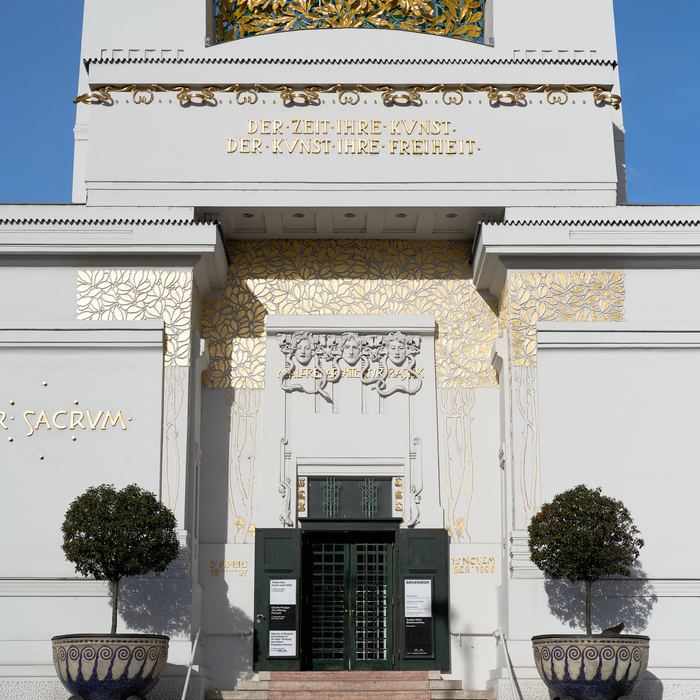
From the street, the building balances severity and growth. White cubic masses form a compact, almost windowless front. Four pylons frame the entrance. Above them rises an open sphere of gilded metal laurel leaves, luminous but permeable, which Viennese observers quickly nicknamed the “golden cabbage.” Laurel also appears in wreaths and on the facade, linking artistic victory, spring and renewal. Owls, masks, serpentine lines and mosaic surfaces animate the geometry.
The facade carries the most famous statement of the movement: “Der Zeit ihre Kunst. Der Kunst ihre Freiheit”—“To every age its art, to art its freedom.” The critic Ludwig Hevesi supplied the words. Their balanced syntax matters. Art should answer its own time, but it must also have freedom within that time. The phrase does not prescribe what modern art ought to look like.
The rear halls are as important as the emblematic front. They were conceived as large, top-lit spaces with movable partitions, allowing each exhibition to remake the interior. Olbrich created an instrument rather than a shrine. Temporary rooms could direct movement, isolate objects, build visual rhythms or dissolve boundaries between architecture and display. French research into the Secession's architectural drawings places this flexible design within the teaching of Otto Wagner, who encouraged a generation to make modern requirements—not inherited styles—the basis of form.[34]
Wagner joined the Secession in 1899. His published demand that architecture respond to contemporary materials, functions and urban life gave intellectual weight to the association's break with Historicism.[45] Olbrich's building did not abandon ornament, but ornament no longer disguised the building as a Renaissance palace or Baroque church. It worked with geometry, surface and use.
Posters, Pallas Athene and a sacred spring
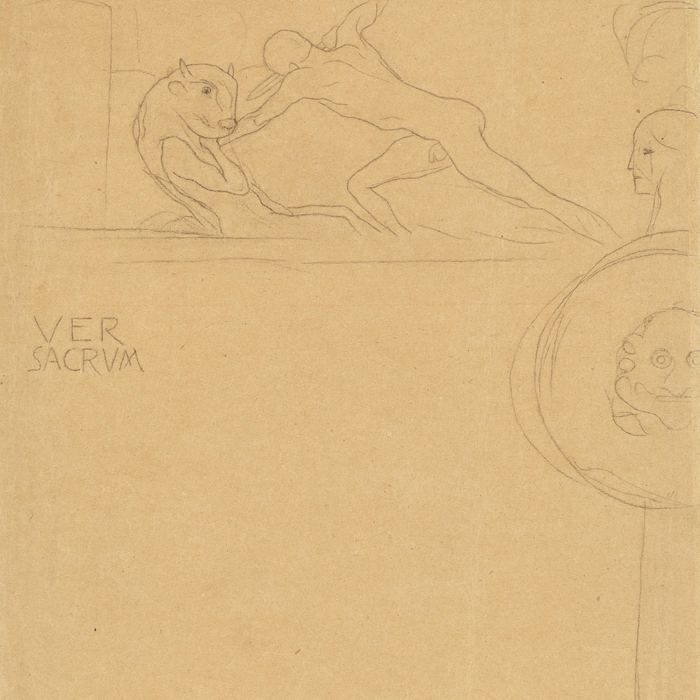
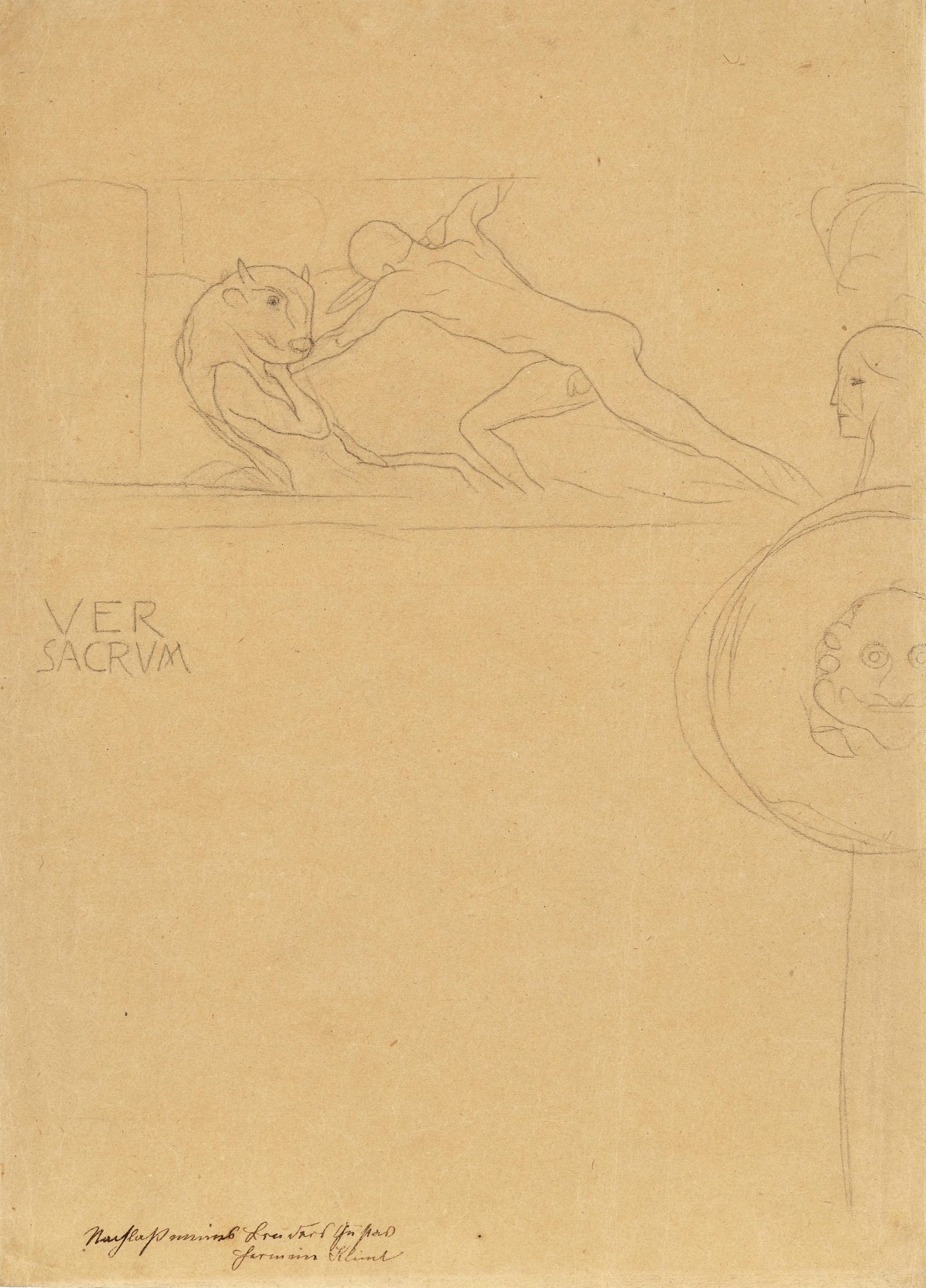
The Secessionists gave their movement a coherent public face before modern branding had a name. Klimt's poster for the first exhibition reduced information to a block near the lower edge and devoted the broad upper field to Theseus defeating the Minotaur under the protection of Athena. The myth made the new association's struggle visible: a youthful hero confronts a monster representing exhausted authority. Viennese censors forced Klimt to hide part of Theseus's nudity behind added tree trunks, turning the supposed battle for artistic freedom into a practical negotiation with official control.[8]
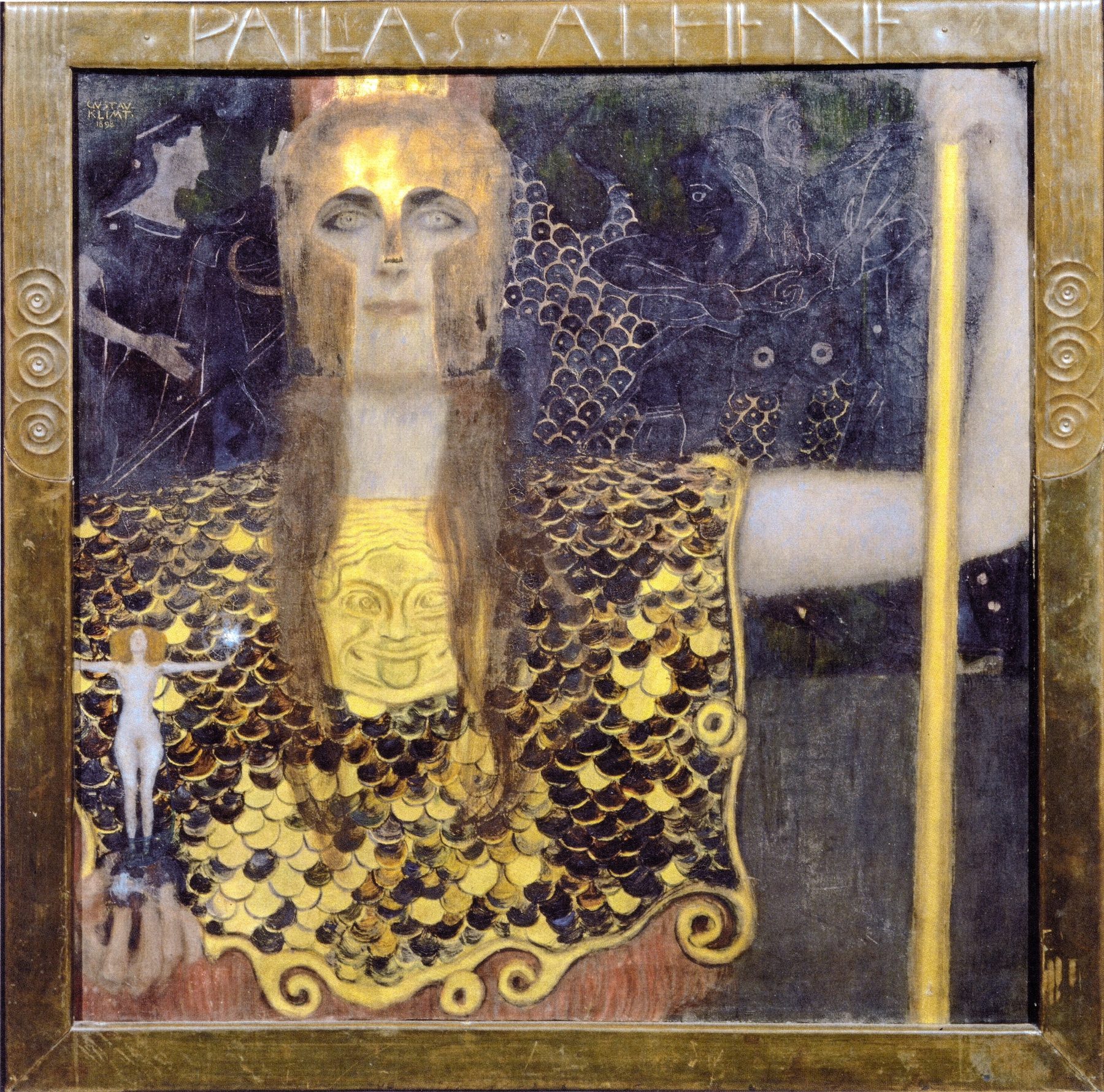
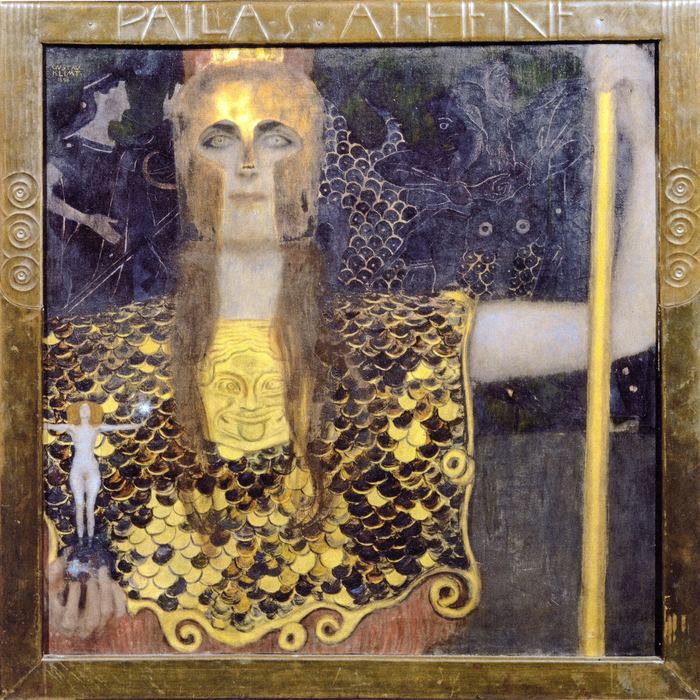
Klimt returned to Athena in Pallas Athene (1898). This is not a placid allegory dressed in antiquity. The armoured goddess meets the viewer with a cold frontal gaze. Her helmet and breastplate catch metallic light; the Medusa head on her armour thrusts out its tongue. In her hand, a tiny naked figure presents Nuda Veritas, naked truth. An academic symbol has been turned against academic reassurance. The painting functioned as a guardian image for the association precisely because it looked both ancient and aggressively new.[10]
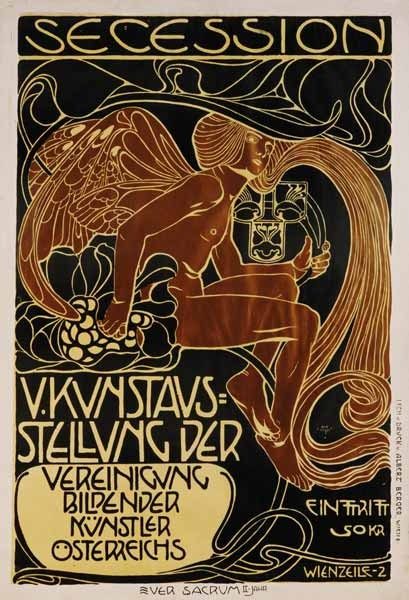
The words Ver Sacrum, Latin for “sacred spring,” appeared on the first poster and named the association's journal. The phrase referred to renewal and to a generation leaving an old settlement to establish another. Published from 1898 to 1903, the journal was much more than a newsletter. Writers, artists and designers treated every page as a field in which type, illustration, border, white space and paper could interact.
Its square format resisted the proportions of conventional magazines. One issue might use disciplined geometry; another would let plant forms curl around a poem. Custom alphabets, woodcuts, lithographs, vignettes and decorative rules gave contributors room to test relationships later developed in posters, textiles and interiors. The Secession's digital archive preserves correspondence with writers, advertisement designs, invitations and issues that reveal how much collaboration sat behind the apparently unified page.[6]
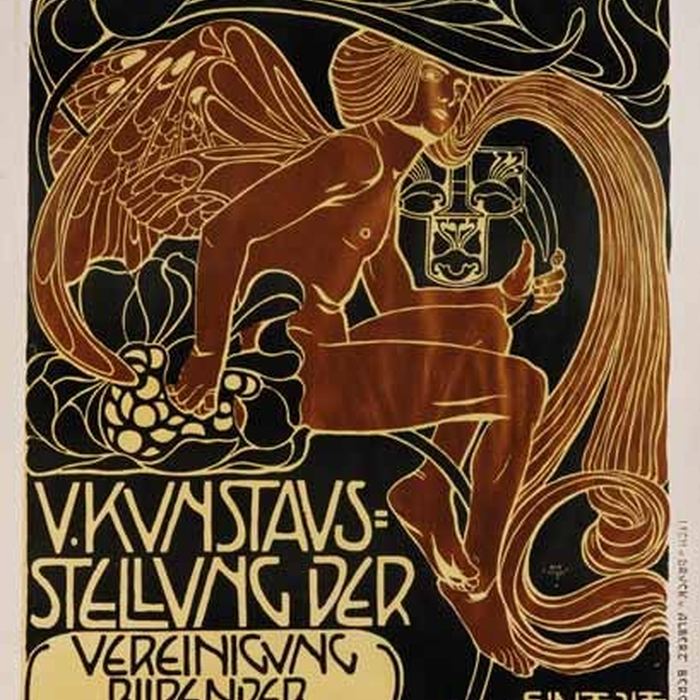
Koloman Moser was central to this culture. He designed covers, ornaments, posters, stained glass, furniture and exhibition rooms, often reducing forms to rhythmic blocks and repeated modules. Archival research also credits him with decoration for Olbrich's building, including glass and exterior motifs, and with designs for numerous exhibitions before 1905.[26] The journal allowed such movement between paper and space. A border could become a wall pattern; a letterform could guide an entire room.
Bringing Europe to Vienna
The founding artists wanted what Klimt described as a more living connection between Vienna and the development of art abroad. Exhibitions therefore carried a double responsibility: to support members and to make international modernism visible. The association presented French, Belgian, British, Scottish, German, Swiss, Scandinavian, Dutch, Polish and other artists, sometimes through concentrated groups that gave Viennese viewers their first sustained encounter with new work.[4]
Auguste Rodin and Giovanni Segantini occupied prominent positions in the ninth exhibition of 1901. Rodin submitted sculpture and works on paper and visited Vienna the following year. Ferdinand Hodler's simplified, rhythmic figures, Jan Toorop's linear Symbolism and Fernand Khnopff's enigmatic interiors complicated any notion that “modern” meant one technique. Edvard Munch offered psychologically charged painting and printmaking. International graphic art brought work by Alphonse Mucha, Aubrey Beardsley and many less familiar figures into the association's paper world.
The eighth exhibition of 1900 became especially important for design. Work from Britain and Scotland, including Charles Rennie Mackintosh and Margaret Macdonald, demonstrated how furniture, textiles, graphics and room arrangement could form a lucid whole. The exhibition provided British Arts and Crafts work with an unusually visible continental platform.[41] Viennese designers did not copy a Scottish style. They converted its tall proportions, controlled emptiness and geometric structure into their own combinations of grid, circle and plane.
The change can be followed in Moser's flat-surface patterns and Hoffmann's interiors. Moser's 1901 Die Quelle converted ornament into interlocking fields that could be applied to floors, textiles or walls. The designs join geometry and living suggestion without pretending to imitate nature.[43] Hoffmann increasingly used the square as module, joint and signature. This Viennese geometry grew from several sources—Biedermeier furniture, Japanese pattern, British design, Wagner's functionalism and the practical demands of production—not from a single moment of influence.
The international exhibitions also affected museums. Purchases and gifts associated with the Secession helped establish collections of modern art in Vienna. The Modern Gallery opened in 1903 with the aim of presenting Austrian art in an international context, an institutional principle close to the association's programme.[20] Modernism was being built simultaneously through artists' exhibitions and public collections.
Follow the Vienna Secession through four stages
Artists take control of exhibition
Failed reform within the Künstlerhaus leads Klimt, Moser, Moll, Hoffmann, Olbrich, Engelhart and allies to form an independent association.
A building, poster and sacred spring
The first exhibition funds Olbrich's flexible pavilion while Klimt's poster, Pallas Athene and Ver Sacrum give the new association a public identity.
–1901
International exchange changes design
European guest displays and the eighth exhibition connect Vienna with Rodin, Munch, British Arts and Crafts and Glasgow's geometric interiors.
–1905
Total art, controversy and rupture
The Beethoven Exhibition creates the most complete synthesis of room, painting, sculpture and music before disputes over art, commerce and control split the founding coalition.
Many artists, many Secessions
Gustav Klimt became the movement's public emblem, but the association depended on distinct kinds of labour. Treating every contribution as an extension of Klimt hides the collaboration that made its exhibitions possible.
Gustav Klimt
Gustav Klimt brought visibility, organisational authority and an increasingly radical pictorial language. His transition from decorated public interiors to flattened Symbolist fields parallels the Secession's rejection of Historicist confidence. Faces and bodies remain sensuously observed while clothing, backgrounds and attributes become pattern. Gold and silver cease to behave as pictured substances and enter the painting as actual reflective matter.[47]
Klimt's landscapes are equally important. Square formats, high horizons and repeated marks turn lakes, orchards and woods into continuous surfaces. Their quiet does not resemble the scandal of his allegories, yet they test the same boundary between observed world and ornamental field. The diversity within one artist warns against equating Secessionism with femme-fatale imagery alone.[28]
Koloman Moser
Moser was the exemplary cross-media practitioner. He painted and drew, edited pages, designed type, organised exhibitions, taught, devised furniture and worked with glass, metal and textiles. His value lies not in one recognisable motif but in his ability to translate a governing proportion from a page into an object or room. MAK research describes him as a universal artist positioned between Klimt's painting and Hoffmann's architecture.[23]
Josef Hoffmann
Hoffmann used architecture and furniture to discipline space. Early curving ornament gave way to rectangles, checkerboards, perforated surfaces and carefully exposed joins. His rooms could feel ceremonial even when built from plain planes. Later projects such as the Purkersdorf Sanatorium demonstrate how furniture, radiators, windows, lighting and circulation could become one controlled environment; a dining chair there is light, functional and expressive at once.[44] These commissions extend Secession thinking, though many postdate Hoffmann's departure from the association.
Joseph Maria Olbrich
Olbrich's principal Viennese achievement is the building that made every subsequent exhibition possible. His move to the Darmstadt Artists' Colony in 1899 also carried the experiment beyond Vienna. The building should not make him seem merely a facilitator: its symbolic front and changeable rear offered a theory of modern art in architectural form.
Carl Moll and Josef Engelhart
Moll combined landscape painting with diplomacy, fundraising, collecting networks and exhibition strategy. His interiors and city views helped make modern taste visible within bourgeois life. Salons such as Berta Zuckerkandl's connected artists, patrons, critics and musicians, many of them from Jewish families central to Vienna's cultural modernity.[9]
Engelhart travelled widely, exhibited scenes of modern life and became a persistent organiser. He remained with the association after the 1905 rupture. His presence reminds us that the continuing Secession was not an empty shell after Klimt left.
Alfred Roller and the wider membership
Alfred Roller designed posters, journal pages and exhibition spaces before carrying the Secession's spatial intelligence into the theatre. His collaboration with Gustav Mahler at the Vienna Court Opera integrated scenery, lighting, costume and musical drama rather than treating sets as painted background.[50] Max Kurzweil, Ernst Stöhr, Wilhelm List, Ferdinand Andri, Emil Orlik and others moved among portraiture, landscape, Symbolism, printmaking and decoration. The association was a working ecology, not a short list of present-day celebrities.
Major artists and designers directory
| Name | Nationality | Key Works |
|---|---|---|
| Adolf Böhm | Austrian | Beethoven Exhibition murals · Secession exhibition designs |
| Alfred Roller | Austrian | Secession posters · Court Opera stage designs |
| Alphonse Mucha | Czech | International guest graphics · Job cigarette posters |
| Aubrey Beardsley | British | International guest graphics · The Climax |
| Auguste Rodin | French | Secession sculpture display · The Age of Bronze |
| Broncia Koller-Pinell | Austrian | The Harvest · Seated Woman Marietta |
| Carl Moll | Austrian | The Naschmarkt in Vienna · Viennese interiors |
| Charles Rennie Mackintosh | Scottish | Eighth Exhibition room · Glasgow interiors |
| Edvard Munch | Norwegian | International guest paintings · The Scream |
| Elena Luksch-Makowsky | Russian | Adolescentia · Ver Sacrum contributions |
| Emil Orlik | Czech-Austrian | Portrait prints · Japanese woodcut studies |
| Emilie Flöge | Austrian | Reform dresses · Salon Schwestern Flöge |
| Emma Schlangenhausen | Austrian | Decorative panels · Woodcuts |
| Ernst Stöhr | Austrian | Secession paintings · Ver Sacrum designs |
| Ferdinand Andri | Austrian | Beethoven Exhibition decoration · Secession posters |
| Gustav Klimt | Austrian | Beethoven Frieze · Pallas Athene |
| Hilde Exner | Austrian | Decorative panels · Applied-arts designs |
| Josef Engelhart | Austrian | Modern-life painting · Secession organisation |
| Josef Hoffmann | Austrian | Beethoven Exhibition rooms · Purkersdorf Sanatorium |
| Joseph Maria Olbrich | Austrian | Secession Building · Darmstadt Artists' Colony |
| Koloman Moser | Austrian | Ver Sacrum · Fifth Secession Exhibition poster |
| Margaret Macdonald Mackintosh | Scottish | Eighth Exhibition designs · Gesso panels |
| Max Klinger | German | Beethoven · Fourteenth Exhibition centrepiece |
| Max Kurzweil | Austrian | Portraits · The Yellow Dress |
| Maximilian Lenz | Austrian | Beethoven Exhibition reliefs · Symbolist painting |
| Otto Wagner | Austrian | Majolica House · Modern Architecture |
| Richard Luksch | German-Austrian | Sculpture · Wiener Werkstätte figures |
| Rudolf von Alt | Austrian | Vienna watercolours · Honorary presidency |
| Teresa Feodorowna Ries | Russian-Austrian | Witch Doing Her Toilet · Sculpture |
| Wilhelm List | Austrian | Symbolist painting · Secession graphics |
Klimt's Faculty paintings: knowledge without reassurance
The University of Vienna commissioned Klimt to paint three monumental allegories—Philosophy, Medicine and Jurisprudence—for the ceiling of its Great Hall. The project began before the Secession, but the association's exhibitions became the paintings' public arena. Philosophy appeared unfinished in the seventh exhibition in 1900, Medicine in the tenth in 1901 and Jurisprudence in the eighteenth, Klimt's retrospective, in 1903.[29]
The commissioners expected dignified celebrations of university disciplines. Klimt offered uncertainty. In Philosophy, bodies emerge from darkness in a vertical stream of birth, desire, age and death. A vast cosmic haze dwarfs rational mastery. Medicine places the goddess Hygeia before a column of vulnerable humanity, but her ritual poise does not cure the suffering around her. Jurisprudence presents a condemned man gripped by octopus-like forces beneath remote female embodiments of law.
The paintings were attacked as ugly, obscure, erotic and inappropriate to public education. The conflict was not simply between prudery and progress. It concerned what a state commission should say about knowledge. Klimt denied that philosophy, medicine and law stood serenely above instinct, mortality and punishment. Officials wanted an ennobling ceiling; he made psychic and bodily limits impossible to ignore.[10]
Klimt withdrew from the commission in 1905 and returned his fee, using private support to preserve control of the works. The paintings were later destroyed by fire in 1945; photographs and preparatory material carry much of what can now be studied. Their controversy established artistic autonomy as a material problem—who paid, who owned, who could refuse—not just a slogan above the Secession entrance.
The Beethoven Exhibition: a total work of art
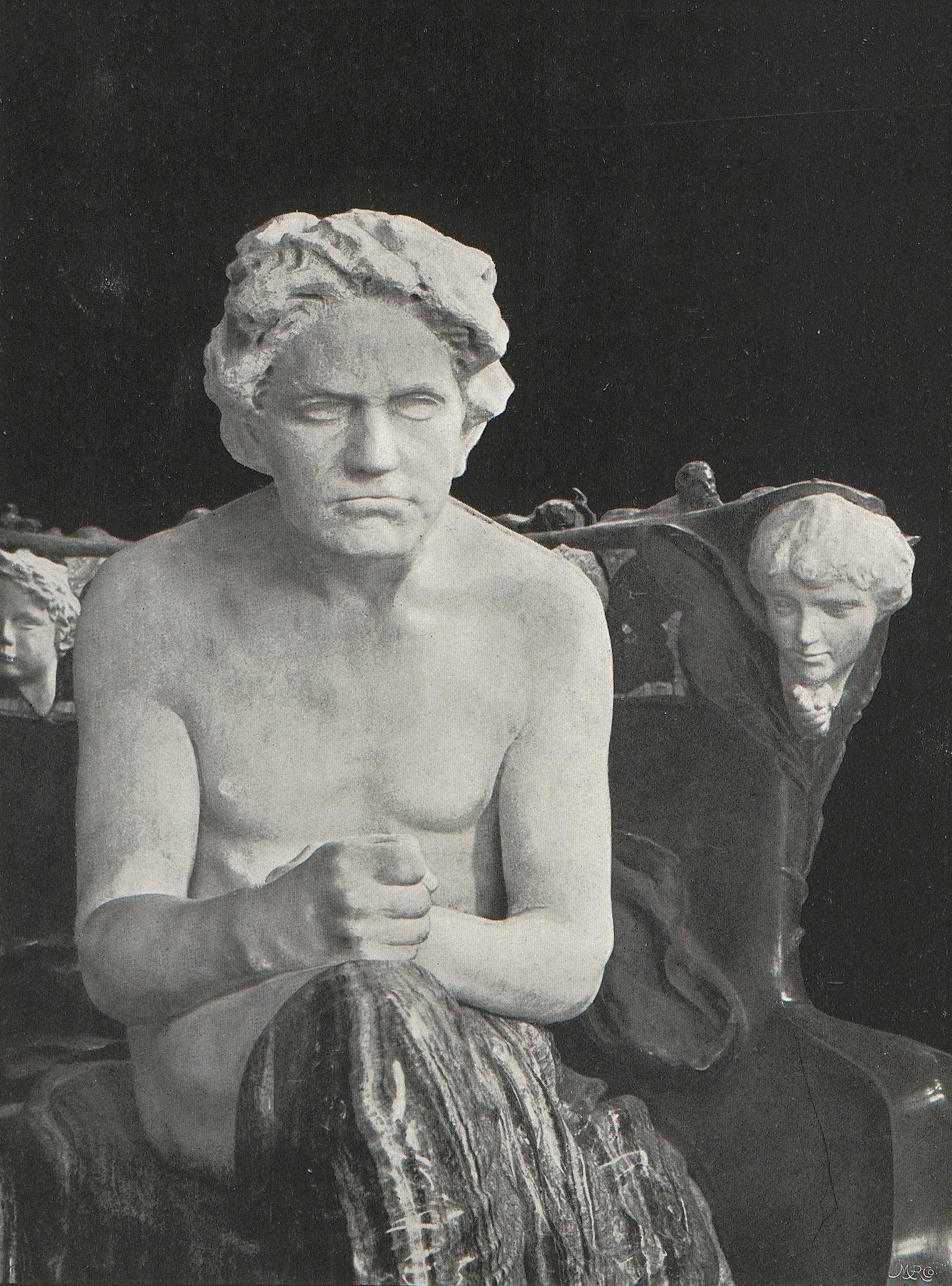
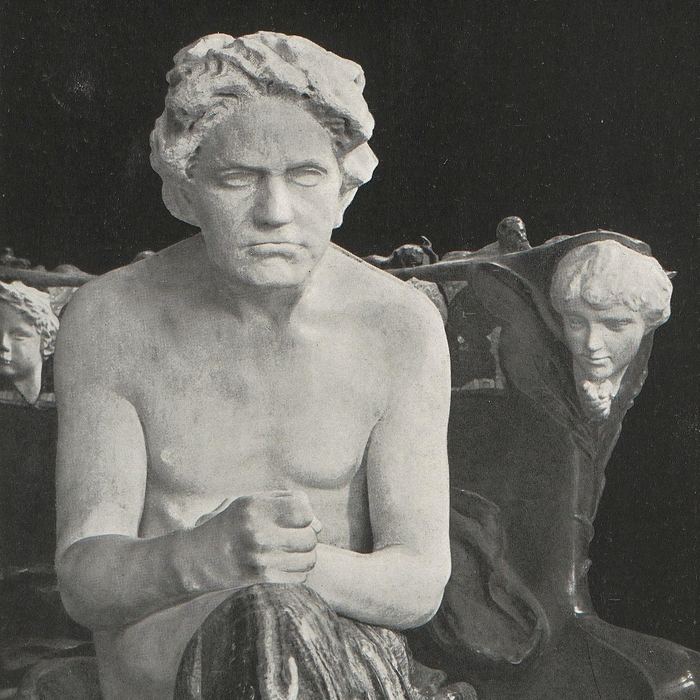
The fourteenth Secession exhibition, held from 15 April to 27 June 1902, transformed Olbrich's building into a temporary monument to Beethoven. Josef Hoffmann directed twenty-one artists. Max Klinger's monumental polychrome statue of the composer stood in the main hall, while Klimt, Roller, Adolf Böhm, Ferdinand Andri and others contributed wall paintings and decoration. Nearly 60,000 people visited, making it one of the association's greatest public successes.[5]
The premise was the Gesamtkunstwerk, a total or integrated work of art. This did not mean that one artist designed every detail. It meant that architecture, painting, sculpture and music would collaborate around a shared experience. Hoffmann simplified the rooms, controlled their sequence and created a setting in which Klinger's Beethoven appeared less like an object for sale than the focus of a modern ritual.
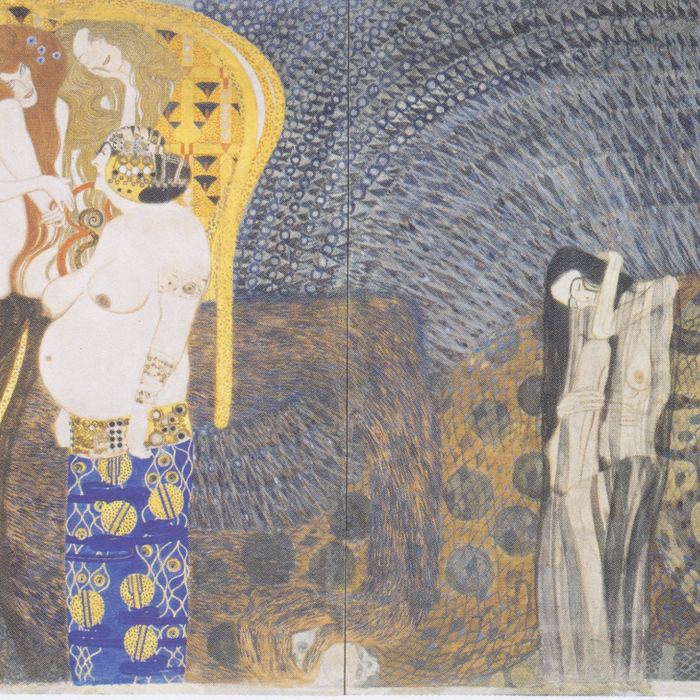
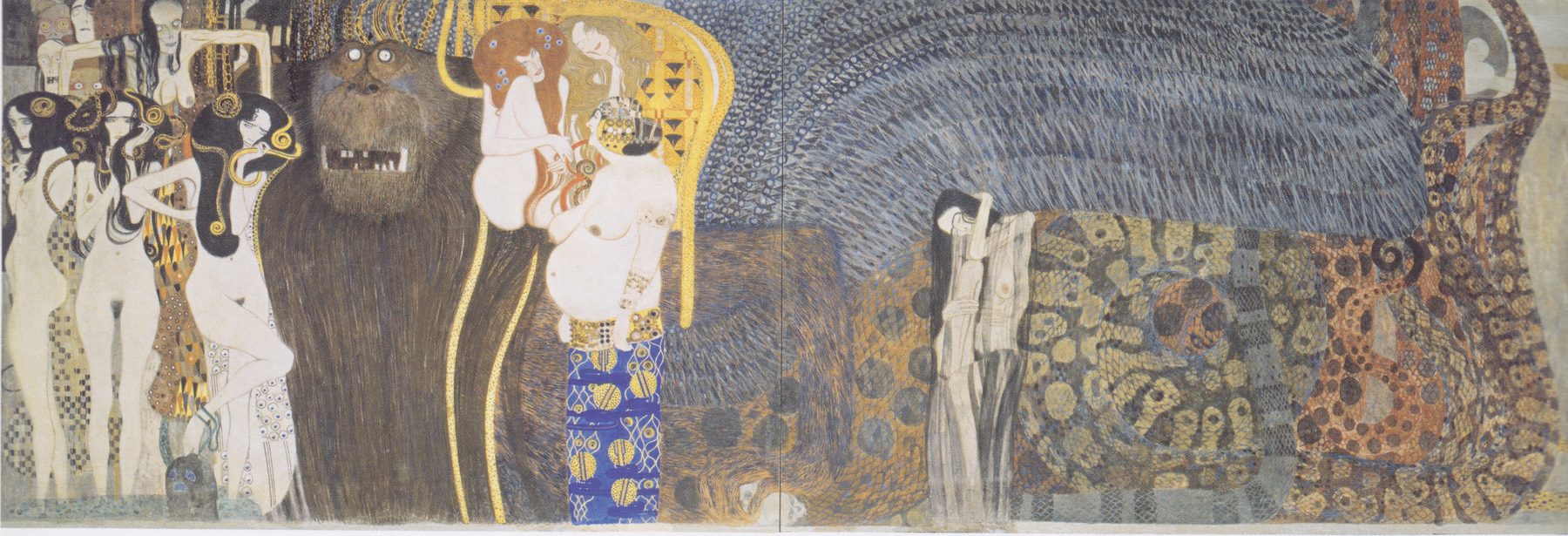
Klimt's Beethoven Frieze occupied three walls of the first side room. The visitor began with pale floating genii, messengers of humanity's longing for happiness, and a pleading group who appeal to a golden-armoured knight. On the central wall the gigantic ape-like Typhoeus stands with his daughters, the Gorgons. Lust, unchastity and excess gleam beside him; a thin crouching figure personifies gnawing grief. The final wall offers poetry, a choir of paradise and an embracing couple beneath the idea that joy can be reached through the arts.
The sequence drew on Richard Wagner's interpretation of Beethoven's Ninth Symphony and on Schiller's “Ode to Joy.” Yet the room did not illustrate a musical score scene by scene. It converted aspiration, danger and release into a visual rhythm. Wide empty grounds isolate attenuated bodies. Repeated horizontal lines guide movement, while clustered ornament thickens around hostile or fulfilled states. A wall opening aligned Klimt's painted path with a view of Klinger's statue, making the visitor's own position part of the composition.
The materials refuse the separation of painting and decoration. Klimt used casein paint, stucco, gilding, coloured glass, mirror and mother-of-pearl on plaster. Some passages are almost immaterial lines; others catch light as real substance. The figure of Typhoeus is massive but held against a shallow surface. The final embrace compresses bodies into an enclosing field of pattern. Form and material carry the psychological narrative together.
Contemporary viewers divided sharply. Admirers recognised a new monumentality, while hostile critics called the figures pathological, obscene or unintelligible. The work's current familiarity can blunt its strangeness. Its skeletal grief, staring Gorgons and unstable mixture of precious surface with physical threat were not designed as comfortable ornament.
The frieze was meant to be temporary, like most exhibition decoration. It survived because the association planned a Klimt retrospective for the following year. Collector Carl Reininghaus bought it in 1903. The work was cut into eight sections, removed from the wall and stored for twelve years before August and Serena Lederer acquired it in 1915. The Lederers, a Jewish family and major Klimt patrons, were dispossessed after the Nazi takeover. The work returned after the war to heir Erich Lederer; Austria purchased it in 1972. A decade of conservation preceded its installation in a purpose-built room beneath the Secession in 1986.[5]
This history changes how the frieze should be seen. A work devised for a few months became one of the permanent anchors of the building. Its material survival depended on collectors, forced displacement, state negotiations, conservation and architectural reconstruction. “Total art” was never timeless; it was vulnerable to the institutions and politics that preserved it.
Gold, surface and the danger of hindsight
Klimt's gold has become a shorthand for Vienna 1900, but chronology prevents it from swallowing the movement. Judith I of 1901 uses gold leaf and a patterned frame before Klimt's two visits to Ravenna in 1903. The mosaics of San Vitale and Sant'Apollinare strengthened his understanding of luminous, front-facing fields; they did not suddenly invent his interest in metallic material.[12] [13]
His best-known Golden Period paintings also extend beyond the core Secession years. The Kiss was produced in 1907–08, after he had left the association, and was shown at the separate 1908 Kunstschau. It belongs to Viennese modernism and to the afterlife of Secession ideas, but calling it a “Vienna Secession painting” without qualification collapses institution and style. The same caution applies to the young Egon Schiele, whose angular Expressionism was enabled by the changed Viennese art world but who was not one of the 1897 founders. Klimt's continuing exploration of intertwined life, desire and death after 1905 likewise belongs to his personal development rather than to a continuing shared Secession programme.[46]
From fine art to a designed life
The Secessionists opposed the automatic division between “high” painting and “minor” applied art. A well-proportioned cabinet, legible page or carefully designed dress could reorganise everyday experience. International Art Nouveau shared this aspiration, drawing on Arts and Crafts reform, Japanese art and new studies of natural form.[37] Vienna gave it a particularly architectural and geometric direction.
The eighth exhibition helped publicise British design, but local institutions mattered equally. Moser and Hoffmann taught at the School of Arts and Crafts, where students learned to move between drawing and production. Women who were excluded from the Academy could sometimes find training there, although opportunity remained unequal. Applied art was both an arena of reform and one of the few porous parts of a restrictive system.
In 1903 Hoffmann and Moser, with financier Fritz Waerndorfer, founded the Wiener Werkstätte. The workshop produced metal, furniture, textiles, ceramics, glass, jewellery, graphic design, fashion and complete interiors. It insisted on visible authorship and high standards of making, and its early products often use repeated squares, restrained surfaces and clear construction.[42]
The Werkstätte was related to the Secession but not identical with it. It was a production cooperative and commercial enterprise, not an exhibition association. It lasted until 1932, long after the founding Secessionists had separated. Its finances, craftspeople, salesrooms and later designers gave it an institutional life of its own.[25] Calling every Hoffmann chair or Werkstätte fabric “Secession” hides the labour and business structure behind the object.
The contrast with Adolf Loos clarifies what was at stake. Loos objected to the artist prescribing an entire way of life through a total interior. He valued modern use, personal culture and distinctions between art and practical objects. Otto Wagner, by contrast, believed modern function and construction could generate artistic form. MAK's Vienna 1900 display places Loos's rival modernism beside Secession and Werkstätte work rather than treating one as the inevitable future.[21]
Women artists and the limits of artistic freedom
The motto promised freedom for art, but the association did not distribute freedom equally. Women were barred from formal Secession membership until 1949. Around 1900 they also faced restricted access to academies, professional associations and juried exhibitions. Some trained privately or at applied-arts schools, created their own organisations and used the Secession, Hagenbund, salons and commercial galleries as partial routes to a career.[15]
Elena Luksch-Makowsky is a central participant rather than a footnote. Born into an artistic family in Saint Petersburg and trained in Russia and Munich, she married sculptor Richard Luksch and moved through Viennese networks. She exhibited at the Secession in 1901, 1902 and 1903, published in Ver Sacrum and later worked with the Wiener Werkstätte. Her Russian folk-art collection and contacts connected the Russian Silver Age with Vienna, unsettling a story that moves only west to east or Paris to Vienna.[16]
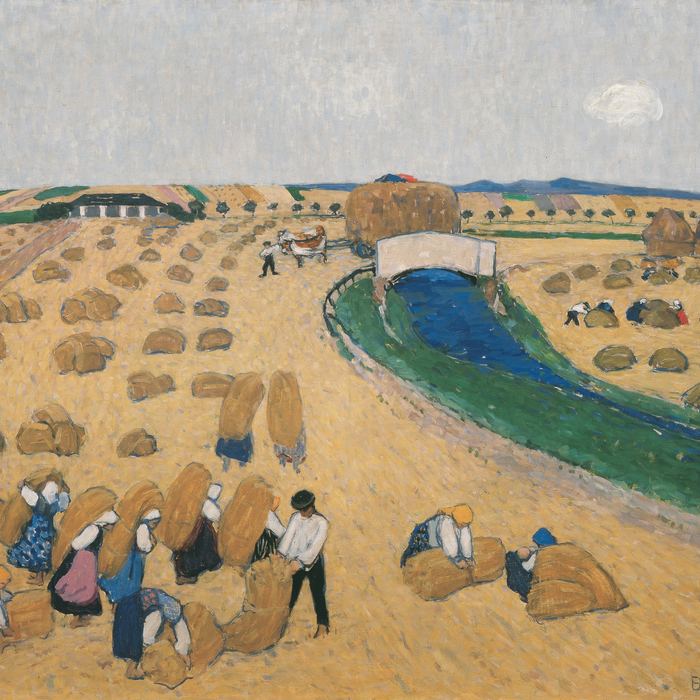
Broncia Koller-Pinell also demonstrates the difference between association membership and artistic participation. Her painting absorbed lighter colour, dry surfaces and flattened Secessionist composition. She supported artists, hosted a significant salon and exhibited at the 1908 Kunstschau organised by Klimt and Hoffmann.[17] Her career should not be reduced to proximity to male colleagues; her training, family resources, Jewish identity and sustained work formed a distinct path.[32]
Emma Schlangenhausen and Hilde van Exner, both pupils of Moser, designed decorative panels shown in the Austrian pavilion at the 1904 St Louis World's Fair. Their careers crossed applied art, international exhibition and Parisian training. French museum research uses these objects to recover the role of women in a supposedly male design revolution.[35]
Emilie Flöge was not a Secession member, but her work belonged to the same environment of designed modern life. With her sisters she ran Salon Schwestern Flöge, a successful fashion business whose workforce reportedly reached about eighty. She promoted reform dresses that loosened rigid shaping and worked in rooms designed by Hoffmann and Moser. Her long creative relationship with Klimt matters, but describing her only as his companion or model erases the enterprise she led.[31]
The association's own recent historical research has also examined anti-Semitism across its institutional life and the political conduct of members under authoritarian and National Socialist rule. That work traces prejudice back into the late monarchy rather than confining it to 1938–45.[7] A history of artistic rebellion cannot assume its protagonists were progressive in every sphere.
Patrons, salons and the social life of modern art
Secession independence depended on money, property and networks. Karl Wittgenstein's construction support is the most visible example, but collectors and commissioners sustained artists through purchases, portraits and interiors. Many belonged to Vienna's prosperous Jewish bourgeoisie, including families such as the Lederers, Bloch-Bauers and Zuckerkandls. Their homes became places where painters, architects, critics, musicians and writers met.
This patronage shaped art. A portrait could announce modern identity; an interior could join furniture, textiles, silver, clothing and painting into a social performance. Hoffmann's later complete rooms and Klimt's society portraits make little sense without commissioners willing to inhabit unfamiliar form. The largely Jewish clientele of early Viennese design is explicitly recognised in the MAK's account of the period.[21]
Patrons did not merely purchase finished ideas. They accepted risk, introduced artists, lent works and supported exhibitions. They could also exert control, and access to expensive handcrafted design limited the social reach of reform. The dream that beautiful objects would improve everyday life often produced costly environments available to a narrow elite. That tension belongs inside the achievement of the Gesamtkunstwerk.
Why the Klimt group left in 1905
The internal rupture is often simplified into “stylists” against “realists”: designers and Symbolists supposedly favoured total art, while painters of observed nature defended easel painting. The labels identify a real difference, but they do not explain the full conflict.
Members disputed how much authority a leading group should exercise, how closely fine and applied arts should be joined, how exhibitions should relate to commerce and whether the association should cooperate with Galerie Miethke, where Carl Moll had taken an artistic role. Personal alliances and organisational control intensified the aesthetic argument.[9]
In 1905 Klimt, Hoffmann, Moser, Moll, Otto Wagner and allies resigned. The event closed the founding coalition, not the Vienna Secession itself. Engelhart and remaining members continued to stage exhibitions. The association's survival is crucial: a movement history that ends when its most famous painter departs repeats the celebrity hierarchy the group had tried to complicate.
The former members organised the Kunstschau Wien in 1908 and 1909. Temporary pavilions and integrated displays renewed the total-environment experiment and gave younger artists greater visibility. The Hagenbund meanwhile became another important platform, especially after the Klimt group's departure and in the 1910s.[33] These organisations were connected parts of Vienna's exhibition ecology, not alternative names for the Secession.
Influence and afterlife
The Secession's most durable invention may be the designed exhibition. Olbrich's flexible halls, Hoffmann's room sequences, Roller's graphics and Moser's coordinated surfaces made viewing into an orchestrated act. Contemporary museums and art fairs routinely commission temporary architecture and visual identities; Vienna's experiments belong to that history.
Its geometric design travelled through Hoffmann and Moser, the Wiener Werkstätte, schools and international exhibitions. The combination of exact grids and expressive material reached later interiors and graphic systems. The V&A places Austrian Secession style within international Art Nouveau while emphasising its distinctive mixture of curving line and geometrical precision.[40]
Klimt's Italian reception extended the movement's reach. He travelled in northern Italy, visited Venice and Ravenna, and later exhibited at the Venice Biennale and the 1911 Rome International Art Exhibition. Italian artists responded selectively to his decorative surface and symbolic figure, making exchange reciprocal rather than a story of Vienna exporting a finished style.[49]
The association also influenced performance. Roller's work with Mahler at the Court Opera pursued unity between stage space, lighting, costume and music. Architecture and design became active partners in interpretation rather than decorative accompaniment. This was the theatrical counterpart to the Beethoven Exhibition.
The modern collection now held by the Belvedere owes something to Secession gifts, purchases and exhibition culture.[18] Olbrich's building still presents contemporary art, while the Beethoven Frieze occupies its lower level. That arrangement produces a productive tension: a historical masterpiece remains permanently accessible beneath rooms that continue to change.
How to recognise Vienna Secession art
There is no single checklist, but several habits of attention are useful.
- Look for a tension between observed bodies and autonomous pattern. In Klimt, a face may feel vividly individual while clothing becomes a field of circles, spirals or rectangles.
- Notice the whole boundary. Frames, margins and surrounding walls are often part of the design rather than neutral edges.
- Follow the line. A contour can describe a figure, become hair, continue as ornament and then control the rhythm of the page.
- Watch empty space. Secession design frequently gives blank ground an active role, isolating a figure or clarifying a sequence.
- Distinguish actual material from painted illusion. Gold leaf, glass, metal, mother-of-pearl and textured plaster reflect light differently from oil paint.
- Read typography as image. Posters and Ver Sacrum pages make letters carry weight, rhythm and proportion.
- Ask how the room directs you. In an exhibition or interior, sightlines and movement may connect works that appear separate in reproduction.
- Identify collaboration. Architect, painter, craftsperson, printer, patron and installer may all have shaped the result.
- Separate association from style. Check whether an object was made by a member, shown in a Secession exhibition, produced by the Werkstätte or merely described later as Secessionist.
- Attend to contradiction. Radical form could coexist with exclusive institutions, elite markets and conventional social attitudes.
MAK research on “form art” is particularly helpful here: after about 1900 the Vienna Secession and School of Arts and Crafts promoted flat, geometric organisation that could cross from graphic art into object and room.[19] The shift did not eliminate Symbolist narrative or natural observation. It provided another structure through which they could operate.
Essential works and designs
Secession Building
Joseph Maria Olbrich; photograph by Conny Duck · 1898; photograph 2024 · Olbrich joined a gilded laurel dome and emblematic facade to adaptable halls, making the exhibition building an active instrument.
Design for the First Secession Exhibition Poster
Gustav Klimt · 1898 · Theseus, the Minotaur and Athena staged artistic renewal as conflict; censorship made the struggle over freedom literal.
Pallas Athene
Gustav Klimt · 1898 · Armour, gold, frontal gaze and the tiny Nuda Veritas turn a classical guardian into a defiant modern emblem.
Poster for the Fifth Vienna Secession Exhibition
Koloman Moser · 1899 · Moser lets flat ornament, compressed lettering and the advertising image operate as one designed surface.
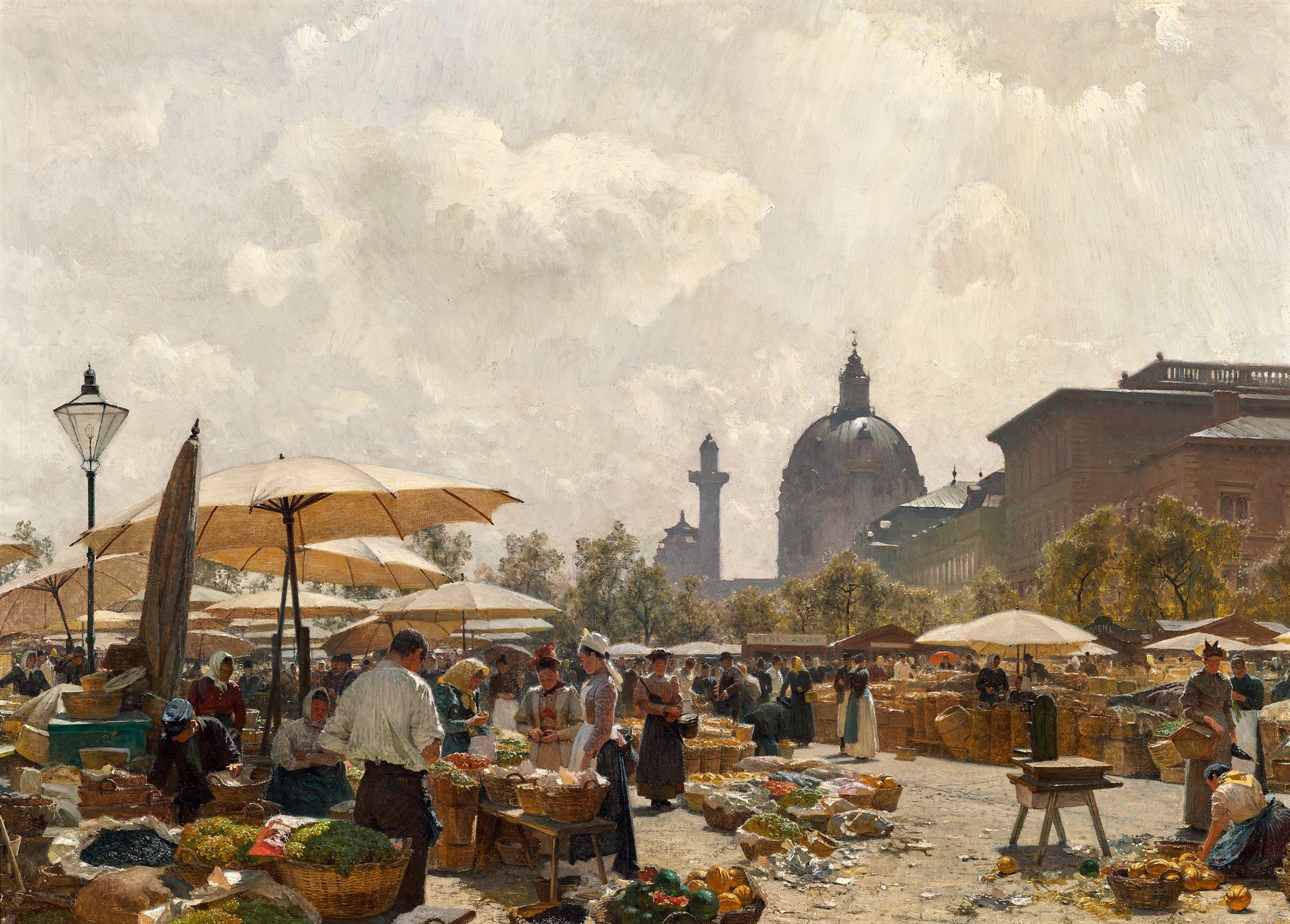
The Naschmarkt in Vienna
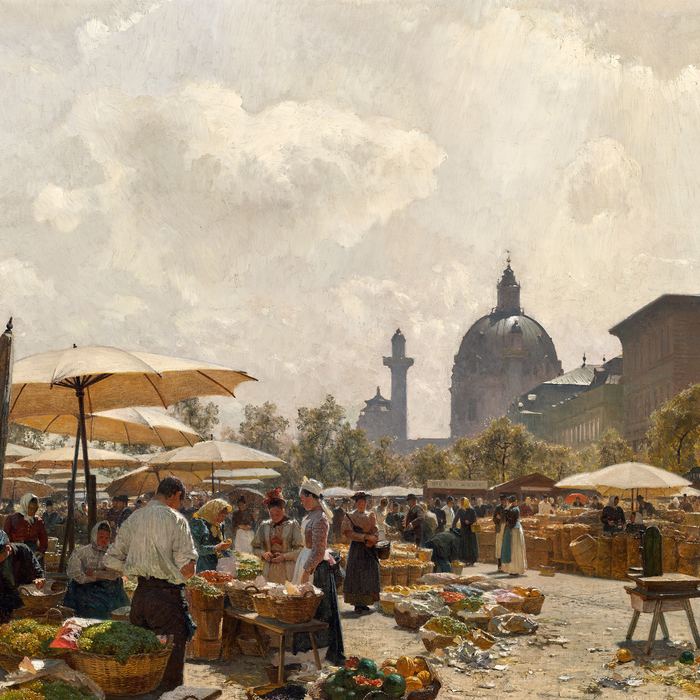
Carl Moll · 1894 · Moll's urban landscape preserves the observed city and the stylistic plurality hidden by a Klimt-only account.
Beethoven Frieze: The Hostile Powers
Gustav Klimt · 1902 · Casein, stucco, gilding, glass, mirror and mother-of-pearl carry a psychological journey through hostile forces toward joy.
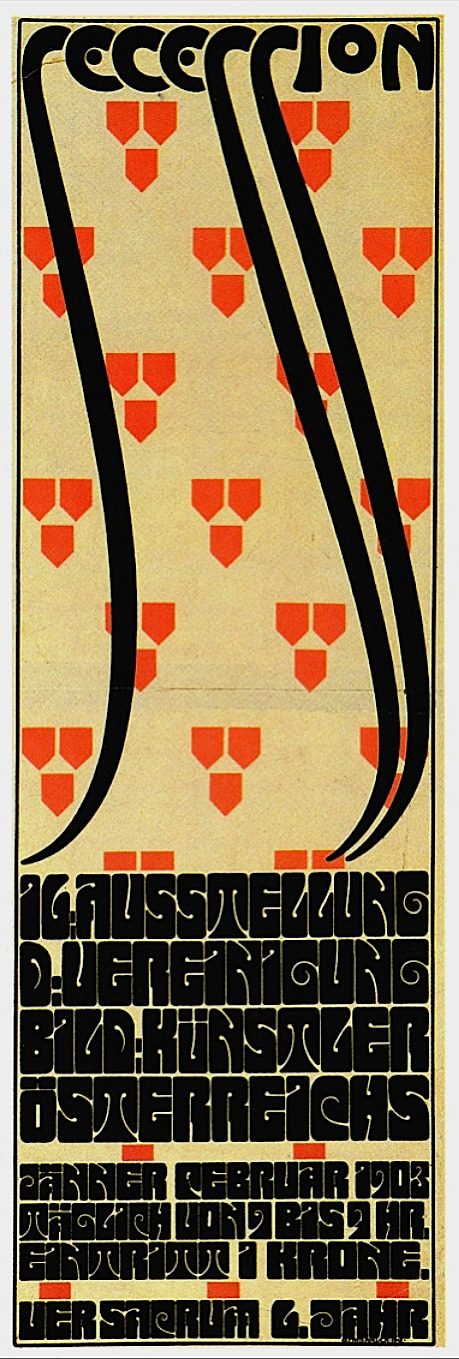
Poster for the Sixteenth Vienna Secession Exhibition
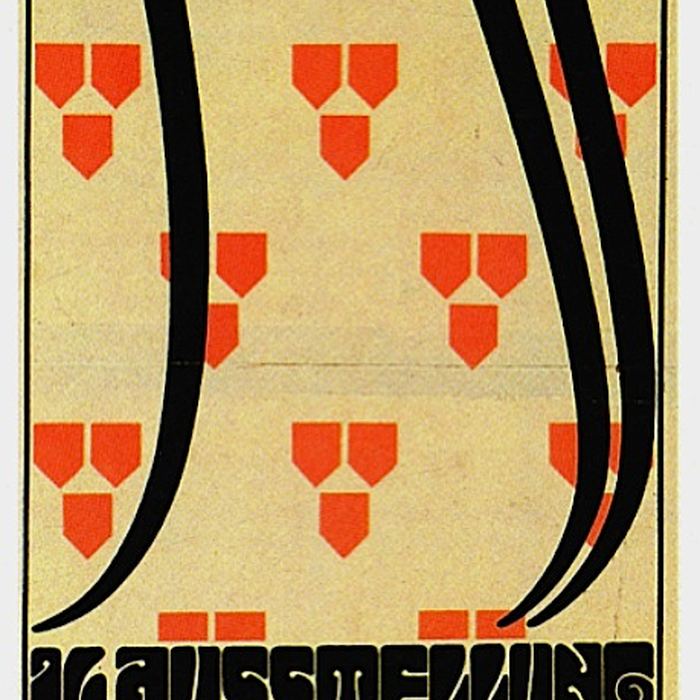
Alfred Roller · 1903 · Roller's geometric lettering and repeat pattern show exhibition identity becoming a complete graphic environment.
Max Klinger's Beethoven in the Fourteenth Vienna Secession Exhibition
Max Klinger and Josef Hoffmann; photographer uncredited · 1902 · Hoffmann's room sequence focused the visitor's route on Klinger's Beethoven within the movement's clearest total-art experiment.
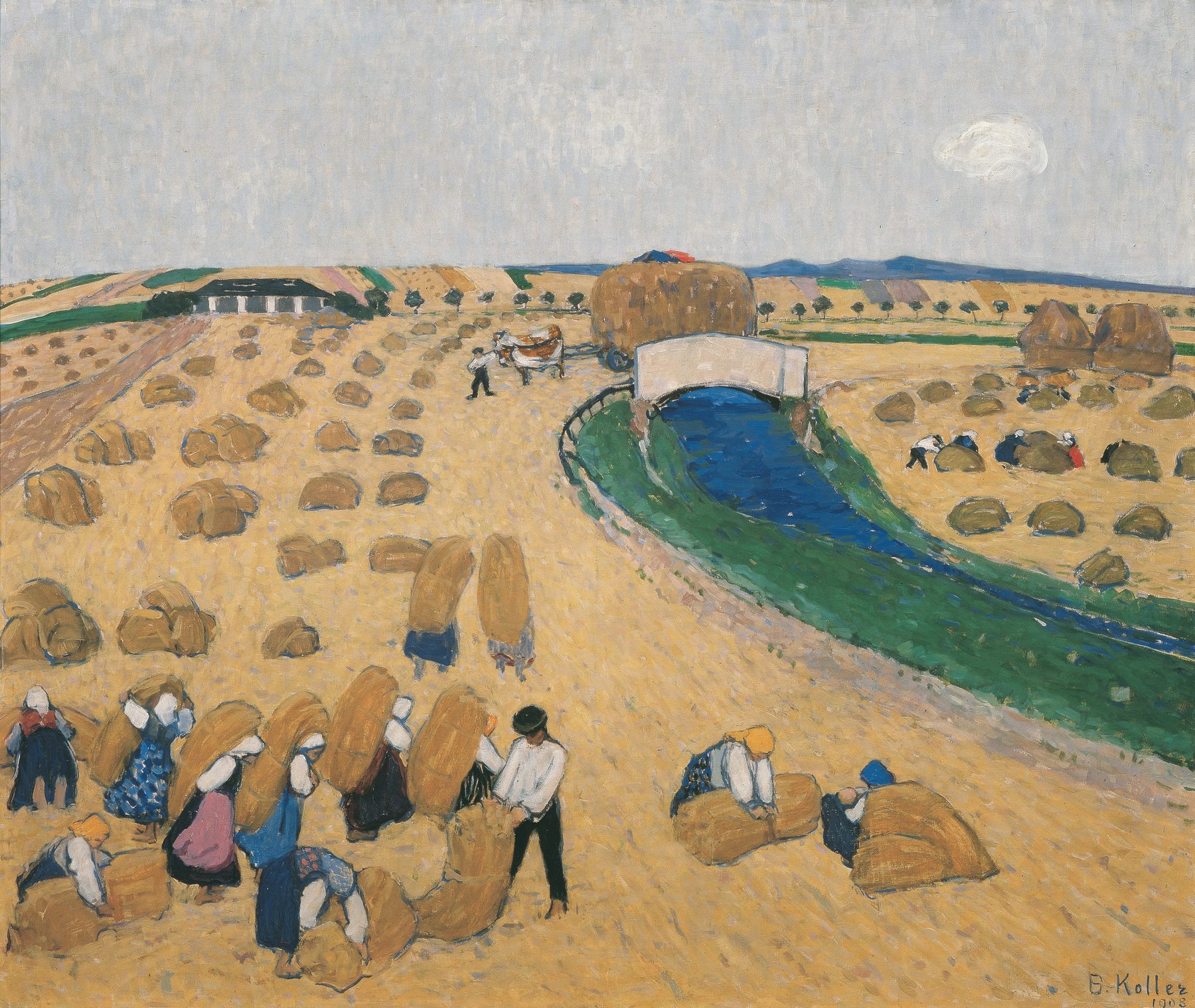
The Harvest
Broncia Koller-Pinell · 1908 · Koller-Pinell's flattened composition belongs to the broader Viennese modern culture and the later Kunstschau afterlife.
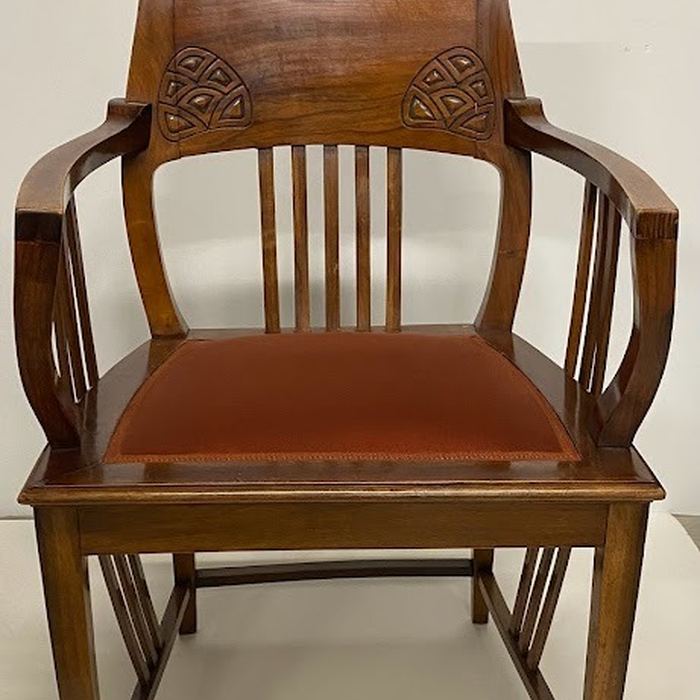
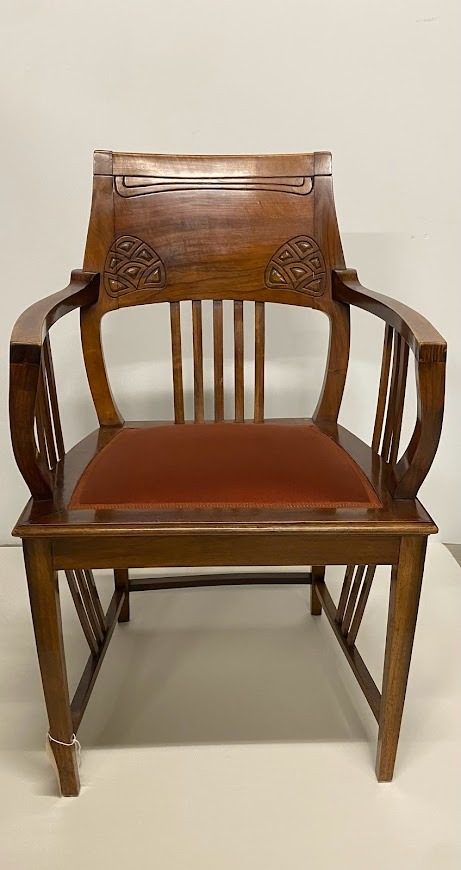
Armchair
Joseph Maria Olbrich · 1898 · This 1898 armchair shows architectural reform moving into furniture, proportion and the designed interior.
Where to see Vienna Secession art
Secession, Vienna
Olbrich's building and Klimt's Beethoven Frieze make this the essential starting point. The facade, entrance sequence and changing contemporary exhibitions reveal why the building is more than a container. The frieze's purpose-built lower room allows close attention to material, scale and narrative.
Belvedere, Vienna
The Belvedere holds the world's largest collection of Klimt paintings and places him among other Austrian modernists. It is the best place to distinguish his Secession-era change from the later Golden Period and to compare portrait, allegory and landscape. Its acquisition history also demonstrates how Secession exhibitions helped build a national modern collection.
Leopold Museum, Vienna
The Leopold Museum's Vienna 1900 display joins painting, works on paper, furniture, models and archival material. It follows Klimt from Historicism to the Secession and onward to Schiele and later Viennese Expressionism without pretending they all belonged to one group.[30]
MAK—Museum of Applied Arts, Vienna
MAK is indispensable for Moser, Hoffmann, the School of Arts and Crafts and the Wiener Werkstätte. Furniture, metalwork, textiles, printed matter and complete design archives show how the ambition to unite the arts was translated into production.[22] [24]
Wien Museum, Vienna
Posters, drawings, photographs, Klimt material and urban history place the association within the changing city. The museum's collections are especially valuable for the first poster, Pallas Athene, exhibition imagery and the social networks around Carl Moll.
Museum of Modern Art and international design collections
MoMA's Vienna 1900 holdings and exhibition history make graphic and architectural material accessible beyond Austria.[38] [39] The Musée d'Orsay's architectural drawings connect Hoffmann and Olbrich to Wagner's school, while the Centre Pompidou's Hoffmann documentation follows the designer across exhibitions and buildings.[36] International collections also demonstrate how quickly the Viennese experiment entered a broader history of modern design.
Museums and collections to explore
Works on paper, textiles and fragile design objects may rotate. Check current displays before travelling.
- 01
Secession
Vienna, Austria
Olbrich's building and Klimt's Beethoven Frieze provide the essential encounter with architecture, scale and changing exhibition space.
Building and friezeVisit collection website - 02
Belvedere
Vienna, Austria
Klimt's Secession-era change can be compared with his later Golden Period, landscapes and other Austrian modernists.
Painting and contextExplore our museum guide - 03
Leopold Museum
Vienna, Austria
Vienna 1900 joins paintings, works on paper, furniture, models and archives before continuing toward Schiele.
Vienna 1900Visit collection website - 04
MAK—Museum of Applied Arts
Vienna, Austria
Furniture, metalwork, textiles and archives make Moser, Hoffmann and the Wiener Werkstätte visible as separate but connected histories.
Applied artsVisit collection website - 05
Wien Museum
Vienna, Austria
Posters, drawings, photographs and urban history place the association inside its changing city and social networks.
City and graphicsVisit collection website - 06
Museum of Modern Art
New York, USA
The Vienna 1900 holdings and exhibition archive make graphic, architectural and design material accessible beyond Austria.
International designVisit collection website - 07
Musée d'Orsay
Paris, France
Architectural drawings connect Olbrich and Hoffmann to Otto Wagner's teaching and the idea of total art.
Architecture on paperVisit collection website - 08
Centre Pompidou
Paris, France
Hoffmann documentation follows the designer from Secession exhibitions into furniture and later architecture.
Hoffmann archiveVisit collection website
Five books for further reading
Vienna 1900: Art, Architecture & Design — Kirk Varnedoe
A broad, visually rich account that treats painting, architecture and design together. It remains useful for understanding why Vienna around 1900 cannot be reduced to Klimt alone, though newer scholarship should supplement its treatment of gender and politics.
Gustav Klimt: The Beethoven Frieze and the Controversy over the Freedom of Art — Stephan Koja, editor
Best for readers who want to reconstruct the 1902 exhibition, the frieze's programme and the debate over autonomous art. Look for editions that reproduce the work in sequence rather than as isolated details.
Koloman Moser: Designing Modern Vienna 1897–1907 — Christian Witt-Dörring, editor
An excellent correction to Klimt-centred histories. It shows how Moser carried proportion, pattern and identity through exhibitions, books, furniture, textiles and the Wiener Werkstätte.
Josef Hoffmann: Progress through Beauty — edited by Christoph Thun-Hohenstein, Matthias Boeckl and Rainald Franz
A substantial study of Hoffmann's long career. The early chapters clarify his role in the Secession, while later projects show which ideas survived the 1905 split and how they changed in practice.
Vienna 1900: Birth of Modernism — Hans-Peter Wipplinger, editor
This wider cultural account places the Secession alongside women artists, fashion, architecture, literature and social history. It is especially helpful for resisting a smooth, heroic narrative of artistic progress.
Frequently Asked Questions
It was first an organisation: an artist-run association founded in 1897 to reform exhibitions and connect Vienna with international modern art. “Vienna Secession” and “Secession style” are also used more broadly for work associated with its members and visual culture. Keeping the organisational and stylistic meanings separate prevents confusion.
They believed its juries, exhibition practices and commercial priorities restricted modern work. After attempts at internal reform failed, they created an association that could select, display and interpret art on its own terms.
No. Members included landscape painters, naturalists, Symbolists, architects, sculptors, graphic artists and designers. Their shared platform was stronger than their stylistic uniformity.
“Der Zeit ihre Kunst. Der Kunst ihre Freiheit” is usually translated as “To every age its art, to art its freedom.” It declares both historical responsiveness and artistic independence.
The openwork dome is formed from gilded laurel leaves. Laurel signified artistic achievement, spring and renewal, while the glowing modern metal crown made the otherwise severe white building visible across the city.
It was the association's journal, published from 1898 to 1903. Its integrated typography, illustration, ornament and literature made it a laboratory for the same unity of the arts pursued in exhibitions.
Literally a “total work of art,” it describes a coordinated experience in which several arts collaborate. At the 1902 Beethoven Exhibition, architecture, painting, sculpture and music were organised around one theme and visitor journey.
No. Klimt painted onto plaster with casein and used stucco, gilding, glass, mirror and mother-of-pearl. It was conceived as temporary exhibition decoration, then cut from the wall and conserved.
It was separate. Hoffmann and Moser were Secession founders and carried related ideas into the workshop, but the Wiener Werkstätte was a production and retail enterprise founded in 1903 with Fritz Waerndorfer.
The split involved several connected disputes: the status of applied art, exhibition policy, leadership, commerce and a proposed relationship with Galerie Miethke. It was not simply a quarrel between abstract and realistic painters.
Women exhibited and contributed to the wider culture, but the association excluded them from formal membership until 1949. Elena Luksch-Makowsky, Teresa Feodorowna Ries, Broncia Koller-Pinell and many others must be discussed as artists with careers, not merely as muses or exceptions.
No. The Klimt group left, but the association continued its exhibition programme and still occupies Olbrich's building. The 1905 date marks the end of the founding coalition, not the institution.
Discussion
Which part of the Vienna Secession seems most radical today: Klimt's symbolic painting, Olbrich's adaptable exhibition building, Moser's page design, Hoffmann's total interiors or the artists' decision to control their own exhibitions? And how should we balance that formal freedom with the exclusions and elite patronage that made the movement possible?
Reader Insights
Ask how partitions, lettering, frames and sightlines organise the visitor before isolating one object.
Distinguish the 1897 association, Secession style, the Wiener Werkstätte and the later Kunstschau exhibitions.
Notice the organisers, architects, designers, women artists, patrons and craftspeople who made the exhibition culture possible.
Join the Conversation
Which seems most radical today: symbolic painting, adaptable exhibition space, total interiors or artist-controlled display?
References
- Building. Vienna Secession. View Source
- Association of Visual Artists Vienna Secession. Vienna Secession. View Source
- First Exhibition of the Association of Austrian Visual Artists Secession 1898. Vienna Secession (German and English; consulted in German and English). View Source
- The Exhibitions of the Vienna Secession. Vienna Secession via Google Arts and Culture (German; consulted in German). View Source
- Beethoven Frieze. Vienna Secession. View Source
- Online Archive. Vienna Secession (German and English; consulted in German and English). View Source
- Oliver Rathkolb: The Long Shadow of Anti-Semitism and National Socialism and the History of the Vienna Secession 1898–1955. Vienna Secession. View Source
- Gustav Klimt: Secession and Pallas Athena (1898). Wien Museum via Google Arts and Culture. View Source
- Carl Molls Beitrag zum Mythos Klimt. Wien Museum (German; consulted in German). View Source
- Gustav Klimt: The Wien Museum Collection. Wien Museum. View Source
- Picture This: Vienna around 1900. Belvedere. View Source
- Klimt: The Secession and Italy. Belvedere. View Source
- Why Did Gustav Klimt Use Gold?. Belvedere. View Source
- Sin and Secession. Belvedere. View Source
- City of Women. Belvedere. View Source
- IN-SIGHT: Elena Luksch-Makowsky. Belvedere. View Source
- Broncia Koller-Pinell. Belvedere (German; consulted in German). View Source
- The Belvedere and Viennese Modernism. Belvedere. View Source
- Klimt Kupka Picasso and Others. Belvedere. View Source
- History and Architecture. Belvedere. View Source
- Vienna 1900. MAK Museum of Applied Arts. View Source
- Josef Hoffmann–Koloman Moser. MAK Museum of Applied Arts. View Source
- Koloman Moser: Universal Artist between Gustav Klimt and Josef Hoffmann. MAK Museum of Applied Arts. View Source
- Josef Hoffmann: Progress through Beauty. MAK Museum of Applied Arts. View Source
- Wiener Werkstätte Archive. MAK Museum of Applied Arts. View Source
- Josef Hoffmann–Koloman Moser: Press Release. MAK Museum of Applied Arts. View Source
- Vienna 1900. Leopold Museum. View Source
- Gustav Klimt. Leopold Museum. View Source
- Gustav Klimt: Artist of the Century Press Text. Leopold Museum. View Source
- Vienna 1900: Birth of Modernism. Leopold Museum. View Source
- Burst Corsets. Leopold Museum. View Source
- Seated Woman Marietta. Leopold Museum. View Source
- From Moderate to Radical Modernism: Hagenbund. Leopold Museum. View Source
- Un art total: dessins de la Sécession viennoise. Musée d'Orsay (French; consulted in French). View Source
- Acquisition: panneaux décoratifs Emma Schlangenhausen et Hilde van Exner. Musée d'Orsay (French; consulted in French). View Source
- Josef Hoffmann Exhibition Documents. Centre Pompidou (French; consulted in French). View Source
- Art Nouveau. Metropolitan Museum of Art. View Source
- Vienna 1900: Art Architecture and Design. Museum of Modern Art. View Source
- Vienna Secession 1898–1905. Museum of Modern Art. View Source
- Art Nouveau: An International Style. Victoria and Albert Museum. View Source
- Arts and Crafts Beyond the UK. Victoria and Albert Museum. View Source
- Wiener Werkstätte. Cooper Hewitt Smithsonian Design Museum. View Source
- Flat Yet Festive. Cooper Hewitt Smithsonian Design Museum. View Source
- A Chair's Nerves. Cooper Hewitt Smithsonian Design Museum. View Source
- Modern Architecture: A Guidebook for His Students to This Field of Art. Otto Wagner and Getty Research Institute. View Source
- Gustav Klimt: The Magic of Line—Cycle of Life. J. Paul Getty Museum. View Source
- Spirit of an Age: Germanic Drawings. J. Paul Getty Museum. View Source
- Secessions: Klimt Stuck Liebermann. Wien Museum (German; consulted in German). View Source
- Klimt. La Secessione e l'Italia. Museo di Roma (Italian; consulted in Italian). View Source
- Gustav Mahler. Musée d'Orsay (French; consulted in French). View Source
- Vienna Secession image records. Wikimedia Commons and Metropolitan Museum of Art Open Access: Secession Building (CC BY-SA 4.0), Design for the First Secession Exhibition Poster (Public domain), Pallas Athene (Public domain), Poster for the Fifth Vienna Secession Exhibition (Public domain), The Naschmarkt in Vienna (Public domain), Beethoven Frieze: The Hostile Powers (Public domain), Poster for the Sixteenth Vienna Secession Exhibition (Public domain), Max Klinger's Beethoven in the Fourteenth Vienna Secession Exhibition (Public domain), The Harvest (Public domain), Armchair (CC0), Elena Luksch-Makowsky before Adolescentia (Public domain).