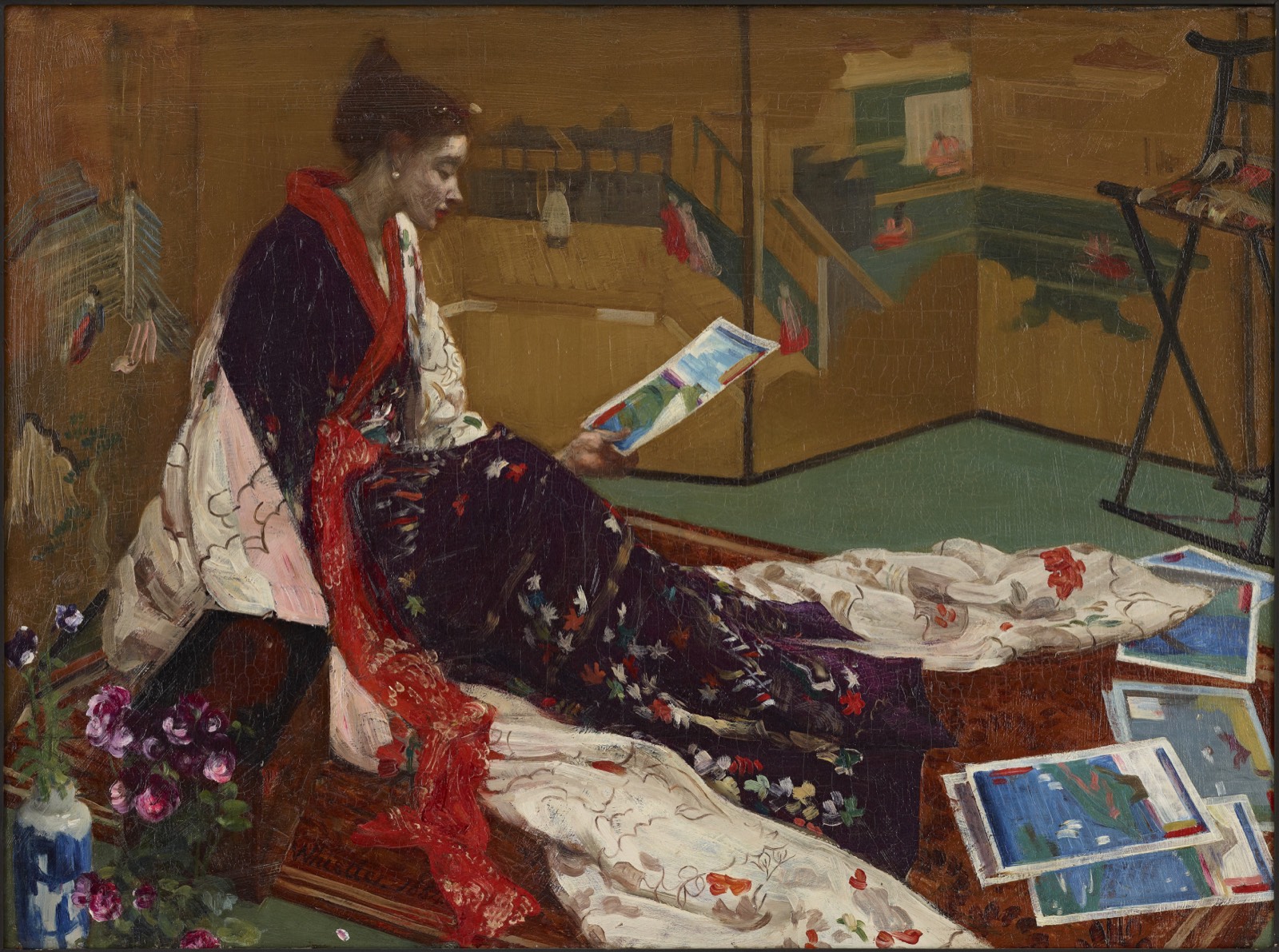
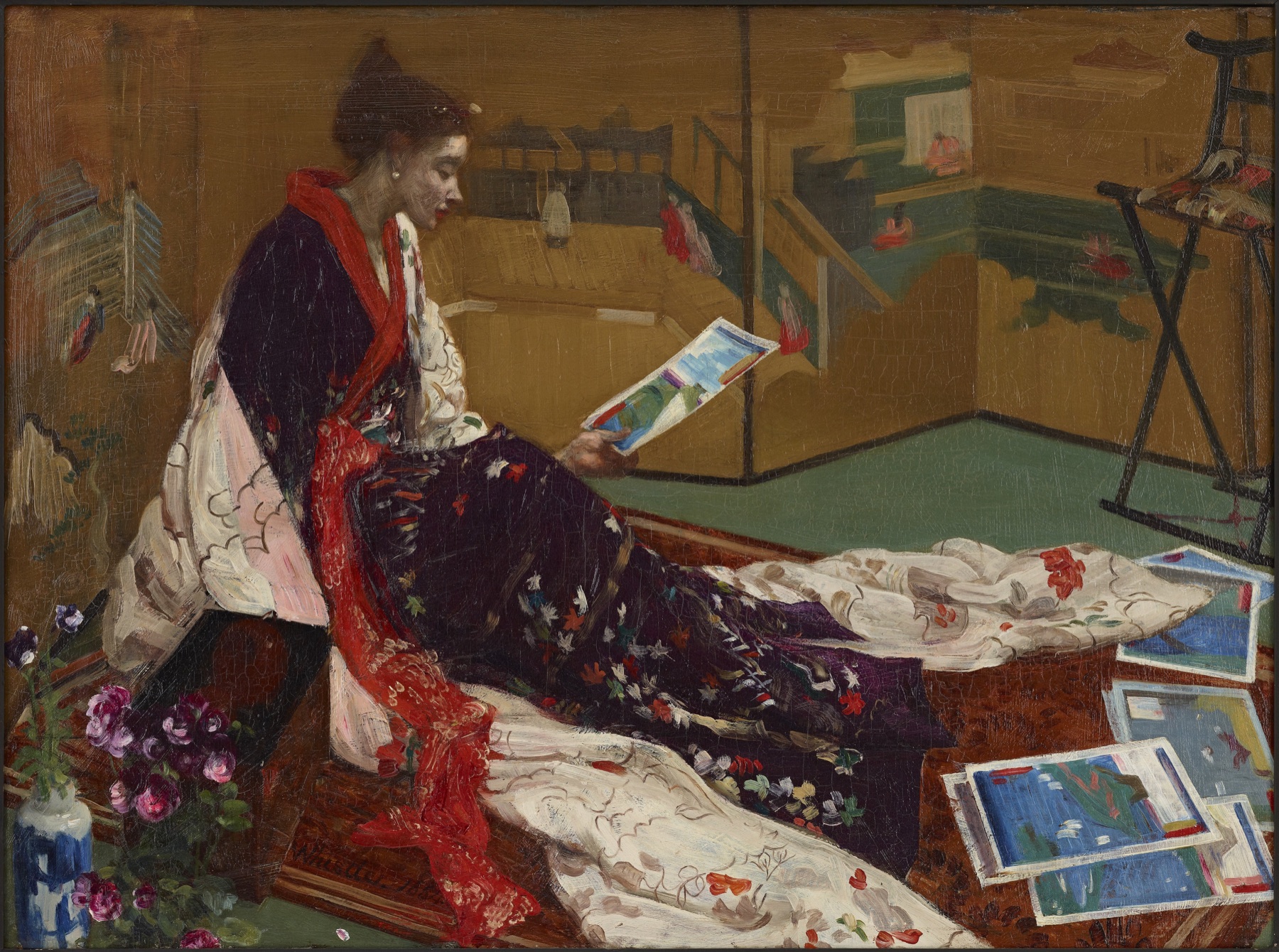
Image reference: Caprice in Purple and Gold: The Golden Screen by James McNeill Whistler.
At a Glance
- MeaningEuropean and American engagement with Japanese art and design
- Practical central periodabout 1854–1910
- Term coinedby the French critic Philippe Burty in 1872
- Major centresParis, London, Vienna, Brussels, Amsterdam, Boston and New York
- Important Japanese mediatorHayashi Tadamasa
- Key channelstrade, world's fairs, shops, dealers, collections, journals and travel
- Major mediapainting, prints, ceramics, glass, metalwork, furniture, textiles, posters, interiors, photography and gardens
- Known forasymmetry, cropping, flat colour, serial imagery, natural motifs and renewed respect for applied art
- Critical contextforced trade, unequal treaties, Orientalist display, cultural appropriation and active Japanese export strategy
Contents
- Where Japonisme fits
- What Japonisme means
- World's fairs
- Bing, Hayashi and the market
- Four stages
- Essential figures
- Monet and Giverny
- How to look
- Essential works
- Where to see Japonisme
Where Japonisme fits
James Whistler
Principal activityÉdouard Manet
Principal activityClaude Monet
Principal activityEdgar Degas
Principal activityMary Cassatt
Principal activityVincent van Gogh
Principal activityHenri de Toulouse-Lautrec
Principal activityChristopher Dresser
Principal activityHayashi Tadamasa
Principal activityJaponisme changed what a picture could look like, what counted as serious design and how art might enter everyday life. From the mid-nineteenth century, Japanese prints, ceramics, lacquer, metalwork, textiles, books and gardens became powerful resources for artists and consumers in Europe and the United States. Some painters surrounded European models with fans and kimonos. Others absorbed abrupt cropping, high viewpoints, flat colour or intervals of empty space so thoroughly that no Japanese object appears. Designers translated Japanese materials and structural ideas into tableware, furniture, glass, silver, posters and complete interiors.[1]
This was not a movement with declared members or a single programme. It was an uneven field of collecting, commerce, scholarship, fantasy and artistic experiment. James Whistler, Édouard Manet, Claude Monet, Edgar Degas, Mary Cassatt, Vincent van Gogh, Henri de Toulouse-Lautrec and the Nabis each selected different things. The same passion could produce a shallow costume piece, an exacting printmaking project or a radical theory of industrial form. Japanese officials, craftspeople and dealers also influenced what travelled, how it was described and who could see it. Japonisme is therefore best understood as a history of selective translation rather than a one-way gift from a passive Japan to an inventive West.[4]
What does Japonisme mean?
Philippe Burty used japonisme in 1872 for a series of articles in La Renaissance littéraire et artistique. He applied the new word to himself and a circle of collectors and artists fascinated by Japanese prints and objects. His initial definition was wry: the taste could be a fashionable caprice among sophisticated connoisseurs. The term soon expanded beyond possession to describe transformations in Western art and design.[5]
Japonism is the usual English spelling. Writers sometimes use japonaiserie for a Western work that visibly stages Japanese costume, fans, screens or bric-a-brac, reserving Japonisme for deeper formal change. The distinction can be useful when comparing an image of a woman wearing a kimono with a Degas interior that has no Japanese object. It is not a rule that nineteenth-century writers followed consistently. Labels should clarify a particular work rather than create false stages from superficial imitation to supposedly pure understanding.[6]
The word also identifies a Western category. It does not name a Japanese school, and it should not replace the identities of the objects involved. A Hiroshige landscape, a katagami textile stencil, a Buddhist sculpture and an export vase came from different practices. Western collectors frequently placed all of them inside one imagined “Japan,” sometimes alongside Chinese porcelain and other Asian goods. The mixture is evidence about Western looking, not a reason to treat the cultures as interchangeable.
Japan, trade and the problem of “opening”
Japan was never completely cut off from the outside world. Tokugawa authorities regulated exchange through selected ports and partners, while knowledge and goods circulated through Dutch, Chinese, Korean, Ryukyuan and other routes. The situation changed violently when Commodore Matthew Perry arrived with American warships in 1853. Treaties concluded from 1854 expanded foreign access and imposed unequal conditions. To say simply that Japan “opened” can hide that armed pressure.[13]
The collapse of the Tokugawa shogunate and the Meiji Restoration of 1868 produced rapid state-led reform. Art and manufacture became diplomatic tools as well as exports. Officials wanted revenue, technical knowledge and international recognition. Japanese participants did not merely watch European buyers discover them. They selected objects, commissioned spectacular works, explained techniques and learned how foreign markets judged quality.[11]
This agency operated within unequal power. Japan avoided formal European colonisation, but treaty ports, tariff restrictions and foreign legal privileges limited sovereignty. Western descriptions often treated the country as a timeless storehouse of exquisite craft at the very moment Japanese people were navigating political upheaval and industrial change. Japonisme's beauty and its imbalance belong to the same history.
World's fairs and the public image of Japan
Before national pavilions, diplomats, merchants and sailors brought Japanese objects into European collections. The 1862 International Exhibition in London created an unusually large public display from the collection of Britain's first diplomatic representative in Japan, Rutherford Alcock. Artists and designers could encounter lacquer, ceramics, metalwork, textiles and prints together. The Japanese Court helped connect the new taste with British design reform and the emerging Aesthetic Movement.[14]
The Paris Exposition Universelle of 1867 became a larger threshold. The Tokugawa government, Satsuma domain and Saga domain presented separately, reflecting political divisions before the Meiji Restoration. A popular tea house and displays of craft converted Japan into spectacle, market and political presence. Prints were shown and sold, but the fair's importance extends beyond one hundred sheets: it made a broad material culture available to artists, manufacturers and consumers.[2]
The Meiji government participated officially at Vienna in 1873. Large ceramics, lacquer, bronzes, textiles, architectural models and displays announced technical excellence and national identity. Some works were made or selected specifically for foreign attention and entered the collection of the museum now called the MAK. Vienna also classified Egypt and Japan together within a European “Orient.” Japan used the fair strategically, while the fair's structure turned difference into organised spectacle.[19] [20]
Philadelphia in 1876 widened American enthusiasm. Paris in 1878 gave Japanese manufactures another immense stage and brought the young interpreter Hayashi Tadamasa to France. By 1900, Japan's display at Paris could assert a historical artistic lineage as well as modern state power. Each fair altered production: size, ornament and finish were adjusted to the architecture of display and the expectations of buyers.
No single discovery
Japonisme has accumulated charming origin stories. Félix Bracquemond supposedly found a volume of Hokusai's Manga used as packing material in a shipment of porcelain. Whistler is said to have discovered prints in a Chinese tea room, and Monet to have found them wrapping goods in a Dutch shop. These stories capture the low status that some prints initially held in Europe. They should be attributed as stories, not used to identify one moment when “the West” discovered Japan.[3]
Bracquemond's encounter in the late 1850s was important because he shared what he saw with artists and critics including Burty, Zacharie Astruc and Manet. Shops such as La Porte Chinoise made fans, prints and ceramics available in Paris. The Goncourt brothers turned collecting into literature and social authority. Théodore Duret travelled in Japan, while Henri Cernuschi formed a collection that became a museum. Louis Gonse attempted a large history of Japanese art. Knowledge arose through conversation, rivalry, publication, display and sale—not a solitary revelation.[2]
These European networks often lacked the language and context needed to distinguish artist, publisher, period and subject. Early admiration could be intense yet imprecise. Later connoisseurship classified signatures and editions, but it also created a canon that elevated Hokusai, Hiroshige and Utamaro while ignoring the popular nineteenth-century prints that buyers actually purchased in great numbers.
Bing, Hayashi and the making of a market
Siegfried Bing became one of the most powerful European dealers in Japanese art. Family and commercial contacts helped him acquire objects; he travelled in Japan, organised exhibitions and stocked thousands of prints. From 1888, his illustrated journal Le Japon artistique appeared in French and in translated editions, placing selected motifs, objects and critical commentary before artists and industrial designers. His later Paris gallery, Maison de l'Art Nouveau, helped give Art Nouveau its name.[3] [23]
Hayashi Tadamasa was not simply Bing's Japanese supplier or rival. Born in 1853 and trained in French, he came to the 1878 Paris fair as an interpreter for the trading company Kiritsu Kōshō Kaisha. He remained in Paris, established a dealership and became an adviser to artists, writers and collectors. His expertise helped clients identify printmakers, subjects and quality. Surviving letters reveal a dense intellectual and commercial network.[9]
From the late 1880s to 1900, Hayashi's business reportedly imported about 160,000 prints and nearly 10,000 illustrated books. Quantity alone does not define his role. He contributed to exhibitions and scholarship, built trust with buyers and represented Japan at international events. He was later criticised for exporting cultural property, but that judgement can obscure his effort to establish Japanese art as serious knowledge in Europe.[10]
His ambitions were reciprocal. Hayashi collected contemporary Western art and hoped to create a museum for it in Japan. He preserved works he considered particularly important when selling other parts of his collection, and his premature death prevented the plan's completion. His career replaces the image of exchange as Europeans acting upon silent Japanese things with a more accurate history of translation, entrepreneurship and institution-building.[12]
Follow Japonisme through four stages
–1867
Coerced trade and first public encounters
Treaty ports, London in 1862 and Paris in 1867 bring prints, ceramics, lacquer and textiles into larger Western markets while Japan remains politically divided.
–1878
Meiji strategy and the world's fairs
Japanese officials, makers and trading companies shape national displays at Vienna, Philadelphia and Paris as European institutions organise Japan within an Orientalist spectacle.
–1890
Dealers, collections and deeper study
Hayashi Tadamasa, Siegfried Bing, collectors, journals and exhibitions turn a fashion for objects into connoisseurship, comparison and sustained artistic experiment.
–1910
Print revival and modern design
Cassatt, Toulouse-Lautrec, the Nabis, Art Nouveau and design reform translate Japanese composition and making until Japonisme disperses through international modernism.
Four ways Japonisme worked
Objects placed on display
The most visible mode puts a kimono, fan, screen, print or blue-and-white vessel inside a Western picture or room. Such objects advertise the owner's modern taste and access to imported goods. They may also reorganise colour and surface. Yet the model—often a European woman—can become another collectible sign, dressed in cultural difference for the spectator.
Pictorial structure absorbed
A second mode removes the prop but retains an approach to seeing: asymmetrical balance, a high horizon, a body cut by the edge, an oblique route into space, a broad unfilled interval or flat areas held by contour. These devices offered alternatives to the centred, modelled and perspectivally continuous conventions of European academic art. They were never a complete Japanese formula, and they interacted with photography and existing European print traditions.
Technique translated
Artists also responded to how objects were made. Mary Cassatt translated layered woodblock colour into copper-plate aquatint, drypoint and soft-ground etching. Paul Gauguin explored the pressure and resistance of carved wood. Designers studied hammered metal, stencil pattern, lacquer, glazing and the relation of ornament to an object's shape. Translation changed both medium and meaning.
Environments redesigned
Finally, Japonisme could reorganise a whole setting. Light furniture, lattices, sparse or asymmetrical ornament, coordinated tableware and designed gardens made Japanese principles part of daily movement. This mode connects Japonisme to Aestheticism, design reform and Art Nouveau's ambition to unite fine and applied arts.[15]
What did Japoniste artists actually see?
The answer was rarely “Japanese art” in any comprehensive sense. What reached a Paris print shop differed from what the Meiji government selected for Vienna, what a British diplomat collected or what a Japanese dealer reserved for a knowledgeable client. Ukiyo-e sheets and illustrated books became exceptionally visible because they were portable, numerous and relatively affordable. Ceramics, fans, lacquer, sword fittings, netsuke, textiles and metalwork offered different lessons about surface, material and construction. Buddhist painting, calligraphy, architecture and many regional traditions remained less accessible to early enthusiasts.
The surviving collections expose a gap between what artists owned and what later histories celebrated. Dealers handled large quantities of Kunisada, Kuniyoshi and other nineteenth-century Utagawa prints. Western connoisseurs gradually elevated Hokusai, Hiroshige and Utamaro as individual “masters,” partly because that model resembled the European organisation of art around singular genius. Popular actor prints might be valued as bold design while their performers, publishers and theatrical occasions remained unidentified.[3]
An illustrated book could be dismantled so that its leaves became framed pictures or design samples. A triptych might be separated. A print could be trimmed, pasted to a wall or displayed upside down. These changes do not make the Western response unreal; they define the form in which the encounter occurred. Van Gogh's print wall, Monet's dining room and Whistler's model handling loose sheets are histories of use as much as histories of influence.
Material had influence too. European printmakers valued smooth, strong Japanese papers and sometimes chose them for etchings or lithographs. Cassatt did not copy the Japanese woodblock system, but she pursued the clarity of layered colour through metal plates. Gauguin turned to the grain and resistance of wood. Toulouse-Lautrec used commercial colour lithography to reach an urban audience much as actor prints had made Edo celebrities visible. Japanese works thus helped renew Western printmaking at the level of audience and manufacture, not only composition.[43] [44]
Knowledge improved unevenly. Publications reproduced motifs without always naming their makers. Dealers and Japanese advisers supplied attributions, translations and assessments of quality. Direct comparison can now restore specificity: a Western artist may have responded to a particular Hiroshige rain design, an Utamaro close-up or a Hokusai page, not to a national aesthetic floating free of objects.
From exotic novelty to visual grammar
Japonisme did not progress in a straight line from bad imitation to good absorption. Visible costume continued alongside sophisticated collecting, and formal innovation could coexist with stereotype. Even an apparently shallow fan-filled interior records the new availability of goods, the gendering of taste and the market that made experimentation possible.
Nor did Japanese sources remain intact when absorbed. A high viewpoint could serve Degas's psychology of modern spectatorship; a Hiroshige crop could become poster impact for Toulouse-Lautrec; the rhythm of a stencil could enter Viennese wallpaper. The most important change was often relational. Artists learned that a void could balance a dense cluster, that ornament could answer an object's shape, and that serial repetition might generate difference rather than sameness.
By the 1890s these ideas no longer looked exclusively Japanese. They had mixed with photography, Symbolism, Arts and Crafts reform, new colour printing and mass publicity. Japonisme became most powerful precisely when it ceased to be recognisable as a set of imported motifs.
Essential figures in Japonisme
Philippe Burty
The critic and collector supplied the term in 1872. His writing shows how a private taste among connoisseurs became a historical argument about modern art.
Félix Bracquemond
Bracquemond shared Hokusai's Manga within the Paris avant-garde and translated Japanese motifs into an influential ceramic service. His work connects print culture, sociability and industry.
James Whistler
Whistler moved from conspicuous Japanese props towards atmospheric and spatial transformation. The Peacock Room made Japonisme into a complete, contested interior.
Hayashi Tadamasa
Hayashi brought language, connoisseurship and commercial organisation to Paris. His Western collection and museum ambition make him central to the reciprocal history of exchange.
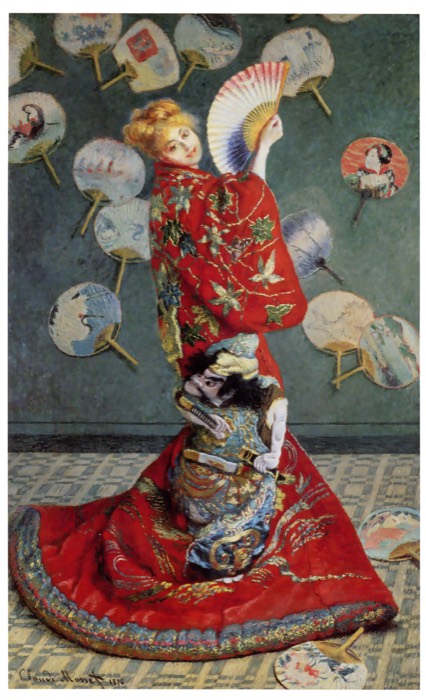
Claude Monet
Monet's route extends from the spectacular masquerade of La Japonaise through sustained print collecting to the designed landscape and serial painting of Giverny.
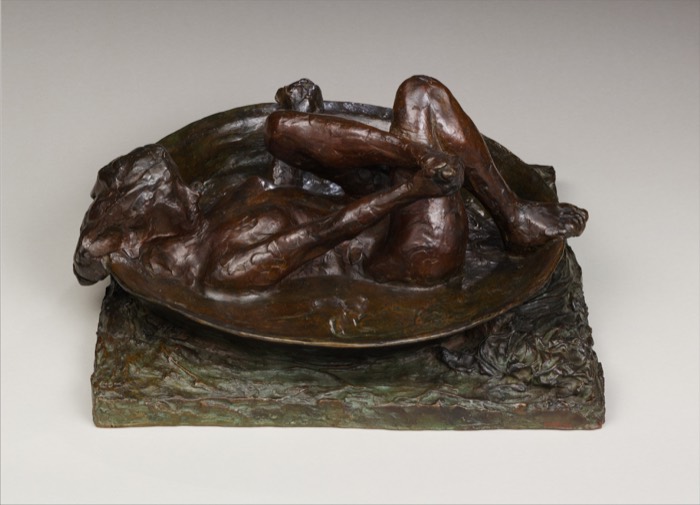
Edgar Degas
Degas demonstrates how Japanese composition could be absorbed without obvious costume or objects. His crops and viewpoints remain intertwined with photography and European graphic practice.
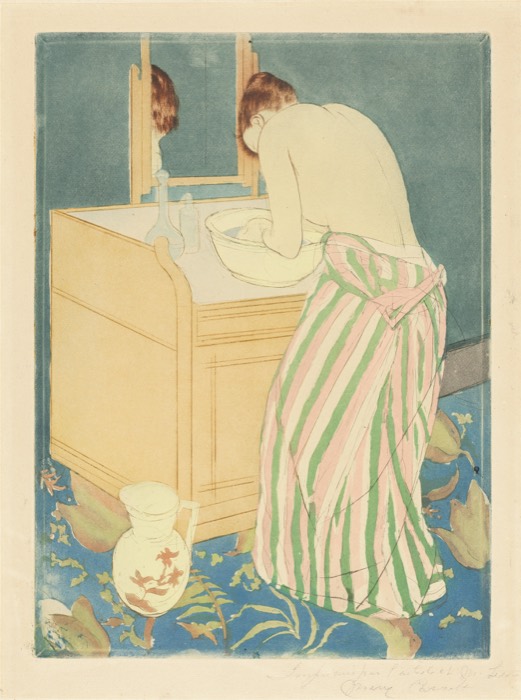
Mary Cassatt
Cassatt's ten colour prints transformed ukiyo-e subjects and polychromy through copper plates, modern women's lives and intensive collaboration with a printer.
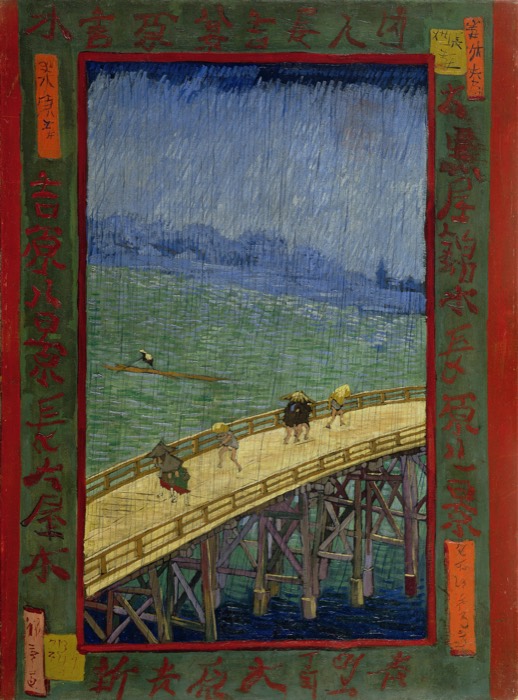
Vincent van Gogh
Van Gogh collected, displayed, copied and radically recoloured Japanese prints. He also invented an ideal Japan that reveals the psychological needs of European Japonisme.
Christopher Dresser
Dresser's study of Japanese craft entered an argument for functional industrial design. His most important Japoniste objects may contain no recognisable Japanese motif.
Major artists and designers directory
| Name | Nationality | Key Works |
|---|---|---|
| Christopher Dresser | British | Teapots · Linthorpe and Minton designs |
| Claude Monet | French | La Japonaise · Japanese Footbridge series |
| Edgar Degas | French | The Tub · Dancers and bathers |
| Edmond de Goncourt | French | Outamaro · Hokusai |
| Edward C. Moore | American | Tiffany silver · Water pitcher |
| Edward William Godwin | British | Anglo-Japanese furniture · Interiors |
| Félix Bracquemond | French | Service Rousseau · Japanese Album |
| Hayashi Tadamasa | Japanese | Print dealership · Exhibition scholarship |
| Henri Somm | French | Japonisme · Parisian prints |
| Henri de Toulouse-Lautrec | French | Divan Japonais · Paris posters |
| James Whistler | American | The Golden Screen · The Peacock Room |
| John La Farge | American | Stained glass · An Artist's Letters from Japan |
| Josef Hoffmann | Austrian | Wiener Werkstätte ornament · Interiors |
| Jules de Goncourt | French | Journal · Early collecting |
| Louis Comfort Tiffany | American | Glass · Silver and interiors |
| Louis Gonse | French | L'Art japonais · Collections |
| Mary Cassatt | American | Woman Bathing · The Coiffure |
| Paul Gauguin | French | Noa Noa woodcuts · Vision after the Sermon |
| Philippe Burty | French | Japonisme essays · Collections and criticism |
| Pierre Bonnard | French | The White Cat · France-Champagne |
| Siegfried Bing | German-French | Le Japon artistique · Maison de l'Art Nouveau |
| Thomas Jeckyll | British | Peacock Room framework · Metalwork |
| Théodore Duret | French | Travels in Japan · Criticism |
| Édouard Manet | French | Portrait of Émile Zola · The Lady with Fans |
| Édouard Vuillard | French | Intimate interiors · Decorative panels |
| Émile Gallé | French | Botanical glass · Art Nouveau furniture |
Whistler: from collected object to atmosphere
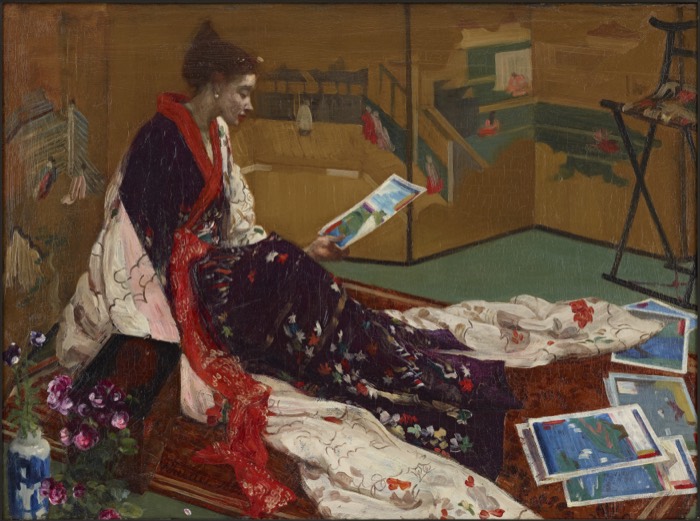
James Whistler was among the earliest major artists to display Japanese objects in ambitious paintings. In Caprice in Purple and Gold: The Golden Screen (1864), his model Joanna Hiffernan sits on the floor studying woodblock prints before a gilt screen. A robe, lacquer box, patterned rug and fan turn the room into an inventory of luxurious difference. The actual prints appear to be by Hiroshige. Hiffernan is not represented as Japanese; she is a modern European woman performing connoisseurship.[27]
The work is more than a costume picture. Its off-centre figure, tilted floor and competition among patterned surfaces weaken conventional depth. Whistler designed a frame whose ornament extended the picture's “Japanese” character into the object around it. Yet the combination remains eclectic, and the scene's central drama is possession: imported objects made an avant-garde identity visible.
Whistler's later Nocturnes demonstrate a more absorbed response. Low horizons, abbreviated forms, broad tonal fields and sparse incidents evoke rather than enumerate. Hiroshige's atmospheric landscapes offered one precedent, but Whistler transformed them through Thames fog, oil paint and his theory that a painting could operate like music. Japanese art strengthened his move away from narrative without dictating a style.[26] [29]
The Peacock Room of 1876–77 extends that ambition into architecture. Thomas Jeckyll had designed a dining room for the shipping magnate Frederick Leyland to display Chinese porcelain. During Jeckyll's illness, Whistler covered the room in blue-green paint and gold, using peacocks and half-moon motifs associated with Japanese textiles. A dispute over permission and payment ended with fighting peacocks representing artist and patron. Chinese ceramics, Japanese design references, British industry and personal conflict occupy one environment. Its mixed identity is precisely what makes the room a major Japoniste work.[28]
Manet: Japan inside a modern genealogy
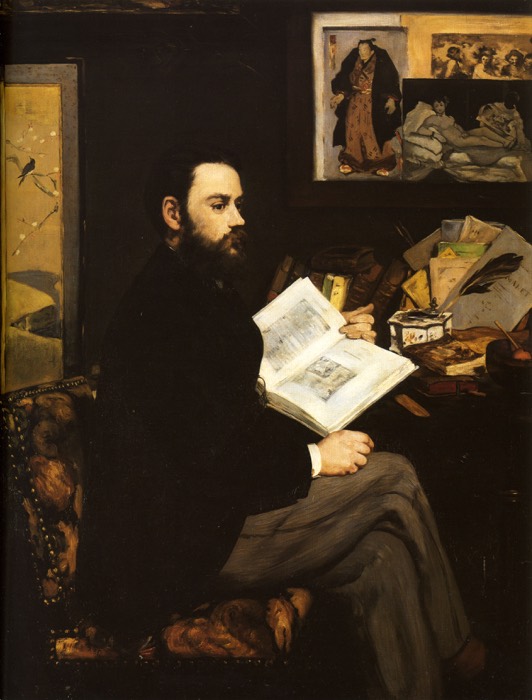
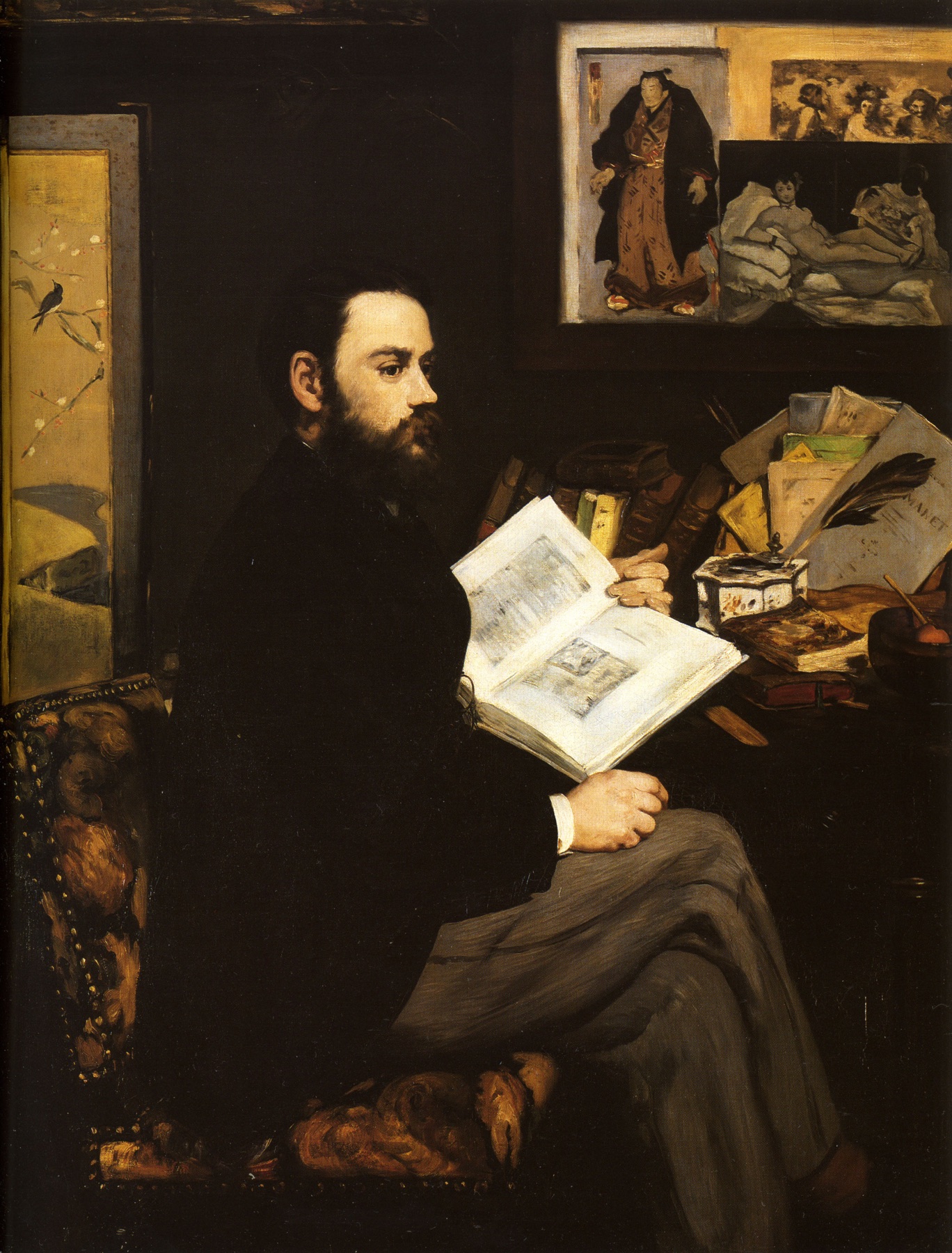
In Édouard Manet's Portrait of Émile Zola (1868), the critic sits at a desk surrounded by carefully arranged evidence. A reproduction of Manet's scandalous Olympia hangs near an engraving after Velázquez. Beside them is a Japanese print of a sumo wrestler by Utagawa Kuniaki II; a screen enters at the left. The objects name Zola's taste, but they also build a genealogy for modern painting. Spain, Japan and Manet's own contested work meet in the advocate's study.[24]
The Japanese print is not a direct model for the portrait's whole composition. Its role is partly symbolic: Japanese art stands for an alternative to official French judgement about modelling, perspective and subject. By reproducing Olympia inside Zola's portrait, Manet also turns the defender into a public ally. Japonisme operates through criticism and reputation as well as visual form.
In The Lady with Fans (1873), Nina de Callias reclines before a wall of opened Japanese fans. By then, Manet, Whistler, Tissot and Renoir had all used such décor. What once advertised novelty had become fashionable bric-a-brac. Nina's amused, alert expression and unconventional costume keep the portrait psychologically alive, but the fans demonstrate how quickly cultural difference could become interior pattern.[25]
Monet: fashion, collecting and a made landscape
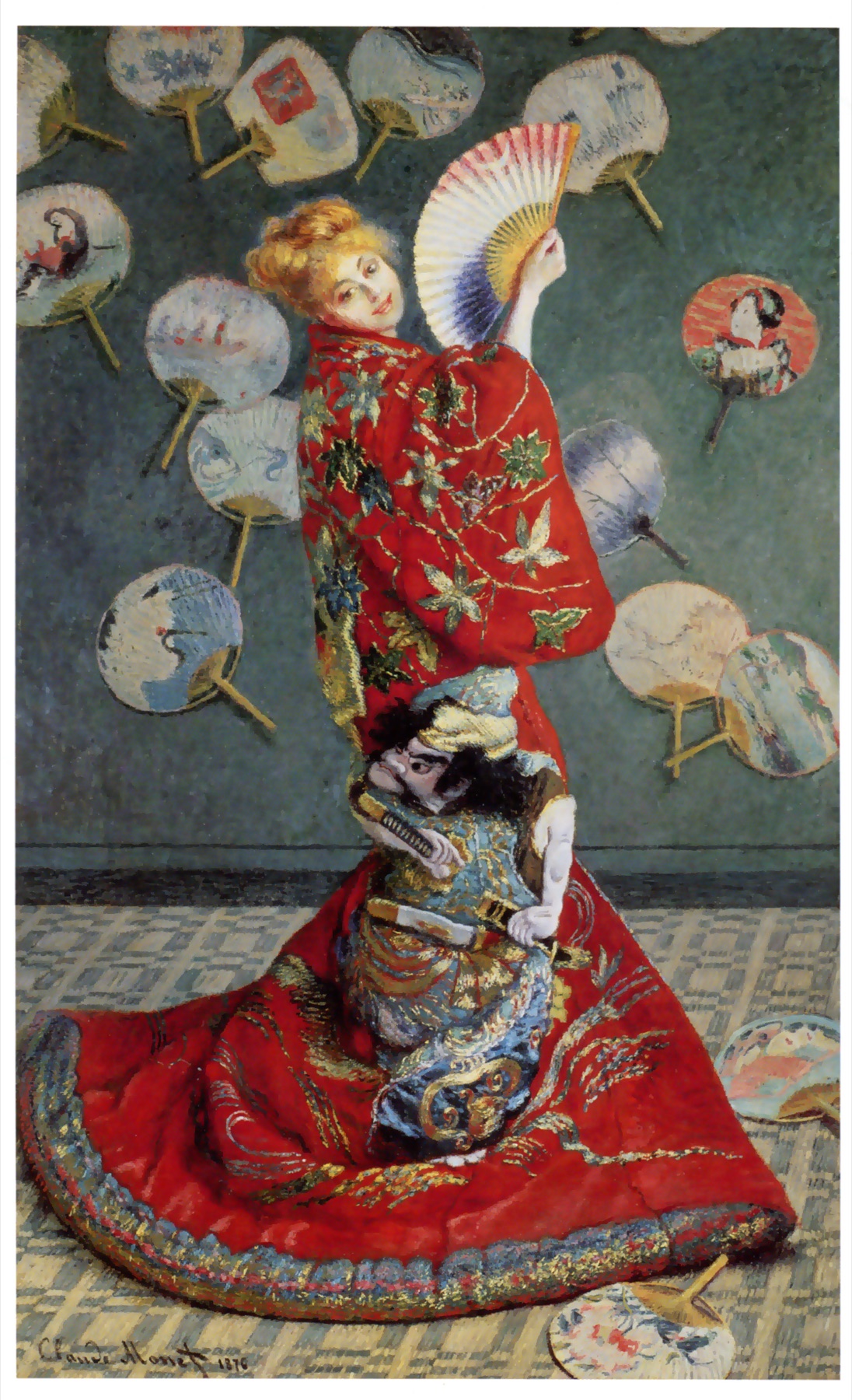
Claude Monet's spectacular Japonerie of 1876, now called La Japonaise, shows his wife Camille in an embroidered red kimono before sixteen fans. She wears a blond wig, emphasising that the “Japanese woman” is a Parisienne in costume. A fan in her hand uses the blue, white and red of France. The warrior embroidered across the robe twists as Camille turns, making her body animate an imported object.[30]
The painting can be witty and troubling at once. It comments on a craze that Monet shared, while converting Camille into the centre of a saleable exotic display. Monet was in debt, and a large colourful Salon-like figure subject could attract attention. When shown at the second Impressionist exhibition, critics praised its virtuosity and mocked its strangeness. The later title La Japonaise intensified a fiction the blond wig had exposed from the start.[31] [32]
Monet's engagement did not end with costume. His Giverny home preserves more than two hundred Japanese prints, including 46 by Utamaro, 23 by Hokusai and 48 by Hiroshige among those on display. They covered the yellow dining room and other domestic walls rather than being kept only in portfolios. Hayashi Tadamasa exchanged prints for Monet paintings and advised him; Japanese collectors and visitors also entered the Giverny circle.[33] [34]
The water garden made collecting spatial. Monet acquired marshy land, redirected water, planted lilies and built an arched wooden bridge. In 1899 he painted the bridge repeatedly from a tightly controlled viewpoint. The high placement of the arch, screen of foliage and absence of conventional sky recall Japanese framing, yet the result also belongs to French horticulture, serial Impressionism and Symbolist ideas of the enclosed garden. The pond was nature redesigned for sustained observation.[35]
Japanese prints gave Monet another way to conceive landscape through horizon, season, repeated motif and changing viewpoint. They did not supply a code that mechanically produced the Water Lilies. The strongest interpretation holds print collecting, garden construction and long painterly practice together.[36]
Degas: influence without costume
Edgar Degas collected Japanese prints but rarely staged conspicuous Japoneries. He absorbed devices that suited his own investigation of bodies in modern interiors: figures pushed to one side, backs turned towards the viewer, floor seen from above, objects cut abruptly and areas left surprisingly open. A dancer may be partly blocked by another body; a woman bathing is observed from a position that feels temporary rather than classically composed.[1]
These strategies could disrupt hierarchy. A chair edge may command as much area as a face; the centre can be empty; a body continues beyond the frame. Japanese prints offered strong precedents for such decentralisation. Photography, caricature and European graphic art also shaped Degas. It is safer to identify a documented field of choices than to label every crop Japanese.[44]
Degas's importance to Japonisme lies partly in this invisibility. He demonstrates that a serious encounter need not advertise the source through costume. Yet subtlety is not proof of greater cultural understanding. Degas could transform a pictorial strategy without knowing the text, market or social role of the Japanese sheet from which it came.
Cassatt: colour on copper
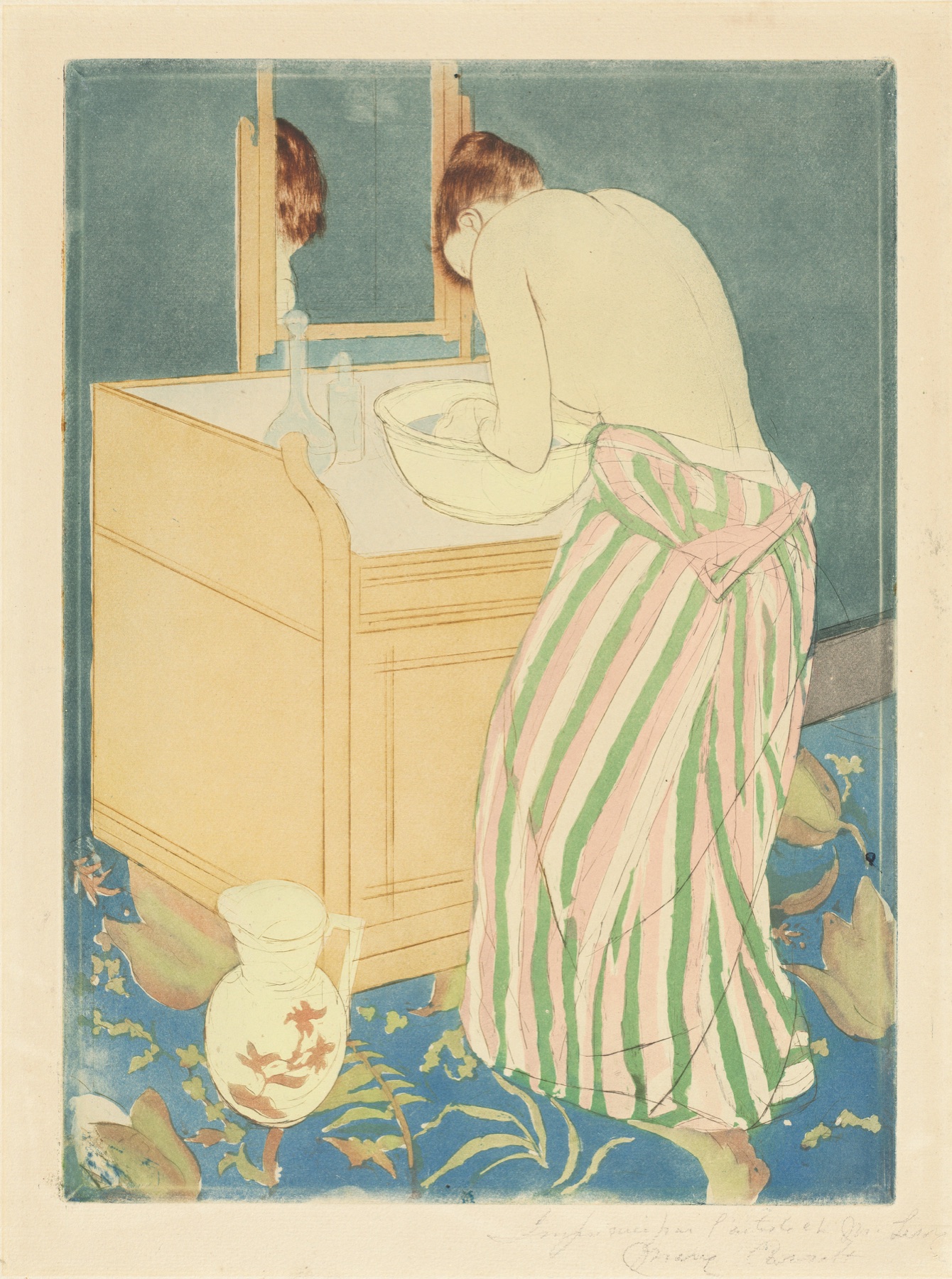
In spring 1890, Mary Cassatt visited a major exhibition of Japanese prints at the École des Beaux-Arts, once with Degas and once with Berthe Morisot. She already collected and knew such work, but the concentrated display prompted a defined project: ten colour prints completed in 1890–91. She wrote of being unable to think about anything but colour on copper.[40]
The subjects are intimate but not trivial: bathing, arranging hair, trying on clothes, reading a letter, riding a tram and holding a child. Cassatt drew on Utamaro's close figures, pattern and unmodelled spaces without transferring courtesans into French rooms. Her women perform ordinary modern acts with concentration. Mirrors, wallpaper and fabric flatten the surface while gestures preserve bodily specificity.
The technique was a translation, not an imitation of woodblock procedure. Cassatt combined drypoint, soft-ground etching and aquatint, sometimes using several plates to register colour. She worked intensively with the professional printer M. Leroy to produce twenty-five impressions of each design. The apparent calm of The Coiffure or Woman Bathing depended on repeated biting, inking, wiping, alignment and proofing.[2]
By converting Japanese polychrome printing into a demanding European copper process, Cassatt created one of the most original print projects of the period. Her wider print corpus confirms that the set was not a decorative detour, and later exhibitions placed it at the centre of her achievement.[41]
Van Gogh: collection, copy and imagined Japan
Vincent van Gogh and his brother Theo acquired hundreds of Japanese prints. Research has revised the sentimental belief that Vincent bought them only for private pleasure: he also hoped to trade them. In 1887 the brothers helped stage a display at the Café du Tambourin. A Kunisada beauty print still in the museum collection represents the popular material that passed through their hands, not only the Hokusai and Hiroshige works later preferred by Western histories.[38] [39]
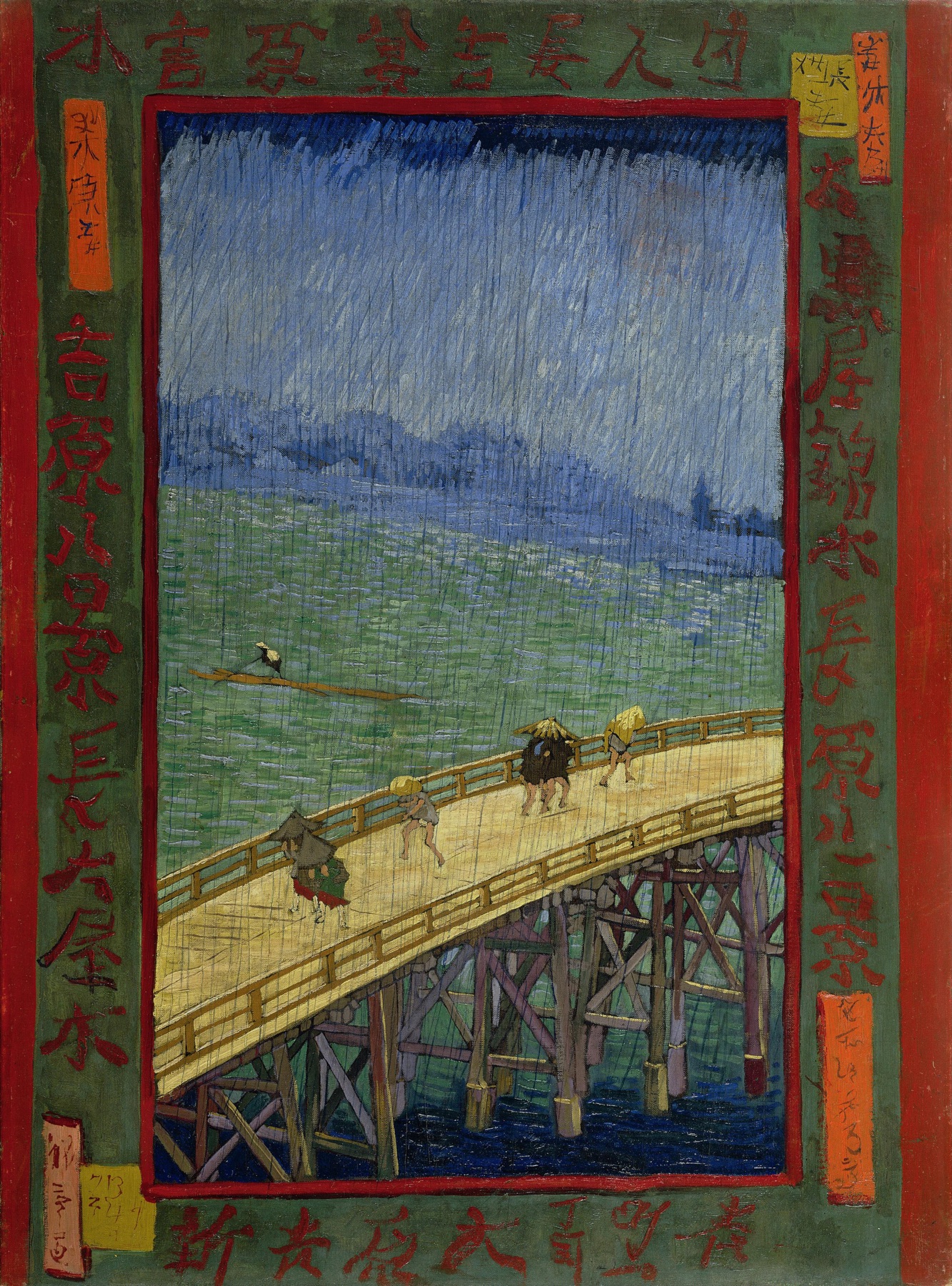
Van Gogh's painted versions of Hiroshige are deliberately unfaithful. Bridge in the Rain and Flowering Plum Orchard enlarge the compositions, intensify colour and add borders filled with copied or invented characters. Oil paint replaces transparent woodblock colour. The transformed frame declares distance even while the central design remains recognisable.[37]
In portraits of Père Tanguy, Japanese prints form a bright wall behind the art-supply dealer. The setting associates a modest Parisian supporter with a hoped-for art of clarity and community. Van Gogh then imagined Provence as his Japan: a place of pure colour, close nature and artists living like devoted monks. That fantasy energised his Arles work, but it was a European construction projected onto both Japanese artists and southern France.
Van Gogh shows why admiration should not be confused with knowledge. He learned profoundly from line, flat area and crop while idealising the people who made the prints. The contradiction does not cancel the paintings; it explains their urgency.
Posters, Nabis and the modern print
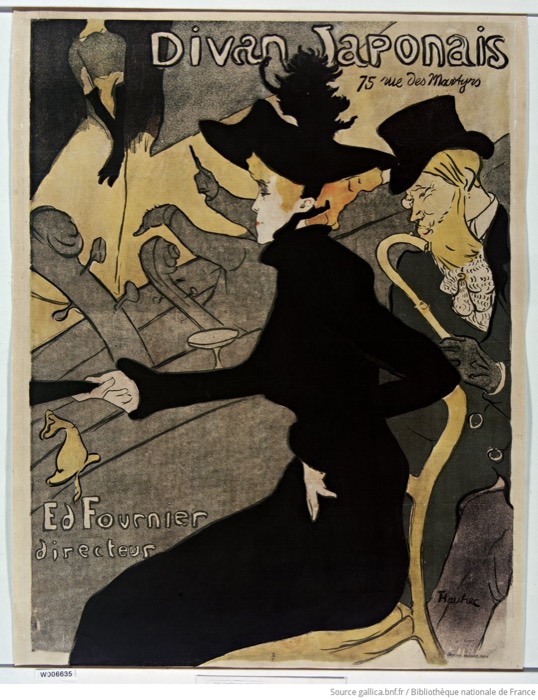
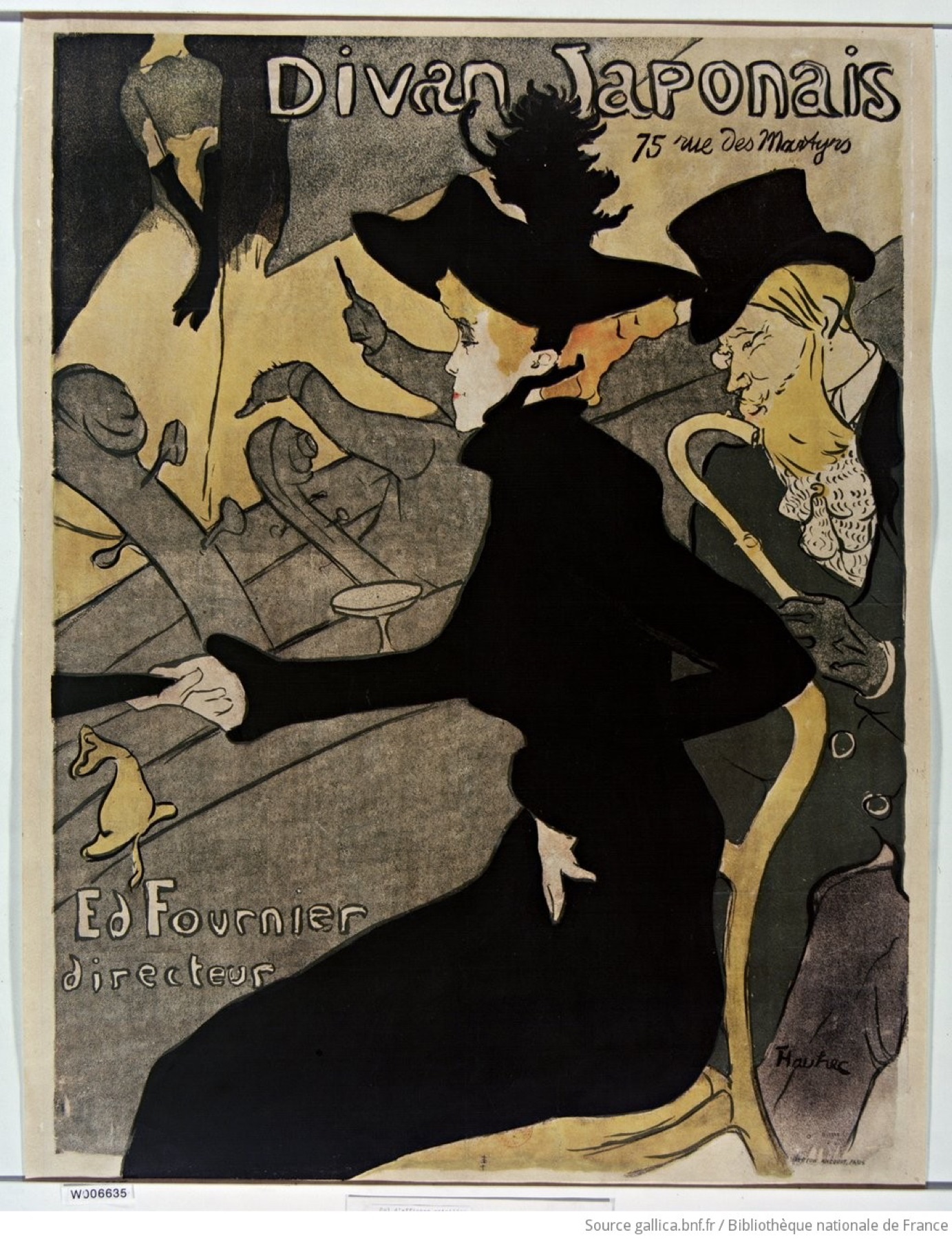
Henri de Toulouse-Lautrec found more than an arrangement of shapes in ukiyo-e. Kabuki actor prints were a publicity system for recognisable performers, just as the new Paris poster promoted dancers and singers. Large silhouettes, flat colour, strong contour, oblique angle and abrupt cropping made a celebrity legible from the street.[42]
In Divan Japonais, Jane Avril sits in the foreground while the singer Yvette Guilbert appears on stage with her head cut off. Her long black gloves identify her. The crop is both Japanese-inflected and commercially exact: a famous attribute substitutes for a conventional portrait. The venue's name converts Japan into part of nightlife branding.
Pierre Bonnard and Édouard Vuillard, members of the Nabis, used high viewpoints, decorative fabrics and narrow panel formats to bind figures to interiors. Bonnard was nicknamed the “very Japanese Nabi,” but his work joined prints to Symbolism, domestic observation and the group's belief in the picture as an ordered surface. Japanese sources strengthened Nabi aims rather than replacing them.[1]
Paul Gauguin adapted outline, flat colour and the physical resistance of woodcut within a practice that drew upon Breton, Javanese, Peruvian, Polynesian and other sources. Japonisme is one strand of that appropriation. Isolating it as a benign formal lesson would conceal the wider colonial fantasies through which Gauguin presented himself and his subjects.[43]
Bracquemond and the table
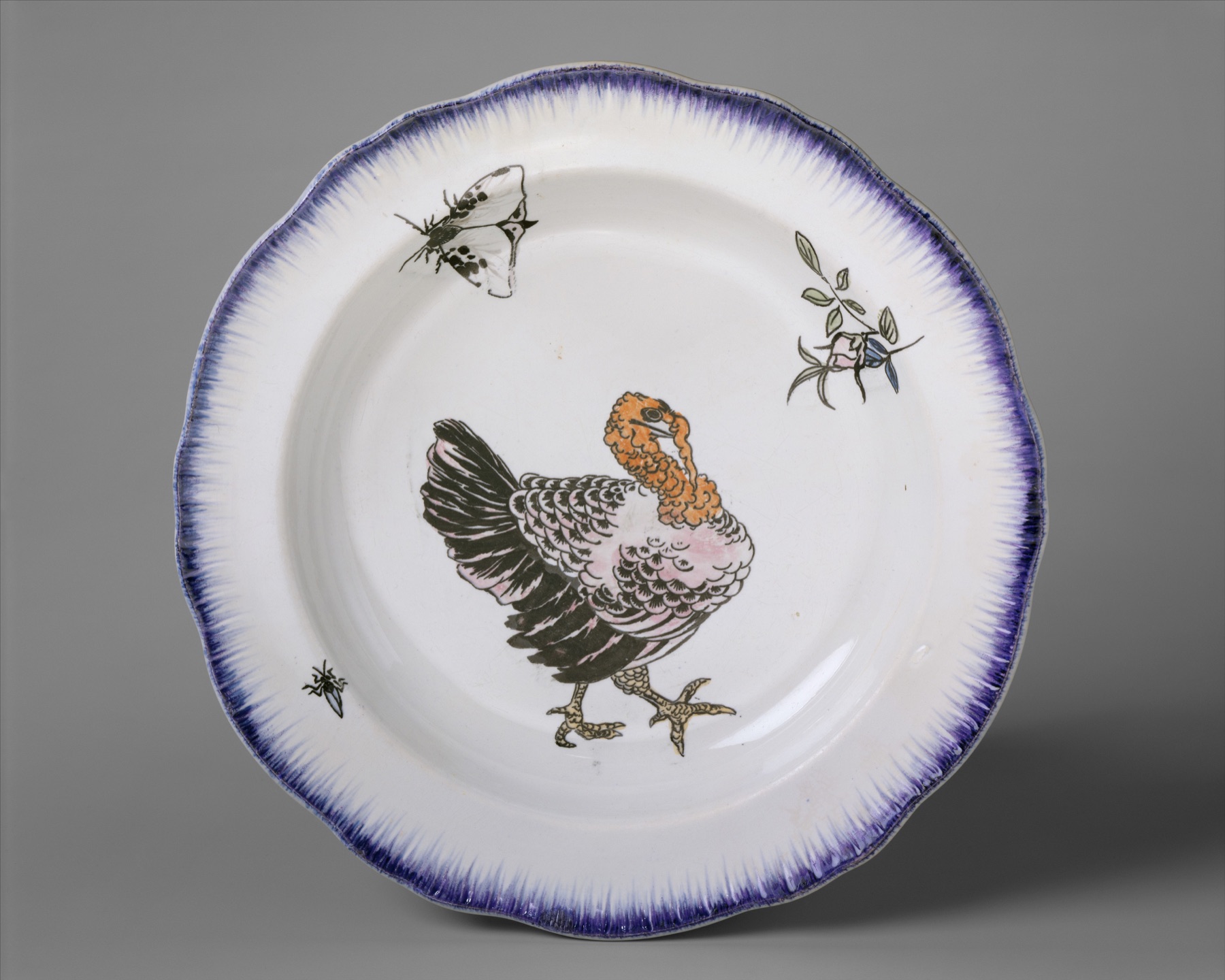
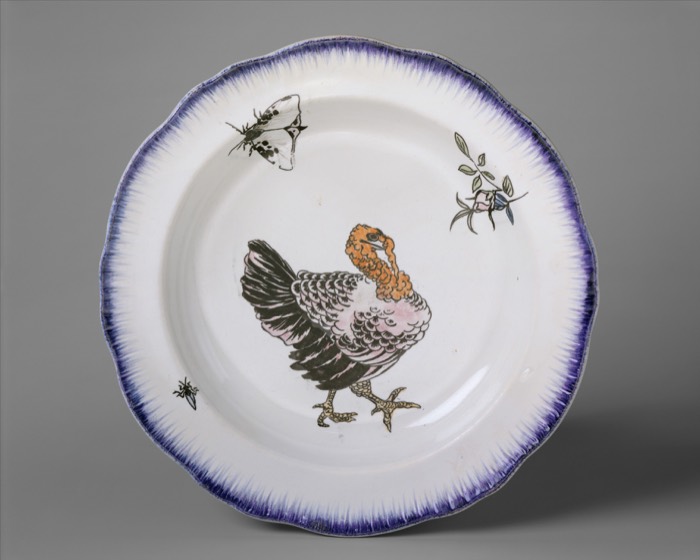
Félix Bracquemond's ceramic Service Rousseau, designed from 1866, brought Japonisme to European dining. Birds, fish, insects, grasses and branches derived from Hokusai and Hiroshige appear in changing combinations across plates and serving pieces. The motifs do not form a symmetrical border around a central emblem. They seem to enter, leave and answer one another across the object.[45]
This freedom was carefully systematised for manufacture. Bracquemond recombined images from several sources and adapted them to curved ceramic surfaces. The service therefore joins appropriation to industrial design: Japanese motifs became a flexible vocabulary for a repeatable European product. Its success at exhibitions helped make asymmetry acceptable in the applied arts.[46]
Japanese stoneware and ceramics shown at the 1878 Paris fair also encouraged French potters to value irregular glaze, dense material and craft process. Théodore Deck, Bracquemond and later art potters combined those lessons with Islamic, Renaissance and local traditions. Japonisme did not displace eclecticism; it gave eclectic design a new material direction.[47]
Britain: the Aesthetic home and industrial form
British Aestheticism made the home a theatre of cultivated taste. Japanese fans, blue-and-white vessels and prints filled shelves and walls, but designers also changed the furniture that carried them. Edward William Godwin used light frames, darkened surfaces and lattice-like construction. Thomas Jeckyll brought stylised birds and sunflowers into metalwork and interiors. Mass manufacturers soon reproduced fans, insects and blossom so widely that a new design language hardened into “motifism.”[15]
Christopher Dresser went further than fashionable ornament. Trained in botany and design reform, he admired the abstraction and fitness he found in Japanese craft. His 1876–77 journey allowed him to study manufacture directly and act as an agent for museums and businesses. Later metal teapots use stark geometry, rivets and functional handles rather than painted geishas or fans. One costing book called a severe 1879 model “English Japanese.”[17]
Dresser's achievement was to treat Japanese design as evidence that industrial production and artistic intelligence could coexist. He supplied designs for ceramics, textiles, wallpaper, glass and metal to many firms. His plant-based ornament reduced nature to structural relations, while his objects limited decoration to what a process could carry. The result can look modern precisely because the Japanese source is not a pasted motif.[18]
Émile Gallé approached nature differently. Botanical knowledge and Japanese composition helped him make stems, insects and watery growth appear to inhabit the layers of glass. Art Nouveau designers used such examples to argue for a unified environment in which furniture, vessel, jewellery and architecture shared living rhythms.[16]
Vienna: objects become an archive of ornament
Objects from Japan's 1873 Vienna display entered the MAK through acquisition and government gift. Their excellent documentation now records what the Meiji state chose to present and what an Austrian museum selected. The collection is not a neutral sample of Japanese art: it is a material history of diplomacy, market taste and institutional classification.[20]
Katagami make that history especially clear. These resilient paper stencils were tools for dyeing textiles in Japan. In Vienna, designers could study their repeated and interlocking patterns apart from the fabrics and workshops for which they were made. Research has identified close relationships between MAK stencils and ornament by Josef Hoffmann and the Wiener Werkstätte.[21]
The visual transfer was generative, but function changed. A working stencil became a museum object and design source. Motifs moved from resist-dyed cloth into wallpapers, endpapers and modern interiors. Japonisme here belongs to the circulation of tools, not just finished masterpieces.
Japonisme in the United States
American interest developed through ports, international fairs, travel and European networks. The Philadelphia Centennial Exhibition of 1876 gave Japanese arts a major official audience. Collectors then donated objects to new museums, while firms converted Japanese-looking asymmetry and natural motifs into household goods. The appetite extended from elite silver to mass-produced wallpaper.[48]
John La Farge collected Japanese colour prints by 1863, unusually early in the United States. He later travelled in Japan and published An Artist's Letters from Japan. His stained glass joined Japanese and Chinese screen-like arrangements with medieval, Romanesque and modern American materials. The mixture resists any claim that one culture supplied a complete style.[50]
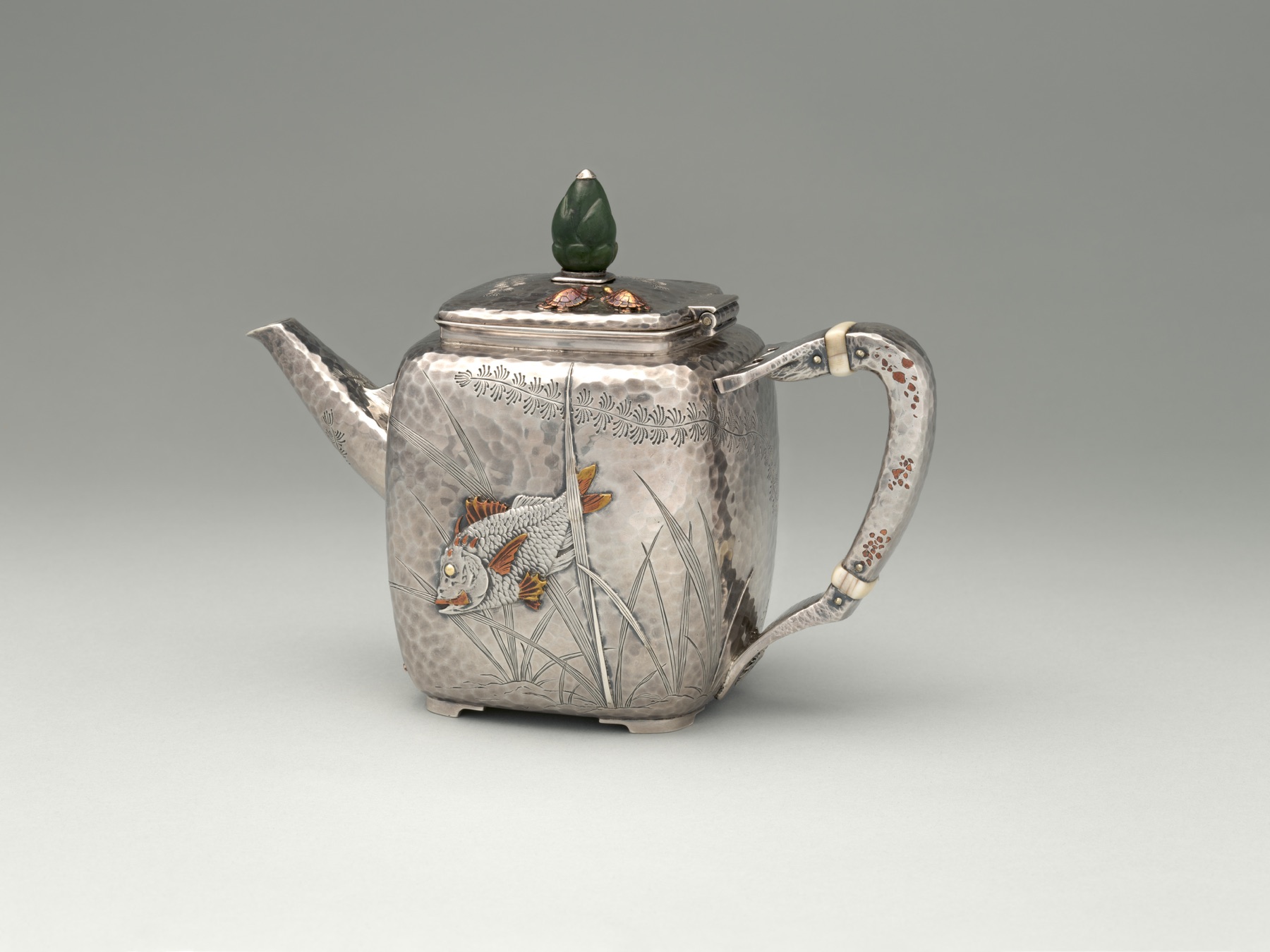
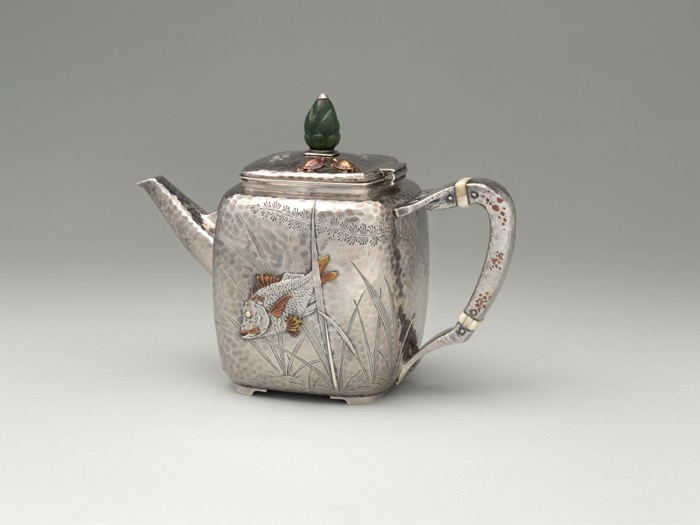
At Tiffany & Co., Edward C. Moore collected Japanese art and used the firm's design library. A celebrated 1878 water pitcher combines a hammered silver body with applied copper, gold and natural motifs arranged as a scene rather than a repeated border. Japanese metalwork and prints informed the surface, while an American luxury firm controlled production and marketing. Tiffany won a grand prize for silver at the Paris fair that year.[49]
Such objects show Japonisme moving in a circuit: Japanese exports reached American designers, American Japoniste silver returned to Paris for exhibition, and later collectors placed both traditions in museums. The history is transatlantic as well as transpacific.
Gender, costume and the possession of Japan
The Western woman in Japanese dress is one of Japonisme's recurring structures. Her body proves that a costly kimono has been acquired, while fans and screens multiply the signs of access. Costume can liberate pattern from ordinary European dress and offer the model a theatrical role. It can also turn “Japan” into something wearable, feminised and available to the viewer.[22]
This pattern does not make every costumed image identical. Camille Monet's blond wig exposes the masquerade; Joanna Hiffernan studies prints rather than impersonating a named Japanese woman; Nina de Callias remains forcefully individual amid fans. Close reading should preserve those differences while asking who controls the setting, who owns the objects and what the title claims.
The fair produced a public version of the same gaze. Tea houses, craft demonstrations and performers made living people part of a national spectacle. Japanese organisers participated strategically, but European display systems often grouped Japan within a generalized Orient. The category could praise refinement while holding its makers at a distance.
Influence, appropriation and evidence
“Influence” can sound automatic, as if a Japanese print acted on a European artist without market, choice or power. A stronger account names the route. Did the artist own the print? See it at a fair? Browse Bing's shop? Work with Hayashi? Copy a particular design? Study an industrial process? Each path produces a different relationship.
Cultural appropriation is also most useful when made specific. Cassatt's adaptation of colour printing is not ethically identical to dressing a model as an exotic fantasy. Dresser learning from manufacturing is not the same as removing a religious sculpture from use. A quotation may be admiring and unequal at once. The object, maker, transaction, representation and later profit all matter.
Visual resemblance alone is weak evidence. Asymmetry and natural motifs exist in many traditions. Hokusai's influence can be demonstrated more persuasively where a collector owned a book, an image repeats a distinctive form or correspondence identifies the source. The large comparative exhibition organised in Tokyo around Hokusai and Japonisme modelled this method by placing named works beside one another across painting, print, sculpture, poster and design.[8]
A two-way history
During the same decades, Japanese artists studied European oil painting, anatomy, perspective, lithography and photography. Meiji institutions developed museums, art schools and official exhibitions partly through foreign models. Japanese commissioners and collectors acquired Western art. Hayashi's unrealised museum plan belongs to that transformation.[12]
Monet's friendships with Hayashi and later Japanese visitors complicate the image of distant influence. Kōjirō Matsukata collected French modern art for Japan, just as European museums were assembling Japanese collections. A later dialogue between the Matsukata collection and Museum Folkwang's French holdings shows modern art moving in both directions.[7]
Reciprocity does not mean equality. Military pressure, wealth and museum power shaped what moved and what survived. Nor does it mean every participant understood the other culture. It means Japanese people must appear as interpreters, buyers, organisers and makers within the history, not only as anonymous sources.
How to look at a Japoniste work
- Name the Japanese object or practice. “A print” is less useful than Hiroshige landscape, Hokusai book, katagami stencil or export lacquer.
- Ask how it arrived. A world's fair, dealer, collection, journey or journal can explain what the artist could know.
- Distinguish prop from structure. A kimono may be the subject; a high viewpoint may shape the entire composition. Both can occur together.
- Look for transformation. What changes when woodblock colour becomes oil, copper aquatint, ceramic decal or hammered silver?
- Notice mixture. Chinese porcelain, Japanese fabric and European furniture may share one room. Do not relabel everything Japanese.
- Consider gender and possession. Who wears, owns, displays or sells cultural difference?
- Check other sources. Photography, European prints, industrial processes and local traditions may explain the same formal choice.
- Restore Japanese agency. Ask who made, exported, explained or selected the source object.
Essential works and designs
Caprice in Purple and Gold: The Golden Screen
James McNeill Whistler · 1864 · Japanese prints, robe, screen and frame turn collecting into a deliberately modern pictorial identity.
Portrait of Émile Zola
Édouard Manet · 1868 · A Kuniaki wrestler print, screen, Olympia and Velázquez construct a modern genealogy around Manet's defender.
La Japonaise
Claude Monet · 1876 · Camille Monet's blond wig and tricolour fan expose the painting as a spectacular French masquerade.
The Tub
Edgar Degas · 1886 · Cropping, elevated viewpoint and compressed space show how Japanese composition could be absorbed without costume.
Woman Bathing
Mary Cassatt · 1890–91 · Cassatt translated ukiyo-e intimacy and layered colour through drypoint, soft-ground etching and aquatint.
Bridge in the Rain (after Hiroshige)
Vincent van Gogh · 1887 · Van Gogh enlarged and recoloured Hiroshige, surrounding the design with an emphatically transformed border.
Divan Japonais
Henri de Toulouse-Lautrec · 1892–93 · Actor-print publicity becomes a Parisian poster system of silhouette, crop and instantly recognisable celebrity.
Soup plate from the Service Rousseau
Félix Bracquemond · 1866–75 · Hokusai- and Hiroshige-derived motifs move asymmetrically across repeatable European tableware.
Teapot
Tiffany & Co. · c. 1880 · Hammered metal, mixed materials and scenic ornament bring Japanese lessons into American luxury manufacture.
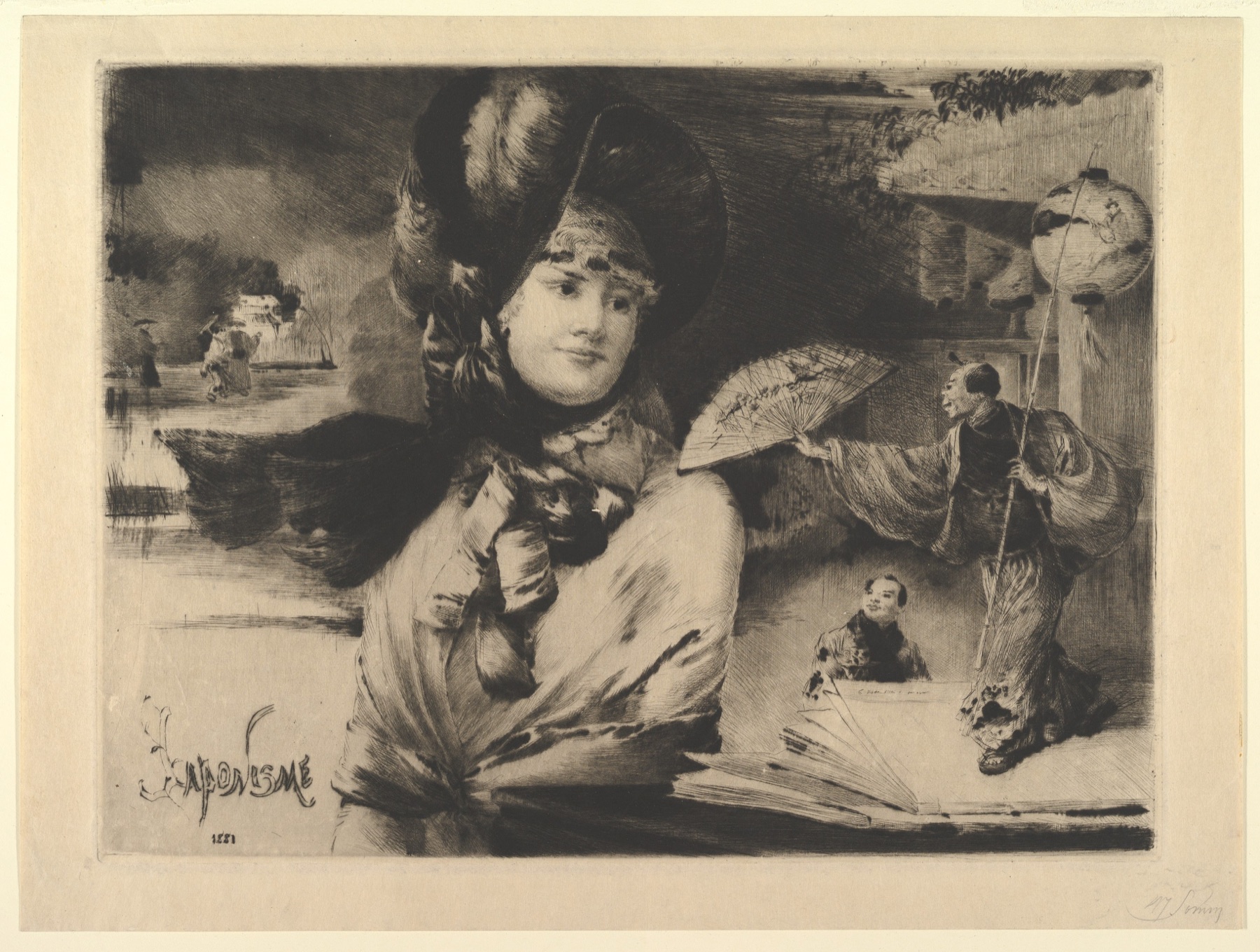
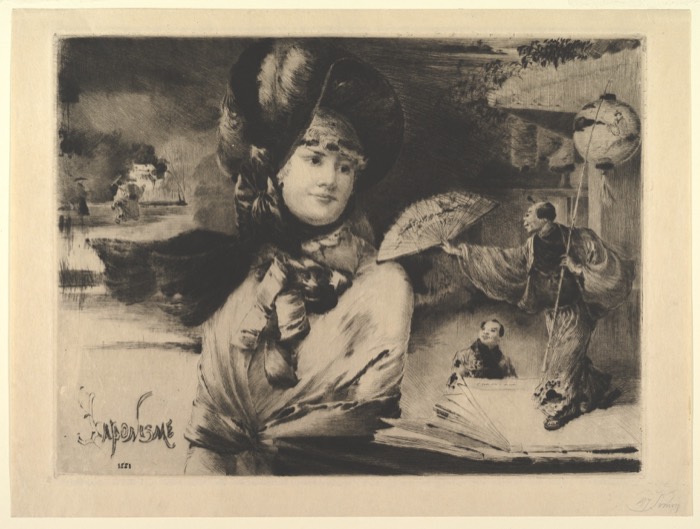
Japonisme
Henri Somm · 1881 · Henri Somm's drypoint records Japonisme as a self-conscious metropolitan fashion and social performance.
Where to see Japonisme
The Musée d'Orsay offers the strongest single route through French painting and decorative art, including Manet, Whistler and Bracquemond. Its landmark 1988 exhibition joined almost every medium and travelled to the National Museum of Western Art, Tokyo, where 429 works drew more than 466,000 visitors.[4] [7]
The Metropolitan Museum of Art can connect Japanese prints with French and American painting, Tiffany silver and Art Nouveau. The National Museum of Asian Art in Washington preserves Whistler's Golden Screen and the complete Peacock Room. The Museum of Fine Arts, Boston displays Monet's La Japonaise and holds exceptional Japanese prints for direct comparison.
At Giverny, Monet's Japanese prints remain on the walls of his house and the water garden can be experienced as a designed environment. The Van Gogh Museum preserves the brothers' Japanese print collection alongside Vincent's paintings. Vienna's MAK joins 1873 fair objects to katagami and Viennese design. Museum Folkwang has staged a particularly broad account of French artists' Japanese inspirations across about four hundred works.[22]
Displays change because prints and textiles are light-sensitive. Check current galleries before travelling, and use digital collections to compare the source object with its Western translation.
Museums and collections to explore
Prints and textiles often rotate because light exposure can damage them. Check current displays before travelling.
- 01
Musée d'Orsay
Paris, France
French painting, prints and decorative art, including Manet, Whistler and Bracquemond.
French art and designVisit collection website - 02
National Museum of Western Art
Tokyo, Japan
Western art in Japan and the institutional history of major Japonisme exhibitions.
Japan–West exchangeVisit collection website - 03
Metropolitan Museum of Art
New York, USA
Japanese prints, French and American art, Tiffany silver and Art Nouveau in one collection.
Cross-media studyVisit collection website - 04
National Museum of Asian Art
Washington, DC, USA
Whistler's Golden Screen and the complete Peacock Room.
Whistler focusVisit collection website - 05
Museum of Fine Arts, Boston
Boston, USA
Monet's La Japonaise beside an exceptional Japanese print collection.
Painting and printsVisit collection website - 06
Fondation Claude Monet
Giverny, France
Monet's print collection remains on the walls beside the designed water garden.
Collection in placeVisit collection website - 07
Van Gogh Museum
Amsterdam, Netherlands
The brothers' Japanese prints alongside Vincent's painted translations.
Collection and copiesVisit collection website - 08
MAK
Vienna, Austria
Objects from the 1873 fair, katagami and their documented relation to Viennese design.
Decorative artsVisit collection website
Suggested books
The Great Wave: The Influence of Japanese Woodcuts on French Prints, by Colta Feller Ives, remains a clear comparative study of Manet, Degas, Cassatt, Bonnard, Vuillard, Toulouse-Lautrec and Gauguin.[2]
Japonisme: The Japanese Influence on Western Art Since 1858, by Siegfried Wichmann, is an expansive visual survey, best read alongside newer scholarship on agency and appropriation.
Japanomania in the Nordic Countries, 1875–1918, edited by Gabriel P. Weisberg, Anna-Maria von Bonsdorff and Hanne Selkokari, moves the history beyond Paris and London.
Japanese Prints: The Collection of Vincent van Gogh, by Chris Uhlenbeck, Louis van Tilborgh and Shigeru Oikawa, reconstructs what the brothers actually acquired and why.[38]
Claude Monet's Collection of Japanese Prints, by Geneviève Aitken and Marianne Delafond, studies the unusually intact Giverny collection rather than treating Monet's interest as a general impression.[33]
Frequently Asked Questions
It is better understood as a cross-current through several movements and media. It had no membership, manifesto or single style, but it transformed Aestheticism, Impressionism, Post-Impressionism, the Nabis, Art Nouveau and modern design.
Philippe Burty used it in a published series in 1872. He initially applied it to a fashionable enthusiasm among collectors and artists before the term acquired its broader art-historical meaning.
There is no single beginning. The forced expansion of trade after 1853–54, the London exhibition of 1862 and Paris fair of 1867 are practical thresholds. Objects and knowledge circulated earlier.
No. Ukiyo-e is a Japanese pictorial culture of prints, paintings and books. Japonisme describes Western responses to many forms of Japanese art, of which ukiyo-e was especially influential.
The word often describes Western images conspicuously filled with Japanese costume and props. It can distinguish fashion from more absorbed formal change, but historical usage was inconsistent.
No. They offered powerful alternatives in composition, subject, colour and seriality, but Impressionism also developed from plein-air practice, French painting, optical study, photography and modern urban life.
He was a Japanese interpreter, dealer, adviser and connoisseur in Paris. He supplied context as well as objects, supported exhibitions and scholarship, collected Western art and hoped to establish a museum in Japan.
Many aspects were, but the term covers relationships with different stakes. Costume fantasy, technical study, commercial collecting and collaboration should be analysed through their specific routes, power and uses rather than judged as identical.
He studied and collected them closely, but his mature landscapes are transformations rather than copies. Viewpoint, seriality and designed nature entered a practice also shaped by Impressionism, horticulture and long observation.
Cassatt converted the layered colour and intimate subjects of Japanese woodcuts into technically demanding copper-plate prints. The set joined Japanese lessons to modern women's daily experience and European print processes.
Profoundly. Ceramics, glass, silver, furniture, textiles, wallpaper, gardens and interiors were central. Japonisme helped challenge the separation between “fine” and applied art.
It did not end neatly. Around 1910, its devices had entered international modernism and mass design so widely that they no longer formed one visible craze. Later exchange continued under different conditions.
Discussion
Which form of Japonisme seems most revealing: the conspicuous display of Japanese objects, the quiet transformation of composition, or the redesign of everyday things? When does artistic translation deepen understanding, and when does it turn another culture into a style available for possession?
Reader Insights
Look for a fair, shop, dealer, collection or journey before treating visual resemblance as evidence.
Distinguish a Hiroshige print, katagami stencil or export vase from a general idea of “Japan.”
Ask what changes as woodblock colour becomes oil, aquatint, ceramic decal or hammered silver.
Join the Conversation
Which form of Japonisme seems most revealing: conspicuous objects, transformed composition or the redesign of everyday things?
References
- Japonisme. Metropolitan Museum of Art. View Source
- The Great Wave The Influence of Japanese Woodcuts on French Prints. Metropolitan Museum of Art. View Source
- Early Collectors of Japanese Prints and The Met. Metropolitan Museum of Art. View Source
- Japonism 1988 exhibition. Musee d'Orsay. View Source
- L'invention du japonisme. Bibliotheque nationale de France (French; consulted in French). View Source
- France et Japon L'invention du japonisme. Bibliotheque nationale de France (Japanese; consulted in Japanese). View Source
- Japonisme Japonism 1988. National Museum of Western Art Tokyo. View Source
- Hokusai and Japonisme. National Museum of Western Art Tokyo. View Source
- Collection of Hayashi Tadamasa letters and materials. National Museum of Western Art Tokyo. View Source
- Hayashi Tadamasa The Paris Art Dealer Who Promoted Japonisme. National Museum of Western Art Tokyo. View Source
- Vienna World Fair and Japonisme. National Diet Library (Japanese; consulted in Japanese). View Source
- French artistic influence in modern Japan. National Diet Library (Japanese; consulted in Japanese). View Source
- Japan 1800-1900 A.D.. Metropolitan Museum of Art. View Source
- An introduction to the Aesthetic Movement. Victoria and Albert Museum. View Source
- Furnishing the Aesthetic Home. Victoria and Albert Museum. View Source
- Objects of Beauty Art Nouveau Glass and Jewellery. Victoria and Albert Museum. View Source
- An A-Z of Metalwork. Victoria and Albert Museum. View Source
- Design Reform. Cooper Hewitt Smithsonian Design Museum. View Source
- Vienna World Exhibition 1873 Revisited Egypt and Japan as Europe's Orient. MAK Vienna (German; consulted in German). View Source
- Masterpieces Asia collection. MAK Vienna (German; consulted in German). View Source
- Katagami in the MAK. MAK Vienna (German; consulted in German). View Source
- Monet Gauguin van Gogh Japanese Inspirations. Museum Folkwang. View Source
- Art Nouveau. Metropolitan Museum of Art. View Source
- Emile Zola. Musee d'Orsay. View Source
- La Dame aux eventails. Musee d'Orsay (French; consulted in French). View Source
- Whistler 1834-1903. Musee d'Orsay (French; consulted in French). View Source
- Caprice in Purple and Gold The Golden Screen report. National Museum of Asian Art Smithsonian. View Source
- Making the Peacock Room. National Museum of Asian Art Smithsonian. View Source
- Symphony in White No. 1 audio tour. National Gallery of Art Washington. View Source
- La Japonaise Camille Monet in Japanese Costume. Museum of Fine Arts Boston. View Source
- Conservation in Action La Japonaise. Museum of Fine Arts Boston. View Source
- Monet and Boston Lasting Impression. Museum of Fine Arts Boston. View Source
- Japanese Prints at Giverny. Fondation Claude Monet. View Source
- Fondation Monet institutional dossier. Fondation Claude Monet. View Source
- The Japanese Footbridge. National Gallery of Art Washington. View Source
- Monet Questioning Nature Section 7 Japonisme. Artizon Museum Tokyo. View Source
- Van Gogh Museum permanent collection gallery texts. Van Gogh Museum. View Source
- Van Gogh Museum Annual Report 2018. Van Gogh Museum. View Source
- Sewing from Series of Glistening Fashions. Van Gogh Museum. View Source
- Mary Cassatt the Daring Printmaker. National Gallery of Art Washington. View Source
- Mary Cassatt exhibition. National Gallery of Art Washington. View Source
- Henri de Toulouse-Lautrec 1864-1901. Metropolitan Museum of Art. View Source
- The Print in the Nineteenth Century. Metropolitan Museum of Art. View Source
- Japonisme The Impact of Japanese Prints in Nineteenth-Century Europe. Art Institute of Chicago. View Source
- Service Bracquemond-Rousseau. Musee d'Orsay. View Source
- Félix Bracquemond Soup Plate. Metropolitan Museum of Art. View Source
- French Art Pottery. Metropolitan Museum of Art. View Source
- Discovering Japanese Art American Collectors and the Met. Metropolitan Museum of Art. View Source
- Tiffany Water Pitcher. Metropolitan Museum of Art. View Source
- John La Farge. Smithsonian American Art Museum. View Source
- Japonisme image records. Wikimedia Commons and Metropolitan Museum of Art Open Access: Caprice in Purple and Gold: The Golden Screen, Portrait of Émile Zola, La Japonaise, The Tub, Woman Bathing, Bridge in the Rain (after Hiroshige), Divan Japonais, Soup plate from the Service Rousseau, Teapot, Japonisme. Selected records identify the reproductions as Public Domain or CC0.