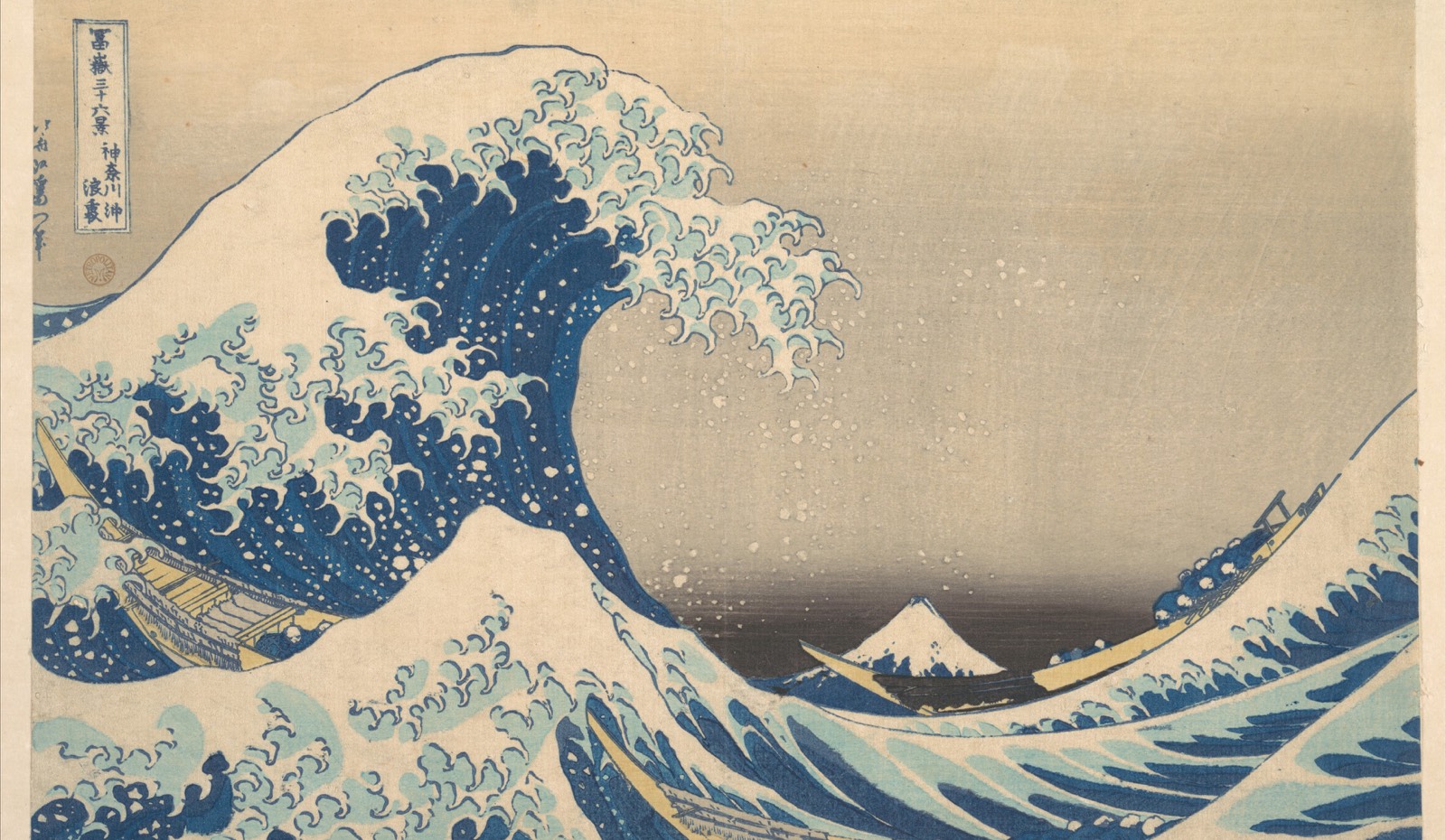
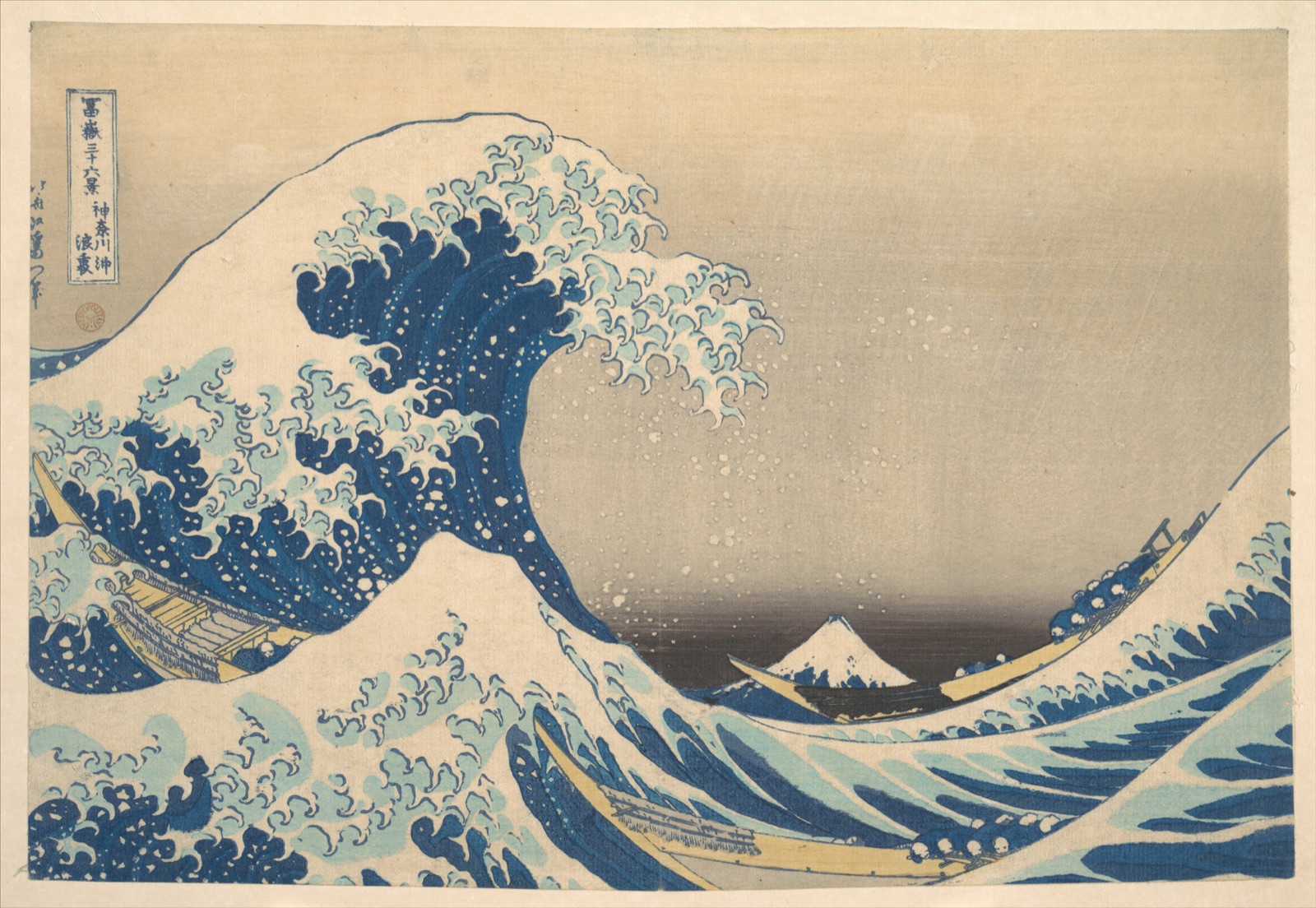
Image reference: Under the Wave off Kanagawa by Katsushika Hokusai.
At a Glance
- Datesprincipally the late seventeenth to late nineteenth century
- Main settingthe Edo period, 1603–1868, with an important Meiji continuation
- Primary centreEdo, with related production in Kyoto and Osaka
- Formspaintings, woodblock prints, illustrated books and drawings
- Productionusually publisher, designer, block cutter and printer working together
- Major subjectsactors, courtesans and townswomen, pleasure quarters, erotica, travel, famous places, warriors, history, literature, nature and current events
- Known forincisive line, flat and graded colour, bold cropping, patterned surfaces, unusual viewpoints, series publishing and close exchange between image and text
- Key cautionukiyo-e was not all Japanese art of the Edo period, and it was not created in order to influence Europe
- NationalityJapanese
- Core artistsMoronobu · Harunobu · Utamaro · Sharaku · Hokusai · Hiroshige
Contents
- Where Ukiyo-e fits
- What “the floating world” means
- How an Ukiyo-e print was made
- Four stages
- Artists to know
- Landscape, travel and the Utagawa age
- How to look at Ukiyo-e
- Essential works and designs
- Ukiyo-e, Europe and Japonisme
- Where to see Ukiyo-e
Where Ukiyo-e fits
Hishikawa Moronobu
Principal activitySuzuki Harunobu
Principal activityTorii Kiyonaga
Principal activityKitagawa Utamaro
Principal activityTōshūsai Sharaku
Principal activityKatsushika Hokusai
Principal activityUtagawa Kunisada
Principal activityUtagawa Kuniyoshi
Principal activityUtagawa Hiroshige
Principal activityTsukioka Yoshitoshi
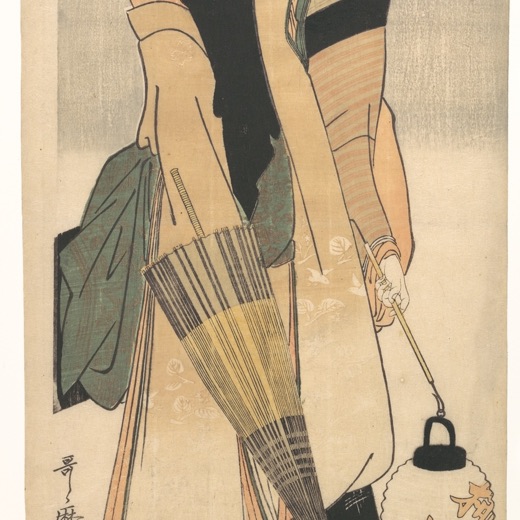
Principal activityUkiyo-e turned the passing life of Japan's great cities into one of the world's most inventive visual cultures. A theatre actor freezes at the height of a dramatic pose. A fashionable woman pauses over a letter. Travellers bend into rain. A wave rises above fast boats while Mount Fuji sits almost impossibly small in the distance. Such images can feel immediate, yet their immediacy was carefully constructed through drawing, carving, printing, publishing and a deep knowledge of contemporary fashion, theatre, poetry and place.[1] [5]
The familiar translation, “pictures of the floating world,” is useful if it is not allowed to become a vague label for all Japanese prints. Ukiyo-e was a long and changing tradition of paintings, illustrated books, drawings and prints. It developed most powerfully in Edo—present-day Tokyo—from the late seventeenth century, flourished under the Tokugawa shogunate and continued to change after the Meiji Restoration of 1868. It was neither an artists' society nor a movement with a manifesto. It was a school, a publishing culture and a way of picturing urban experience.[2] [7]
Colour woodblock prints became its most reproducible and internationally famous form, but even those sheets were not made by a designer working alone. Publishers commissioned projects and judged markets; designers drew; expert cutters translated lines into cherrywood; printers layered water-based colour on paper. The name of Hokusai or Hiroshige identifies the designer, not every hand responsible for the object. Seeing this collaboration clearly makes ukiyo-e more, not less, remarkable.[3] [8]
What does “the floating world” mean?
The word ukiyo carried a deliberate play on language. In Buddhist usage, a homophone evoked the sorrowful, unstable world of earthly existence. Seventeenth-century writers substituted a character meaning “to float” and redirected impermanence toward enjoyment of the present. In 1661, the writer Asai Ryōi described a life given to moonlight, snow, cherry blossom, maple leaves, song, drink and drifting with the current. Adding e, “picture,” produced an apt name for images of fleeting appearances and pleasures.[2] [16]
That literary formulation is evocative, but it is not a membership rule. Ukiyo-e subjects went far beyond pleasure. They included manual labour, pilgrimage, storms, monsters, famous battles, children, plants, parody, advertising and news-like spectacle. Nor was the “floating world” socially free. Its most glamorous images often centred on kabuki and the licensed Yoshiwara pleasure quarter, tightly regulated spaces in which celebrity, consumption and coercion coexisted.
The phrase therefore works on several levels. It identifies theatres and pleasure districts; it acknowledges fashion's rapid changes; it describes a commercial image market hungry for novelty; and it can carry older ideas about life's transience. A rain shower vanishes, an actor leaves a role, a beauty ages, a woodblock wears down. Ukiyo-e repeatedly converts that instability into an object that can circulate.[5] [21]
Edo, entertainment and a market for images
Edo grew into a vast political and commercial centre under Tokugawa rule. Samurai administrators, merchants, craftspeople and service workers lived within an ordered society whose official status system did not prevent prosperous townspeople from developing a powerful consumer culture. Kabuki theatres, restaurants, teahouses, publishers and the Yoshiwara created interconnected markets for information and desire.[2]
Prints operated within those networks. Actor images could appear in connection with a current production, functioning as souvenirs, publicity and celebrity portraits. Images of courtesans circulated names, houses, clothes and reputations. Illustrated books joined pictures to comic fiction, travel knowledge, poetry or erotic narrative. A buyer did not need to approach a court or temple patron to encounter art; prints were sold through publishers and shops, and successful designs could reach large audiences.[5] [20]
Affordability should not be confused with simplicity. Many sheets require knowledge of actor crests, poetic place names, classical literature, seasonal signs or puns. Privately commissioned surimono paired verse with images for restricted circles and could use unusually fine paper, embossing, metallic pigments and exacting printing. Popular and learned culture were not opposites. A print could be inexpensive entertainment for one reader and an intricate field of allusions for another.[6] [21]
The publishing trade also encouraged serial attention. A title such as Thirty-six Views of Mount Fuji, Fifty-Three Stations of the Tōkaidō or One Hundred Famous Views of Edo invited viewers to recognise a larger project and anticipate another sheet. Cartouches, publisher marks, signatures and censorship seals became part of the design. The modern museum habit of isolating one masterpiece can obscure the rhythm of collecting a series over time.
More than prints
Ukiyo-e is often used as if it meant “Japanese colour woodblock print.” That shortcut leaves out painting. Artists now celebrated for reproducible designs also produced hanging scrolls, handscrolls, screens and albums. Paintings were unique objects and could command major commissions. The Museum of Fine Arts, Boston, holds more than seven hundred ukiyo-e paintings, evidence of a substantial field rather than a marginal supplement to print history.[18]
Hishikawa Moronobu's painted Standing Courtesan shows how fashion, textile design and bodily presentation moved across media. The artist came from a textile-designing family, and the robe's complex patterns are not secondary decoration. They locate a figure within a world of material skill, luxury and looking.[23]
Books are equally important. Moronobu first gained renown as an illustrator. By the eighteenth century, publishers brought together verse, prose and images in formats ranging from cheap popular books to luxurious poetry anthologies. The National Diet Library connects the rise of nishiki-e and refined colour books to a system in which publisher capital, designer invention, cutting and printing worked together.[8]
How an ukiyo-e print was made
The finished sheet compresses many stages into one surface. A publisher normally initiated or financed a project, matched subject and artist to likely demand, coordinated craftspeople and arranged sale. The designer prepared an image in ink. A final drawing was pasted face-down on a block and cut away in the process of creating the key block, which preserved the principal contours and text. Proofs from that block could guide colour separation.[3] [11]
Each additional colour required a printable area on another block or another face of a block. Registration marks called kento allowed dampened paper to be placed consistently. The printer brushed water-based pigments onto the relief surface, positioned the paper and rubbed its back with a baren. Repeating the operation built the image colour by colour. The apparent lightness of a finished print depended on physical precision.
The roles were specialised but interactive. A cutter had to decide how a brush line would survive translation into relief, sometimes preserving hair-thin contours or the swelling force of calligraphy. A printer controlled moisture, pigment density and pressure and could create bokashi, the graded colour visible in skies, water and shadows. Publishers could request alterations, approve proofs and change colours in later runs. “By Hokusai” remains useful shorthand for design authorship, but the printed object records a team. Specialist Japanese workshops continue this division of skilled labour today.[12] [25] [35]
From black line to brocade colour
The earliest single-sheet ukiyo-e prints were normally sumizuri-e, printed in black ink. Colour might then be added by hand. Terms such as tan-e, beni-e and urushi-e identify different palettes or surface effects, while benizuri-e used a small number of colour blocks. These were not merely incomplete steps toward a predetermined full-colour goal. Strong black line and reserved paper created their own aesthetics.[4] [14]
Around 1765, full polychrome printing reached a new level in Edo. The resulting nishiki-e—“brocade pictures”—could layer numerous colours with accurate registration. Calendar commissions and competitive connoisseurship helped encourage the change. Suzuki Harunobu became its most celebrated early designer, though no complex production technology should be credited to one artist alone. Publishers, cutters and printers made the advance possible.[1] [9]
Colour did not eliminate material variety. Printers used embossing without ink, mica grounds that catch light, burnishing, powdered metal and delicate gradation. Formats shaped meaning: narrow pillar prints suited architectural interiors; vertical and horizontal ōban sheets supported portraits and landscapes; diptychs and triptychs extended action across separate pieces of paper. Illustrated books offered sequences and page turns impossible in a single sheet.
A design is not one unchanging object
Two impressions from the same blocks can look markedly different. Early printings may preserve delicate lines and carefully modulated colour. As blocks wear, edges soften. A publisher might alter pigments, omit a printing stage or simplify a gradient. Individual sheets can later be trimmed, backed, faded or repaired. Organic colours are especially vulnerable to light.[15] [20]
This is why “the original Great Wave” is a misleading phrase if it suggests one painted source object. Many impressions were printed from the design's blocks, and museums hold several. Each is an original period impression in a qualified sense, but its colour, line and condition have an individual history. Comparing copies teaches us about publishing decisions as well as preservation.
Follow Ukiyo-e through four stages
–1740
Urban genre painting and the printed line
Moronobu and the Torii school help establish books, single-sheet pictures, actor images, beauties and pleasure-quarter subjects through monochrome, hand-coloured and limited-palette printing.
–1800
Colour, celebrity and the publisher's golden age
Full polychrome nishiki-e expands colour and narrative as Harunobu, Kiyonaga, Utamaro and Sharaku reshape intimate scenes, women and actor portraiture.
–1858
Books, travel, landscape and Utagawa reach
Hokusai, Hiroshige, Kuniyoshi and Kunisada enlarge the market for landscape, travel, warriors, actors, literature and ambitious multi-sheet design.
–1890s
Upheaval, news and transformation
Late Utagawa artists and Yoshitoshi address political change, new technology and Meiji life as photography and lithography alter the old publishing ecology.
Stage one: the printed line, c. 1670–1740
Ukiyo-e emerged from earlier genre painting and book culture rather than appearing fully formed. Moronobu helped make the human figure, fashionable clothing and the social spaces of Edo compelling subjects for books, single-sheet prints and paintings. His workshop's bold contours gave reproducible images a strong graphic identity.[8] [24]
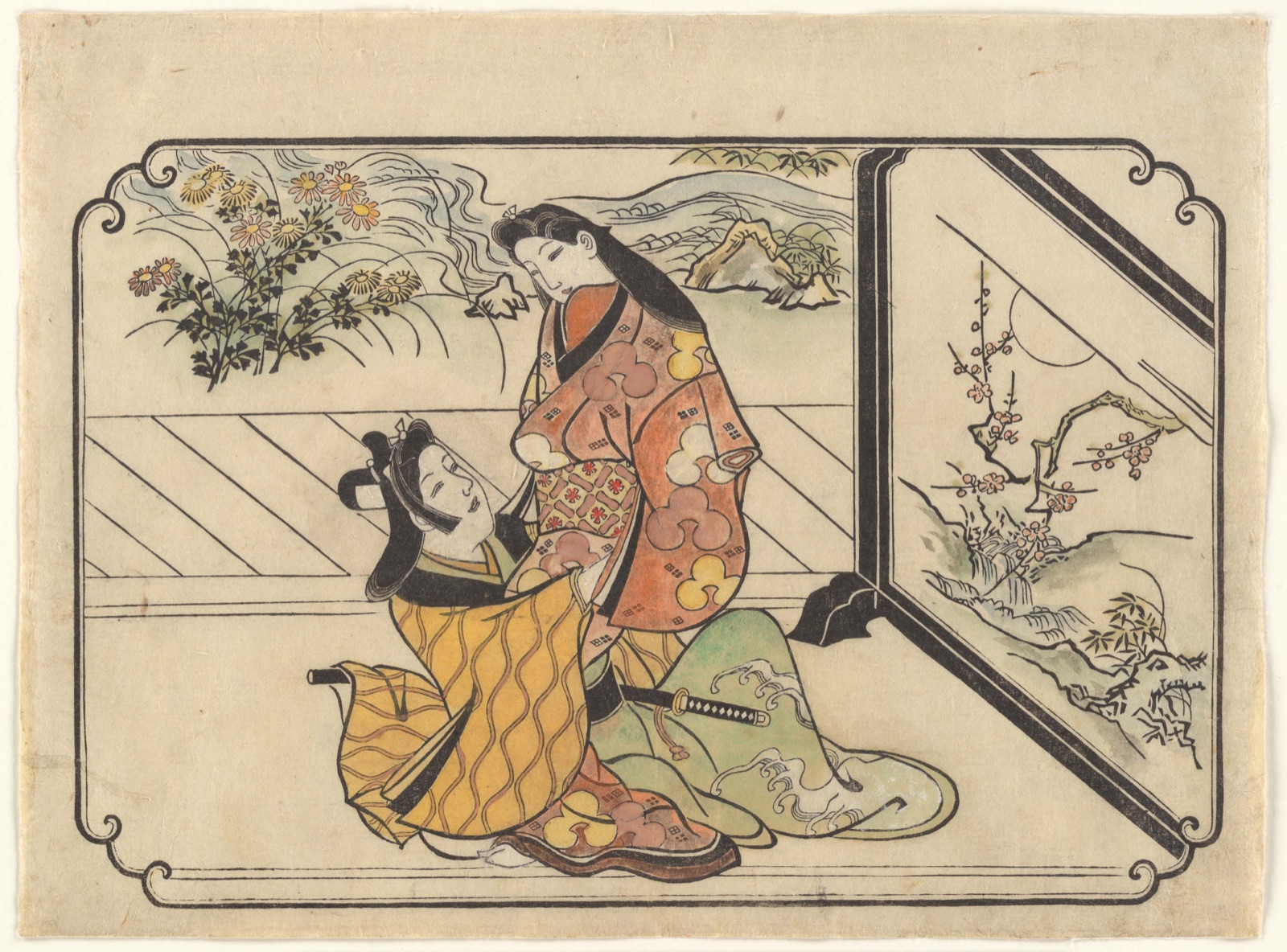
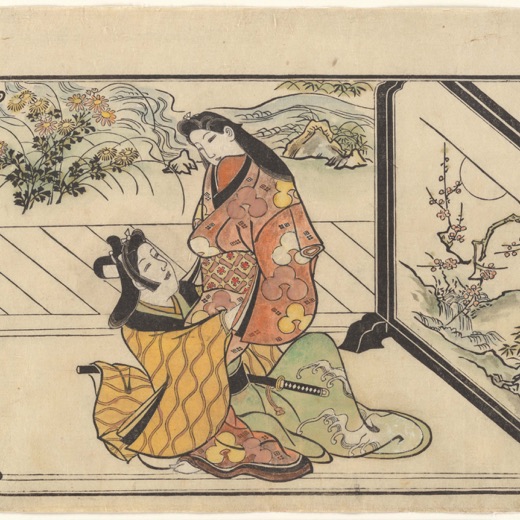
An early Moronobu-associated sumizuri-e can be read through what black line accomplishes. Curving robes, screens and figures are not coloured mechanically; their varied widths recall the movement of a brush while clarifying pattern for print. In Courtesan with a Young Man beside a Screen, restrained hand colour accompanies the printed structure. The couple includes a wakashu, a male youth identified by hairstyle, reminding viewers that floating-world desire was not confined to heterosexual pairings or to modern gender categories.[24]
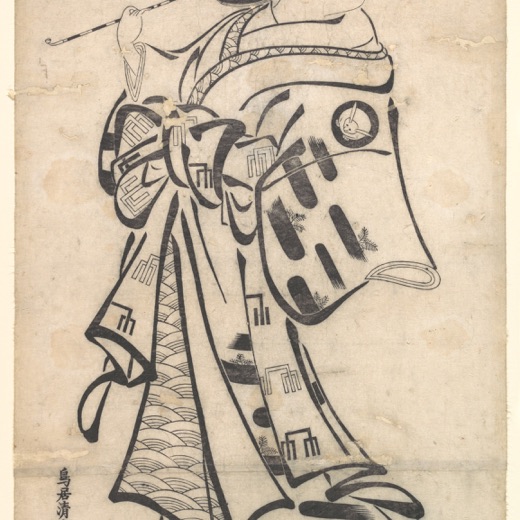
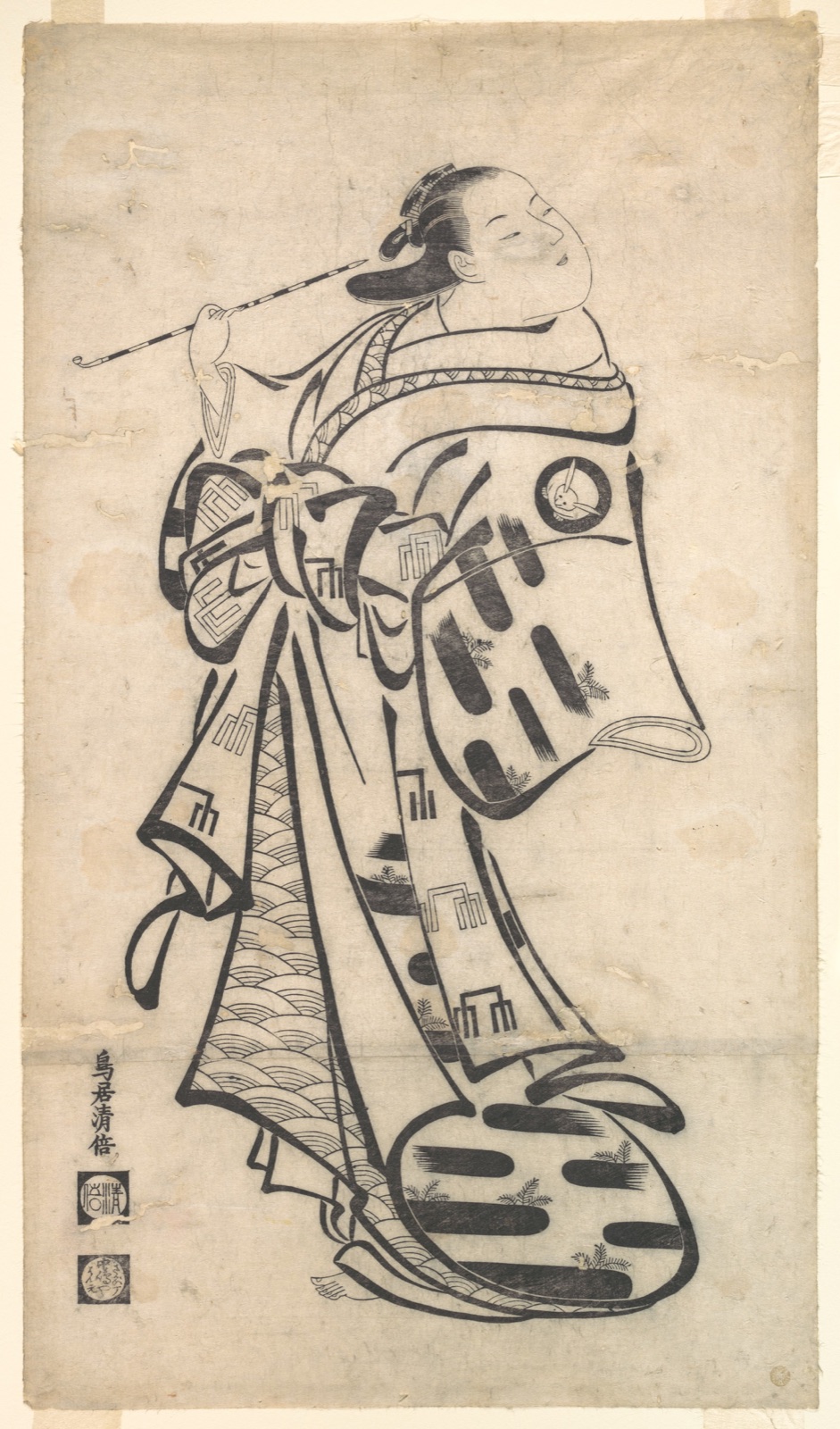
The Torii school became closely associated with kabuki imagery. Torii Kiyonobu I and Torii Kiyomasu I developed figures whose swelling, energetic lines could carry stage action into a still image. Kiyomasu's standing courtesan shows the opposite possibility: a long, controlled figure built from robust outer contours and delicate textile patterns. The cutter's translation makes the drawn line both more regular and more materially forceful.[25]
Early prints also reveal constant borrowing. A pose might move from one designer to another; an old religious or literary figure might be recast as contemporary fashion; the same actor crest could identify a theatrical lineage across generations. Modern expectations of novelty and individual ownership do not map neatly onto this visual economy.
Stage two: colour, beauty and actor celebrity, c. 1740–1800
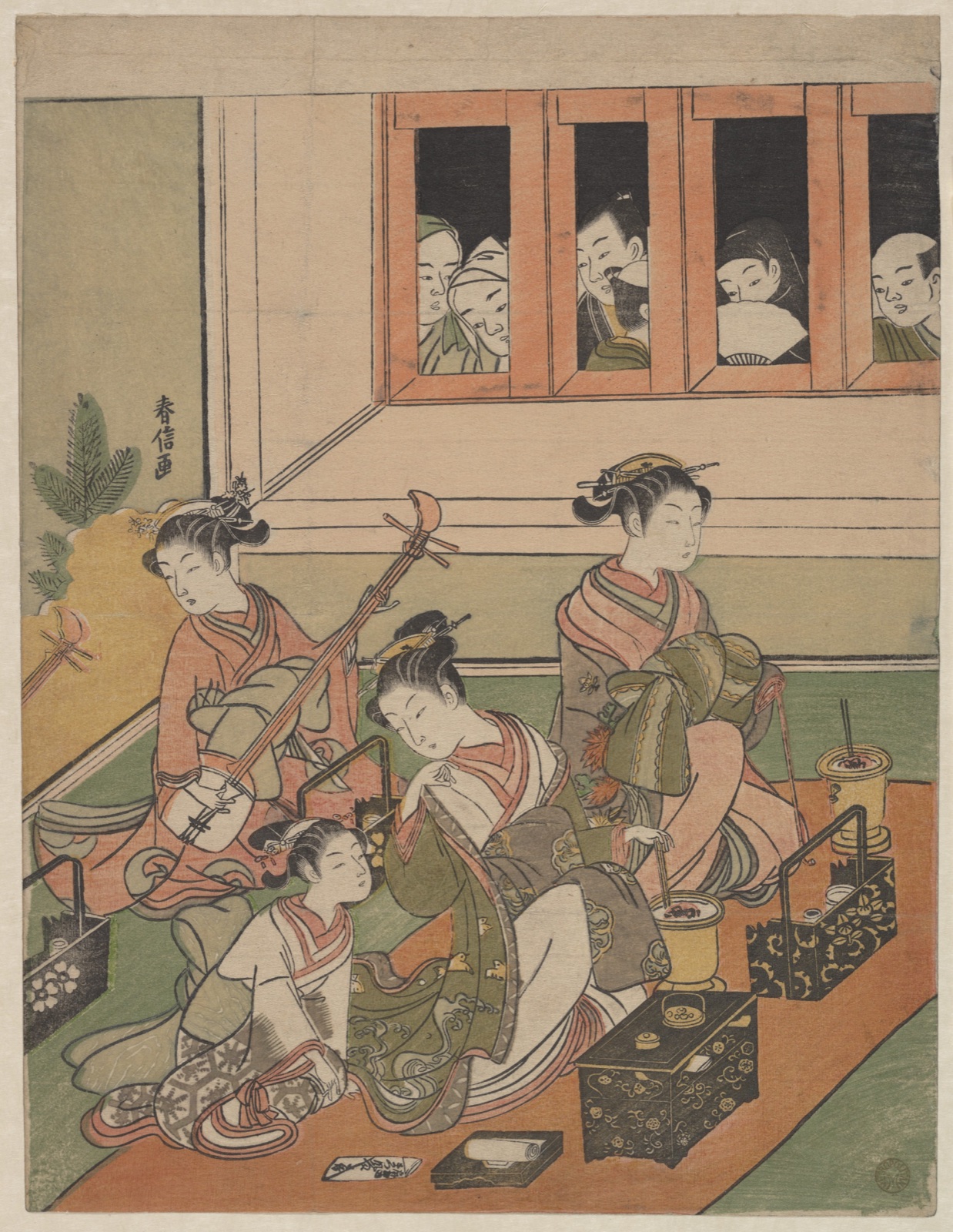
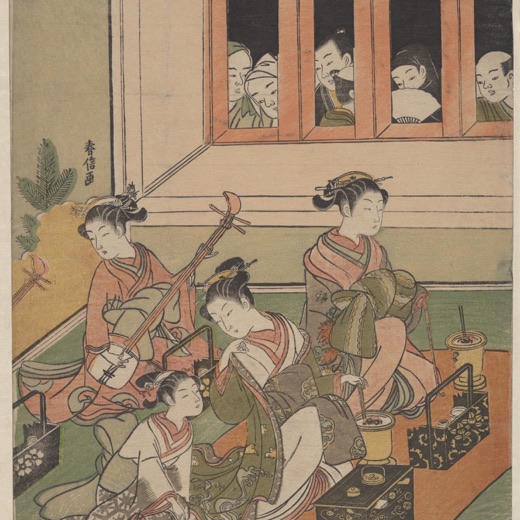
Harunobu's polychrome prints did more than add hues to earlier outlines. Colour could organise intimacy and attention. In The Watchers and the Watched, men crowd a window while courtesans occupy a richly described interior. Frames within the image separate observers from observed. The viewer receives privileged access but is also made aware of looking as an activity. Sumptuous clothing and refined colour beautify the scene; the window exposes the commercial gaze sustaining it.[22]
Harunobu frequently placed slender young figures within contemporary versions of classical poems or stories. The distance between old reference and modern clothes created wit for informed audiences. His work demonstrates why ukiyo-e should not be divided into “decorative pictures” and “serious literature.” The pleasure lies partly in recognising both at once.
Katsukawa Shunshō and his followers pushed actor prints toward recognisable likeness. A kabuki actor represented a role, a performance lineage and a public personality. The printed face could combine the climax of a character with traits associated with the performer. These sheets were topical: theatre-goers wanted the actors and productions of their own moment.[4] [5]
Torii Kiyonaga expanded figures into stately groups whose bodies, architecture and landscape unfold across diptychs and triptychs. Kitagawa Utamaro then made the close-up image of a woman—especially the ōkubi-e, or large-head portrait—a field of subtle distinction. A tilt of the head, arrangement of hair, transparency of fabric or movement of fingers could separate one type, mood or named sitter from another.[19] [30]
Yet “beauty print” is not a neutral category. Bijin-ga includes high-ranking courtesans, geisha, townswomen, fictional figures and ideal types. Some women became celebrities whose names carried market value. Many lived under binding contracts and sexual exploitation. Prints could advertise them while concealing exhaustion, debt, illness and restricted movement. It is possible to admire Utamaro's control of line and gesture while refusing to mistake an elegant image for a complete social record.[21]
Publisher Tsutaya Jūzaburō was central to this late eighteenth-century culture. Based in the Yoshiwara publishing world, he promoted Utamaro and the mysterious Tōshūsai Sharaku, pairing artistic invention with commercial judgement. His role undermines the idea that publishers were passive manufacturers who simply reproduced finished art.[13]
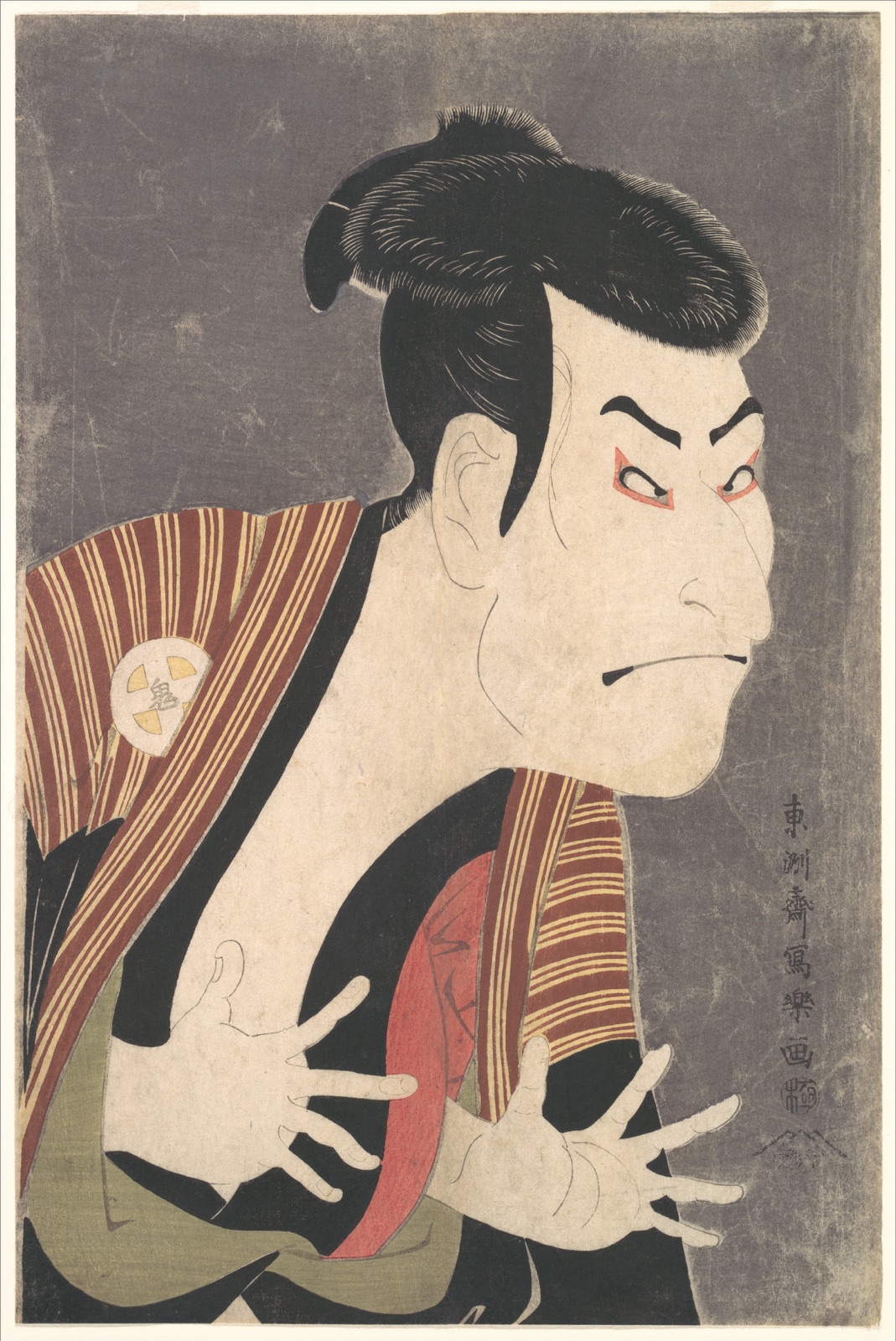
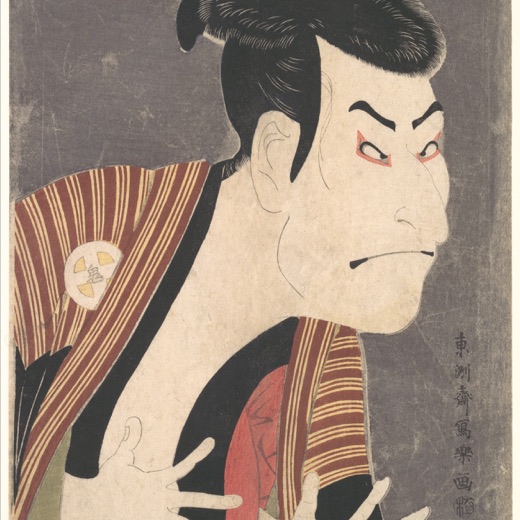
Sharaku's 1794 Kabuki Actor Ōtani Oniji III as Yakko Edobei is almost confrontational. The actor leans forward with bent fingers, bristling hair and a compressed, leering face. He plays a villainous servant, yet the portrait also seems to expose the performer within the role. A dark mica ground removes ordinary setting and sharpens the silhouette. Gesture, costume and physiognomy meet at the instant of theatrical threat.[26]
Sharaku's concentrated period of activity and uncertain identity have invited speculation. The mystery should not overwhelm the prints. Their force depends on a specific performance culture, on the publisher's project and on a cutter and printer capable of preserving exaggeration without flattening it into caricature.
Artists to know
Katsushika Hokusai
Hokusai's long career crossed actor prints, books, surimono, manuals, nature studies, ghosts and landscape. His Fuji series joined sacred place to labour, travel, weather and serial invention. [27] [40]
Utagawa Hiroshige
Hiroshige turned roads, bridges, post stations and changing weather into sequences of felt experience. Abrupt foregrounds and difficult rain effects transformed the famous-place print. [28] [34]
Major artists directory
| Name | Nationality | Key Works |
|---|---|---|
| Chōbunsai Eishi | Japanese | Elegant beauties, Pleasure-quarter triptychs |
| Hishikawa Moronobu | Japanese | A Visit to the Yoshiwara, Courtesan with a Young Man beside a Screen |
| Isoda Koryūsai | Japanese | Courtesans of the Chōjiya, Pillar prints |
| Katsukawa Shunshō | Japanese | Actor portraits, Bijin-ga |
| Katsushika Hokusai | Japanese | Under the Wave off Kanagawa, Fine Wind, Clear Morning |
| Keisai Eisen | Japanese | Beauties of the Yoshiwara, Kisokaidō series |
| Kitagawa Utamaro | Japanese | Three Beauties of the Present Day, Geisha |
| Kobayashi Kiyochika | Japanese | One Hundred Views of Musashi, Tokyo night scenes |
| Nishikawa Sukenobu | Japanese | Hyakunin jorō shinasadame, Illustrated books |
| Ochiai Yoshiiku | Japanese | Actor portraits, News prints |
| Okumura Masanobu | Japanese | Perspective Picture of the Interior of a Theatre, Lacquer prints |
| Suzuki Harunobu | Japanese | The Watchers and the Watched, Evening Bell at the Clock |
| Torii Kiyomasu I | Japanese | An Oiran Standing, Kabuki actor prints |
| Torii Kiyonaga | Japanese | Women at a Bathhouse, Pleasure-quarter triptychs |
| Torii Kiyonobu I | Japanese | Actors in a Dance, Kabuki actor prints |
| Toyohara Kunichika | Japanese | Actor triptychs, Thirty-Six Good and Evil Beauties |
| Tsukioka Yoshitoshi | Japanese | One Hundred Aspects of the Moon, Waking Up: A Girl of the Kōka Era |
| Tōshūsai Sharaku | Japanese | Kabuki Actor Ōtani Oniji III as Yakko Edobei, Actor Ichikawa Ebizō |
| Utagawa Hiroshige | Japanese | Sudden Shower over Shin-Ōhashi Bridge and Atake, Fifty-Three Stations of the Tōkaidō |
| Utagawa Hiroshige II | Japanese | One Hundred Famous Views in the Various Provinces, Famous places |
| Utagawa Kunisada | Japanese | The Thirty-Six Immortals of Poetry as Kabuki Actors, Actor portraits |
| Utagawa Kuniyoshi | Japanese | Takiyasha the Witch and the Skeleton Spectre, The 108 Heroes of the Popular Suikoden |
| Utagawa Sadahide | Japanese | Complete Picture of the Newly Opened Port of Yokohama, Panoramic prints |
| Utagawa Toyoharu | Japanese | Perspective prints, Famous places |
| Utagawa Toyokuni I | Japanese | Yakusha butai no sugata-e, Actor prints |
| Utagawa Yoshitora | Japanese | Yokohama prints, Warrior triptychs |
Women, sex and the limits of the glamorous view
Ukiyo-e includes a vast erotic field now commonly called shunga, “spring pictures.” Artists across the tradition designed erotic books, albums, scrolls and prints. Some images are comic or fantastic; others focus on married couples, courtesans, youths or same-sex encounters. They circulated among different audiences and were not a secret exception to an otherwise decorous school.[4] [24]
The pleasure quarters also generated artistic and literary accomplishment. Courtesans could be trained in music, poetry and calligraphy, and images sometimes depend on that learning. But the culture's refinement must not become an excuse for erasing violence. The Yoshiwara was government licensed and commercially organised. The women represented as fashion authorities or romantic protagonists often lacked control over the terms of their labour.[2] [21]
Close looking can hold these truths together. A viewer may study the extraordinary carving of hair, the patterned layering of robes and the intelligence of a sitter's gesture, then ask what the image sells and whose perspective it privileges. Harunobu's watching men, Utamaro's named beauties and anonymous erotic protagonists do not give identical answers.
Text, poetry and the art of allusion
Words are not intrusions into ukiyo-e. Titles, poems, dialogue, actor names, publisher marks and seals often organise the image. A viewer might need to read a poem to understand why a plant, garment or place matters. Rebus and pun could connect the visible subject to something unstated.[6]
Techniques called mitate and yatsushi reimagined established themes. A classical poet might appear as a fashionable townsperson; a scene from The Tale of Genji could be rebuilt in contemporary Edo; a historical hero might be displaced into a permitted period. Such transformations were playful, erudite and sometimes useful under censorship.[39]
Surimono intensified the exchange. Privately ordered for poetry groups or special occasions, these prints were not normally sold through the ordinary market. Their imagery and verse could require insider knowledge. Fine paper, blind embossing and metallic effects rewarded close handling. The category prevents a simple opposition between mass print and elite art: the same collaborative technology served both broad commerce and restricted circles.[3] [21]
Stage three: landscape, travel and the Utagawa age, c. 1800–1858
Landscape became a major commercial force in the nineteenth century, but it did not emerge from nowhere. Earlier painters and printmakers had pictured famous places, and Okumura Masanobu and Utagawa Toyoharu experimented with Western-style perspective. After the shogunate relaxed restrictions on non-Christian foreign books in 1720, imported European images offered selective lessons in recession and shadow. Japanese artists adapted these devices rather than replacing local spatial systems.[9] [40]
Travel culture supplied audiences and subjects. Roads improved under Tokugawa administration; compulsory movement by domain lords sustained traffic; pilgrims, merchants and sightseers travelled; guidebooks turned temples, viewpoints and post stations into recognisable destinations. By the early nineteenth century, a journey could be imagined through pictures even by someone who stayed in Edo.[5] [9]
Hokusai and a world organised around Fuji
Hokusai worked across actor prints, illustrated books, privately commissioned prints, manuals, flowers and birds, ghosts and landscapes during an exceptionally long career. His Thirty-six Views of Mount Fuji, issued from around 1830, joined a sacred and nationally resonant mountain to labour, weather, travel and everyday ingenuity. Imported Prussian blue helped give the early sheets a striking chromatic identity.
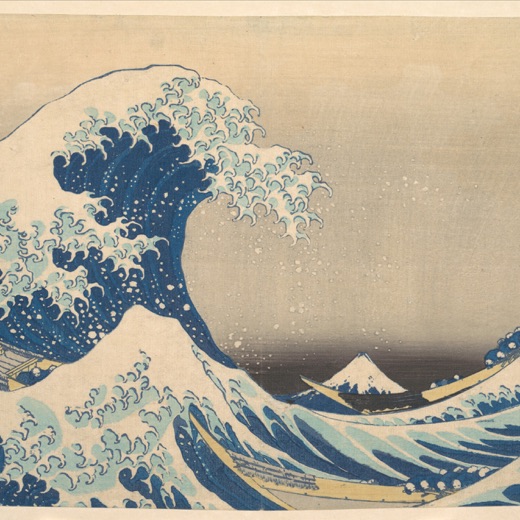
Under the Wave off Kanagawa is the series' most famous design, but familiarity can erase its structure. Three narrow boats race across a rough sea. Their crews bend low, repeating the hulls' curves. A huge wave curls above them, its foam dividing into claw-like fingers. Fuji sits inside the wave's hollow, visually rhymed with a smaller crest while remaining the composition's most stable form.[27]
The image is not simply “nature versus humanity.” These are working boats, not anonymous victims placed in a universal disaster. The print joins maritime labour, a fast urban economy, a revered mountain and the technical drama of blue. It is also one sheet in a series that repeatedly changes Fuji's scale and role.
Fine Wind, Clear Morning, often called Red Fuji, reverses the drama. The mountain occupies most of the sheet, and small touches of cloud cross the blue sky. Repeated printing matters here: surviving impressions vary in sky, slope and colour, changing the time and atmosphere a viewer perceives.
Hiroshige: weather, travel and the near view
Hiroshige developed another landscape language. His Fifty-Three Stations of the Tōkaidō made post stations, rivers, mountains and travellers into a sequence of changing conditions. Human figures are often small, but their postures tell us how cold, rain, ascent or waiting feels.[29]
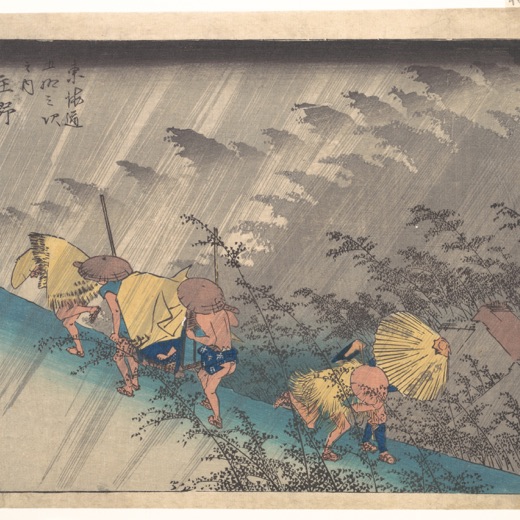
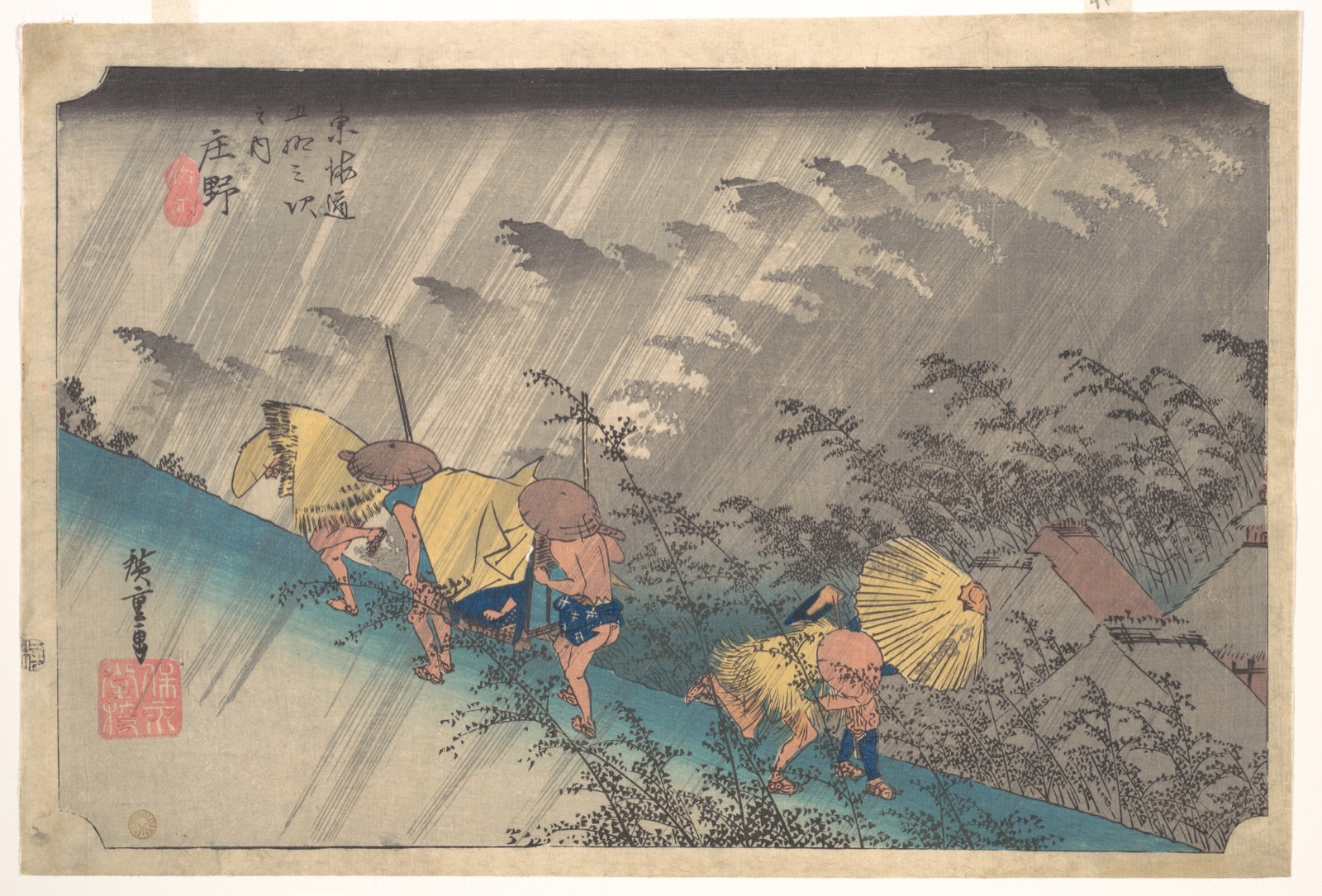
In Sudden Shower at Shōno, rain cuts diagonally across a hillside while porters and villagers run in opposite directions. Trees bend, a palanquin tilts and the road becomes a steep stage for effort. The scene may be largely invented rather than a faithful record of Shōno. Its truth is experiential: the suddenness of being caught outside.[29]
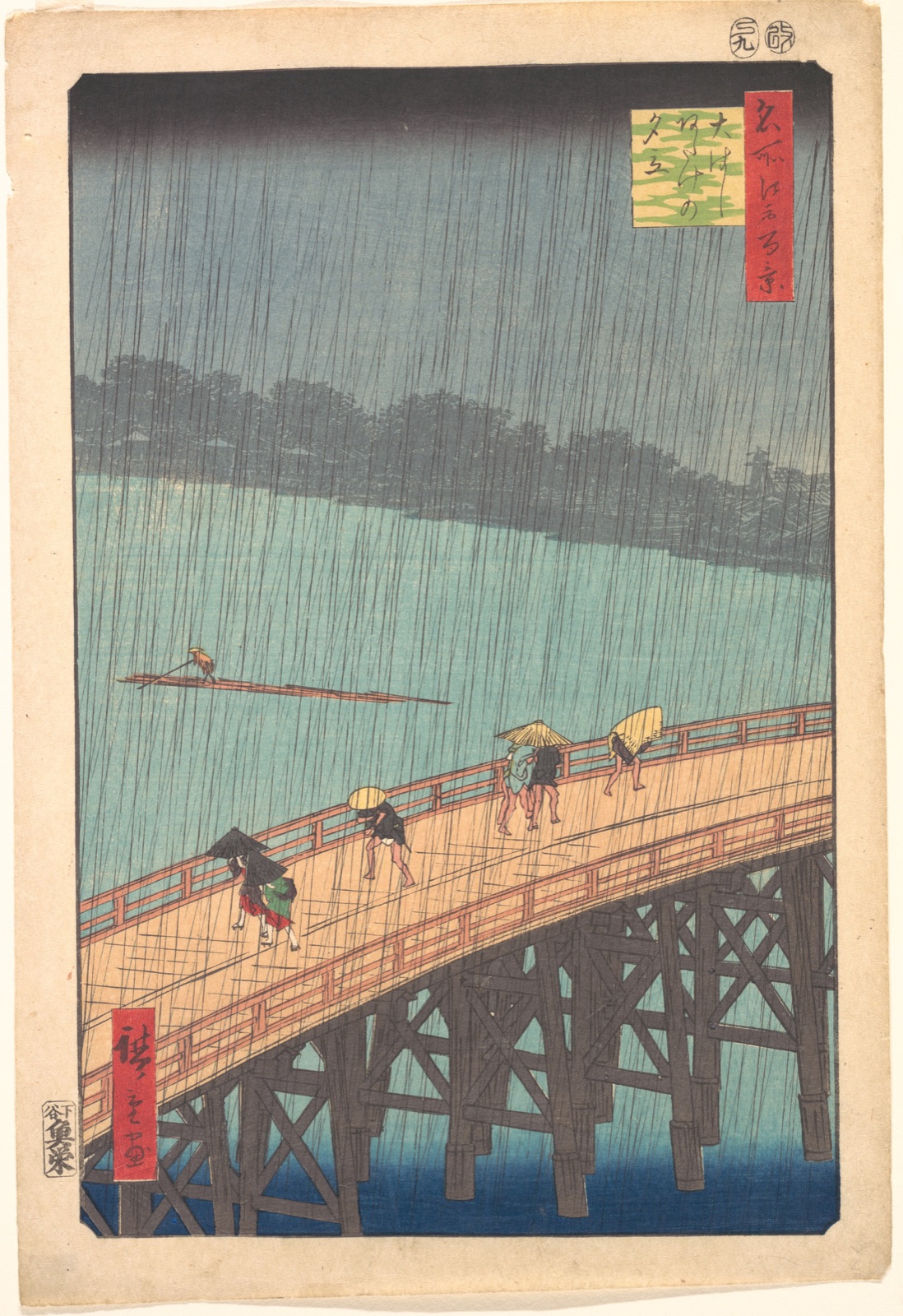
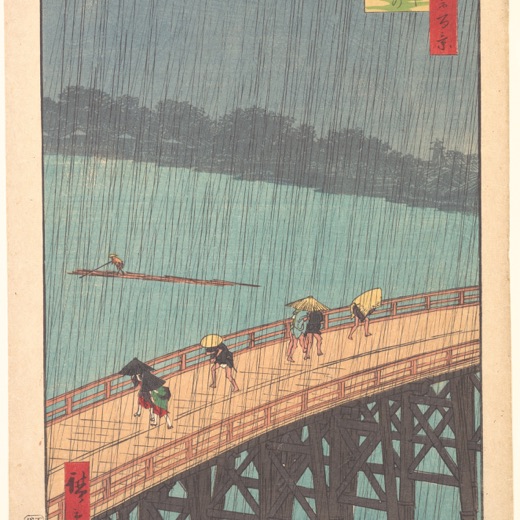
The later Sudden Shower over Shin-Ōhashi Bridge and Atake uses a vertical format. The dark bridge crosses low through the picture as figures hurry beneath umbrellas. Beyond it, a boatman is exposed on the river. Fine slanting lines create rain across water, wood and sky—a demanding cutting and printing problem. The far shore nearly dissolves, while the close bridge remains an emphatic bar.[28]
Hiroshige's One Hundred Famous Views of Edo repeatedly employs such abrupt foregrounds: a bridge support, branch, wheel or banner may crop the view. These devices make the city feel encountered rather than surveyed from nowhere. They also became especially influential when European artists later studied Japanese prints.[34]
Kunisada, Kuniyoshi and the range of the Utagawa school
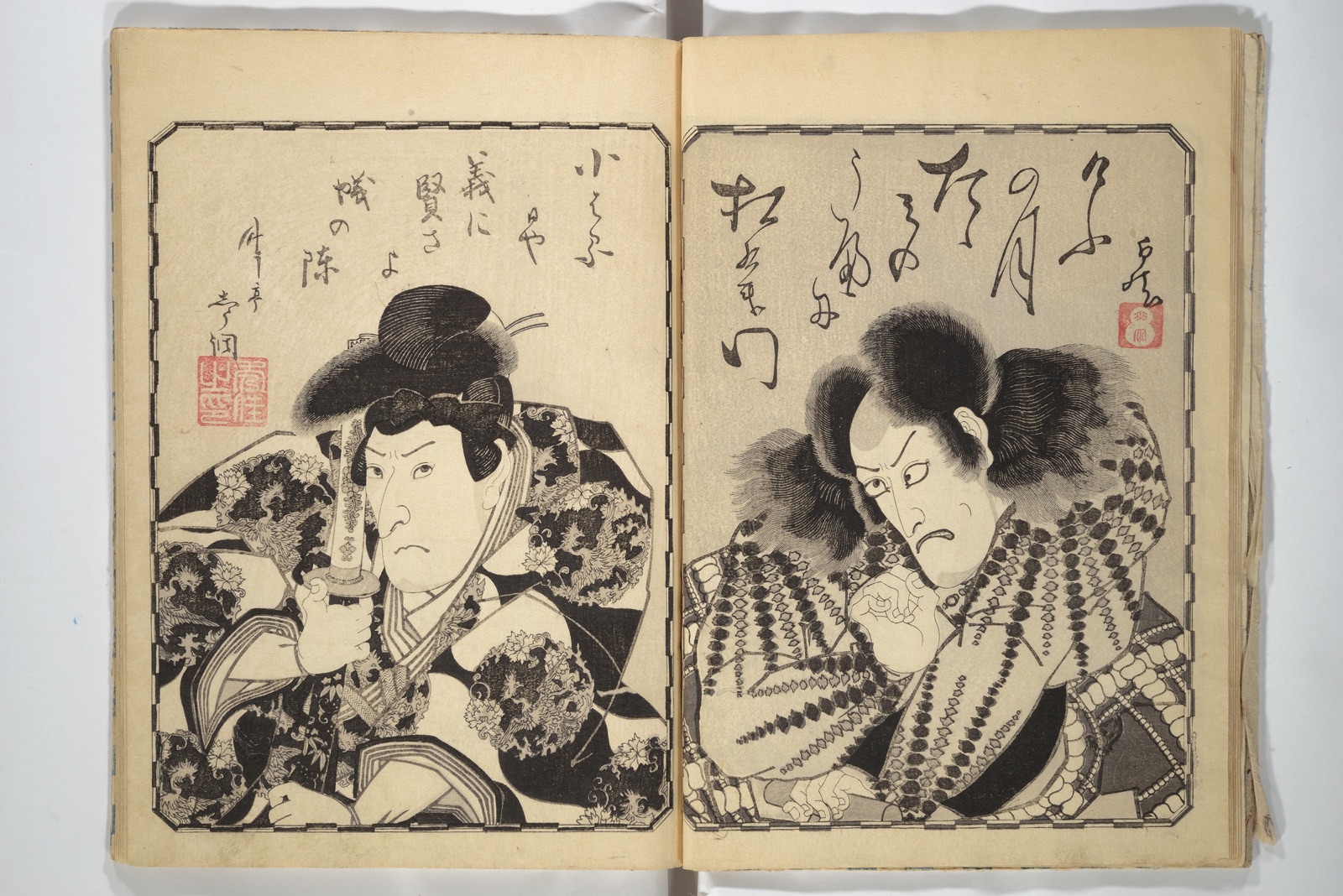
The fame of two landscape masters can distort the nineteenth century. Utagawa Kunisada was extraordinarily productive and successful, especially in actor prints and images of women. His illustrated Thirty-Six Immortals of Poetry as Kabuki Actors layers classical poetic prestige, contemporary performers and book format. The result is not a lesser alternative to landscape but a demonstration of how completely theatre, literature and publishing remained intertwined.[31]
Utagawa Kuniyoshi ranged across warrior tales, cats, landscapes, comic images, actors and supernatural spectacle. Triptychs allowed bodies, weapons, smoke and monsters to cross the seams between sheets. The viewer reconstructs one event from three separately printed objects. Such scale was still commercial and reproducible, but it approached the visual impact of a screen.
Both artists trained in the Utagawa lineage and drew on publisher networks that dominated late Edo print culture. Their breadth makes rigid genre labels unreliable. A single project can be actor portrait, literary parody and fashion plate at the same time.[39]
Censorship, disguise and topical meaning
Publishers operated under shogunal regulation. Censorship rules changed, and seals can help date prints, but restrictions did not produce one simple opposition between authority and rebellious artists. The industry depended on approval and developed conventions for remaining legible while avoiding prohibited claims.
Historical displacement was one tool. A work could rename recent warriors as figures from an older chronicle. In Yoshitoshi's 1866 Masakiyo's Challenging Battle, characters stand in for later historical people whose direct portrayal was forbidden. The print's aliases are not merely decorative archaism; they are part of how the image negotiated publication.[33]
Parody could also shelter several meanings, though it should not automatically be treated as coded political protest. Sometimes a contemporary recasting was witty, fashionable or commercially attractive. Responsible interpretation requires evidence from title, seals, text, publication date and visual reference rather than assuming that every puzzle hides dissent.
Stage four: upheaval and transformation, c. 1858–1890s
Hiroshige died in 1858 as Japan's political order entered crisis. The fall of the Tokugawa shogunate, the restoration of imperial rule, new international trade, warfare, railways, photography and lithography altered subjects and markets. Bright imported aniline dyes changed colour. Yokohama prints pictured foreigners and unfamiliar goods. Triptychs reported battles, ceremonies, exhibitions and modern urban life.[7]
The year 1868 is therefore a turning point, not a guillotine. Utagawa artists continued working, and younger designers adapted the collaborative woodblock system. Tsukioka Yoshitoshi's career crosses the boundary. His early work includes violent historical scenes and spectacular triptychs; his later series revisit women, legend and literature with extraordinary cutting and printing finesse.
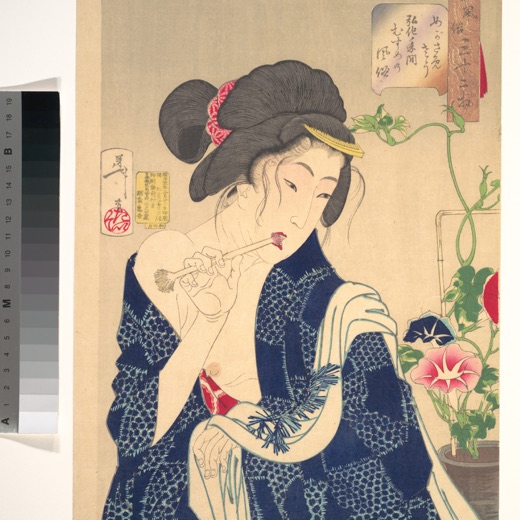
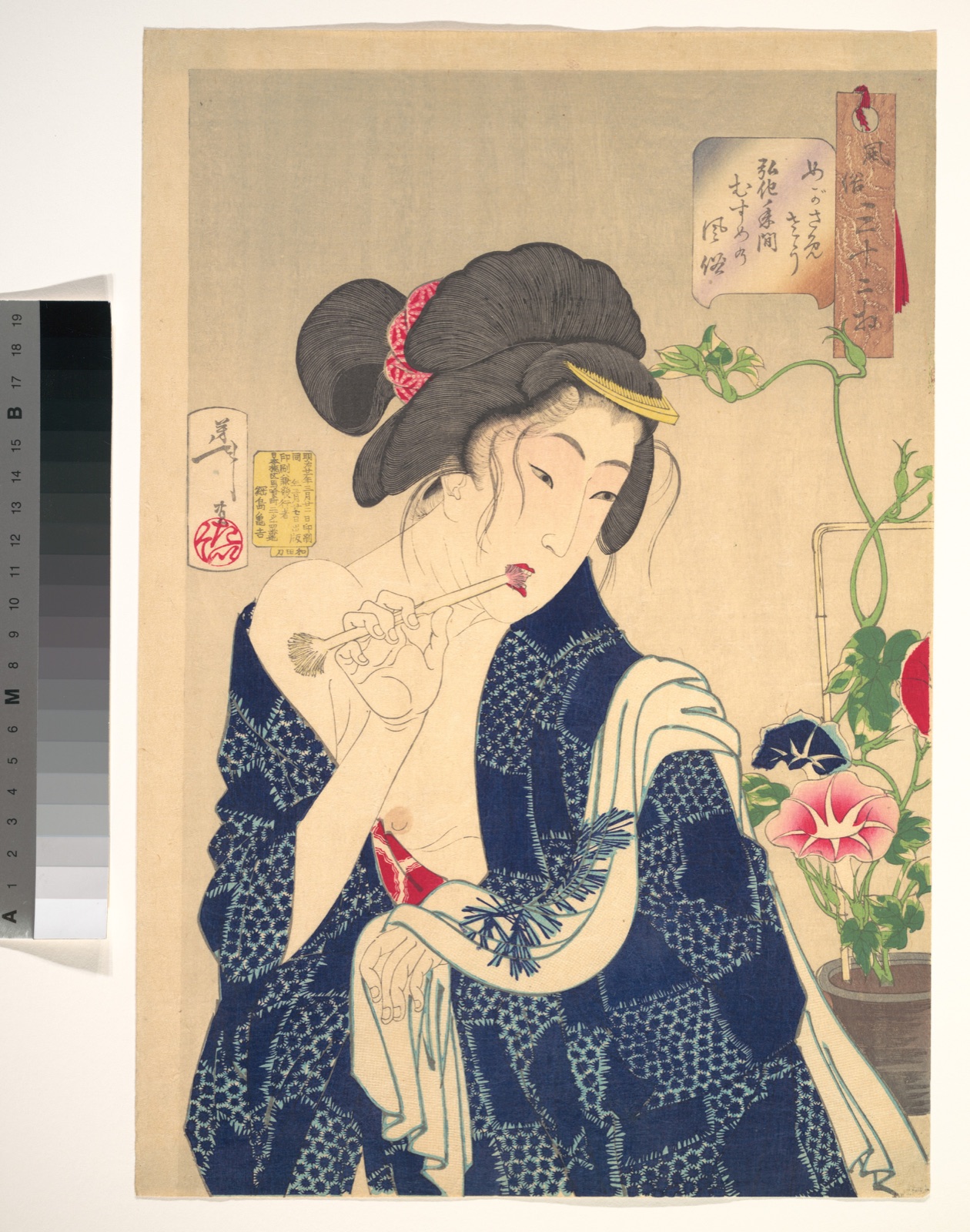
In Waking Up: A Girl of the Kōka Era, made in 1888, a woman cleans her teeth as her robe slips from one shoulder and morning glory flowers echo the hour. Hairlines test the cutter's control. The subject looks backward to a recent historical era while the series participates in Meiji reflection on changing female appearance and manners.[32]
Photography and mechanical printing competed with woodblock publishing, especially for news. Yet traditional skills did not simply disappear. In the twentieth century, shin-hanga revived publisher-led collaboration for new markets, while sōsaku-hanga promoted jiga, jikoku, jizuri—self-designed, self-cut and self-printed work—as an ideal of individual authorship. Both movements defined themselves partly through the ukiyo-e inheritance, but neither is merely its last chapter.[10]
Ukiyo-e within Edo art
Ukiyo-e should not stand in for every artwork made under the Tokugawa. The period also supported Kanō painting, Rinpa, literati painting or nanga, Buddhist art, calligraphy, ceramics, lacquer, textiles, sculpture and architecture. Artists and patrons could encounter more than one mode, and boundaries were not impermeable.[38]
The distinction matters because “Japanese style” is often imagined from the features Western modernists admired in prints: flat colour, asymmetry, cropping and pattern. Those features are real but not exhaustive. Ukiyo-e itself incorporated courtly poetry, Chinese stories, Western perspective and older painting. It was never culturally sealed.
Kyoto and Osaka also complicate an Edo-only story. Their pleasure quarters, illustrated books and actor-print traditions developed different accents. Osaka actor prints often focused intensely on performers and local theatre audiences. Edo remained the main centre from which the category takes its historical shape, not the sole place urban print culture existed.
How to look at ukiyo-e
Begin by identifying the kind of object. Is it a painting, book leaf or single-sheet print? Is the sheet one panel of a diptych or triptych? Does a museum show the full margins, or has the image been trimmed? These questions change what can be inferred.
Then look for six things:
- Line: where does it swell, taper or almost disappear? Imagine the cutter preserving the designer's brushwork in relief.
- Registration: examine the meeting of colours and contours. Slight misalignment reveals the sequence of printing.
- Surface: search for mica, embossing, burnishing, metallic powder or visible paper texture.
- Text: locate titles, poems, signatures, publishers and seals. Meaning may depend upon reading rather than image alone.
- Viewpoint: notice cropped foreground objects, high horizons, tilted interiors and competing systems of depth.
- Use: ask whether the object promoted an actor, illustrated a poem, advertised a place, marked an occasion or formed part of a series.
Do not judge colour only through a bright digital file. A museum image may record a well-preserved impression, a faded sheet or adjusted lighting. Compare impressions when possible. A later printing can be historically valuable even when its line is less crisp; it may reveal continuing demand or a publisher's changed taste.
Essential works and designs
Courtesan with a Young Man beside a Screen
Hishikawa Moronobu · late 17th century · An early printed image in which strong contour, restrained colour and social identity work together.
An Oiran Standing
Torii Kiyomasu I · early 18th century · The Torii school's forceful line translated into the controlled elegance of a standing figure.
The Watchers and the Watched
Suzuki Harunobu · 1764–72 · Early full colour becomes a way to organise spectatorship, display and the pleasure-quarter interior.
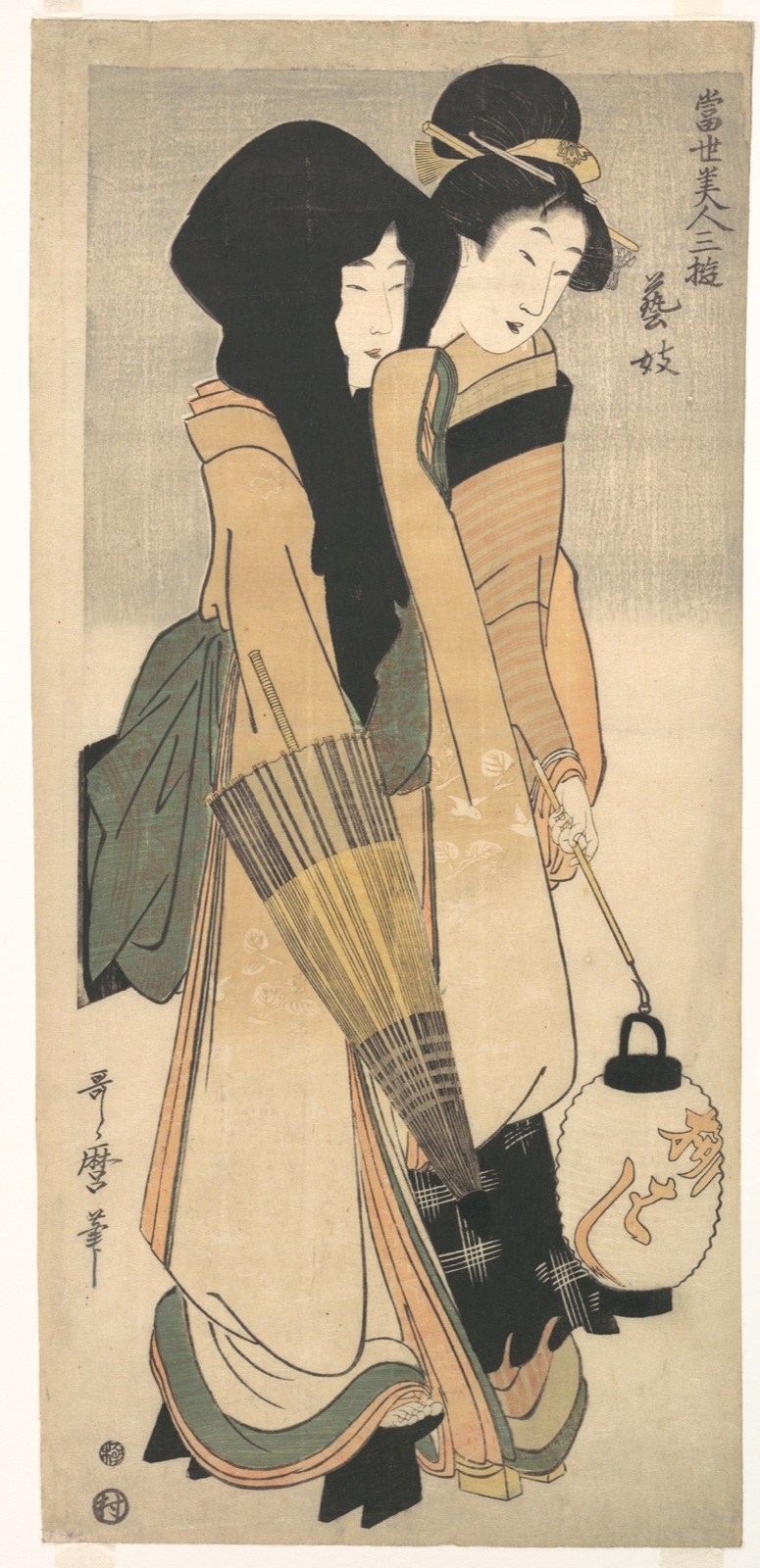
Geisha
Kitagawa Utamaro · c. 1792–93 · A large-head beauty portrait built through gesture, fashion, line and differentiated celebrity.
Kabuki Actor Ōtani Oniji III as Yakko Edobei
Tōshūsai Sharaku · 1794 · Theatrical character and performer identity compressed into charged hands, face and silhouette.
Under the Wave off Kanagawa
Katsushika Hokusai · c. 1830–32 · Maritime labour, Fuji and the technical drama of repeated blue printing held in one unstable structure.
Sudden Shower at Shōno
Utagawa Hiroshige · c. 1833–35 · The bodily experience of weather transformed into diagonal line and urgent movement.
Sudden Shower over Shin-Ōhashi Bridge and Atake
Utagawa Hiroshige · 1857 · A vertical famous-place print whose cropping and fine rain lines depend on exceptional cutting and printing.
The Thirty-Six Immortals of Poetry as Kabuki Actors
Utagawa Kunisada · 1865 · Classical poetry, current theatre and illustrated-book production joined in one late Utagawa project.
Waking Up: A Girl of the Kōka Era
Tsukioka Yoshitoshi · 1888 · A technically exact Meiji image that looks back to an earlier era without ending the ukiyo-e story in 1868.
- Hishikawa Moronobu, A Visit to the Yoshiwara, late 1670s–early 1680s — a painted handscroll that expands the floating world into architecture, work, food preparation and performance rather than isolated beauties.
- Suzuki Harunobu, The Watchers and the Watched, 1764–72 — an early full-colour meditation on display, spectatorship and the pleasure-quarter interior.[22]
- Kitagawa Utamaro, Three Beauties of the Present Day, c. 1793 — a landmark in the large-head beauty portrait, balancing idealisation with differentiated celebrity.
- Tōshūsai Sharaku, Kabuki Actor Ōtani Oniji III as Yakko Edobei, 1794 — theatrical character and actor identity compressed into charged hands, face and silhouette.[26]
- Hokusai, Under the Wave off Kanagawa, c. 1830–32 — maritime labour, Fuji and the power of repeated blue printing held in one unstable structure.[27]
- Hokusai, Fine Wind, Clear Morning, c. 1830–32 — a monumental mountain whose atmosphere shifts across surviving impressions.
- Hiroshige, Sudden Shower at Shōno, c. 1833–35 — the bodily experience of weather transformed into diagonal line and urgent movement.[29]
- Hiroshige, Sudden Shower over Shin-Ōhashi Bridge and Atake, 1857 — one of the clearest demonstrations of the vertical famous-place print and the technical difficulty of rain.[28]
- Utagawa Kuniyoshi, Takiyasha the Witch and the Skeleton Spectre, c. 1844–47 — a supernatural triptych whose giant apparition unifies three separately printed sheets.
- Tsukioka Yoshitoshi, One Hundred Aspects of the Moon, 1885–92 — a late series that renews history and literature through Meiji-era design and craftsmanship.
Ukiyo-e, Europe and Japonisme
Japanese prints reached Europe before Japan's mid-nineteenth-century treaty ports fully expanded trade, then circulated far more widely through dealers, collectors, exhibitions and illustrated publications. Their cropping, clear contour, flat shapes, unusual viewpoints and colour impressed artists including Whistler, Manet, Degas, Monet, Van Gogh, Toulouse-Lautrec and Mary Cassatt.[35] [36]
The influence was neither uniform nor innocent. European artists selected features useful to their own arguments, sometimes mixing ukiyo-e with ceramics, textiles and fantasies of Japan. Dealers and collectors detached sheets from books or series and elevated some designers above others. Western museums preserved vast numbers of prints, but their collections also helped define a canon centred on what Europe found modern.[17]
Japonisme is therefore an important afterlife, not ukiyo-e's purpose. Hokusai did not design the Great Wave so that Van Gogh or twentieth-century graphic designers could discover flatness. Hiroshige's places carried Japanese travel, poetic and commercial meanings before they became compositional lessons abroad. Returning those settings to the foreground prevents influence from becoming a story in which Japanese art matters mainly after Western recognition.
The exchange also moved in more than one direction. Ukiyo-e artists had already adapted imported perspective and pigments. Meiji printmakers pictured Western clothes, machines and events. The history is not a sealed Japan suddenly opened by Europe, but a changing field of controlled contacts, selective borrowing and unequal global markets.
Where to see ukiyo-e
Tokyo offers the strongest historical concentration of specialist viewing. The Ota Memorial Museum of Art rotates exhibitions from a major ukiyo-e collection, while the Sumida Hokusai Museum focuses on Hokusai's life and work in the area where he was born. The Tokyo National Museum and Edo-Tokyo Museum place prints, paintings, books and urban culture within broader Japanese history. Because works on paper cannot remain exposed indefinitely, current display schedules should always be checked.
The Museum of Fine Arts, Boston, holds an exceptional collection of prints and more than seven hundred ukiyo-e paintings. The Metropolitan Museum of Art, British Museum, Art Institute of Chicago and Smithsonian's National Museum of Asian Art provide major study collections. The Library of Congress preserves more than 2,500 Japanese prints and drawings, with significant material digitised for comparison.[7] [18]
In France, the Bibliothèque nationale de France holds about three thousand Japanese prints and a thousand illustrated books, including strong Hokusai material and collections formed during the history of Japonisme. Its holdings help readers study both Japanese production and the European systems through which prints were collected.[17]
No collection shows everything at once. Light sensitivity makes rotation a conservation necessity. Digital catalogues are especially useful for comparing impressions, inscriptions and series, but scale and surface effects still reward seeing a sheet in person.
Museums and collections to explore
Works on paper rotate because light exposure can damage them. Check current displays before travelling and use collection catalogues to compare impressions.
- 01
Ota Memorial Museum of Art
Tokyo, Japan
Specialist ukiyo-e exhibitions drawn from a major collection; displays rotate to protect works on paper.
Specialist collectionVisit collection website - 02
Sumida Hokusai Museum
Tokyo, Japan
Hokusai's life, designs and Sumida connections, supported by rotating exhibitions and research.
Hokusai focusVisit collection website - 03
Tokyo National Museum
Tokyo, Japan
Prints, paintings and books placed within the wider history of Japanese art.
National collectionVisit collection website - 04
Museum of Fine Arts, Boston
Boston, USA
An exceptional print collection and more than seven hundred ukiyo-e paintings.
Prints and paintingsVisit collection website - 05
Metropolitan Museum of Art
New York, USA
Extensive open-access records for artists, techniques, series and individual impressions.
Open-access studyVisit collection website - 06
British Museum
London, UK
A major collection for comparing artists, publishers, impressions and the history of European collecting.
Major study collectionVisit collection website - 07
Library of Congress
Washington, DC, USA
More than 2,500 Japanese prints and drawings, with substantial material available digitally.
Digitised collectionVisit collection website - 08
Bibliothèque nationale de France
Paris, France
Around three thousand Japanese prints and a thousand illustrated books, including important Hokusai holdings.
Prints and booksVisit collection website
Suggested books
- Amy Reigle Newland, ed., The Hotei Encyclopedia of Japanese Woodblock Prints — a substantial reference for artists, schools, formats, publishers and technical vocabulary.
- Andreas Marks, Japanese Woodblock Prints: Artists, Publishers and Masterworks, 1680–1900 — particularly useful for restoring publishers and chronological networks to an artist-centred history.
- Timothy Clark, C. Andrew Gerstle, Aki Ishigami and Akiko Yano, eds., Shunga: Sex and Pleasure in Japanese Art — an important, carefully contextualised account of erotic production.
- Sarah E. Thompson, Hokusai's Landscapes: The Complete Series — a series-based way to move beyond the Great Wave as an isolated icon.[40]
- Matthi Forrer, Hiroshige: Prints and Drawings — a broad introduction to Hiroshige's landscape, figure and nature imagery.
These are editorial reading suggestions rather than a guarantee that a particular edition is currently available. Any future book-purchase module should verify edition, cover, seller destination and value before publication.
Frequently Asked Questions
Ukiyo-e is a Japanese tradition of paintings, illustrated books and prints associated especially with urban culture from the late seventeenth through nineteenth century. Its name is commonly translated as “pictures of the floating world.”
Not in the modern sense of artists joining a manifesto-led group. It is better understood as a school, subject tradition and publishing culture that changed across more than two centuries.
No. Colour woodblock prints are its most famous products, but artists also made paintings, drawings and illustrated books. Print and painting histories overlap.[18]
Normally a publisher coordinated a designer, block cutter and printer. Each contributed specialist decisions, even though modern labels usually foreground the designer.[3]
Many commercial sheets were affordable and printed in substantial numbers. Others, especially privately commissioned surimono, used costly materials and addressed restricted poetry circles. Price and refinement varied greatly.
Actor prints often capture a dramatic stage pose and the personality of both role and performer. Exaggeration makes theatrical energy legible in a still image, as in Sharaku's portraits.[26]
No. The field includes travel, landscape, warriors, myths, literary parody, erotica, nature, sumo, daily life, foreigners, current events and many other subjects.[37]
No. The Meiji Restoration changed institutions, technology and demand, but woodblock artists continued working. Later shin-hanga and sōsaku-hanga movements reinterpreted different parts of the tradition.[10]
Discussion
Does learning about the cutter, printer and publisher change how you use the phrase “a Hokusai print”? Which carries more of a design's meaning: the depicted subject, the poem and inscriptions, or the differences between impressions? How should museums present the beauty of Yoshiwara imagery while explaining the lives and coercion it aestheticised? And when an image such as the Great Wave becomes a global icon, what parts of its original series, labour and place are most easily lost?
Reader Insights
Ask whether you are looking at a painting, book leaf, single sheet or one panel of a multi-sheet design before interpreting it.
Look beyond the designer’s signature to the publisher, cutter and printer whose decisions made each impression possible.
Colour, line, trimming and fading can change what a design looks like. One digital image never represents every surviving sheet.
Join the Conversation
Does learning about the cutter, printer and publisher change how you use the phrase “a Hokusai print”—and what is most easily lost when the Great Wave becomes a global icon?
References
- Woodblock Prints in the Ukiyo-e Style. Metropolitan Museum of Art. View Source
- Art of the Pleasure Quarters and the Ukiyo-e Style. Metropolitan Museum of Art. View Source
- The Floating World of Ukiyo-e: Overview. Library of Congress. View Source
- Early Masters. Library of Congress. View Source
- Major Genres: Beauties Actors and Landscapes. Library of Congress. View Source
- Images and Literary Sources. Library of Congress. View Source
- Fine Prints: Japanese pre-1915. Library of Congress. View Source
- 画譜と絵本. National Diet Library (Japanese; consulted in Japanese). View Source
- 名所絵の誕生. National Diet Library (Japanese; consulted in Japanese). View Source
- 創作版画と新版画. National Diet Library (Japanese; consulted in Japanese). View Source
- 伝統の技術・職人. Adachi Hanga (Japanese; consulted in Japanese). View Source
- よくあるご質問. Adachi Hanga (Japanese; consulted in Japanese). View Source
- 写楽の眼・恋する歌麿. Edo-Tokyo Museum (Japanese; consulted in Japanese). View Source
- ボストン美術館 浮世絵名品展. Edo-Tokyo Museum (Japanese; consulted in Japanese). View Source
- 浮世絵(錦絵)はひとつの絵柄につき何枚ずつ摺られていたのか. Edo-Tokyo Museum (Japanese; consulted in Japanese). View Source
- Estampes japonaises: images d'un monde éphémère. Bibliothèque nationale de France (French; consulted in French). View Source
- Estampes japonaises. Bibliothèque nationale de France (French; consulted in French). View Source
- Drama and Desire. Museum of Fine Arts Boston. View Source
- Collections Online: bijin. British Museum. View Source
- Tracking down the Plum Garden. British Museum. View Source
- Brush Writing in the Arts of Japan. Metropolitan Museum of Art. View Source
- The Watchers and the Watched. Metropolitan Museum of Art. View Source
- Standing Courtesan. Metropolitan Museum of Art. View Source
- Courtesan with a Young Man beside a Screen. Metropolitan Museum of Art. View Source
- An Oiran Standing. Metropolitan Museum of Art. View Source
- Kabuki Actor Ōtani Oniji III as Yakko Edobei. Metropolitan Museum of Art. View Source
- Under the Wave off Kanagawa. Metropolitan Museum of Art. View Source
- Sudden Shower over Shin-Ōhashi Bridge and Atake. Metropolitan Museum of Art. View Source
- Sudden Shower at Shōno. Metropolitan Museum of Art. View Source
- Geisha from Three Amusements of Contemporary Beauties. Metropolitan Museum of Art. View Source
- The Thirty-Six Immortals of Poetry as Kabuki Actors. Metropolitan Museum of Art. View Source
- Waking Up: A Girl of the Kōka Era. Metropolitan Museum of Art. View Source
- Masakiyo's Challenging Battle. Metropolitan Museum of Art. View Source
- One Hundred Famous Views of Edo. Smithsonian Institution Cooper Hewitt. View Source
- Early Collectors of Japanese Prints and The Metropolitan Museum of Art. Metropolitan Museum of Art. View Source
- The Great Wave: The Influence of Japanese Woodcuts on French Prints. Metropolitan Museum of Art. View Source
- Japanese prints and drawings filing series. Library of Congress. View Source
- The Arts of Japan. Metropolitan Museum of Art. View Source
- Genji and Print Culture: From Ukiyo-e to Manga. Metropolitan Museum of Art. View Source
- Hokusai's Landscapes. Museum of Fine Arts Boston. View Source
- Ukiyo-e image records. Metropolitan Museum of Art Open Access: Courtesan with a Young Man beside a Screen, An Oiran Standing, The Watchers and the Watched, Geisha, Kabuki Actor Ōtani Oniji III as Yakko Edobei, Under the Wave off Kanagawa, Sudden Shower at Shōno, Sudden Shower over Shin-Ōhashi Bridge and Atake, The Thirty-Six Immortals of Poetry as Kabuki Actors, Waking Up: A Girl of the Kōka Era. All ten object records mark the reproduced images Public Domain.