by Tom Gurney
Tom Gurney BSc (Hons) is an art history expert with over 20 years experience
Published on June 19, 2020 / Updated on October 12, 2026
Email: tomgurney1@gmail.com / Phone: +44 7429 011000
Buffalo Trail: The Impending Storm by Albert Bierstadt
A line of buffalo crosses a stream beneath clouds that seem capable of swallowing the whole landscape. Albert Bierstadt gives the leading animal a solid, unmistakable presence near the foreground, then lets its companions diminish into the dark meadow on the right. Their passage supplies the picture’s movement; the immense sky supplies its uncertainty.
Painted in 1869, this oil on canvas measures 74.9 × 125.7 cm. It belongs to the National Gallery of Art, Washington, DC, accession 2014.79.3.[1]
At a Glance
Where this painting sits in Bierstadt’s career
Dates refer to the paintings, rather than to the journeys behind them. Approximate dates and ranges retain the qualifications in the collection records.
Lake Lucerne
1858Mountain Brook
1863Street in Nassau
c. 1877–1880The Last of the Buffalo
1888–1889The Golden Gate
1900Contents
Following the herd
The nearest buffalo has almost reached the left bank. Its heavy shoulder, lowered head and short legs form a compact dark shape against the shining water. Behind it, other animals occupy the stream or approach from the grass. The diagonal they describe carries our attention away from the foreground into a much less legible distance. Bodies that are plainly individual near us become small brown marks beneath the storm.
This modest crossing gives the landscape a practical scale. We can imagine the width of the stream from the animals standing in it, or judge the height of the surrounding vegetation against their backs. Beyond that intimate ground, distances become harder to grasp. A dark ridge on the right merges with the weather above it, while the far trees near the centre are little more than silhouettes. The herd belongs to a space we can initially measure, but follows a path into one we cannot.
Bierstadt makes the foreground rewarding to examine. Low shrubs, broad leaves and tufts of grass crowd the banks. Small touches of yellow and warm brown interrupt the greens, and the water catches broken glints around the animals’ feet. On the left, tall trees expose twisted trunks and irregular branches against the sky. Their foliage appears stirred by wind. Pale rock faces rise behind them, providing a brief glimpse of mountains without taking command of the composition.
The animals’ movement seems measured, even though the title alerts us to danger. That difference in tempo matters: the buffalo continue their passage while the atmosphere appears to change on a far greater scale. The viewer can feel the threat before any visible catastrophe occurs.
A sky larger than the landscape
The strongest contrast lies between the ground’s many small particulars and the broad, swelling forms overhead. Clouds rise above the meadow in great rounded masses. Their undersides deepen toward blue-black on the right; higher edges catch a pale light. Small openings show blue sky between them, but offer little sense that the weather has settled.
The light arrives unevenly. It picks out portions of the rock on the left, catches the stream and touches the edges of leaves, while leaving much of the herd and the distant land in shadow. The sky’s brightest region is high above the crossing, so the eye moves between the small illuminated passage below and a much wider opening overhead. Light gives us points of orientation within a scene otherwise dominated by darkness.
There is no visible lightning strike or dramatic collision to resolve the suspense. Bierstadt paints the approach of a storm, leaving the next event outside the picture. The title turns clouds into a promise of change; the continuing procession holds us in the moment before it arrives.
The precision of the foliage and the carefully graduated atmosphere also reveal how much the effect depends on controlled handling. Conservators Lance Mayer and Gay Myers distinguish Bierstadt’s varied studies from the more methodical surfaces of many finished paintings. Their findings concern other canvases, but offer a useful comparison for the tightly described details visible here.[2] The leaves, ripples and cloud edges make the depicted world persuasive without requiring conspicuous brushwork to carry the drama.
A memory of buffalo in the West
The National Gallery relates the scene to Bierstadt’s western travel studies and reproduces an 1859 letter from his journey with Frederick W. Lander’s party. Watching a buffalo cross water, he recalled: “I felt half inclined to lay down my rifle and take up my sketchbook.” Admiration briefly prevented either action.[1]
The episode brings the painter’s position into unusually sharp focus. He approached the animal with a rifle, yet found its appearance compelling enough to think of drawing it. Looking, hunting and making art coexisted in that encounter. The letter records a moment of hesitation; it does not say that he gave up hunting.
The remembered animal in water offers a strong point of comparison with the finished picture, painted ten years later. The precise connection remains uncertain: neither the stream nor an exact viewpoint is established. The letter, as quoted by the museum, helps us understand the appeal of the subject, while the canvas draws that encounter into a much larger atmospheric drama.
The storm and the changing West
Peter H. Hassrick reads this storm as a historical warning. In Albert Bierstadt: Witness to a Changing West, he places the painting between Buffalo Trail (1867) and Western Kansas (1876): abundance gives way to peril and loss. He links the 1869 canvas to the completion of the transcontinental railroad and interprets the buffalo as a counterpart to Plains peoples threatened by dispossession.[3]
This reading expands the threat beyond the weather. The animals’ smallness, the gathering darkness and the narrow crossing can suggest a vulnerable future. Yet there is no train, hunter or abandoned carcass to specify the danger. A historical interpretation works through the atmosphere and composition, rather than through an explicit human action. The painting lets us see a continuing passage and anticipate its interruption.
The museum’s emphasis on a peaceful crossing and Hassrick’s emphasis on peril need not cancel one another. They direct attention to different parts of the picture. At ground level, the herd proceeds through a richly vegetated landscape. Above it, a much larger force is gathering. The tension between those two experiences gives the historical reading room to develop, while remaining an interpretation rather than a documented statement by Bierstadt about this canvas.
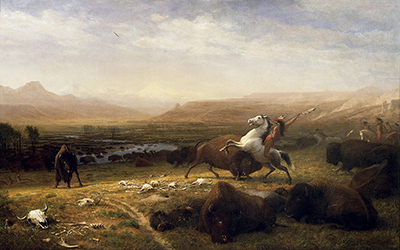
Hassrick considers the separate 1867 Buffalo Trail a more hopeful treatment.[3] The Last of the Buffalo belongs to a later phase and survives in two major versions, at the National Gallery and the Buffalo Bill Center of the West. Lisa Strong’s Corcoran catalogue account discusses those hunting scenes in relation to bison preservation.[4] Their human confrontation and fallen animals make loss explicit in a way that the 1869 crossing leaves suspended.
A living resource, beyond the painted meadow
The historical stakes become clearer when the buffalo are understood as part of human economies and cultures. The National Park Service identifies their importance to many Indigenous nations as food, clothing, shelter, tools and ceremonial life. It places the nineteenth-century decline within westward settlement, rail transport and international demand for hides, alongside pressures from drought, livestock competition and disease.[5]
Those different pressures resist a simple equation between storm clouds and one cause of destruction. Weather belongs to the animals’ world; the commercial and political forces that transformed their future belonged to a much larger human system. In the picture, the rich foreground vegetation still gives the herd an apparently sustaining environment. The clouds can be read as a threat to that continuity without making the painted stream a map of a particular industrial advance.
The State Historical Society of North Dakota’s account helps distinguish the later hide trade from hunting for food and household materials. Industrial demand and improved tanning made hides valuable; railways connected hunters with distant markets. Its published excerpt from Running Antelope’s February 1883 interview in the Bismarck Tribune records his objection to hunters taking hides and leaving usable meat to waste. He asked the federal government to stop white hunters killing the buffalo on which his people depended.[6]
Running Antelope’s words belong to a later crisis, fourteen years after this canvas. They do not explain Bierstadt’s intentions in 1869. They offer an Indigenous account of loss whose emphasis is on livelihood, waste and protection of resources. That perspective gives substance to what a general phrase such as the “changing West” can conceal. The disappearance of animals was also a disruption of food, work and relations with the land.
The painting contains no visible human claimant to the meadow. That absence helps it sustain the impression of an animal world proceeding on its own terms. It also leaves the viewer without a depicted person who can tell us what the herd means to those living nearby. Hassrick’s interpretation and the historical accounts bring those relationships back into the act of looking. The result is a fuller reading of the animals’ vulnerability, while preserving the difference between a suggestive landscape and a historical document of a specific hunt.
The painting’s later circulation
Mr. and Mrs. Lansdell K. Christie funded the Corcoran’s 1960 purchase. The canvas transferred to the National Gallery in 2014. Its recorded exhibitions include Des Moines in 1958 and Art and Enterprise in 1991–1992.[1]
This later record places the canvas within the collecting and reassessment of American art. It does not establish its first buyer or how viewers responded when it was new. Nor does the work’s inclusion in a major retrospective prove that its storm was originally received as a conservation allegory. Its museum history and its critical interpretations answer different questions: one traces the object’s circulation, while the other asks what its atmosphere and subject can mean.
Watch: Albert Bierstadt
Five perspectives on his paintings and their historical setting.
American Landscape Painting: Albert Bierstadt and the American Land
A Museum of Fine Arts, Boston presentation on American Landscape Painting: Albert Bierstadt and the American Land.
Explore Bierstadt’s artworks
Discussion
How does the herd’s river crossing change under the weight of the approaching storm?
Reader Insights
Trace the line from the nearest buffalo into the meadow. Where do individual bodies become a collective movement?
Read the documented letter passage alongside the finished painting. What does the account reveal about the artist’s competing responses to wildlife?
How does Running Antelope’s later account of waste and livelihood affect your reading of the herd’s vulnerability?
Join the Conversation
Share a specific observation, documented connection or comparison from Buffalo Trail: The Impending Storm.
References
- National Gallery of Art. “Buffalo Trail: The Impending Storm,” artwork 166427. Interpretation, overview, provenance and exhibitions. The 1859 letter is quoted through the museum. View source text
- Lance Mayer and Gay Myers. “Bierstadt and Other 19th-Century American Painters in Context,” Journal of the American Institute for Conservation 38, no. 1 (1999), pp. 55–67, especially §§3.1–3.2, “Studies” and “Finished Paintings.” View source text
- Peter H. Hassrick. “Albert Bierstadt: Witness to a Changing West,” Points West, Fall/Winter 2017; published online by the Buffalo Bill Center of the West, 18 May 2018. Discussion of Buffalo Trail (1867), Buffalo Trail: The Impending Storm (1869) and Western Kansas (1876), with figures 5–7. View source text
- Lisa Strong; Corcoran Gallery of Art. Strong’s “Albert Bierstadt, The Last of the Buffalo,” in Sarah Cash, ed., Corcoran Gallery of Art: American Paintings to 1945 (2011), printed pp. 170–172, especially pp. 170–171 on the two versions and conservation theme. The catalogue’s illustrated inventory, printed p. 288, records Buffalo Trail: The Impending Storm, its dimensions and Christie purchase credit. View source text
- National Park Service. “People and Bison,” sections “Importance of Indigenous Cultures” and “The Brink of Extinction.” View source text
- State Historical Society of North Dakota. “Bison Hunting,” North Dakota Studies, sections “The Great Bison Hunts” and “Federal Law: Hunting on Indian Land”; Running Antelope’s interview, Bismarck Tribune, 16 February 1883, reproduced there. View source text