by Tom Gurney
Tom Gurney BSc (Hons) is an art history expert with over 20 years experience
Published on June 19, 2020 / Updated on October 12, 2026
Email: tomgurney1@gmail.com / Phone: +44 7429 011000
Donner Lake from the Summit by Albert Bierstadt
Albert Bierstadt’s Donner Lake from the Summit looks down through the Sierra Nevada towards blue water and a distance flooded with sunlight. The railway on the right occupies little of this immense prospect, but it gives the view a particular historical purpose. Collis P. Huntington commissioned the painting to commemorate the transcontinental railroad’s completion in 1869; he and Bierstadt had visited the summit together.[1]
The finished 1873 work is oil on canvas, 183.2 × 305.3 centimetres, in New York Historical, accession 1909.16.[1] On a surface roughly six feet high and ten feet wide, the mountains provide the spectacle. The railway supplies a route through them. Looking between those two scales reveals how the picture joins the experience of a formidable landscape to the promise of easier passage.
At a Glance
Where this painting sits in Bierstadt’s career
Dates refer to the paintings, rather than to the journeys behind them. Approximate dates and ranges retain the qualifications in the collection records.
Lake Lucerne
1858Mountain Brook
1863Street in Nassau
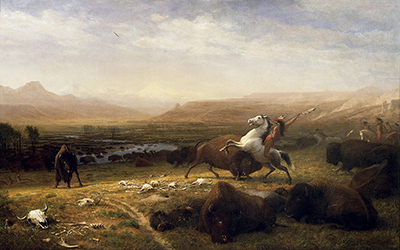
c. 1877–1880The Last of the Buffalo
1888–1889The Golden Gate
1900Contents
Looking down towards Donner Lake
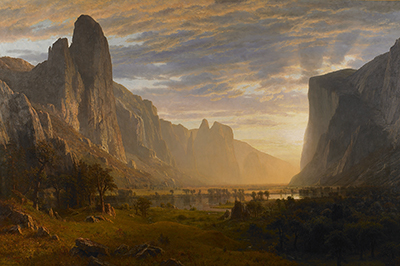
The foreground is uneven and shadowed. Rocks, low vegetation and broken slopes make the ground feel difficult to traverse, while tall pines on the left rise against the brighter distance. Beyond them, the terrain opens in successive stages. Sunlit passages draw the eye between darker ridges until the lake appears, its cool blue surface distinct from the warm surrounding land. Haze carries the view onwards towards mountains that have almost lost their solidity.
The elevated viewpoint matters. We look into the country from above rather than standing on the shore. The water becomes a destination for the eye, reached across rough ground. A steep mass on the right gives the panorama a strong boundary, but the lower forms near the centre allow the gaze to escape into the distance. The broad canvas holds the immediate weight of the mountains and the apparent openness beyond them within one view.
Light connects these spaces. The sun appears high in the pale sky, and its brightness spreads through the far landscape before reaching the dark foreground. The lake offers clarity amid the overlapping slopes. Its turquoise colour seems especially vivid because much of the country around it is softened by golden haze.
The trees create a different rhythm. Their narrow trunks and pointed crowns interrupt the broad planes of rock. Some stand together on the left; others punctuate the descent towards the water. They help us measure the height of the surrounding forms without reducing the landscape to a set of dimensions. The railway’s line is finer still. Finding it requires the viewer to move from the overall atmosphere to a comparatively small, deliberate mark across the slope.
A panorama commissioned for the railway
The engineered route follows the right middle distance, tucked among the rocky forms. Its modest visual prominence changes how the commission is encountered. The picture asks us first to admire the landscape, then to notice that a passage through it has been established. The line gains significance through its setting: even a small intrusion of regularity becomes consequential amid so much rough ground.
Angela Miller interprets this arrangement as a reconciliation of conflicting ideals. Railway development depended on the resources of the country, including timber, while Bierstadt preserved the appearance of a natural sanctuary. In her reading, the broad, sunlit composition absorbs the disruptive railway into a reassuring vision of national expansion. This is a critical account of the painting’s choices, rather than Bierstadt’s recorded explanation of them.[2]
The railway participates in the transition from dark foreground to luminous distance. Its line helps establish a passage, while the broad movement towards the lake gives the landscape visual priority.
The scene also differs from an account of construction. We do not watch rock being removed or tracks being laid. The railway is encountered as part of a finished prospect. That distinction leaves room for histories which the visual harmony cannot itself explain.
A separate study of the descent
The Fine Arts Museums of San Francisco identifies View of Donner Lake, California, dated 1871–72, as a study for a larger work. It is oil on paper mounted on canvas, 74.3 × 55.6 centimetres, accession 1984.54. The museum also connects the subject with Bierstadt’s journey to San Francisco with his wife in July 1871.[3]
The difference in format is substantial: a narrow descent and a broad panorama offer different amounts of space around the lake. The study’s paper support also distinguishes it materially from the 1873 canvas.
Miller’s comparison stresses the earlier work’s steep terrain and more conspicuous railway. She notices a slender foreground cross and proposes, conditionally, that it might commemorate railway construction deaths.[2] The suggestion adds a possible memorial association, but the cross does not securely identify a particular event or person.
In the large painting, the horizon spreads across a much wider field. The water can sit within an extended succession of ridges, and the foreground gives the eye several approaches towards it. The change in format helps explain why this commission offers more than an enlarged record of the descent: it organises a spacious encounter with the country through which the railway passes.
The work behind the crossing
Stanford’s Chinese Railroad Workers in North America Project describes the summit crossing as a difficult excavation through granite. Chinese crews worked on the Sierra tunnels; at Summit Tunnel, a central shaft allowed work to advance from four directions. Severe winters obstructed entrances and forced workers to dig passages through snow. The company subsequently built extensive snow sheds to protect the route.[4]
Those details give the painting’s rough slopes a second significance. The rock which offers dramatic shapes to the viewer was also material that workers had to penetrate. The bright, open sky encourages the eye to travel freely across the picture; an actual railway journey depended on underground excavation and protection from weather. The line’s small size within the composition should not be confused with the scale of the work required to establish it.
The National Park Service records unequal conditions for Chinese employees, including lower pay and responsibility for their own food and lodging. In 1867, workers between Cisco and Truckee struck for better wages, shorter days and reduced tunnel shifts. Management cut supplies to the camps, helping force an end to the action.[5]
The strike brings the workers into this history as people who organised and made demands. A commission associated with a railroad executive can be read alongside the experience of the labourers who made the celebrated crossing possible. That broader view changes the meaning of accomplishment: the finished route depended on human endurance, skill and conflict as well as financing and engineering.
Stanford’s project also explains the limits of the surviving record. It draws on company and government documents, archaeology and descendants’ oral histories because no letters, diaries or memoirs by the Chinese railroad workers themselves are known to survive.[4] These are therefore researched histories of the work, assembled from evidence with unequal perspectives. They do not identify individual labourers in Bierstadt’s scene.
Forests and an inhabited landscape
The pines initially appear as elements of the view: dark vertical accents against illuminated slopes. Their presence also helps us consider the materials of railway development. California State Parks describes local mills established by 1867 that produced ties and lumber for snow sheds and communities, rapidly leaving logged hillsides.[6] This regional history does not identify the painted trees as a particular timber supply. It makes the relationship between forests and the railway more concrete.
The area also had a human history before either the commission or the railway. The same State Parks account identifies it as Washoe homeland, describes seasonal hunting and gathering, and records the taking of lands by newcomers after the Gold Rush. Washoe people adapted their livelihoods and continued to build communities.[6]
A distant prospect can make inhabited country appear secluded. Reading its history alongside the image allows us to recognise that the land had uses, relationships and meanings beyond the traveller’s view from the summit. The painting does not provide evidence for a particular village omitted from its composition, or establish an intention to erase one. Its emphasis on mountains and light gives only a partial account of the place.
The Donner name and the painting’s reception
The name recalls the winter ordeal of 1846–47. California State Parks distinguishes the families camped near the lake from the Donner family’s camp at Alder Creek, and describes failed attempts to cross the pass and subsequent rescue efforts.[6] The painting’s expansive light offers a striking contrast with that history. It does not depict the stranded party or reconstruct the conditions of its winter camp.
New York Historical records a critic’s response to the painting’s San Francisco debut in 1873: the earlier crossing’s hardship was set against the speed and ease of railway travel.[1] That contemporary response shows how the landscape’s beauty and the name’s disturbing associations could participate in the same account of progress.
There is more than one way to attend to the contrast. A viewer may see reassurance in the passage through formidable mountains. Knowledge of the construction work makes that reassurance depend on effort which the panorama does not show. Knowledge of Washoe land history complicates the idea that accessibility began when the railway arrived. The bright distance remains visually compelling while the meanings attached to reaching it become less simple.
A view shaped by travel and collecting
The Nevada Museum of Art’s Surmounting Donner Summit exhibition placed this subject within a wider culture of travel and representation. Its account describes the Summit Hotel, built in 1870, as a railway way station and a base for exploring the mountains. Painters and photographers, including Bierstadt, Thomas Hill, Alfred A. Hart and Carleton Watkins, received railroad executives’ commissions for grand images of the region.[7]
This context helps explain the elevated prospect’s appeal. The summit could be both a place encountered during travel and a view carried away in pictures. A panorama extended that encounter to audiences who had not stood above the lake. Its large dimensions allowed distant country to become an imposing presence within an exhibition or collection.
The New York painting was given to the museum by Archer Milton Huntington.[1] Its public history now brings viewers to a work commissioned for a railway commemoration, yet capable of sustaining questions about the crossing’s labour and the country it traversed. The eye can still follow the light towards the lake. The railway, once found, gives us a reason to look back at the slopes through which that journey was made possible.
Watch: Albert Bierstadt
Five perspectives on his paintings and their historical setting.
American Landscape Painting: Albert Bierstadt and the American Land
A Museum of Fine Arts, Boston presentation on American Landscape Painting: Albert Bierstadt and the American Land.
Explore Bierstadt’s artworks
Discussion
How does the small railway line affect this vast view towards Donner Lake?
Reader Insights
Trace the railway through the middle distance. Where does your eye first leave the broad landscape to follow the line?
Compare the shadowed foreground with the luminous distance. Which changes in colour and shape make the lake seem accessible?
How might a narrow vertical view change the experience of looking down towards the lake?
Join the Conversation
Share a specific observation, documented connection or comparison from Donner Lake from the Summit.
References
- New York Historical. Donner Lake from the Summit, 1873, accession 1909.16. Object record, commission history, gift and transmitted 1873 reception. View source text
- Angela Miller. “Albert Bierstadt, Landscape Aesthetics, and the Meanings of the West in the Civil War Era.” Art Institute of Chicago Museum Studies 27, no. 1 (2001), pp. 49–50; figs. 8–9, pp. 52–53. Railway interpretation and separate study comparison. View source text
- Fine Arts Museums of San Francisco. View of Donner Lake, California, 1871–72, accession 1984.54. Study record, support, dimensions and journey context. View source text
- Chinese Railroad Workers in North America Project, Stanford University. Geography of Chinese Workers Building the Transcontinental Railroad, 2018. Introduction and “Summit Tunnel”; engineering, winter work and evidence limits. View source text
- National Park Service. “Chinese Labor and the Iron Road,” Golden Spike National Historical Park. Working conditions and the 1867 strike. View source text
- California State Parks. Donner Memorial State Park, revised 2017, PDF pp. 2, 4–5. Washoe history, winter camps and local lumber production. View source text
- Nevada Museum of Art. “Surmounting Donner Summit—A Symbol of American Progress,” exhibition essay, 2015–16. Regional travel, hotel and railroad patronage. View source text