by Tom Gurney
Tom Gurney BSc (Hons) is an art history expert with over 20 years experience
Published on June 19, 2020 / Updated on October 12, 2026
Email: tomgurney1@gmail.com / Phone: +44 7429 011000
Sunset in the Rockies by Albert Bierstadt
Low sunlight turns the lake and the faces of the cliffs gold. Almost everything close to us remains dark: trees, fallen wood, the uneven shoreline and a projecting rock beside the water. In the reproduction of Sunset in the Rockies shown here, Albert Bierstadt brings the eye towards the light by enclosing it within shadow.
Bridgeman Images records the matching composition as Sunset in the Rockies, image CH236623, and catalogues it as oil on canvas with the broad date ‘C19th AD’. The current entry gives no original painting dimensions. Its anonymous ‘Private Collection’ label and Christie's Images credit do not establish a present owner or a verified auction history.[1] The agreement of the cliffs, central trees and reflected sunset identifies the pictured composition, while its exact year and location remain unconfirmed.
At a Glance
Where this painting sits in Bierstadt’s career
Dates refer to the paintings, rather than to the journeys behind them. Approximate dates and ranges retain the qualifications in the collection records.
Lake Lucerne
1858Mountain Brook
1863Street in Nassau
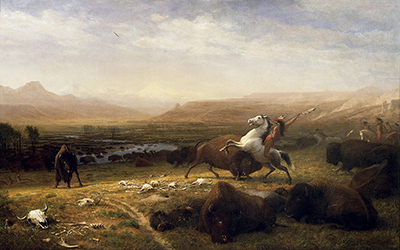
c. 1877–1880The Last of the Buffalo
1888–1889The Golden Gate
1900Sunset in the Rockies
Undated (precise year unconfirmed)Contents
A landscape arranged around light
The brightest opening lies at the left, where the sun appears close to the horizon. Its reflection draws a narrow path across the water. A dark cliff at the far left acts like a screen, cutting into the glow; beyond it, slender trees and distant mountain forms become progressively less distinct. The haze allows the landscape to seem extensive without giving us a sharply measurable view.
The right half has a very different weight. High rock faces rise towards the upper edge, their ridges picking up warm light while recesses remain brown. At their feet, a projecting ledge interrupts the downward movement. Trees along this ledge and the shore help us compare the height of the cliffs with familiar forms. The painting makes scale something to discover within the arrangement.
A group of taller trees near the centre bridges these two halves. Their fine branches show against the illuminated distance, while their trunks connect with the foreground bank. We can follow their silhouettes into the sky, then return along the dark shore towards the water. The light draws us away; the trees bring us back to the nearest ground.
The clouds repeat the colour of the rock faces, with orange patches passing into grey and brown. Water, sky and stone therefore share a warm range of colour. Against it, the dark vegetation becomes especially distinct. This exchange of light and shadow gives the picture much of its drama even before we try to name individual landmarks.
Why the dark foreground matters
The sunset's force depends on how much of the picture remains comparatively dim. The nearest shore is not merely an empty border around the principal view. Its irregular shapes give the eye a place to begin before crossing towards the illuminated water and rock. Dark forms interrupt that movement, so that the light is encountered through a succession of edges rather than spread evenly across the scene.
The nineteenth-century chemist Michel-Eugène Chevreul investigated how neighbouring tones affect one another. In the English edition of his colour treatise published in 1861, his grey-paper experiment shows a lighter area appearing lighter beside a darker one, while the darker area appears darker.[2] This is a useful historical account of visual contrast, not evidence that Bierstadt read the book or deliberately followed that experiment.
Here, the dark bank and tree silhouettes make the adjacent brightness especially conspicuous. Yet contrast is only part of the effect. The reflection's position, the distant haze and the illuminated cliff surfaces give the light different roles within the landscape. Some passages attract us towards the horizon; others bring out the height and irregularity of the rock. The painting joins the apparent brilliance of light with the organisation of space.
The foreground also prevents the sunset from becoming uniformly reassuring. Tangled vegetation, uneven ground and heavy rock keep an element of difficulty close to the viewer. The view is inviting because of its radiance, but our imagined position remains within shadow. We look towards a bright opening from ground that is not equally clear or easy to traverse.
Water and the sense of a route
The water supplies the most continuous passage towards the distance. The reflected glow lies on a surface whose smaller interruptions remain visible around it. It carries brightness into the lower part of the painting without removing the dark shapes of the surrounding banks.
That passage differs from an actual path. We can follow the reflection with our eyes, but the picture does not show a clear road taking a traveller towards the light. Trees, rock and shoreline frame an experience of access while keeping much of the terrain closed. The difference between seeing into a landscape and moving through it contributes to the scene's tension.
The tall trees near the centre have a related function. Their branches divide the luminous background into smaller openings, preventing the eye from sliding directly across the whole bright area. They make the distance appear through a screen of nearby forms. Against the broad cliffs, those comparatively slender trunks also provide one of the picture's clearest indications of scale.
The scene and its limits
This reproduction does not establish an exact viewpoint, a securely documented date or a present collection. Those details require an object record that can be matched to this particular composition. The title alone cannot make the cliffs a survey of a named place, and the absence of clearly visible people cannot establish that the land had no human history.
Bierstadt travelled west in 1859 and returned in 1863, gathering material that he developed into paintings. The Smithsonian American Art Museum’s biography places these journeys alongside his European training and his later work in California.[3] Travel supplied observations; a finished landscape could bring them into a carefully composed relationship.
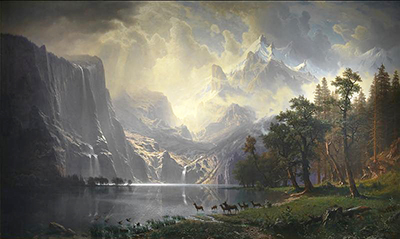
For a documented example, compare Among the Sierra Nevada Mountains, California of 1868. The Smithsonian identifies that painting as a studio work made in Rome and describes its idealised California landscape.[4] Its broad lake, animals and luminous heights give a different rhythm from the closer, darker framing here. These pictures let us examine how Bierstadt changed the position of the viewer and the balance between near shadow and distant light.
Painted light and the conditions of looking
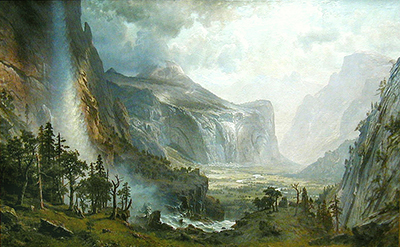
A landscape can depict brilliant light while its appearance depends on the light falling upon it. Conservators Lance Mayer and Gay Myers discuss hanging height, daylight, artificial illumination, frames and variation in Bierstadt's methods. Their account of the 1867 display of The Domes of the Yosemite describes controlled lighting and raised viewing galleries.[5]
That documented display is distinct from this sunset's unresolved history. It encourages a useful distinction between the light represented within a picture and the circumstances in which its surface is seen. A glowing scene remains an achievement in paint.
This reproduction supports discussion of the bright opening and darker forms, but not an account of the object's varnish, pigment mixtures, glazing sequence or condition. Its colours cannot measure a particular evening in the mountains. Visible effect and material explanation require different evidence.
An inviting view and an incomplete history
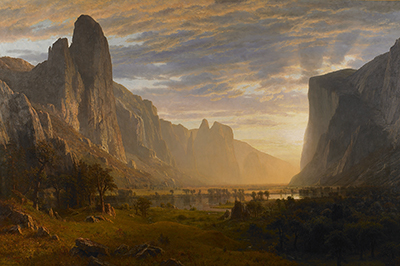
Compare Looking Down Yosemite Valley, California. Its broad middle distance gives light more room to spread across an open valley. In the Birmingham Museum of Art's interpretation, Joanna Wilson connects that 1865 painting's calm, expansive scenery with the appeal of the West to eastern viewers at the end of the Civil War. She reads the composition's apparent emptiness within a history of national expansion.[6]
That is an interpretation of the Birmingham painting, not a documented intention for this sunset. It raises a useful question, however: what does a landscape's invitation allow a viewer to overlook? Here, the light can make the distant country appear desirable even when the foreground remains dark and difficult. An attractive view does not provide a complete account of the place it represents.
The absence of easily recognisable inhabitants in this reproduction should therefore remain a description of the picture. It cannot establish that the land was unoccupied or lacked human history. Similarly, the title's reference to the Rockies does not identify an exact cliff, lake or route. The painting's organisation can be examined closely without turning its selected view into a comprehensive geographical or historical record.
Sunset in the Rockies holds the viewer between an illuminated distance and a shaded foreground. The reflection promises continuity; the trunks and rock interrupt it. Its drama comes from that relationship as much as from the warm colour itself. Looking slowly makes the sunset a structure through which space is experienced, rather than simply an orange atmosphere laid over a mountain scene.
Watch: Albert Bierstadt
Five perspectives on his paintings and their historical setting.
American Landscape Painting: Albert Bierstadt and the American Land
A Museum of Fine Arts, Boston presentation on American Landscape Painting: Albert Bierstadt and the American Land.
Explore Bierstadt’s artworks
Discussion
The brightest lake and cliffs are enclosed by shadow. How does the darker shore help you reach the sunset?
Reader Insights
Which rocks, trees and fallen wood interrupt your route towards the reflected light?
How does the narrow reflected glow connect the horizon with the foreground without lighting the whole lake?
What questions about viewing conditions arise from the conservation account, and which would require evidence specific to this canvas?
Join the Conversation
Share a specific observation, documented connection or comparison from Sunset in the Rockies.
References
- Bridgeman Images. Sunset in the Rockies (oil on canvas), CH236623. Exact catalogue entry and visually matched reproduction: broad nineteenth-century date, medium, anonymous collection label and photographic credit; precise year, dimensions, viewpoint and present owner unconfirmed. View source text
- Michel-Eugène Chevreul. The Laws of Contrast of Colour, translated by John Spanton, 1861, part I, section I, chapter I, §§8–10. The distinction between contrast of tone and colour and the grey-paper experiment. View source text
- Smithsonian American Art Museum. “Albert Bierstadt.” Artist biography, paragraphs on European study, the 1859 and 1863 western journeys, and the 1871–73 California visit. View source text
- Smithsonian American Art Museum. Among the Sierra Nevada, California, 1868, 1977.107.1. Collection interpretation and the 2015 publication label on Rome studio production and the imagined California landscape. View source text
- Lance Mayer and Gay Myers. “Bierstadt and Other 19th-Century American Painters in Context,” Journal of the American Institute for Conservation 38, no. 1, 1999, pp. 55–67, especially §§2–2.3 and 3.1–3.2. Viewing conditions, presentation and variation in working methods. View source text
- Joanna Wilson / Birmingham Museum of Art. “January 2014: Looking Down Yosemite Valley, California.” Curatorial interpretation of the 1865 painting and its historical appeal. View source text