by Tom Gurney
Tom Gurney BSc (Hons) is an art history expert with over 20 years experience
Published on June 19, 2020 / Updated on October 12, 2026
Email: tomgurney1@gmail.com / Phone: +44 7429 011000
Dogwood by Albert Bierstadt
A small red tree catches the light inside a much taller forest. In Albert Bierstadt's Dogwood, the eye moves past dark foreground trunks towards this concentrated patch of colour, then discovers the quieter water and animals beneath it.
The Haggin Museum's archived collection entry dates the painting to after 1875 and identifies it as oil on canvas, 44⅝ × 34¾ inches.[1] The upright format makes the surrounding trunks feel high above the open ground.
At a Glance
Where this painting sits in Bierstadt’s career
Dates refer to the paintings, rather than to the journeys behind them. Approximate dates and ranges retain the qualifications in the collection records.
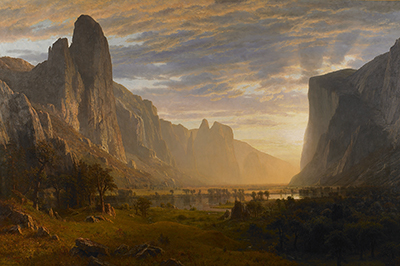
Lake Lucerne
1858Mountain Brook
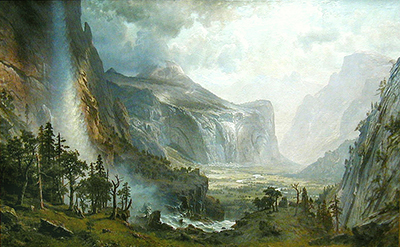
1863Dogwood
After 1875Street in Nassau
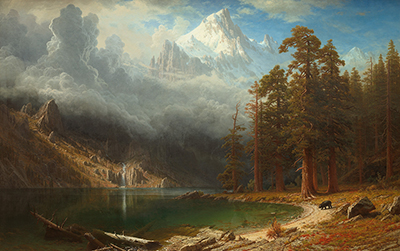
c. 1877–1880The Last of the Buffalo
1888–1889The Golden Gate
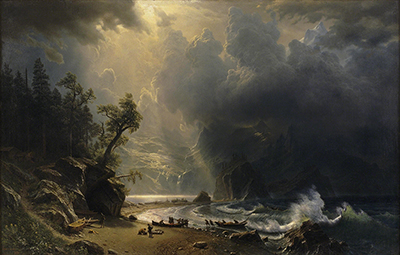
1900Contents
The bright tree within the forest
The largest trunk stands near the left edge, its broad base spreading into the earth. Warm highlights run along one side, while the opposite side remains dark. Beyond it, thinner trunks appear at successive distances, gradually losing their distinctness within the green interior.
A curved tree at the right reaches across the upper canvas. Its irregular branches join the foliage overhead, making a partial arch around the central opening. The two sides do not form a symmetrical frame: one is heavy and nearly upright, the other bends and divides. That difference keeps the woodland from becoming a simple corridor.
The small tree's red foliage is the clearest warm accent within this green space. Lighter touches pick out the upper leaves, with deeper red closer to the base. Around it, greens change from luminous yellow-green to darker, cooler passages. The colour contrast makes the tree stand out even though it occupies relatively little of the canvas.
Water passes low through the foreground. Its irregular course is quieter than the cascades of Bierstadt's mountain scenes. Small pale marks and warmer reflections interrupt the darker surface. Rocks and tufts of grass break up the bank, offering details that become noticeable after the red foliage first claims attention.
Light made visible through darkness
The light does not illuminate every part of the forest equally. The nearer trunks remain substantial and dark, while a brighter space opens behind them. Their shaded surfaces make the distance feel accessible without allowing us to forget the enclosure around it. Looking into the picture involves crossing a threshold formed by those trees.
The red foliage is not the only illuminated feature. Light also catches the ground beneath the left-hand trunk and touches leaves higher in the canopy. These smaller accents prevent the sapling from becoming an isolated emblem. They connect it to an uneven distribution of light across the whole woodland.
Michel-Eugène Chevreul's nineteenth-century account of simultaneous contrast offers a useful distinction between illumination and perception. His grey-paper experiment shows neighbouring light and dark tones appearing farther apart than the same tones viewed separately.[2] It helps explain why a painted bright opening can seem especially luminous beside shaded trunks. This is a way to analyse a visible relationship, rather than evidence that Bierstadt read the treatise or followed its experiment when making Dogwood.
This reproduction has a strong warm cast, making precise colour names less secure than light-and-dark relationships. The Haggin describes emerald water and a scarlet tree.[1] Comparing the image with its account helps us recognise contrast while allowing for differences in reproduction.
Small animals and a close view
The deer remain low within the composition, with slender legs and small changes of pose distinguishing them from the surrounding brown ground. They bring movement into a scene otherwise dominated by standing trunks. Their scale also gives a measure to the forest: the trees belong to a space that living bodies can occupy.
The Haggin associates this upright woodland format with Asher B. Durand, distinguishing Bierstadt's theatrical light and colour.[1] The comparison helps us consider how a close forest interior can convey grandeur.
A woodland tradition beyond the mountain panorama
The museum's Durand comparison deserves more than a passing name. Kevin J. Avery explains that Durand repeatedly sketched relatively close natural subjects in pencil and oil, developing woodland interiors from these encounters. His 1855 Letters on Landscape Painting promoted learning through the study of ordinary things outdoors.[3] Such a tradition makes an interior forest a substantial subject in its own right.
Durand's In the Woods, painted in 1855, gives that tradition a specific example. The Metropolitan Museum of Art identifies outdoor sketches made in the Catskills during the previous summer as its basis.[4] The important comparison is not an identical location or tree arrangement. It is the possibility of sustaining a large painting through the experience of being surrounded by woodland, rather than looking across a vast prospect.
In Dogwood, the upright format reinforces that experience. The trunks continue above the animals and stream, drawing attention to the height of the enclosed space. The eye travels upwards as well as towards the opening. A scene can feel expansive through the distance from forest floor to canopy, even without a far-off mountain range.
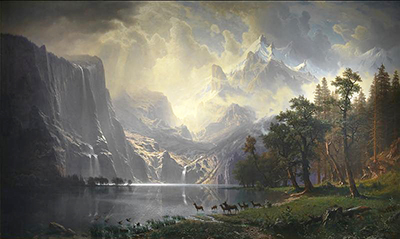
Bierstadt's familiar panoramic reputation can make this difference easy to overlook. Compare Among the Sierra Nevada, California: there, distant peaks and broad water organise a sweeping view. Here, the chief event is a change of light within close vegetation. Both compositions allocate attention through contrast, but they ask us to occupy different kinds of space.
Quiet feeling and the spectacle of colour
Durand's fourth landscape letter, published in 1855, sharpens a productive tension in this comparison. He criticised art directed primarily towards money or merely dazzling colour and effects. Yet he also described landscape paintings as companions that could revive memories and offer relief from city life and daily work.[5] His argument joined cultivated perception to a picture's emotional value.
Those ideas should not be assigned automatically to Bierstadt. They belong to Durand's published account of art's purposes, not to a documented explanation of Dogwood. They nevertheless show why the woodland tradition involved questions about the viewer's state of mind, as well as faithful descriptions of trees.
The Haggin's theatrical-lighting comparison raises a question about what the effect achieves.[1] The tree attracts attention immediately; the animals and water reward a slower look. Strong colour invites us towards the quieter details, giving the scene a changing pace.
The deer contribute to this slower pace. They occupy the clearing without bringing a hunter or obvious threat into view. Their presence makes the shelter feel inhabited. It does not establish a moral allegory, a precise species or Bierstadt's personal religious convictions; it gives the surrounding scale and stillness a living measure.
Observation, study and a finished picture
A documented preparatory work helps keep the woodland comparison precise. The Brandywine Museum identifies Durand's Landscape, Wood Scene (Sketch in the Woods), about 1854, as one of several oil studies made before In the Woods. Its interpretation stresses the coexistence of flourishing vegetation and decaying trees.[6] This establishes a particular relationship between two Durand works, rather than a general rule that every forest painting began as the same kind of sketch.
No equivalent preparatory relationship has been established here for Dogwood. The closeness of its subject does not demonstrate that this canvas was painted outdoors, and detailed bark does not record the sequence in which paint was applied. Looking can explain the organisation of the finished scene while leaving those questions of making open.
A comparison with Mountain Brook also draws attention to what the two pictures present. Water, rocks and woodland provide shared elements, but the stronger current in the brook painting supplies a more active route through its foreground. Dogwood concentrates on a luminous opening and the animals beside its subdued water. The distinction enlarges our understanding of Bierstadt's woodland subjects without inventing a common site or preparatory connection.
Staying within the clearing
The eye can return to the sapling after following the trees upwards or examining the stream below. Its small size and strong colour make it both a centre of attention and part of a much taller environment. The surrounding dark forms keep it from dissolving into a uniformly bright woodland.
That balance gives the painting its intimacy. We remain near the forest floor, among trunks and animals, while the light suggests further space beyond. Bierstadt's grandeur here depends on the scale and organisation of a sheltering place: a single bright tree can carry the attention that a distant summit commands elsewhere.
Watch: Albert Bierstadt
Five perspectives on his paintings and their historical setting.
American Landscape Painting: Albert Bierstadt and the American Land
A Museum of Fine Arts, Boston presentation on American Landscape Painting: Albert Bierstadt and the American Land.
Explore Bierstadt’s artworks
Discussion
How does the small red tree become the centre of attention within a much taller forest?
Reader Insights
Follow the dark trunks towards the red foliage. Which contrast most strongly gives the sapling its importance?
Look at the deer and water below the tree. How do those details change the scale and pace of looking?
Compare the discussion of Durand’s studies and landscape letters with this finished picture. Which ideas about attention and feeling help explain the forest’s appeal?
Join the Conversation
Share a specific observation, documented connection or comparison from Dogwood.
References
- Haggin Museum. Dogwood. Collection entry archived on 18 December 2015: date after 1875, medium and measurements; woodland format, Durand comparison and light effects. Its historical gallery location does not establish present display. View source text
- Michel-Eugène Chevreul. The Laws of Contrast of Colour, translated by John Spanton, 1861, Part I, Section I, chapter I, §§8–10. Simultaneous contrast and the grey-paper experiment. View source text
- Kevin J. Avery. “Asher Brown Durand (1796–1886),” Metropolitan Museum of Art, October 2009. Close natural subjects, woodland interiors and the 1855 letters. View source text
- Metropolitan Museum of Art. Asher Brown Durand, In the Woods, 1855, object 95.13.1. The documented basis in Catskill sketches made during 1854. View source text
- Asher B. Durand. “Letters on Landscape Painting,” Letter IV, The Crayon, 14 February 1855, pp. 97–98; reprinted in Kindred Spirits: Asher B. Durand and the American Landscape, 2007, pp. 238–239. Motives, perception and landscape as a companion. View source text
- Brandywine Museum of Art. Asher B. Durand, Landscape, Wood Scene (Sketch in the Woods), about 1854, object 80.3.11. A documented preparatory study for In the Woods. View source text