 by Tom Gurney
Tom Gurney BSc (Hons) is an art history expert with over 20 years experience
Published on June 19, 2020 / Updated on October 12, 2026
Email: tomgurney1@gmail.com / Phone: +44 7429 011000
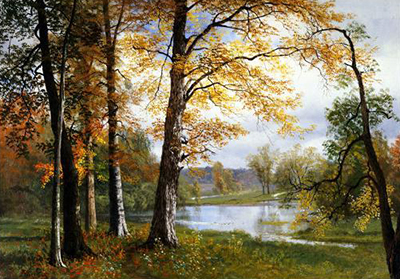
Quiet Lake by Albert Bierstadt
Golden foliage hangs above a pale stretch of water in Quiet Lake, also circulated as A Quiet Lake. Several trunks stand close to the viewer, dividing the landscape into narrow openings. Beyond them, a grassy bank and distant trees surround the water. The scene's light comes through this woodland screen, making the leaves, bark and lake participate in the same luminous arrangement.
Bridgeman Images lists the matching composition as A Quiet Lake, an oil on canvas by Albert Bierstadt, under image number CH380497. Its date field gives only the broad description ‘C19th AD’; no original painting dimensions appear in the current entry. The record labels the location ‘Private Collection’ and credits Christie's Images, without identifying a present owner or establishing an auction history.[1] A precise creation date and named landscape location therefore remain unconfirmed. The image can be examined as a particular woodland landscape without assigning it to a documented western expedition.
At a Glance
Where this painting sits in Bierstadt’s career
Dates refer to the paintings, rather than to the journeys behind them. Approximate dates and ranges retain the qualifications in the collection records.
Lake Lucerne
1858Mountain Brook
1863Street in Nassau
c. 1877–1880The Last of the Buffalo
1888–1889The Golden Gate
1900Quiet Lake
Undated (precise year unconfirmed)Contents
The trees form the composition
The large trunk slightly left of centre is the strongest upright. Its rough, brown surface widens towards the roots and contrasts with the slender pale trunk beside it. Farther left, darker trees stand closer together, making that side of the view more enclosed.
Branches from the central tree spread across the upper part of the picture. Some carry dense clusters of yellow leaves; others appear as dark lines against the sky. On the right, a thinner tree leans inward, its irregular branches extending towards the water. The resulting canopy has openings rather than a continuous edge, allowing pieces of pale sky to remain visible among the foliage.
These trees establish the painting's scale. Their roots occupy the near ground, while the far bank appears much smaller between the trunks. The lake is encountered through gaps in an environment already close to the viewer, rather than from a distant panoramic lookout.
Light divided across the scene
The foliage is brightest near the upper centre, where yellow and orange touches gather around dark branches. Lower down, red and orange leaves lie among green plants at the bases of the trees. Their scattered colour connects the canopy to the ground without making the entire foreground equally bright.
The grass at the bottom right remains green, crossed by darker passages. The contrast between these shaded areas and the illuminated leaves makes the sunlight feel selective. It picks out particular surfaces, leaving other parts of the woodland subdued.
The pale trunk has a different role. Its light bark is visible even beside the darker trees, adding an upright accent below the golden canopy. Light in this picture is therefore conveyed through several kinds of contrast: warm leaves against cool sky, pale bark against dark trunks, and open water beyond shaded ground.
This variation gives the landscape more interest than an evenly sunlit scene. The eye moves between surfaces that catch attention in different ways, while the tree trunks keep those changes organised within a clear structure.
Water beyond the foreground
The lake occupies a relatively small part of the image, but its pale horizontal surface opens the view. It interrupts the mass of trees and grass, allowing the composition to expand towards the far bank.
A narrow band of green land separates the water from the background trees. Their slender trunks and softened crowns contrast with the larger forms in the foreground. Across the lake, reflections and faint darker marks break up the pale surface without creating the forceful movement of rapids or a waterfall.
The title encourages a reading of stillness. That effect is visible in the balance of upright trunks, gently spreading branches and level water. It does not require a story about the artist's mood, nor does it establish that the place was untouched by people. No clearly identifiable human activity appears in the available reproduction, but the wider history of an unnamed site remains unknown.
Autumn colour and living foliage
The United States Botanic Garden's plant-science account explains that deciduous plants reduce chlorophyll production as they prepare for seasonal dormancy. As chlorophyll diminishes, other compounds contribute more visibly to leaf colour: carotenoids to yellow and orange, anthocyanins to red and purple, and tannins to brown.[2]
That explanation gives a biological context to the mixture of colours seen here. The painting contains yellow crowns, reddish areas near the ground and substantial passages of green. Such variety makes autumn foliage a rich subject for an artist, with colour changing across neighbouring plants and individual parts of a scene.
The image cannot determine a precise month or identify every tree. Its narrow pale trunk suggests a different kind of bark from the rough central tree, but a secure species identification would require better botanical evidence. What can be examined directly is how those differences contribute to the painted view.
Light as an art-historical subject
Bierstadt's attention to illumination can be placed within a wider discussion of nineteenth-century American landscape painting. The National Gallery of Art's 1980 publication American Light: The Luminist Movement, 1850–1875 brought together paintings, drawings and photographs concerned with light and atmosphere, including works by Bierstadt.[3]
That publication offers a later art-historical framework for considering how artists organised such effects. Its catalogue description emphasises different means of recording light and responding to nature. The overview does not identify Quiet Lake as one of the works discussed.
For this image, the most useful questions are specific. How does the bright canopy relate to the shaded ground? Why does the pale water remain visible behind the dark trunks? How do the small sky openings keep the leaves from becoming an undifferentiated mass? These relationships explain the painting's luminosity more precisely than a stylistic label alone.
A documented comparison: A Quiet Cove
St. Johnsbury Athenaeum holds a separate Bierstadt painting, A Quiet Cove, which it records as undated, oil on canvas, measuring 24 × 32 inches.[4] Its reproduction shows an open stretch of water surrounded by trees, distant hills and a small building near the opposite shore. Pale reflections lead towards that building, while darker vegetation gathers at the edges.
The Athenaeum interprets its painting as an idealised scene in which details support an overall experience of peace and respite. That interpretation belongs to A Quiet Cove, but the comparison shows two different ways of organising a tranquil waterside subject.
In A Quiet Cove, the open water leads into the landscape. In Quiet Lake, nearby trunks and golden branches hold the viewer beneath the trees. The similar titles should not obscure their different compositions or lead to the transfer of one work's measurements and collection history to the other.
Looking through the woodland
Follow the rough central trunk upwards into the yellow canopy, then look through the branches towards the pale sky. Returning downwards, the opening beside the trunk brings the lake and far bank into view.
This movement joins the picture's nearest and most distant forms. The trees give the scene structure, autumn colour supplies its strongest accents, and the water creates space within the woodland. Together they sustain the quiet effect expressed by the title.
Watch: Albert Bierstadt
Five perspectives on his paintings and their historical setting.
American Landscape Painting: Albert Bierstadt and the American Land
A Museum of Fine Arts, Boston presentation on American Landscape Painting: Albert Bierstadt and the American Land.
Explore Bierstadt’s artworks
Discussion
The lake appears through a screen of autumn trees. How does the woodland shape your experience of the water beyond it?
Reader Insights
Which openings allow your eye to reach the lake, and which foreground forms hold it near the rough bark and roots?
How do yellow leaves above and red-orange touches below connect the canopy with the ground?
Compare this composition with the documented A Quiet Cove discussed above. How does each organise open water and enclosed woodland?
Join the Conversation
Share a specific observation, documented connection or comparison from Quiet Lake.
References
- Bridgeman Images. A Quiet Lake (oil on canvas), CH380497. Exact catalogue record and visually matched reproduction: broad nineteenth-century date, material, anonymous collection label and photographic credit. Precise year, original dimensions, landscape location and present owner remain unconfirmed. View source text
- Isabel B. Emanuel, United States Botanic Garden. To Defoliate or Not to Defoliate, That is the Question, 13 December 2024. Chlorophyll, seasonal dormancy and autumn leaf pigments. View source text
- National Gallery of Art. American Light: The Luminist Movement, 1850–1875, John Wilmerding and contributors, 1980. Publication overview only: light, atmosphere and comparative scope including Bierstadt. View source text
- St. Johnsbury Athenaeum. Albert Bierstadt—A Quiet Cove. Collection record, dimensions, museum interpretation and visually inspected reproduction of a separate work. View source text