



 by Tom Gurney
Tom Gurney BSc (Hons) is an art history expert with over 20 years experience
Published on June 19, 2020 / Updated on October 12, 2026
Email: tomgurney1@gmail.com / Phone: +44 7429 011000
Albert Bierstadt Paintings
Albert Bierstadt’s paintings offer several ways into a landscape. A mountain panorama draws the eye towards a distant summit; a forest interior brings it back to bark, stones and moving water. A Bahamian street makes people and everyday activity the centre of attention. Exploring these subjects together reveals the range of an artist whose reputation rests chiefly on his enormous paintings of the American West.
The gallery below brings together 94 entries from this site. It is a selection for browsing, rather than a complete catalogue of Bierstadt’s output. Begin with the eight paintings here for his major western compositions, or follow the regional and subject routes to discover a different side of his work. Each linked article examines an individual picture, its history and the evidence behind its identification.
Contents
Eight paintings to begin with
These works make a useful first circuit because they offer different encounters with Bierstadt’s landscapes. Their dates run from his breakthrough in the Rockies to his late treatment of the threatened bison. All eight are oils on canvas, but their subjects, scale and public histories differ.
Among the Sierra Nevada, California
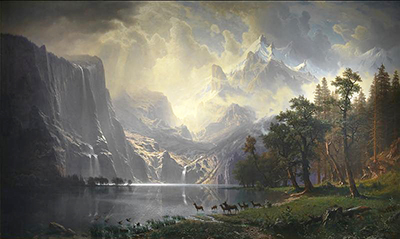
In Among the Sierra Nevada, California, deer gather beside a quiet lake while light breaks through clouds around the peaks. The dark trees and reflective water give the viewer a foothold beneath the mountain spectacle. Painted in 1868 and now at the Smithsonian American Art Museum, it also shows how far a Californian landscape could travel: the museum’s newer, 2015 account places its making in Bierstadt’s Rome studio, followed by exhibitions in Berlin and London before shipment to the United States.[1]
The Rocky Mountains, Lander’s Peak
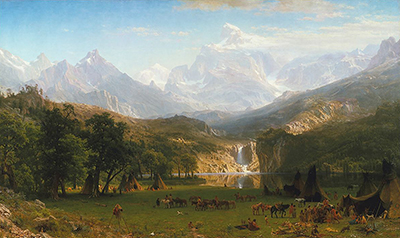
The Rocky Mountains, Lander’s Peak (1863), at the Metropolitan Museum of Art, gives the foreground to a Shoshone village. People, horses and shelters occupy the shore beneath distant snowy mountains. In the Met’s Native Perspectives, Cherokee painter Kay WalkingStick draws attention to that family life and explains the picture’s composite construction from drawings, photographs and oil studies. This is a rewarding starting point for asking how firsthand observation became an idealized image of the West.[2]
The Last of the Buffalo
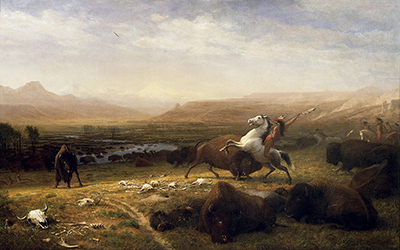
The Last of the Buffalo (1888–1889), at the National Gallery of Art, places a mounted hunt above a foreground of dead animals, with living herds extending into the distance. The apparent abundance is unsettling in a work made when bison survival was in question. The museum interprets the scene as a romantic invention addressing the destruction that accompanied settlement. Read it alongside the earlier mountain paintings to see how Bierstadt’s expansive landscape could carry a more troubled subject.[3]
A Storm in the Rocky Mountains, Mt. Rosalie
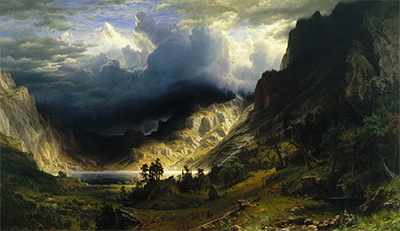
Clouds, cliffs and sharp changes of light give A Storm in the Rocky Mountains, Mt. Rosalie (1866), at the Brooklyn Museum, a restless energy. A bright lake opens within the dark terrain, while the storm seems to overtake the space above it. Gerald L. Carr’s catalogue account connects the composition with Bierstadt’s Colorado experience and also identifies California motifs within it. Compare it with Lander’s Peak: the two pictures turn accumulated western observations into very different kinds of spectacle.[4]
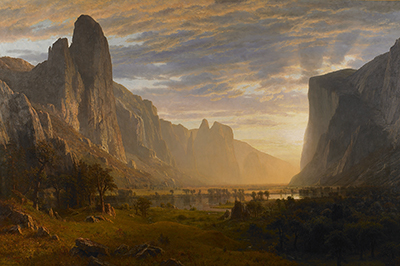
Looking Down Yosemite Valley, California
Looking Down Yosemite Valley, California (1865), at the Birmingham Museum of Art, opens a long corridor between immense cliffs. Warm light fills the distance while the foreground remains darker and more enclosed. It is an especially clear introduction to the way Bierstadt uses successive changes of illumination to carry the eye through a landscape. The valley’s space unfolds across a canvas more than eight feet wide.[5]
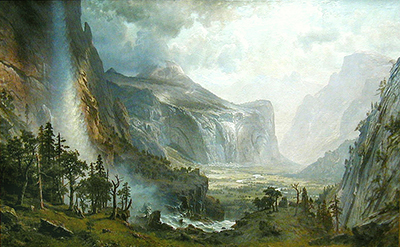
The Domes of the Yosemite
The Domes of the Yosemite (1867), at the St. Johnsbury Athenaeum, moves the viewer high above the valley, beside a plunging waterfall. At 116 × 180 inches, it is nearly ten feet high and fifteen feet wide. The Athenaeum explains that Bierstadt compressed the valley’s features to bring its landmarks into closer relation. This is a picture to explore for the connection between topography, pictorial rearrangement and the physical experience of a huge painting.[6]
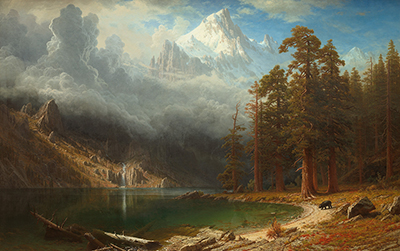
Mount Corcoran
In Mount Corcoran (c. 1876–1877), at the National Gallery of Art, a small bear follows the shore beneath trees, clouds and a snowy summit. Look first at the quiet lake, then at the enormous mountain above it. The title introduces another route into the picture: first exhibited as Mountain Lake, it was renamed during Bierstadt’s pursuit of collector William Wilson Corcoran. Its article follows the patronage history behind this seemingly remote scene.[7]
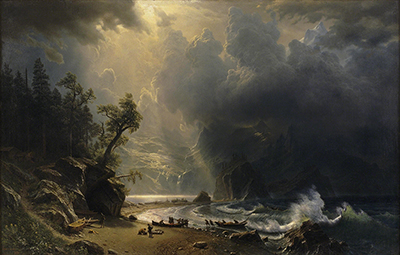
Puget Sound on the Pacific Coast
Puget Sound on the Pacific Coast (1870), at Seattle Art Museum, brings canoes and an inhabited beach into the path of towering clouds and breaking surf. The museum traces its construction to Columbia River studies, Northwest Coast objects and a possible printed source. Bierstadt had not visited the precise site named in the title. It offers a particularly useful comparison with his mountain panoramas: regional knowledge could support a convincing picture without making it a record of one shoreline.[8]
Follow a region or a different kind of view
Europe and the mountain panorama
Start with Lake Lucerne (1858) to see the European foundation of Bierstadt’s panoramic painting. Nancy K. Anderson’s National Gallery catalogue describes its development from Swiss studies and compares its organisation with the later Lander’s Peak and Looking Down Yosemite Valley. Technical examination revealed a moved church, altered mountain profiles and a cliff changed into trees. The apparently continuous view emerged through revision.[9]
The European route also includes Sunrise on the Matterhorn, together with the gallery’s Italian subjects, Olevano, Fishing Boats at Capri and Portico of Octavia, Rome. Europe remained part of Bierstadt’s travels after he became famous for American subjects; the Smithsonian’s biography records journeys to Europe, the West and Nassau through his mature career.[10]
The Rockies, California and the Northwest
For the western journeys, move from Lander’s Peak to Storm, then to the Yosemite paintings. Bierstadt’s 1859 journey supplied material from the Wind River region; his 1863 travels brought him to California and Yosemite.[10] The pictures that followed make a productive sequence, but an exhibition date is not necessarily the date when he first saw the landscape. Carr’s account of Storm separates the 1863 Colorado encounter from the canvas begun in 1865 and unveiled the following year.[4]
Within the California group, compare Looking Down with The Domes: the former leads the eye along the valley; the latter places it on an elevated mountainside. Continue to California Spring, Donner Lake from the Summit and the many waterfall and redwood subjects in the gallery. For the Northwest, pair Puget Sound with Mount Hood. These routes let you explore a region through several pictorial choices rather than expecting one painting to stand for all of it.
Woodland and close observation
Mountain Brook (1863), at the Art Institute of Chicago, provides a change of distance. Pale birches, boulders and small falls occupy an upright, enclosed woodland scene. The museum locates its sources in New Hampshire’s White Mountains and proposes that elements of the Flume were incorporated into an imaginary composition. More than a metre high, it is substantial even though its field of attention is much narrower than that of the western panoramas.[11] Follow it with the gallery’s forest, tree and quiet-lake subjects, looking at how each picture gives access to a confined space.
Nassau and the sea
Street in Nassau brings the viewer to a road, a wall and the daily movements of Afro-Bahamian people. Alba Campo Rosillo contrasts this human scale with Bierstadt’s panoramic sublime, while placing the scene within the Bahamas’ colonial and tourism history. Her account links his Bahamian visits with his wife Rosalie’s search for a climate that might ease her illness.[12]
The sea provided another, more turbulent subject. Compare The Shore of the Turquoise Sea with The Golden Gate. Campo Rosillo identifies the recurring breaking wave across the Bahamian paintings and the 1900 Golden Gate. A motif could travel as readily as the artist, entering a new geographical setting while retaining a familiar pictorial force.[12]
Late work and returning subjects
The Last of the Buffalo and The Golden Gate are useful entrances to Bierstadt’s later work because they show him returning to the large landscape through different subjects. The former revisits the western plains; the latter carries the wave composition into a Pacific scene.[3][12] Follow their individual histories, then compare them with earlier works sharing animals, weather or water.
Recognising a version, study or reproduction
A familiar title is only the beginning of an identification. Check the composition, date, dimensions, support and collection together. The Rocky Mountains, Lander’s Peak at the Met is the broad canvas with the village foreground; the separate Rocky Mountains, Lander’s Peak article concerns the smaller upright painting. Compare their formats before following the shared title.
The Last of the Buffalo survives in two large painted versions, at the National Gallery of Art and the Buffalo Bill Center of the West in Cody. Dare Myers Hartwell and Helen Mar Parkin found related compositional changes beneath both surfaces, supporting an overlapping working process rather than a simple finished original followed by a copy. Their technical findings and the Cody canvas’s later reconstruction belong to the particular objects examined.[13]
Support matters as much as size. Bierstadt painted in oil on paper and board as well as canvas. Mayer and Myers distinguish quick studies from highly finished small paintings that can function as independent works; a small oil is not automatically an outdoor sketch or merely an unfinished stage.[14] Campo Rosillo records Street in Nassau as oil on board pasted onto canvas, a construction quite different from the vast canvases above.[12]
A printed version introduces a further distinction. The Amon Carter Museum’s Domes of the Yosemite is a chromolithograph dated 1870, printed by T. J. Dillman, with its publisher recorded as possibly Oeldruck von Breidenbach & Company. It carries the composition into a separate medium and format; it is not the Athenaeum’s 1867 oil painting.[15] Keeping these identities in view makes comparison more revealing: we can ask what changes when a composition becomes smaller, shifts support, or reaches its audience in print.
Browse the paintings gallery
Use the gallery to follow a place, subject or visual detail that catches your attention. The individual articles provide fuller histories and distinguish related works where the evidence allows. Titles with uncertain dates should be read with the qualifications given in their entries; a date attached to one version does not establish the date of every picture sharing its name.
Watch: Albert Bierstadt
Five perspectives on his paintings and their historical setting.
Albert Bierstadt: A collection of 404 paintings (HD)
A LearnFromMasters presentation on Albert Bierstadt: A collection of 404 paintings (HD).
Albert Bierstadt Paintings Catalogue










 Albert Bierstadt.jpg)

 Albert Bierstadt.jpg)


 Albert Bierstadt.jpg)


 Albert Bierstadt.jpg)


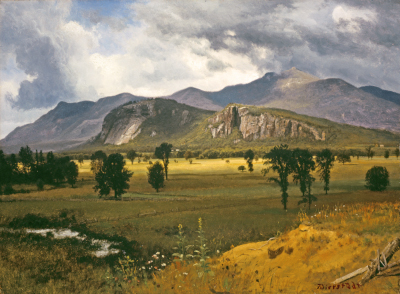
Explore Bierstadt’s artworks
Discussion
Which route through Bierstadt’s paintings reveals the most interesting change in his treatment of landscape?
Reader Insights
Set a mountain panorama beside a forest interior or Nassau street. What changes in the scale of the subject and the viewer’s imagined position?
Choose two related works with similar titles. Which composition, collection or medium details establish that they are separate objects?
Use the gallery to select a pair linked by water, weather, wildlife or travel. What distinct question would you bring to their individual articles?
Join the Conversation
Share a specific observation, documented connection or comparison from Albert Bierstadt Paintings.
References
- Smithsonian American Art Museum. “Among the Sierra Nevada, California,” accession 1977.107.1; object details and the 2015 Commemorative Guide publication label, for Rome, Berlin and London. View source text
- Kay WalkingStick (Cherokee), The Metropolitan Museum of Art. “Kay WalkingStick on The Rocky Mountains, Lander’s Peak,” in Native Perspectives (2019); object identification, accession 07.123, and painting-specific response. View source text
- National Gallery of Art. “The Last of the Buffalo,” accession 2014.79.5; date, visual description and introductory interpretation. View source text
- Gerald L. Carr. “A Storm in the Rocky Mountains—Mount Rosalie,” in American Paradise: The World of the Hudson River School (The Metropolitan Museum of Art, 1987), printed pp. 290–293, especially pp. 290–292, for the Colorado journey, California motifs and execution chronology. View source text
- Birmingham Museum of Art. “Looking Down Yosemite Valley, California,” accession 1991.879; title, medium, canvas dimensions and dated signature. View source text
- St. Johnsbury Athenaeum. “Albert Bierstadt — The Domes of the Yosemite”; object heading, dimensions and account of the Columbia Rock viewpoint and compressed geography. View source text
- National Gallery of Art. “Mount Corcoran,” accession 2014.79.4; date, visual description and introductory account of the changed title and 1878 purchase. View source text
- Seattle Art Museum. “Puget Sound on the Pacific Coast,” accession 2000.70; object date and “Label Text,” especially “A Portrait of a Place,” for Columbia River studies, collected objects and the possible Swan illustration. View source text
- Nancy K. Anderson. “Lake Lucerne,” in American Paintings of the Nineteenth Century, Part I (National Gallery of Art, 1996), printed pp. 33–39; p. 33, technical notes; pp. 33–36, studies and early history; pp. 36–38, western comparisons. View source text
- Smithsonian American Art Museum. “Albert Bierstadt”; “Artist Biography,” for the 1859 and 1863 western journeys and later travel. View source text
- Art Institute of Chicago. “Mountain Brook,” accession 1997.365; “About this artwork,” date, medium and dimensions. View source text
- Alba Campo Rosillo. “Bierstadt’s view of a street in Nassau: a painting about becoming,” Open Windows 11 (2022), printed pp. 3–25; pp. 5–11, Nassau, picturesque scale, travel and supports; fig. 4 and p. 25, The Golden Gate and recurring wave compositions. The political and social reading is Campo Rosillo’s interpretation. View source text
- Dare Myers Hartwell and Helen Mar Parkin. “Corcoran and Cody: The Two Versions of The Last of the Buffalo,” Journal of the American Institute for Conservation 38, no. 1 (1999), pp. 45–54; §3, relationship of the paintings, and §4, treatment. “Corcoran” identifies the canvas now at the National Gallery of Art. View source text
- Lance Mayer and Gay Myers. “Bierstadt and Other 19th-Century American Painters in Context,” Journal of the American Institute for Conservation 38, no. 1 (1999), pp. 55–67; §3.1, “Studies,” for varied handling, paper supports and independent small paintings. View source text
- Amon Carter Museum of American Art. “[The Domes of the Yosemite],” accession 1968.42; “Object Details,” date, object type, medium and contributor fields. View source text