by Tom Gurney
Tom Gurney BSc (Hons) is an art history expert with over 20 years experience
Published on June 19, 2020 / Updated on October 12, 2026
Email: tomgurney1@gmail.com / Phone: +44 7429 011000
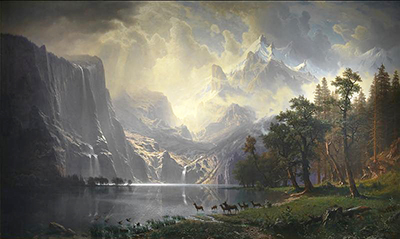
In the Sierras by Albert Bierstadt
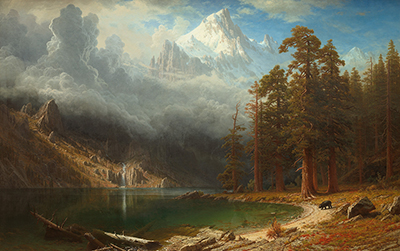
A still lake stretches beneath cliffs and a pointed, snow-covered mountain. In Albert Bierstadt's In the Sierras, the brightest light reaches into the upper valley while the foreground remains close, green and comparatively sheltered. The picture brings an immense-looking landscape into a small frame.
Harvard Art Museums dates the oil painting on canvas to 1868. It measures 33 by 40.6 centimetres and bears the lower-right monogram and date AB 68. It belongs to the Fogg Museum collection, accession 1940.299.[1]
At a Glance
Where this painting sits in Bierstadt’s career
Dates refer to the paintings, rather than to the journeys behind them. Approximate dates and ranges retain the qualifications in the collection records.
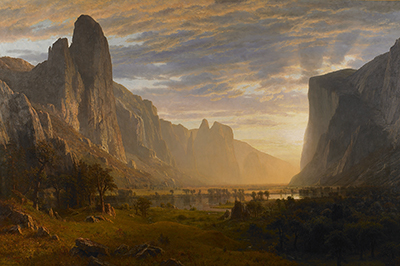
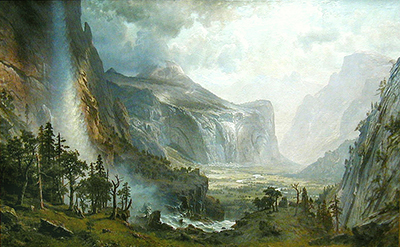
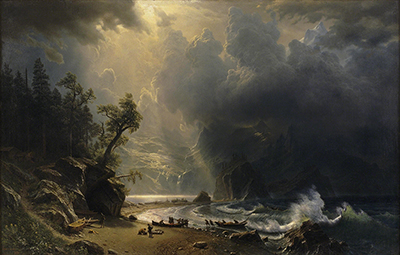
Lake Lucerne
1858Mountain Brook
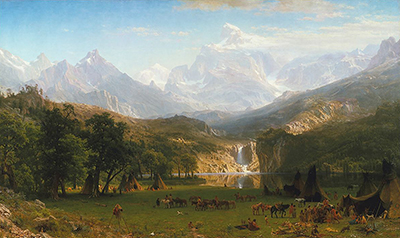
1863In the Sierras
1868Street in Nassau
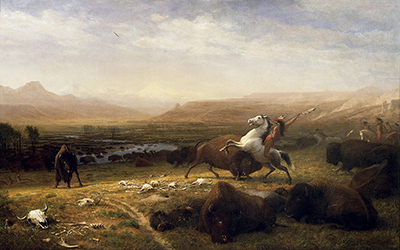
c. 1877–1880The Last of the Buffalo
1888–1889The Golden Gate
1900Contents
Shore, lake and mountain
The near shore offers a place from which to begin looking. Rocks lie among grass and low vegetation, with water entering between them. At the left, a group of leafy trees provides a dark, irregular boundary. A thinner trunk leans towards the open view, its sparse branches standing against the lighter distance.
Across the lake, trees occupy a narrow strip of land extending from the right. Their reflections darken the water below them. This strip gives the lake another edge, preventing it from becoming an undifferentiated space between the viewer and the mountains.
Beyond it, the land rises through overlapping cliffs and ridges. The mountain forms become successively lighter and less sharply defined towards the centre. The snow-covered peak rises above that sequence, with a smaller pointed form beside it. These changes in overlap, tone and outline make the distance appear substantial despite the painting's modest physical size.
The lake's comparatively smooth surface has a different rhythm from the broken ground around it. Narrow reflections connect the illuminated slopes with the water, but their subdued edges keep them from competing with the mountain. The view alternates between uneven surfaces and a quieter, horizontal interval.
Light opening the valley
The brightest part of the sky lies left of the principal snowy peak. Pale light descends through the atmosphere, while darker clouds gather above and behind the mountain. The contrast makes the peak's outline particularly conspicuous without placing it at the centre of the canvas.
Lower down, light catches exposed slopes and patches of rock. Those warmer passages help the eye move through the valley. They also keep the mountains from becoming a uniform mass of grey: each plane receives or resists the illumination differently.
The near trees have their own accents of brightness. Small yellow-green leaves interrupt the darker foliage, and the thin leaning tree becomes more visible against the sky. The foreground remains shaded enough to feel near, but it contains details that reward looking before the eye travels into the open distance.
This is one reason the picture can seem both enclosed and expansive. The lake opens the view, while the trees and rocky margins hold the spectator close to the shore. The luminous upper valley is encountered through that nearer place.
From Lake Tahoe to In the Sierras
Harvard records Landscape and Lake Tahoe as former titles.[1] The present title identifies a region more broadly than the earlier lake name.
A former title is useful evidence of how a picture has been understood, but it cannot alone establish a precise viewing position. Neither the snowy summit nor the lake's shape should be assigned a modern place name simply because the image looks geographically convincing. Here the recorded titles invite attention to the relationship between regional identity and the composition's particular arrangement.
The small picture retains considerable variety within that arrangement. Broad cliff faces, distant spires, a bright snow peak and shaded trees appear together, with the water holding them apart. Its sense of place depends on these relationships as well as on whatever landscape prompted them.
Colour studies during the western journey
Fitz Hugh Ludlow's The Heart of the Continent, published in 1870, describes the artists' daily work during their Yosemite stay. He recalls their leaving camp with stools and colour boxes, beginning colour studies early in the day, and returning in the evening to show the day's work before cleaning their brushes.[2]
The account makes landscape study a sustained activity, supported by the routines of a travelling party. It offers a more concrete picture of fieldwork than imagining an artist suddenly producing a finished view at one inspired moment.
Ludlow's enthusiastic claim for the importance of that work is his assessment. His narrative does not identify a preparatory study for In the Sierras or prove that this canvas was painted in Yosemite. It supplies testimony about the practices through which observations could accumulate before later paintings took shape.
Small paintings and the word sketch
William Kloss's essay on the separate Twilight, Lake Tahoe, in the Diplomatic Reception Rooms collection, discusses a small picture Bierstadt gave to Adeline Morse around 1873–74. Kloss explains that Bierstadt asked her to describe it to a critic as a sketch, connecting that attitude with an academic hierarchy that valued larger, highly finished pictures more publicly.[3]
This comparison gives the word sketch a social meaning as well as a technical one. It could help position a gift or intimate work in relation to the expectations of patrons and critics. The term need not describe a careless or undeveloped image.
The gift, letter and proposed relationship to a larger painting concern Twilight, Lake Tahoe. They should not become a provenance or working history for Harvard's canvas. What the example offers here is a way to consider the different kinds of attention that a smaller landscape could receive.
Conservators Lance Mayer and Gay Myers likewise distinguish several kinds of Bierstadt studies, including highly finished small pictures. Their discussion of South Dome, Yosemite Valley shows that a study could have carefully developed paint application and a composition able to function independently.[4]
Small scale is therefore a beginning for inquiry. In this picture, the many distances, contrasting surfaces and shifts of light have been brought into an arrangement that invites close viewing. Its size alone cannot decide whether it was a preliminary work or an independent painting.
Regional painting and the urban viewer
The Nevada Museum of Art's account of Lake Tahoe painting places the subject within the developing art world of San Francisco. It connects artistic interest in the region during the 1860s with the Comstock silver discovery and with visitors such as Thomas Starr King. Its exhibition interpretation also stresses the spiritual meanings that many nineteenth-century viewers found in mountains and still water.[5]
A landscape painting could bring those associations into an urban home. The museum describes this as a way to experience the apparent remoteness and beauty of the Sierra through an image.[5]
That reading is relevant to the contrast between the sheltered shore and luminous mountains here. It does not establish a particular owner's religious interpretation or prove that Bierstadt intended each beam of light as a theological symbol. The picture offers visual relationships through which such associations could arise.
The region as a lived homeland
The Washoe Tribe of Nevada and California's own history identifies Lake Tahoe as a geographical and spiritual centre of the Washoe homeland. It describes seasonal movement through the surrounding country, fishing and gathering, and the continuing practice of plant gathering by tribal members. It also recounts the disruption brought by mining, immigration, logging and pressure on the region's resources.[6]
These accounts change what a nineteenth-century description of remote wilderness can mean. A place perceived as distant from a city could already be central to another community's life. An image without conspicuous inhabitants does not establish an unoccupied landscape.
The former Lake Tahoe title makes this regional history worth considering while the painting's exact topography remains uncertain. The tribal account does not identify this particular shore or mountain. Its contribution is to keep the wider region within a continuing human history, alongside the interpretations of artists, travellers and museum audiences.
Ownership and later exhibition
Harvard records descent through the Curtiss family and the 1940 gift from Mr. and Mrs. Frederic Haines Curtiss. The earlier acquisition around 1880 is qualified: Frederic's letter recalled a possible purchase by his father but expressed uncertainty.[1]
That uncertain beginning differs from the securely documented museum gift.
Harvard also records its inclusion in Take Care: The Conservation of Paintings in 1954 and the touring American West exhibition in 1974.[1] These are historical exhibitions.
The listings establish past exhibitions, without identifying a conservation treatment or a present gallery location.
Looking across a small canvas
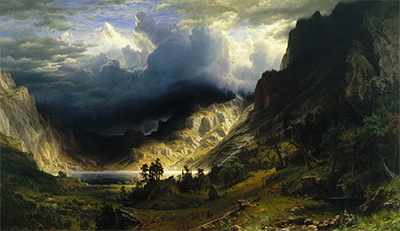
Compare Among the Sierra Nevada, California, where water and illuminated mountains occupy a much broader panorama. In the Sierras holds the shoreline more closely around the lake and places the snowy peak within a relatively compact sequence of cliffs. Shared landscape elements can produce different experiences according to their spacing and scale.
The most useful way back into this picture is through the nearer rocks and leaning tree. Follow their outlines towards the smooth water, then the warm slopes and the pale mountain. Each transition changes the kind of surface the eye encounters. The luminous distance gains much of its force from the darker, more tangible place through which we approach it.
Watch: Albert Bierstadt
Five perspectives on his paintings and their historical setting.
American Landscape Painting: Albert Bierstadt and the American Land
A Museum of Fine Arts, Boston presentation on American Landscape Painting: Albert Bierstadt and the American Land.
Explore Bierstadt’s artworks
Discussion
How does this small canvas bring a sheltered near shore into relation with imposing mountains?
Reader Insights
Follow the leaning tree and water towards the snowy peak. Which spacing or contrast gives the compact view its depth?
Consider the former Landscape and Lake Tahoe titles. What can a regional title communicate without establishing one exact viewpoint?
Read the Washoe account beside the urban art-world context. How do these different relationships with the Sierras extend beyond the painted lake?
Join the Conversation
Share a specific observation, documented connection or comparison from In the Sierras.
References
- Harvard Art Museums. In the Sierras, 1868, accession 1940.299. Object record, former titles, qualified Curtiss provenance and historical exhibitions. View source text
- Fitz Hugh Ludlow. The Heart of the Continent, Hurd and Houghton, 1870, pp. 433–436. Selected account of daily colour studies during the Yosemite stay; original book digitised by BYU. View source text
- William Kloss. “Twilight, Lake Tahoe,” in Treasures of State, 1991; published by the U.S. Department of State. Separate picture, gift and the status of a sketch. View source text
- Lance Mayer and Gay Myers. “Bierstadt and Other 19th-Century American Painters in Context,” Journal of the American Institute for Conservation 38, 1999, section 3.1. Types of studies and the separate South Dome. View source text
- Nevada Museum of Art. Lake Tahoe's Golden Age — Nineteenth Century Paintings of the Region, 2015–16. Regional art, visitors and the museum's interpretation of spiritual and urban viewing contexts. View source text
- Washoe Tribe of Nevada and California. “Washoe History.” The lake-centred homeland, seasonal practices, continuing gathering and historical disruption. View source text