by Tom Gurney
Tom Gurney BSc (Hons) is an art history expert with over 20 years experience
Published on June 19, 2020 / Updated on October 12, 2026
Email: tomgurney1@gmail.com / Phone: +44 7429 011000
A Western Landscape by Albert Bierstadt
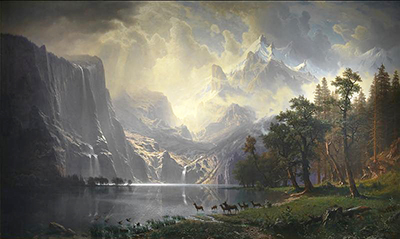
A lake fills the lower half of a mountain basin, catching the pale reflection of a brightly illuminated cliff. On the opposite side, a wooded slope descends into shadow. Between them, a thin waterfall drops towards the distant shore, and a bird crosses the open air. Albert Bierstadt's A Western Landscape brings these contrasting forms into a small but spacious composition.
The Spencer Museum of Art at the University of Kansas identifies the work as an oil painting on preprimed linen, dated to the late 1860s or 1870s.[1] The support measures 20 × 26.4 centimetres. It entered the collection as a gift from the Collection of David L. Barber, Sr., and carries accession number 2009.0176. The museum's broad dating should be retained rather than replaced with a precise year unsupported by this record.
At a Glance
Where this painting sits in Bierstadt’s career
Dates refer to the paintings, rather than to the journeys behind them. Approximate dates and ranges retain the qualifications in the collection records.
Lake Lucerne
1858Mountain Brook
1863Street in Nassau
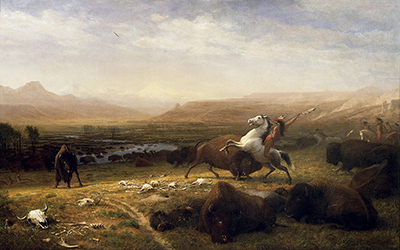
c. 1877–1880The Last of the Buffalo
1888–1889The Golden Gate
1900A Western Landscape
Late 1860s or 1870sContents
Distinguishing paintings with similar titles
This work should be distinguished from the Newark Museum of Art's Western Landscape, an oil on canvas dated 1869. Newark's record explains that its painting was previously called Mount Whitney, a title the museum considers incorrect.[2] That history belongs to Newark's larger canvas, with its different arrangement of mountains, lake and foreground trees.
The Rockwell Museum's Mount Whitney, dated circa 1877, is another separate painting. Its museum guide identifies a canvas measuring 69 × 116¾ inches and illustrates a broad mountain view with a forested shore and deer.[3] Neither its date nor its collection location should be attached to the small Spencer painting simply because both subjects include mountains and water.
The identifying features here are the pale, steep left-hand cliff, the narrow fall near the centre-right, the bird beside it and the rocky shore entering from the lower right. They allow the image to be recognised more securely than its general landscape title alone.
A valley opening beyond the water
The lake draws the viewer into the scene. Its nearer edge extends beyond the bottom of the picture, while its far end narrows into a small, light area between the mountain sides. The composition therefore begins close to the water and leads towards a more distant enclosed space.
The two sides of the basin do different work. On the left, an exposed rock face dominates, descending steeply towards its reflection. On the right, the mountain is darker and more wooded, with the foreground tree continuing that mass towards the viewer.
A lower ridge stretches across the centre. Behind it, pale pointed peaks rise into the clouded sky. These overlapping forms create several stages of distance: nearby shore, enclosing slopes, middle ridge and remote summits.
The mountains do not form a symmetrical wall. Their differing angles and colours keep the passage towards the far shore open, while still giving the lake a strong sense of enclosure.
The illuminated cliff
The left-hand cliff is the brightest large landform. Its yellow-green surface contains pale streaks, shallow shadows and darker lines of trees. Changes across its face make the steep slope appear varied rather than flat.
Several diagonal bands descend towards the water. They guide the eye downward, carrying the mountain's shape into the reflected area below. Narrow trees appear in scattered groups, making the height of the rock more apparent through their small scale.
Along the upper edge, darker vegetation is partly softened by mist. This is a different kind of boundary from the sharp lower junction between stone and water. The cliff thus changes in clarity as well as colour from top to bottom.
Its prominence gives the painting a clear centre of illumination. Yet the brightest surface occupies one side rather than the exact middle, creating a balance with the darker right-hand slope and foreground tree.
Water, reflection and the nearer shore
The lake shifts from a pale, reflective area beneath the cliff to deeper blue-green in the foreground. Short horizontal marks interrupt those colours, suggesting surface movement without breaking the broad impression of still water.
The reflection repeats the cliff in a less definite form. Its light colour spreads downwards, while the rock's many divisions become softer and more horizontal. This correspondence joins the two halves of the picture without making them identical.
Near the right-hand shore, the water becomes lighter around partially submerged stones. Individual rocks have darker undersides and bright upper surfaces, so the viewer can distinguish them from both the lake and the dry ground.
A small tree rises near the shallows. Behind it, larger rocks sit at the water's edge. These details give the nearest part of the scene a different pace: after following the broad reflection, the eye can pause over separate stones, vegetation and small changes of surface.
Trees frame a place to look from
The large tree on the right extends its leafy branches above the rocky bank. Its trunk is partly shadowed, and its dark crown sits against the lighter sky and distant mountains. It makes the near shore feel close enough to stand beside.
The branch tips reach into the view but leave the central lake open. This gives the tree a framing role, while its uneven silhouette prevents the edge from becoming rigid. Smaller trees follow the mountainside behind it, diminishing into the distance.
The dry bank contains gold and brown passages beside cooler greens near the water. These colours link the foreground to the illuminated cliff across the lake, even though the two areas are separated by an extensive darker surface.
The viewer is given a position within the landscape through this accessible-looking shore. That pictorial invitation does not establish an actual trail, a recorded viewing point or the place where Bierstadt worked.
A waterfall and a bird in open space
The waterfall appears as a slender pale line against the darker central slope. It follows an uneven course, with small changes in direction as it descends. Its light colour makes it legible from a distance despite the surrounding mountain's much greater size.
A bird with spread wings crosses the space just to its right. The body and wings create a short horizontal shape beside the fall's vertical descent. This small contrast introduces a different kind of movement into the landscape.
The bird can suggest flight through the basin, while the waterfall suggests falling water. Neither requires a fixed symbolic explanation. The image does not establish the bird's species or support a claim that it represents a particular ideal such as freedom.
Both details become clearer during close looking. They reward attention after the viewer has first taken in the cliffs, lake and clouded peaks.
Scale and an idealised western view
The painting's physical size matters. A composition that seems to encompass a broad mountain world occupies a support only 20 centimetres high. Its many stages of distance are concentrated into a surface suited to close examination.
The Spencer Museum's interpretation places Bierstadt's western landscapes within an idealised vision offered to eastern audiences, including expectations of abundant resources and territorial possession. That perspective adds historical weight to the apparently peaceful scene.
No settlement or human figure is clearly visible here. This is a feature of the composition, rather than evidence that the land depicted was unoccupied. Without a securely identified site, the image cannot establish a particular community or reconstruct a local history of land use.
Comparing Mount Corcoran
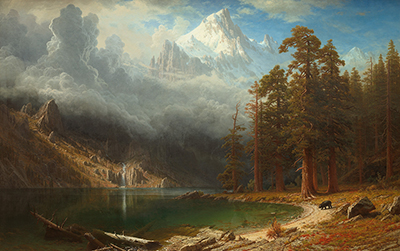
Bierstadt's Mount Corcoran, now in the National Gallery of Art, is a much larger oil painting dated circa 1876–1877. The gallery describes its convincing mountain setting as imagined, despite the specific title.[4]
Both works arrange water below mountains, with a wooded shore on the right and a waterfall in the farther landscape. In Mount Corcoran, tall foreground pines, a bear and a dominant snowy summit give the view a different emphasis. Its clouds form a large, strongly modelled mass above the lake.
In A Western Landscape, the brightest cliff descends directly towards its reflection, while the remote peaks remain comparatively small and pale. The foreground tree frames the basin without competing with an enormous central summit. These visible differences show how similar ingredients can produce distinct experiences of space.
Begin with the foreground rocks, follow the light reflection towards the cliff, and then cross to the waterfall and bird. Return through the distant peaks and the tree on the right. The circuit reveals the painting's balance between large enclosing forms and details small enough to be missed at first glance.
Watch: Albert Bierstadt
Five perspectives on his paintings and their historical setting.
American Landscape Painting: Albert Bierstadt and the American Land
A Museum of Fine Arts, Boston presentation on American Landscape Painting: Albert Bierstadt and the American Land.
Explore Bierstadt’s artworks
Discussion
A small linen support contains a spacious mountain lake. How does the composition create so many stages of distance within its modest dimensions?
Reader Insights
How do the illuminated left-hand slope and its pale reflection connect land with the lake?
What do the slender waterfall and crossing bird contribute to the larger stillness of the basin?
Which catalogue details distinguish the Spencer painting from Newark’s Western Landscape and prevent their histories from being combined?
Join the Conversation
Share a specific observation, documented connection or comparison from A Western Landscape.
References
- Spencer Museum of Art, University of Kansas. A Western Landscape, late 1860s or 1870s, 2009.0176. Object record and museum interpretation; original museum image visually inspected. View source text
- The Newark Museum of Art. Western Landscape, 1869, 61.516. Record of a separate painting and its former title; image visually inspected. View source text
- The Rockwell Museum. Art & Healing Guide, PDF page 3, Mount Whitney, circa 1877, 78.14 F. Selected page and illustrated separate painting inspected. View source text
- National Gallery of Art. Mount Corcoran, circa 1876–1877, 2014.79.4. Object record and account of its imagined setting; original comparison image visually inspected. View source text