by Tom Gurney
Tom Gurney BSc (Hons) is an art history expert with over 20 years experience
Published on June 19, 2020 / Updated on October 12, 2026
Email: tomgurney1@gmail.com / Phone: +44 7429 011000
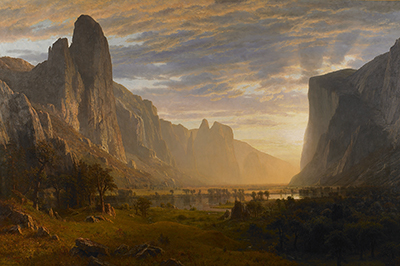
Looking up the Yosemite Valley by Albert Bierstadt
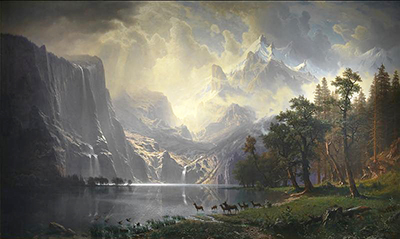
Sunlight crosses an open meadow between tall granite walls, with people, horses and water visible near the foreground. Albert Bierstadt's Looking up the Yosemite Valley draws the eye into the valley from a low position, making the cliffs seem to rise around the spectator. The scene is monumental, but its small figures make looking and recording part of the landscape's life.
The Haggin Museum dates this undated oil on canvas to 1863–1875 and gives dimensions of 36 × 58½ inches. It identifies the view from the valley's western end, with El Capitan at the left, Cathedral Rocks at the right and Bridalveil Falls against the right-hand cliff.[1] These landmarks establish a recognisable setting. The painting's atmosphere and arrangement turn that setting into a sustained encounter between nearby human activity and an immense space.
At a Glance
Where this painting sits in Bierstadt’s career
Dates refer to the paintings, rather than to the journeys behind them. Approximate dates and ranges retain the qualifications in the collection records.
Lake Lucerne
1858Looking up the Yosemite Valley
Probably 1863–1875Mountain Brook
1863Street in Nassau
c. 1877–1880The Last of the Buffalo
1888–1889The Golden Gate
1900Contents
A low viewpoint and an opening meadow
Bierstadt places comparatively dark ground across the bottom of the canvas. Low rocks, trunks and uneven surfaces keep this nearest space distinct from the open meadow beyond. The spectator's eye must pass that shadowed boundary before reaching the brightest grass. The landscape therefore opens gradually, rather than offering its full distance without an approach.
In the meadow, trees stand as individual, slender forms. Their trunks interrupt the light while leaving space around them. Farther back, vegetation loses definition as it approaches the hazier middle of the valley. This change in clarity connects the detailed near ground with the distant cliffs. The eye moves through things it can distinguish towards a space it can apprehend only more broadly.
El Capitan occupies much of the left side. Its illuminated face is divided by long pale marks and darker seams, giving the rock a height that can be followed across its surface. The right-hand cliffs have a more complicated outline, with ridges and sloping masses that catch and lose the light. The valley's sides are held in balance by their scale, while retaining different shapes and rhythms.
The low viewpoint strengthens their height. We see enough meadow and water to imagine ground beneath our feet, then look up towards peaks whose scale dwarfs it. The foreground provides access without making the scene domestically small. This is one reason the painting can seem welcoming and formidable at the same time: a party can occupy the valley floor, yet its presence scarcely alters the great walls around it.
Light that gathers the view
The painting's light is selective. A bright strip of meadow opens beyond the foreground, and the cliff faces catch sunlight in broad passages. Trees, rocks and the nearer water remain darker. The contrast gives the composition several distances of attention: the spectator can inspect the near surfaces, pause at the lighted meadow and then follow the softened valley inward.
Clouds partly break the warm sky, while haze collects between the distant masses. The central distance is less sharply defined than the cliffs on either side. This prevents the viewer from settling on a single distant object as the painting's entire destination. The vista is held open by atmosphere, and the flanking rock faces continue to govern the experience.
Bridalveil Falls has a different role from the towering cliffs. It is a small, pale descent against the shaded right-hand side. Gerald L. Carr, writing in the Metropolitan Museum's American Paradise catalogue, describes its reduced summer flow.[2] Within the picture, the narrow watercourse helps articulate the cliff rather than competing with its mass. It supplies movement and a recognisable feature without becoming the composition's principal spectacle.
The Merced introduces a quieter line through the meadow. Its horizontal stretch and reflections give the lower painting a pause beneath the upward movement of the rocks. Water appears in two different conditions: the distant fall descends against stone, while the nearer river spreads through inhabited ground. Their separation contributes to the painting's range, joining geological height with a place where the visitors can stop.
An artist within the landscape
The Haggin identifies the figure recording the view as possibly Bierstadt himself.[1] The qualification is important, but the activity does not depend on a certain portrait identification. The small figure makes the practice of looking visible. The landscape contains someone trying to translate it into another image.
Carr describes the artist seated near a grazing horse, with a separate party of men and horses farther away.[2] The arrangement makes observation and travel related but distinguishable activities. One person has stopped to work; others remain grouped within the meadow. Animals connect both to the practical business of moving through Yosemite.
Those figures establish more than scale. They give the valley a pace of human activity. The great cliffs remain fixed within the view, while the party can arrive, pause and continue. The seated artist's task prolongs the pause. He does not simply pass through the landscape; he attends to it closely enough to make something from the encounter.
This is a particularly suggestive subject for a finished studio painting. We look at a developed image of Yosemite that includes the gathering of visual information within it. The little artist is part of the scene's subject, while the whole canvas demonstrates what that kind of work could become. The foreground and meadow connect the experience of being there with the experience of looking at a painting elsewhere.
The journey behind the image
Bierstadt's Yosemite visit in 1863 included the writer Fitz Hugh Ludlow and artists Virgil Williams and Enoch Wood Perry.[1] This places the painting's theme of shared travel and individual observation within an actual artistic journey. Yosemite supplied material to more than one person, and the work of recording could involve conversations as well as solitary looking.
In Carr's reconstruction, the party made sketching excursions and gathered at camp to see the day's work. He reads Looking up the Yosemite Valley as a commemoration of that visually active life.[2] The connection helps explain why the small artist is a meaningful element. The landscape offers a recollection of a way of working, alongside its depiction of familiar cliffs.
The painted view is not a literal diagram of those routines. A canvas can bring together the place, the atmosphere and an activity associated with the journey without reproducing a dated episode in every detail. Here the artist and party occupy a composed setting in which the opening meadow, opposing cliffs and river are carefully related. The painting turns travel into a durable arrangement for a spectator.
Why the date remains a range
The date of the journey does not automatically date the finished canvas. Carr explains that the picture reached the Haggin collection in 1930 with an attribution to 1863 and an identification of the artist figure as Bierstadt. He finds the figure identification plausible, but questions the early date.[2]
His evidence is the chronology of Bierstadt's work after returning east. Published reports of the painter's and Ludlow's arrival in New York in December 1863 described a substantial portfolio of oil studies. Reports from the following weeks did not indicate that the Yosemite studio paintings were far advanced. By mid-1864, finished compositions were emerging. This makes it necessary to separate work gathered during the trip from paintings developed afterwards.[2]
Carr's catalogue dates Looking up more narrowly to about 1865–1867, while also considering a possible connection with Bierstadt's later California journey. His preference rests on the picture's theme and its relationship with other 1860s Yosemite works. He notes that many securely related later Yosemite paintings emphasise animals or omit anecdotal human activity. This is a comparative argument, rather than a year inscribed on the canvas.[2]
The Haggin's current 1863–1875 range remains broader.[1] Keeping both judgements visible helps explain the painting's history without manufacturing certainty. The scene relates to Bierstadt's Yosemite experience, but the surviving information allows more than one account of when he completed it. The artist's return to a subject could involve earlier studies, later visits and subsequent studio work.
Related Yosemite paintings
Carr places Looking up beside Cho-looke, the Yosemite Fall, another picture in which a visiting party helps define the landscape's subject.[2] Their formats produce different encounters. Cho-looke directs attention upwards from a sheltered camp towards the waterfall; Looking up opens the meadow across a horizontal canvas and carries the eye into the valley between cliffs.
The difference is also a difference in how people occupy the view. The Timken camp is concentrated beneath a wood, with travel and painting equipment nearby. In the Haggin work, figures are separated across open ground, and the artist's activity is more closely connected with the view spreading before him. Human scale remains small in both, but the distribution of activity changes the landscape's mood.
Looking Down Yosemite Valley, California provides a second comparison. Its title describes an opposing direction of looking, towards a bright western distance. The Haggin painting brings attention into the valley's interior. A familiar place can generate different compositions as the spectator's position and direction change.
Carr also situates the work within the period of Bierstadt's major Yosemite exhibition paintings, including Looking Down and The Domes of the Yosemite.[2] This gives the smaller inhabited view a setting within a wider artistic enterprise. It explores a distinct relationship between visitor and place rather than merely reducing one grand panorama to another size.
The valley and the visitor's selection
The meadow may look removed from nineteenth-century development, but a landscape painting presents a selection of activities and surfaces. The National Park Service records a growing network of toll routes, lodging and land claims before Bierstadt's visit. It also describes the 1864 grant's connection between scenic preservation, public recreation and improvements.[3] Yosemite's beauty was being encountered through changing forms of access.
The painting makes one part of that history visible: artists and travellers occupying the valley floor. It does not attempt to include every form of labour, settlement or Indigenous life connected with the place. Its small party defines an experience of Yosemite, while the monumental setting gives that experience unusual visual authority.
A later public life
The painting's audience extended beyond Stockton. The Haggin's 2021 anniversary bulletin records that Looking Up Yosemite Valley was lent to the Reagan White House in 1981.[4] The loan is a documented episode in the work's later display history, distinct from its nineteenth-century making and collecting.
That later setting illustrates the mobility of a landscape image. A painting of artists in Yosemite could become a representation of western scenery within a prominent national interior. The bulletin does not explain the reasons for the selection or establish an official interpretation. What it does show is that the picture continued to find public uses long after Bierstadt's journey.
Its capacity to move between settings belongs to the subject itself. The painted artist seeks a record of the place; the completed canvas offers that record to people who may never occupy its meadow. Bierstadt's combination of small human activity and expansive landscape allows the spectator to imagine an encounter while recognising its great difference in scale. The valley remains the dominant presence, and the act of looking remains one of its visible events.
Watch: Albert Bierstadt
Five perspectives on his paintings and their historical setting.
American Landscape Painting: Albert Bierstadt and the American Land
A Museum of Fine Arts, Boston presentation on American Landscape Painting: Albert Bierstadt and the American Land.
Explore Bierstadt’s artworks
Discussion
How do the small visiting figures make looking and recording part of this monumental valley view?
Reader Insights
Consider the proposed identification of the artist figure. How does the activity affect the picture even while the sitter’s identity remains qualified?
Compare this horizontal meadow with the upright falls in Cho-looke. How does the viewer’s route through each picture change?
Read the 1863 visit beside Carr’s discussion of the finished canvas’s dating. What evidence prevents treating the journey year as an automatic painting date?
Join the Conversation
Share a specific observation, documented connection or comparison from Looking up the Yosemite Valley.
References
- Haggin Museum. Looking up the Yosemite Valley. Current collection metadata and essay; date range, measurements, landmarks, travelling companions and possible artist figure. View source text
- Gerald L. Carr. Looking Up the Yosemite Valley, in American Paradise: The World of the Hudson River School. Metropolitan Museum of Art, 1987, pp. 288–290; object entry, dating discussion and notes. View source text
- National Park Service, Yosemite National Park. Concessions History. Early routes, visitor economy and the Yosemite Grant. View source text
- Haggin Museum. Museum Bulletin, special edition, Summer 2021, p. 4, anniversary timeline; 1981 White House loan. View source text