by Tom Gurney
Tom Gurney BSc (Hons) is an art history expert with over 20 years experience
Published on June 19, 2020 / Updated on October 12, 2026
Email: tomgurney1@gmail.com / Phone: +44 7429 011000
Bridal Veil Falls, Yosemite Valley, California by Albert Bierstadt
Bridalveil Fall appears as a narrow white descent among the cliffs at the right of this wide Yosemite view. Albert Bierstadt gives much of the foreground to a sunlit meadow, scattered trees and a small grazing herd, allowing the waterfall to emerge within a larger arrangement of valley floor and rock walls.
The Cincinnati Art Museum dates Bridal Veil Falls, Yosemite Valley, California to 1871–1873. The medium is oil on paper mounted on canvas, and the painting measures 48 by 66.1 centimetres. It belongs to the museum as accession 2002.45, with the credit The Edwin and Virginia Irwin Memorial.[1]
At a Glance
Where this painting sits in Bierstadt’s career
Dates refer to the paintings, rather than to the journeys behind them. Approximate dates and ranges retain the qualifications in the collection records.
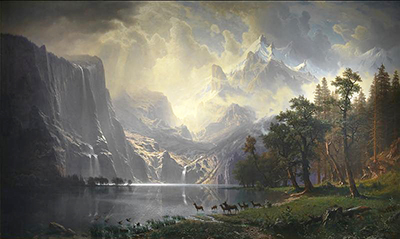
Lake Lucerne
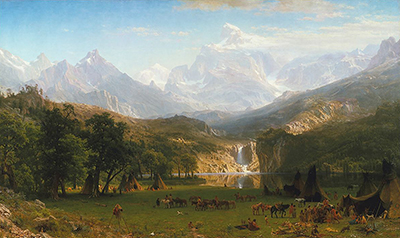
1858Mountain Brook
1863Street in Nassau
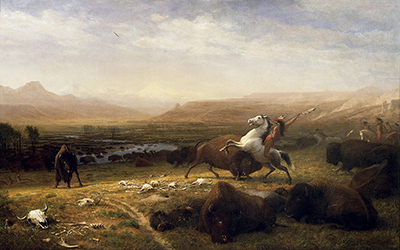
c. 1877–1880The Last of the Buffalo
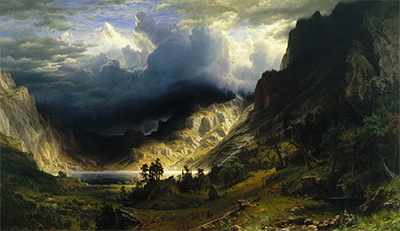
1888–1889The Golden Gate
1900Contents
The open centre of the valley
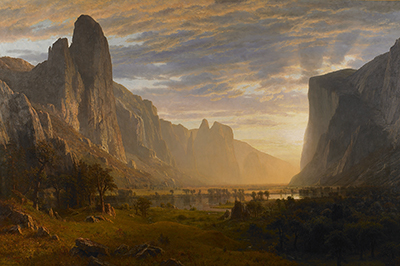
The rock walls rise at both sides, leaving a broad passage of blue sky between them. The left cliff enters directly from the picture's edge. At the right, successive formations climb above the trees, their upper surfaces catching warmer light.
This arrangement makes the opening at the centre important. It permits a view towards softer, more distant slopes beyond the foreground woodland. The viewer can look into the valley rather than confronting an uninterrupted wall of granite.
The trees interrupt that outward movement without completely blocking it. Their crowns overlap the cliffs and distant hills, marking changes of distance. A tall, narrow conifer near the centre occupies the transition between the shaded woodland and the pale opening beyond.
The viewpoint belongs near the valley floor. It looks upward towards the high rock faces, with grass and low vegetation close at hand. The composition's breadth comes from the lateral spread of cliffs and woodland, rather than from looking down into Yosemite from above.
Finding the waterfall
The fall descends along a darker rock face to the right of centre. Its light colour makes it visible, but it does not occupy the largest or brightest area of the picture. Nearby conifers partly interrupt the lower portion of its descent.
Its narrow shape adds a different kind of line to the cliffs. The stone is divided by ridges, seams and sloping surfaces; the water follows a more continuous downward course. The viewer can distinguish its movement while still seeing it as part of the much larger wall.
The National Park Service describes Bridalveil as a 620-foot waterfall whose volume and appearance change with the season and wind. That physical variability matters when looking at a painted fall, but the visible stream does not establish the exact date or flow conditions of Bierstadt's scene.[2]
In his 1910 account of Yosemite, Galen Clark also describes the wind altering the fall's appearance from moment to moment.[3] Bierstadt's image gives the descending water a stable place within the composition, even though the actual feature is continuously changing.
Trees of different shapes
One of the most conspicuous foreground trees stands at the left, with a broad crown and an irregular, branching trunk. Its spreading limbs differ from the narrower silhouettes of the surrounding conifers. The contrast gives the woodland variety without requiring an exact identification of every tree.
Near the middle, another broad tree has a lower crown and a trunk that divides visibly above the meadow. A thinner, broken or bare trunk stands beside it. These neighbouring forms make the foreground more complex than a uniform belt of healthy upright trees.
Farther right, tall conifers repeat the cliffs' vertical emphasis. Their dark trunks and graduated crowns offer a scale against which the rock faces can be judged. The trees are substantial within the woodland, yet the cliffs continue far above them.
Smaller plants at the lower edge bring the eye back to the immediate ground. Upright stems, scattered pale stones and patches of red flowers break the meadow into details that reward closer viewing. Bierstadt moves from these modest features to the immense rock formations without abandoning either scale.
Light crossing the meadow
Warm illumination reaches the grass and upper cliffs, while long darker passages cross the valley floor. The meadow is divided into bands rather than filled with one even colour. Those changes make the ground seem to extend beneath and between the trees.
The darkest woodland lies against the paler stone, where trunks remain legible despite their small size. At the upper right, warm rock faces sit beside deeper shadow. Their differences reveal the complicated surfaces of the cliffs and prevent the wall from appearing flat.
The sky provides another contrast. Its relatively quiet blue occupies the space between the crowded foreground and rugged skyline. The small amount of distant land visible beneath it gives the eye a route through the scene.
The image supports discussion of changing illumination across grass, trees and rock. It does not settle a precise hour of the day. Bierstadt's organisation of light is more securely visible than the particular conditions that may have prompted it.
A small herd in a large setting
Small brown animals are visible across the meadow left of centre, near the base of the spreading trees. Their low bodies and occasional raised heads suggest a grazing deer herd. They are easier to notice in a larger reproduction than in a small overview of the painting.
They change the foreground from an expanse of vegetation into an inhabited space. The grass supports activity, even though that activity occupies only a tiny part of the overall view. Their size also helps convey the relationship between meadow, mature trees and towering cliffs.
The viewer's attention can alternate between those animals and the waterfall. One belongs to a quiet horizontal passage near the valley floor; the other draws the eye vertically up the rock face. The scene offers several centres of interest rather than arranging every element around the named fall.
A second Bridal Veil painting
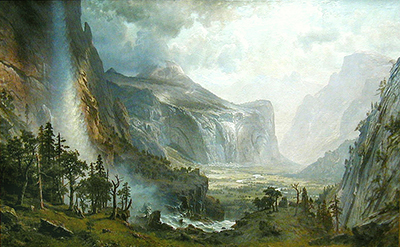
The North Carolina Museum of Art owns a different Bierstadt painting titled Bridal Veil Falls, Yosemite, dated circa 1871–1873 and painted in oil on canvas.[4] Its tall format concentrates on falling water, luminous spray and a rocky stream, with two deer in the lower foreground.
The Cincinnati work opens the view across a meadow and surrounding cliffs. Its waterfall shares attention with the woodland and valley floor. Similar titles and dates therefore describe distinct compositions; they do not make the two paintings interchangeable.
This comparison shows how differently a recurring subject can be presented. One view emphasises the waterfall's descent and enveloping atmosphere. The other allows viewers to discover it within a broader, more open setting.
What a later viewer sees
In Cincinnati's staff-selection series, Brad Hawse chooses this painting as an example of nature's beauty and art's ability to encourage its protection. He connects the appeal of Bierstadt's western landscapes with the experience of people who could not visit such places themselves.[5]
This is a contemporary response to the painting. It explains why a museum viewer might find the work moving, rather than documenting a particular nineteenth-century decision caused by this object.
Hawse's response also makes the wide composition significant. The meadow, woodland and high cliffs offer a place to imagine entering. Their invitation can inspire concern for the landscape represented, even when the viewer encounters it through a museum painting.[5]
Yosemite beyond the frame
The Southern Sierra Miwuk Nation's account of its traditions describes Yosemite as a continuing homeland. It recounts the destruction of the last homes at Wahhoga in 1969 and describes continuing cultural gatherings in the valley.[6]
That account supplies a human history which the meadow view does not show. The apparent absence of people in the composition cannot establish that the valley was unoccupied or that Indigenous relationships with it ended.
The contrast matters when interpreting the picture's welcoming openness. What appears available for a viewer's imagination also belongs within a history of communities, displacement and continuing cultural activity. The landscape's meaning extends beyond the scenery Bierstadt selected.[6]
The painting remains rewarding to examine closely. Its small herd, varied trees and alternating bands of light give the valley floor an activity that a quick glance can miss. Above them, the narrow waterfall joins the much larger cliffs, keeping its identity while sharing the scene with the world around it.
Watch: Albert Bierstadt
Five perspectives on his paintings and their historical setting.
American Landscape Painting: Albert Bierstadt and the American Land
A Museum of Fine Arts, Boston presentation on American Landscape Painting: Albert Bierstadt and the American Land.
Explore Bierstadt’s artworks
Discussion
How does the broad meadow affect the place of Bridalveil Fall within this wide valley view?
Reader Insights
Locate the slender waterfall, then compare its prominence with the meadow and cliffs. Which part of the landscape first directs your attention?
Set this Cincinnati painting beside the separate upright North Carolina work. How does changing the format alter the relationship between water, trees and animals?
Consider the Southern Sierra Miwuk account alongside the apparently open meadow. What history must be understood through voices beyond the painted view?
Join the Conversation
Share a specific observation, documented connection or comparison from Bridal Veil Falls, Yosemite Valley, California.
References
- Cincinnati Art Museum. Bridal Veil Falls, Yosemite Valley, California, accession 2002.45. Date, medium, dimensions and credit. View source text
- National Park Service. “Bridalveil Fall Trail.” Height and changing flow. View source text
- Galen Clark. The Yosemite Valley, 1910, “Waterfalls in Yosemite Valley.” Hosted historical transcription. View source text
- North Carolina Museum of Art. Bridal Veil Falls, Yosemite, accession 87.9. Separate painting's object record. View source text
- Brad Hawse / Cincinnati Art Museum. “Staff Picks: Brad Hawse's CAM Favorites.” Personal response to the painting in the museum's staff series. View source text
- Southern Sierra Miwuk Nation. “Traditions.” Continuing Yosemite homeland and Wahhoga history. View source text