by Tom Gurney
Tom Gurney BSc (Hons) is an art history expert with over 20 years experience
Published on June 19, 2020 / Updated on October 27, 2026
Email: tomgurney1@gmail.com / Phone: +44 7429 011000
Expulsion from the Garden of Eden by Thomas Cole: Introduction
A bright garden remains visible on the right, but the way into it has become a place of judgement. In Thomas Cole’s Expulsion from the Garden of Eden, a towering mass of rock divides luxuriant vegetation and clear light from a storm-darkened wilderness. Adam and Eve are almost lost within this immense setting. Their smallness is central to the painting: the consequences of their banishment seem to extend through the whole landscape. Painted in 1828, the oil on canvas belongs to the Museum of Fine Arts, Boston. [1]
Cole made the picture as a companion to The Garden of Eden, now at the Amon Carter Museum of American Art in Fort Worth. The two paintings brought biblical history into the landscape art through which he was establishing his reputation. Together they offer abundance and loss; within Expulsion itself, those conditions confront each other across a single, sharply divided space. Understanding that double relationship helps explain both the picture’s emotional force and the controversy it provoked when first exhibited. [2]
At a Glance
- ArtistThomas Cole (1801–1848).
- Date1828.
- MediumOil on canvas.
- CollectionMuseum of Fine Arts, Boston; accession 47.1188.
- SubjectAdam and Eve’s banishment from Eden.
- CompanionThe Garden of Eden (1828), Amon Carter Museum of American Art, accession 1990.10. [3]
- First exhibitionNational Academy of Design, New York, May 1828. [4]
This work in Cole’s career
First European journey
1829–1832The Course of Empire
1834–1836The Oxbow
1836The Voyage of Life
1840 and 1842Church’s training
1844–1846Notes and sources
American recognition. Three New York sales brought Cole to the attention of artists and patrons. [5]
Expulsion from the Garden of Eden. This early biblical landscape of 1828 makes the contrast between a bright garden and a threatening wilderness carry the story of expulsion. [2]
First European journey. Looking in Britain and Italy enlarged the repertoire of his American landscapes. [5]
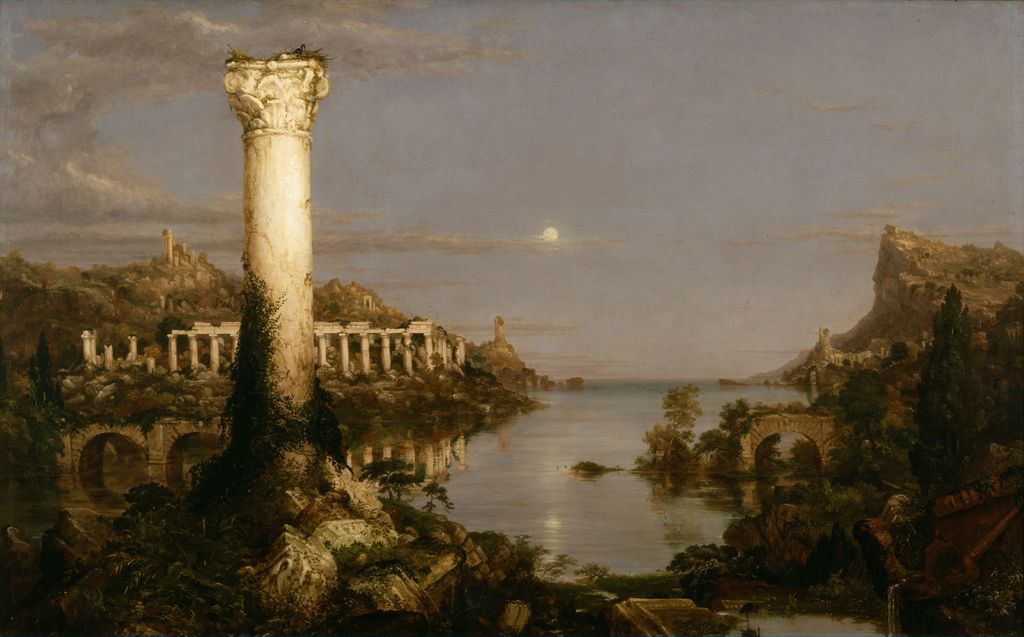
The Course of Empire. Five invented landscapes turn the rise and fall of civilisation into a visual argument. [5]
The Oxbow. An American prospect joined direct observation to a carefully staged view. [5]
The Voyage of Life. The original cycle and Roman replicas give human life the course of a river. [5]
Church’s training. Cole taught Frederic Edwin Church in Catskill. [5]
Home in the Woods. A late cabin landscape brings settlement and surrounding woodland into one scene. [5]
Contents
- Introduction
- A landscape divided by banishment
- Why Adam and Eve are so small
- Light, storm and the sublime
- Genesis, Milton and the landscape tradition
- Two different visions of Eden
- The exhibition and the accusation of copying
- Looking from the foreground into the distance
- A biblical loss with American implications
A landscape divided by banishment
The most immediate event is a change in the character of space. On the right, light opens a distant prospect beyond trees and water. On the left, heavy cloud presses over broken ground, bare branches and the towering rock that occupies the centre. Cole gives these regions different degrees of visibility. One invites the eye onwards; the other interrupts it with dark surfaces and abrupt edges. The contrast is legible before the viewer has found the human figures.
The central rock does much more than separate two halves of a composition. Its upward thrust makes the threshold formidable. The dark opening near its base marks a passage through the barrier, but the luminous force around that opening prevents it from resembling an ordinary route through mountain scenery. Light becomes a warning as well as an attraction. The painting’s narrative turns on access: a beautiful world is close enough to see, yet no longer available to the people leaving it.
Cole avoids reducing that division to an even balance. The rocky centre and shadowed foreground weigh heavily against the distant brightness. Eden occupies a space of recession, while the inhospitable terrain pushes towards us. The viewer therefore encounters the fallen world as the more immediate environment. Paradise has already become something looked back towards, rather than a place from which the scene is comfortably surveyed.
That construction is a strong example of what art historian Tim Barringer calls Cole’s historical landscape: a biblical or mythological subject conveyed principally through its surroundings, with figures reduced in scale. The rocks, sky and vegetation carry a task often assigned to faces, gestures and crowded action in history painting. Cole asks landscape to express the seriousness of a foundational religious story. Its scale is emotional as well as physical. [2]
Why Adam and Eve are so small
Adam and Eve provide the essential human point of reference, but they do not dominate the picture. Their diminutive presence makes the height of the surrounding rock and the depth of the foreground chasm feel extraordinary. Without them, the setting would still appear dramatic; with them, its drama becomes a measure of human vulnerability. The viewer has to search for the protagonists within the world their actions have changed.
This is a different way of representing the Fall from a close view of a couple’s grief or a large angel driving them away. Cole gives the expulsion an environmental dimension. Separation, exposure and danger are already apparent in the setting, so the figures need not explain everything through a plainly readable expression. Their movement out of the garden is a small event in pictorial size and an immense event in consequence.
Smallness also gives the scene an extended duration. A large figure could bring the viewer to a single decisive gesture. Here the eye moves from the bright distance to the passage, then out towards the dark foreground. The story unfolds as a journey through unequal spaces. What matters is not simply that Adam and Eve have left a particular location, but that they must enter a different relationship with the world.
Barringer places Cole alongside earlier painters who made tiny figures bear weight within vast landscapes. Richard Wilson’s Niobe communicates tragedy through storm, lightning and agitated trees, while Washington Allston’s Elijah in the Desert locates a prophet in an extensive wilderness. Such examples help explain why a religious subject could become more powerful, rather than less, when its people occupied very little of the canvas. They also show that Cole’s approach belonged to a developed pictorial tradition. [2]
Light, storm and the sublime
The weather gives the opposing regions their emotional character. Dark clouds on the left make the rocks seem more severe, while the bright right-hand distance suggests continuity and abundance. The difference is not merely a contrast between two times of day. It creates two experiences of nature: the reassuring prospect of a world that sustains its inhabitants, and a threatening world whose power exceeds them.
Light is especially complicated at the threshold. Across the broader garden it offers visibility, depth and warmth. Around the central passage it becomes a concentrated force, cutting into the surrounding darkness. Cole uses the same pictorial resource to make a place desirable and to signal the impossibility of returning to it. That tension helps prevent the scene from settling into a simple dark-versus-light diagram.
The painting exemplifies the sublime, an aesthetic category associated with experiences of overwhelming scale, danger and awe. Barringer contrasts the beautiful character of The Garden of Eden with the sublime character of Expulsion, connecting those modes respectively with the traditions of Claude Lorrain and Salvator Rosa. The distinction explains the pair’s broad effect, although a viewer can also find beauty in the light of Expulsion. Fear and attraction operate together. [2]
Nor should every weather effect be treated as a separately decoded symbol. The storm is already a persuasive means of making the outer world feel exposed and unstable. The broken foreground, forbidding rock and dark sky reinforce one another through shape and tone. Cole’s meaning arises from that coordinated experience, as well as from the biblical title. His landscape does not need a one-to-one explanation for every cloud or tree to communicate the loss of security.
Genesis, Milton and the landscape tradition
The underlying story comes from Genesis: Adam and Eve lose their place in the garden after disobedience, and the way back is guarded. Cole’s picture concentrates on the banishment and the division it creates. Biblical narrative supplies the event; the extraordinary landscape supplies the event’s scale. Barringer relates the Eden subjects to Cole’s upbringing within the English Dissenting tradition, where the Fall and its consequences were important religious concerns. That context helps explain the subject’s availability to him, without establishing a precise private meaning for every painted detail. [6]
Another important connection runs through John Milton’s Paradise Lost. Cole encountered John Martin’s illustrations to Milton through mezzotints available in New York. Barringer identifies Martin’s Adam and Eve Driven out of Paradise as a starting point for Expulsion. These prints enabled an American painter to study a contemporary British artist’s dramatic treatment of biblical space before travelling to Europe himself. The relationship was a practical exchange through reproducible images, rather than only a later encounter in a museum. [2]
Mezzotint was particularly suited to atmospheric darkness and brilliant interruptions of light. Martin’s example offered a way to organise religious drama around contrasts of vast terrain, shadow and radiance. Cole worked in oil, but his composition participated in the visual world those prints circulated. The resemblance would become a public issue in 1828; it also places the picture within a larger conversation between literature, painting and printmaking.
Oswaldo Rodriguez Roque, writing in American Paradise, interprets Cole’s early religious landscapes as an effort to give landscape the intellectual standing traditionally associated with history painting. Rather than regard natural description as an end in itself, Cole sought subjects that engaged imagination and feeling. Roque connects that ambition with the artistic hierarchy of Joshua Reynolds and with the association-based aesthetics of Archibald Alison. These are scholarly accounts of his outlook, not proof that a single philosophical text dictated Expulsion. [7]
The picture thus belongs to several traditions at once. Its biblical narrative, Miltonic pictorial source and expressive terrain do not cancel its place in Cole’s development as a painter of American scenery. They explain how he could make observed landscape forms serve an imagined history, transforming a familiar artistic strength into a more ambitious kind of subject.
Two different visions of Eden
The companion The Garden of Eden is a separate finished painting, not another title for the Boston canvas or a preparatory version of it. Dated 1828, it is an oil on canvas signed and dated in New York and held by the Amon Carter Museum of American Art. Keeping the works distinct is essential: the garden painting represents the abundance from which the figures in Expulsion are excluded. [3]
Barringer’s catalogue entry dates the making of The Garden of Eden to November 1827–March 1828 and explains that Cole began Expulsion while the first work was under way. An 1827 sketchbook records his thinking about the garden in unusually rich terms, bringing together mountains, water, trees, flowers, fruits, animals and birds. The notes reveal the range of natural forms he considered when imagining Eden. [6]
The garden also combines kinds of scenery that do not belong to a single American location. Barringer identifies tropical vegetation alongside a mountain and lake prospect associated with the White Mountains. He connects the distant peak with Cole’s drawings of Mount Chocorua and suggests that tropical plants could draw on living specimens in New York or memories of Saint Eustatius. The possible sources matter because Eden is assembled as an imagined concentration of natural richness, rather than painted as a surveyed historical site. [6]
Seen together, the works offer a broader narrative than Expulsion alone. The garden gives the viewer time to dwell within plenitude before the second painting makes loss unavoidable. The tiny figures in both prevent the human story from overwhelming the surrounding creation. In the first, that creation is the source of delight; in the second, altered access to it becomes the source of grief and danger.
The pairing also changes how we read the bright right side of Expulsion. It is more than a pleasing contrast needed to enliven dark rock. It recalls an entire companion canvas devoted to the flourishing world. A trace of the first painting’s experience remains within the second, making banishment painful because the object of loss is still visible. The two works depend on related ideas, but each has its own pictorial centre of gravity.
The garden composition subsequently reached audiences through James Smillie’s engraving for an illustrated Bible published in 1831. Barringer discusses a later adaptation by Robert Scott Duncanson and a possible connection with Frederic Edwin Church’s Heart of the Andes. This history belongs to The Garden of Eden, rather than demonstrating that every later Eden image descends from Expulsion. It shows why distinguishing the two canvases matters beyond their original exhibition: a companion can develop a different public life through print, even after the pair has been separated into different collections. [6]
Watch: Thomas Cole
Choose a film to explore the artist’s work, its interpretation and its wider setting.
Thomas Cole: Painting the American Landscape (remastered audio)
An introduction to Cole’s landscapes and artistic ambitions.
Watch on YouTubeThe exhibition and the accusation of copying
In May 1828 Cole exhibited eight landscapes at the National Academy of Design’s Third Annual Exhibition in New York, including both Eden paintings. He offered the pair for sale in the hope of financing a journey to Europe. Their public appearance therefore joined artistic ambition to a practical need: he wanted to demonstrate what landscape painting could achieve and secure the means to continue his education. [4]
The response exposed the risk of relying on widely known prints. On 21 June the sculptor John Browere, writing as “Middle-Tint” in the New-York Morning Courier, accused Cole of copying Martin. The allegations concerned two different sources: The Paphian Bower for The Garden of Eden, and Adam and Eve Driven out of Paradise for Expulsion. [4]
Cole replied in the American on 23 June, denying the charges. He also placed a print of The Paphian Bower beside The Garden of Eden at the exhibition, inviting direct comparison. The invitation to compare those works made the garden painting an especially visible focus of the dispute. Barringer nevertheless judges the resemblance between Cole’s Expulsion and Martin’s image substantial. [4] [2]
The accusations and Cole’s defence distinguish influence from a contested claim of literal copying. They do not require us to adopt either pole without qualification. Martin supplied a recognisable model of dramatic religious landscape, and Cole disputed what his critic made of that relationship. The controversy tells us how exposed an aspiring painter could be when expanding his range through imagery already familiar to an exhibition audience.
Neither painting sold at the Academy exhibition. They were shown in Boston without securing buyers, and a raffle was unsuccessful. The 2018 chronology records their eventual separate sales in May 1829: The Garden of Eden went to banker Charles Wilkes, and Expulsion to Dr David Hosack. Those transactions finally helped make Cole’s European travel possible. Artistic importance and immediate commercial success did not coincide. [6] [4]
Gilmor’s involvement makes the difficulties more revealing than a simple tale of rejection. In January 1829 he declined Cole’s offer of the paintings but advanced three hundred dollars towards the European journey. A patron could support the artist’s development without choosing to acquire these particular works. Hosack’s subsequent purchase likewise connects the finished Expulsion with Cole’s wider circle: Barringer names him as a patron whose botanical collection offered access to living plants relevant to the imagined garden. That connection does not prove that a specific plant in the Boston painting came from Hosack’s grounds. It does show how artistic, scientific and collecting interests could overlap around a landscape painter’s work. [4] [6]
Looking from the foreground into the distance
The picture rewards a second look that reverses the first impression. Instead of beginning with the commanding rock, follow the water and the broad zones of shadow from the foreground towards the garden. Depth initially appears to promise entry into the landscape, as it often does in a panoramic view. Here, however, the central obstruction and guarded passage turn that promise into a problem. A distant prospect can be seen without being reachable.
That conflict gives the setting a particular poignancy. The garden is neither obliterated nor hidden completely beyond the frame. Cole preserves it as a continuing visual presence, while placing a forbidding terrain between it and the immediate foreground. The eye repeatedly attempts a journey that the narrative denies to the figures. Looking becomes an analogue for longing: distance draws us onwards, and the division keeps reminding us of loss.
A biblical loss with American implications
Barringer reads the Eden paintings as a parable for America, connecting their contrast of natural abundance and loss with Cole’s concern about destructive economic expansion. His account draws together the painter’s English experience, American landscapes and later writing about scenery. It is a persuasive modern interpretation, but it does not turn the Boston painting into a literal illustration of a particular development project or political event. [2]
The distinction matters because the biblical story already gives the work a coherent subject. An environmental reading adds a historical dimension to that subject; it need not replace it. Cole’s imagined paradise can evoke the richness of American nature while remaining Eden. Equally, his hostile wilderness can express the theological consequences of banishment without representing a specific damaged tract of land.
In this reading, the vulnerable resource is not only beautiful scenery but the possibility of living well within it. The couple’s loss of access makes abundance appear conditional rather than guaranteed. For a viewer considering Cole’s later concern with landscape change, that structure offers a useful point of connection. It asks what people risk losing through their actions, although the terms of that question must remain sensitive to the difference between a biblical narrative and modern environmental debate.
The pair also anticipates Cole’s Course of Empire, where a sequence of landscapes carries a history of growth, magnificence and collapse. Barringer explicitly links the works through the consequences of human folly. Expulsion shows how early Cole had begun to make change itself a landscape subject: the same world could be desired, inhabited differently and finally lost. [2]
Its later museum life provides another kind of continuity. The MFA identifies the painting with the gift of Martha C. Karolik for its collection of American paintings and records the exhibition Thomas Cole and the Garden of Eden at the Fenimore Art Museum in 2018. The work remains compelling because its immense scenery makes a recognisable human experience, exclusion from a cherished place, feel both personal and immense. [1]
Artworks directory
Explore paintings, drawings and studies across Cole’s career. The two Voyage of Life sets appear separately. Dates and study identifications draw on the exhibition and collection catalogues, supplemented by the National Gallery’s drawing records. [5] [8] [9] [10]
| Name | Date | Medium |
|---|---|---|
| The Oxbow | 1836 | Painting |
| The Titan’s Goblet | 1833 | Painting |
| The Architect’s Dream | 1840 | Painting |
| The Course of Empire: The Savage State | ca. 1834 | Painting |
| The Course of Empire: The Arcadian or Pastoral State | ca. 1834 | Painting |
| The Course of Empire: The Consummation of Empire | 1835–1836 | Painting |
| The Course of Empire: Destruction | 1836 | Painting |
| The Course of Empire: Desolation | 1836 | Painting |
| The Voyage of Life: Childhood | 1842 | Painting |
| The Voyage of Life: Youth | 1842 | Painting |
| The Voyage of Life: Manhood | 1842 | Painting |
| The Voyage of Life: Old Age | 1842 | Painting |
| Home in the Woods | 1847 | Painting |
| Distant View of Niagara Falls | 1830 | Painting |
| View on the Catskill—Early Autumn | 1836–37 | Painting |
| Lake with Dead Trees (Catskill) | 1825 | Painting |
| River in the Catskills | 1843 | Painting |
| A View of the Mountain Pass Called the Notch of the White Mountains (Crawford Notch) | 1839 | Painting |
| Expulsion from the Garden of Eden | 1828 | Painting |
| The Subsiding of the Waters of the Deluge | 1829 | Painting |
| The Mountain Ford | 1846 | Painting |
| American Lake Scene | 1844 | Painting |
| A View near Tivoli (Morning) | 1832 | Painting |
| Aqueduct near Rome | 1832 | Painting |
| The Hunter’s Return | 1845 | Painting |
| The Voyage of Life: Childhood (first version) | 1840 | Painting |
| The Voyage of Life: Youth (first version) | 1840 | Painting |
| The Voyage of Life: Manhood (first version) | 1840 | Painting |
| The Voyage of Life: Old Age (first version) | 1840 | Painting |
| Panorama of the Oxbow on the Connecticut River as seen from Mount Holyoke | ca. 1832 (museum); 1833 (2018 catalogue) | Drawing |
| Sketch for The Oxbow | 1836 | Painting |
| From Nature | 1823 | Drawing |
| View of the Round-Top in the Catskill Mountains (Sunny Morning on the Hudson) | 1827 | Painting |
| Scene from The Last of the Mohicans: Cora Kneeling at the Feet of Tamenund | 1827 | Painting |
| View of Monte Video, the Seat of Daniel Wadsworth | 1828 | Painting |
| The Garden of Eden | 1828 | Painting |
| Tomb of General Brock, Queenston Heights, Ontario | 1830 | Painting |
| Effect for Newstead Abbey, Nottinghamshire, England | 1830 | Drawing |
| The Ilissos, from the Parthenon West Pediment | 1829 or 1830 | Drawing |
| Life Study for the Prostrate Shepherd in The Angel Appearing to the Shepherds | 1831–1832 | Painting |
| Interior of the Colosseum, Rome | ca. 1832 | Painting |
| Campagna di Roma (Study for Aqueduct near Rome) | 1832 | Painting |
| Landscape with a Round Temple | ca. 1830s | Painting |
| Stormy Landscape | 1832 | Painting |
| View of Florence from San Miniato | 1837 | Painting |
| Mount Holyoke, Massachusetts (after Basil Hall) | ca. 1829–1831 | Drawing |
| Layout for The Course of Empire | 1833 | Drawing |
| Study for The Course of Empire: The Savage State | ca. 1834 | Painting |
| Study for The Course of Empire: The Arcadian or Pastoral State | ca. 1834 | Painting |
| Study for The Course of Empire: Desolation | 1836 | Painting |
| Study for Dream of Arcadia | 1838 | Painting |
| Clouds | ca. 1830s | Painting |
| Study for The Hunter’s Return | 1845 | Painting |
| Study for Home in the Woods | ca. 1847 | Painting |
| Sunrise in the Catskills | 1826 | Painting |
| Study for The Mountain Ford | 1846 | Drawing |
| Tree Trunks | 1825–1840 | Drawing |
Frequently Asked Questions
It belongs to the Museum of Fine Arts, Boston, accession 47.1188. Collection ownership does not by itself establish whether a work is currently on display. [2]
Their scale lets the landscape express the magnitude of their banishment. Barringer places the picture in the tradition of historical landscape, where biblical or mythological figures occupy a small part of an emotionally charged setting. [2]
Discussion
Look again at Expulsion from the Garden of Eden and compare your reading with the questions below.
Reader Insights
How does the painting’s effect change when you locate Adam and Eve after first looking at the rocks, trees and sky?
Does the visible brightness of Eden make the scene feel more hopeful, or make the banishment more painful?
Which detail or comparison would you add to this account, and what evidence supports your reading?
Join the Conversation
Share the details that shaped your response, or suggest a comparison for other readers.
References
- Museum of Fine Arts, Boston, “Art Bridges Initiative”, undated, painting credit and Phase One exhibition listing, Thomas Cole and the Garden of Eden, 25 May–30 September 2018. https://www.mfa.org/collections/americas/art-bridges-initiative
- Tim Barringer, “Thomas Cole’s Atlantic Crossings”, in Elizabeth Mankin Kornhauser and Tim Barringer, Thomas Cole’s Journey: Atlantic Crossings, 2018, pp. 29–32, including fig. 8. https://cdn.sanity.io/files/cctd4ker/production/be901737ad5f92e33d91db53c6dd8ce6ed47ff27.pdf
- Amon Carter Museum of American Art, “The Garden of Eden”, undated, collection record 1990.10. https://www.cartermuseum.org/collection/garden-eden-199010
- Shannon Vittoria, “Chronology”, in Kornhauser and Barringer, Thomas Cole’s Journey: Atlantic Crossings, 2018, pp. 248–249, entries for May–June 1828 and January–May 1829. https://cdn.sanity.io/files/cctd4ker/production/be901737ad5f92e33d91db53c6dd8ce6ed47ff27.pdf
- Elizabeth Mankin Kornhauser and Tim Barringer, Thomas Cole’s Journey: Atlantic Crossings (2018). Career context and artwork/study metadata: catalogue entries 10–66 and chronology, PDF pp. 137–231 and 249–262; related Barringer essay passages, PDF pp. 23–66.
- Tim Barringer, “The Garden of Eden”, catalogue entry 14, in Kornhauser and Barringer, Thomas Cole’s Journey: Atlantic Crossings, 2018, pp. 140–142. https://cdn.sanity.io/files/cctd4ker/production/be901737ad5f92e33d91db53c6dd8ce6ed47ff27.pdf
- Oswaldo Rodriguez Roque, “The Exaltation of American Landscape Painting”, in American Paradise: The World of the Hudson River School, 1987, pp. 26–27, 30. https://cdn.sanity.io/files/cctd4ker/production/dce378a2ad2f7a6d05cbdc4b9c29b9b9733b3cd1.pdf
- Franklin Kelly et al., American Paintings of the Nineteenth Century, Part I (National Gallery of Art, 1996). Cole catalogue and both Voyage of Life sets, PDF pp. 91–124.
- National Gallery of Art, Study for The Mountain Ford (1846), accession 2015.19.772. Collection record and open-access image.
- National Gallery of Art, Tree Trunks (1825–1840), accession 2015.19.607. Collection metadata and open-access image.
- Splash image source.
Thomas Cole, Expulsion from the Garden of Eden, 1828. Oil on canvas. Museum of Fine Arts, Boston, gift of Martha C. Karolik for the M. and M. Karolik Collection of American Paintings, 1815–1865 (47.1188).