by Tom Gurney
Tom Gurney BSc (Hons) is an art history expert with over 20 years experience
Published on June 19, 2020 / Updated on October 27, 2026
Email: tomgurney1@gmail.com / Phone: +44 7429 011000
The Oxbow by Thomas Cole: Introduction
A storm withdraws from a wooded mountainside while sunshine opens a vast river valley below. At the centre of this encounter, almost hidden among the rocks, Thomas Cole sits beside his easel and turns to look at us. His painting invites two kinds of attention: the pleasure of following the Connecticut River around its great bend, and the harder task of deciding what human beings have done, and might yet do, to the land. Painted in 1836, The Oxbow brings the drama of history painting into a recognisable American view. Its full title is View from Mount Holyoke, Northampton, Massachusetts, after a Thunderstorm—The Oxbow. [1] [2]
The division is immediately compelling. On the left, trees, rocks and weather seem to resist order. On the right, cultivated fields settle into patterns around a luminous loop of water. Yet Cole gave neither side a simple label. The landscape has been read as a hopeful union of wilderness and settlement, as a warning about the transformation of nature into property, and as a statement of the artist’s responsibility to make people look carefully. These readings overlap, but they do not mean the same thing. The painting’s lasting interest lies partly in its ability to sustain their disagreement. [2] [3]
At a Glance
- ArtistThomas Cole.
- Date1836.
- Full titleView from Mount Holyoke, Northampton, Massachusetts, after a Thunderstorm—The Oxbow.
- Medium and sizeOil on canvas, 130.8 × 193 cm (51½ × 76 inches).
- CollectionThe Metropolitan Museum of Art, New York; accession 08.228, gift of Mrs. Russell Sage, 1908.
- First public exhibitionNational Academy of Design, New York, 1836.
- First purchaserCharles Nicoll Talbot, who paid $500.
The object details are recorded by the Metropolitan Museum; the exhibition and purchase are documented in the 2018 catalogue Thomas Cole’s Journey: Atlantic Crossings. [1] [4]
This work in Cole’s career
First European journey
1829–1832The Course of Empire
1834–1836The Oxbow
1836The Voyage of Life
1840 and 1842Church’s training
1844–1846Notes and sources
American recognition. Three New York sales brought Cole to the attention of artists and patrons. [5]
First European journey. Looking in Britain and Italy enlarged the repertoire of his American landscapes. [5]
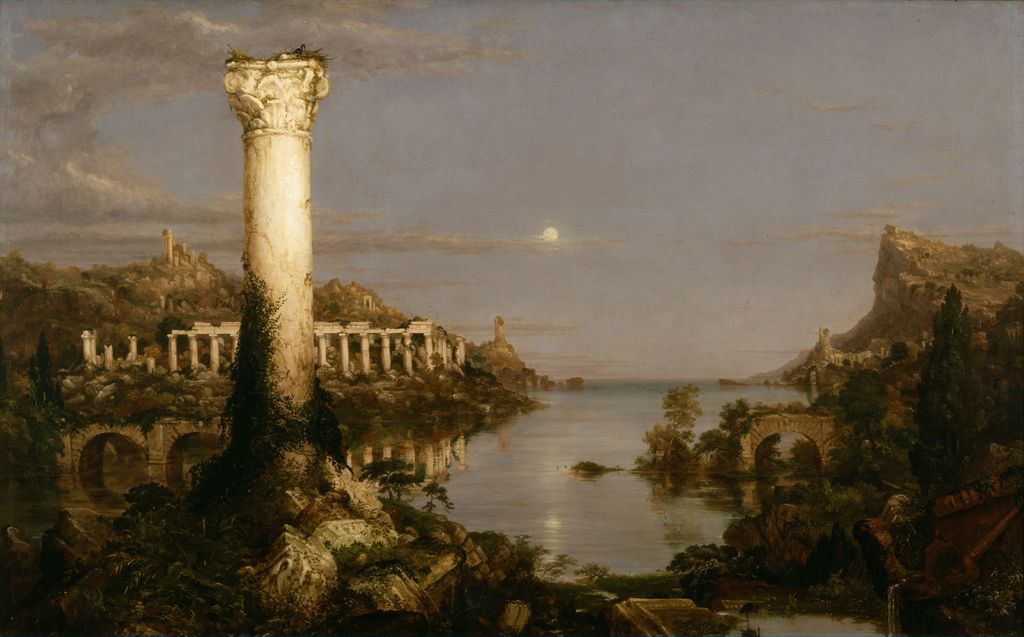
The Course of Empire. Five invented landscapes turn the rise and fall of civilisation into a visual argument. [5]
The Oxbow. An American prospect joined direct observation to a carefully staged view. [5]
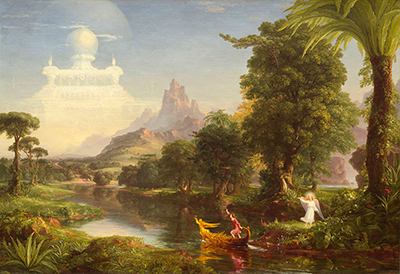
The Voyage of Life. The original cycle and Roman replicas give human life the course of a river. [5]
Church’s training. Cole taught Frederic Edwin Church in Catskill. [5]
Home in the Woods. A late cabin landscape brings settlement and surrounding woodland into one scene. [5]
Contents
- Introduction
- A view with a story in its title
- Mount Holyoke before the painting
- What the field drawing records
- An interruption that became a major work
- How the composition holds its opposites together
- The painter who turns towards us
- Beneath the paint: drawing, ground and speed
- A hopeful synthesis or an environmental warning?
- After Cole: a river that changed
A view with a story in its title
The familiar short title identifies the river’s curved course. An oxbow is a loop resembling the bowed wooden yoke used for a pair of oxen; here the water encloses a broad tongue of farmland. Seen from above, the bend becomes the painting’s clearest shape. It is large enough to hold the right half together, yet distant enough to establish the extraordinary height from which we look. The surrounding fields, riverbanks and wooded ridges make this a particular landscape rather than a general emblem of rural America. Cole’s viewpoint looks southwest from Mount Holyoke towards the Connecticut River south of Northampton, Massachusetts. [4]
The longer title gives the view a sequence. “After a Thunderstorm” asks us to understand the darkness at left and the clearer sky at right as parts of a changing condition. Weather becomes an event with a before and an after, even though both remain present on the canvas. We can follow the departing storm and imagine the light reaching the ground it has left. The title thus encourages a reading through time as well as a survey of space. Elizabeth Mankin Kornhauser emphasises this narrative element: Cole was compressing a complicated tale into one landscape, rather than simply naming a place. [2]
That distinction matters because the short title was not the whole of the painting’s original public identity. It appeared at the National Academy of Design in 1836 as View from Mount Holyoke, Northampton, Massachusetts, after a Thunderstorm, with its availability for sale stated in the catalogue. When Margaret Olivia Slocum Sage gave the painting to the Metropolitan Museum in 1908, she requested the addition of “The Oxbow” to its title. The naming history joins the original exhibition picture to the concise name by which it is now widely recognised. [4]
Its physical scale also changes the experience. At nearly two metres wide, the canvas allows the valley to spread before the spectator while keeping the foreground rocks insistently close. This combination of breadth and proximity helps explain Cole’s later advice about placing it in a collector’s home: the picture should receive side light and hang as low as conveniently possible. His instructions suggest a viewer entering the scene alongside the seated painter, rather than observing the whole as a remote diagram. The painting’s height above the river is part of its subject; the viewer’s position before the canvas is part of its effect. [1] [2]
Annotated Details from The Oxbow
Follow six details from the passing storm to the river valley and the painter’s working place.
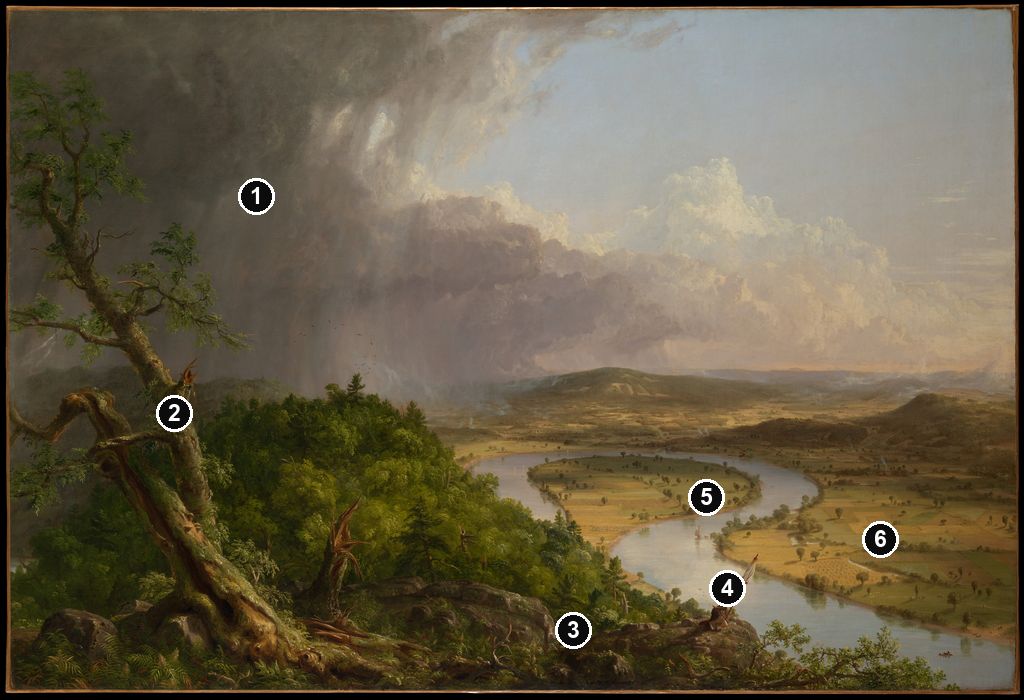
Details from THE OXBOW
Open the detail photographs to compare the small human presence with the landscape around it.
A storm moving across the view
Dark cloud and falling rain occupy the left, while brighter air opens over the valley. The contrast makes weather part of the view’s unfolding experience. [1]
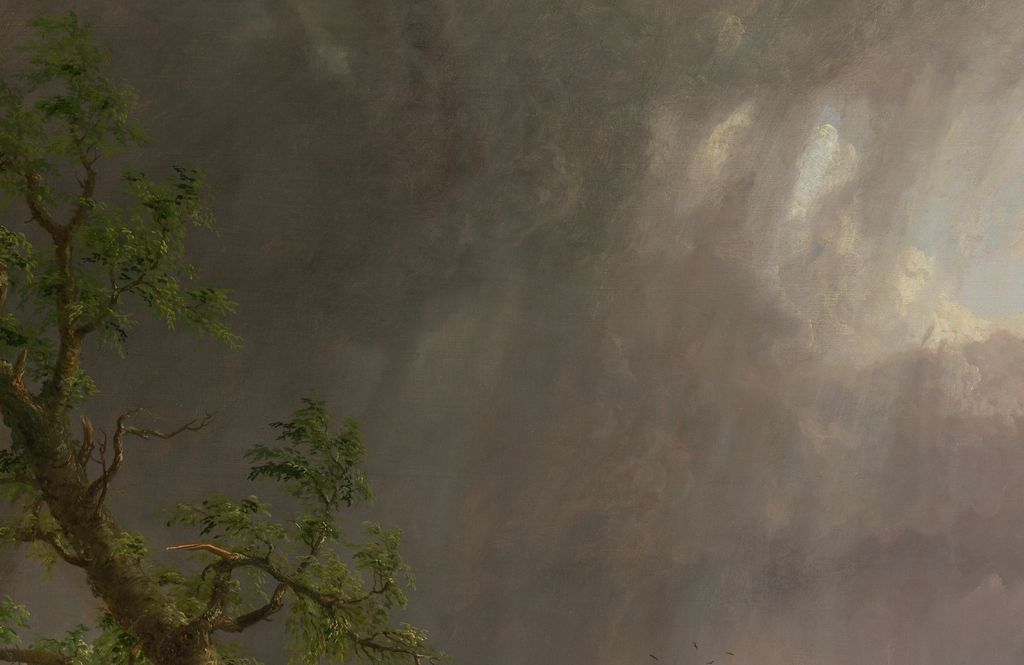
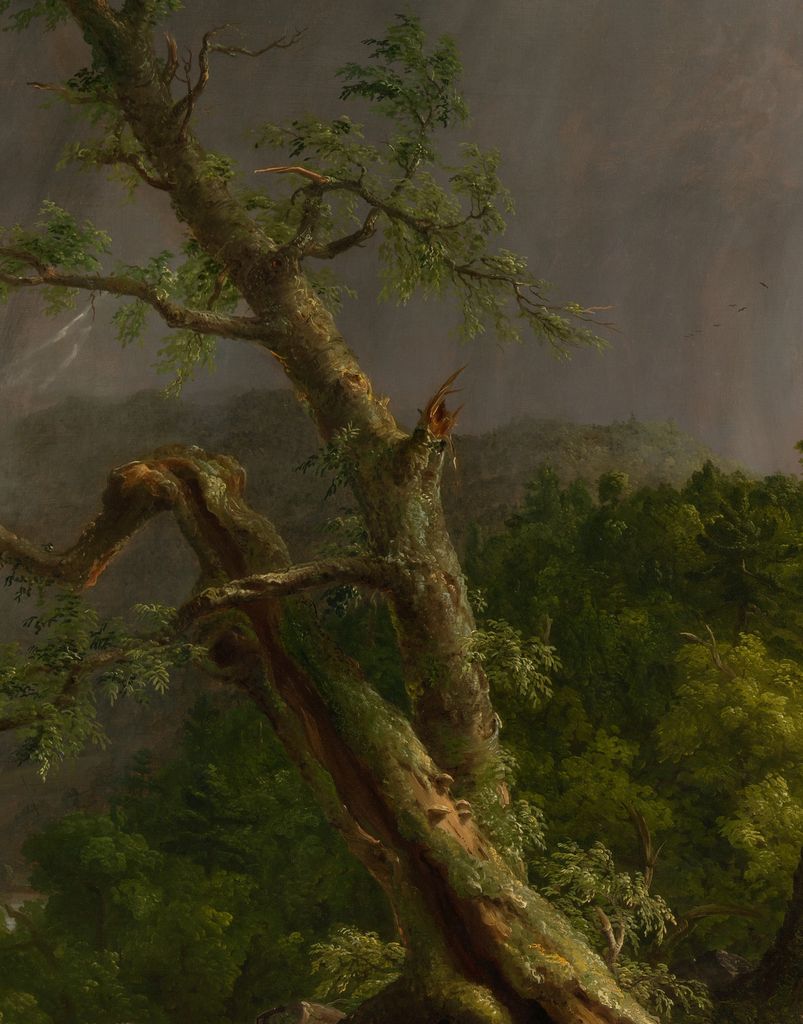
The broken tree
The tree’s exposed, damaged limbs make the foreground physically emphatic beside the softer cultivated distance. Its irregular form helps organise the contrast between the two sides. [2]
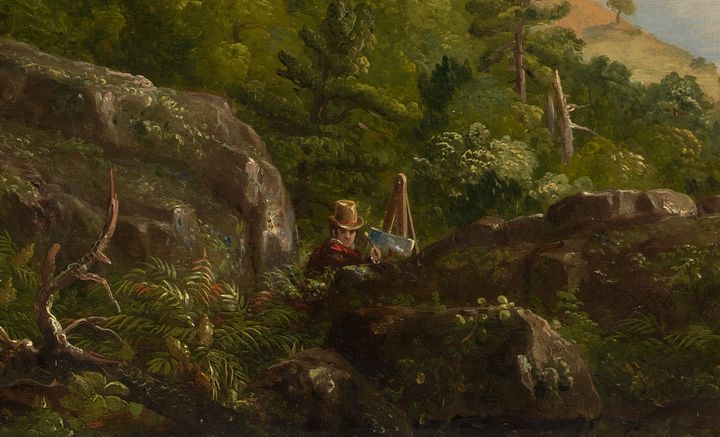
Cole at work
Cole places a seated image of himself among the foreground rocks, turning towards the viewer. Discovering him changes the apparent emptiness of the prospect: this is also a working place. [1] [2]
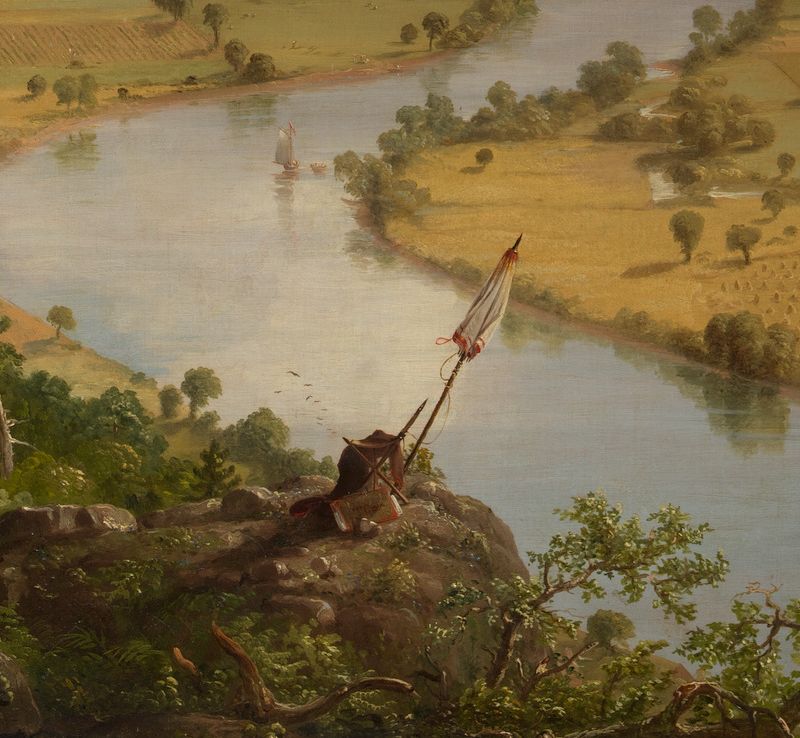
The painter’s parasol
The tilted parasol and equipment give the tiny artist a recognisable place within the wide landscape. Their presence joins a panoramic view to the practical act of making a picture. [2]
The river’s great bend
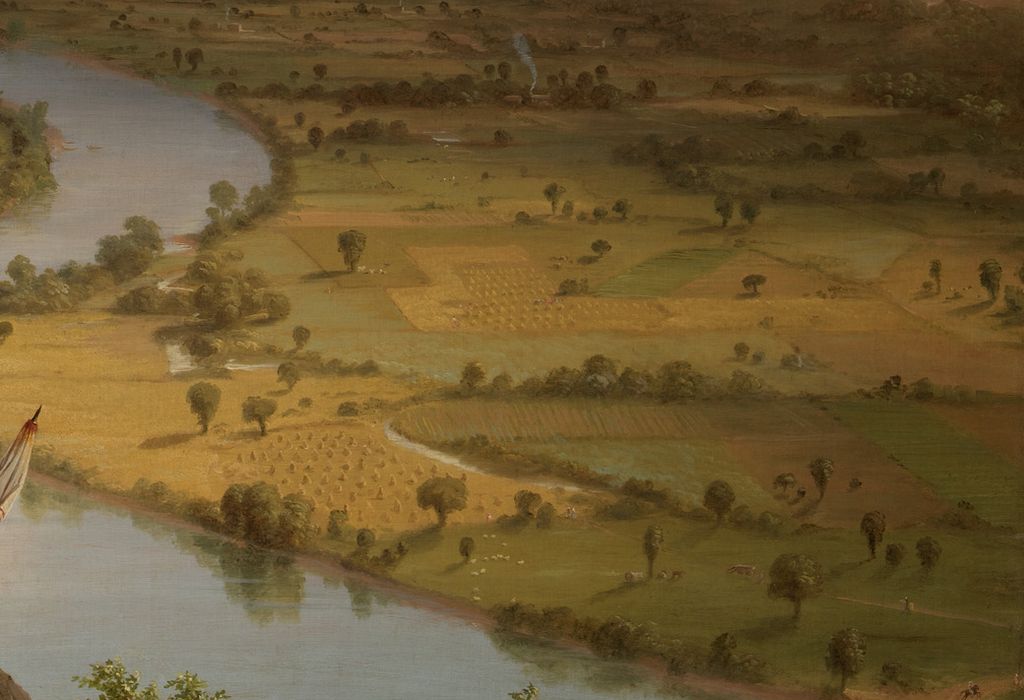
The Connecticut River curves around a cultivated tract, carrying the eye from the elevated foreground into the broad valley. Its looping shape gives the painting its familiar short title. [1]
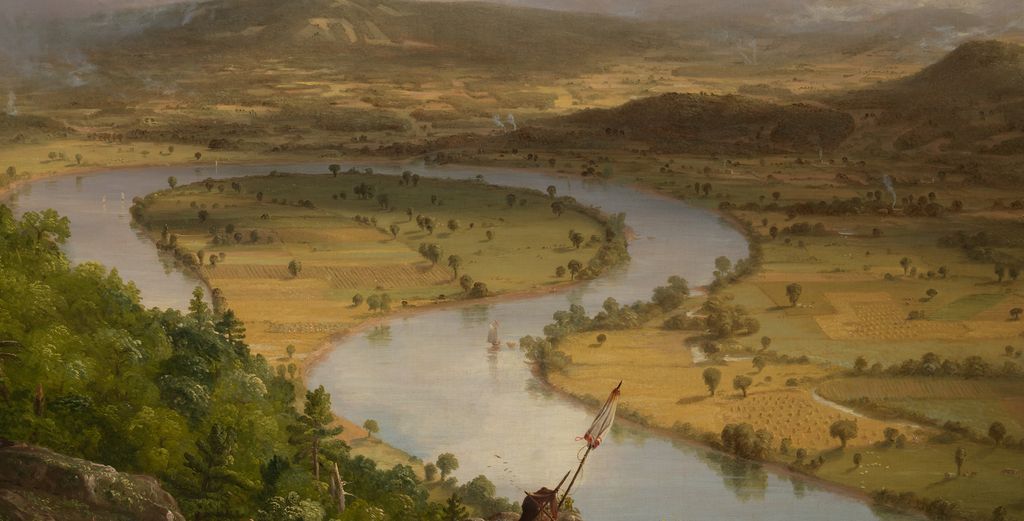
Cultivation in the valley
Fields, small trees and traces of settlement divide the land into a different pattern from the dense foreground woods. Roque’s reading of the scene explores how Cole brings these forms of occupation into relation. [2]
Mount Holyoke before the painting
Cole did not discover an untouched summit. By the time he made the painting, Mount Holyoke was an established place for visitors to admire the valley. A carriage road and a log shelter had been constructed in 1821, helping to draw tourists to the mountain. Its elevated prospect was already celebrated in travel writing and pictures. In 1827, Cole’s patron Daniel Wadsworth recommended Northampton and Mount Holyoke among the places worth seeing on a journey through New England. There is no evidence that Cole climbed the mountain on that particular trip. [2]
The distinction between the actual summit and Cole’s painted foreground is therefore essential. He omitted the visible infrastructure of tourism and installed himself as the conspicuous witness among rocks and trees. The absence of a road or shelter does not make the painting a straightforward record of a landscape beyond human access. It shows how an artist can remove familiar modern features to concentrate an experience. Kornhauser relates this decision to Cole’s earlier practice of eliminating tourist structures from a finished wilderness picture while retaining them in preparatory material. [2]
Another visitor helped Cole think about the view before his own detailed field drawing. Basil Hall, a retired Royal Navy officer and travel writer, published an image of it in his Forty Etchings of 1829. Hall had used a camera lucida, an optical device that helped a draughtsman establish the outlines of what he saw. Cole traced the published image on a separate sheet, probably during his European journey between 1829 and 1831. The tracing shows an early, specific interest in the prospect; it should not be confused with the more extensive drawing he later made at the site. [6]
Hall’s admiration for this view sat within a travel account that sharply criticised American manners, institutions and appreciation of art. Oswaldo Rodriguez Roque argues that the controversy surrounding Hall’s writings gives Cole’s choice an additional significance. In Roque’s reading, an American painter could answer doubts about the country’s scenery and cultural capacity by making this landscape worthy of sustained artistic attention. The connection is plausible and historically illuminating, but it remains a reconstruction of the intellectual setting, rather than an explanation Cole supplied for every element in the finished canvas. [3]
The difference between Hall’s image and Cole’s composition is substantial. Cole adopted a higher viewpoint, making the loop of the river less compressed and more circular. He also brought foreground ledges into the picture, providing a place from which the spectator can look and a place where the artist can be seen working. His finished canvas turns a topographical prospect into a relationship between nearby physical experience and an immense distance. Hall’s published view was one prompt among several; the painting does much more than enlarge it. [6] [7]
What the field drawing records
The surviving graphite panorama in the Detroit Institute of Arts is an unusually useful companion to the painting. It belongs to a sketchbook that Cole had begun using in Italy. The 2018 catalogue places his Mount Holyoke drawing in August 1833, during the journey towards Boston after his return to America. Detroit’s current object record gives the sheet a broader date of about 1832. Those two datings should remain distinguishable: the museum’s approximate catalogue date and the later exhibition catalogue’s itinerary-based account do not express precisely the same judgement. [6] [8]
The drawing extends across a panoramic spread, with the river continuing beyond the principal bend. Cole recorded the directions south and southwest and made numerous written notes. He distinguished woods from meadow, identified pine and sumac, described reddish-grey rock, and noted that trees in the meadows were generally elms. Rows of corn, a sandbar and a ferry also entered this working record. These annotations preserve information that graphite could not readily convey, especially colour and the character of vegetation. They also reveal how closely the painting’s great distance depended on small observations. [6]
Such notes resist the idea that Cole’s landscape was invented without regard for its location. The river’s course, the relative placement of wooded heights and farmland, and the character of the foreground all had an observational basis. But the drawing equally resists treating the canvas as a transparent window onto a single afternoon. A field sketch gathers usable knowledge; a studio composition selects, adjusts and combines it. Cole changed the ferry’s position in accordance with a note, strengthened the division of the landscape, and developed weather that could carry the picture’s drama. [6]
The distant mountainside already bears faint indications of clearing in the field drawing. This detail becomes significant when considering the more conspicuous pale marks in the finished painting. It offers a material link between observed changes to the land and a feature later given symbolic interpretations. We do not have to choose between believing that Cole looked carefully and recognising that he shaped what he saw. His drawings are evidence of both operations: they record particulars while preparing the means to make a larger argument. [2] [6]
An interruption that became a major work
The opportunity to paint the view arrived during a difficult commission. Cole had been working on The Course of Empire, the five canvases ordered by his friend and patron Luman Reed. Its central painting, The Consummation of Empire, required a densely organised city, ceremonial crowds and elaborate architecture. Through the winter of 1835–36 Cole struggled with this labour, reporting delays and discomfort in the bitter cold. Reed and Asher Brown Durand encouraged him to put the series aside briefly and produce a landscape for the National Academy’s spring exhibition. The Oxbow emerged from that interval. [2]
It was therefore an exhibition picture made for sale, rather than a Mount Holyoke scene commissioned in advance by its eventual owner. Reed’s support was central to its creation, but Charles Nicoll Talbot purchased the finished work. This separation between encouraging patron and first buyer makes the circumstances clearer. Cole could pursue a familiar subject with considerable freedom, while still worrying about whether the public would pay for the result. His commercial need and artistic ambition were operating together. [4]
In his letter to Reed of 2 March 1836, Cole explained that views usually took less time and sold more readily than imaginary subjects. He had already begun the Mount Holyoke landscape. He described it as among the finest scenes in his sketchbook, recognised the site's popularity, and hoped to compete with the conspicuous landscapes expected at the exhibition. His short statement of ambition was that he would make something “that would tell a tale.” The wording comes from a practical letter about deadlines, money, size and framing; it belongs to a working artist trying to make his next picture succeed. [4]
The choice of a large canvas combined necessity with inclination. Cole had one ready on which he had tried the first architectural sketches for Reed’s central Empire picture. Having a smaller stretcher made and cutting down and restretching the canvas would consume time. Yet he also admitted that he wanted a large exhibition painting. The often-repeated story that a spare canvas alone determined this masterpiece misses that desire for an imposing public statement. Conversely, it is unnecessary to pretend that practical constraints had no part in the result. Cole’s letter holds both explanations together. [4]
The finished work took about six weeks. Even after painting it, Cole needed to varnish, frame, pack and transport it from Catskill to New York. Ice on the Hudson threatened the journey. He ordered the frame from Parker and Clover, his preferred New York makers, and the painting reached the exhibition in time for its opening on 27 April 1836. The 2018 catalogue identifies the commissioned frame as the one surviving on the work. Its substantial presentation was part of Cole’s attempt to make one painting command attention in a crowded exhibition. [2] [4]
How the composition holds its opposites together
The diagonal division is powerful because it cuts across more than the ground. Clouds, mountain, trees, river and cultivated plain participate in the same change. At left, the viewer encounters a dense foreground before looking beyond it; at right, the land seems to unfold almost at once into a broad distance. The dark weight of the near slope makes the brightness of the valley feel expansive. The river then carries the eye around a loop, giving the distant half a form as memorable as the broken tree in the foreground. Kornhauser describes the division as a deliberate creation of tension between wilderness and human alteration. [2]
The contrast also brings together two established ways of representing landscape. The sublime was associated with overwhelming scale, danger, darkness and forces that exceed human control. The beautiful offered gentler relationships, clearer order and the pleasures of cultivation. Roque connects Cole’s left-hand scenery with the wild landscapes of Salvator Rosa and the right-hand valley with the luminous pastoral tradition of Claude Lorrain. These associations are tools for understanding the picture’s visual language, rather than a claim that Cole simply copied either artist. [3]
Cole’s storm gives the sublime a moving form. The clouds sweep around the upper left, and the energetic tree shapes below continue the sense of rotation. Kornhauser relates this circular movement to J. M. W. Turner, particularly Snow Storm: Hannibal and His Army Crossing the Alps. She also compares the slanting storm passages with John Constable’s Rainstorm over the Sea. Cole’s European encounters help explain how recognisable New England scenery could acquire an unusually ambitious weather drama. His painting belongs to an American place and an international history of landscape art. [2]
The right side invites a different pace of looking. Fine divisions within the fields, haystacks, tiny buildings, animals and boats become visible as attention slows. Smoke rises from chimneys, and figures work or move through the cultivated land. It is a functioning landscape, although the high viewpoint makes its people and activities minute. The river remains a natural curve around which human order has been imposed. Its smooth light and the repeating field patterns can appear reassuring; they can also suggest the extent to which almost every available piece of valley floor has been organised for use. [2]
That double possibility is central to the painting. The valley’s beauty does not by itself prove that Cole meant to celebrate every transformation shown there. Equally, the fact that it is cultivated does not make every house or field a token of destruction. The contrast has to be interpreted in relation to the whole canvas and Cole’s wider concerns. Looking from left to right gives a sudden change in mood; looking back from the river to the storm makes the supposedly settled view feel less final. The two conditions occupy one world and remain visible at the same time.
The picture’s colours reinforce these relationships. Greens and golds vary through the richly wooded foreground, while lavender and darker tones give the storm its density. Across the valley, lighter greens and yellows contribute to the gentler, more muted effect. The differences involve handling as well as colour: Kornhauser notes the animated brushwork on the left and more restrained passages at right. A broad reproduction shows the division clearly, but sustained attention reveals how that division is built from different kinds of painted activity. [2]
The painter who turns towards us
Cole’s self-portrait is easy to overlook. He sits between rock ledges near the lower centre, with his work on an easel beside him. He wears a pale top hat, a high white collar and a red sash. Rather than standing before the easel, he turns his head and upper body towards the spectator. This small reversal changes the relationship between viewer and scene. We are no longer merely looking through his painting at a landscape; we have encountered the artist within the landscape, and he acknowledges our arrival. [2]
His equipment helps identify the activity. A closed umbrella points upwards near the right-hand ledge, alongside a camp stool and a portfolio. Cole placed his signature and the date on the portfolio, connecting the authored painting to the tools represented within it. These objects also establish his figure as a working professional rather than a traveller added only to indicate scale. He has brought the practical apparatus required to observe and paint outdoors. Roque interprets this self-inclusion as the artist mediating between nature and a public capable of appreciating it. [3] [4]
The little canvas on his easel deserves attention without being treated as a precise miniature of the whole picture. Kornhauser observes that it appears to contain a brighter, cloud-filled blue sky and perhaps a rocky ledge, rather than simply duplicating the prospect stretched before us. His figure therefore evokes the gathering of studies from nature as well as the completed work’s imaginative construction. The giant painting was made in the studio, even though the self-portrait stages the artist working on the mountain. [2] [7]
The open-to-closed change in the umbrella further connects observation with design. It was open in the small oil study and in the underdrawing beneath the large painting. Cole closed it in the finished version. Dorothy Mahon’s technical study establishes that alteration; Kornhauser reads the closed umbrella, together with the sunlit position of the artist, as contributing to the sense that time has elapsed since the nearby storm passed. The physical change is demonstrable, while its contribution to the narrative remains an interpretation. Keeping those two kinds of evidence distinct makes the detail more useful. [7] [2]
Beneath the paint: drawing, ground and speed
The evidence beneath The Oxbow corrects an appealing but inaccurate story. Cole did not paint this landscape over a finished version of The Consummation of Empire. Infrared examination reveals an abandoned architectural underdrawing on the prepared canvas. Some of its forms resemble architecture in the completed Empire picture, but their scale, perspective and arrangement differ. Mahon concludes that Cole used the support to test ideas before painting the architectural composition on a separate canvas. The discovery gives the two works a direct material connection without turning one into the erased, fully painted predecessor of the other. [7]
The investigation also found an important difference between their preparations. The Oxbow has a fine, plain-weave linen support with a thin white ground containing lead white and calcite, followed by a muted pinkish-orange priming made from lead white, vermilion and chrome yellow. The Consummation of Empire has a much thicker white ground and a more intense vermilion priming. These are findings from the 2018 technical comparison, not colours guessed from photographs. They show how the construction of a painting begins before its visible subject appears. [7]
Mahon argues that the contrasting surfaces suit contrasting tasks. The thick, smooth preparation of the Empire canvas accommodated precise architecture and numerous small figures. The thinner preparation of The Oxbow preserved the texture of the weave and supported atmospheric passages of cloud, water and vegetation. In places, its warm ground functions as a middle tone beneath thin paint. The technical evidence suggests that Cole had prepared the eventual landscape support with landscape painting in mind, even though he temporarily drew architectural ideas on it. This is a stronger account than assuming that every choice began with the six-week exhibition deadline. [7]
The small preparatory oil study explains another stage of the work. It was made in 1836 on composition board prepared with white primer, and measures only 14 × 23.8 cm in the 2018 catalogue. Its apparently spontaneous surface conceals a freely drawn graphite plan. Cole marked the course of the river, the rocks, distant heights and contrasting skies, then ruled a horizontal line across the study. A corresponding line beneath the large canvas helped him transfer the design into its different proportions. The large painting allowed more height for sky than the elongated study. [6] [7]
The sequence is more intricate than making a finished sketch and then copying it. Mahon finds that Cole transferred the graphite design while it was still exposed, before painting the small study. The positions of the registration lines and the close correspondence between freely drawn features support this explanation. He then painted the study to establish colours and relationships useful for the full composition. A slash of crimson marks the intended position of his self-portrait, while the umbrella and stool are indicated with economical strokes. Drawing, colour testing and the large picture developed as related operations. [7]
These findings sharpen the distinction between different kinds of “sketch”. The graphite panorama was a field record; the small oil was a studio preparation using a rapid manner associated with outdoor studies. Christopher Riopelle describes the latter as a hybrid of oil sketch and preparatory study. Its quick handling does not prove that Cole painted it on Mount Holyoke. More broadly, Riopelle shows how Cole developed his practice of outdoor oil sketching in Italy and carried it back to America. The Oxbow draws upon that learning while remaining a carefully planned exhibition work. [9]
On the large canvas Cole worked quickly with predominantly thin applications of paint, often wet into wet. Mahon reports no major changes in the painted composition evident in the surface or X-radiograph, although the underdrawing records earlier choices such as the open umbrella. The X-ray images reveal energetic, swirling strokes where lead white is present. A few later touches deepen shadows and finish leaves. Small impressions at the edges, caused when the frame pressed against paint that was still soft, preserve unusually direct evidence of the haste surrounding the exhibition deadline. [7]
The same examination records later intervention. Before entering the Metropolitan Museum in 1908, the painting was attached to a new machine-woven linen support with an aqueous adhesive, and its original stretcher was replaced. Unprimed tacking edges support the conclusion that the original format has survived. These are documented features of the object’s treatment history. They should not be expanded into a claim about an undocumented recent restoration or the painting’s present condition. The value of conservation research here is its precise account of surviving material, rather than a general assurance that the work has remained untouched. [7]
Watch: Thomas Cole
Choose a film to explore the artist’s work, its interpretation and its wider setting.
Thomas Cole: Painting the American Landscape (remastered audio)
An introduction to Cole’s landscapes and artistic ambitions.
Watch on YouTubeA hopeful synthesis or an environmental warning?
Roque’s influential interpretation gives the contrast between the two halves an affirmative role. In his 1984 article, he relates The Oxbow to Cole’s defence of American scenery in the “Essay on American Scenery”, published in January 1836. The essay argued that American landscapes could combine qualities often associated with different European places and artistic traditions. Wilderness and rural settlement, violent weather and lovely skies, grandeur and gentleness could coexist. For Roque, the painting translates that variety into a new synthesis, while suggesting that America’s associations could be directed towards the future as well as the past. [3]
The argument makes Cole’s self-portrait a declaration of cultural confidence. An artist is present to recognise the landscape’s value and convey it to others. In Roque’s account, the painting answers foreign criticism by showing that American scenery can sustain serious art. His 1987 catalogue entry develops the idea that Cole worked from observed particulars while transforming them to express an intellectual programme. Neither the topographical drawing nor the broader moral ambition is sufficient by itself. Their conjunction is the achievement. [3] [10]
Kornhauser’s 2018 reading places greater pressure on the cultivated half. She argues that its repeated divisions, muted palette and comparatively static handling should not automatically be understood as an idyllic pastoral. The field patterns make visible the labour and ordering through which the landscape becomes productive. Their precision contrasts with the animated, interconnected natural forms on the mountainside. In this interpretation the diagonal presents a moral choice, asking viewers to consider the consequences of converting the wilderness into material wealth. [2]
Her argument draws strength from Cole’s written anger about tree felling at the time he was making the painting. His letters to Reed in March 1836 complained of the destruction of a beloved Catskill valley. That correspondence supplies a relevant contemporary concern; it does not establish that every cultivated field in Massachusetts was meant as an accusation. Kornhauser connects Cole’s experiences in industrial northern England, his European travels and his American observations to an early environmental consciousness. Her reading makes the painting’s beauty carry a warning as well as an invitation. [2]
The two accounts help identify what is genuinely unsettled. Both recognise the contrast between wild foreground and cultivated distance, the artist’s public role and the importance of Cole’s writings. They differ over whether the composition resolves those opposites or keeps them in troubling tension. A reader can see the luminous valley as attractive and still notice the restraint of its handling, the totality of its divisions and the threat implicit in the storm. The painting gives us those conditions together; these studies establish no single unambiguous verdict from Cole on the whole scene. [2] [3]
Historical language about an American wilderness also needs care. Calling a place wild or imagining it as a national inheritance does not establish that it lacked Indigenous history, ownership or continuing presence. Cole’s arrangement directs attention towards the lone painter on the summit and the cultivated valley below. Its omissions belong to the image and to nineteenth-century ways of framing land. They should not be turned into evidence that living Indigenous communities had vanished. The ecological force of a modern reading can be considered while recognising the limits of the historical viewpoint through which the landscape was represented.
The disputed marks on the mountain
Small pale forms on the distant hillside have generated an interpretation much more specific than the broad contrast between wilderness and cultivation. The 1987 catalogue discusses a proposal that the clearings resemble Hebrew characters spelling “Noah”, or, seen from an inverted viewpoint, “Shaddai”, meaning the Almighty. In that reading, the marks would introduce a biblical covenant or divine judgement into a seemingly topographical detail. The catalogue presents this as a possibility; it is not an inscription securely identified by the artist. [10]
Kornhauser challenges a literal decoding. She notes that Hebrew scholars consulted about the shapes did not accept the proposed reading. Technical examination found no lettering planned in the underdrawings of either the small oil study or the finished canvas. The field drawing also records clearing on the hillside, and Eliza Goodridge’s contemporary watercolour of the region provides another representation of selective deforestation. These observations supply a credible landscape basis for the marks independently of the Hebrew hypothesis. [2] [7]
The absence of lettering beneath the paint does not prove that Cole could never have added suggestive shapes later. Kornhauser allows a broader possibility: the defaced mountain might invite a moral or biblical association without constituting readable words. Her suggestion remains separate from the documented clearing and separate again from the rejected claim of a reliably decoded message. The most useful way to look at the hillside is therefore to begin with the pale interruptions in its wooded surface and ask how they affect the contrast across the canvas. The painting remains intellectually rich without a secret inscription. [2]
Exhibition, ownership and the growth of its reputation
The painting did not begin its public life with the unanimous acclaim its later fame might suggest. It was one of 236 pictures in the National Academy of Design exhibition of 1836. Reviews were generally favourable but uneven in enthusiasm, and the 2018 catalogue observes that they did not explore its narrative implications in much depth. A notice in the Knickerbocker Magazine remarked that the picture “wants to be studied”. The phrase is a useful contemporary reminder that its strongest effects might require more than a first impression. [3] [4]
Talbot bought it for Cole’s requested $500. His name matters because an older account misidentified the buyer as George H. Talbot. The correction was already present as Charles N. Talbot in the 1987 American Paradise catalogue and is developed as Charles Nicoll Talbot in 2018. Talbot was a New York merchant in the China trade with strong Northampton connections and involvement in the Northampton Silk Company. His religious and commercial associations have encouraged scholars to consider why a picture combining natural grandeur and productive land might appeal to him. Those associations establish a context for the purchase, rather than direct access to his private response. [4] [10]
The painting continued to appear in exhibitions while in private ownership. Talbot lent it to the Dunlap Benefit Exhibition in 1838. Durand chose it for Cole’s memorial exhibition in 1848, and it appeared in the Artists’ Fund Society’s third annual exhibition in 1862. These occasions show that the picture remained available to a public, but they should not be mistaken for uninterrupted prominence. Its present status developed through later collecting, museum presentation, reproduction and scholarship. [4]
Sage acquired the work from Talbot’s estate and donated it to the Metropolitan Museum in 1908. The gift brought it into an institution where American painting was gaining a larger public presence. Kornhauser connects its acquisition with the museum’s preparations for the Hudson-Fulton celebration of 1909, while treating the possible influence of Sage’s friends and advisers as possibilities rather than proven motives. The secure ownership story is simpler: Talbot’s purchase, Sage’s acquisition from his estate, and her gift to the museum. [4]
The museum became central to the painting’s growing reputation. By the later twentieth century, reproduction and scholarship had made it a familiar example of American landscape painting. Roque’s work helped establish its iconographic ambitions, and subsequent historical and technical studies expanded the questions it could answer. The 2018 Atlantic Crossings exhibition brought its European connections and relationship with The Course of Empire into renewed focus. The history of looking at The Oxbow is consequently part of its significance: different generations have discovered different stakes in the same division of land and sky. [2] [10]
Other landscapes that clarify The Oxbow
The Course of Empire is the closest comparison because it shares the immediate circumstances of the painting’s making. The five pictures follow a landscape through successive forms of human occupation, splendour, violence and abandonment. The Oxbow compresses contrasting conditions into one present view. A real American river valley acquires the power to raise questions similar to those posed by an imaginary historical cycle. Their connection is strongest when understood through the artist’s simultaneous work and documented preparations, rather than through a claim that both offer an identical lesson. [2] [7]
Cole’s earlier View of Monte Video, the Seat of Daniel Wadsworth, Esq. offers another elevated prospect with wild and cultivated ground. Kornhauser sees a comparatively harmonious relationship there, mediated by Wadsworth’s house, whereas The Oxbow makes the division more dramatic and difficult. The comparison clarifies that a high panorama was not enough to determine the later picture’s meaning. Cole could use related scenery and compositional ideas to establish different relationships between people and nature. [2]
The later Catskill views make environmental change more explicit. View on the Catskill—Early Autumn reconstructs a valley whose trees had been felled, using earlier material to preserve its former beauty. River in the Catskills includes a train and more conspicuous signs of clearing and development. The railway belongs to that later painting, not to The Oxbow or Early Autumn. Together these works demonstrate how Cole could record, remember and criticise different states of a familiar landscape. [2]
The panoramic tradition continued through artists including Frederic Edwin Church and Albert Bierstadt, though their aims were not always Cole’s. Kornhauser identifies the elevated prospect and expansive landscape as important parts of his legacy. A much later direct response is Stephen Hannock’s The Oxbow: After Church, After Cole, Flooded of 2000, which returns to the Connecticut River and combines its broad view with personal narrative. Such comparisons help explain why Cole’s painting remains a usable form for later artists: it offers both an unforgettable place and a structure for thinking about change. [2]
After Cole: a river that changed
The river bend in Cole’s painting belongs to a particular phase of the landscape’s history. NASA’s account of a 2017 Landsat image explains that spring floods cut through the meander’s narrow neck in 1840, four years after the canvas was completed. A railroad bridge built in 1843 further separated the oxbow from the main river. Interstate 91 brought another major intervention in the 1960s, dividing the pond and helping create smaller triangular and diamond-shaped bodies of water. [11]
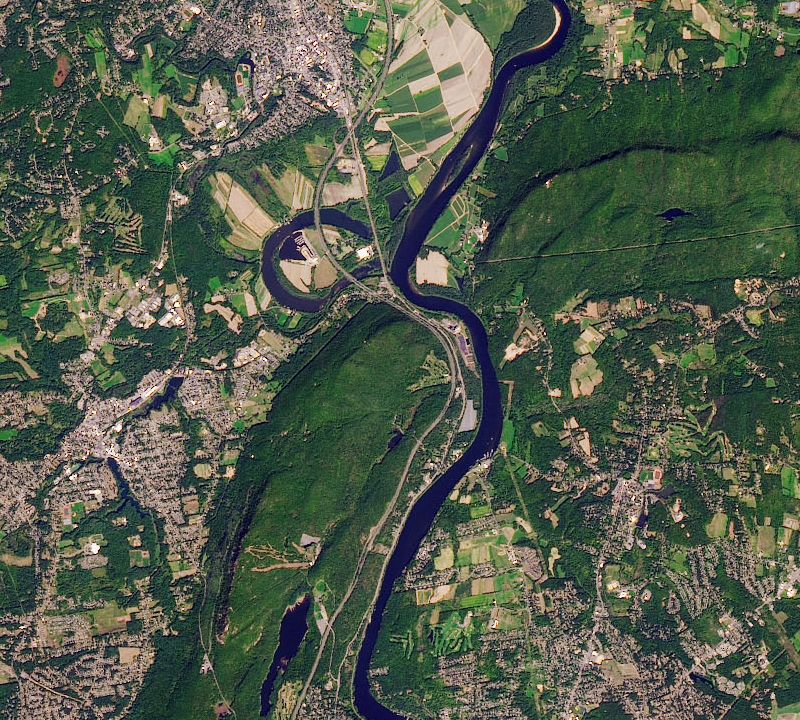
Detail of a 2017 Landsat 8 image around the Connecticut River oxbow. The surviving pond and neighbouring river channel record a landscape altered by the 1840 flood and later infrastructure. Image: NASA Earth Observatory / Joshua Stevens, using USGS Landsat data. NASA image; public domain. Cropped and resized.
The satellite image gives an overhead comparison with Cole’s elevated, oblique prospect. Its remaining curved water and altered channels make change legible, while fields, roads and settlement occupy the surrounding terrain. It records conditions in 2017, rather than an unchanged survival of the scene painted in 1836. A familiar outline can conceal a different relationship between the river and its former course.
This later history sharpens the distinction between a painting and a geographical survey. Cole composed the prospect while the great bend was still connected to the river. His picture preserves an arrangement subsequently transformed by flooding and construction, but its foreground, weather and artistic choices remain essential to what that arrangement means.
Artworks directory
Explore paintings, drawings and studies across Cole’s career. The two Voyage of Life sets appear separately. Dates and study identifications draw on the exhibition and collection catalogues, supplemented by the National Gallery’s drawing records. [5] [12] [13] [14]
| Name | Date | Medium |
|---|---|---|
| The Oxbow | 1836 | Painting |
| The Titan’s Goblet | 1833 | Painting |
| The Architect’s Dream | 1840 | Painting |
| The Course of Empire: The Savage State | ca. 1834 | Painting |
| The Course of Empire: The Arcadian or Pastoral State | ca. 1834 | Painting |
| The Course of Empire: The Consummation of Empire | 1835–1836 | Painting |
| The Course of Empire: Destruction | 1836 | Painting |
| The Course of Empire: Desolation | 1836 | Painting |
| The Voyage of Life: Childhood | 1842 | Painting |
| The Voyage of Life: Youth | 1842 | Painting |
| The Voyage of Life: Manhood | 1842 | Painting |
| The Voyage of Life: Old Age | 1842 | Painting |
| Home in the Woods | 1847 | Painting |
| Distant View of Niagara Falls | 1830 | Painting |
| View on the Catskill—Early Autumn | 1836–37 | Painting |
| Lake with Dead Trees (Catskill) | 1825 | Painting |
| River in the Catskills | 1843 | Painting |
| A View of the Mountain Pass Called the Notch of the White Mountains (Crawford Notch) | 1839 | Painting |
| Expulsion from the Garden of Eden | 1828 | Painting |
| The Subsiding of the Waters of the Deluge | 1829 | Painting |
| The Mountain Ford | 1846 | Painting |
| American Lake Scene | 1844 | Painting |
| A View near Tivoli (Morning) | 1832 | Painting |
| Aqueduct near Rome | 1832 | Painting |
| The Hunter’s Return | 1845 | Painting |
| The Voyage of Life: Childhood (first version) | 1840 | Painting |
| The Voyage of Life: Youth (first version) | 1840 | Painting |
| The Voyage of Life: Manhood (first version) | 1840 | Painting |
| The Voyage of Life: Old Age (first version) | 1840 | Painting |
| Panorama of the Oxbow on the Connecticut River as seen from Mount Holyoke | ca. 1832 (museum); 1833 (2018 catalogue) | Drawing |
| Sketch for The Oxbow | 1836 | Painting |
| From Nature | 1823 | Drawing |
| View of the Round-Top in the Catskill Mountains (Sunny Morning on the Hudson) | 1827 | Painting |
| Scene from The Last of the Mohicans: Cora Kneeling at the Feet of Tamenund | 1827 | Painting |
| View of Monte Video, the Seat of Daniel Wadsworth | 1828 | Painting |
| The Garden of Eden | 1828 | Painting |
| Tomb of General Brock, Queenston Heights, Ontario | 1830 | Painting |
| Effect for Newstead Abbey, Nottinghamshire, England | 1830 | Drawing |
| The Ilissos, from the Parthenon West Pediment | 1829 or 1830 | Drawing |
| Life Study for the Prostrate Shepherd in The Angel Appearing to the Shepherds | 1831–1832 | Painting |
| Interior of the Colosseum, Rome | ca. 1832 | Painting |
| Campagna di Roma (Study for Aqueduct near Rome) | 1832 | Painting |
| Landscape with a Round Temple | ca. 1830s | Painting |
| Stormy Landscape | 1832 | Painting |
| View of Florence from San Miniato | 1837 | Painting |
| Mount Holyoke, Massachusetts (after Basil Hall) | ca. 1829–1831 | Drawing |
| Layout for The Course of Empire | 1833 | Drawing |
| Study for The Course of Empire: The Savage State | ca. 1834 | Painting |
| Study for The Course of Empire: The Arcadian or Pastoral State | ca. 1834 | Painting |
| Study for The Course of Empire: Desolation | 1836 | Painting |
| Study for Dream of Arcadia | 1838 | Painting |
| Clouds | ca. 1830s | Painting |
| Study for The Hunter’s Return | 1845 | Painting |
| Study for Home in the Woods | ca. 1847 | Painting |
| Sunrise in the Catskills | 1826 | Painting |
| Study for The Mountain Ford | 1846 | Drawing |
| Tree Trunks | 1825–1840 | Drawing |
Frequently Asked Questions
Technical examination reveals an architectural underdrawing related to The Consummation of Empire. It is evidence of an abandoned pencil design, not a completed Empire painting covered with the landscape. Cole painted the finished Consummation on a separate canvas. [7]
A proposed reading identifies them as Hebrew words connected with Noah and the Almighty, but that interpretation is disputed. The 2018 study questions the letter forms, finds no planned lettering in the underdrawing, and relates the marks to documented clearing on the mountainside. A definite decoded message cannot be established. [2] [10]
The original belongs to the Metropolitan Museum of Art in New York. Its accession number is 08.228, and it entered the collection as the gift of Mrs. Russell Sage in 1908. [1]
Discussion
Look again at The Oxbow and compare your reading with the questions below.
Reader Insights
Does the sunlit valley seem to reconcile human activity with nature, or does its careful division into fields make the wild foreground more precious? Which details most strongly shape your answer?
How does finding Cole’s small self-portrait change your experience of the panorama? Does his turned gaze make you feel like a companion, an observer or someone asked to judge the landscape?
Which detail or comparison would you add to this account, and what evidence supports your reading?
Join the Conversation
Share the details that shaped your response, or suggest a comparison for other readers.
References
- The Metropolitan Museum of Art, View from Mount Holyoke, Northampton, Massachusetts, after a Thunderstorm—The Oxbow, collection record, 2026 metadata; object 10497, accession 08.228. Museum object record; collection metadata.
- Elizabeth Mankin Kornhauser, “Manifesto for an American Sublime: Thomas Cole’s The Oxbow”, in Thomas Cole’s Journey: Atlantic Crossings, 2018, printed pp. 63–95, especially pp. 64–65, 74–89, 90–95. Exhibition catalogue.
- Oswaldo Rodriguez Roque, “The Oxbow by Thomas Cole: Iconography of an American Landscape Painting”, Metropolitan Museum Journal, vol. 17 (1982), published 1984, printed pp. 63–73; Cole correspondence and the 1836 Knickerbocker Magazine notice reproduced within the article. Journal article.
- Elizabeth Mankin Kornhauser, catalogue entry 51, View from Mount Holyoke, Northampton, Massachusetts, after a Thunderstorm—The Oxbow, in Thomas Cole’s Journey: Atlantic Crossings, 2018, printed pp. 202–203; includes Thomas Cole’s letter to Luman Reed, 2 March 1836. Catalogue entry.
- Elizabeth Mankin Kornhauser and Tim Barringer, Thomas Cole’s Journey: Atlantic Crossings (2018). Career context and artwork/study metadata: catalogue entries 10–66 and chronology, PDF pp. 137–231 and 249–262; related Barringer essay passages, PDF pp. 23–66.
- Elizabeth Mankin Kornhauser, catalogue entries 47–50, Hall’s view and Cole’s tracing, panorama and oil study, in Thomas Cole’s Journey: Atlantic Crossings, 2018, printed pp. 198–201. Preparatory works catalogue.
- Dorothy Mahon, “Thomas Cole’s The Oxbow and The Consummation of Empire: A Technical Comparison”, in Thomas Cole’s Journey: Atlantic Crossings, 2018, printed pp. 106–115, especially pp. 106–111. Technical study.
- Detroit Institute of Arts, Panorama of the Oxbow on the Connecticut River as seen from Mount Holyoke, collection record, accessed 2026; graphite pencil on off-white wove paper, accession 39.566.66; catalogue date ca. 1832. Drawing record.
- Christopher Riopelle, “Thomas Cole and the Landscape Oil Sketch”, in Thomas Cole’s Journey: Atlantic Crossings, 2018, printed pp. 96–105, especially pp. 102–105. Oil sketch essay.
- Oswaldo Rodriguez Roque, View from Mount Holyoke, Northampton, Massachusetts, after a Thunderstorm (The Oxbow), in American Paradise: The World of the Hudson River School, 1987, printed pp. 125–127. Catalogue entry.
- NASA Earth Observatory, Adam Voiland, “Connecticut River Oxbow”, 15 October 2017. Source.
- Franklin Kelly et al., American Paintings of the Nineteenth Century, Part I (National Gallery of Art, 1996). Cole catalogue and both Voyage of Life sets, PDF pp. 91–124.
- National Gallery of Art, Study for The Mountain Ford (1846), accession 2015.19.772. Collection record and open-access image.
- National Gallery of Art, Tree Trunks (1825–1840), accession 2015.19.607. Collection metadata and open-access image.
- Splash image source.
Thomas Cole, View from Mount Holyoke, Northampton, Massachusetts, after a Thunderstorm—The Oxbow, 1836. Oil on canvas, 130.8 × 193 cm. The Metropolitan Museum of Art, New York, Gift of Mrs. Russell Sage, 1908 (08.228).