by Tom Gurney
Tom Gurney BSc (Hons) is an art history expert with over 20 years experience
Published on June 19, 2020 / Updated on October 27, 2026
Email: tomgurney1@gmail.com / Phone: +44 7429 011000
Thomas Cole Prints: Introduction
A Thomas Cole print may preserve the sweep of a waterfall or the luminous castle in The Voyage of Life, yet it is a different object from the painting that supplied its design. Historical engravings brought his landscapes into books and homes, giving the compositions lives beyond their original canvases. In one striking case, a printed view of Niagara became the model for decoration on Staffordshire pottery. Understanding these movements means looking at the people who translated Cole's pictures as well as at Cole himself. [1]
The useful first question is therefore: what kind of print is this? A nineteenth-century impression made after Cole, a reproduction of that engraving, and a modern colour reproduction of a painting can share a familiar title while differing in maker, date, medium and appearance. Those distinctions help explain both the history of the image and what a buyer or viewer is actually seeing.
At a Glance
- Historical printsreproductive works credited to their printmakers, with Cole identified as the artist whose design they follow.
- A prominent exampleJames Smillie's The Voyage of Life–Youth, selected by the American Art-Union in 1849 and published and distributed in 1850; the Metropolitan Museum's impression was printed by J. Dalton. [2]
- Another documented makerEdward Gallaudet, whose The Whirlwind, 1836, is an engraving after Cole. [3]
- Essential distinctiona historical print after Cole is separate from an oil painting by Cole and from a modern reproduction made for display.
Contents
- Introduction
- What “after Thomas Cole” means
- Niagara travels from painting to book and table
- Youth and the audience of the Art-Union
- The same title can conceal different objects
- Choosing a reproduction for display
- Reading the surviving sheets
What “after Thomas Cole” means
The word after is a credit, not a suggestion that the printmaker worked beside Cole or that Cole engraved the plate. It identifies the source of the composition. A print record can therefore name Cole and another artist without making their roles interchangeable. Fenner, Sears & Co. translated his Niagara painting into a small printed image; Smillie translated the allegory of Youth. The painting supplied the design, while the print existed through a further act of making. [1] [2]
Gallaudet's The Whirlwind makes this division unusually explicit. The National Gallery of Art records separate inscriptions naming Cole as the painter and Gallaudet as the engraver. It dates the object to 1836 and describes its medium as engraving in black on wove paper. Its bibliography connects it with the 1837 Token and Atlantic Souvenir. These details place a particular sheet within a history of book illustration rather than establishing an original engraving by Cole. [3]
Naming the engraver gives the print its own identity. It also encourages a different kind of attention. A colour painting can establish distance through changes of hue; a monochrome reproduction has to make its landscape legible through relationships between marks, dark passages and the light of the paper. The composition may remain recognisable while the means by which we experience it change. Reproductive work is consequently worth studying as an interpretation in another medium, as well as a means of carrying a design elsewhere.
This distinction matters when searching for “original Thomas Cole prints”. The phrase can be used loosely. An old impression of an engraving after Cole may be an authentic historical print, but that does not make it an original work engraved by Cole. The maker's name, the medium and the date clarify what the attractive but ambiguous word original leaves unresolved.
Niagara travels from painting to book and table
Cole’s Niagara imagery shows that reproduction formed part of his professional activity during his lifetime. The 2018 catalogue associates a separate Niagara panel with John Howard Hinton’s The History and Topography of the United States. That panel and its commission history should remain distinct from the Chicago painting. While in London, Cole supplied twelve American views for Hinton: ten paintings and two drawings. The catalogue records delivery of the Niagara painting in January 1831. Fenner, Sears & Co. made the print, which appeared on 1 April 1831 as the frontispiece to the first English edition of the second volume. [1]
The small image retained the idea of looking towards the distant falls across a broad landscape. The British Museum's impression, titled A distant view of the Falls of Niagara, is dated 1831 and identifies two figures on a rock at the left, looking towards the waterfall. Its record names Fenner, Sears & Co. as maker and printer, and Isaac Taylor Hinton and Simpkin & Marshall as publishers. Those credits reveal several participants behind an image that a reader might associate with Cole alone. [4]
Shannon Vittoria's entry in Thomas Cole's Journey: Atlantic Crossings follows the engraving into later European and American editions and into circulation outside Hinton's book, including examples published in Germany, Ireland and Scotland. A painted view could thus reach people who had never stood before Cole's panel. Its movement through different publications made the landscape portable, repeatable and available in new settings. [1]
The next transformation was more radical. William Adams & Sons used the engraving for a serving platter in its American Views dinnerware. According to Vittoria, the pottery extended the landscape to the left, added a large arching tree and replaced the distant thunderstorm with a line of trees. A floral and shell border enclosed the scene. This was an adaptation to a decorative object, rather than an exact miniature of the painting. [1]
The example makes fidelity a concrete question. A familiar waterfall does not guarantee an unchanged composition. Alterations to the sky, trees and framing can soften or redirect a landscape's effect. Vittoria also notes that the pottery did not carry Cole's name and that he received no payment for this use of his imagery. Dissemination and recognition were therefore different things: an image might become familiar while the identity of its painter receded. [1]
Youth and the audience of the Art-Union
Smillie's Youth belongs to a later story. Cole painted the original Voyage of Life in 1840 and a second set in Rome in 1842. Franklin Kelly's National Gallery catalogue identifies the first set as the paintings purchased by the American Art-Union in 1848 and connects their growing fame after Cole's death with the commission for Smillie's engraving. The distinction between the sets matters: the familiar print follows the 1840 original, rather than the Roman replica now in Washington. [5]
The Art-Union selected Youth in 1849; the Metropolitan Museum dates publication and distribution to 1850. Its impression records Smillie as artist, Cole as the source, Dalton as printer and the Art-Union as publisher, with etching and engraving as the medium. The annual five-dollar membership included a large print and a chance to win original art in a lottery. It did not promise every subscriber a Cole painting. [2]
That arrangement joined two forms of access. Members could possess a printed image, while the possibility of owning an original remained uncertain. Kelly describes the broad circulation of Smillie's Youth and the subsequent engraving of the other scenes. Reproduction helped a series originally commissioned for a private owner become a widely recognised account of human life. The print's audience was part of the work's history, rather than merely a later footnote to its painted form. [5]
Watch: Thomas Cole
Choose a film to explore the artist’s work, its interpretation and its wider setting.
Thomas Cole: Painting the American Landscape (remastered audio)
An introduction to Cole’s landscapes and artistic ambitions.
Watch on YouTubeThe same title can conceal different objects
A date should belong to the object being described. Youth can refer to an 1840 painting, an 1842 replica or a later print; those dates answer different questions. Reynolda's 2021 exhibition listed a Smillie Youth dated 1854–55. Its date should remain distinct from the Metropolitan Museum's 1850 example, even though both are engravings after the same composition. A later impression does not move the painting's creation into the 1850s. [6]
Dimensions need the same care. Museum records may distinguish the printed image, the plate and the whole sheet. A paper margin can make a print's overall dimensions substantially larger than its composition. Comparing an image measurement with another object's sheet measurement gives a misleading impression of scale. Keep the measurement label with the number, and identify the collection and accession when discussing a particular impression. [2] [3]
The Niagara records also preserve a terminology difference: the 2018 catalogue calls its exhibited example an engraving, while the British Museum classifies its impression as an etching. Retaining each collection's wording is more reliable than silently assigning every surviving sheet one technical description. The title and maker establish a relationship; the individual object record supplies the precise identification. [1] [4]
Choosing a reproduction for display
For a modern purchase, begin with the image you want to live with. A reproduction of Cole's colour painting and a reproduction of Smillie's monochrome print offer different experiences of Youth. In the former, colour carries much of the landscape's atmosphere. In the latter, the historical printmaker's translation is itself part of the subject. The product description should say which object supplied the image.
Then check the full composition and the printed area. A tightly cropped illustration may omit parts of the banks, sky or surrounding landscape; a border may be printed within the advertised dimensions. Paper prints, stretched canvas reproductions and framed products also create different relationships between image and wall. Look for a clear account of the support, dimensions and framing rather than assuming that a familiar title describes a standard product.
A modern reproduction can be enjoyed without claiming the status of a nineteenth-century impression. Conversely, a historic engraving deserves identification beyond the painting's title. No general promise about a seller's colour accuracy, materials or longevity follows from the fact that its image derives from Cole. Those qualities belong to the particular product and its documented specifications.
Reproduction remains a substantial part of the series' reception. Munson's 2025 exhibition Canvas to Culture gathered more than fifty works connected with The Voyage of Life, tracing printed and painted reproductions into later media and identifying a translation of Youth in The Jazz Singer of 1927. That account gives the print history a wider setting: Cole's compositions continued to be adopted and reshaped long after their first publication. [7]
Reading the surviving sheets
The paper around an engraving can be as informative as the landscape within it. Gallaudet’s The Whirlwind preserves credits for painter and engraver below a dramatic scene of trees and water. Keeping those inscriptions visible lets the viewer recognise the division of labour rather than encounter an anonymous monochrome “Cole”. The sheet’s title and surrounding paper belong to the historical object. [3]
A later Old Age impression in the National Gallery of Art is dated about 1855. It names Smillie as engraver, John H. Daniels as printer and Benjamin B. Russell as publisher. Below the image, its Boston publication line and proof designation help identify this particular sheet. These details give a concrete example of the series’ continued circulation after the Art-Union’s 1850 Youth: a familiar painted composition could acquire another printed identity through a different printer and publisher. [8]
Selected Thomas Cole Prints
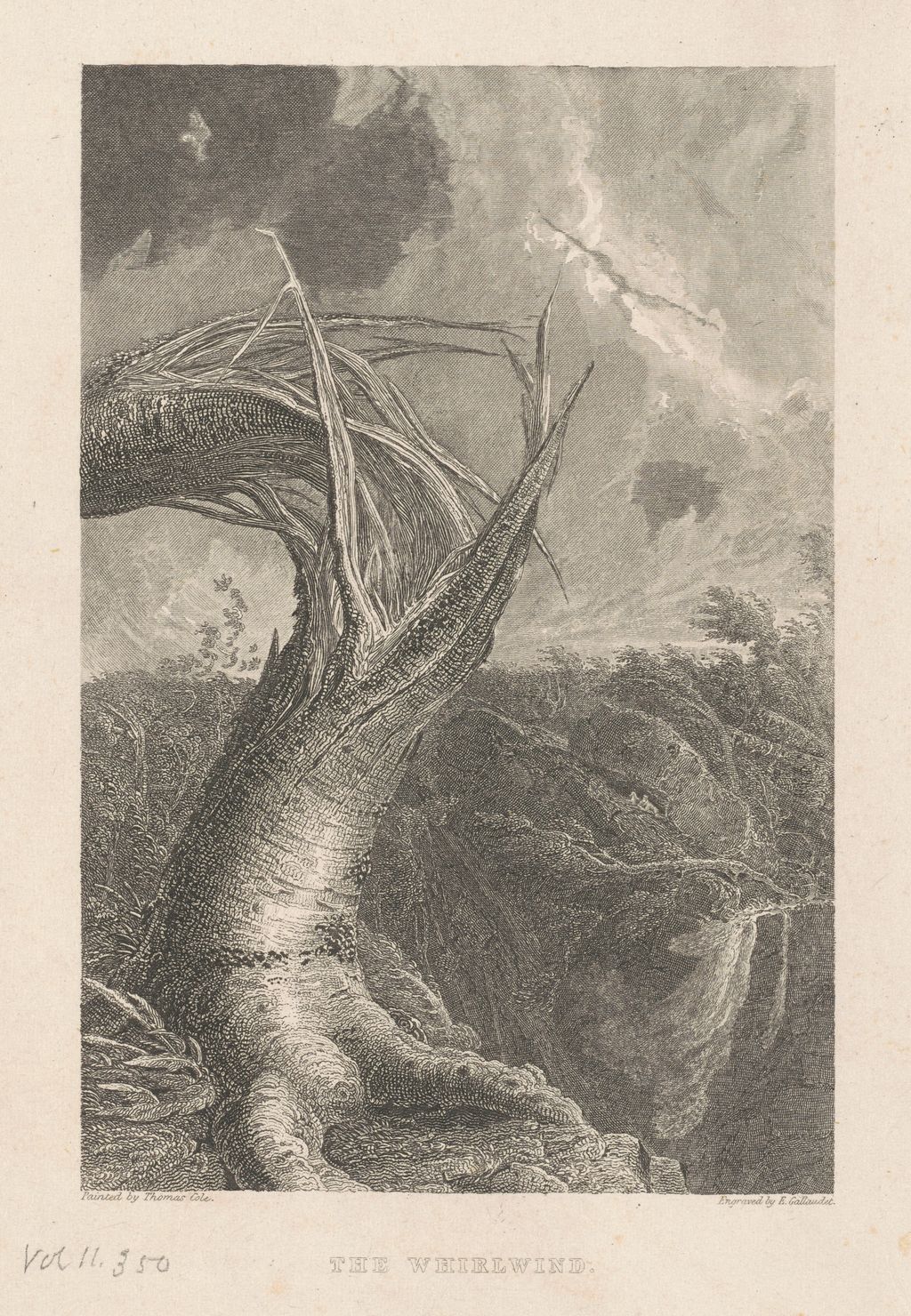
The Whirlwind
Edward Gallaudet, after Thomas Cole, 1836. Engraving in black on wove paper. National Gallery of Art, Corcoran Collection (Gift of Alice F. Williams, 1958), 2015.19.920.
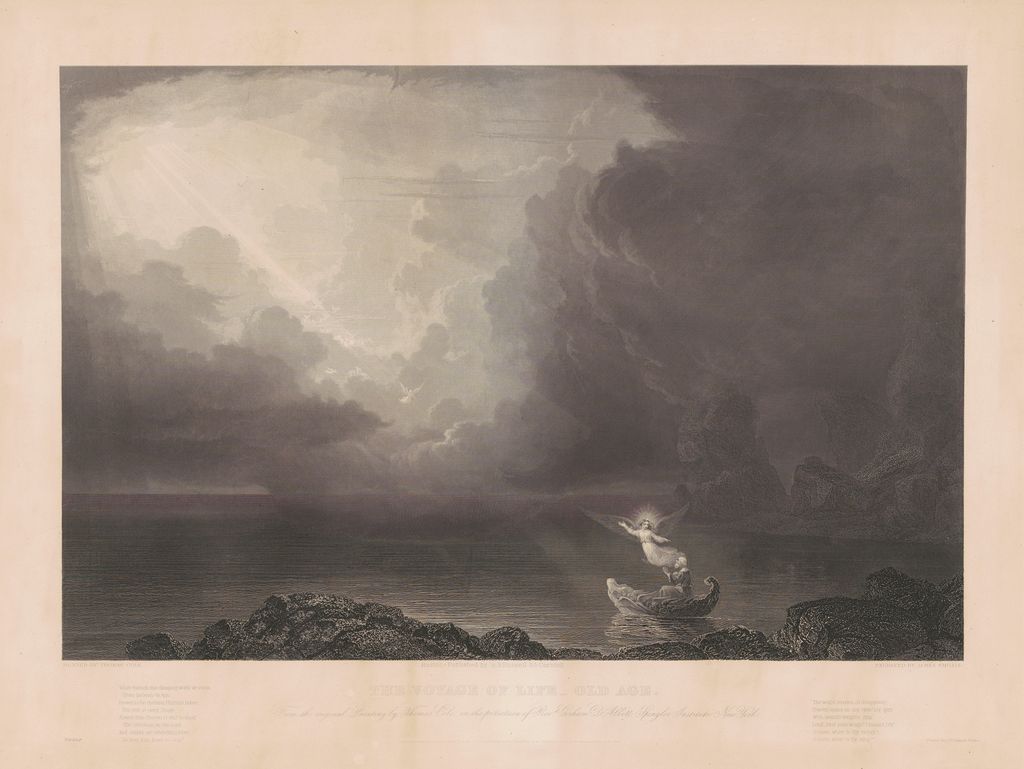
The Voyage of Life: Old Age
James Smillie, after Thomas Cole, c. 1855. Engraving in black on wove paper; printed by John H. Daniels and published by Benjamin B. Russell. National Gallery of Art, Corcoran Collection, 2015.19.341.
Artworks directory
Explore paintings, drawings and studies across Cole’s career. The two Voyage of Life sets appear separately. Dates and study identifications draw on the exhibition and collection catalogues, supplemented by the National Gallery’s drawing records. [9] [10] [11] [12]
| Name | Date | Medium |
|---|---|---|
| The Oxbow | 1836 | Painting |
| The Titan’s Goblet | 1833 | Painting |
| The Architect’s Dream | 1840 | Painting |
| The Course of Empire: The Savage State | ca. 1834 | Painting |
| The Course of Empire: The Arcadian or Pastoral State | ca. 1834 | Painting |
| The Course of Empire: The Consummation of Empire | 1835–1836 | Painting |
| The Course of Empire: Destruction | 1836 | Painting |
| The Course of Empire: Desolation | 1836 | Painting |
| The Voyage of Life: Childhood | 1842 | Painting |
| The Voyage of Life: Youth | 1842 | Painting |
| The Voyage of Life: Manhood | 1842 | Painting |
| The Voyage of Life: Old Age | 1842 | Painting |
| Home in the Woods | 1847 | Painting |
| Distant View of Niagara Falls | 1830 | Painting |
| View on the Catskill—Early Autumn | 1836–37 | Painting |
| Lake with Dead Trees (Catskill) | 1825 | Painting |
| River in the Catskills | 1843 | Painting |
| A View of the Mountain Pass Called the Notch of the White Mountains (Crawford Notch) | 1839 | Painting |
| Expulsion from the Garden of Eden | 1828 | Painting |
| The Subsiding of the Waters of the Deluge | 1829 | Painting |
| The Mountain Ford | 1846 | Painting |
| American Lake Scene | 1844 | Painting |
| A View near Tivoli (Morning) | 1832 | Painting |
| Aqueduct near Rome | 1832 | Painting |
| The Hunter’s Return | 1845 | Painting |
| The Voyage of Life: Childhood (first version) | 1840 | Painting |
| The Voyage of Life: Youth (first version) | 1840 | Painting |
| The Voyage of Life: Manhood (first version) | 1840 | Painting |
| The Voyage of Life: Old Age (first version) | 1840 | Painting |
| Panorama of the Oxbow on the Connecticut River as seen from Mount Holyoke | ca. 1832 (museum); 1833 (2018 catalogue) | Drawing |
| Sketch for The Oxbow | 1836 | Painting |
| From Nature | 1823 | Drawing |
| View of the Round-Top in the Catskill Mountains (Sunny Morning on the Hudson) | 1827 | Painting |
| Scene from The Last of the Mohicans: Cora Kneeling at the Feet of Tamenund | 1827 | Painting |
| View of Monte Video, the Seat of Daniel Wadsworth | 1828 | Painting |
| The Garden of Eden | 1828 | Painting |
| Tomb of General Brock, Queenston Heights, Ontario | 1830 | Painting |
| Effect for Newstead Abbey, Nottinghamshire, England | 1830 | Drawing |
| The Ilissos, from the Parthenon West Pediment | 1829 or 1830 | Drawing |
| Life Study for the Prostrate Shepherd in The Angel Appearing to the Shepherds | 1831–1832 | Painting |
| Interior of the Colosseum, Rome | ca. 1832 | Painting |
| Campagna di Roma (Study for Aqueduct near Rome) | 1832 | Painting |
| Landscape with a Round Temple | ca. 1830s | Painting |
| Stormy Landscape | 1832 | Painting |
| View of Florence from San Miniato | 1837 | Painting |
| Mount Holyoke, Massachusetts (after Basil Hall) | ca. 1829–1831 | Drawing |
| Layout for The Course of Empire | 1833 | Drawing |
| Study for The Course of Empire: The Savage State | ca. 1834 | Painting |
| Study for The Course of Empire: The Arcadian or Pastoral State | ca. 1834 | Painting |
| Study for The Course of Empire: Desolation | 1836 | Painting |
| Study for Dream of Arcadia | 1838 | Painting |
| Clouds | ca. 1830s | Painting |
| Study for The Hunter’s Return | 1845 | Painting |
| Study for Home in the Woods | ca. 1847 | Painting |
| Sunrise in the Catskills | 1826 | Painting |
| Study for The Mountain Ford | 1846 | Drawing |
| Tree Trunks | 1825–1840 | Drawing |
Frequently Asked Questions
The engraving follows the first Voyage of Life set, completed in 1840, rather than Cole's 1842 Roman replicas. [5]
It means that the print follows a design by Cole. Gallaudet's The Whirlwind, for example, separately names Cole as painter and Gallaudet as engraver. [3]
A modern printed canvas is a reproduction. Its support does not make it an oil painting by Cole, and it should be described by its actual printing process, source image and materials.
Discussion
Look again at Thomas Cole Prints and compare your reading with the questions below.
Reader Insights
How might encountering Cole's Niagara in a book or on a serving platter change the way someone understands the landscape?
What do you gain, and what might you lose, when a colour painting is translated into a monochrome engraving?
Which detail or comparison would you add to this account, and what evidence supports your reading?
Join the Conversation
Share the details that shaped your response, or suggest a comparison for other readers.
References
- Shannon Vittoria, catalogue entries 19–21, in Elizabeth Mankin Kornhauser and Tim Barringer, Thomas Cole's Journey: Atlantic Crossings, Metropolitan Museum of Art, 2018, printed pp. 152–155, PDF pp. 156–159. Catalogue PDF.
- Metropolitan Museum of Art, James Smillie after Thomas Cole, The Voyage of Life–Youth, 1850, object 42.119.516; collection metadata and Art-Union description, accessed 6 October 2026. Print record.
- National Gallery of Art, Edward Gallaudet after Thomas Cole, The Whirlwind, 1836, accession 2015.19.920; metadata, inscriptions and bibliography, accessed 6 October 2026. Print record.
- British Museum, Fenner, Sears & Co. after Thomas Cole, A distant view of the Falls of Niagara, 1831, registration 1900,1231.1408; collection metadata and description, accessed 6 October 2026. Print record.
- Franklin Kelly, “The Voyage of Life”, in American Paintings of the Nineteenth Century, Part I, National Gallery of Art, 1996, printed pp. 100–101, PDF pp. 116–117. Its print distribution chronology is qualified by the Metropolitan Museum's current object record. Catalogue PDF.
- Reynolda House Museum of American Art, The Voyage of Life: Art, Allegory, and Community Response, exhibition description and selected artwork list, 16 July–12 December 2021. Exhibition.
- Munson, Canvas to Culture: Thomas Cole's Voyage of Life Lives On, exhibition description, 28 February–25 May 2025. Exhibition.
- National Gallery of Art, James Smillie after Thomas Cole, The Voyage of Life: Old Age, c.1855, accession 2015.19.341; maker roles, medium, credit, provenance and inscriptions, consulted 6 October 2026. Print record.
- Elizabeth Mankin Kornhauser and Tim Barringer, Thomas Cole’s Journey: Atlantic Crossings (2018). Career context and artwork/study metadata: catalogue entries 10–66 and chronology, PDF pp. 137–231 and 249–262; related Barringer essay passages, PDF pp. 23–66.
- Franklin Kelly et al., American Paintings of the Nineteenth Century, Part I (National Gallery of Art, 1996). Cole catalogue and both Voyage of Life sets, PDF pp. 91–124.
- National Gallery of Art, Study for The Mountain Ford (1846), accession 2015.19.772. Collection record and open-access image.
- National Gallery of Art, Tree Trunks (1825–1840), accession 2015.19.607. Collection metadata and open-access image.
- Splash image source.
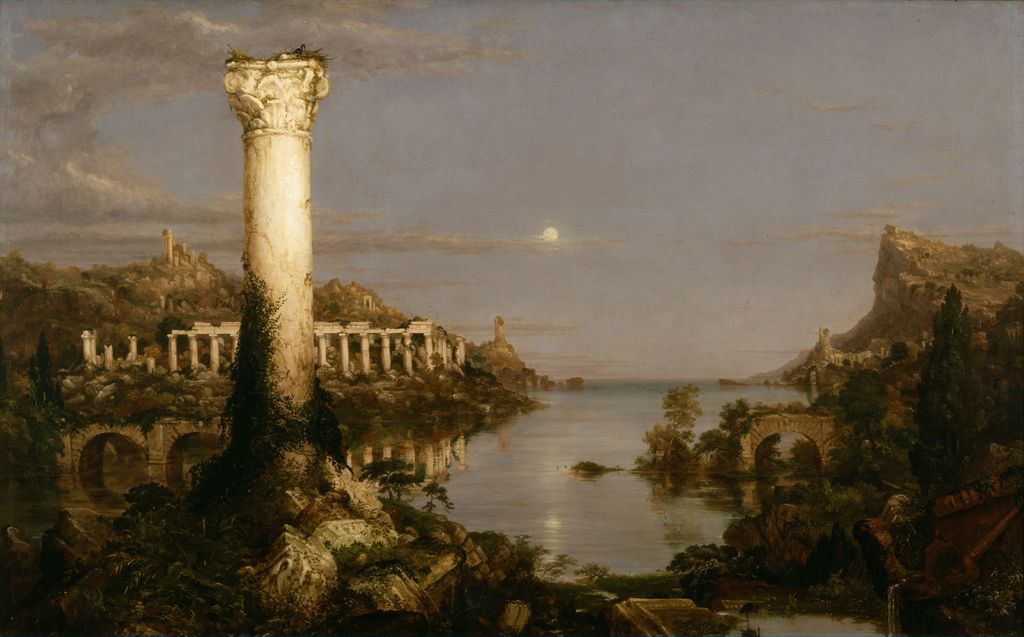
Thomas Cole, The Course of Empire: The Consummation of Empire, 1835–1836. Oil on canvas, 130.2 × 193 cm. New York Historical, gift of the New-York Gallery of the Fine Arts, 1858 (1858.3).