by Tom Gurney
Tom Gurney BSc (Hons) is an art history expert with over 20 years experience
Published on June 19, 2020 / Updated on October 27, 2026
Email: tomgurney1@gmail.com / Phone: +44 7429 011000
Prints: Introduction
Frederic Edwin Church’s landscapes reached audiences through more than their original canvases. Engravers, lithographers, publishers and book illustrators translated his images into forms that could circulate beyond an exhibition. Those reproductions are part of the history of his work: they reveal how a painted spectacle became an image to own, study or encounter on a printed page.
The word “print” covers several different objects. A nineteenth-century engraving after Church, a lithograph with added paint and a modern reproduction of a museum photograph have different materials and histories. Looking at specific examples makes those distinctions visible, while also showing the skill involved in carrying a landscape from one medium into another.
Selected Church Prints
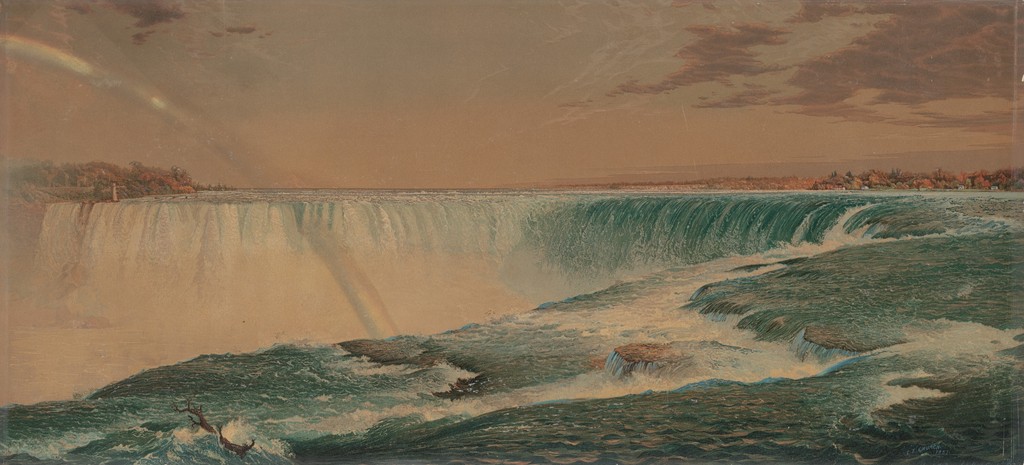
The Great Fall, Niagara (Charles Risdon, after Church)
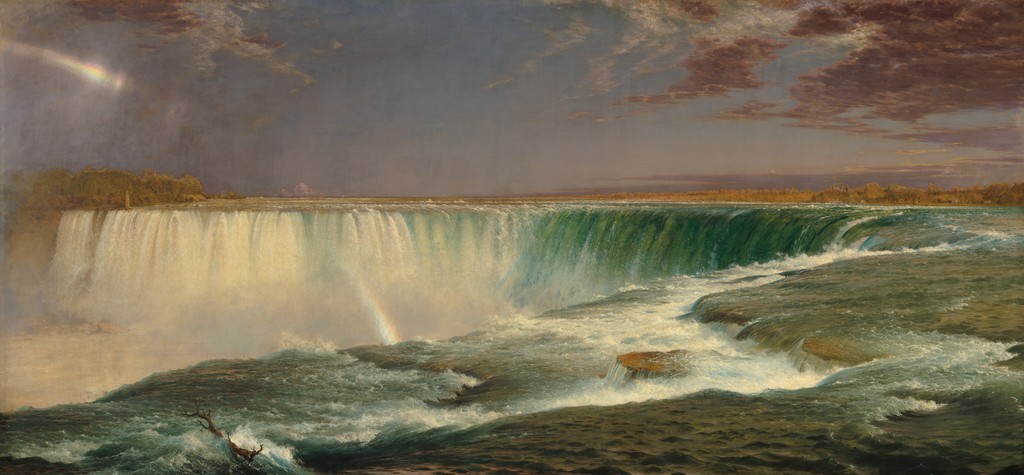
Charles Risdon, after Frederic Edwin Church, The Great Fall, Niagara, 1874. Hand-coloured chromolithograph on paperboard; sheet 41.43 × 90.81 cm. Day and Son Lithographers, publisher. Courtesy National Gallery of Art, Washington, Corcoran Collection, 2015.19.576. CC0/Open Access. Supplied image area; earlier 1857 inscriptions do not establish impression date.
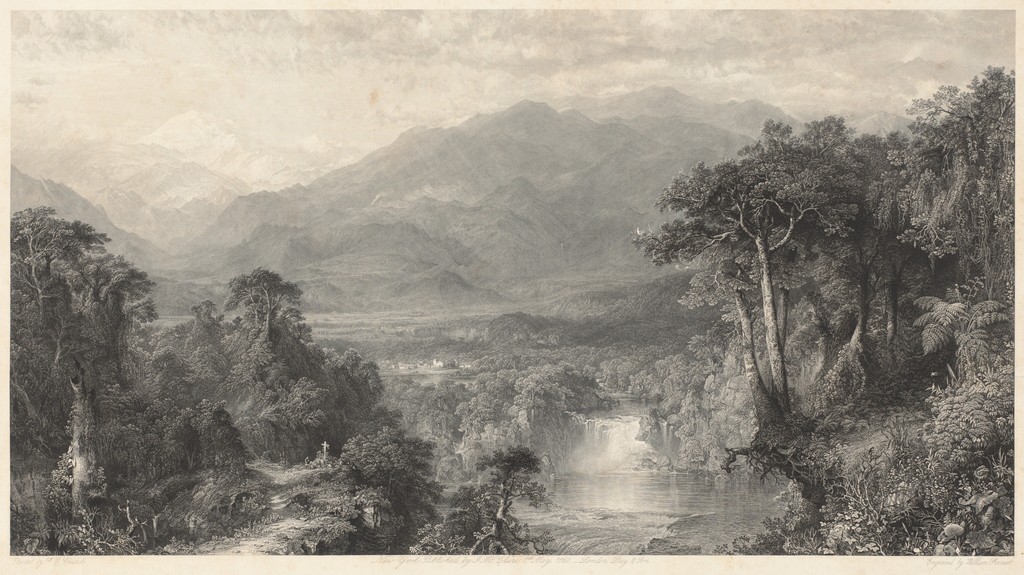
The Heart of the Andes (William Forrest, after Church)
William Forrest, after Frederic Edwin Church, The Heart of the Andes, 1862. Engraving in black on wove paper; image 34.4 × 63.2 cm, sheet 52.8 × 78.9 cm. Published by J. McClure, New York, and Day & Son, London. Courtesy National Gallery of Art, Washington, Gift of A. Thompson Ellwanger III, 1992.34.1. CC0/Open Access. Delivered image and narrow inscription margin; whole physical sheet extent not asserted.
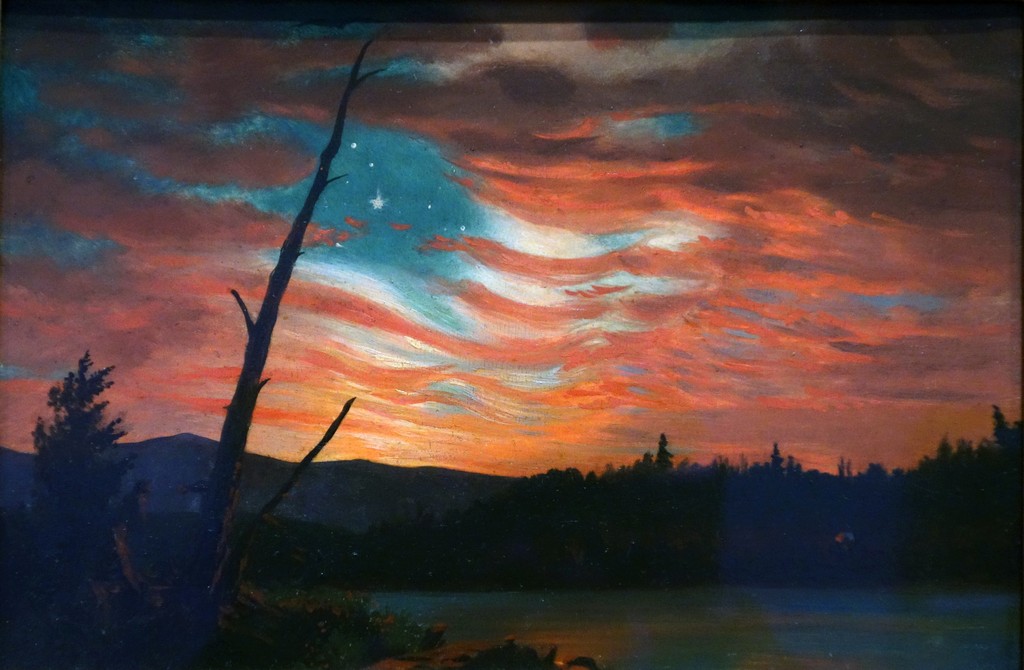
Our Banner in the Sky
Frederic Edwin Church, Our Banner in the Sky, 1861. Oil paint over lithograph on paper, laid down on cardboard, 19.0 × 28.9 cm. Terra Foundation for American Art, Daniel J. Terra Collection, 1992.27; photograph Choliamb, via Wikimedia Commons. Faithful 2D public-domain reproduction. Exact Terra version, presumably hand-painted by Church as the foundation qualifies.
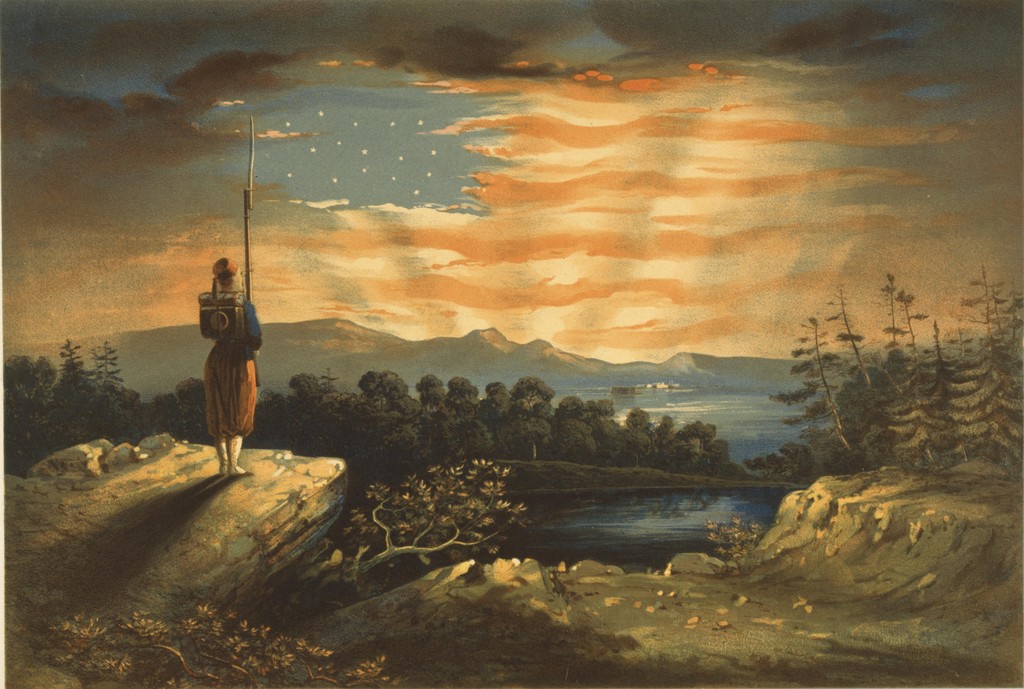
Our Heaven Born Banner (William Bauly, adapting Church’s motif)
William Bauly, Our Heaven Born Banner, circa 1861. Colour lithograph by Sarony, Major & Knapp; published by William Schaus. Library of Congress scan, LC-USZC4-12417/cph.3g12417, via Wikimedia Commons. Public-domain expired 1861 print. Picture-area reproduction: external lettering/verse not in this file; adaptation of Church’s motif, not his original painting.
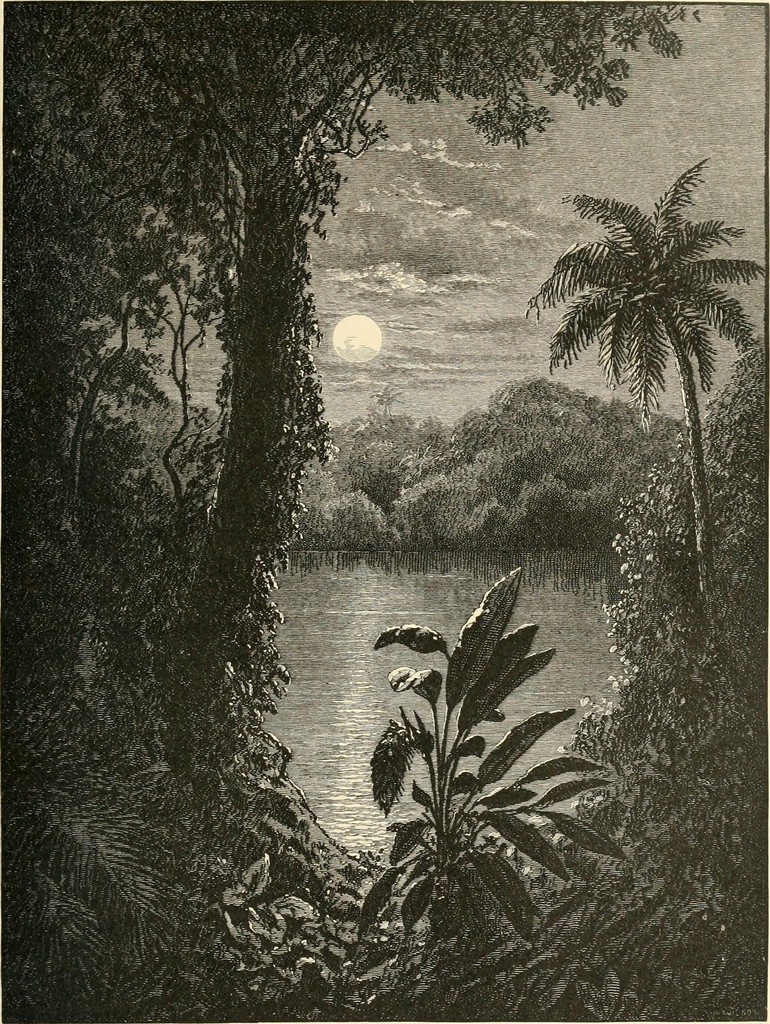
A Tropical Moonlight (wood engraving after Church)
Wood engraving after Frederic Edwin Church, A Tropical Moonlight, in G. W. Sheldon, American Painters, New York: D. Appleton and Company, 1879, plate associated with p.10. University of California Libraries/Internet Archive scan, via Internet Archive Book Images and Wikimedia Commons; engraver unverified. Public-domain 1879 print and faithful scan. Printed reproduction after painting, not colour canvas image.
At a Glance
- Principal artist whose images are discussedFrederic Edwin Church
- Other makersCharles Risdon, William Forrest, William Bauly and specialist printers and publishers
- Processes representedChromolithography, metal engraving, wood engraving and painting over a lithograph
- ExamplesNiagara, The Heart of the Andes, Our Banner in the Sky and A Tropical Moonlight
- Important distinctionDate of the painting, date printed in an inscription and date assigned to an impression may differ
- Useful details to inspectFull composition, margins, maker and publisher names, medium and collection record
Contents
- A print after a painting
- Exhibition audiences and the reproduction business
- Niagara in colour lithography
- William Forrest and The Heart of the Andes
- Different impressions, different records
- Our Banner in the Sky: print and paint together
- An adapted patriotic image
- A Tropical Moonlight on the printed page
- Looking at a reproduction today
- Annotated details
A print after a painting
The Victoria and Albert Museum describes printmaking as transferring an image from one surface to another through a repeatable process. A block or plate can produce multiple impressions, but each impression is a physical object with its own paper, ink and condition.[1]
When a museum calls a print “after” Church, it identifies the painter as the source of the design. The person who engraved or lithographed the image may be another maker. This division of work matters: translating painted colour, foliage and atmosphere into printed marks requires decisions about lines, tones and emphasis.
A reproductive print can therefore be studied both as a version of a painting and as a work in another medium. Recognising the source landscape is only the beginning. The print’s scale, surface and lettering can explain how it was made available to viewers and how its makers presented their roles.
Annotated Details from Prints
The numbered points draw attention to visible features discussed in this article. Look from each detail back to the full composition. Each image keeps its own identity, date and medium in the caption below.
Charles Risdon, The Great Fall, Niagara (1874 impression)
Charles Risdon, after Frederic Edwin Church, The Great Fall, Niagara, 1874. Hand-coloured chromolithograph on paperboard; sheet 41.43 × 90.81 cm. Day and Son Lithographers, publisher. Courtesy National Gallery of Art, Washington, Corcoran Collection, 2015.19.576. CC0/Open Access. Supplied image area; earlier 1857 inscriptions do not establish impression date. Source image. CC0 / NGA Open Access designated public-domain object image. Numbered overview resized; detail crops added from the source master. No recolouring.
.jpg)
William Forrest, The Heart of the Andes (1862 engraving)
William Forrest, after Frederic Edwin Church, The Heart of the Andes, 1862. Engraving in black on wove paper; image 34.4 × 63.2 cm, sheet 52.8 × 78.9 cm. Published by J. McClure, New York, and Day & Son, London. Courtesy National Gallery of Art, Washington, Gift of A. Thompson Ellwanger III, 1992.34.1. CC0/Open Access. Delivered image and narrow inscription margin; whole physical sheet extent not asserted. Source image. CC0 / NGA Open Access public-domain image. Numbered overview resized; detail crops added from the source master. No recolouring.
.jpg)
Our Banner in the Sky (Terra version, oil over lithograph)
Frederic Edwin Church, Our Banner in the Sky, 1861. Oil paint over lithograph on paper, laid down on cardboard, 19.0 × 28.9 cm. Terra Foundation for American Art, Daniel J. Terra Collection, 1992.27; photograph Choliamb, via Wikimedia Commons. Faithful 2D public-domain reproduction. Exact Terra version, presumably hand-painted by Church as the foundation qualifies. Source image. Public domain: PD-old-100-expired / faithful 2D reproduction PD-Art / Public Domain Mark. Numbered overview resized; detail crops added from the source master. No recolouring.
.jpg)
William Bauly, Our Heaven Born Banner (circa 1861)
William Bauly, Our Heaven Born Banner, circa 1861. Colour lithograph by Sarony, Major & Knapp; published by William Schaus. Library of Congress scan, LC-USZC4-12417/cph.3g12417, via Wikimedia Commons. Public-domain expired 1861 print. Picture-area reproduction: external lettering/verse not in this file; adaptation of Church’s motif, not his original painting. Source image. Public domain: US publication circa 1861, expired copyright; faithful reproduction of historic 2D print. Numbered overview resized; detail crops added from the source master. No recolouring.
.jpg)
A Tropical Moonlight (1879 wood engraving after Church)
Wood engraving after Frederic Edwin Church, A Tropical Moonlight (also known as Twilight in the Tropics; painting dated 1874), published in G. W. Sheldon, American Painters, New York: D. Appleton and Company, 1879, plate associated with p. 10. University of California Libraries / Internet Archive scan, via Internet Archive Book Images and Wikimedia Commons. Engraver unverified. Public-domain historical engraving and faithful scan; Public Domain Mark 1.0. Wood engraving after Frederic Edwin Church, A Tropical Moonlight, in G. W. Sheldon, American Painters, New York: D. Appleton and Company, 1879, plate associated with p.10. University of California Libraries/Internet Archive scan, via Internet Archive Book Images and Wikimedia Commons; engraver unverified.. Source image. Public-domain 1879 wood engraving and faithful scan / expired copyright; not CC0. Numbered overview resized; detail crops added from the source master. No recolouring.
.jpg)
Details from PRINTS
These crops come directly from the verified source images. They preserve the original colours or printed tones; the numbered overview is a separate aid to looking.
Charles Risdon, The Great Fall, Niagara (1874 impression)
Printed brink
Green tones describe water rolling over the curved brink. This is Risdon’s recorded 1874 impression after Church, rather than a photograph of the oil painting.
 Detail 01 printed-brink.jpg)
Rainbow and mist
A rainbow descends through pale falling water and mist. Compare the printed transitions with the painting’s related passage.
 Detail 02 rainbow-and-mist.jpg)
Foreground water
Small repeated marks describe the moving foreground water. They make the print’s surface a distinct way of rendering the scene.
 Detail 03 foreground-water.jpg)
William Forrest, The Heart of the Andes (1862 engraving)
Pale mountain
The snowy mountain remains light against the sky. Forrest’s engraving carries the landscape through printed tones rather than the painting’s colours.
 Detail 04 pale-mountain.jpg)
Dense foreground trees
Closely gathered lines give the near trees weight. Their density differs from the softer treatment of distant land.
 Detail 05 dense-foreground-trees.jpg)
Waterfall and river
Bright water cuts through the darker foreground. The tonal route preserves an important part of the composition across the change of medium.
 Detail 06 waterfall-and-river.jpg)
Our Banner in the Sky (Terra version, oil over lithograph)
Stars and blue opening
Small pale stars appear within a blue opening. Their arrangement helps turn the sky’s colours into the suggestion of a flag.
 Detail 07 stars-and-blue-opening.jpg)
Cloud stripes
Alternating reddish and pale cloud bands extend across the sky. Their edges remain cloud-like even as they suggest stripes.
 Detail 08 cloud-stripes.jpg)
Bare tree
The bare trunk rises across the illuminated sky like a flagstaff. Its dark irregular branches keep the motif connected to the natural setting.
 Detail 09 bare-tree.jpg)
William Bauly, Our Heaven Born Banner (circa 1861)
Sentry and rifle
A sentry stands with an upright rifle at the left. Bauly’s adapted image gives a human figure the position occupied by a bare tree in Church’s motif.
 Detail 10 sentry-and-rifle.jpg)
Cloud flag
Stars and alternating cloud bands spread across the sky. Their arrangement carries the adapted patriotic image.
 Detail 11 cloud-flag.jpg)
Water and distant buildings
Water, buildings and wooded shores extend below the sky. The broader setting helps distinguish this lithograph from Church’s source image.
 Detail 12 water-and-distant-buildings.jpg)
A Tropical Moonlight (1879 wood engraving after Church)
Moon within foliage
The bright moon appears within an opening framed by dark foliage. In this wood engraving, light and shade depend on the density of printed marks.
 Detail 13 moon-within-foliage.jpg)
Right-hand palms
Separately described palm fronds stand against the lighter distance. Their thin lines differ from the densely worked left tree.
 Detail 14 right-hand-palms.jpg)
Foreground leaves
Broad leaves rise close to the spectator. Their strong shapes help distinguish the near bank from the moonlit water beyond.
 Detail 15 foreground-leaves.jpg)
Exhibition audiences and the reproduction business
Church’s Niagara became a public attraction in 1857. The National Gallery of Art explains that Williams, Stevens, & Williams bought the painting and its copyright for $4,500, then charged twenty-five cents to see it. Visitors to the exhibition, which opened on 1 May, received a pamphlet explaining how to order a chromolithograph.[2]
The arrangement connected looking at the canvas with acquiring a reproduction. A visitor could encounter the large painting in a carefully presented exhibition and then obtain a more portable version. The two experiences were related, though a print could not reproduce the original canvas’s physical scale or painted surface.
This helps explain why the print’s history belongs beside the painting’s exhibition history. Reproduction was a commercial undertaking with several participants, rather than an incidental activity after a picture had become famous. The painter’s design, a publisher’s investment and a specialist printmaker’s labour contributed to the result.
Niagara in colour lithography
Lithography works through the different responses of greasy drawing materials and dampened blank areas to printing ink. Colour lithography builds an image through successive colours; Brigham Young University’s account of Victorian illustration explains that separate colours typically required separate printing plates.[1][3]
The National Gallery of Art holds Charles Risdon’s The Great Fall, Niagara, after Church, with Day and Son named as publisher. It describes this particular impression as a hand-coloured chromolithograph on paperboard and dates it to 1874. The record also transcribes Church’s 1857 date and an 1857 copyright inscription. Those earlier inscriptions should not be used to turn the museum’s 1874 impression into a securely dated first issue.[4]
In the print, green water rolls over the curving brink, while pale foam cuts across the nearer surface. A dark branch interrupts the foreground, giving the rushing water a small, irregular object around which to move. Toward the left, a rainbow descends into the mist beneath a warm sky.
These features preserve the painting’s broad attraction: the spectator seems close to water that cannot be controlled. Yet the printed surface has its own appearance. Fine marks describe the waves, and changes of tone separate the nearer water from the falling sheet beyond it. Looking at those relationships makes the reproduction more interesting than treating it as a smaller substitute for the canvas.
William Forrest and The Heart of the Andes
The reproduction of The Heart of the Andes required another kind of translation. In his study of the painting, Metropolitan Museum of Art curator Kevin J. Avery explains that John McClure contracted William Forrest to engrave a steel plate. Forrest studied the original in Britain in 1859 and had it returned briefly in 1860. He also used photographs and a small watercolour copy as intermediaries; Avery attributes that copy to a professional British copyist, rather than securely to Church himself.[5]
The National Gallery’s black engraving of 1862 names the participants in its inscription: Church as painter, Forrest as engraver, J. McClure as the New York publisher and Day & Son in London. It carries the publication date 1 May 1862 and belongs to the museum as accession 1992.34.1.[6]
The landscape remains recognisable without its painted colours. The snowy mountain is pale against the sky, while closely worked trees fill the near right side. Waterfall and river create another bright passage through the darker foreground. The contrast between densely described growth and softer distance sustains the movement through the scene.
Forrest’s treatment makes tonal relationships especially conspicuous. A leaf or branch must be distinguished through printed marks, while a distant ridge can emerge through a much quieter transition. The viewer follows a familiar composition through a different system of description. Its monochrome appearance demonstrates how much of the landscape’s organisation can survive a change of medium.
William Forrest, after Frederic Edwin Church, The Heart of the Andes, 1862. Engraving in black on wove paper; image 34.4 × 63.2 cm, sheet 52.8 × 78.9 cm. Published by J. McClure, New York, and Day & Son, London. Courtesy National Gallery of Art, Washington, Gift of A. Thompson Ellwanger III, 1992.34.1. CC0/Open Access. Delivered image and narrow inscription margin; whole physical sheet extent not asserted. Image source. CC0 / NGA Open Access public-domain image. Resized; full source proportions retained.
Different impressions, different records
Museums describe individual examples of the Forrest reproduction in different ways. The Metropolitan Museum records its 1862 impression as a steel engraving, accession 1979.535.1. The Pennsylvania Academy of the Fine Arts describes its example as engraving, etching and stipple on chine collé on cream wove paper, accession 1985.x.199.[7][8]
Those descriptions should remain attached to their respective objects. A shared title and design do not justify transferring every material detail or sheet measurement from one museum’s example to another. The National Gallery’s black engraving, for instance, has its own image and sheet dimensions and its own collection credit.
Metal engraving also differs from wood engraving. As the V&A explains, a metal engraver cuts lines into a plate, where they hold ink for transfer to paper. In a wood engraving, the raised parts of the end-grain block carry the ink, while cut-away areas remain unprinted.[1] Similar-looking networks of lines can consequently arise from quite different printing surfaces.
Watch: Frederic Edwin Church
Choose a film to explore the artist’s work, its interpretation and its wider setting.
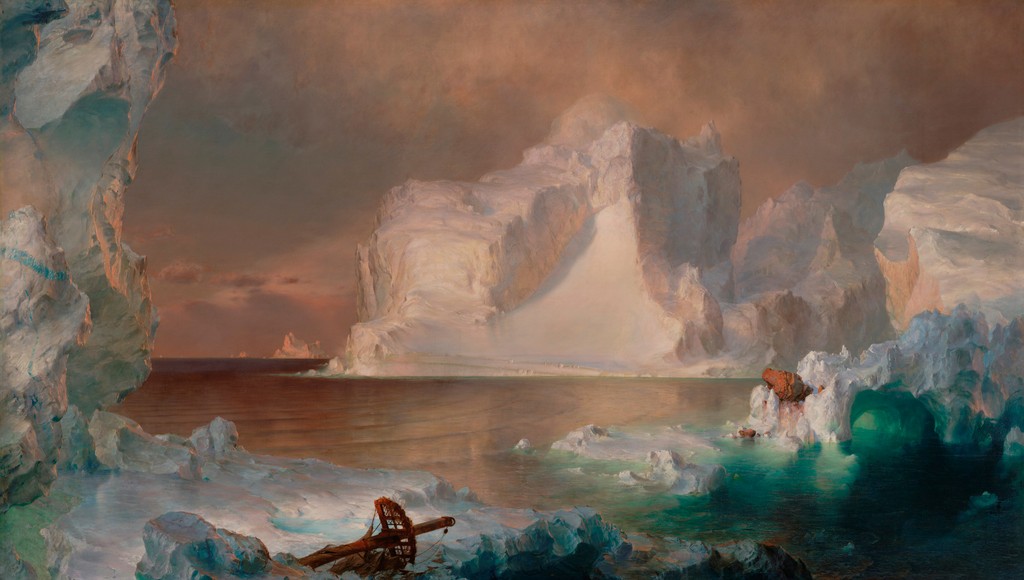
Frederic Edwin Church's "The Icebergs" on the Move at the DMA
Follow the Dallas Museum of Art as it moves Church’s large painting The Icebergs.
Watch on YouTubeOur Banner in the Sky: print and paint together
The Terra Foundation’s Our Banner in the Sky complicates any simple division between painting and print. It consists of oil paint over a lithograph on paper laid on cardboard. The foundation explains that Church’s initial oil sketch followed the attack on Fort Sumter in April 1861 and that a chromolithograph was commissioned that June. Its version is one of several lithographs presumably painted by Church himself; that attribution remains qualified.[9]
In the image, red and pale clouds spread from a blue area containing stars. A bare tree rises at the left like a flagpole, while the darker land stays low beneath the sky. The suggestion of a flag depends on how these natural forms are arranged, rather than on a clearly bounded piece of cloth.
The layered medium gives this object a distinctive place among the reproductions. It begins with a printed design, but added paint makes it something more particular than an unaltered lithographic impression. The museum’s description establishes that combination; a digital photograph alone cannot reveal every boundary between the underlying print and the paint above it.
Frederic Edwin Church, Our Banner in the Sky, 1861. Oil paint over lithograph on paper, laid down on cardboard, 19.0 × 28.9 cm. Terra Foundation for American Art, Daniel J. Terra Collection, 1992.27; photograph Choliamb, via Wikimedia Commons. Faithful 2D public-domain reproduction. Exact Terra version, presumably hand-painted by Church as the foundation qualifies. Image source. Public domain: PD-old-100-expired / faithful 2D reproduction PD-Art / Public Domain Mark. Resized; full source proportions retained.
An adapted patriotic image
Our Heaven Born Banner develops the sky-as-flag idea into a different composition. Its catalogue information, reproduced in the Wikimedia Commons record from the Library of Congress, names William Bauly as painter, Sarony, Major & Knapp as lithographers and William Schaus as publisher. The colour lithograph dates to around 1861 and is described as evidently based on Church’s picture or its chromolithographic reproduction.[10]
A sentry stands on the left-hand rocks, looking toward the luminous sky. His upright rifle replaces the tree’s role as the apparent flagstaff. Water, distant buildings and wooded shores provide a more extensive setting below the stars and coloured cloud bands.
The change makes human vigilance central to the scene. Church’s tree supplies a natural silhouette; the adapted print gives that position to an armed figure. Recognising the relationship between the images does not make them identical works or remove the other makers’ contributions. The altered foreground shows how a memorable device could be reused to carry a more explicit narrative.
William Bauly, Our Heaven Born Banner, circa 1861. Colour lithograph by Sarony, Major & Knapp; published by William Schaus. Library of Congress scan, LC-USZC4-12417/cph.3g12417, via Wikimedia Commons. Public-domain expired 1861 print. Picture-area reproduction: external lettering/verse not in this file; adaptation of Church’s motif, not his original painting. Image source. Public domain: US publication circa 1861, expired copyright; faithful reproduction of historic 2D print. Resized; full source proportions retained.
A Tropical Moonlight on the printed page
A different encounter appears in G. W. Sheldon’s American Painters, published in New York in 1879. Its title page announces examples engraved on wood, and a plate captioned A Tropical Moonlight identifies the source as a painting by Church.[11] This is a historical reproduction associated with the work discussed as Twilight in the Tropics.
Dark foliage frames the large moon above the water. The left-hand tree is densely worked, while palms at the right show individually described fronds. Broad foreground leaves rise into the opening, and lighter horizontal marks suggest the reflected light on the water.
The print offers a particularly clear example of hatching doing the work of colour and tone. Closely gathered marks make the near vegetation substantial; more open passages allow the moon and illuminated water to stand out. The arrangement can be studied through these relationships without mistaking the monochrome illustration for evidence of the original canvas’s colours.
BYU’s account explains why wood engraving suited nineteenth-century book illustration: wood blocks could be printed alongside movable type.[3] That general capability does not identify the particular press used for Sheldon’s book, but it helps place its illustrated treatment of Church within a wider printing culture.
Wood engraving after Frederic Edwin Church, A Tropical Moonlight, in G. W. Sheldon, American Painters, New York: D. Appleton and Company, 1879, plate associated with p.10. University of California Libraries/Internet Archive scan, via Internet Archive Book Images and Wikimedia Commons; engraver unverified. Public-domain 1879 print and faithful scan. Printed reproduction after painting, not colour canvas image. Image source. Public-domain 1879 wood engraving and faithful scan / expired copyright; not CC0. Resized; full source proportions retained.
Looking at a reproduction today
Begin by identifying what the image represents. Is it a photograph of the oil painting, a scan of a particular historical engraving, or a photograph of an object combining print and paint? A title alone may leave these distinctions unresolved. Maker names, dates and medium descriptions provide more useful evidence.
Next, inspect the extent of the reproduction. A picture area, a sheet including lettering and a framed object offer different information. Cropping away an inscription can remove the names that explain a print’s making, while a coloured border can make the proportions difficult to judge.
Modern digital printing introduces another process; the V&A describes inkjet printing as transferring ink through nozzles onto a receiving surface.[1] A newly printed reproduction of an 1862 engraving is still newly printed, even when the historic date remains visible within its image.
These distinctions sharpen the pleasure of looking. Church’s paintings can be followed through water, vegetation, atmosphere and architecture; their reproductions add another set of choices about lines, colours, surfaces and circulation. Attending to both reveals the landscape and the means by which it reached its viewers.
Artworks directory
A documented selection of Church’s works discussed across these articles, together with identified prints after his designs. This is not a catalogue raisonné. Repeated titles and aliases are reconciled; studies remain distinct from finished paintings. Some dates remain unconfirmed. Other makers are named where a print adapts Church’s work.
| Name | Date | Medium |
|---|---|---|
| Above the Clouds at Sunrise | 1849 | Oil on canvas |
| The Aegean Sea | About 1877 | Oil on canvas |
| The Andes of Ecuador | 1855 | Oil on canvas |
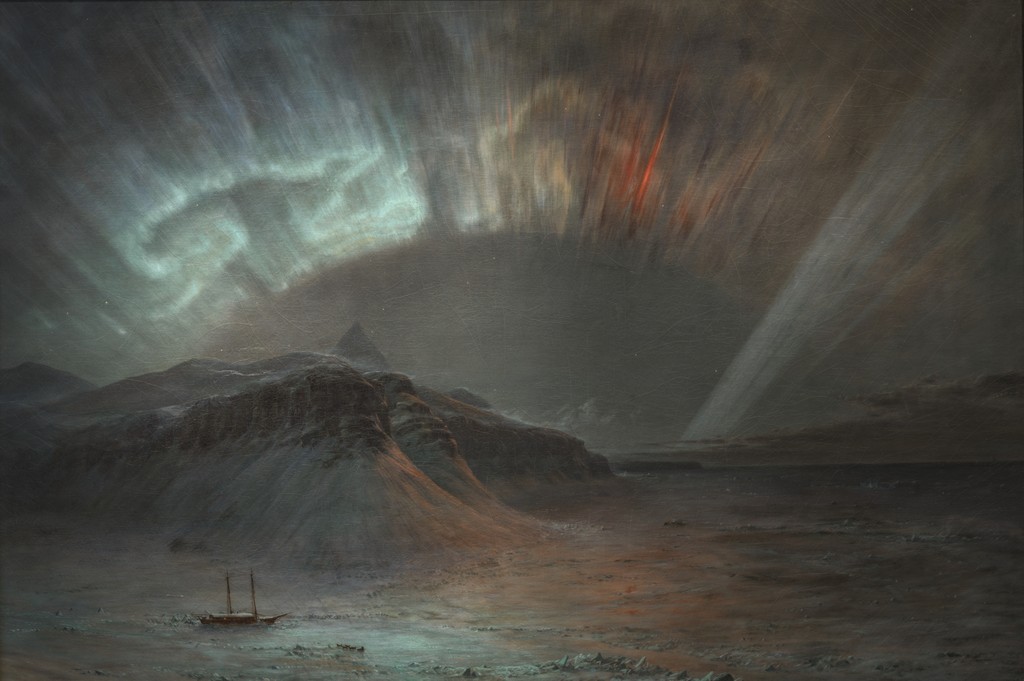
| Aurora Borealis | 1865 | Oil on canvas |
| Autumn in North America | Circa 1856 | Oil on board |
| Coast Scene | 1852 | Oil on canvas |
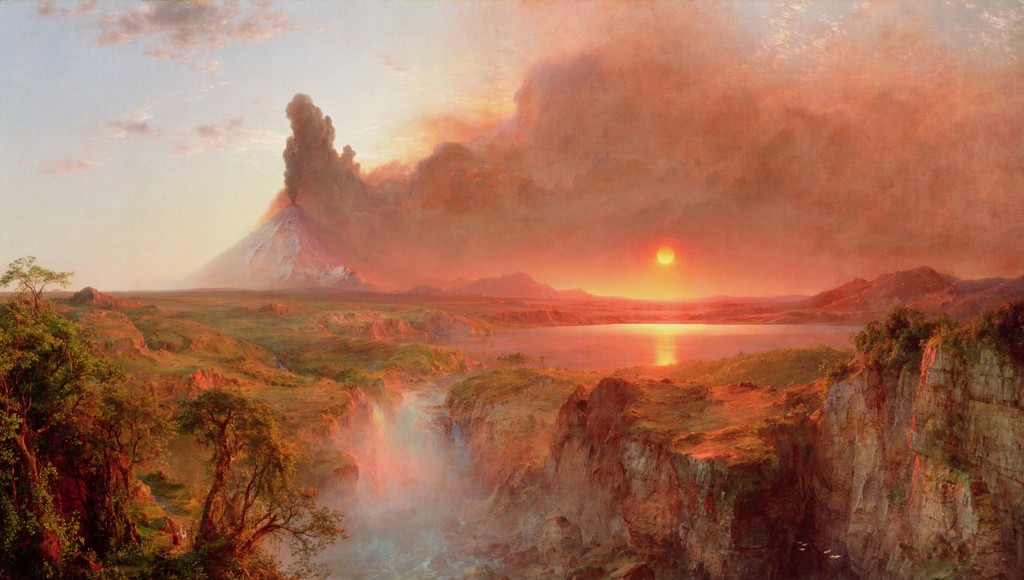
| Cotopaxi | 1862 | Oil on canvas |
| A Country Home | 1854 | Oil on canvas |
| El Khasné, Petra | 1874 | Oil on canvas |
| El Rio de Luz | 1877 | Oil on canvas |
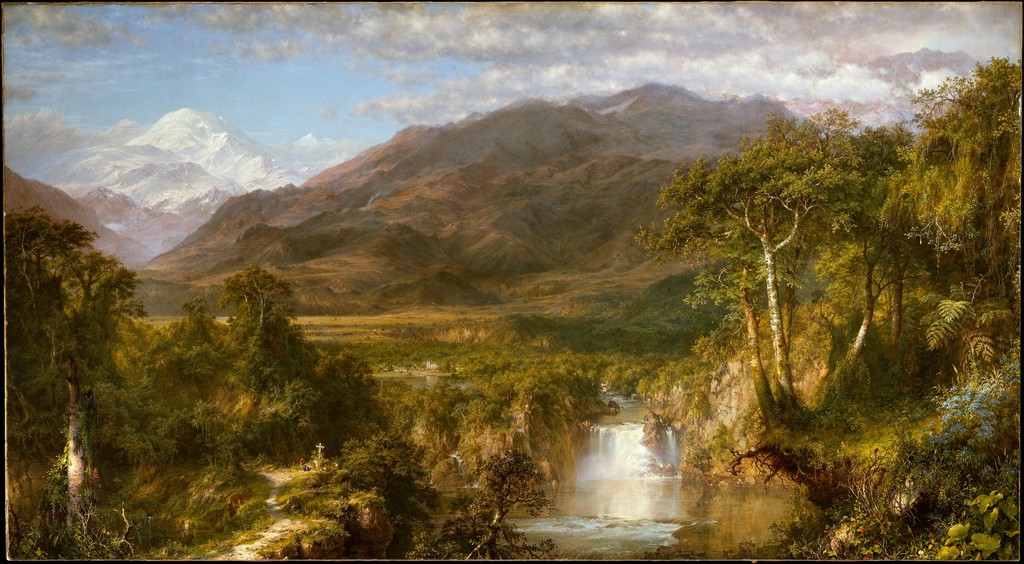
| The Heart of the Andes | 1859 | Oil on canvas |
| The Icebergs | 1861; foreground mast added between mid-1862 and early 1863 | Oil on canvas |
| Jerusalem from the Mount of Olives | 1870 | Oil on canvas |
| Mount Ktaadn | 1853 | Oil on canvas |
| Our Banner in the Sky | 1861 | Oil paint over lithograph on paper, laid down on cardboard |
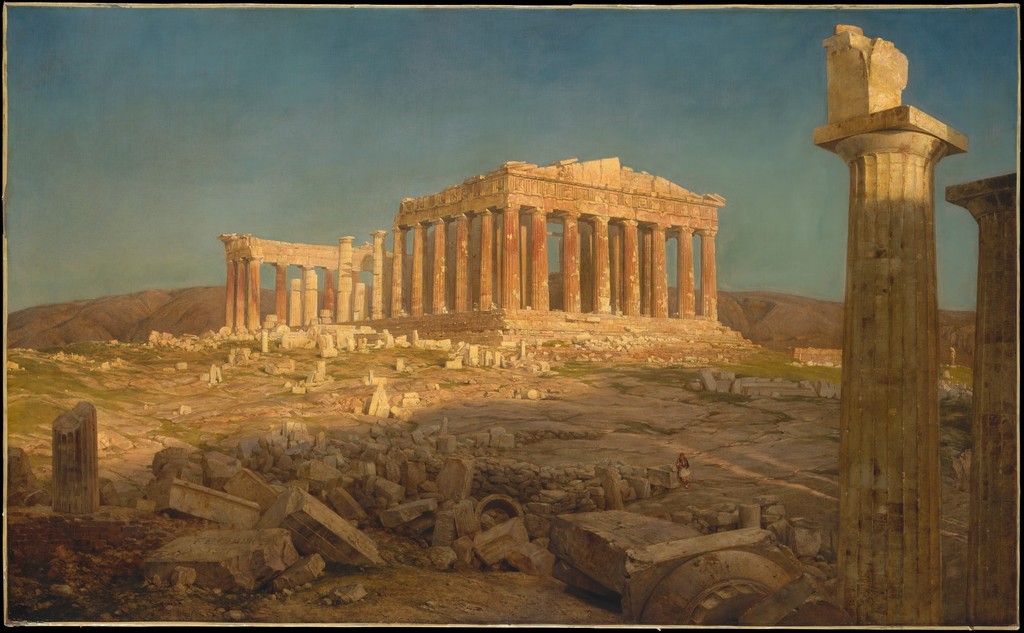
| The Parthenon | 1871 | Oil on canvas |
| Rainy Season in the Tropics | 1866 | Oil on canvas |
| Storm in the Mountains | 1847 | Oil on canvas |
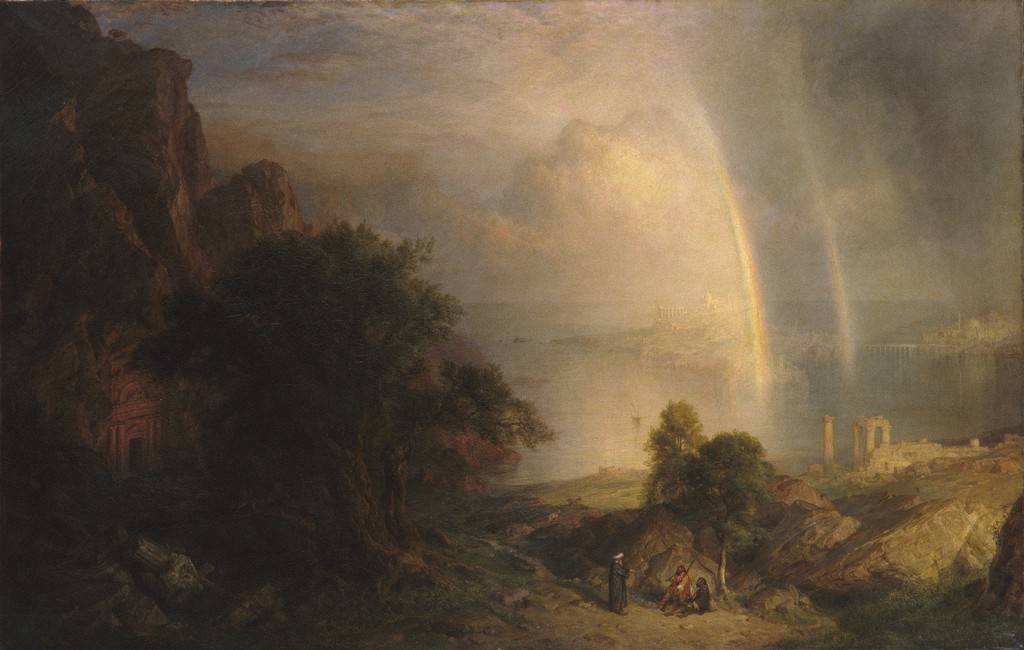
| Syria by the Sea | 1873 | Oil on canvas |
| Tamaca Palms | 1854 | Oil on canvas |
| Tropical Scenery | 1873 | Oil on canvas |
| Twilight in the Tropics | 1874; signed and dated, according to Bonhams’ catalogue | Oil on canvas |
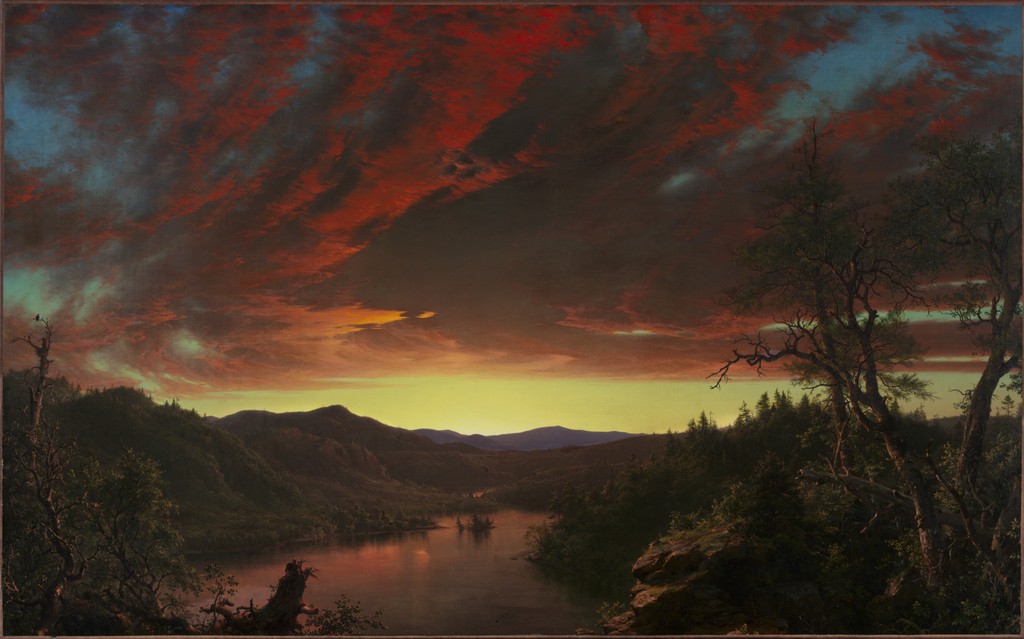
| Twilight in the Wilderness | 1860 | Oil on canvas |
| View of Cotopaxi | 1857 | Oil on canvas |
| Niagara | 1857 | Oil on canvas |
| Magdalena River, New Granada, Equador | 1853 | Graphite heightened with white on wove paper |
| Tamaca Palm, Colombia or Ecuador | May–October 1853 | Graphite on gray laid paper |
| Mixed Sketches with a Champan, Río Magdalena, Colombia | May 1853 | Graphite on gray laid paper |
| Study for Rainy Season in the Tropics | 1865–1866 | Graphite on ruled notepad paper |
| Al-Khazneh, Petra (study) | February–March 1868 | Oil and graphite on tan paperboard |
| The Great Fall, Niagara (Charles Risdon, after Church) | 1874 impression | Hand-coloured chromolithograph on paperboard |
| The Heart of the Andes (William Forrest, after Church) | 1862 | Engraving in black on wove paper |
| Our Heaven Born Banner (William Bauly, adapting Church’s motif) | circa 1861 | Colour lithograph |
| A Tropical Moonlight (wood engraving after Church) | 1879 publication | Wood engraving in American Painters |
| Off Iceberg, Newfoundland | June 1859 | Oil and graphite on paperboard |
| Parthenon at Night, Athens | April 1869 | Oil and graphite on tan paperboard |
| Jerusalem from the Mount of Olives (study) | 1 April 1868 | Oil and graphite study |
| Horseshoe Falls (study) | December 1856–January 1857 | Oil on paper mounted to canvas |
| Niagara Falls, from the American Side | 1867 | Oil on canvas |
| Study for The Heart of the Andes | 1858 | Oil study |
| Mount Chimborazo through Rising Mist and Clouds | 1857 | Oil study |
| Cotopaxi Erupting, Viewed from Quito, Ecuador | June 1857 | Oil and graphite on tan paperboard |
| Cotopaxi (painted for Cyrus Field) | 1855 | Painting |
| Chimborazo | 1864 | Painting |
| Twilight, A Sketch | 1858 | Oil on canvas |
| View of Baalbek | 1868 | Oil and pencil on board |
| Three Bedouins | Date unconfirmed | Oil study |
| Coast Scene, Mount Desert (later canvas) | 1863 | Painting |
| The Wreck | Date unconfirmed | Painting |
| Grand Manan Island, Bay of Fundy | Date unconfirmed | Painting |
| Summer in South America | circa 1853 | Painting |
| Evening in Vermont | Date unconfirmed | Painting |
| Home by the Lake | Date unconfirmed | Painting |
| Storm in the Blue Mountains, Jamaica | August 1865 | Painting |
| The Natural Bridge, Virginia | 1852 | Painting |
| The Vale of St. Thomas, Jamaica | 1867 | Painting |
| Tequendama Falls, near Bogota, New Granada | Date unconfirmed | Painting |
| Sunrise in Syria | Before the 1876 exhibition | Painting |
| Cuernavaca (oil study; descriptive title) | 1898 | Oil study |
| Olana window design (descriptive title) | Date unconfirmed | Watercolour and graphite |
| Olana dining-room stencil sketch (descriptive title) | Date unconfirmed | Oil and graphite |
| Olana house (with Calvert Vaux) | 1870–1872; later additions | Architecture |
| Olana designed landscape | From 1860; developed over decades | Designed landscape |
Frequently Asked Questions
No. The examples discussed here name other engravers and lithographers, including William Forrest and Charles Risdon. Church’s paintings supplied the source designs.
No. The National Gallery dates its Great Fall, Niagara impression to 1874 although the record transcribes 1857 inscriptions.
Its medium combines oil paint with a lithograph on paper laid on cardboard.
No. It translates the composition into a monochrome wood-engraved illustration.
No. The collection record and physical object provide information that may not be visible in a digital reproduction.
Discussion
Look again at the images and ideas explored in Prints. These editorial prompts invite your own observations.
Reader Insights
What changes when a painting is translated into the lines or colours of a print?
How do the credited makers and dated impressions affect the way you compare these images?
Which print would make you want to seek out its related painting, and why?
Join the Conversation
Share a detail, comparison or question about Prints below.
References
- Victoria and Albert Museum, What is print?: repeatable processes, relief, engraving, lithography and digital printing.
- National Gallery of Art, The 19th-Century Blockbuster: Frederic Edwin Church’s Niagara, 4 August 2023.
- Brigham Young University, Harold B. Lee Library, From Sketch to Print: Methods and Technologies.
- National Gallery of Art, Charles Risdon after Church, The Great Fall, Niagara, 2015.19.576: date, medium and inscriptions.
- Kevin J. Avery, Church’s Great Picture: The Heart of the Andes, Metropolitan Museum of Art, 1993, p.40: Forrest’s reproduction and its intermediaries.
- National Gallery of Art, William Forrest after Church, The Heart of the Andes, 1992.34.1.
- Metropolitan Museum of Art, The Heart of the Andes, steel engraving, 1979.535.1.
- Pennsylvania Academy of the Fine Arts, William Forrest after Church, The Heart of the Andes, 1985.x.199.
- Terra Foundation for American Art, Our Banner in the Sky: Conversations with the Collection.
- Our Heaven Born Banner, Wikimedia Commons: reproduced Library of Congress catalogue description and makers.
- G. W. Sheldon, American Painters, New York: D. Appleton and Company, 1879: title page and A Tropical Moonlight plate associated with p.10.
- Splash image source.
Charles Risdon, after Frederic Edwin Church, The Great Fall, Niagara, 1874. Hand-coloured chromolithograph on paperboard; sheet 41.43 × 90.81 cm. Day and Son Lithographers, publisher. Courtesy National Gallery of Art, Washington, Corcoran Collection, 2015.19.576. CC0/Open Access. Supplied image area; earlier 1857 inscriptions do not establish impression date. Image source. CC0 / NGA Open Access designated public-domain object image. Resized; full source proportions retained.