 by Tom Gurney
Tom Gurney BSc (Hons) is an art history expert with over 20 years experience
Published on June 19, 2020 / Updated on October 27, 2026
Email: tomgurney1@gmail.com / Phone: +44 7429 011000
Rainy Season in the Tropics: Introduction
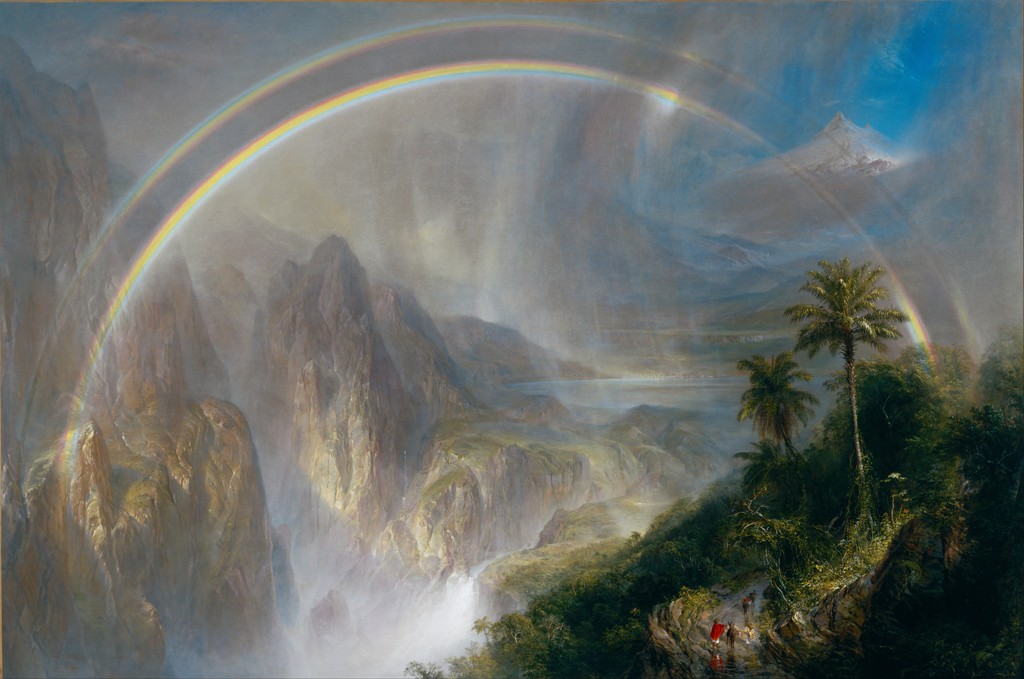
Frederic Edwin Church’s Rainy Season in the Tropics stretches a double rainbow across a landscape of cliffs, palms, waterfalls and distant mountains. Completed in 1866, the large oil painting belongs to the de Young, part of the Fine Arts Museums of San Francisco. Its sharply observed plants and weather sit within an expansive, imaginatively arranged scene.[1] Light reaches the lush right foreground while rain and shadow gather over the broken terrain on the left, bringing contrasting conditions into one view.
At a Glance
- ArtistFrederic Edwin Church (1826–1900)
- TitleRainy Season in the Tropics
- Date1866
- MediumOil on canvas
- Dimensions142.9 × 213.8 cm, as published in the 1989 National Gallery of Art catalogue
- Collectionde Young, Fine Arts Museums of San Francisco
- CreditMuseum purchase, Mildred Anna Williams Collection
- DevelopmentBegun in 1864; completed after Church’s 1865 Jamaica visit
- Related drawingStudy for Rainy Season in the Tropics, 1865–1866, Cooper Hewitt, Smithsonian Design Museum, 1917-4-771
- Central featureA primary rainbow and a fainter secondary bow with reversed colours
This work across Church’s career
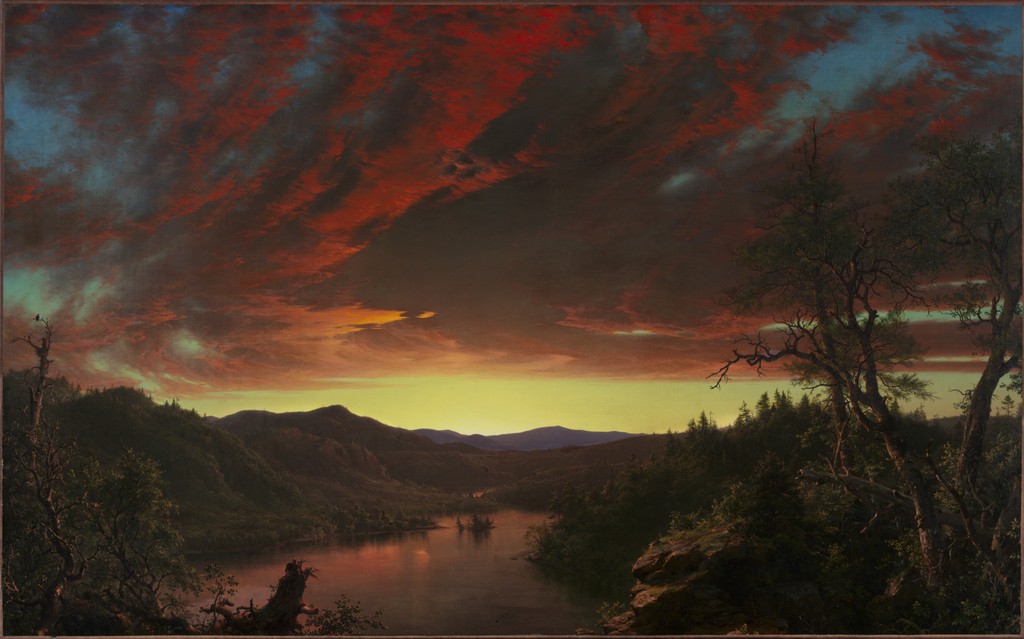
Tamaca Palms
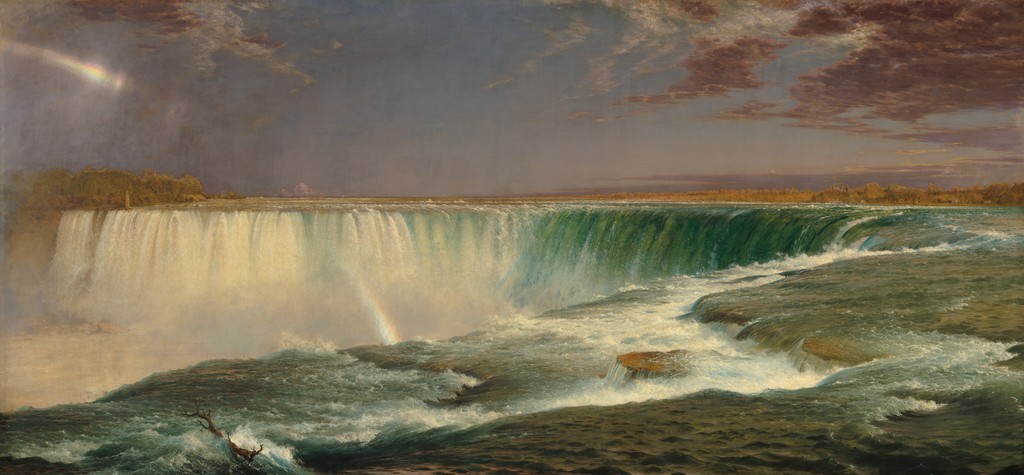
1854Niagara
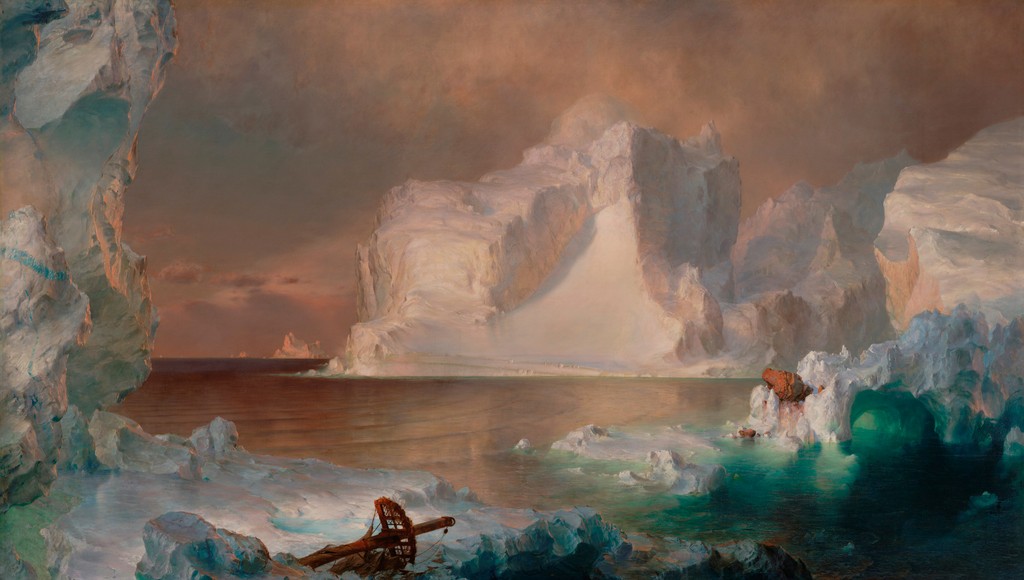
1857The Icebergs
1861; foreground mast added between mid-1862 and early 1863Cotopaxi
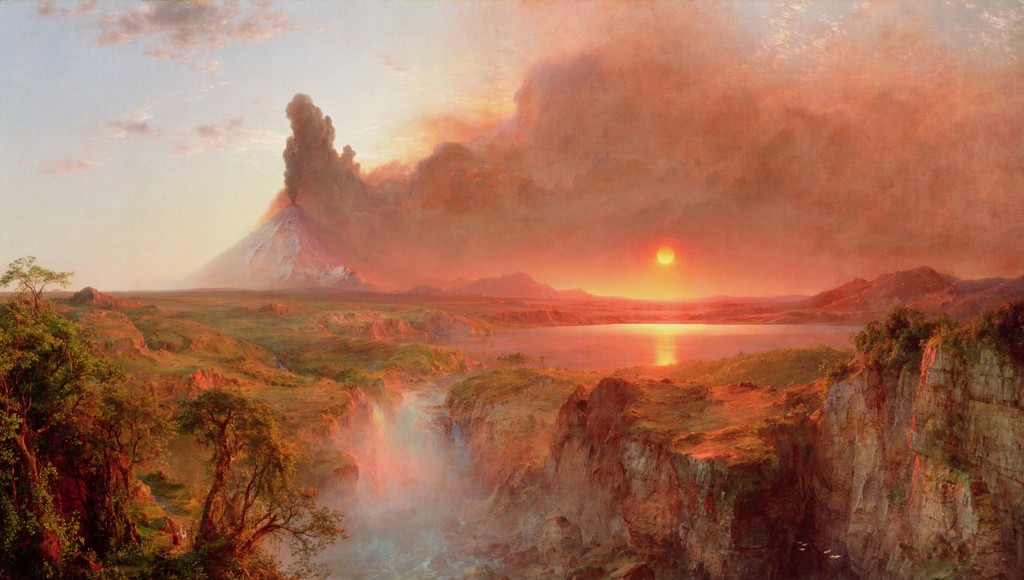
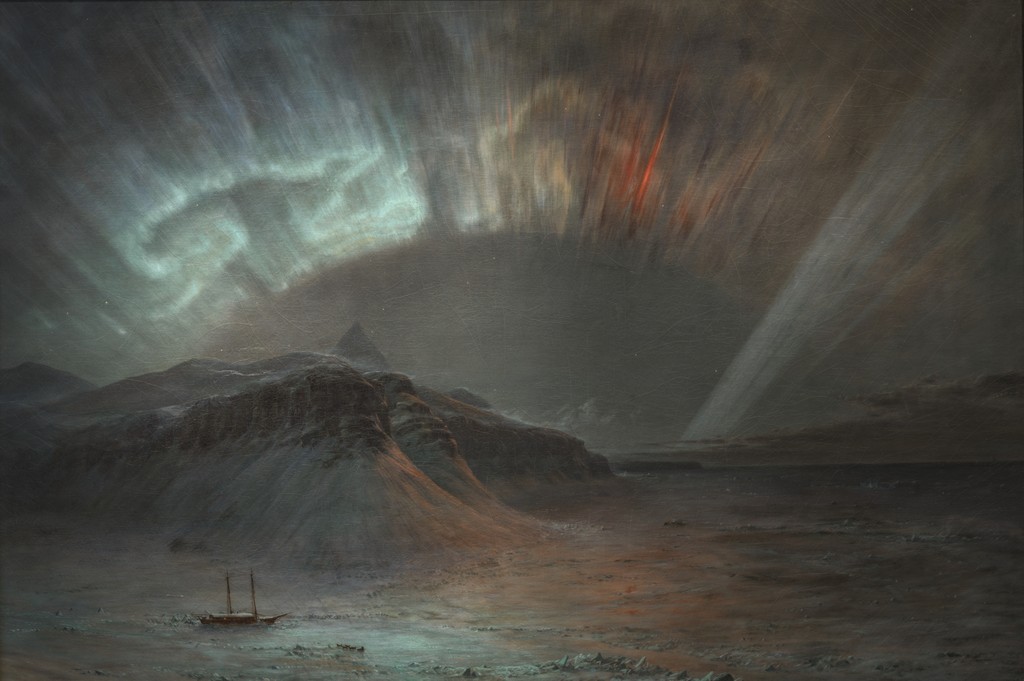
1862Aurora Borealis
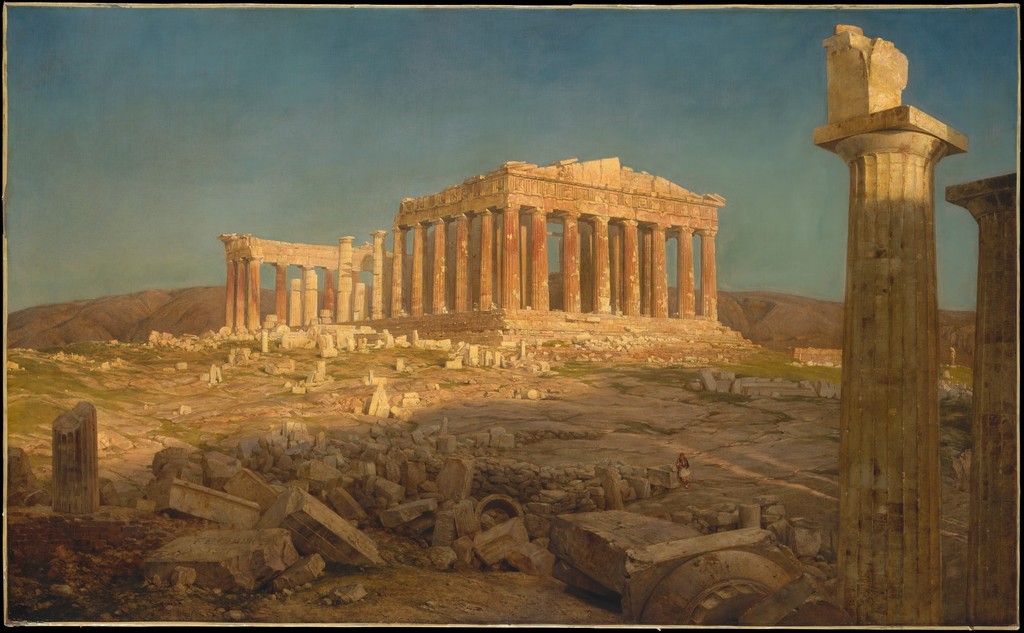
1865The Parthenon
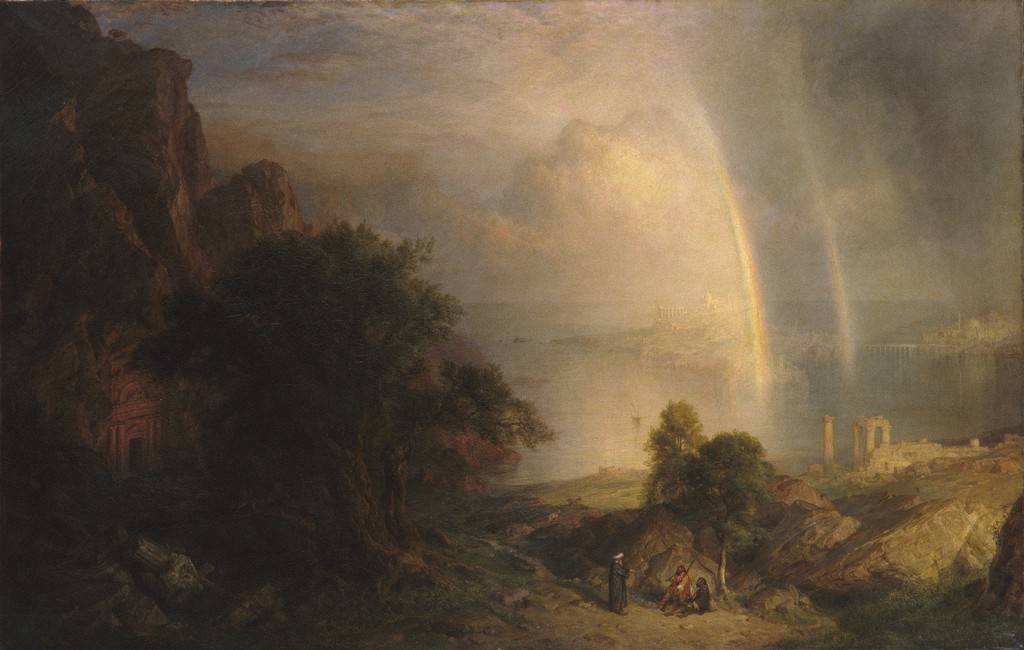
1871The Aegean Sea
About 1877Contents
- A landscape held beneath two arcs
- How a double rainbow forms
- Comparing the painting with a photograph
- A painting developed over several years
- The preparatory drawing
- Studying weather and vegetation in Jamaica
- Looking into the right foreground
- Rain, falling water and distant mountains
- Bereavement and interpretations of hope
- Annotated details
A landscape held beneath two arcs
The rainbow provides the clearest connection across an otherwise divided scene. Its broad inner arc rises from the left-hand rocks, passes over the central opening and descends toward the palms on the right. A second, paler arc follows outside it. Their curves give continuity to the sky above irregular cliffs and uneven stretches of vegetation.
Below them, Church offers several ways of judging distance. Large leaves, tangled growth and the trunks of palms occupy the near right edge. Across the gap, steep rock faces have a substantial presence, although rain softens parts of their outlines. Much farther away, pale mountains rise behind a succession of hazier forms.
The eye can therefore move upward with the bows or deeper into the landscape beneath them. Neither movement excludes the other. The rainbow makes the whole arrangement graspable at once, while the changing visibility of individual features encourages slower examination of the space it spans.
Annotated Details from Rainy Season in the Tropics
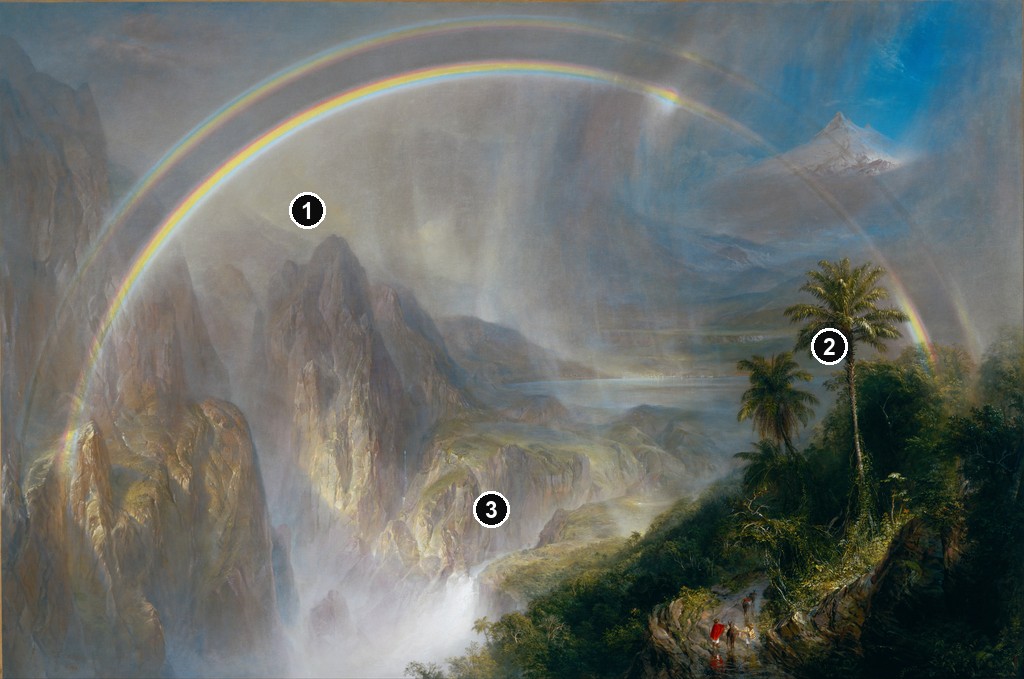
The numbered points draw attention to visible features discussed in this article. Look from each detail back to the full composition. Frederic Edwin Church, Rainy Season in the Tropics, 1866. Oil on canvas, 142.9 × 213.8 cm as published in the 1989 National Gallery catalogue. de Young, Fine Arts Museums of San Francisco, Museum purchase, Mildred Anna Williams Collection. Source image. Public domain / faithful reproduction of a two-dimensional public-domain painting. Numbered overview resized; detail crops added from the source master. No recolouring.
Details from RAINY SEASON IN THE TROPICS
These crops come directly from the verified source images. They preserve the original colours or printed tones; the numbered overview is a separate aid to looking.
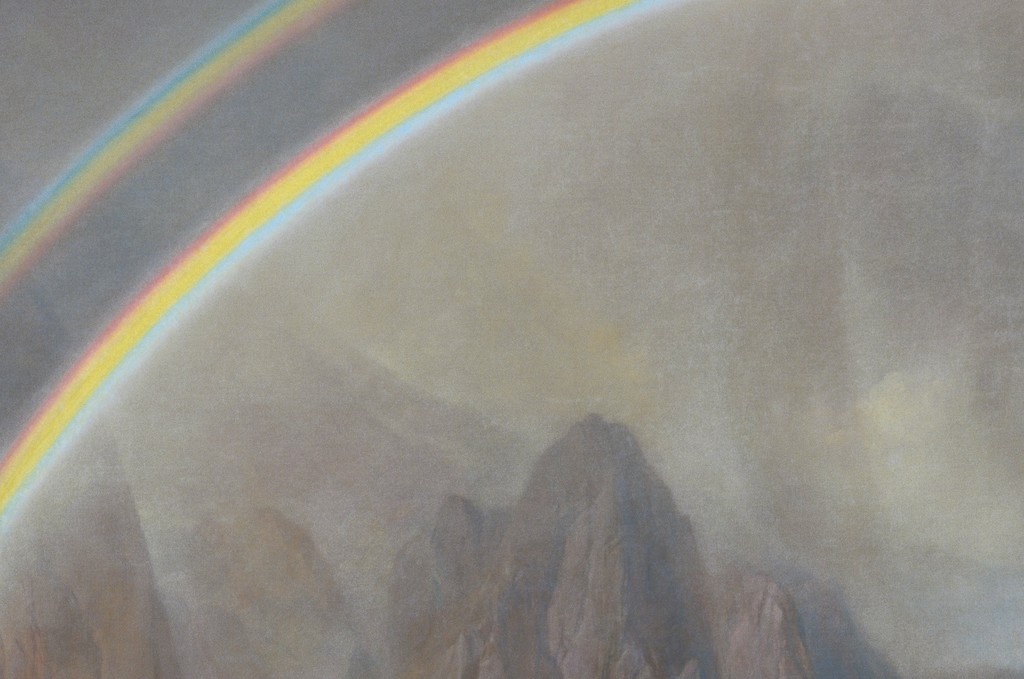
Two rainbow arcs
The brighter primary bow is accompanied by a fainter outer arc. Compare their spacing and colour order within the surrounding rain and cloud.
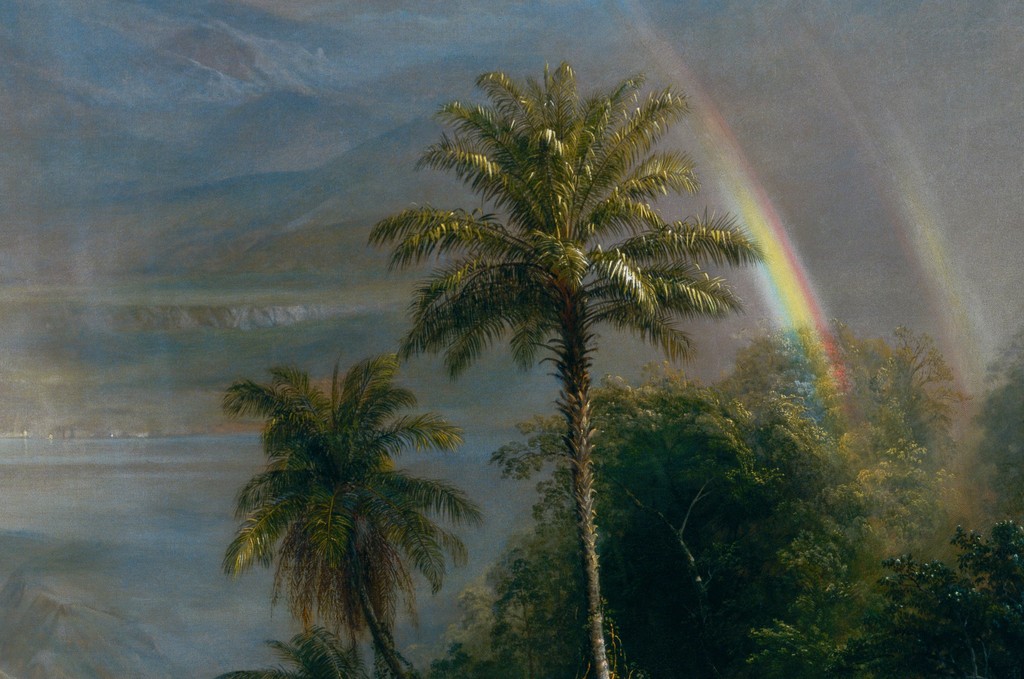
Foreground palms
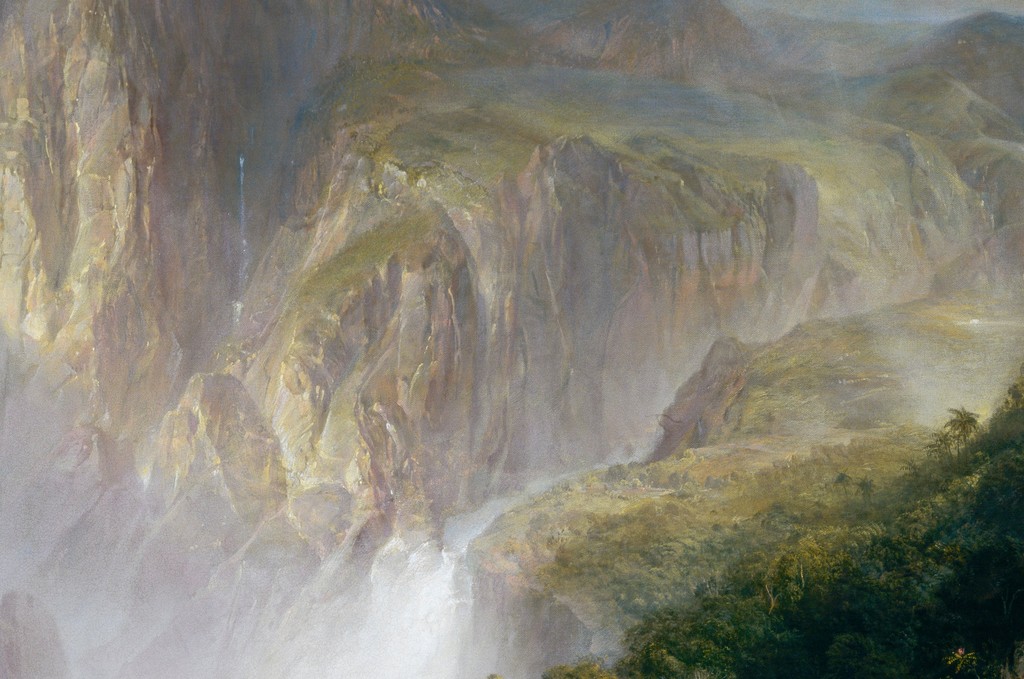
Palm crowns rise from the right foreground. Their darker, more sharply described forms contrast with the mistier mountains.
Falling water and mist
Pale descending water meets a softened atmospheric interval. The passage draws the eye inward beneath the large rainbow arcs.
How a double rainbow forms
A double rainbow has a physical explanation. Sunlight entering raindrops is refracted, separated into colours and reflected internally before returning toward the observer. The National Weather Service explains that the primary bow involves one internal reflection, while the secondary involves two. The second appears outside the first and reverses its colour sequence.[2]
In Church’s painting, the stronger inner bow has its warm red edge toward the outside of its curve. The less conspicuous outer bow reverses that arrangement. This distinction is easily missed when the painting is viewed at a small size, but it makes the paired arcs more than a repeated decorative outline.
The effect also places the implied observer in relation to the weather: sunlight must come from behind the observer toward rain ahead. Church does not need to paint the sun itself to establish that relationship. Illuminated foliage and rain-filled distance make contrasting light conditions visible across the scene.
Comparing the painting with a photograph
Stefan Fussan’s photograph of a double rainbow over the Klias Wetlands in Borneo, taken on 21 January 2009, offers a useful comparison.[3] It shows a bright primary bow above sunlit trees and a much fainter secondary arc farther out in the grey sky. Dark water occupies the foreground.
The photograph helps explain why the outer bow can be hard to notice. Its colours are weaker, and parts of its curve merge with the background. In the painting, Church similarly gives the second arc less prominence, although both curves remain important to the overall design.
The two images also differ in their treatment of space. The photograph concentrates attention on sky, treetops and water from one modern viewpoint. Church adds a much deeper sequence of cliffs, valleys and mountains, spreading the weather effect across an extensive panorama. The photograph was taken in another tropical location more than a century later; it illustrates the phenomenon rather than documenting the landscape he painted.
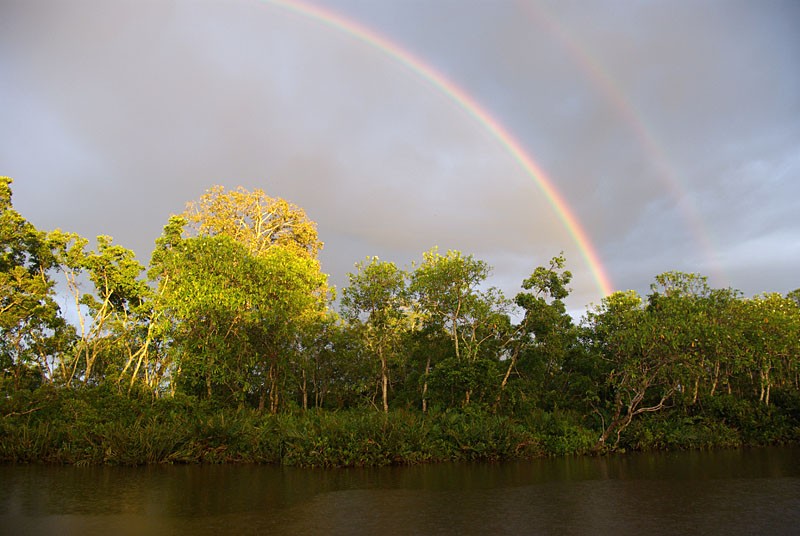
Double rainbow over the Klias Wetlands, Borneo, 21 January 2009. Photograph by Stefan Fussan, CC BY-SA 3.0 Unported. Modern photograph illustrating the optical effect in another tropical location. Stefan Fussan / Wikimedia Commons, CC BY-SA 3.0 Unported. Image source. CC BY-SA 3.0 Unported. Resized; full source proportions retained.
A painting developed over several years
The chronology matters when connecting the canvas with Church’s personal history. Franklin Kelly’s National Gallery of Art essay places its beginning in 1864 and its completion in the middle of 1866.[4] The initial conception therefore preceded Church’s visit to Jamaica and the bereavement that prompted that journey.
Olana curator Evelyn D. Trebilcock describes the unfinished painting as already present in Church’s Tenth Street studio when he travelled to Jamaica in 1865. She relates its earlier material to his South American experience, while explaining how Jamaican observations supplied fresh botanical and atmospheric detail.[5]
These stages distinguish an evolving composition from a scene painted directly outdoors. A large canvas could draw upon observations made at different times, with new studies affecting a design already under way. Its title describes a broad climatic subject, and the combination of palms, precipitous rocks and distant snowy heights should not be treated as the record of one Jamaican lookout.
The preparatory drawing
Cooper Hewitt, Smithsonian Design Museum holds Church’s Study for Rainy Season in the Tropics, dated 1865–1866. The institutional open-access record identifies graphite on white notepad paper ruled in blue ink, measuring 13.4 × 20.6 cm. It was given by Louis P. Church and bears accession 1917-4-771.[6]
The drawing already places the double bow over a central opening, with prominent rocks to the left and palms to the right. The lightly ruled sheet lets the broad organisation stand out without the finished canvas’s rich colour. Graphite shading establishes the nearest slopes and the drop between them, while faint lines carry the view toward distant peaks.
The right-hand palm group appears more upright and exposed against the sky than the densely layered vegetation of the painting. On the left, a substantial building occupies a cliff edge beneath the descending bow. That conspicuous architectural feature does not appear in the same form in the finished canvas.
The comparison shows Church revising the balance of natural and built forms while retaining the overarching curves. It also makes the amount of invention visible. A drawing can establish relationships that remain useful through later changes, rather than simply providing an outline to be transferred unchanged onto a larger surface.
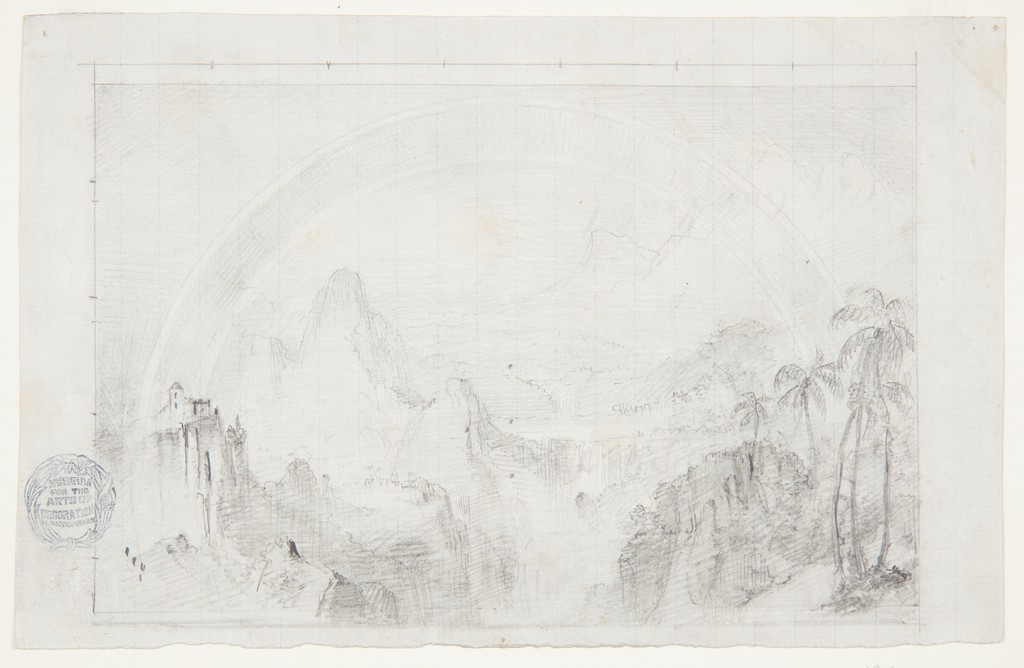
Frederic Edwin Church, Study for Rainy Season in the Tropics, 1865–1866. Graphite on white notepad paper ruled in blue ink, 13.4 × 20.6 cm. Cooper Hewitt, Smithsonian Design Museum, Gift of Louis P. Church, 1917-4-771. CC0. Image source. CC0 1.0 Universal. Resized; full source proportions retained.
Studying weather and vegetation in Jamaica
Church and his wife Isabel spent several months in Jamaica in 1865. Trebilcock describes sustained sketching, with Church recording vegetation and changes in weather. Among the works she discusses is Storm in the Blue Mountains, Jamaica, painted in August, which contributed to his developing tropical subject.[5]
Her account also draws on Horace Robbins’s letters describing Church’s speed and concentration when making studies. Those observations help explain how numerous smaller records could supply a large studio picture. A study might preserve the shape of a plant, the meeting of rain and sunlight, or the appearance of distant slopes without recording every element of the eventual panorama.
The relationship can be examined in the finished painting’s right foreground. Broad leaves overlap narrow fronds, and stems cross areas of deeper shade. Some surfaces catch small touches of light while others disappear into the surrounding growth. That variety gives the vegetation substance beyond a general patch of green.
Watch: Frederic Edwin Church
Choose a film to explore the artist’s work, its interpretation and its wider setting.
Frederic Edwin Church's "The Icebergs" on the Move at the DMA
Follow the Dallas Museum of Art as it moves Church’s large painting The Icebergs.
Watch on YouTubeLooking into the right foreground
The nearest plants form a complicated edge to the view. Their shapes differ markedly from the smooth rainbow above: spreading leaves, hanging growth and irregular branches interrupt the ground and the lower sky. The upper palm crowns remain recognisable against lighter areas, while smaller plants accumulate around their bases.
A narrow path threads through this growth. Small travellers and animals occupy it, including a red-clad figure near the lower right. They are easy to overlook because the surrounding leaves and trunks command so much more space. Once noticed, they provide a scale for the vegetation and a possible route into the landscape.
The ground along the route catches light in patches. Its broken surface contrasts with the distant water, which appears calmer and more continuous. Church thus makes the near area available for close inspection while keeping the farther scene less definite. The foreground offers a place to imagine standing, even as the panorama carries the eye beyond the travellers’ immediate surroundings.
Rain, falling water and distant mountains
Water appears in several different forms. A slender fall descends among the left-hand rocks, while a more diffuse veil of rain or mist crosses the central distance. Farther back, a stretch of pale water provides a quieter interval between successive landforms.
These passages differ in their edges. Falling water is described as a narrow pale movement against darker terrain. Mist spreads more broadly and partly hides the forms behind it. The distant water is flatter, its appearance shaped by the surrounding haze rather than by conspicuous turbulence.
High on the right, a pale snowy peak remains visible beyond the warmer, greener foreground. Its remoteness depends on both scale and contrast: it is smaller and less sharply defined than the nearer rocks, yet its light surface separates it from the sky. The painting moves between climates and elevations within one continuous prospect, without identifying every feature as an exact geographical landmark.
Bereavement and interpretations of hope
Herbert Edwin and Emma Frances, Church and Isabel’s two young children, died in March 1865. James Anthony Ryan’s account places the Jamaica journey after that loss and reads Rainy Season in relation to grief and the possibility of renewal.[4] The museum’s interpretation also associates the double rainbow with renewed optimism after bereavement.[1]
The painting’s changing conditions support such a reading: heavy weather and broken ground coexist with light and vigorous growth. Nevertheless, the documented family history does not establish a separate meaning for every rock, plant or valley. The picture had already begun before the deaths, and its visible forms continued to develop through subsequent study.
Kelly offers a related national interpretation, connecting the rainbow with the biblical covenant and hopes for peace after the American Civil War.[4] Personal and national readings can overlap without exhausting the painting’s subject. Its weather remains convincing as weather, and its plants retain their particular forms even when considered within a larger account of recovery.
Jamaica’s historical setting
Olana’s institutional exhibition account places Church’s Jamaican visit within an island under British colonial rule. It also notes the Morant Bay rebellion and its violent suppression later in 1865, after the Churches had departed.[7]
That context qualifies an encounter with the tropics organised around scenery and botanical observation. The island was an inhabited society with political conflicts and the continuing consequences of slavery. Church’s broad landscape selects weather, terrain and small figures from the possibilities available to a painter; it does not provide a complete account of contemporary Jamaican life.
Olana connects some of this history specifically with Church’s later Vale of St Thomas. Those arguments should be considered with that painting rather than assigned automatically to the foreground of Rainy Season. Here, the historical setting helps situate the studies without identifying the invented panorama as the location of the rebellion.
Scale and the museum collection
The 1989 National Gallery catalogue publishes dimensions of 142.9 × 213.8 cm for the canvas.[4] At more than two metres wide, the painting allows both the broad weather effect and very small foreground incidents to matter. A reduced reproduction makes the curves immediately apparent, while the plants, path and falling water reward a closer view.
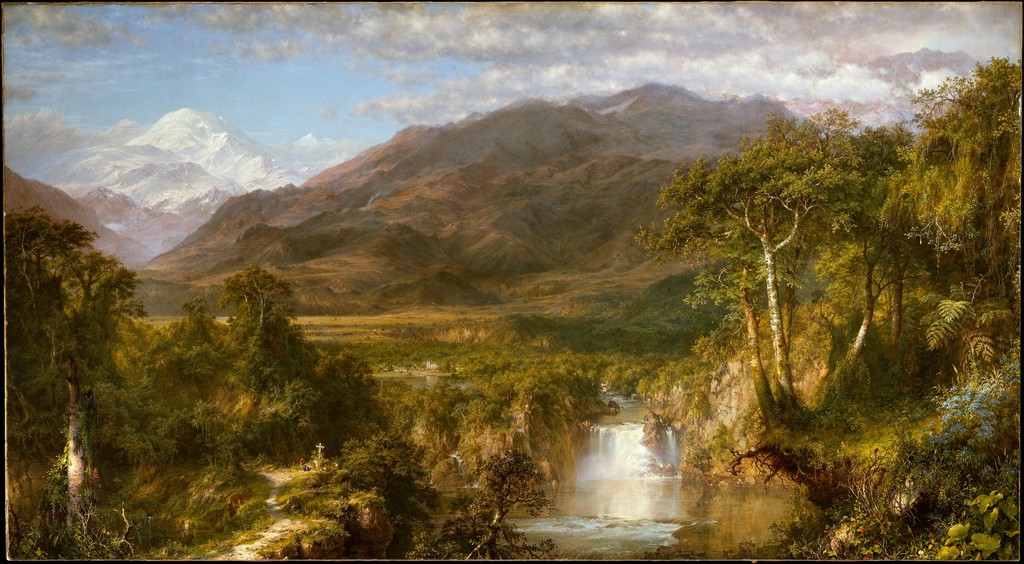
The owning museum credits its acquisition as a museum purchase through the Mildred Anna Williams Collection.[1] The combination of spectacle and close description also links it with The Heart of the Andes. In both pictures, Church brings detailed observations into an extensive composed landscape, allowing the eye to travel between near particulars and distant mountains.
Artworks directory
A documented selection of Church’s works discussed across these articles, together with identified prints after his designs. This is not a catalogue raisonné. Repeated titles and aliases are reconciled; studies remain distinct from finished paintings. Some dates remain unconfirmed. Other makers are named where a print adapts Church’s work.
| Name | Date | Medium |
|---|---|---|
| Above the Clouds at Sunrise | 1849 | Oil on canvas |
| The Aegean Sea | About 1877 | Oil on canvas |
| The Andes of Ecuador | 1855 | Oil on canvas |
| Aurora Borealis | 1865 | Oil on canvas |
| Autumn in North America | Circa 1856 | Oil on board |
| Coast Scene | 1852 | Oil on canvas |
| Cotopaxi | 1862 | Oil on canvas |
| A Country Home | 1854 | Oil on canvas |
| El Khasné, Petra | 1874 | Oil on canvas |
| El Rio de Luz | 1877 | Oil on canvas |
| The Heart of the Andes | 1859 | Oil on canvas |
| The Icebergs | 1861; foreground mast added between mid-1862 and early 1863 | Oil on canvas |
| Jerusalem from the Mount of Olives | 1870 | Oil on canvas |
| Mount Ktaadn | 1853 | Oil on canvas |
| Our Banner in the Sky | 1861 | Oil paint over lithograph on paper, laid down on cardboard |
| The Parthenon | 1871 | Oil on canvas |
| Rainy Season in the Tropics | 1866 | Oil on canvas |
| Storm in the Mountains | 1847 | Oil on canvas |
| Syria by the Sea | 1873 | Oil on canvas |
| Tamaca Palms | 1854 | Oil on canvas |
| Tropical Scenery | 1873 | Oil on canvas |
| Twilight in the Tropics | 1874; signed and dated, according to Bonhams’ catalogue | Oil on canvas |
| Twilight in the Wilderness | 1860 | Oil on canvas |
| View of Cotopaxi | 1857 | Oil on canvas |
| Niagara | 1857 | Oil on canvas |
| Magdalena River, New Granada, Equador | 1853 | Graphite heightened with white on wove paper |
| Tamaca Palm, Colombia or Ecuador | May–October 1853 | Graphite on gray laid paper |
| Mixed Sketches with a Champan, Río Magdalena, Colombia | May 1853 | Graphite on gray laid paper |
| Study for Rainy Season in the Tropics | 1865–1866 | Graphite on ruled notepad paper |
| Al-Khazneh, Petra (study) | February–March 1868 | Oil and graphite on tan paperboard |
| The Great Fall, Niagara (Charles Risdon, after Church) | 1874 impression | Hand-coloured chromolithograph on paperboard |
| The Heart of the Andes (William Forrest, after Church) | 1862 | Engraving in black on wove paper |
| Our Heaven Born Banner (William Bauly, adapting Church’s motif) | circa 1861 | Colour lithograph |
| A Tropical Moonlight (wood engraving after Church) | 1879 publication | Wood engraving in American Painters |
| Off Iceberg, Newfoundland | June 1859 | Oil and graphite on paperboard |
| Parthenon at Night, Athens | April 1869 | Oil and graphite on tan paperboard |
| Jerusalem from the Mount of Olives (study) | 1 April 1868 | Oil and graphite study |
| Horseshoe Falls (study) | December 1856–January 1857 | Oil on paper mounted to canvas |
| Niagara Falls, from the American Side | 1867 | Oil on canvas |
| Study for The Heart of the Andes | 1858 | Oil study |
| Mount Chimborazo through Rising Mist and Clouds | 1857 | Oil study |
| Cotopaxi Erupting, Viewed from Quito, Ecuador | June 1857 | Oil and graphite on tan paperboard |
| Cotopaxi (painted for Cyrus Field) | 1855 | Painting |
| Chimborazo | 1864 | Painting |
| Twilight, A Sketch | 1858 | Oil on canvas |
| View of Baalbek | 1868 | Oil and pencil on board |
| Three Bedouins | Date unconfirmed | Oil study |
| Coast Scene, Mount Desert (later canvas) | 1863 | Painting |
| The Wreck | Date unconfirmed | Painting |
| Grand Manan Island, Bay of Fundy | Date unconfirmed | Painting |
| Summer in South America | circa 1853 | Painting |
| Evening in Vermont | Date unconfirmed | Painting |
| Home by the Lake | Date unconfirmed | Painting |
| Storm in the Blue Mountains, Jamaica | August 1865 | Painting |
| The Natural Bridge, Virginia | 1852 | Painting |
| The Vale of St. Thomas, Jamaica | 1867 | Painting |
| Tequendama Falls, near Bogota, New Granada | Date unconfirmed | Painting |
| Sunrise in Syria | Before the 1876 exhibition | Painting |
| Cuernavaca (oil study; descriptive title) | 1898 | Oil study |
| Olana window design (descriptive title) | Date unconfirmed | Watercolour and graphite |
| Olana dining-room stencil sketch (descriptive title) | Date unconfirmed | Oil and graphite |
| Olana house (with Calvert Vaux) | 1870–1872; later additions | Architecture |
| Olana designed landscape | From 1860; developed over decades | Designed landscape |
Frequently Asked Questions
It was completed in 1866. The 1989 National Gallery catalogue places its beginning in 1864, before Church’s 1865 Jamaica visit.
It belongs to the de Young, Fine Arts Museums of San Francisco, through a museum purchase for the Mildred Anna Williams Collection.
The canvas combines earlier South American material with observations made in Jamaica. It is a composed tropical panorama rather than the record of one identified Jamaican viewpoint.
A secondary rainbow results from an additional internal reflection within raindrops. It appears outside the primary bow, with reversed colours and a fainter appearance.
The work began before their deaths. Scholars and the museum nevertheless interpret its subsequent development and imagery in relation to bereavement and renewed hope.
The 1989 National Gallery catalogue gives 142.9 × 213.8 cm. Those are the published measurements used here; slightly different figures appear in later online metadata.
Discussion
Look again at the images and ideas explored in Rainy Season in the Tropics. These editorial prompts invite your own observations.
Follow the two rainbow arcs, then trace the path through the plants. What changes when you move from the whole panorama to its smallest figures? Compare the drawing’s cliff-edge building and palm group with the finished painting, and consider how the changes alter the balance of the scene.
Reader Insights
How do the two rainbow arcs relate to the landscape beneath them?
What differences become visible when you compare the painting with the rainbow photograph?
Which areas of light and shadow make the weather feel most changeable?
Join the Conversation
Share a detail, comparison or question about Rainy Season in the Tropics below.
References
- Fine Arts Museums of San Francisco / de Young, Rainy Season in the Tropics, Google Arts & Culture. Museum-authored interpretation, date, medium and acquisition credit.
- National Weather Service, Rainbow. Rainbow formation and primary/secondary colour sequence.
- Stefan Fussan, Klias Wetlands Double Rainbow 01, 21 January 2009, Wikimedia Commons. Modern photographic comparison; CC BY-SA 3.0 Unported selected from the offered licences.
- Frederic Edwin Church, National Gallery of Art, 1989. Franklin Kelly, p. 62 and relevant notes 145–147 on pp. 74–75; catalogue 38, p. 114; James Anthony Ryan, pp. 131–132 and notes 26–31, p. 152; Debora Rindge, chronology, p. 166. Development dates, published canvas measurement and attributed interpretations; letters cited within the essays were not directly consulted.
- Evelyn D. Trebilcock, Frederic Edwin Church in Jamaica, originally Summer 2010, Antiques & Fine Art, archived by Incollect. Curator's account of the unfinished canvas, field studies, weather, vegetation and Robbins's observations, with notes 1–12. Original letters and associated exhibition catalogue not directly consulted.
- Cooper Hewitt, Smithsonian Design Museum, Study for Rainy Season in the Tropics, 1917-4-771, institutional collection record; exact record in Smithsonian's open-access dataset. Dataset record used for the 1865–1866 date, medium, 13.4 × 20.6 cm dimensions, credit and exact CC0 image. Catalogue marked Research in Progress.
- Olana, Frederic Church: Artista global, 2026 institutional labels. Jamaica introduction, paraphrased from Spanish: colonial setting and events after the visit. Interpretation particular to Vale of St Thomas is distinguished from this canvas.
- Splash image source.
Frederic Edwin Church, Rainy Season in the Tropics, 1866. Oil on canvas, 142.9 × 213.8 cm as published in the 1989 National Gallery catalogue. de Young, Fine Arts Museums of San Francisco, Museum purchase, Mildred Anna Williams Collection. Image source. Public domain / faithful reproduction of a two-dimensional public-domain painting. Resized; full source proportions retained.