 by Tom Gurney
Tom Gurney BSc (Hons) is an art history expert with over 20 years experience
Published on June 19, 2020 / Updated on October 27, 2026
Email: tomgurney1@gmail.com / Phone: +44 7429 011000
Quotes: Introduction
Frederic Edwin Church’s letters reveal an artist whose pleasure in landscapes extended into travel, friendship and the making of a home. His most memorable remarks often began as news for someone he knew: a description of Petra, an invitation to use his studio or an account of work on his estate.
The six excerpts below retain their dates and correspondents. Read together, they show several aspects of Church’s character, from delight in a striking view to generosity toward other artists. They also bring his grand painted landscapes into contact with the ordinary circumstances of his life.
At a Glance
- SpeakerFrederic Edwin Church
- FormExcerpts from private letters
- Dates represented1868–1899
- CorrespondentsErastus Dow Palmer and Emily Cole
- Principal subjectsPetra, home, artistic encouragement, Olana and friendship
- ArchiveAlbany Institute of History & Art
Contents
- Church speaking to friends
- Petra and the brilliance of carved stone
- Returning to the centre of his world
- Offering help to a young artist
- Making landscapes through roads and views
- Choosing a subject for personal pleasure
- Keeping old friends in mind
- Reading the letters beside the paintings
Church speaking to friends
A letter addresses a particular person at a particular moment. Church could move from a remarkable scene to family news, building work or a joke without treating those subjects as separate worlds. This makes his correspondence especially revealing alongside his biography: the painter appears as a traveller, neighbour, father and friend as well as the maker of ambitious pictures.
His words also change emphasis when their surroundings are restored. A boast about owning the centre of the world becomes warmer when it follows a safe family homecoming. A comparison between building roads and painting becomes more precise when it appears beside news of work in his studio. The circumstances explain the tone, while the short quotation preserves his voice.
Petra and the brilliance of carved stone
“You can imagine this fairy like temple blazing like sunlight among those savage black rocks—”
Source
Frederic Edwin Church to Erastus Dow Palmer, Jaffa, 10 March 1868.[1]
Church was describing the monument he called the Khasné, now commonly known as the Treasury, after his visit to Petra. His long letter takes Palmer through the journey and the practical problem of finding time and freedom to sketch. The vivid sentence belongs to a much fuller description of the carved façade, its ornaments and the surrounding rock.
The contrast between brightness and darkness is particularly important. Church describes a luminous reddish stone face emerging from a darker setting. His comparison to sunlight conveys how intensely the architecture struck him; it does not require the stone itself to emit light.
In his later painting El Khasné, Petra, the pale façade appears through a narrow opening between dark rocks. Comparing the letter with the picture makes that contrast easier to notice. The phrase also carries Church’s historical vocabulary and enthusiasm: his description gives access to his response, rather than serving as a modern archaeological account of the monument.
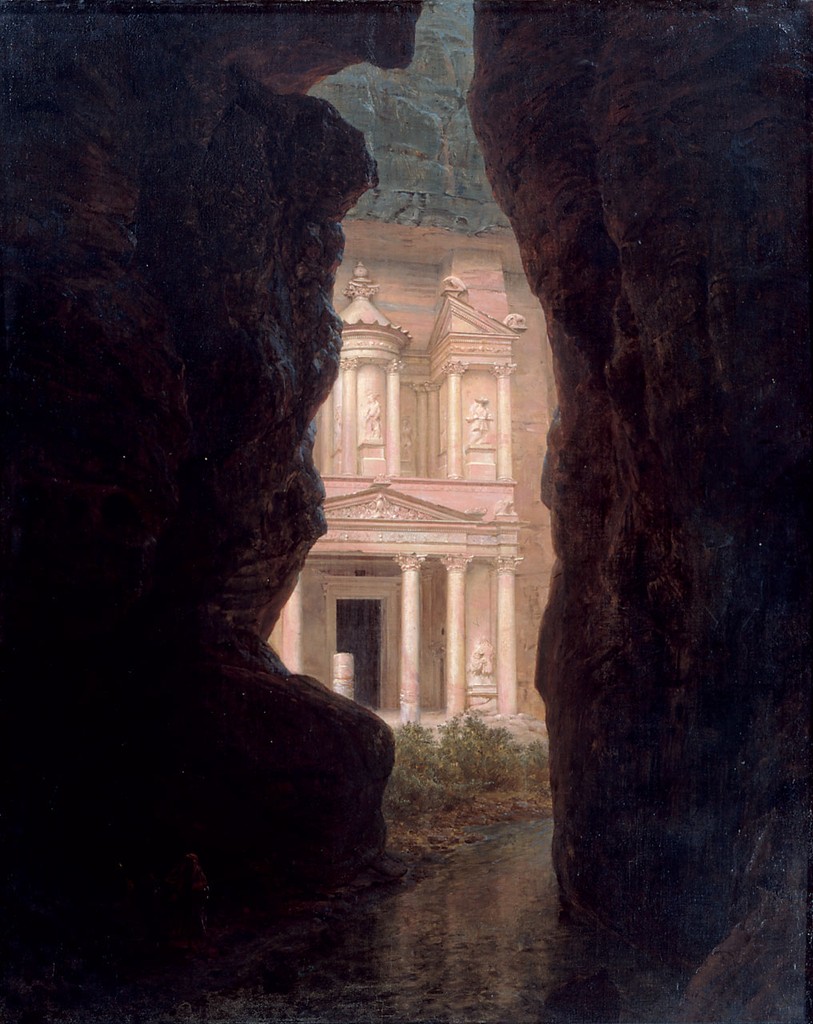
Frederic Edwin Church, El Khasné, Petra, 1874. Oil on canvas, 153.7 × 127.6 cm. Olana State Historic Site, New York State Office of Parks, Recreation and Historic Preservation, OL.1981.10; via Wikimedia Commons. Faithful reproduction of a public-domain painting. Later canvas, distinct from the March 1868 letter. Image source. Public domain / faithful reproduction of a two-dimensional public-domain painting. Resized; full source proportions retained.
Returning to the centre of his world
“About an hour this side of Albany is the Center of the World—I own it—”
Source
Frederic Edwin Church to Erastus Dow Palmer, Hudson, 7 July 1869.[2]
Church wrote this exuberant claim after returning from travel abroad. He had visited his parents in Connecticut and was preparing his Hudson property for his family. Soon after the quoted words, he describes sitting alone in the little dining room beside a wood fire and feeling thankful that they had travelled and returned safely.
The ownership remark therefore sits within an expression of relief and attachment. His world had widened through travel, but home remained a place of reunion and pleasure. Palmer was a friend whom he wanted to see, and the letter’s warmth depends partly on that familiarity.
It also looks forward. Church admired Palmer’s sculpture Sleep and wished for a new house where he could place it suitably. The reference keeps the scene distinct from the completed main house at Olana. The celebrated phrase belongs to a homecoming during the development of the property, rather than a description of its final architectural form.
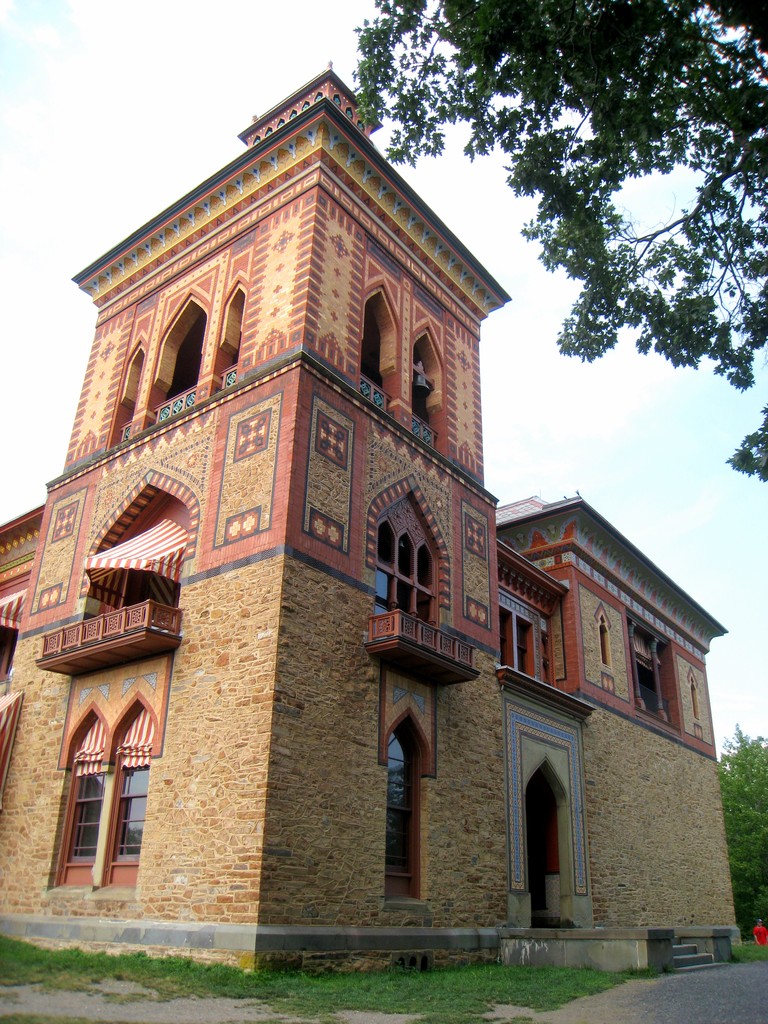
Daderot, exterior of Olana State Historic Site, Columbia County, New York, 20 August 2009. Wikimedia Commons; photographer’s public-domain dedication. Modern exterior view of the later house; distinct from the dining-room scene described in Church’s July 1869 letter. Image source. Public-domain dedication by photographer. Resized; full source proportions retained.
Offering help to a young artist
“it would give me real pleasure to be of use to him”
Source
Frederic Edwin Church to Erastus Dow Palmer, Hudson, 7 June 1872.[3]
The person Church wanted to help was Palmer’s son Walter Launt Palmer, whom he called Wallie. The letter begins with household matters, including doors for the new house, before turning to the beauty of the countryside and its changing cloud effects. Church wished the younger artist could be there to see them.
His offer was practical. He placed his studio, advice and materials at Wallie’s disposal, connecting artistic encouragement with access to a place to work. The short excerpt captures the pleasure he took in being useful, while the surrounding sentences explain what that usefulness could mean.
This is a revealing companion to Church’s landscape studies and drawings. Watching the sky and working from nearby scenery were activities that could be shared. The letter does not set out a formal teaching programme; it records a generous invitation from an experienced painter to a younger one within an established friendship between their families.
Making landscapes through roads and views
“I can make more and better landscapes in this way than by tampering with canvas and paint in the Studio.”
Source
Frederic Edwin Church to Erastus Dow Palmer, Olana, 18 October 1884.[4]
Church had just reported making about one and three-quarter miles of road that season, opening new views. Elsewhere in the same letter, he lists several tasks under his supervision: road construction, flooring, carpentry and work on a sewer outlet. He also says he is painting a picture in his studio.
That last detail matters. His playful comparison gives landscape making a place beside painting, while the letter shows both activities continuing. It describes the satisfaction of working on the estate, rather than announcing that he had stopped making pictures.
The remark suggests a useful way to think about Olana. A road changes where a person can move and what becomes visible along the way. Instead of fixing a scene within a painted rectangle, Church could arrange an experience unfolding through a real place. The views he mentions were part of deliberate work on the property, involving other people as well as his supervision.
Watch: Frederic Edwin Church
Choose a film to explore the artist’s work, its interpretation and its wider setting.
Frederic Edwin Church's "The Icebergs" on the Move at the DMA
Follow the Dallas Museum of Art as it moves Church’s large painting The Icebergs.
Watch on YouTubeChoosing a subject for personal pleasure
“enjoy modeling something for your own pleasure”
Source
Frederic Edwin Church to Erastus Dow Palmer, Olana, 24 July 1892.[5]
This advice was addressed to Palmer as a sculptor. Church was responding sympathetically to his friend’s feelings about family members being away. He agreed with Palmer’s decision to decline orders that could bring persistent work and worry, then suggested modelling something whose subject Palmer could choose freely.
The sentence concerns the conditions of making art as much as its subject. Church recognised a difference between working to another person’s requirements and taking time over something chosen for oneself. His encouragement offered Palmer a way to remain creatively occupied without accepting the demands of a commission.
It is best understood as advice between friends in those circumstances. Church was not laying down a general rule against patrons or commissioned work. The excerpt instead reveals his attention to another artist’s enjoyment and freedom. The pleasure of making something, even without an immediate order to fulfil, was worth preserving.
Keeping old friends in mind
“I feel anxious about all my friends—”
Source
Frederic Edwin Church to Emily Cole, Cuernavaca, 16 February 1899.[6]
Writing from Mexico, Church was concerned by reports of bad weather and influenza in the United States. Emily was Thomas Cole’s daughter, and his letter asks after members of her family. The brief phrase opens a communication shaped by affection and the difficulties of knowing how distant friends were faring.
Church also sent news of Isabel and their son Louis in Florida and spoke of his own circumstances in Cuernavaca. Those details place his concern within a network of people living apart yet maintaining contact. Travel did not remove the obligations and attachments of friendship.
This late letter gives a different impression from the dramatic language of the Petra account. Its subject is the wellbeing of familiar people. Set beside the earlier excerpts, it broadens the portrait of Church: the observer who delighted in unusual sights also remembered old friendships and wanted reassurance about the people connected with them.
Reading the letters beside the paintings
Dates and addressees help distinguish these different voices. Church describes Petra to an artist friend, celebrates returning home, offers assistance and later encourages Palmer to work for his own pleasure. None of those remarks needs to stand for everything he believed about art.
The letters are most rewarding when read beside the objects and places they evoke. The Petra painting makes the contrast of rock and façade visible. The Olana photograph shows the later house associated with his life at home, while the correspondence draws attention to its earlier development and the work beyond its walls. Together, words and images connect the pleasure of looking with the practical and personal circumstances in which Church lived.
Artworks directory
A documented selection of Church’s works discussed across these articles, together with identified prints after his designs. This is not a catalogue raisonné. Repeated titles and aliases are reconciled; studies remain distinct from finished paintings. Some dates remain unconfirmed. Other makers are named where a print adapts Church’s work.
| Name | Date | Medium |
|---|---|---|
| Above the Clouds at Sunrise | 1849 | Oil on canvas |
| The Aegean Sea | About 1877 | Oil on canvas |
| The Andes of Ecuador | 1855 | Oil on canvas |
| Aurora Borealis | 1865 | Oil on canvas |
| Autumn in North America | Circa 1856 | Oil on board |
| Coast Scene | 1852 | Oil on canvas |
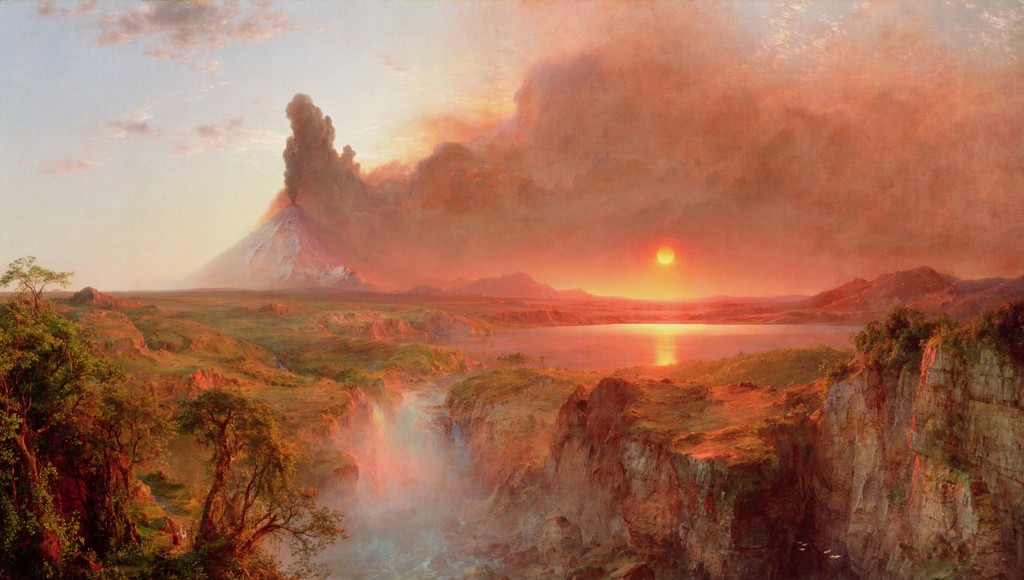
| Cotopaxi | 1862 | Oil on canvas |
| A Country Home | 1854 | Oil on canvas |
| El Khasné, Petra | 1874 | Oil on canvas |
| El Rio de Luz | 1877 | Oil on canvas |
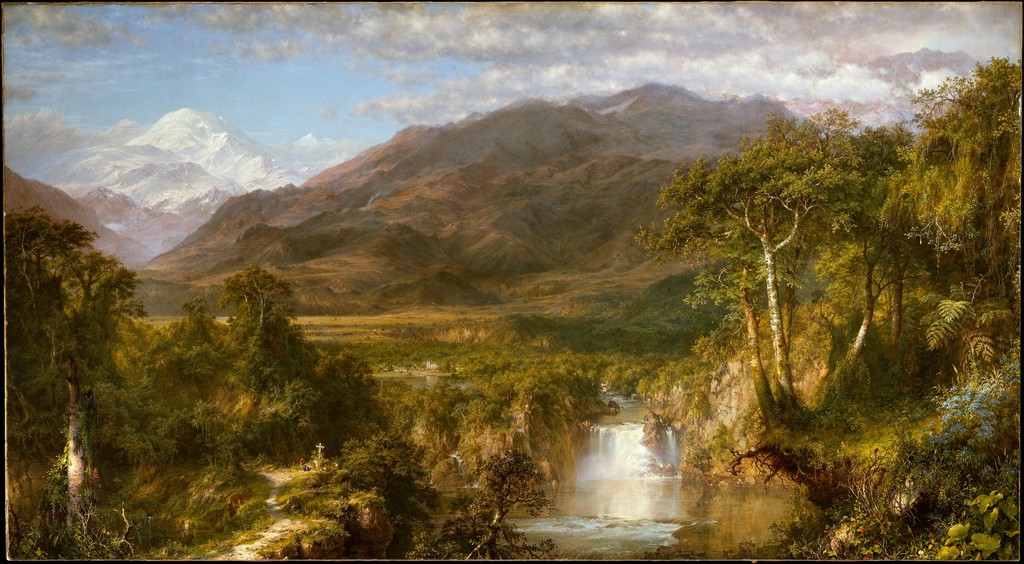
| The Heart of the Andes | 1859 | Oil on canvas |
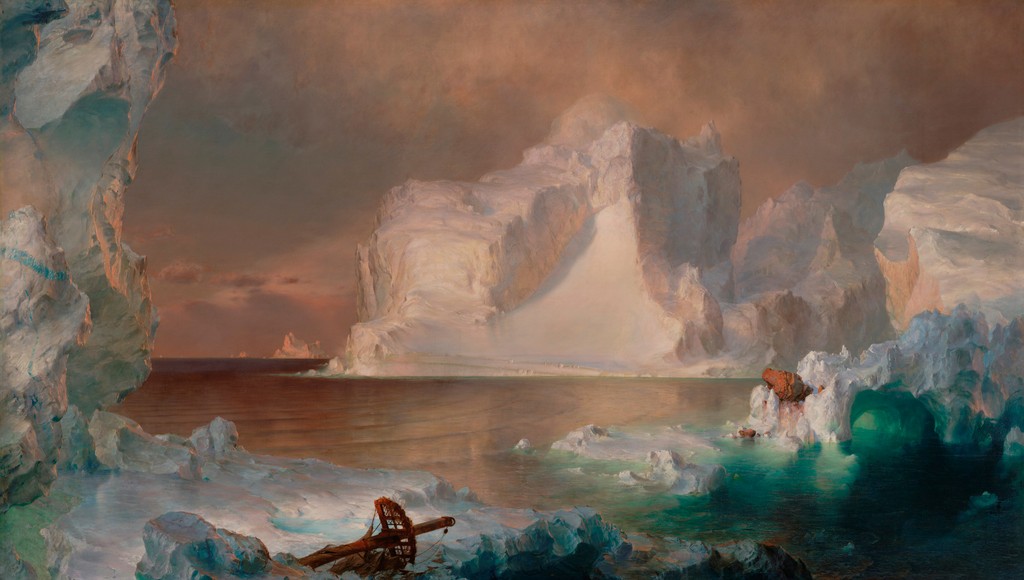
| The Icebergs | 1861; foreground mast added between mid-1862 and early 1863 | Oil on canvas |
| Jerusalem from the Mount of Olives | 1870 | Oil on canvas |
| Mount Ktaadn | 1853 | Oil on canvas |
| Our Banner in the Sky | 1861 | Oil paint over lithograph on paper, laid down on cardboard |
| The Parthenon | 1871 | Oil on canvas |
| Rainy Season in the Tropics | 1866 | Oil on canvas |
| Storm in the Mountains | 1847 | Oil on canvas |
| Syria by the Sea | 1873 | Oil on canvas |
| Tamaca Palms | 1854 | Oil on canvas |
| Tropical Scenery | 1873 | Oil on canvas |
| Twilight in the Tropics | 1874; signed and dated, according to Bonhams’ catalogue | Oil on canvas |
| Twilight in the Wilderness | 1860 | Oil on canvas |
| View of Cotopaxi | 1857 | Oil on canvas |
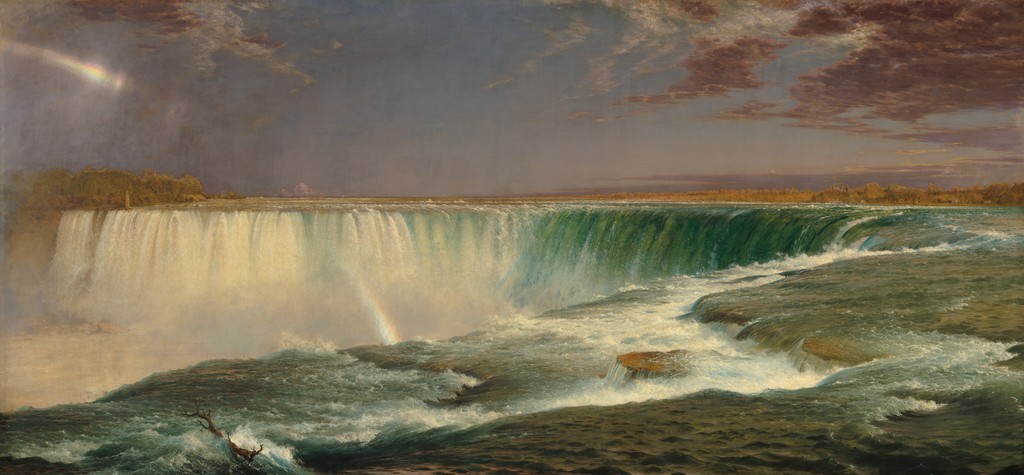
| Niagara | 1857 | Oil on canvas |
| Magdalena River, New Granada, Equador | 1853 | Graphite heightened with white on wove paper |
| Tamaca Palm, Colombia or Ecuador | May–October 1853 | Graphite on gray laid paper |
| Mixed Sketches with a Champan, Río Magdalena, Colombia | May 1853 | Graphite on gray laid paper |
| Study for Rainy Season in the Tropics | 1865–1866 | Graphite on ruled notepad paper |
| Al-Khazneh, Petra (study) | February–March 1868 | Oil and graphite on tan paperboard |
| The Great Fall, Niagara (Charles Risdon, after Church) | 1874 impression | Hand-coloured chromolithograph on paperboard |
| The Heart of the Andes (William Forrest, after Church) | 1862 | Engraving in black on wove paper |
| Our Heaven Born Banner (William Bauly, adapting Church’s motif) | circa 1861 | Colour lithograph |
| A Tropical Moonlight (wood engraving after Church) | 1879 publication | Wood engraving in American Painters |
| Off Iceberg, Newfoundland | June 1859 | Oil and graphite on paperboard |
| Parthenon at Night, Athens | April 1869 | Oil and graphite on tan paperboard |
| Jerusalem from the Mount of Olives (study) | 1 April 1868 | Oil and graphite study |
| Horseshoe Falls (study) | December 1856–January 1857 | Oil on paper mounted to canvas |
| Niagara Falls, from the American Side | 1867 | Oil on canvas |
| Study for The Heart of the Andes | 1858 | Oil study |
| Mount Chimborazo through Rising Mist and Clouds | 1857 | Oil study |
| Cotopaxi Erupting, Viewed from Quito, Ecuador | June 1857 | Oil and graphite on tan paperboard |
| Cotopaxi (painted for Cyrus Field) | 1855 | Painting |
| Chimborazo | 1864 | Painting |
| Twilight, A Sketch | 1858 | Oil on canvas |
| View of Baalbek | 1868 | Oil and pencil on board |
| Three Bedouins | Date unconfirmed | Oil study |
| Coast Scene, Mount Desert (later canvas) | 1863 | Painting |
| The Wreck | Date unconfirmed | Painting |
| Grand Manan Island, Bay of Fundy | Date unconfirmed | Painting |
| Summer in South America | circa 1853 | Painting |
| Evening in Vermont | Date unconfirmed | Painting |
| Home by the Lake | Date unconfirmed | Painting |
| Storm in the Blue Mountains, Jamaica | August 1865 | Painting |
| The Natural Bridge, Virginia | 1852 | Painting |
| The Vale of St. Thomas, Jamaica | 1867 | Painting |
| Tequendama Falls, near Bogota, New Granada | Date unconfirmed | Painting |
| Sunrise in Syria | Before the 1876 exhibition | Painting |
| Cuernavaca (oil study; descriptive title) | 1898 | Oil study |
| Olana window design (descriptive title) | Date unconfirmed | Watercolour and graphite |
| Olana dining-room stencil sketch (descriptive title) | Date unconfirmed | Oil and graphite |
| Olana house (with Calvert Vaux) | 1870–1872; later additions | Architecture |
| Olana designed landscape | From 1860; developed over decades | Designed landscape |
Frequently Asked Questions
They are excerpts from private letters preserved by the Albany Institute of History & Art. Each quotation identifies its correspondent and date.
Palmer was a sculptor and Church’s friend. Several of the excerpts concern their homes, families and artistic work; one offers help to Palmer’s son Walter.
His October 1884 letter reports both work on the property and painting in his studio. The road-building quotation should be read within that context.
Discussion
Look again at the images and ideas explored in Quotes. These editorial prompts invite your own observations.
Which excerpt most changes your impression of Church: his delight in Petra, attachment to home or encouragement of another artist? How does reading a letter beside a painting change what you notice?
Reader Insights
Which passage changes the way you imagine Church speaking to a friend?
How does the context of a dated letter affect your reading of its words?
Which quoted observation would you compare most closely with one of his pictures?
Join the Conversation
Share a detail, comparison or question about Quotes below.
References
- Albany Institute of History & Art. Church to Erastus Dow Palmer, 10 March 1868: original letter scans and transcription.
- Albany Institute of History & Art. Church to Erastus Dow Palmer, 7 July 1869: original letter scans and transcription.
- Albany Institute of History & Art. Church to Erastus Dow Palmer, 7 June 1872: original letter scans and transcription.
- Albany Institute of History & Art. Church to Erastus Dow Palmer, 18 October 1884: original letter scans and transcription.
- Albany Institute of History & Art. Church to Erastus Dow Palmer, 24 July 1892: original letter scans and transcription.
- Albany Institute of History & Art. Church to Emily Cole, 16 February 1899: original letter scans and transcription.
- Splash image source.
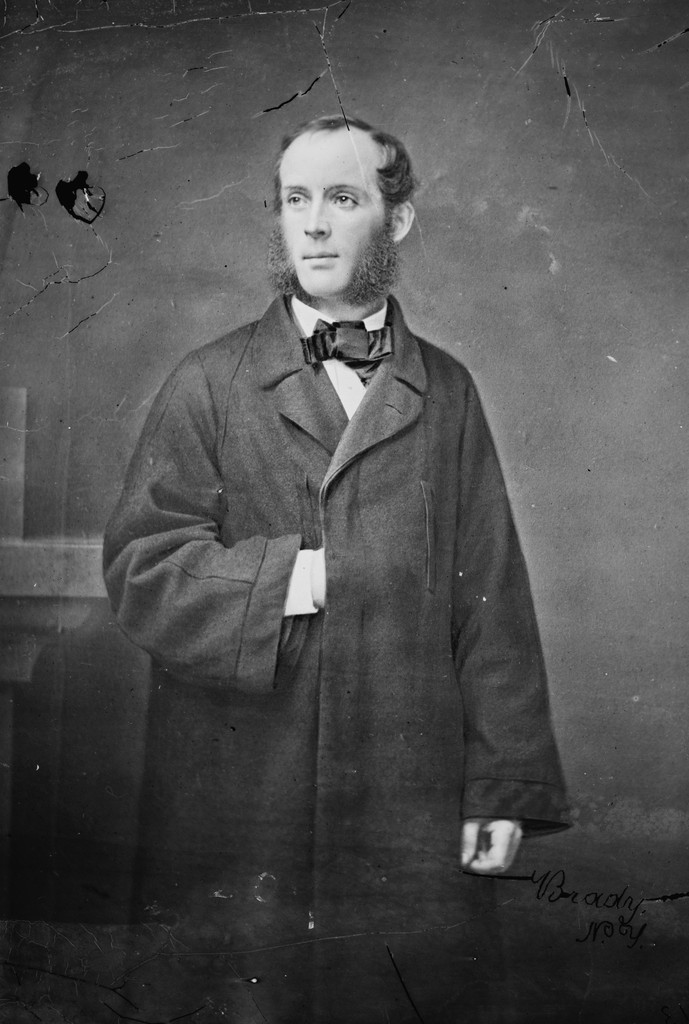
Mathew Brady studio, Frederic Edwin Church, between 1855 and 1865. Library of Congress, Prints and Photographs Division, Brady-Handy Photograph Collection, cwpbh.02727; via Wikimedia Commons. Public domain. Original plate damage retained. Image source. Public domain; nineteenth-century photograph, creator died 1896. Resized; full source proportions retained.