by Tom Gurney
Tom Gurney BSc (Hons) is an art history expert with over 20 years experience
Published on June 19, 2020 / Updated on October 27, 2026
Email: tomgurney1@gmail.com / Phone: +44 7429 011000
Thomas Cole Quotes: Introduction
Thomas Cole’s words make landscape an argument about how to live. A waterfall becomes a voice, a sky becomes the source of a scene’s feeling, and a familiar valley becomes a test of what society values. His Essay on American Scenery, published in January 1836, moves between descriptions of visible things and an appeal to cultivate attention. It asks readers to recognise beauty before habitual indifference, commerce or fashion makes them overlook it. [1]
His later Lecture on Art extends that argument to paintings, education and public patronage. Cole wanted art to give pleasure, develop perception and reach people beyond wealthy collectors. These writings also contain difficult assumptions about civilisation, national identity and religion. Read in context, his quotations reveal a searching and sometimes combative thinker, rather than a supplier of interchangeable sayings about nature. [2]
At a Glance
- Scenerythe Essay on American Scenery appeared in the American Monthly Magazine in January 1836. The excerpts below follow a modern abridged transcription. [1]
- Artthe undated Lecture on Art was probably first composed around 1845. Evidence that Cole actually delivered it remains uncertain. [2]
- Reading approachshort passages make most sense beside the argument or occasion that produced them.
- Attributionpoetry and other writers’ words quoted by Cole must be distinguished from his own prose.
Contents
- Introduction
- Learning to look
- Waterfalls, skies and the expression of landscape
- Beauty and the costs of improvement
- “We are still in Eden”
- Art beyond a copy of nature
- A public place for painting
- Conviction, livelihood and doubt
Learning to look
“The spirit of our society is to contrive but not to enjoy”
Cole places this observation in the section of his 1836 essay concerned with cultivating a taste for scenery. The contrast is between making arrangements, accumulating wealth and finding the capacity to take pleasure in the world. He does not simply tell readers to stop working. He asks what their work enables them to experience. A society that produces only further demands upon itself can become very efficient at missing the reasons for living. [1]
The pleasure he describes requires practice. Familiarity alone does not make someone observant: a person can repeatedly pass a field, hill or stretch of river without attending to its appearance. Cole argues that knowledge increases the capacity for enjoyment. Looking becomes an acquired sensitivity to forms, relationships and changes of light, rather than a momentary reaction to an obviously impressive view. His intended audience includes people who have not yet learned that sensitivity.
This helps explain the essay’s movement from general claims to individual landscape elements. Mountains, water, forests and skies give the reader something particular to examine. Instead of leaving beauty as an abstract good, he breaks scenery into experiences that someone might recognise on a journey or near home. The familiar world becomes available for renewed attention. [1]
Cole also gives this attention a moral purpose. He believes that contemplating natural beauty can encourage benevolence and religious feeling. The argument belongs to his Christian understanding of creation: scenery is valuable because it can disclose a world beyond selfish appetite. A modern reader need not accept that moral response as automatic to see the force of his practical observation. The ability to enjoy a place depends partly on what one has learned to notice there. [1]
Waterfalls, skies and the expression of landscape
“The waterfall may be called the voice of the landscape”
In the essay’s discussion of waterfalls, Cole distinguishes an active sound from the noises wind draws out of rocks and woods. Water strikes its own notes, which the surroundings return. The comparison makes the landscape seem responsive without requiring the reader to imagine it literally speaking. Sound becomes a way of understanding a place’s character. [1]
The passage also considers a waterfall’s apparent permanence and constant movement. Its outline can remain recognisable while its substance changes continually. That combination makes it more than an attractive object within a view: it becomes an occasion for thinking about time. Cole’s descriptions of Niagara develop this experience through volume, duration and power. The visitor encounters something whose scale enlarges ordinary habits of thought.
He does not confine landscape expression to dramatic features. Still water conveys tranquillity through reflection, while a rushing stream suggests impetuosity. These are comparisons between visible behaviour and human feeling. They show how scenery could become meaningful without a painted figure explaining the emotion. Cole’s vocabulary gives different kinds of water distinct expressive roles. [1]
“The soul of all scenery”
This is how Cole introduces the sky in the same essay. He immediately explains its importance through light, shade and colour. A sky does not merely fill the space above hills; its condition affects the appearance of everything beneath it. Serenity and storm organise a whole scene, while sunrise and sunset transform its surfaces. [1]
The observation offers a useful approach to his painting style and technique. Before identifying a tree or building, consider what kind of light makes it visible and how that light connects it to the rest of the view. Cole’s writing shifts attention from separate objects to the atmosphere shared between them. Landscape feeling emerges from those relationships, not solely from the choice of a grand subject.
Beauty and the costs of improvement
“the ravages of the axe are daily increasing”
Near the conclusion of the 1836 essay, Cole turns from appreciation to loss. The urgency comes from the speed at which wooded scenery is disappearing. A beautiful place is not simply an inexhaustible resource waiting for a visitor: it can be altered before people have understood what they are losing. The everyday axe brings the essay’s larger moral argument down to a material action. [1]
Yet his position is more complicated than opposition to every human intervention. Earlier in the essay he values cultivated scenery for its domestic associations and welcomes the possibility that artistic judgement might improve dwelling places. He also imagines future architecture along the Hudson. What troubles him in the conclusion is destruction that removes natural beauty without supplying a corresponding beauty through art. His criticism concerns the manner and judgement of development as well as its extent. [1]
His journal entry of 1 August 1836 makes that distinction especially clear. After walking beside railway works near Catskill, he records the loss of a favourite place’s quietness. He then considers how the works required by commerce might preserve scenery, or even make its charms more accessible. The transcription contains revisions within this passage, so its argument is better paraphrased than compressed into a newly assembled quotation. Cole condemns needless devastation while allowing that useful works and scenic pleasure could coexist. [3]
The same caution matters when considering technology. On 28 April 1839 he reflected on the inventions of Daguerre and Talbot. He anticipated that photographic methods could challenge misleading topographical views and provide materials for imaginative artists, although he also worried about artists becoming idle. His response combines hope with reservations. It gives no warrant for making his criticism of the axe into a general rejection of invention. [3]
“We are still in Eden”
“We are still in Eden; the wall that shuts us out of the garden is our own ignorance and folly.”
The essay ends by locating the obstacle to enjoyment within the observer. Cole has just described landscapes undergoing damage, yet he insists that abundant beauty remains available. Eden here is an invitation to recognise what surrounds the reader, rather than a declaration that human society is innocent or that its actions have no consequences. Ignorance can prevent enjoyment as surely as physical destruction can remove its object. [1]
The sentence’s theological imagery does not erase the essay’s historical limitations. Cole calls American scenery a national inheritance and celebrates its wildness, but his account treats Indigenous people through a demeaning opposition between savagery and civilisation. He acknowledges ancient western mounds while describing their associations as lacking the recorded deeds that animate European places. That judgement reveals the boundaries of the history he recognises; it does not establish that those landscapes had no human history. [1]
His argument therefore holds together environmental concern and a restricted account of belonging. Readers can value his insistence on attentive looking while questioning whose experience his language excludes. The Eden sentence becomes richer when kept beside those tensions. Its generosity towards natural beauty does not automatically make every surrounding claim generous towards people.
Watch: Thomas Cole
Choose a film to explore the artist’s work, its interpretation and its wider setting.
Thomas Cole: Painting the American Landscape (remastered audio)
An introduction to Cole’s landscapes and artistic ambitions.
Watch on YouTubeArt beyond a copy of nature
“Through Nature we contemplate Art and Art discovers the beautiful in Nature.”
In Lecture on Art, Cole makes the relationship reciprocal. Looking at the world informs art; looking at art can teach a viewer to recognise qualities in the world. A painting offers more than a substitute for a place someone cannot visit. It can change the attention they bring to places they already know. [2]
The surrounding argument distinguishes imitation from mechanical copying. Cole proposes that an artist selects characteristic, sublime and beautiful qualities, separating them from accidental appearances. His ideal of truth is consequently not satisfied by reproducing whatever happens to fall before the eye. Judgement belongs to the making of the image. This is central to understanding how a painter devoted to nature could also defend invented scenery and ambitious allegory. [2]
The lecture’s date and form require care. Its manuscript contains rough drafts and a later revision; the Historic Site’s edition mainly follows the revision and estimates an initial composition around 1845. Breath marks suggest possible reading aloud, but the publisher reports no secure evidence of delivery. Calling every sentence part of a documented public address would give its audience and occasion a certainty they do not possess. [2]
Nor is every striking line within it Cole’s own. The edition identifies poetry by Friedrich Schiller and Martin Farquhar Tupper, and a passage from Goethe. Cole used other authors to lend rhythm and authority to his argument. Their presence helps reveal his reading and intellectual affinities; it does not transfer authorship of their sentences to him. [2]
A public place for painting
“It is not genius they lack, it is opportunity”
Cole directs this claim towards American artists in the later lecture. He praises their abilities while blaming limited opportunities for restricting their ambitions. The problem is not merely whether artists can produce attractive pictures. It is whether society supports the scale and kinds of work through which they might realise their strongest ideas. Patronage becomes part of the conditions of artistic achievement. [2]
He challenges the excuse that the country is too young or poor to sustain painting and sculpture by pointing to spending on luxurious furniture, steamboats and entertainment. Wealth already exists; the question is how it is distributed. His proposal includes training, competition and payment for artists undertaking public decoration. These practical measures give substance to his elevated language about art’s moral influence.
“That Art shall be exposed—free as air—to every Citizen, high or low, rich or poor.”
The aspiration appears within his defence of public art. Cole welcomes pictures in private homes, galleries, prints and books, but wants access to extend further. His interest in large works is connected to collective experience: many people must be able to encounter them, including workers whose leisure might otherwise offer little opportunity for sustained contemplation. [2]
That aim accompanies a paternal view of improvement. Cole imagines art drawing labourers away from pleasures he considers degrading. His language does not give all existing tastes equal standing. Nevertheless, he insists that beauty should benefit people beyond those who can purchase it. The lecture joins a hierarchy of artistic values to a broad demand for access, a combination more revealing than either belief taken alone. [2]
Conviction, livelihood and doubt
“Every great Artist works to God”
This clean phrase appears in Cole’s journal after reflections on Gothic architecture and a quotation from Michelet discussed following the August 1840 entry. Cole admires labour devoted to beauty even where its details are difficult for ordinary spectators to see. He then turns from the account he has read to his own statement about artistic devotion. The phrase belongs to Cole, while the preceding description of unnamed cathedral workers is borrowed. [3]
His ideal does not remove the practical pressures of his profession. The Historic Site’s West Parlor text reproduces a passage from his letter to Ithiel Town of 25 May 1840, during the disagreement over The Architect’s Dream:
“my profession would be both anxious and precarious”
Cole is considering the consequences if patrons could reject commissioned pictures at their discretion. This is the voice of someone defending the conditions under which he works, not simply declaring independence from financial concerns. The exhibition text also preserves Town’s objections as Town’s words, allowing readers to recognise a disagreement rather than mistake one participant’s position for the other’s. [4]
“I doubt much whether I have acted judiciously”
Cole writes this on 22 May 1842, reflecting on the time he has devoted in Rome to repainting The Voyage of Life. He wonders whether smaller paintings and more study of figures and nature would have been a better use of his limited stay. The doubt concerns a decision about work, study and resources; it is not a repudiation of the series’ religious meaning. [3]
These passages add an essential human scale to the grander declarations. Cole’s commitment to meaningful art coexists with uncertainty about how to make it, sustain a household and find a public. His words are strongest when they retain those occasions: the view threatened by clearing, the institutions asked to support artists, the commission disputed and the weeks of study sacrificed. Context gives the quotation its particular weight.
Artworks directory
Explore paintings, drawings and studies across Cole’s career. The two Voyage of Life sets appear separately. Dates and study identifications draw on the exhibition and collection catalogues, supplemented by the National Gallery’s drawing records. [5] [6] [7] [8]
| Name | Date | Medium |
|---|---|---|
| The Oxbow | 1836 | Painting |
| The Titan’s Goblet | 1833 | Painting |
| The Architect’s Dream | 1840 | Painting |
| The Course of Empire: The Savage State | ca. 1834 | Painting |
| The Course of Empire: The Arcadian or Pastoral State | ca. 1834 | Painting |
| The Course of Empire: The Consummation of Empire | 1835–1836 | Painting |
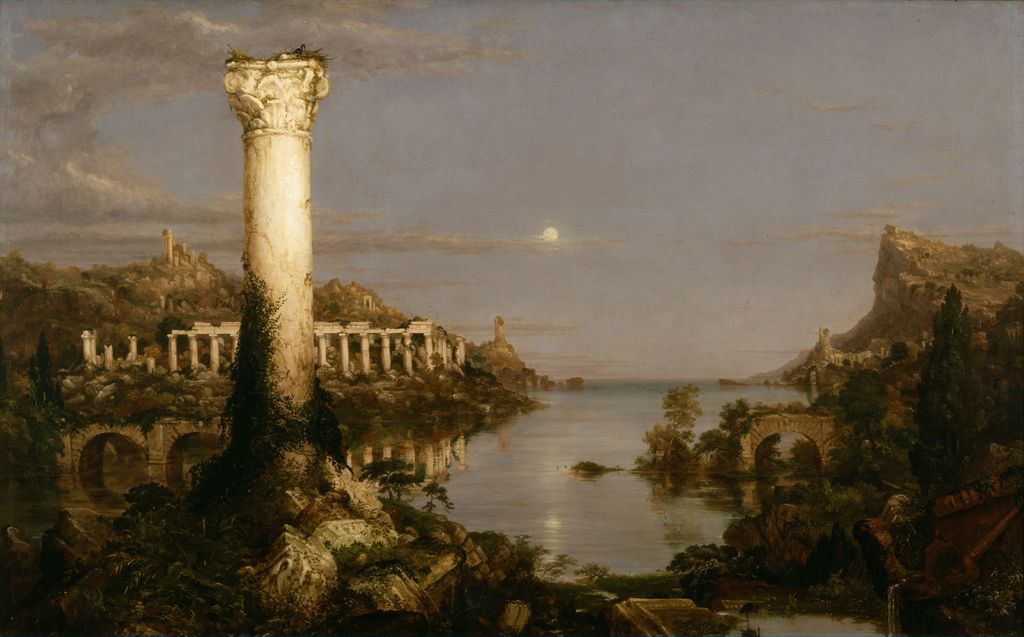
| The Course of Empire: Destruction | 1836 | Painting |
| The Course of Empire: Desolation | 1836 | Painting |
| The Voyage of Life: Childhood | 1842 | Painting |
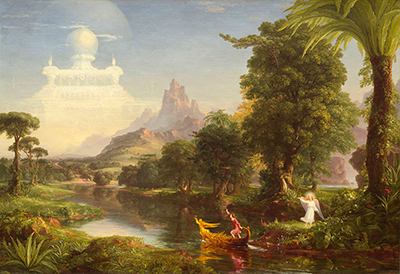
| The Voyage of Life: Youth | 1842 | Painting |
| The Voyage of Life: Manhood | 1842 | Painting |
| The Voyage of Life: Old Age | 1842 | Painting |
| Home in the Woods | 1847 | Painting |
| Distant View of Niagara Falls | 1830 | Painting |
| View on the Catskill—Early Autumn | 1836–37 | Painting |
| Lake with Dead Trees (Catskill) | 1825 | Painting |
| River in the Catskills | 1843 | Painting |
| A View of the Mountain Pass Called the Notch of the White Mountains (Crawford Notch) | 1839 | Painting |
| Expulsion from the Garden of Eden | 1828 | Painting |
| The Subsiding of the Waters of the Deluge | 1829 | Painting |
| The Mountain Ford | 1846 | Painting |
| American Lake Scene | 1844 | Painting |
| A View near Tivoli (Morning) | 1832 | Painting |
| Aqueduct near Rome | 1832 | Painting |
| The Hunter’s Return | 1845 | Painting |
| The Voyage of Life: Childhood (first version) | 1840 | Painting |
| The Voyage of Life: Youth (first version) | 1840 | Painting |
| The Voyage of Life: Manhood (first version) | 1840 | Painting |
| The Voyage of Life: Old Age (first version) | 1840 | Painting |
| Panorama of the Oxbow on the Connecticut River as seen from Mount Holyoke | ca. 1832 (museum); 1833 (2018 catalogue) | Drawing |
| Sketch for The Oxbow | 1836 | Painting |
| From Nature | 1823 | Drawing |
| View of the Round-Top in the Catskill Mountains (Sunny Morning on the Hudson) | 1827 | Painting |
| Scene from The Last of the Mohicans: Cora Kneeling at the Feet of Tamenund | 1827 | Painting |
| View of Monte Video, the Seat of Daniel Wadsworth | 1828 | Painting |
| The Garden of Eden | 1828 | Painting |
| Tomb of General Brock, Queenston Heights, Ontario | 1830 | Painting |
| Effect for Newstead Abbey, Nottinghamshire, England | 1830 | Drawing |
| The Ilissos, from the Parthenon West Pediment | 1829 or 1830 | Drawing |
| Life Study for the Prostrate Shepherd in The Angel Appearing to the Shepherds | 1831–1832 | Painting |
| Interior of the Colosseum, Rome | ca. 1832 | Painting |
| Campagna di Roma (Study for Aqueduct near Rome) | 1832 | Painting |
| Landscape with a Round Temple | ca. 1830s | Painting |
| Stormy Landscape | 1832 | Painting |
| View of Florence from San Miniato | 1837 | Painting |
| Mount Holyoke, Massachusetts (after Basil Hall) | ca. 1829–1831 | Drawing |
| Layout for The Course of Empire | 1833 | Drawing |
| Study for The Course of Empire: The Savage State | ca. 1834 | Painting |
| Study for The Course of Empire: The Arcadian or Pastoral State | ca. 1834 | Painting |
| Study for The Course of Empire: Desolation | 1836 | Painting |
| Study for Dream of Arcadia | 1838 | Painting |
| Clouds | ca. 1830s | Painting |
| Study for The Hunter’s Return | 1845 | Painting |
| Study for Home in the Woods | ca. 1847 | Painting |
| Sunrise in the Catskills | 1826 | Painting |
| Study for The Mountain Ford | 1846 | Drawing |
| Tree Trunks | 1825–1840 | Drawing |
Frequently Asked Questions
Yes. The sentence appears in the conclusion of his Essay on American Scenery, published in January 1836. It urges readers to overcome the ignorance and folly that prevent them from enjoying natural beauty. [1]
The manuscript is undated, and the Historic Site’s edition suggests that Cole first composed it around 1845. It reports no secure evidence that he delivered it, although markings for breath pauses suggest possible reading aloud. [2]
Not necessarily. Lecture on Art includes quotations identified as Schiller, Goethe and Tupper, among others. A sentence’s appearance within a Cole text does not establish that he composed it. [2]
Discussion
Look again at Thomas Cole Quotes and compare your reading with the questions below.
Reader Insights
Cole believed that looking at art could teach people to recognise beauty in nature. Has a painting changed the way you notice a familiar place?
How does Cole’s demand for public access to art sit alongside his conviction that some pleasures and tastes were more valuable than others?
Which detail or comparison would you add to this account, and what evidence supports your reading?
Join the Conversation
Share the details that shaped your response, or suggest a comparison for other readers.
References
- Thomas Cole, “Essay on American Scenery,” American Monthly Magazine, 1 (January 1836), pp. 1–12. Modern abridged transcription hosted by California State University, Northridge, sections on contemplation, taste, wildness, water, forests, sky, associations and conclusion; the transcription does not retain original page divisions.
- Thomas Cole, Lecture on Art, undated manuscript, probably first composed circa 1845; transcription by Peter Fedoryk, Thomas Cole National Historic Site, first published 2020, second printing 2021. Publisher’s note and lecture, PDF p. 3; printed pp. 8–13, 15–23 and notes p. 26 (PDF pp. 9–16, 18).
- Thomas Cole, Thoughts & Occurrences, journal; transcription by Peter Fedoryk, Thomas Cole National Historic Site, 2022; original manuscript, New York State Library, Thomas Cole Papers, SC10635, Box 4a, Folder 1. Journal transcription, editorial note PDF p. 4; entries 1 August 1836, 28 April 1839, reflections following August 1840 and 22 May 1842, PDF pp. 24, 43, 49–50, 54.
- Thomas Cole National Historic Site, West Parlor, “Hidden Stories”, undated interpretive script, PDF p. 3: Thomas Cole to Ithiel Town, 25 May 1840, and Town’s correspondence of 20 May and 4 July 1840, reproduced excerpts.
- Elizabeth Mankin Kornhauser and Tim Barringer, Thomas Cole’s Journey: Atlantic Crossings (2018). Career context and artwork/study metadata: catalogue entries 10–66 and chronology, PDF pp. 137–231 and 249–262; related Barringer essay passages, PDF pp. 23–66.
- Franklin Kelly et al., American Paintings of the Nineteenth Century, Part I (National Gallery of Art, 1996). Cole catalogue and both Voyage of Life sets, PDF pp. 91–124.
- National Gallery of Art, Study for The Mountain Ford (1846), accession 2015.19.772. Collection record and open-access image.
- National Gallery of Art, Tree Trunks (1825–1840), accession 2015.19.607. Collection metadata and open-access image.
- Splash image source.
Thomas Cole, The Architect’s Dream, 1840. Oil on canvas, 134.6 × 213.5 cm. Toledo Museum of Art, 1949.162.