by Tom Gurney
Tom Gurney BSc (Hons) is an art history expert with over 20 years experience
Published on June 19, 2020 / Updated on October 27, 2026
Email: tomgurney1@gmail.com / Phone: +44 7429 011000
The Voyage of Life: Childhood by Thomas Cole: Introduction
A tiny passenger raises his arms in a golden boat. Behind him, a guardian angel steers the vessel out of an enormous dark cavern; ahead, flowers crowd the riverbanks and a pale morning opens beyond the rocks. In The Voyage of Life: Childhood, Thomas Cole makes the beginning of a human life both joyful and mysterious. The child encounters a world full of things to delight in, while remaining unaware of where the river will carry him. Cole's own explanation connects the cavern with earthly origins and the unknown past, and the morning with the pleasures of early life. [1]
The painting discussed here is Cole's 1842 version, made in Rome and now belonging to the National Gallery of Art in Washington. It is the first scene in his second complete set of The Voyage of Life. An earlier Childhood, painted for Samuel Ward as part of the series completed in 1840, belongs to Munson in Utica, New York. Both are paintings by Cole, but they are separate objects with separate histories. [1]
This opening scene establishes the journey's most important relationships: a vulnerable traveller, a protective companion and a current that continues whether its passenger understands it or not. Its serenity becomes more moving when set beside the confident youth, distressed adult and aged voyager who follow. Yet the painting also rewards attention on its own, particularly to the difference between the infant's small, welcoming surroundings and the vast landscape above him.
At a Glance
- ArtistThomas Cole. [1]
- TitleThe Voyage of Life: Childhood. [1]
- Version discussedThe second set, painted in Rome, 1842. [1]
- Medium and dimensionsOil on canvas; 134.3 × 195.3 cm. [1]
- CollectionNational Gallery of Art, Washington; Ailsa Mellon Bruce Fund; accession 1971.16.1. [1]
- Place in the seriesFirst of four paintings, followed by Youth, Manhood and Old Age. [1]
- Earlier versionPart of the original series completed in 1840, now at Munson, Utica. [1]
This work in Cole’s career
First European journey
1829–1832The Course of Empire
1834–1836The Oxbow
1836The Voyage of Life
1840 and 1842Church’s training
1844–1846Notes and sources
American recognition. Three New York sales brought Cole to the attention of artists and patrons. [2]
First European journey. Looking in Britain and Italy enlarged the repertoire of his American landscapes. [2]
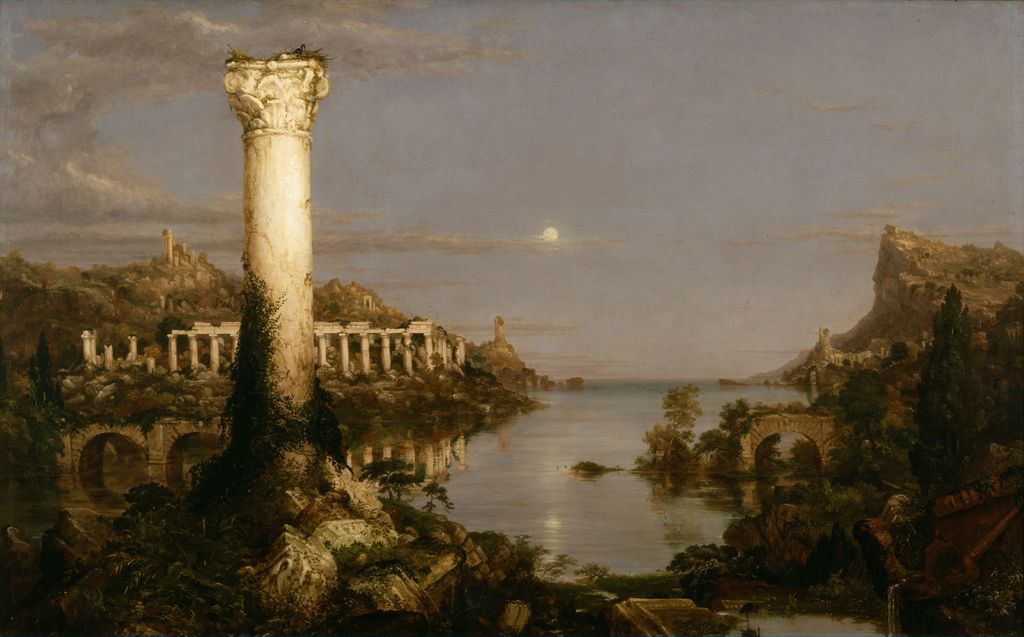
The Course of Empire. Five invented landscapes turn the rise and fall of civilisation into a visual argument. [2]
The Oxbow. An American prospect joined direct observation to a carefully staged view. [2]
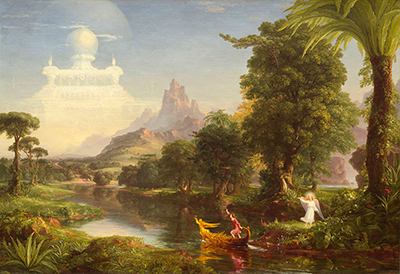
The Voyage of Life. The original cycle and Roman replicas give human life the course of a river. [2]
The Voyage of Life: Childhood. The 1842 Roman version begins the life journey with an infant, a guardian angel and a boat emerging into a flourishing landscape. [1]
Church’s training. Cole taught Frederic Edwin Church in Catskill. [2]
Home in the Woods. A late cabin landscape brings settlement and surrounding woodland into one scene. [2]
Contents
- Introduction
- Out of the cavern
- The infant and the guardian
- A golden boat made of passing hours
- Morning light and a world of flowers
- What Cole's description tells us
- Two paintings of the same beginning
- Looking at a cave, looking from one
Out of the cavern
The cavern occupies much of the left side of the picture. Its opening is irregular, edged by projecting rock and patches of green growth. Inside, the darkness deepens until it becomes difficult to distinguish the channel from the enclosing stone. The boat appears just beyond this obscurity, low in the composition, and moves towards the right. The sharp contrast between the bright figures and the cave makes their emergence the painting's first event.
Cole did not describe the cavern as a particular place. In the explanatory text reproduced by art historian Franklin Kelly, it signifies earthly origin and the mysterious past. The association is broad enough to preserve the sense of something unknowable. The picture shows life coming into view without pretending to show everything that precedes it. Cole had already included a river issuing from a cave, a child and a guardian steering in his earliest surviving written plan for the series, dated autumn 1836. [1]
The river supplies a particularly effective threshold. Water joins the dark interior to the illuminated foreground, so the boat does not simply appear in a different world; it travels from one space into another. Reflections pick up the white robe and golden hull, locating the figures on the same surface as the rocks and plants. This is a fantastic vessel in an imagined setting, but its movement is made physically legible.
Above it, the mountain rises far beyond the scale of its occupants. Jagged ridges recede towards the centre, partly veiled by cloud and warm atmosphere. The infant is almost lost beneath this architecture of rock. Nevertheless, the mountain's weight does not make the journey immediately frightening. The banks around the boat are covered with growing things, and the water carries it without the violent pitching that will dominate Manhood. Cole places smallness and security together.
The dark cave also keeps the scene from becoming an uninterrupted garden. Its presence gives the flowers and morning their force: brightness has somewhere to emerge from. Looking from left to right, we move between a space that resists inspection and one that offers abundant detail. The child has entered the visible world, and the painting invites us to share his pleasure in discovering it.
Annotated Details from Childhood
Compare four details with the full composition, then open the photographs for a closer view.
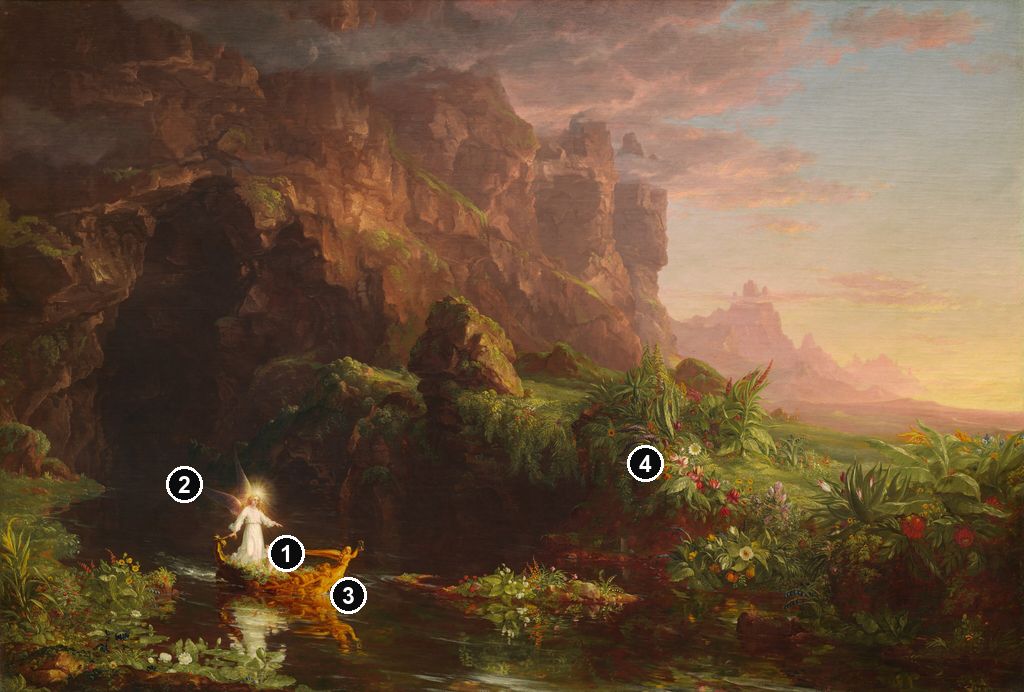
Details from CHILDHOOD
Each crop comes from the same painting shown above.
The boat and child
A small child travels in the gilded boat with the guardian angel nearby. Their scale makes the surrounding flowers, banks and cliffs feel abundant and protective. [1]
The dark opening
The boat emerges from darkness beneath the rocks into the open landscape. Cole’s explanation gives that movement a place within the allegory of earthly beginnings. [1]
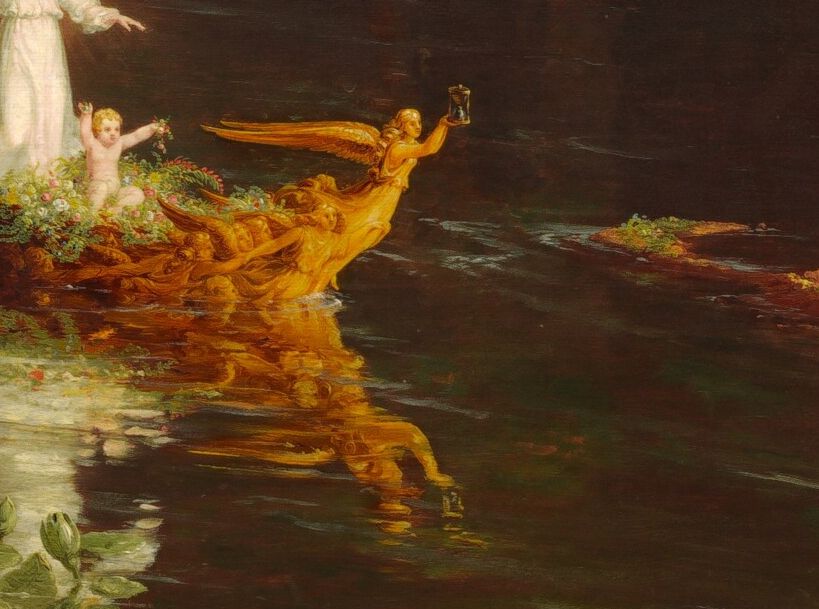
The figure at the prow
The small winged figure at the boat’s prow belongs to a vessel that recurs through the series. Its position helps viewers follow the same traveller despite the changing surroundings. [1]
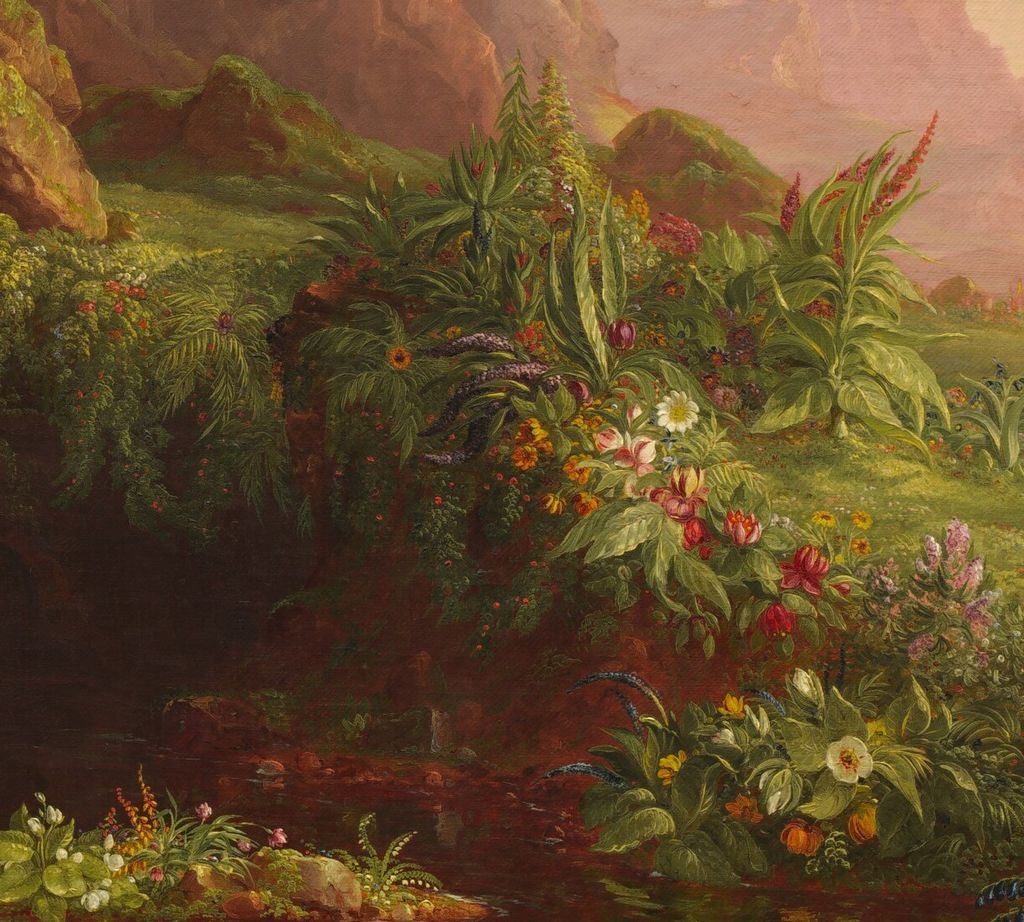
The flowering bank
Flowers and luxuriant foliage occupy the bank beside the infant’s route. Their crowded colour and variety contribute to the childhood scene’s sense of plenitude. [1]
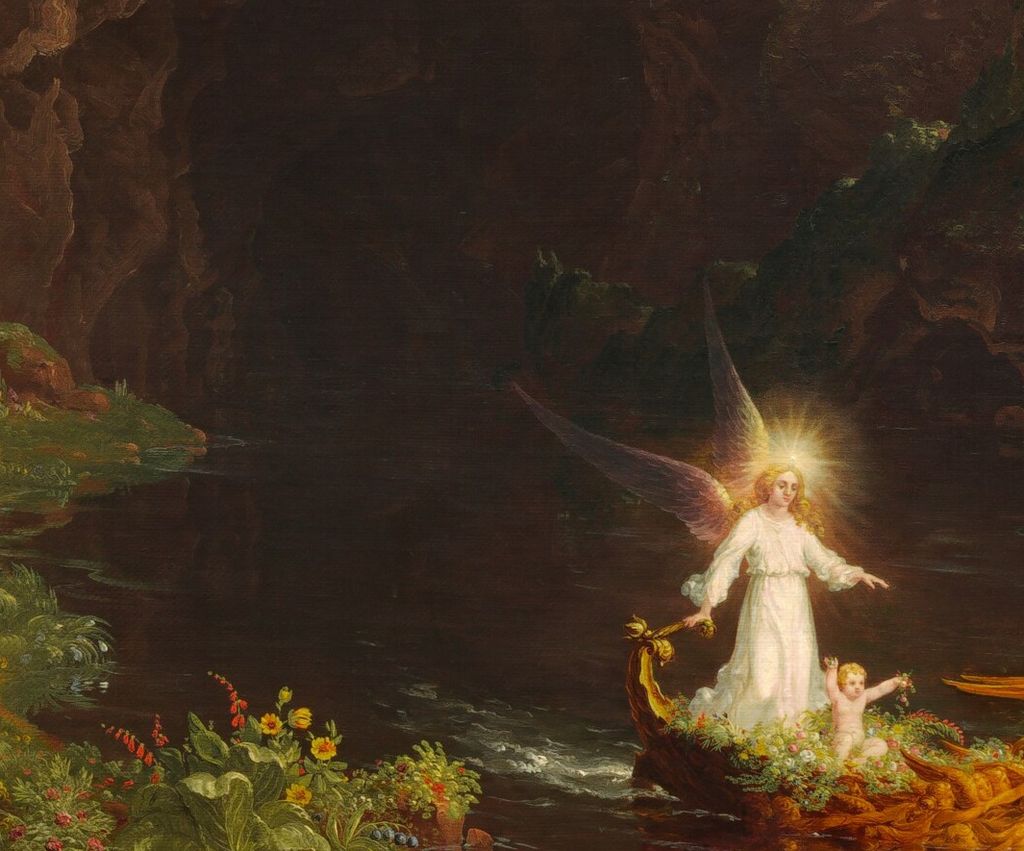
The infant and the guardian
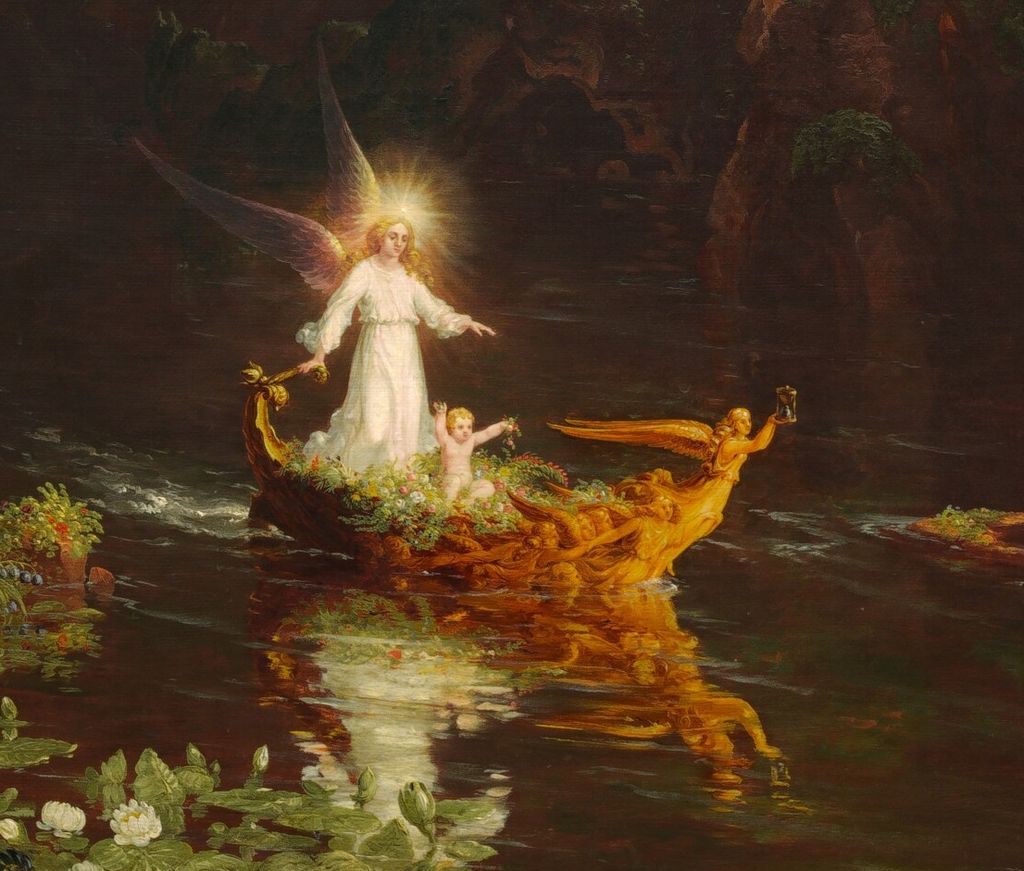
The infant is surrounded by flowers within the boat. His lifted arms and lively posture answer the guardian's steadier stance. Cole describes him as laughing, and identifies joyousness and wonder as the characteristic emotions of childhood. Those are the artist's chosen qualities for this allegorical beginning, rather than a claim that every child's life is sheltered or happy. [1]
The guardian stands behind the passenger, dressed in white, with wings extending into the darker space. A radiance around the head makes the figure especially conspicuous against the cavern. One arm reaches towards the boat's rear while the other opens towards the passage ahead. The pairing gives the scene a clear division of responsibilities: the infant responds to the world; the guardian directs his movement through it. Cole explicitly describes the vessel as steered by an angelic form. [1]
This relationship matters more than the figures' relatively small scale might suggest. A landscape this large could dwarf a lone infant into insignificance. The standing companion instead makes the little boat a protected interior. Its flowers gather around the child like a continuation of the banks, and the guardian's brightness gives this pocket of life a focus. Protection is shown through position and action as well as through the angel's recognisable appearance.
The child does not look back into the cavern to solve the mystery of his origin. Nor does he study a distant goal, as the youth will do in the next painting. His delight belongs to what is immediately available. That difference helps explain why Cole keeps the banks close around him. In his account, the limited scope of the scene corresponds to childhood's restricted experience, pleasures and desires. The enclosure is therefore meaningful without being punitive. [1]
The guardian will remain important throughout the series, but its relationship to the traveller changes. In Youth, it stands on the bank while the young man takes the helm. In Manhood, it watches from the clouds. In Old Age, it directs the traveller towards a heavenly vision. Cole's sequence moves from immediate guidance through apparent distance to spiritual revelation. Childhood supplies the first, most visibly reassuring form of that companionship. [1]
A golden boat made of passing hours
The boat is far more ornate than anything required to cross a stream. Sculptured bodies form its sides and prow, and its gold catches the light against the dark water. At the front, a small winged figure holds an hourglass. The vessel's decorative richness first attracts attention as another pleasure in this luxuriant world. Close looking, however, reveals a reminder that the journey has already begun to consume time.
Cole explains that the sculptured figures represent the Hours. The traveller is borne along by hours just as the boat is borne along by the current. The image translates an invisible process into something tangible: time gives the passenger a place to sit, carries him forward and cannot be separated from his journey. Cole also states that the boat identifies the subject from one picture to the next. It provides continuity even as age, scenery and weather change. [1]
In Childhood, the ornament is intact, bright and buoyant. Its later appearance in Old Age, with figures broken and drooping, makes this first condition especially poignant. The hourglass is present at the beginning, not introduced only when the voyager is old. Cole's allegory allows pleasure and the passing of time to coexist; the infant need not understand the symbol for it to operate in the picture. [1]
The golden hull also has a practical compositional role. Its strong colour distinguishes the boat from the brown rock, green vegetation and dark surface. The reflection extends that colour downwards, anchoring the moving vessel in a broad foreground that might otherwise be dominated by plants. The eye can locate the narrative quickly, then wander through the surrounding detail. Cole makes a small object carry the story without asking it to occupy the centre of the canvas.
Morning light and a world of flowers
Warm light spreads from the right across the sky and distant formations. Clouds carry pink and peach tones, while the closest rock remains much darker. The morning is not presented as a uniform wash over the whole landscape. Instead, light reaches some surfaces and leaves others shaded, giving the infant's newly visible world depth and variety. The radiant guardian and gleaming boat bring that distant brightness into the lower foreground.
Cole identifies the rising sun's rosy light and luxuriant vegetation as emblems of early life's joy. His initial design for the cycle linked the progression of the day, from morning towards darkness, with the progression of the seasons from spring towards winter. Childhood therefore begins several kinds of time at once: the traveller's age, the day's light, growing life and the hours embodied in the boat. [1]
The flowers invite a slower kind of viewing than the broad mountain and sky. Clusters of red, white and yellow blooms mingle with large leaves and spiky growth. Some plants stand upright along the bank; others spread low beside the water. Cole varies their shapes and densities, so abundance can be experienced as a succession of particular things rather than a single green mass. Their proximity makes the foreground feel rich enough to absorb the infant's attention.
One plant has a stated symbolic role. Cole calls the Egyptian lotus in the foreground an emblem of human life. That identification comes from his explanation, and should not be expanded into an unsupported botanical inventory of the whole painting. It gives a specific detail another function while leaving much of the vegetation available to ordinary visual pleasure. The same flowers can belong to the scene's sensuous richness and its allegorical structure. [1]
There is open distance beyond the enclosing banks, but it is not yet the traveller's destination. The pale formations on the right suggest a world much larger than the passage around his boat. We can look towards that distance while the infant remains absorbed nearby. Cole thus separates the breadth of the viewer's awareness from the narrowness of the child's experience without making the latter seem deficient.
Watch: Thomas Cole
Choose a film to explore the artist’s work, its interpretation and its wider setting.
Thomas Cole: Painting the American Landscape (remastered audio)
An introduction to Cole’s landscapes and artistic ambitions.
Watch on YouTubeWhat Cole's description tells us
Cole prepared explanations for the four paintings, which appeared in exhibition catalogues and magazines, including The Knickerbocker. Kelly reproduces them in the National Gallery's catalogue. The Childhood text first describes the visible scene and then gives the symbols their meanings: cavern, Hours, morning, close banks and lotus. Reading it alongside the painting helps distinguish a documented interpretation from an association a viewer might independently bring to the image. [1]
The written account does not remove the need to look. Knowing that a cave stands for origins does not explain the experience of seeing a white figure against its darkness. Knowing that flowers signify joy does not exhaust the contrast between their small, varied forms and the immense rock above them. Cole joins an accessible explanation to decisions about scale, colour and placement that must be encountered visually.
He had once considered painting explanatory inscriptions into the scenery, including words at the cave mouth, but abandoned that device. The finished composition consequently allows the dark entrance to remain part of the landscape rather than a surface for written instruction. The accompanying description supplies verbal clarity elsewhere. That distinction helps preserve the scene's immediate sense of discovery even for readers who know the allegory. [1]
The scene is the opening of a Christian account of life culminating in immortality. Its gentleness should be understood within that larger framework, while its appeal can extend to viewers who do not share Cole's religious beliefs. The infant's vulnerability, the comfort of a companion and the delight of a newly encountered world are visible before any symbol is named. They are the human relationships through which Cole introduces his more explicitly spiritual story. [1]
Two paintings of the same beginning
Cole's first Childhood emerged from the series commissioned by the New York banker Samuel Ward in 1839. By September that year Cole had prepared finished studies to settle the arrangement and light before undertaking the large paintings. Ward died before the series was completed, and subsequent disagreements with his estate concerned Cole's right to exhibit it. The first set was shown at the National Academy of Design in November 1840. [1]
The second set arose partly from Cole's difficulty gaining access to the originals. With his nephew Henry Bayless, he arranged full-size tracings and painted copies of the figures so that he could make another version. He took preparatory material to Europe and undertook the replicas in Rome in 1841–42. By mid-March 1842, Childhood, Youth and Manhood were complete. The date and place inscribed at the lower left of Washington's Childhood identify this Roman painting. [1]
Kelly describes the National Gallery set as generally brighter in colour than the originals, a difference particularly evident when the sets were exhibited together in 1985. He does not establish whether Cole deliberately sought that effect or whether it resulted from different available pigments. The principal compositional revisions between the completed sets occurred in Manhood. For Childhood, the secure distinction is between closely related versions of the same opening, not between different allegories. [1]
Cole himself was cautious about judging the new paintings. In his journal on 28 February 1842, he wondered whether they were better than Ward's, hoped they would prove profitable and regretted time diverted from further study. He also expressed longing for his family. These private concerns complicate any assumption that the serene infancy depicted here records an equally serene moment in its maker's life. They do not identify the painted infant as a portrait of one of his children. [3]
The Roman set helped carry the subject to audiences through exhibitions in Boston, New York and Philadelphia in 1843–44. Later nineteenth-century prints and copies spread the imagery further. Munson's 2025 exhibition, Canvas to Culture, traced how successive generations adopted the original quartet's stages of spiritual growth through reproductions and other media. The continuing familiarity of the subject makes attention to its separate painted versions particularly valuable: a recognisable composition is not the same thing as a single interchangeable object. [1] [4]
Looking at a cave, looking from one
Michael Gaudio compares the cave in Childhood with Cole’s earlier Kaaterskill Falls. Here the spectator watches a child emerge from darkness; in the waterfall picture the view is framed from within a cave, making emergence part of the spectator’s own imagined experience. This distinction extends the cave’s significance beyond its familiar symbolism of birth and the mysterious past. [5]
The boat and angel make an outward movement visible in Childhood. Against the dark opening, their passage into light can be followed from outside. Comparing the two compositions helps explain how Cole could use related forms to organise very different relationships between a viewer and a landscape.
Artworks directory
Explore paintings, drawings and studies across Cole’s career. The two Voyage of Life sets appear separately. Dates and study identifications draw on the exhibition and collection catalogues, supplemented by the National Gallery’s drawing records. [2] [6] [7] [8]
| Name | Date | Medium |
|---|---|---|
| The Oxbow | 1836 | Painting |
| The Titan’s Goblet | 1833 | Painting |
| The Architect’s Dream | 1840 | Painting |
| The Course of Empire: The Savage State | ca. 1834 | Painting |
| The Course of Empire: The Arcadian or Pastoral State | ca. 1834 | Painting |
| The Course of Empire: The Consummation of Empire | 1835–1836 | Painting |
| The Course of Empire: Destruction | 1836 | Painting |
| The Course of Empire: Desolation | 1836 | Painting |
| The Voyage of Life: Childhood | 1842 | Painting |
| The Voyage of Life: Youth | 1842 | Painting |
| The Voyage of Life: Manhood | 1842 | Painting |
| The Voyage of Life: Old Age | 1842 | Painting |
| Home in the Woods | 1847 | Painting |
| Distant View of Niagara Falls | 1830 | Painting |
| View on the Catskill—Early Autumn | 1836–37 | Painting |
| Lake with Dead Trees (Catskill) | 1825 | Painting |
| River in the Catskills | 1843 | Painting |
| A View of the Mountain Pass Called the Notch of the White Mountains (Crawford Notch) | 1839 | Painting |
| Expulsion from the Garden of Eden | 1828 | Painting |
| The Subsiding of the Waters of the Deluge | 1829 | Painting |
| The Mountain Ford | 1846 | Painting |
| American Lake Scene | 1844 | Painting |
| A View near Tivoli (Morning) | 1832 | Painting |
| Aqueduct near Rome | 1832 | Painting |
| The Hunter’s Return | 1845 | Painting |
| The Voyage of Life: Childhood (first version) | 1840 | Painting |
| The Voyage of Life: Youth (first version) | 1840 | Painting |
| The Voyage of Life: Manhood (first version) | 1840 | Painting |
| The Voyage of Life: Old Age (first version) | 1840 | Painting |
| Panorama of the Oxbow on the Connecticut River as seen from Mount Holyoke | ca. 1832 (museum); 1833 (2018 catalogue) | Drawing |
| Sketch for The Oxbow | 1836 | Painting |
| From Nature | 1823 | Drawing |
| View of the Round-Top in the Catskill Mountains (Sunny Morning on the Hudson) | 1827 | Painting |
| Scene from The Last of the Mohicans: Cora Kneeling at the Feet of Tamenund | 1827 | Painting |
| View of Monte Video, the Seat of Daniel Wadsworth | 1828 | Painting |
| The Garden of Eden | 1828 | Painting |
| Tomb of General Brock, Queenston Heights, Ontario | 1830 | Painting |
| Effect for Newstead Abbey, Nottinghamshire, England | 1830 | Drawing |
| The Ilissos, from the Parthenon West Pediment | 1829 or 1830 | Drawing |
| Life Study for the Prostrate Shepherd in The Angel Appearing to the Shepherds | 1831–1832 | Painting |
| Interior of the Colosseum, Rome | ca. 1832 | Painting |
| Campagna di Roma (Study for Aqueduct near Rome) | 1832 | Painting |
| Landscape with a Round Temple | ca. 1830s | Painting |
| Stormy Landscape | 1832 | Painting |
| View of Florence from San Miniato | 1837 | Painting |
| Mount Holyoke, Massachusetts (after Basil Hall) | ca. 1829–1831 | Drawing |
| Layout for The Course of Empire | 1833 | Drawing |
| Study for The Course of Empire: The Savage State | ca. 1834 | Painting |
| Study for The Course of Empire: The Arcadian or Pastoral State | ca. 1834 | Painting |
| Study for The Course of Empire: Desolation | 1836 | Painting |
| Study for Dream of Arcadia | 1838 | Painting |
| Clouds | ca. 1830s | Painting |
| Study for The Hunter’s Return | 1845 | Painting |
| Study for Home in the Woods | ca. 1847 | Painting |
| Sunrise in the Catskills | 1826 | Painting |
| Study for The Mountain Ford | 1846 | Drawing |
| Tree Trunks | 1825–1840 | Drawing |
Frequently Asked Questions
Cole painted two versions. The original belongs to the series completed in 1840, now at Munson. The version discussed here dates from 1842 and was painted in Rome; it belongs to the National Gallery of Art in Washington. [1]
In Cole's explanation, the dark cavern represents earthly origin and the mysterious past. The infant emerges from it into a world of morning light and flowers. Cole does not identify it as a specific geographical cave. [1]
The angelic guardian steers while the infant enjoys his surroundings. Its changing relationship to the traveller links all four pictures, from direct protection in Childhood to the revelation of a heavenly destination in Old Age. [1]
Cole identifies them as the Hours: they express the idea that passing time carries people along the stream of life. The same boat helps viewers recognise the traveller's continuing journey across the four paintings. [1]
It is an allegorical landscape. Its infant, guardian, cave, boat and plants express aspects of Cole's account of human life. The detailed water, rock and vegetation make that imagined setting persuasive, but the subject is not a documented journey through a named location. [1]
Discussion
Look again at The Voyage of Life: Childhood and compare your reading with the questions below.
Reader Insights
How does the immense dark mountain affect the sense of safety created by the guardian and the flowers around the infant?
Does learning what the boat's Hours represent change the way you experience the painting's pleasure and tranquillity?
Which detail or comparison would you add to this account, and what evidence supports your reading?
Join the Conversation
Share the details that shaped your response, or suggest a comparison for other readers.
References
- Franklin Kelly, “Thomas Cole” and “The Voyage of Life”, in American Paintings of the Nineteenth Century, Part I, National Gallery of Art, 1996, printed pp. 95–108 (PDF pp. 111–124), particularly pp. 95–102 and 107–108; Cole's explanation of Childhood reproduced on p. 102. Catalogue PDF.
- Elizabeth Mankin Kornhauser and Tim Barringer, Thomas Cole’s Journey: Atlantic Crossings (2018). Career context and artwork/study metadata: catalogue entries 10–66 and chronology, PDF pp. 137–231 and 249–262; related Barringer essay passages, PDF pp. 23–66.
- Thomas Cole, journal, entry of 28 February 1842, in Thomas Cole's Journal, 1834–1848, transcription published by the Thomas Cole National Historic Site, 2022, PDF p. 53. Journal transcription.
- Munson, Canvas to Culture: Thomas Cole's Voyage of Life Lives On, exhibition description, 28 February–25 May 2025, unpaginated. Exhibition record.
- Michael Gaudio, “At the Mouth of the Cave: Listening to Thomas Cole’s Kaaterskill Falls”, Art History 33, no. 3 (June 2010), pp. 448–465, especially pp. 454–455, 458 and note 23 on p. 465. Source.
- Franklin Kelly et al., American Paintings of the Nineteenth Century, Part I (National Gallery of Art, 1996). Cole catalogue and both Voyage of Life sets, PDF pp. 91–124.
- National Gallery of Art, Study for The Mountain Ford (1846), accession 2015.19.772. Collection record and open-access image.
- National Gallery of Art, Tree Trunks (1825–1840), accession 2015.19.607. Collection metadata and open-access image.
- Splash image source.
Thomas Cole, The Voyage of Life: Childhood, 1842. Oil on canvas, 134.3 × 195.3 cm. National Gallery of Art, Washington, Ailsa Mellon Bruce Fund, 1971.16.1. Second set, painted in Rome.