by Tom Gurney
Tom Gurney BSc (Hons) is an art history expert with over 20 years experience
Published on June 19, 2020 / Updated on October 27, 2026
Email: tomgurney1@gmail.com / Phone: +44 7429 011000
The Voyage of Life: Old Age by Thomas Cole: Introduction
An old man sits in a small golden boat beneath a sky that seems almost to swallow the sea. Beside him, a radiant angel points towards an opening in the clouds. The light is far away, yet its connection with the voyager is immediate: his upturned face and raised hands answer the guardian's gesture. Thomas Cole's The Voyage of Life: Old Age brings a four-part journey to its conclusion by turning attention from the dangers of the river towards what might lie beyond death. In Cole's explanation, the scene promises Christian immortality. [1]
The painting discussed here is the 1842 canvas in the National Gallery of Art, Washington, accession 1971.16.4. Cole made it in Rome as the last picture of his second complete set. The first version, completed in 1840 for Samuel Ward, belongs to Munson in Utica, New York. Both paintings conclude the same allegory, but distinguishing them keeps their dates, making and histories clear. [1]
At a Glance
- ArtistThomas Cole. [1]
- TitleThe Voyage of Life: Old Age. [1]
- Date and version1842, second set, painted in Rome. [1]
- Medium and sizeOil on canvas, 133.4 × 196.2 cm. [1]
- CollectionNational Gallery of Art, Washington; Ailsa Mellon Bruce Fund; accession 1971.16.4. [1]
- Place in the seriesFourth and final scene, following Childhood, Youth and Manhood. [1]
- SubjectThe end of earthly life and the disclosure of a heavenly destination, within Cole's Christian allegory. [1]
This work in Cole’s career
First European journey
1829–1832The Course of Empire
1834–1836The Oxbow
1836The Voyage of Life
1840 and 1842Church’s training
1844–1846Notes and sources
American recognition. Three New York sales brought Cole to the attention of artists and patrons. [2]
First European journey. Looking in Britain and Italy enlarged the repertoire of his American landscapes. [2]
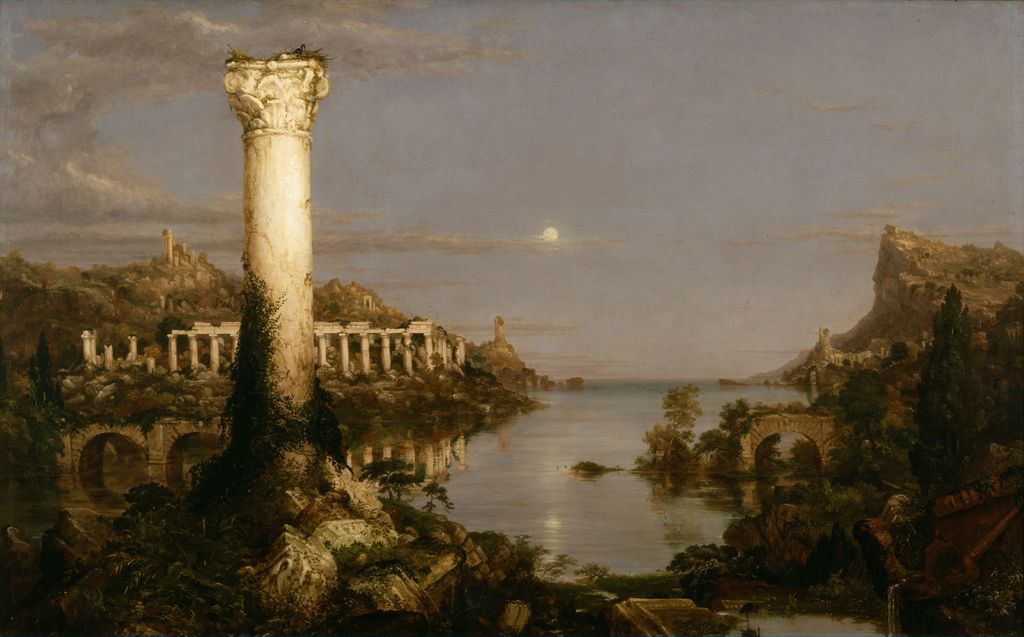
The Course of Empire. Five invented landscapes turn the rise and fall of civilisation into a visual argument. [2]
The Oxbow. An American prospect joined direct observation to a carefully staged view. [2]
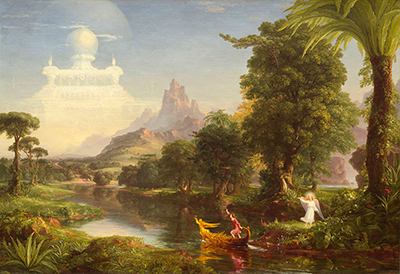
The Voyage of Life. The original cycle and Roman replicas give human life the course of a river. [2]
The Voyage of Life: Old Age. The 1842 Roman cycle ends at an open sea, where the returning angel redirects the voyager’s attention towards the heavens. [1]
Church’s training. Cole taught Frederic Edwin Church in Catskill. [2]
Home in the Woods. A late cabin landscape brings settlement and surrounding woodland into one scene. [2]
Contents
- Introduction
- Where the river opens into the ocean
- A worn boat and a responding figure
- Light that changes the destination
- What Cole means by old age
- Two sets and the last Roman canvas
- An ending that reopens the journey
Where the river opens into the ocean
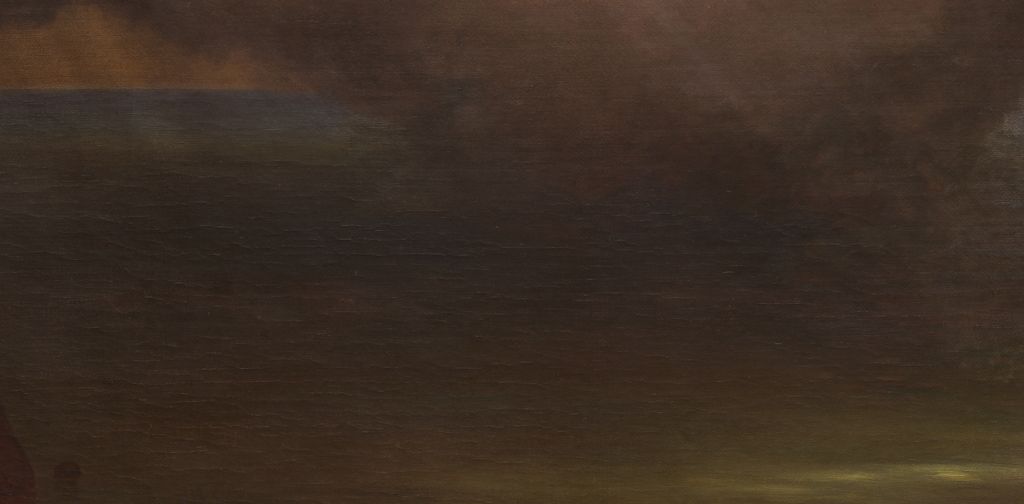
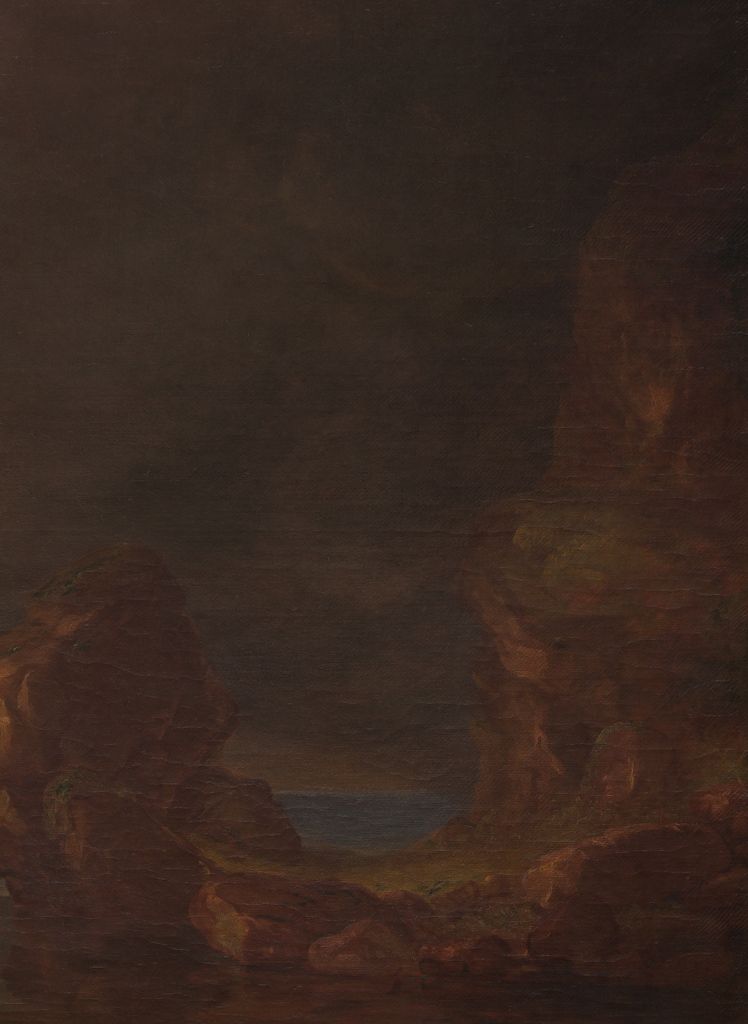
The most striking change from Manhood is the disappearance of confinement. In the preceding scene, jagged cliffs and violently rushing water surround the traveller. Here, water spreads across the canvas, and the remaining rocks no longer form a continuous channel. A tall, irregular formation stands behind the boat at the right; lower rocks interrupt the foreground. Beyond them, the surface recedes towards a dim horizon. The viewer can look across a distance that the river gorge previously denied.
That openness does not immediately mean comfort. The dark water offers no visible destination and little by which to measure its depth. The boat occupies only a small part of the picture, placed low and towards the right. Much of the remaining space belongs to clouds. Without the guardian and the opening above, the expanded setting could appear more lonely than liberating. Cole retains uncertainty at the level of the landscape while answering it through the spiritual figures.
His written explanation identifies the surviving rocks as the last boundary of the earthly world and the ocean as the end towards which human life moves. The boat has reached the river's mouth. This is therefore more than an evening on a broad stretch of water: the change from river to ocean marks a change in the kind of existence being imagined. A bounded route gives way to a space that cannot be navigated by familiar landmarks. [1]
The near absence of growing things reinforces that change. Earlier scenes make plants and trees integral to the journey. Flowers surround the infant, while the youth travels between luxuriant banks. In Old Age, rocky fragments replace those inviting shores. Cole's description connects this barrenness with the loosening of earthly attachments. That connection belongs to his account of the picture; the absence of greenery is something the viewer can observe independently. [1]
Cole arrived at this austerity through revision. Franklin Kelly's catalogue study explains that the 1839 oil studies initially sent the boat in the same direction throughout the sequence. Cole reversed its course in the finished Youth and Old Age, and removed almost all land from the final scene. These changes preceded the 1840 originals. The reversal is consequently part of the series' development, rather than a novelty introduced in the 1842 replica. Kelly suggests practical hanging arrangements or a preference for complementary pairs as possible considerations, without establishing a single cause. [1]
Annotated Details from Old Age
Compare four details with the full composition, then open the photographs for a closer view.
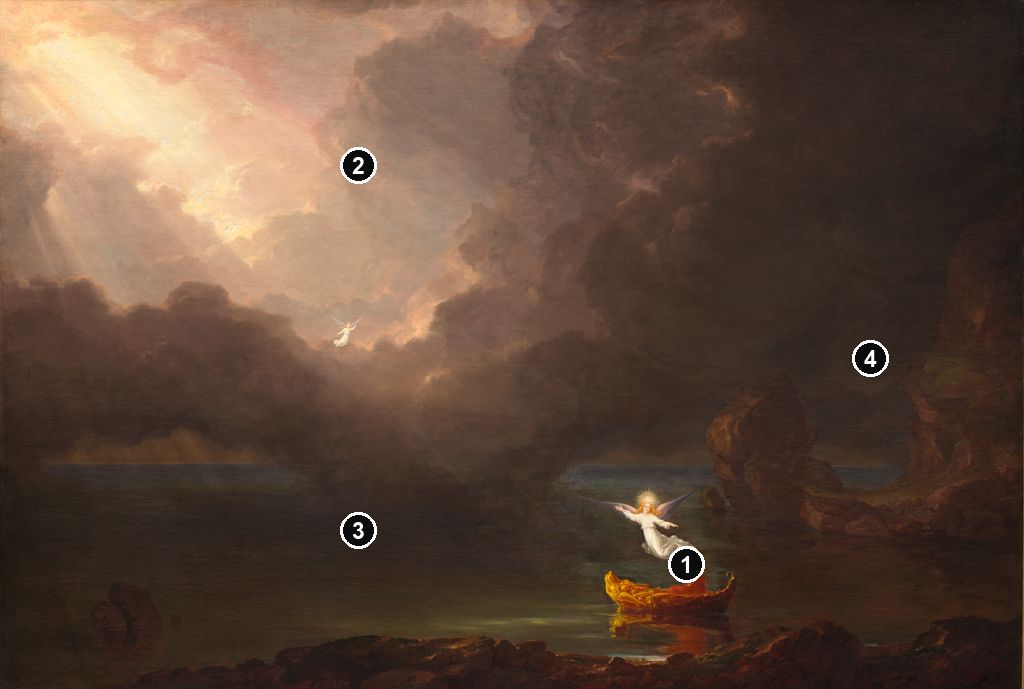
Details from OLD AGE
Each crop comes from the same painting shown above.
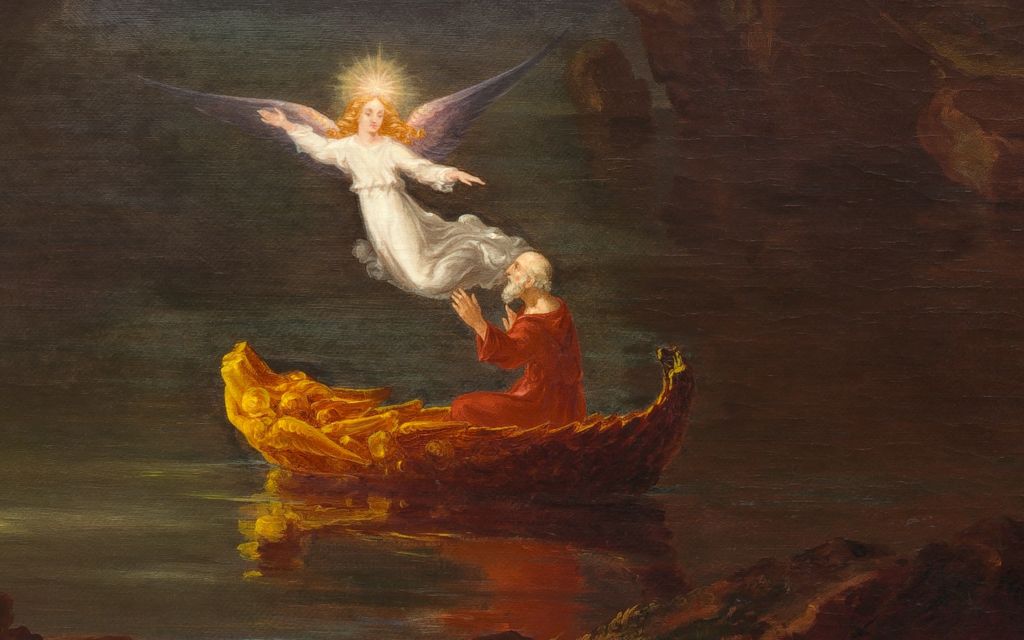
The voyager and angel
The aged traveller meets the angel above the boat. Their renewed proximity changes the isolation of Manhood into a scene of guidance and expectation. [1]
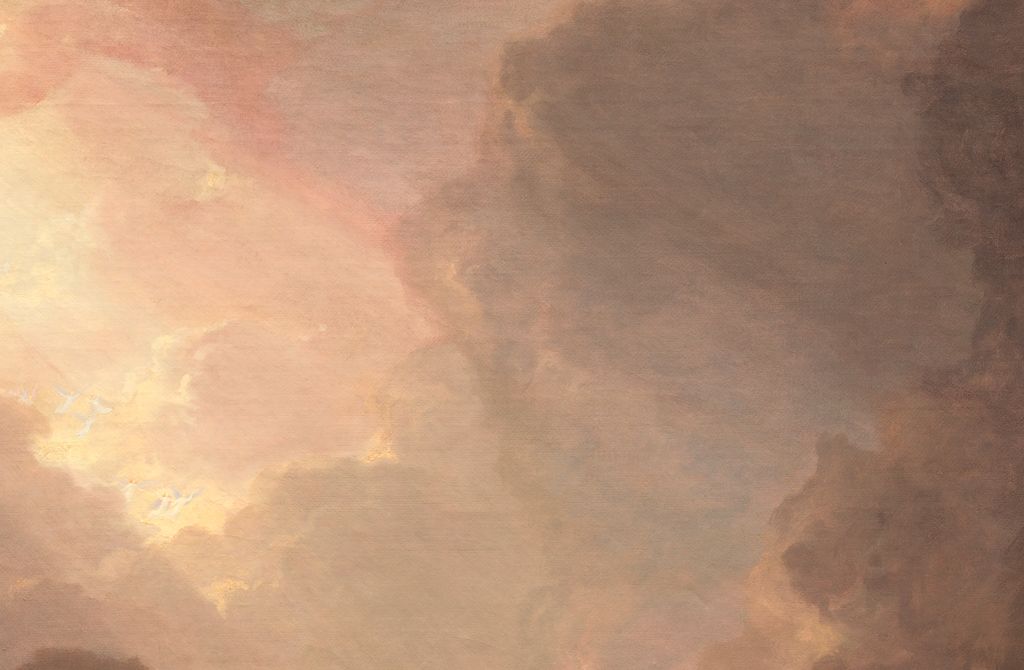
The light beyond the clouds
Light opens through the upper clouds and reveals distant angelic forms. In Cole’s explanation, the opening belongs to a Christian vision of immortality. [1]
The open water
The river has widened into an expanse with little visible shore ahead. The landscape no longer directs attention towards worldly achievement or a difficult passage between rocks. [1]
The dark enclosing rocks
Dark cliffs and vegetation remain at the right edge while the boat faces open water and light. The contrast places the departure from earthly surroundings within the composition. [1]
A worn boat and a responding figure
The boat's warm colour makes it recognisable even against the enormous dark setting. It has been the traveller's enclosure since infancy, but its elaborate ornament now looks damaged and depleted. Cole explicitly identified its sculptured figures as the Hours. Their broken and drooping state in Old Age indicates that the traveller's remaining time is nearly spent. The boat carries the series' argument in an object that has accompanied the viewer through every picture. [1]
This detail also joins present stillness to earlier violence. The voyager has survived the storm, but the vessel bears its consequences. Cole does not replace the damaged boat with a new, triumphant conveyance. The same small craft continues, carrying an aged figure whose red clothing catches the eye beneath the guardian's white drapery. Its vulnerability remains visible even as the picture introduces reassurance.
The man directs his attention upwards. His face, hands and upper body make a compact answering movement towards the angel. At this scale, the gesture matters more than an elaborate facial expression: the figure is small enough that a viewer first recognises his relationship to the light and only then examines his features. The action gives the scene an emotional centre without competing with the sky's immense expansion.
The guardian is equally small, but more luminous. Its spread wings and outstretched arm open the space above the boat, leading the eye away from the seated figure. The old man does not share the guardian's ability to move through that space. The picture connects them through attention and gesture rather than through a shared bodily position. The contrast makes guidance visible while preserving the traveller's physical dependence.
The relationship becomes clearer when compared with Childhood. There, the angel steers while the infant enjoys a world he cannot understand. In Old Age, protection again appears close to the boat, but the traveller now recognises it. Cole's explanation says that the guardian has accompanied him unseen and is finally disclosed to him. Its renewed proximity does not imply that it disappeared from his life between the first and last scenes. [1]
Dependence thus changes its meaning across the sequence. The child lacks experience; the old man has passed through hope, danger and prayer. To see the final scene as a simple return to infancy would miss this change in awareness. The voyager can no longer direct his course, yet he can respond to what the guardian shows him. Cole makes recognition, rather than control of the boat, the important action at the journey's end.
Light that changes the destination
The largest illumination occupies the upper left. Pale gold and rose tones gather around a breach in the clouds, while heavier brown and grey masses extend across the right. Rays reach downwards through the opening. The sky is neither uniformly dark nor completely transformed: brightness emerges from within a composition that retains large areas of obscurity.
A descending angel in the clouds links that distant brightness with the guardian near the boat. Cole's written description speaks of angels approaching along cloudy steps to welcome the traveller into immortal life. The figures establish a route different from the river's. The eye moves upward and across the sky, while the boat remains upon the water below. Earthly travel and heavenly reception become connected without being confused. [1]
This arrangement revises the promise of Youth. In that painting, an aerial palace appears ahead of a confident young man. Cole identified it with hopes of glory and fame, and the river turns away from it. Old Age also offers a radiant destination beyond ordinary reach, but the traveller receives guidance towards it. The earlier scene asks the viewer to notice the gap between aspiration and the river's course. The final scene closes that gap within a religious promise. [1]
Cole's first surviving written outline, from autumn 1836, imagined a glorious city appearing through the clouds in the final picture. The finished scene gives greater prominence to light and welcoming angels. This development matters because it shifts attention away from the architecture of a destination towards an encounter. The final revelation is carried by the old man's response and the guardian's gesture, rather than by another palace demanding close inspection. [1]
The contrast between light and darkness is therefore both visual and explanatory. One can feel the warmth of the opening and the loneliness of the sea before consulting Cole's text. His account then specifies what the light promises. The scene's force depends on both experiences: a viewer sees a fragile human presence under a tremendous sky, while the allegory supplies an answer to that fragility.
Watch: Thomas Cole
Choose a film to explore the artist’s work, its interpretation and its wider setting.
Thomas Cole: Painting the American Landscape (remastered audio)
An introduction to Cole’s landscapes and artistic ambitions.
Watch on YouTubeWhat Cole means by old age
Cole's description gives the picture an unusually definite interpretation. Earthly time is ending, bodily existence is loosening its hold, and the traveller begins to perceive immortal life. The guardian reveals a reality inaccessible to ordinary mortal vision. Death is the threshold around which the composition is organised, but Cole represents the promise beyond it rather than showing the traveller's death as a bodily event. [1]
His explanation also makes a sweeping claim that the world has lost its interest for the aged voyager. That should be read as a statement within this allegory, rather than a reliable description of how every older person experiences life. Cole reduces a lifetime to four selected emotional and spiritual conditions. The clarity gained through that reduction carries a limitation: real lives need not follow his progression from carefree infancy through ambition and trouble to religious release. [1]
The final picture nevertheless leaves room for a viewer's response beyond agreement with its doctrine. Its small human figure, scarred vessel and newly open space invite reflection on vulnerability and the desire for reassurance. Those observations do not require treating the angel as a merely decorative element or overlooking Cole's Christian explanation. The religious meaning and the bodily precariousness coexist; each becomes more affecting through the other.
Two sets and the last Roman canvas
Ward commissioned the first complete series in 1839, but died before its completion. Disputes with the lawyer handling his estate, James S. Huggins, concerned Cole's right to exhibit the pictures. Cole eventually showed the originals in New York in November 1840, then prepared full-size tracings and copies of the figures with his nephew Henry Bayless. These materials enabled the later Roman set after negotiations failed to secure further access to Ward's canvases. [1]
The second set was consequently both a repetition of an established design and another opportunity to make the subject available to viewers. Cole apparently began with Manhood in late 1841. By mid-March 1842, the first three pictures were complete; he finished Old Age in late March or early April. The fourth canvas ended an intense period of work on compositions developed over several years. [1]
Cole did not experience this labour with the uncomplicated assurance of the allegory's conclusion. In his journal on 28 February 1842, he wondered whether the replicas improved upon Ward's set and hoped they would prove profitable. He also worried about the study time they had consumed and longed for his family. His May entries weigh the cost and uncertainty of taking the paintings to England. The creator of this confident spiritual destination remained uncertain about the future of the work itself. [3]
Kelly finds the Roman canvases brighter in colour than the originals but leaves the reason unresolved: deliberate choice and differences in available pigments are possibilities. The second set should not be described as a wholly new conception. In Old Age, the major removal of land and reversal of direction had already occurred before the original finished canvas. The distinction is between the evolution of the composition and its subsequent reconsideration in a replica. [1]
Technical examination adds a more intimate kind of evidence. The National Gallery catalogue records a herringbone twill support, a white ground and coloured secondary grounds, including yellow beneath the man, boat and guardian and red beneath part of the dark sky. Infrared examination detected a change near the horizon in the central rock contour and a possible slight alteration to the man's left hand. Two angels at the bottom of the descending group also left traces of an earlier painted state. These are specific findings about the 1842 canvas, documented in the 1996 catalogue. They do not establish the preparation of the 1840 painting or either version's present condition. [1]
The replicas subsequently travelled through exhibitions in Boston, New York and Philadelphia during 1843–44. They belonged to George K. Shoenberger of Cincinnati by May 1846, possibly from 1845, and eventually entered the National Gallery in 1971. The first set followed a separate history, including purchase and lottery distribution by the American Art-Union in 1848. Remembering these two histories helps explain why a familiar title alone cannot identify a particular canvas. [1]
An ending that reopens the journey
Old Age gives The Voyage of Life a destination, but it also changes how the earlier scenes are understood. The guardian's nearness encourages viewers to reconsider its apparent distance in Manhood. The heavenward opening recalls the youthful palace, while the worn boat recalls the decorated vessel of infancy. What looked like separate landscapes becomes a sustained argument about time, knowledge and guidance.
Later audiences have continued to reconsider that argument. Reynolda's 2021 exhibition The Voyage of Life: Art, Allegory, and Community Response placed the sequence's framework alongside works from three centuries and stories contributed by its community. Its approach demonstrates how Cole's stages can prompt discussion of experiences extending beyond his own model. It does not make the four stages a complete account of those experiences. [4]
The final painting's particular achievement is to make an ending visible without reducing it to disappearance. The voyager remains small, the boat remains fragile, and darkness still occupies much of the world around him. Yet his attention has found a direction. Cole brings the journey to a close through that meeting between a human gesture and a distant light.
Artworks directory
Explore paintings, drawings and studies across Cole’s career. The two Voyage of Life sets appear separately. Dates and study identifications draw on the exhibition and collection catalogues, supplemented by the National Gallery’s drawing records. [2] [5] [6] [7]
| Name | Date | Medium |
|---|---|---|
| The Oxbow | 1836 | Painting |
| The Titan’s Goblet | 1833 | Painting |
| The Architect’s Dream | 1840 | Painting |
| The Course of Empire: The Savage State | ca. 1834 | Painting |
| The Course of Empire: The Arcadian or Pastoral State | ca. 1834 | Painting |
| The Course of Empire: The Consummation of Empire | 1835–1836 | Painting |
| The Course of Empire: Destruction | 1836 | Painting |
| The Course of Empire: Desolation | 1836 | Painting |
| The Voyage of Life: Childhood | 1842 | Painting |
| The Voyage of Life: Youth | 1842 | Painting |
| The Voyage of Life: Manhood | 1842 | Painting |
| The Voyage of Life: Old Age | 1842 | Painting |
| Home in the Woods | 1847 | Painting |
| Distant View of Niagara Falls | 1830 | Painting |
| View on the Catskill—Early Autumn | 1836–37 | Painting |
| Lake with Dead Trees (Catskill) | 1825 | Painting |
| River in the Catskills | 1843 | Painting |
| A View of the Mountain Pass Called the Notch of the White Mountains (Crawford Notch) | 1839 | Painting |
| Expulsion from the Garden of Eden | 1828 | Painting |
| The Subsiding of the Waters of the Deluge | 1829 | Painting |
| The Mountain Ford | 1846 | Painting |
| American Lake Scene | 1844 | Painting |
| A View near Tivoli (Morning) | 1832 | Painting |
| Aqueduct near Rome | 1832 | Painting |
| The Hunter’s Return | 1845 | Painting |
| The Voyage of Life: Childhood (first version) | 1840 | Painting |
| The Voyage of Life: Youth (first version) | 1840 | Painting |
| The Voyage of Life: Manhood (first version) | 1840 | Painting |
| The Voyage of Life: Old Age (first version) | 1840 | Painting |
| Panorama of the Oxbow on the Connecticut River as seen from Mount Holyoke | ca. 1832 (museum); 1833 (2018 catalogue) | Drawing |
| Sketch for The Oxbow | 1836 | Painting |
| From Nature | 1823 | Drawing |
| View of the Round-Top in the Catskill Mountains (Sunny Morning on the Hudson) | 1827 | Painting |
| Scene from The Last of the Mohicans: Cora Kneeling at the Feet of Tamenund | 1827 | Painting |
| View of Monte Video, the Seat of Daniel Wadsworth | 1828 | Painting |
| The Garden of Eden | 1828 | Painting |
| Tomb of General Brock, Queenston Heights, Ontario | 1830 | Painting |
| Effect for Newstead Abbey, Nottinghamshire, England | 1830 | Drawing |
| The Ilissos, from the Parthenon West Pediment | 1829 or 1830 | Drawing |
| Life Study for the Prostrate Shepherd in The Angel Appearing to the Shepherds | 1831–1832 | Painting |
| Interior of the Colosseum, Rome | ca. 1832 | Painting |
| Campagna di Roma (Study for Aqueduct near Rome) | 1832 | Painting |
| Landscape with a Round Temple | ca. 1830s | Painting |
| Stormy Landscape | 1832 | Painting |
| View of Florence from San Miniato | 1837 | Painting |
| Mount Holyoke, Massachusetts (after Basil Hall) | ca. 1829–1831 | Drawing |
| Layout for The Course of Empire | 1833 | Drawing |
| Study for The Course of Empire: The Savage State | ca. 1834 | Painting |
| Study for The Course of Empire: The Arcadian or Pastoral State | ca. 1834 | Painting |
| Study for The Course of Empire: Desolation | 1836 | Painting |
| Study for Dream of Arcadia | 1838 | Painting |
| Clouds | ca. 1830s | Painting |
| Study for The Hunter’s Return | 1845 | Painting |
| Study for Home in the Woods | ca. 1847 | Painting |
| Sunrise in the Catskills | 1826 | Painting |
| Study for The Mountain Ford | 1846 | Drawing |
| Tree Trunks | 1825–1840 | Drawing |
Frequently Asked Questions
It represents the end of earthly life and the prospect of Christian immortality. Cole's written explanation identifies the ocean as life's final destination and the opening in the clouds as a revelation of existence beyond death. [1]
It belongs to the National Gallery of Art in Washington, accession 1971.16.4. The 1840 original belongs to Munson in Utica, New York. [1]
Cole says the guardian has continued to accompany the traveller and is now revealed to him. Its close position completes a relationship established in Childhood, although the old man's awareness differs from the infant's dependence. [1]
Its sculptured figures represent the Hours. Their damaged and drooping condition indicates that earthly time is nearly over; the worn vessel also connects the calm final scene with the storms the traveller has survived. [1]
Cole presents an allegorical ocean rather than identifying a particular coastline. Its role is to show the river of life opening into eternity, with the remaining rocks marking the last earthly shores. [1]
Discussion
Look again at The Voyage of Life: Old Age and compare your reading with the questions below.
Reader Insights
How does the damaged boat affect your response to the angel's promise of safety and welcome?
What changes when you compare the heavenly light in Old Age with the aerial palace in Youth?
Which detail or comparison would you add to this account, and what evidence supports your reading?
Join the Conversation
Share the details that shaped your response, or suggest a comparison for other readers.
References
- Franklin Kelly, “The Voyage of Life”, in American Paintings of the Nineteenth Century, Part I, National Gallery of Art, 1996, printed pp. 95–108; PDF pp. 111–124, with text on pp. 111–118 and 123–124 and plates on pp. 119–122. Cole's explanatory texts are reproduced on printed pp. 102 and 107. Catalogue PDF.
- Elizabeth Mankin Kornhauser and Tim Barringer, Thomas Cole’s Journey: Atlantic Crossings (2018). Career context and artwork/study metadata: catalogue entries 10–66 and chronology, PDF pp. 137–231 and 249–262; related Barringer essay passages, PDF pp. 23–66.
- Thomas Cole, Thoughts & Occurrences, journal transcribed by Peter Fedoryk, Thomas Cole National Historic Site, 2022; entries of 28 February, 22 May and 26 May 1842, PDF pp. 53–54. Journal transcription.
- Reynolda House Museum of American Art, The Voyage of Life: Art, Allegory, and Community Response, exhibition description and selected artwork list, 16 July–12 December 2021. Exhibition record.
- Franklin Kelly et al., American Paintings of the Nineteenth Century, Part I (National Gallery of Art, 1996). Cole catalogue and both Voyage of Life sets, PDF pp. 91–124.
- National Gallery of Art, Study for The Mountain Ford (1846), accession 2015.19.772. Collection record and open-access image.
- National Gallery of Art, Tree Trunks (1825–1840), accession 2015.19.607. Collection metadata and open-access image.
- Splash image source.
Thomas Cole, The Voyage of Life: Old Age, 1842. Oil on canvas, 133.4 × 196.2 cm. National Gallery of Art, Washington, Ailsa Mellon Bruce Fund, accession 1971.16.4. Second version, painted in Rome.