by Tom Gurney
Tom Gurney BSc (Hons) is an art history expert with over 20 years experience
Published on June 19, 2020 / Updated on October 12, 2026
Email: tomgurney1@gmail.com / Phone: +44 7429 011000
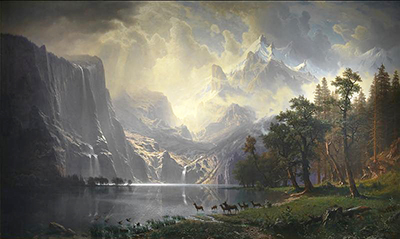
Sundown at Yosemite by Albert Bierstadt
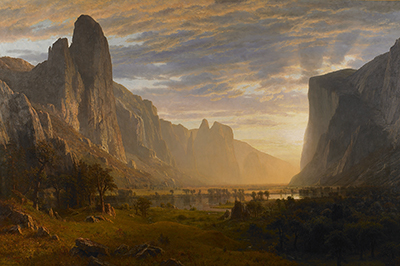
Orange light fills the valley and its reflection, surrounding dark trees and three cattle at the water's edge. In Albert Bierstadt's Sundown at Yosemite, sunset occupies almost the entire middle of the picture. Cool colour survives above and below it, keeping the glow from becoming uniform. The familiar valley is made strange by the intensity of a passing effect.
The Carmen Thyssen Collection dates this oil on canvas to about 1863. It measures 30.5 × 40.6 cm, inventory CTB.1980.9.[1] Those modest dimensions are important. The landscape can seem expansive in reproduction, but its light and broad colour relationships are gathered into a canvas small enough for close viewing.
At a Glance
Where this painting sits in Bierstadt’s career
Dates refer to the paintings, rather than to the journeys behind them. Approximate dates and ranges retain the qualifications in the collection records.
Lake Lucerne
1858Mountain Brook
1863Sundown at Yosemite
About 1863Street in Nassau
c. 1877–1880The Last of the Buffalo
1888–1889The Golden Gate
1900Contents
The valley becomes a field of colour
At the upper left, blue-green passages remain among the warmer sky. Towards the centre, the colour turns yellow and orange. Distant cliffs repeat that warmth, so their edges can seem to emerge from the atmosphere rather than stand sharply against it. The sunset affects how we distinguish the land, as well as what colour we assign to it.
The left-hand formation has a broad rounded face beside narrower upright shapes. Darker marks provide some internal structure, but the main effect is a mass of heated colour. Across the valley, a steep wall enters from the right edge. Together, these rock formations enclose the brightest opening without giving the distance a sharply defined endpoint.
The orange is not confined to the sky. It passes into the mountains, water and distant bank, tying different parts of the landscape to the same hour. Because the warmth extends so widely, a small dark tree or animal becomes unusually conspicuous. The picture's relationships depend on what remains distinct within the glow.
At the top, the cooler patches keep the sky varied. They also help the warm areas feel luminous: orange has a stronger presence when it is seen beside something cooler. Bierstadt allows this contrast to remain evident across the surface. The picture does not require every cloud and ridge to be separately described in order to suggest a large, changing atmosphere.
Water, trees and cattle
The water stretches horizontally beneath the cliffs. Its warm surface repeats the sky, with reflected tree trunks making thin interruptions. The far bank forms a low division between the water and the distant orange space. This horizontal arrangement steadies the composition beneath the rising rocks.
Tall trees at the right carry the darker foreground upwards. Their foliage crosses both cliff and sky, joining the near shore to the taller forms beyond. They are more sharply defined than the distance, but their fine branches leave openings through which the warm atmosphere remains visible. The foreground is a frame rather than a solid barrier.
Three cattle occupy the shore. One bends towards the water while the others stand nearby. Their silhouettes give the eye familiar forms within the broader fields of colour. They also supply a different scale of activity: the light spreads across the valley, but an animal's movement remains local and ordinary.
The near grass is green and dark, with warmer touches towards the edge of the water. This band gives the spectator a position from which to look. We encounter the cattle and shore first, then pass across reflection towards the cliffs. The sunset reaches the foreground without making all its objects dissolve into the same atmospheric colour.
The cattle also complicate an easy description of the scene as a wholly untouched landscape. Their presence is part of the picture, even where no building or person is conspicuous. The image gathers monumental scenery and domestic animals into the same setting. Its beauty does not depend on an absence of every sign of use.
A small study of changing light
Elizabeth Garrity Ellis's collection essay places Sundown among the quickly worked oil studies associated with Bierstadt's 1863 Yosemite journey. She connects their attention to colour with Fitz Hugh Ludlow's account of the artists studying the valley.[1] That context gives the painting a different emphasis from an elaborate exhibition panorama: a transitory relationship of light and colour becomes its principal interest.
The visible arrangement supports such a reading. The mountains establish the setting, but their internal detail does not compete with the broad warm atmosphere. Nearer forms are concentrated around the shore. The picture's coherence comes from how these areas interact, rather than from an accumulation of separately finished incidents.
A small study need not be regarded as an incomplete large painting. It can preserve an effect worth returning to, and it can make that effect convincing at its own scale. Here the reflection is integral to the sunset's reach. The warm sky is made more encompassing because water repeats it below the dark trees.
What the word “study” can mean
Conservators Lance Mayer and Gay Myers document considerable variety among Bierstadt's studies. They discuss Italian Costume Studies, where portions of blue paper remain exposed, and the more highly finished South Dome, Yosemite Valley, whose surface is fully covered with paint. The latter could be appreciated as an independent painting as well as a study.[2]
These are different objects from Sundown, with different supports and histories. Their usefulness here is to clarify a working category. A study can gather information rapidly, work through an arrangement or develop a subject to considerable finish. Calling a picture a study does not tell us all its material characteristics or determine how complete it should look.
The comparison also helps explain why Bierstadt's practice cannot be reduced to a contrast between rough outdoor sketches and meticulous studio canvases. The surviving works occupy a range of purposes and degrees of finish. Each needs to be considered in its own right. This small sunset remains engaging as a self-contained arrangement, whether approached as a record of light or as a completed landscape experience.
The language surrounding Yosemite
Ellis places the sunset within a wider history of writing about the valley. Thomas Starr King, a Unitarian minister, described Yosemite in letters and planned to accompany Bierstadt and Ludlow. Her essay relates the glowing landscape to religious and national expectations surrounding the American West.[1]
That historical language helps explain why a natural effect could acquire significance beyond weather. A spectacular sunset offered writers and spectators a way to speak about revelation, promise and an extraordinary landscape. Such meanings belonged to a cultural setting; they were not automatically fixed by a particular orange passage or cliff shape.
Barbara Novak's selection of nineteenth-century writings in MoMA's The Natural Paradise shows how closely observations of scenery could be joined to spiritual and moral arguments. Her section on skies includes Thomas Cole's description of the sky as the source of a landscape's changing light, colour and expression.[3] The context makes attention to atmosphere a serious artistic concern rather than a decorative addition to topography.
Bierstadt's picture gives that concern a visible form. The sunset changes the appearance of the whole valley. Its reach explains why the cattle, trees and water feel part of one encounter even though their shapes differ. We can appreciate this effect without assigning the painter a precise religious statement that the canvas does not spell out.
Small sunset and large sunset
The most useful comparison is Sunset in the Yosemite Valley, the much larger Haggin canvas of 1868. Ellis includes that work in her discussion of the Yosemite sunset subject.[1] The two pictures organise their light differently, even where the broad theme is shared.
In Sundown, warmth extends across much of the landscape and its reflection. The cattle are easy to locate because their dark silhouettes meet a bright expanse of water. The light feels pervasive. In the Haggin painting, broad shadows and heavy cloud surround a more concentrated opening of brilliance. The river carries that light into a foreground that remains harder to penetrate.
Size also changes the encounter. The Thyssen canvas can be examined at close range as a compact whole. The larger painting gives its cliffs and dark near ground greater physical presence. It turns contrast into a more imposing spectacle. These differences concern composition and scale, rather than a documented claim that the small canvas was the direct preparatory model for every part of the larger one.
Looking Down Yosemite Valley, California offers another way to compare colour and distance. Its broad prospect separates the foreground and receding valley more carefully. Sundown brings many of those distances together through the common warmth of sunset. It asks us to attend to a particular transformation of the place.
The small canvas's interest lies in that concentration. The cliffs identify a substantial world, the shore provides a place within it, and the water extends the evening's colour. Bierstadt gives a passing effect enough structure to remain convincing after the light itself has gone.
Watch: Albert Bierstadt
Five perspectives on his paintings and their historical setting.
American Landscape Painting: Albert Bierstadt and the American Land
A Museum of Fine Arts, Boston presentation on American Landscape Painting: Albert Bierstadt and the American Land.
Explore Bierstadt’s artworks
Discussion
Orange light spreads through the valley and its reflection. How does this small canvas make a passing colour effect feel expansive?
Reader Insights
Where do blue-green passages interrupt the warmth, and how do they keep the sunset from becoming uniform?
What do the dark trees and three cattle contribute to an image whose middle distance is dominated by orange light?
How does the conservation account of Bierstadt’s varied studies broaden your understanding of this quickly worked sunset?
Join the Conversation
Share a specific observation, documented connection or comparison from Sundown at Yosemite.
References
- Elizabeth Garrity Ellis; Museo Nacional Thyssen-Bornemisza. Sundown at Yosemite. Carmen Thyssen Collection, CTB.1980.9; metadata and signed essay on studies, travel writing and sunset imagery. View source text
- Lance Mayer and Gay Myers. Bierstadt and Other 19th-Century American Painters in Context. Journal of the American Institute for Conservation 38, 1999, section 3.1, “Studies”; distinctions among surviving study objects. View source text
- Barbara Novak. “On Divers Themes from Nature,” in The Natural Paradise: Painting in America, 1800–1950. Edited by Kynaston McShine, Museum of Modern Art, 1976, especially “On Skies”; historical writing on light and landscape. View source text