by Tom Gurney
Tom Gurney BSc (Hons) is an art history expert with over 20 years experience
Published on June 19, 2020 / Updated on October 12, 2026
Email: tomgurney1@gmail.com / Phone: +44 7429 011000
Kern's River Valley, California by Albert Bierstadt
A broad stretch of blue-green water opens beneath pale mountain walls. On the near bank, tall trees rise through shade and warm light; horses and small human figures occupy the lower part of the scene. Albert Bierstadt's Kern's River Valley, California makes the river an interval between the wooded foreground and a hazier distance.
Wikimedia Commons catalogues the reproduced painting as circa 1871, oil on canvas, approximately 90.2 × 132.1 centimetres, in a private collection.[1] Its cited Athenaeum entry, preserved in a 2015 web archive, gives the same approximate date and medium, with measurements of 90.17 × 132.08 centimetres. That record identifies its contributor and a June 2003 entry date.[2]
These are linked secondary descriptions, rather than two independent confirmations from an owner or auction catalogue. The more precise numbers in the archived entry do not provide stronger evidence that the original canvas was recently measured. Its anonymous private-collection label does not identify a present owner. A securely matched primary object record remains needed to confirm the painting's date, support and physical dimensions. The title connects the scene with the Kern River country, but does not securely identify an exact viewpoint or each distant mountain.
At a Glance
Where this painting sits in Bierstadt’s career
Dates refer to the paintings, rather than to the journeys behind them. Approximate dates and ranges retain the qualifications in the collection records.
Lake Lucerne
1858Mountain Brook
1863Street in Nassau
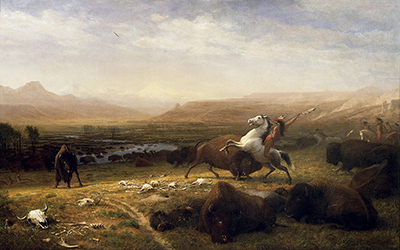
c. 1877–1880The Last of the Buffalo
1888–1889The Golden Gate
1900Kern's River Valley, California
Date unconfirmedContents
People and horses beside the bank
Two horses stand in the water near the lower edge. The darker animal carries a rider; the paler one has a dark load across its back. Their legs interrupt the shallow-looking foreground water, while their bodies stand out against the much larger blue-green surface behind them.
Farther left, another horse stands on the grass near the trees. A small seated figure appears beside the base of the leaning trunk. The separation between this pair and the animals at the water creates two places of human occupation rather than a single compact group.
The image does not establish the travellers' identities, destination or relationship to Bierstadt. Nor is the seated figure's activity clearly enough described to identify a book or sketching materials. The group can be understood as an interruption within the landscape without turning it into an autobiographical portrait.
The load on the pale horse suggests the practical business of travelling with equipment. Yet its contents remain unresolved. What the painting shows most clearly is the relationship of scale: the horses are substantial foreground forms, but slight beside the trees and mountain walls.
Upright trunks and one leaning tree
The left edge contains a succession of relatively straight trunks. Dark foliage gathers between them, while warmer light catches some of their bark and the ground beneath. This forest has depth within itself, with nearer trunks obscuring those behind.
One tree leans away from that upright group and rises through the open centre-left. Its trunk curves and divides higher up, spreading branches across the upper part of the image. The lighter leaves and sky between them give the canopy a more delicate surface than the dense woodland at the edge.
This difference creates a transition from enclosure to openness. The straight trunks establish a shaded boundary; the leaning tree reaches towards the river and sky. Its angle also helps connect the seated figure near its base with the wider view beyond.
The grassy bank carries small pale marks among its greens and golds. Shadows divide this illuminated surface into irregular areas, making the ground more varied than a continuous bright strip. The near shore then bends towards the horses and continues along the lower edge of the water.
The river as an open middle ground
The water occupies much of the lower right and centre. Its nearest passages are relatively transparent in appearance, while farther out the blue-green colour becomes more continuous. Narrow pale marks cross the surface and suggest ripples or reflected light.
A few bare branches project above the water near the right. Their thin angled lines interrupt the broader horizontal strokes. They provide something distinct to examine within an area otherwise described through shifts of colour and brightness.
These effects do not measure the river's depth, current speed or temperature. A pale band might suggest disturbed water, reflection or both; it cannot establish where the flow is fastest. Bierstadt's painted surface should be examined before converting every colour change into a physical property of the river.
Farther away, the water narrows towards an opening between the two banks. Trees gather on a low strip of land to the right, their forms becoming softer towards the centre. The river therefore gives the eye a route into the composition, even where the exact continuation of its channel becomes difficult to follow.
Mountain walls in softened light
The nearest trees have comparatively sharp outlines. Beyond them, the rock faces appear in pale grey, violet and pink tones, with some divisions losing definition in haze. This contrast makes the distance feel removed from the detailed bank.
A darker, pointed rock form rises towards the centre-left, while a larger wall occupies the right. Between them lie softer slopes and higher pale forms. Their overlapping silhouettes create successive layers rather than a single backdrop.
Light is strongest in the upper central opening. The canopy cuts into it with fine branches, while the distant slopes receive a more diffuse illumination. The scene can suggest morning through its gentle glow, but the reproduction alone does not establish a precise hour.
The painting's organisation is more useful to describe directly than to reduce to a fixed rule of thirds. The leaning trunk, broad water and opposing mountain walls work together, but their relationships include diagonals, overlapping masses and changes in definition as well as divisions of the canvas.
The Kern River country beyond the title
The National Wild and Scenic Rivers System describes the Kern's North and South Forks as passing through varied terrain, including granite formations, waterfalls, open meadows and steep-sided canyons. Its account identifies glacially sculpted features in the North Fork canyon and substantial differences across the river corridor.[3]
This wider geography helps explain why a Kern River title can evoke more than one kind of landscape. It does not establish which reach Bierstadt painted or identify a particular cliff from its silhouette. Modern geographic descriptions and the nineteenth-century composition answer different questions.
The water here appears broad and relatively sheltered. Elsewhere the river system includes sharply contrasting conditions. The painting selects a particular visual effect, rather than providing a comprehensive portrait of the watershed.
An 1872 report of travel and studies
Michael D. Schroeder's Gilbert Munger document archive transcribes an art notice from the San Francisco Daily Evening Bulletin dated 9 November 1872. It reports that Bierstadt had returned from the “Kern River country” and subsequently made trips near Donner Lake and Lake Tahoe to produce studies.[4]
This is a transcription of a period report; the original newspaper page has not been inspected here. It offers evidence for the artist's regional travel, while remaining separate from the provisional circa 1871 date assigned to this reproduction. It does not establish that the present painting was made during that trip or completed outdoors.
The Metropolitan Museum of Art's account of a different work, Owens Valley, California, dated 1872, also connects Bierstadt with an extended western journey that summer. The museum describes that painting as oil on paper laid down on canvas.[5] Its specific identification and support belong to the Owens Valley work, not automatically to the Kern scene.
Together, these records place southern Sierra subjects within a period of travel and study. They strengthen the regional context without filling gaps in the present painting's ownership or production history.
Looking back towards the travellers
The large mountain walls can initially make the foreground activity seem incidental. Look again at the separation between the rider in the water and the seated figure beside the tree. Their positions lead attention across the near bank and give the scene more than one human point of entry.
Then follow the thin branches above the river towards the softer trees and the central opening. Bierstadt balances details that can be individually recognised with areas where light and atmosphere make forms less definite. That movement between close ground and distant space gives the painting its breadth, even while its exact object history remains incompletely documented.
Watch: Albert Bierstadt
Five perspectives on his paintings and their historical setting.
American Landscape Painting: Albert Bierstadt and the American Land
A Museum of Fine Arts, Boston presentation on American Landscape Painting: Albert Bierstadt and the American Land.
Explore Bierstadt’s artworks
Discussion
How do the river’s travellers connect the wooded near bank with the pale mountain walls?
Reader Insights
Compare the rider in the water with the seated figure beside the tree. How does their separation give the near ground more than one point of attention?
Follow the straight trunks and leaning tree into the hazier rock forms. Which contrast most strongly separates the bank from the mountains?
Read the transcribed 1872 notice beside the river-region description. What can those accounts establish without identifying every painted feature?
Join the Conversation
Share a specific observation, documented connection or comparison from Kern's River Valley, California.
References
- Wikimedia Commons. Bierstadt Albert Kern-s River Valley California.jpg. Reproduction metadata, reported circa 1871 date, medium and dimensions; current owner unverified. View source text
- The Athenaeum, archived by the Internet Archive. Kern River Valley, California, object 11382, capture dated 22 June 2015. Member-entered record dated 24 June 2003, cited by Commons; circa 1871, oil on canvas, 90.17 × 132.08 cm and anonymous private collection. Secondary source chain, without primary object confirmation. View source text
- National Wild and Scenic Rivers System. Kern River. River-corridor scenery and geology, used as regional context. View source text
- Michael D. Schroeder. The Art of Gilbert Munger: Document Archive, selected 9 November 1872 entry. Transcription attributed to the San Francisco Daily Evening Bulletin. View source text
- The Metropolitan Museum of Art. Owens Valley, California, 1872, L.2024.16.2. Collection record and account of Bierstadt's western travel. View source text