by Tom Gurney
Tom Gurney BSc (Hons) is an art history expert with over 20 years experience
Published on June 19, 2020 / Updated on October 12, 2026
Email: tomgurney1@gmail.com / Phone: +44 7429 011000
Bay of Monterey by Albert Bierstadt
Dark rocks rise above a pale beach, while a small wave breaks at the left. Albert Bierstadt's Bay of Monterey draws attention to the meeting of sand, stone, vegetation and sea. Its open water occupies a comparatively narrow interval beside the more substantial forms of the shore.
A matching painting appeared at Brunk Auctions on 28 May 2025 as Cala, Bay of Monterey. The catalogue identifies oil on paper mounted on Masonite, measuring 13¾ by 18¾ inches, approximately 34.9 by 47.6 centimetres, with the signature at the lower left. It supplies no precise painting date.[1]
At a Glance
Where this painting sits in Bierstadt’s career
Dates refer to the paintings, rather than to the journeys behind them. Approximate dates and ranges retain the qualifications in the collection records.
Lake Lucerne
1858Mountain Brook
1863Street in Nassau
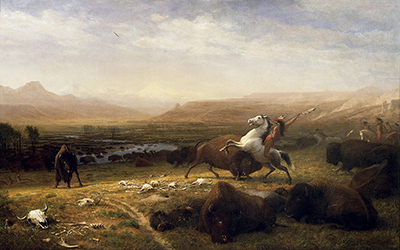
c. 1877–1880The Last of the Buffalo
1888–1889The Golden Gate
1900Bay of Monterey
UndatedContents
The rocks above the beach
The largest formation stands right of centre, where steep faces rise from the sand. A narrow opening interrupts its jagged profile, allowing a small patch of pale sky to show through. Beside it, a broader, flatter-topped mass extends towards the vegetation at the right.
Below these high rocks, a smaller upright formation has a markedly different outline. Its narrow middle widens towards the top, making it conspicuous against the blue water. The contrast between its slender shape and the larger mass behind it creates a sequence of forms rather than one continuous wall.
The distant coast is quieter. Low, grey-blue shapes extend along the left-hand horizon, and their edges soften into the surrounding atmosphere. The nearby rocks have darker shadows and clearer divisions between their faces. That difference separates the foreground shore from the land across the water.
The eye can therefore move through the picture in two directions. The beach leads outward towards the sea, while the rocks pull attention upward to their uneven profiles. Both movements begin among the much lower stones scattered near the viewer.
Sand, stones and vegetation
The foreground boulders vary in size and shape. Some appear rounded, while smaller fragments interrupt the light sand between them. Shadows distinguish their surfaces and reveal the uneven ground without making every stone equally prominent.
The broad dark rock at the lower left cuts across the picture's edge. Behind it, the sand opens into lighter passages that continue towards the larger formation. These intervals give the shore depth: the viewer sees around and between the stones rather than confronting a flat row of objects.
Vegetation occupies the sloping ground at the right. Thin upright marks emerge from pale sand, becoming denser towards the shaded bank. A light, fallen branch lies across the darker growth above them. Its colour and horizontal direction make it distinct from both the plants and the tall rock faces.
The picture's sense of place depends on these differences. Sand catches light broadly; stones interrupt it with heavier forms; vegetation breaks it into smaller marks. The beach remains varied even though no human activity is conspicuous in the view.
A history in the auction catalogue
Brunk records the painting at Kennedy Galleries by 1960 and exhibited there in 1961. Its listed history also includes Maxwell Galleries, the Carmel Museum of Art and Hirschl & Adler in 1982, before its appearance among the furnishings of Historic Iris Court in 2025.[1]
The catalogue notes its inclusion in the Albert Bierstadt Catalogue Raisonné Project's database. That is a research-project record, rather than evidence of a completed published catalogue entry. The sale history does not establish its present location.[1]
A coast that continues to change
The U.S. Geological Survey's Monterey Bay Marine Sanctuary Geological Processes and Framework describes the region as an open system linking land with the offshore environment. Sediment derived from land enters the sea, where storms, currents and other disturbances can move it onward. The account also connects the survival of beaches and rocky coastlines with the balance between erosion and deposition.[2]
This gives the scene's combination of sand and exposed rock a wider significance. A beach is part of an active exchange of material, even when a painting presents it under quiet conditions. The breaking wave supplies a visible moment of motion within a shore whose larger changes take much longer to perceive.
The regional account cannot identify the painted rock's geological formation or measure erosion at this particular site. It helps explain the kinds of processes connecting the picture's different materials, without turning its forms into a geological survey.[2]
More than an empty stretch of sand
NOAA's Monterey Bay National Marine Sanctuary account describes rocky shores as habitats for diverse intertidal organisms. Repeated exposure and immersion bring changes in temperature, drying and wave action, helping to create different zones of marine life along the shore.[3]
That account encourages a closer reading of the spaces between the painted rocks. The painting makes sand, stone and a breaking wave visible, but the reproduction does not allow a reliable identification of small intertidal animals or algae. Their absence from the picture's description is different from evidence that the shore lacked life.
The wave at the left is especially useful to notice. A narrow white crest rises against a dark stone and spreads across the blue water. It introduces activity without overwhelming the larger arrangement of rocks and beach. The calm belongs to the composition; the coastal habitat remains subject to recurring movement and exposure.[3]
Bierstadt's other Monterey subject
The U.S. House of Representatives holds Bierstadt's Entrance into Monterey, dated 1876. The canvas measures 72 by 120 inches and was acquired in 1878. Its institutional account describes a Spanish expedition conducting a Catholic Mass beside the bay, with domestic animals representing the West's abundance. It hung in the House Chamber with Discovery of the Hudson River until 1901.[4]
That work makes Monterey the setting for a historical narrative. Bay of Monterey directs attention instead towards the immediate physical character of a beach. The shared place-name does not make the small shore painting a study for the large canvas or an illustration of the same event.[4]
A regional history beyond the painted view
The Esselen Tribe of Monterey County's own history describes the severe consequences of the mission system for Esselen, Rumsen and Salinan people, including separation of families and restrictions on languages and cultural practices. It also recounts the displacement associated with later land grants.[5]
Read alongside the House's account of Bierstadt's ceremonial scene, this history gives a different perspective on the region represented by his Monterey subjects. A coast could be celebrated as scenery or as the setting for European arrival while also belonging to communities whose lives were profoundly disrupted.
The Tribe's account does not identify the exact beach in Bay of Monterey. It supplies regional history that cannot be recovered from the empty-looking shore alone. The lack of painted figures leaves that human history outside the picture's visible subject.[5]
Looking from the shore
Return to the small upright rock against the water. Its unusual outline gives the eye a point of focus between the low foreground boulders and the larger cliff-like mass. Around it, pale sand and blue water keep the different forms legible.
Bierstadt's view offers several kinds of scale within a small composition: stones close enough to inspect, rocks rising above the bank, and a distant coast softened by atmosphere. Its quietness emerges from the way those distances are held together while the wave continues to break beside them.
Watch: Albert Bierstadt
Five perspectives on his paintings and their historical setting.
American Landscape Painting: Albert Bierstadt and the American Land
A Museum of Fine Arts, Boston presentation on American Landscape Painting: Albert Bierstadt and the American Land.
Explore Bierstadt’s artworks
Discussion
Which relationship dominates this beach view: rock and sand, shore and water, or nearby detail and distant space?
Reader Insights
Find the small opening that reveals the sky. How does it change the apparent weight of the large formation?
Read the geological and intertidal accounts beside the painted rocks. What processes and living relationships extend beyond what this still image shows?
Compare this shore with Entrance into Monterey. How does a coastal place acquire different meanings in a beach scene and a historical narrative?
Join the Conversation
Share a specific observation, documented connection or comparison from Bay of Monterey.
References
- Brunk Auctions. Cala, Bay of Monterey, Historic Iris Court Sale, 28 May 2025, lot 56. Matching lot photograph, materials, dimensions and recorded history. View source text
- U.S. Geological Survey. Monterey Bay Marine Sanctuary Geological Processes and Framework. Regional geological system, sediment movement and coastline change. View source text
- NOAA, Monterey Bay National Marine Sanctuary. “Tidepooling Tips.” Rocky-shore habitats and intertidal environmental changes. View source text
- U.S. House of Representatives, History, Art & Archives. Entrance into Monterey, 1876, accession 2004.002.000. Object record and historical interpretation. View source text
- Esselen Tribe of Monterey County. “Our History.” The Tribe's account of mission-era disruption and later displacement. View source text