by Tom Gurney
Tom Gurney BSc (Hons) is an art history expert with over 20 years experience
Published on June 19, 2020 / Updated on October 12, 2026
Email: tomgurney1@gmail.com / Phone: +44 7429 011000
Thunderstorm in the Rocky Mountains by Albert Bierstadt
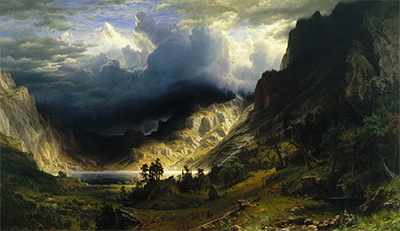
Deer gather along a rocky shoreline while enormous clouds fill the sky above them. A broken tree rises on the left, its bare branches sharply outlined against a brighter opening. Albert Bierstadt's Thunderstorm in the Rocky Mountains combines the stillness of animals at the water with an atmosphere that makes the surrounding landscape feel unsettled.
The Museum of Fine Arts, Boston's historical AMICA record identifies the work as an oil on canvas of 1859, measuring 48.58 × 73.98 centimetres, accession 43.134.[1] Its credit line names Mrs. Edward Hale and Mrs. John Carroll Perkins, who gave it in memory of their father, Elias T. Milliken. The record supplies an object identity and collection history, rather than a guarantee of where visitors can see it today.
At a Glance
Where this painting sits in Bierstadt’s career
Dates refer to the paintings, rather than to the journeys behind them. Approximate dates and ranges retain the qualifications in the collection records.
Lake Lucerne
1858Mountain Brook
1863Street in Nassau
c. 1877–1880The Last of the Buffalo
1888–1889The Golden Gate
1900Contents
- A sky larger than the landscape below
- Light falls unevenly across the shore
- The broken tree and its surroundings
- Animals poised between land and water
- Rocks, plants and the edge of the water
- Storm scenery in the Rocky Mountain west
- The date within Bierstadt's western career
- A photographic way of organising space
- Comparing a larger mountain panorama
A sky larger than the landscape below
The clouds occupy most of the canvas. The land forms a comparatively narrow band, with the deer, trees and nearby rocks gathered along its lower edge. This distribution makes weather the largest presence before the viewer has examined any individual animal.
The sky has several layers. Pale, rounded clouds rise near the centre; deeper grey passages collect towards the right; flatter cloud stretches across the upper edge. Openings reveal blue between these masses, so the atmosphere is neither uniformly dark nor entirely closed.
Light catches particular cloud edges, giving their folds a sense of volume. Darker interiors appear to sit behind brighter rims. The eye can move through these changing tones as it would between overlapping forms on the ground, finding depth in the sky itself.
Light falls unevenly across the shore
The foreground is not lit as a continuous strip. Grass near the deer catches warm highlights, while trees behind them form a dark band. Certain stones stand out brightly against the water; other rocky surfaces remain almost hidden within brown shadow.
This unequal illumination brings the animals forward. Their reddish bodies are separated from the dark landscape behind them, making the group easier to find than its small scale might suggest. The illuminated grass and stones then connect the gathering to the nearer shore.
Towards the right, the water deepens in colour beneath the darker sky. On the left, a brighter atmospheric opening sets off the bare tree. These differences hold the picture together through a series of contrasts rather than one broad, even glow.
The light does not establish a recorded hour or the exact direction of a moving storm. Its visible role is compositional: it selects bodies and surfaces within a landscape whose greater part remains shaded.
The broken tree and its surroundings
The prominent trunk on the left is twisted and abruptly divided. One branch reaches sideways, while an upper section bends towards the brighter clouds. Its irregular outline gives the foreground a vertical accent that differs from the smoother rising forms in the sky.
Nearby living trees have fuller crowns. Their dark foliage makes the bare trunk easier to distinguish and places it among several kinds of growth. The contrast can suggest age, damage and change without proving that lightning caused this particular tree's condition.
At its base, stones and rough ground continue the sense of broken forms. A low rocky rise leads towards an upright fragment nearer the centre. Together, these shapes carry the eye from the immediate foreground towards the distant mountain band.
The tree's position also gives it a framing role. It draws attention to the left side and then directs the gaze along its angled branches towards the clouds. It remains an element of the landscape rather than a documented symbol with one securely established meaning.
Animals poised between land and water
The deer are distributed across a narrow strip beside the water. Some hold their heads upright; others lower them towards the surface. Their different postures make the group more varied than a row of repeated silhouettes.
The animal farther left stands on the grassy bank, separated slightly from the others by rocks and open ground. Nearer the centre, overlapping bodies bring the gathering closer together. Towards the right, lowered heads and slender legs appear beside reflections and dark water.
Their positions allow quiet activity to continue beneath the unsettled sky. The group is not shown running or fleeing. Raised heads might invite a viewer to imagine alertness, but the painting does not establish a particular reaction to thunder or a coming downpour.
This restraint gives the scene much of its tension. Weather fills the larger world around the deer, while their immediate actions remain small and recognisable. Their warm colour becomes a point of attention within the cooler, darker expanse.
Rocks, plants and the edge of the water
Several prominent rocks interrupt the lower foreground. Their angular surfaces contrast with the deer’s smoother bodies and the thin vertical marks of shoreline vegetation. Small highlights catch their tops, while their sides remain dark.
Plants emerge from the shallows in scattered groups. Reflections and short marks across the surface make the boundary between ground and water less definite than the distant tree line. The eye has to examine these nearer passages more slowly to distinguish stems, stones and illuminated ripples.
The effect gives the foreground substance. It is not simply a platform for the animals, but a varied habitat made from wet edges, rough surfaces and low growth. The reproduction does not securely identify a named river or supply a measure of water depth; neither is needed to recognise this carefully organised shore.
Storm scenery in the Rocky Mountain west
NOAA explains that thunderstorms require moisture, unstable air and a lifting mechanism. It also describes mountain terrain forcing air upwards and notes the occurrence of summer upslope thunderstorms in the Rocky Mountain west.[2] This general context makes the association between mountain landforms and rising storm clouds understandable.
It does not turn the painting into a meteorological observation. The image cannot establish its clouds' height, an exact storm category or a particular day's weather. Thunder, a sound named by the title, is suggested through atmosphere rather than made directly visible.
The blue openings are therefore as important as the darkness. They let the viewer see changes within the sky, while the lower landscape remains partly illuminated. The scene presents weather as a developing presence, without recording its complete course.
The date within Bierstadt's western career
The year 1859 also belongs to Bierstadt's first western journey. The Metropolitan Museum of Art's account of the separate The Rocky Mountains, Lander's Peak explains that he accompanied Frederick W. Lander's government survey expedition and reached the Wind River Range that summer.[3]
This supplies a useful historical setting, but does not establish the precise site or circumstances of Thunderstorm in the Rocky Mountains. Its date alone cannot prove that the canvas was finished outdoors during the expedition. A specific preparatory study or dated account would be needed to reconstruct that process.
The monogram and date reported at the lower left as “AB 59” provide another identifying feature in the reproduction record.[4] They support the work's established date without identifying the particular clouds, animals or shoreline as a single witnessed event.
A photographic way of organising space
Matthew Baigell proposes a photographic influence on this early landscape in his discussion reprinted by Resource Library.[5] He points to the compression of land into the lower part of the canvas, the sharp foreground boulders and the abrupt tonal division between nearby hills and distant mountains. His argument concerns the organisation of a view, rather than the identification of a surviving photograph that Bierstadt copied.
The low mountain band makes the proposal useful when looking at the painting. Instead of leading steadily upwards through a sequence of slopes, the eye crosses the shore and then encounters an immense field of cloud. The rocks seem close enough to inspect, while the hills beyond occupy very little of the picture's height. Near detail and distant expanse coexist within a compressed strip.
Baigell also acknowledges other explanations for the contrasting dark and light ridges, including Düsseldorf landscape painting and the effects of cloudy weather. That qualification matters: a resemblance to photographic organisation does not establish a single source or a particular camera operator. The composition can be understood through his proposal while its precise dependence on photography remains open.
Comparing a larger mountain panorama
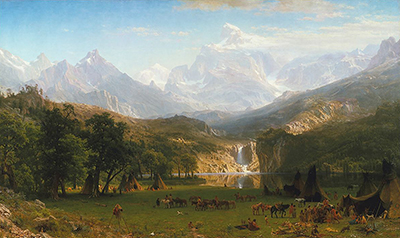
The Met's Lander's Peak, painted in 1863, measures 186.7 × 306.7 centimetres. It places an extensive foreground encampment below mountains and water, giving human activity a much larger compositional role.
In the smaller Thunderstorm, the animals and broken tree occupy a low landscape strip, while the great cloud field dominates the view. The difference is visible as well as physical: one composition allows the eye to move among numerous foreground activities; the other repeatedly returns attention to the relationship between weather and a small gathering at the shore.
Begin with the bare tree, move across the brightest clouds, and then look down towards the deer. Follow their bodies along the water before returning through the foreground rocks. The circuit reveals how Bierstadt brings a large atmospheric drama into close relation with modest, detailed forms of life.
Watch: Albert Bierstadt
Five perspectives on his paintings and their historical setting.
American Landscape Painting: Albert Bierstadt and the American Land
A Museum of Fine Arts, Boston presentation on American Landscape Painting: Albert Bierstadt and the American Land.
Explore Bierstadt’s artworks
Discussion
Deer occupy a narrow shore beneath enormous clouds. How does the division between sky and ground give weather such a strong presence?
Reader Insights
How does the twisted tree connect the near bank with the brighter opening in the clouds?
What rhythms do the raised and lowered heads introduce along the water’s edge?
How does the general account of mountain thunderstorms help you think about the scene without reconstructing a specific meteorological event?
Join the Conversation
Share a specific observation, documented connection or comparison from Thunderstorm in the Rocky Mountains.
References
- Museum of Fine Arts, Boston, via the AMICA Library. Thunderstorm in the Rocky Mountains, 1859, BMFA.43.134. Museum-contributed catalogue record, library year 1998; current gallery placement unverified. View source text
- NOAA. Ingredients for a Thunderstorm, JetStream. General formation and mountain-terrain context; no reconstruction of the painted weather. View source text
- The Metropolitan Museum of Art. The Rocky Mountains, Lander's Peak, 1863, 07.123. Expedition context and details of the separate comparison painting; original image visually inspected. View source text
- Wikimedia Commons. Albert Bierstadt – Thunderstorm in the Rocky Mountains.jpg. Reproduction record and reported inscription; original image visually inspected. View source text
- Matthew Baigell. Albert Bierstadt, discussion of Thunderstorm in the Rocky Mountains, reprinted in Resource Library. Proposed photographic organisation and alternative explanations; no exact source photograph identified. View source text