 by Tom Gurney
Tom Gurney BSc (Hons) is an art history expert with over 20 years experience
Published on June 19, 2020 / Updated on October 12, 2026
Email: tomgurney1@gmail.com / Phone: +44 7429 011000
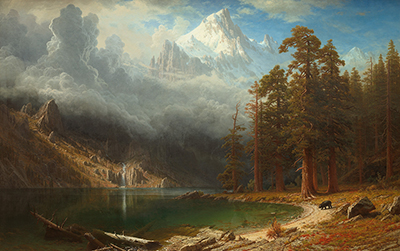
Mount Corcoran by Albert Bierstadt
Albert Bierstadt’s Mount Corcoran brings an immense mountain landscape within reach of a quiet lakeshore. A bear walks beside the water, fallen timber lies close to the viewer, and sunlight catches the trunks of tall pines. Above this richly observed foreground, clouds gather around a snow-covered summit. The scene feels discoverable, yet its apparent geographical certainty is part of the painting’s art. The National Gallery of Art identifies it as an imagined landscape.[1]
Painted around 1876–1877, this oil on canvas measures 154.1 × 243.5 cm and belongs to the National Gallery of Art’s Corcoran Collection. It was exhibited in New York in 1877 as Mountain Lake, catalogue number 452 at the National Academy of Design. The later title connects its mountain scenery to the Washington collector William Wilson Corcoran.[1]
For comparisons with other nineteenth-century American landscape painters, explore the Hudson River School.
At a Glance
Annotated Details from Mount Corcoran
Use the numbered details to explore how Bierstadt builds this scene from light, scale and overlapping forms. Image: National Gallery of Art, Corcoran Collection (Museum Purchase, Gallery Fund, 1878). Image source.
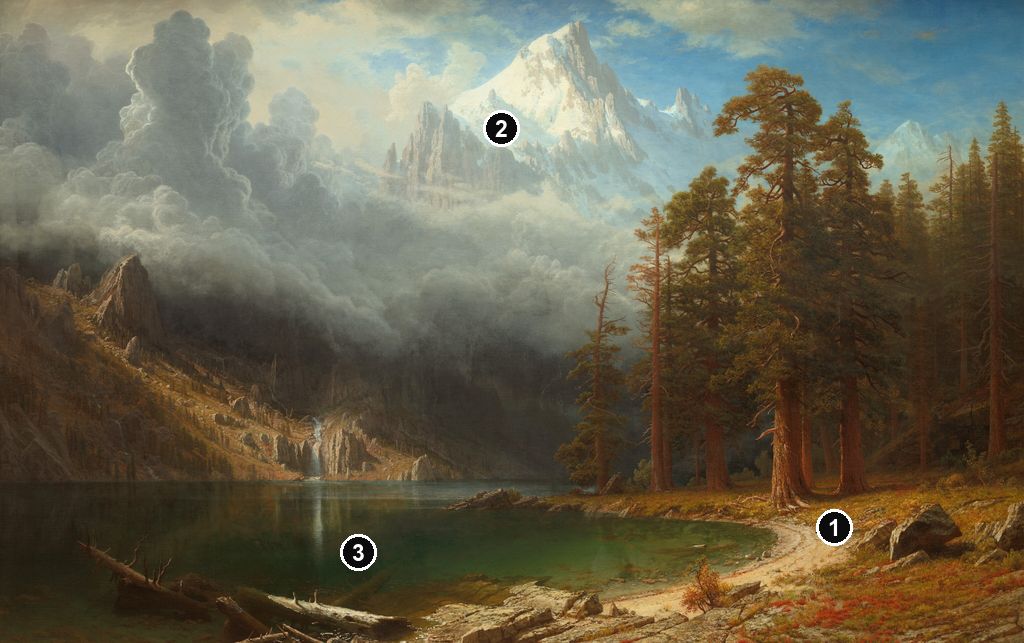
Details from MOUNT CORCORAN
Compare these enlarged passages with their positions in the full painting.
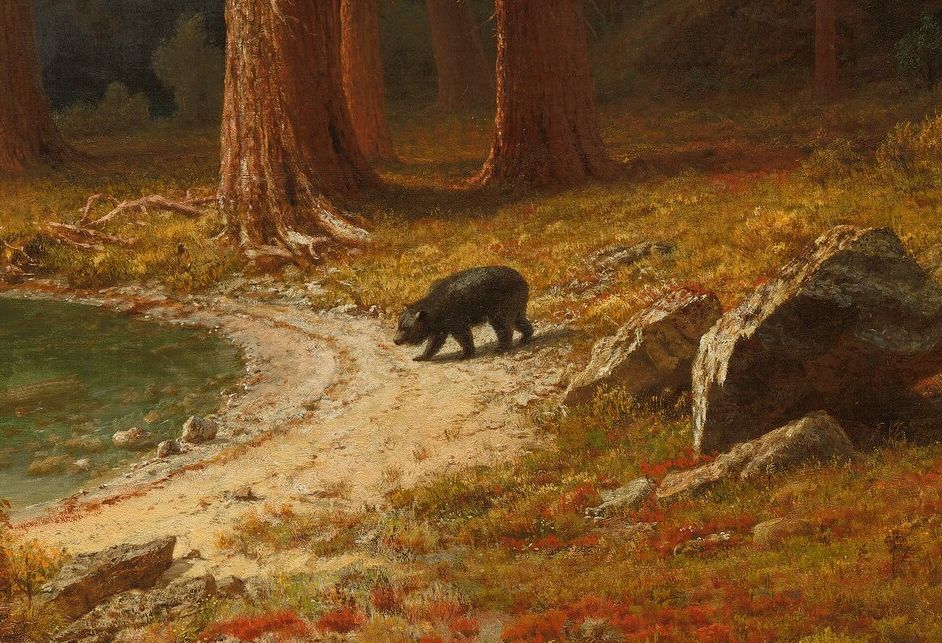
A bear beside the water
Find the bear near the shore. Its dark shape brings a living presence into the landscape and helps measure the surrounding rocks and trees.
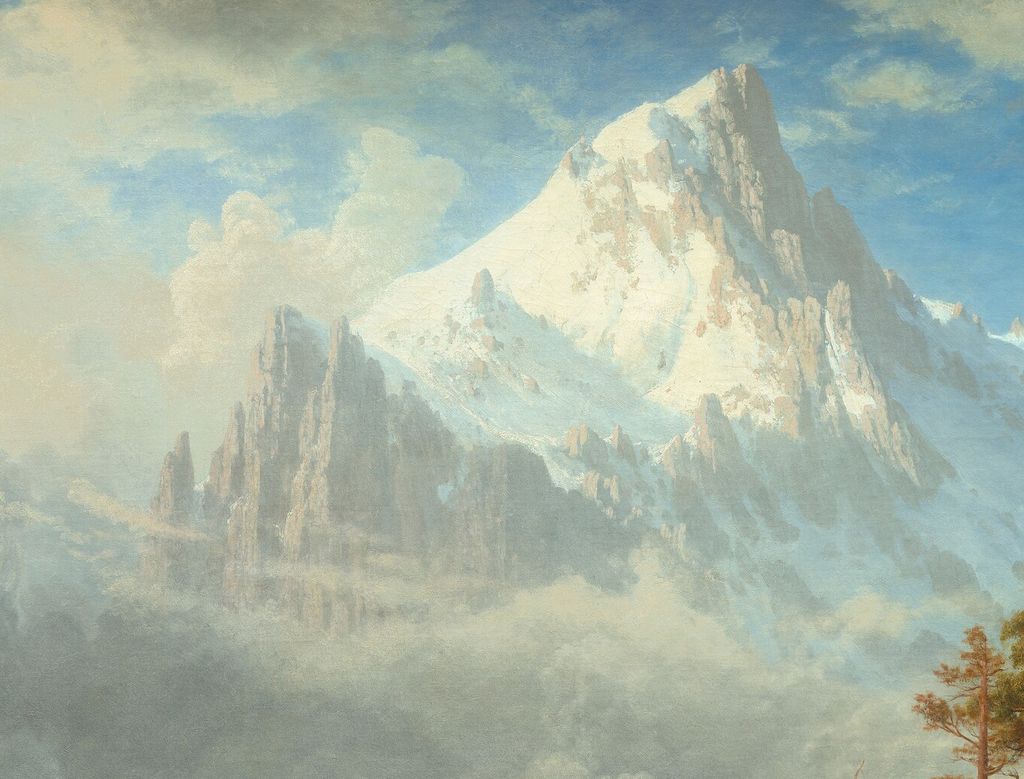
The snowy summit
Compare the bright snow with the shadowed rock below. These alternating surfaces give the distant mountain its sharply modelled form.
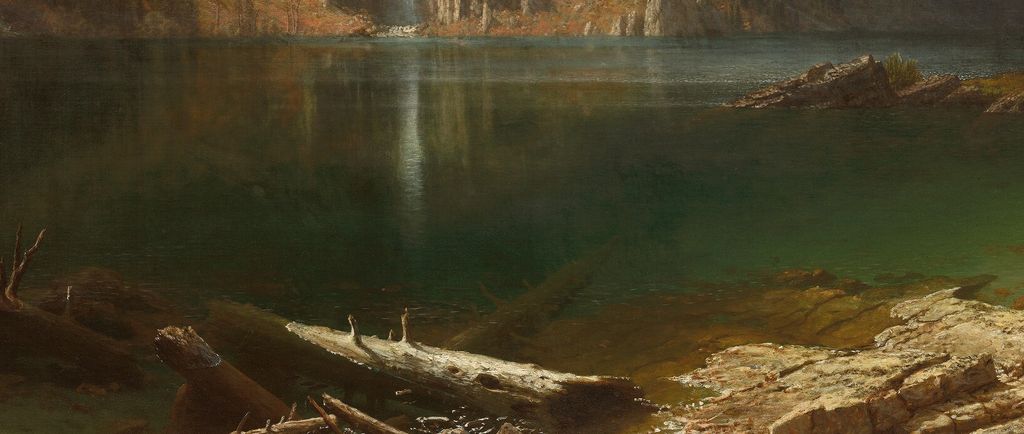
Fallen wood and shallow water
Follow the fallen wood along the foreground shore. The nearby textures and transparent shallows create a close starting point for the distant view.
Where this painting sits in Bierstadt’s career
Dates refer to the paintings, rather than to the journeys behind them. Approximate dates and ranges retain the qualifications in the collection records.
Lake Lucerne
1858Mountain Brook
1863Mount Corcoran
c. 1876–1877Street in Nassau
c. 1877–1880The Last of the Buffalo
1888–1889The Golden Gate
1900Contents
- Annotated close reading
- From the lakeshore to the summit
- Observation and studio invention
- Naming a picture for a patron
- A mountain with changing names
- What an early museum catalogue told visitors
- The painted surface and its care
- The bear and two different buffalo landscapes
- From the Corcoran to the National Gallery
From the lakeshore to the summit
The nearest part of the picture invites slow inspection. Across the lower edge, broken branches and pale, weathered wood lie among rocks. Through the green shallows, the lake bed remains visible. Farther out, the same water becomes a dark, reflective surface, catching the descending waterfall and portions of the opposite shore. Transparency and reflection coexist: we look into the lake near our feet and across it toward the mountains. These changes in the water make the foreground feel close enough to enter.
The curving strip of pale shore on the right gives the eye a route into the scene. The bear occupies this narrow boundary between land and water. Its dark body is unmistakable but small enough to be missed on a first glance. Once noticed, it changes our sense of scale. The tree trunks become enormous, the lake opens wider, and the distant summit seems farther away. Its unhurried presence makes the foreground feel inhabited without competing with the landscape.
The trees form a substantial screen on the right. Their reddish trunks and irregular branches carry the warm colours of the ground upward against the cooler blue sky. On the left, a rocky slope descends toward a narrow waterfall. These unequal sides hold the lake between them. They also prevent the composition from becoming a simple centred mountain portrait: the eye moves among shore, forest, falling water and cloud before reaching the great peak.
Above the lake, the atmosphere is much less settled. Dense grey clouds occupy the left side and obscure the lower reaches of the mountains, while the summit rises into brighter air. Its snow catches the light; its cliffs remain sharply articulated. The height is difficult to measure because cloud conceals the connection between the accessible shore and the distant rock. We can inspect the foreground almost object by object, but the mountain’s full extent escapes us.
The calm water provides a horizontal pause beneath this upward movement. Rounded cloud masses rival the angular mountain forms, while the trees’ crooked outlines interrupt the broad planes of sky. Even the light has several roles: it exposes the shore, models the tree trunks and picks out the summit through haze. The painting holds our attention by changing the kind of looking required as we move from one region to another.
Observation and studio invention
Nancy K. Anderson’s study of Lake Lucerne explains how Bierstadt transformed field observations into a large composition. Examination of that earlier canvas revealed changes to mountain profiles, a cliff replaced by trees and a church repositioned more than once. Sketches supported a process of selection and rearrangement rather than binding the finished painting to every detail of a single view.[2]
Those technical findings concern Lake Lucerne. They nevertheless provide a useful comparison for the conviction of Mount Corcoran: recognisable natural forms can belong to an invented arrangement. The lake’s green shallows make immediate sense as water; the rough timber and uneven ground encourage trust in the nearby landscape. None of those convincing particulars establishes a surveyed connection to the peak overhead.
The mountain and cloud also share a pictorial function. Both rise in great masses above the dark horizontal lake, but one appears solid and the other transient. Their overlap makes it difficult to see where the mountain begins. That withheld connection is part of the view’s grandeur. Bierstadt gives the summit enough clarity to command attention while leaving its distance and full height uncertain.
Naming a picture for a patron
Lisa Strong’s research describes hostile criticism of Mountain Lake in 1877 and Bierstadt’s subsequent effort to secure a museum home. Samuel Ward helped place the renamed painting before Corcoran. The curator William MacLeod questioned a supporting War Department map when he discovered that its mountain name had been added by hand at Bierstadt’s request. Strong also complicates the purchase story: the gallery paid at least half the price, with Corcoran later paying the balance. MacLeod requested changes to the clouds in 1877 and 1878.[3]
The title addressed a prospective buyer as well as naming a remote place. It preserved the connection between the western landscape and the painting’s intended future in a Washington collection.
The requested cloud revisions concern a central feature of the composition. Their masses supply scale while concealing terrain; altering them could change our experience of the mountain’s height and distance.
A mountain with changing names
Francis P. Farquhar’s 1926 account of Mount Langley records a complicated naming history. Clarence King had mistaken the peak for Mount Whitney; subsequent clarification required a different name. Farquhar reproduces a Wheeler Survey statement linking the peak to Bierstadt’s name Mount Corcoran, and records the use of Langley in 1905 after the name Sheep Mountain. This historical account concerns a real summit and its changing labels.[4]
Naming the mountain and identifying the painted view are separate tasks. A peak can have a traceable history on maps without the painting being a literal portrait of it. Nor should a reader assume that every later use of Mount Corcoran refers to precisely the same summit. For this canvas, the most useful distinction is between the real geography involved in the naming campaign and the composition’s assembled landscape.
What an early museum catalogue told visitors
The Corcoran Gallery’s catalogue dated January 1903 presented the painting as a Southern Sierra Nevada scene. Its short entry supplied a peak height and explained the name as a compliment to Corcoran. It also dated the painting to 1875, earlier than the current museum dating. The entry shows how confidently a museum could frame this landscape as a specific place; its historical measurements and date should be distinguished from today’s object record.[5]
That brief label would have guided a visitor’s first encounter. A mountain height encourages us to regard the summit as measurable, and a regional designation offers a location for the lake and forest. The current interpretation of an imagined scene changes that expectation. We can still admire the apparent precision of the rocks and water, while recognising that the picture’s persuasive unity comes from composition as well as observation.
The painted surface and its care
Conservator Dare Myers Hartwell discusses a later encounter between Bierstadt and the gallery. In MacLeod’s journal entry of 22 July 1886, reproduced by Hartwell, the artist recommended applying poppy oil to Mount Corcoran and praised a copal varnish dissolved in turpentine; Weidenbach disagreed. Hartwell found no evidence that copal varnish was used in treating the Corcoran paintings. The record establishes advice and disagreement, rather than confirming that this proposed treatment was carried out.[6]
This evidence adds a material dimension to the painting’s museum history. The canvas continued to concern its maker after the sale, and discussion extended beyond the landscape’s title or the shape of its clouds. The transparent shallows, dark reflections and bright snow depend on the appearance of a painted surface. Looking at them involves an object with a history of care, as well as an illusion of an untouched mountain lake.
The bear and two different buffalo landscapes
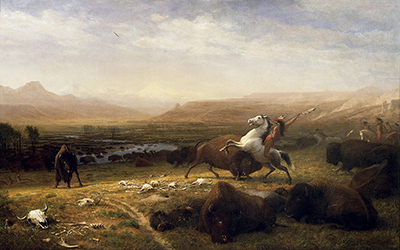
Susan Barnett compares the miniature bear here with the animals in Buffalo Trail: The Impending Storm, reading both as ways of emphasising landscape scale. She contrasts their subordinate role with the prominent figures in The Last of the Buffalo.[7]
The comparison is productive when we look at the pictures together. In Buffalo Trail, the herd makes a diagonal across the water beneath a towering cloud bank. Its movement leads the eye through the lower part of the scene, and the storm makes that passage feel precarious. In Mount Corcoran, a single animal occupies a small patch of bright shore. There is no procession to follow: our attention can pause with the bear, then turn back to the still lake and summit.
The Last of the Buffalo brings animals and human action forward. A rearing horse, a hunter and a charging bison interrupt the broad view, while fallen bodies occupy the nearest ground. Here, by comparison, the bear does not explain an event. It gives the viewer a living measure within an environment that remains visually dominant. These differences show how Bierstadt could use a large landscape either to contain a small animal presence or to stage an urgent encounter.
From the Corcoran to the National Gallery
The National Gallery records the painting’s purchase by the Corcoran Gallery in 1878 and its acquisition by the National Gallery in 2014. Its exhibition history includes De Gustibus, a 1949 examination of taste and criticism, and National Parks and the American Landscape in 1972.[1] These changing settings invite different questions: how the picture persuaded a collector, how its spectacle met critical resistance, and how an imagined western scene has represented landscape in a museum.
Watch: Albert Bierstadt
Five perspectives on his paintings and their historical setting.
American Landscape Painting: Albert Bierstadt and the American Land
A Museum of Fine Arts, Boston presentation on American Landscape Painting: Albert Bierstadt and the American Land.
Explore Bierstadt’s artworks
Discussion
Which details make the lakeshore feel close, and which make the summit feel difficult to reach?
Reader Insights
Look at the transparent shallows and the reflective water farther away. How does the change in the lake’s surface guide your attention?
Compare the outlines of the clouds with the mountain. Where do they separate clearly, and where do they merge?
Find the bear beside the water. How does noticing it change your sense of the surrounding trees and mountain?
Join the Conversation
Share a specific observation, documented connection or comparison from Mount Corcoran.
References
- National Gallery of Art. “Mount Corcoran,” accession 2014.79.4. Object record, provenance and exhibition history. View source text
- Nancy K. Anderson. “Lake Lucerne,” American Paintings of the Nineteenth Century, Part I (1996), printed pp. 33–38. Separate painting’s technical examination and studio composition. View source text
- Lisa Strong. “Albert Bierstadt, Mount Corcoran,” Corcoran Gallery of Art: American Paintings to 1945 (2011), printed p. 140; notes pp. 267–268. Published research on criticism, naming, purchase and revisions. View source text
- Francis P. Farquhar. Place Names of the High Sierra (1926), “Langley, Mount” entry. Historical account reproducing earlier survey and climbing records. View source text
- Corcoran Gallery of Art. Catalogue, January 1903, printed p. 31, no. 46. Historical museum description and dating. View source text
- Dare Myers Hartwell. “Bierstadt’s Late Paintings: Methods, Materials, and Madness,” Journal of the American Institute for Conservation 38, no. 1 (1999), pp. 33–44, section 3. MacLeod’s 1886 journal entry reproduced and interpreted. View source text
- Susan Barnett. “The Last of the Buffalo and their Revival,” National Gallery of Art, 1 September 2026, “Twin Buffalo Paintings.” Comparison of animal scale. View source text