by Tom Gurney
Tom Gurney BSc (Hons) is an art history expert with over 20 years experience
Published on June 19, 2020 / Updated on October 12, 2026
Email: tomgurney1@gmail.com / Phone: +44 7429 011000
Street in Nassau by Albert Bierstadt
A woman in a red skirt walks away along a pale road. Other people gather beneath the trees at the left, while smaller figures continue towards the houses beyond. The road gives Albert Bierstadt’s Street in Nassau its depth, but the red skirt gives it a centre. Light, colour and daily movement bring an inhabited place into focus.
The Carmen Thyssen Collection dates the painting to around 1877–1880. It is oil on board mounted on canvas, measures 35.5 × 48.3 centimetres and bears accession number CTB.1996.19.[1] The modest dimensions suit a view in which a gate, the edge of a wall and the space around a pedestrian matter as much as the distant landscape.
At a Glance
Where this painting sits in Bierstadt’s career
Dates refer to the paintings, rather than to the journeys behind them. Approximate dates and ranges retain the qualifications in the collection records.
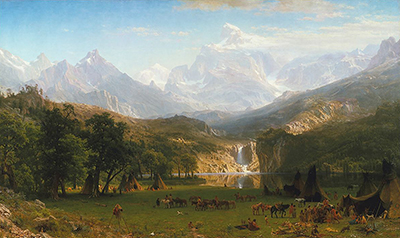
Lake Lucerne
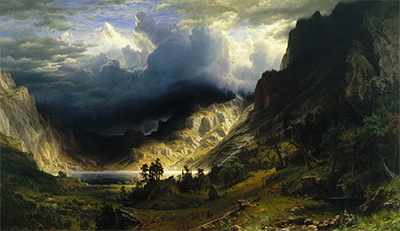
1858Mountain Brook
1863Street in Nassau
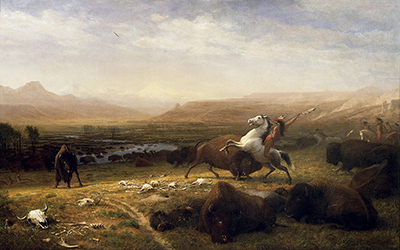
c. 1877–1880The Last of the Buffalo
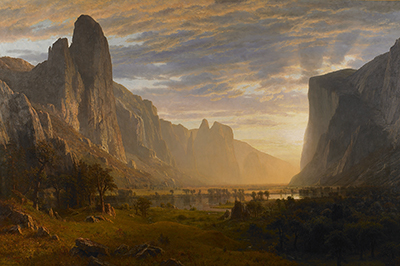
1888–1889The Golden Gate
1900Contents
Following the road
The road begins broadly across the foreground, then contracts towards the middle of the picture. Its distant continuation is bright and narrow, passing between low buildings and vegetation. The changing width allows the viewer to judge how far the figures stand from one another, even where their individual features are indistinct.
At the left, a substantial wall approaches the viewer on a diagonal. Two entrance pillars rise from it, their pointed caps breaking the line of masonry beneath the trees. The gate provides a small, ordered piece of architecture within the irregular foliage. It also makes the wall a boundary with an opening, rather than simply a continuous screen.
Trees rise behind that boundary and spread across the upper part of the canvas. Their trunks differ in position and colour: the one nearer the entrance stands within the deep green canopy, while another reaches upwards towards the left edge. Branches cross and divide the mass of leaves. Small openings reveal the sky without dissolving the sense of shade.
The right-hand side is more exposed. Lower vegetation and flowers border the road, leaving a larger field of sky above them. This asymmetry is useful. The heavy canopy at the left gives the foreground a sheltered place, while the brighter right side opens the view towards the distance.
Shadow crosses the road in uneven bands. It breaks the broad surface into distinct patches without concealing the route. We can follow the pale ground through those interruptions, moving from a dark near foreground into sunlight and then towards the small buildings beyond.
The people occupy different parts of that sequence. A hatted figure stands near the entrance; others gather beside the wall. The woman in red has moved out towards the open middle ground. Their distribution makes the street a place of pauses and encounters as well as passage. The viewer’s eye moves quickly down the road, but the people within it are following separate rhythms.
Nassau in Bierstadt’s life
Nancy K. Anderson’s National Gallery of Art biography records Rosalie Bierstadt’s first winter journey to Nassau in the autumn of 1876, following advice to seek a warm climate for her consumption. Bierstadt maintained his New York studio and travelled elsewhere, but visits to his wife gave him new tropical subjects.[2] The islands became part of his working life through repeated travel and family circumstances.
Gerdts distinguishes Rosalie’s prolonged residence from her husband’s visits and stresses the uncertain dates of individual studies.[1] The approximate date of Street in Nassau preserves that distinction. The painting belongs to his Bahamian production without being assigned to an undocumented day of work.
The subject enlarges the familiar account of his career. A road, a property boundary and people on foot provide the central material. Their proximity asks for attention to small changes in position and colour. The picture offers a way of understanding Bierstadt through local activity, alongside the mountains and sweeping views that brought him fame.
Alba Campo Rosillo describes its approachable scale through the picturesque and connects its colour and movement with an experimental aspect of his Bahamian work.[3] That interpretation directs attention to the painting’s varied, inhabited spaces. It does not require us to imagine that he abandoned the dramatic landscapes he continued to make.
How the red skirt changes the view
The central red is vivid, but it occupies a very small part of the surface. Its importance depends on where it appears. Greens surround the woman, while pale ground and clothing keep her silhouette legible. The colour stands out without severing the figure from the street.
Other accents distribute attention across the composition. Red flowers appear at the right; pale patches mark the road, gate and clothing; blue sky shows above and between the branches. Each draws the eye for a different reason. The skirt provides a concentrated note, while the sky offers a much larger area of relief from the foliage.
Campo Rosillo compares these relationships with Michel Eugène Chevreul’s theory of simultaneous colour contrast.[3] The historical theory gives us a language for describing the interaction of neighbouring colours. It remains a comparison, rather than evidence that Bierstadt owned or followed the treatise.
Chevreul distinguishes between changes in the apparent intensity of adjacent tones and changes in the apparent colour of adjacent hues. In John Spanton’s English translation, The Laws of Contrast of Colour, he demonstrates the first effect with lighter and darker grey papers placed side by side. Their appearance changes at the meeting edge even though the papers themselves have not been altered.[4]
His second distinction concerns different colours seen together. Neighbouring hues affect one another’s appearance, making their differences more pronounced. The argument concerns perception: colour is experienced in a setting, rather than as an isolated property of one patch.[4]
This distinction helps explain more than the woman’s red clothing. The lit gate pillars stand beside dark masonry and leaves. The pale road crosses shadow before reaching brighter ground. At each point, the nearby darkness contributes to the apparent strength of the light. We read illumination through relationships distributed over the picture.
The effect changes when we shift attention. Looking first at the woman makes the surrounding greens seem like a setting for her colour. Looking first at the canopy makes her skirt a small interruption in a much larger green mass. The composition accommodates both approaches, keeping the human figure prominent without making the whole landscape revolve around a single incident.
A road for residents and visitors
James H. Stark’s History and Guide to the Bahama Islands, first published in 1891, offers another perspective on Nassau. Its descriptions address the northern visitor encountering scenery already anticipated through pictures and imagination. The digitised copies contain later revisions, so they should be read as evidence of a developing tourist view rather than a precise account of Nassau when Bierstadt painted it.[5]
Stark makes looking part of the journey. His Nassau chapter presents gardens, foliage and streets as things that a newcomer will notice, while descriptions of nearby drives turn routes into successions of attractive scenes. This is a form of travel in which the visitor expects the surroundings to answer an existing idea of the tropics.
The painting can produce a similar pleasure. Shade, flowers and an open road invite a viewer to imagine entering the scene. Yet the figures also make a different use of the place. Standing by a gate, walking with a load and gathering beside a wall are activities that need not exist for a visitor’s benefit.
Stark’s description of the approach to Grantstown records women bringing fruit and vegetables towards the market, sometimes accompanied by children carrying material for hat making. Elsewhere, he describes small roadside stalls and work taking place near homes.[5] These accounts show how a street could connect households, goods and markets. They do not identify the contents of the painted woman’s basket or prove her occupation.
That distinction keeps the comparison useful. We can recognise the road as a setting for economic and social movement without turning every figure into an illustration of the guidebook. A person walking away may have a destination and purpose that the painting does not disclose. The viewer’s limited knowledge is part of the encounter.
The guide also describes racial separation between Nassau and its surrounding settlements. Its treatment of Black residents often turns their lives into attractions for an outsider. The account is evidence of that viewpoint as well as a source of observations about urban space.[5] Reading it critically helps us question the easy assumption that a pleasing scene offers an equally comfortable life to everyone within it.
One particularly revealing passage praises public order while recording the use of convicted people to labour on the streets in the heat.[5] The apparent neatness of a road could therefore belong to a history of work and coercion that a visitor’s enjoyment concealed. This passage does not demonstrate that the road in Bierstadt’s painting was built or maintained by such labour. It establishes why a smooth, attractive street cannot by itself tell us the conditions under which it was made.
The wall as a social boundary
Gerdts proposes the road towards Grantstown and a white-owned property, while emphasising sunlight and atmosphere more than social divisions.[1]
The arrangement itself is more secure than a named location. The wall separates an enclosed property from public movement. The residence behind it is largely hidden; people on the road remain available to view. Architecture governs access and visibility before we know who owns the ground.
The distant buildings occupy a different position. They are small, more exposed and reached through the receding road. Their distance prevents close examination, while the nearby masonry has enough weight to be apprehended as a substantial boundary. The composition brings unlike forms of habitation into a common field of vision.
Campo Rosillo interprets this contrast through colonial racial inequality, identifying the figures as Afro-Bahamian and connecting the road’s movement with diaspora and changing identity.[3] Her reading gives social force to the relation between enclosure and passage. It remains a scholarly interpretation of the image, rather than a political statement established in Bierstadt’s own words.
The difference in emphasis between the two scholars leaves an active question for the viewer. The trees provide shade and visual pleasure, while the wall separates spaces. Those functions occur together. The painting’s beauty does not settle what the boundary meant for the people using the street.
Nor does a group of small figures make the image a comprehensive record of a community. Individual identities, conversations and destinations remain unavailable. The foreground gives people a visible place in the landscape while preserving the distance between their lives and the visiting artist’s representation.
The quiet street and the force of the sea
Bierstadt’s island subjects also included dramatic coastal paintings. The Haggin Museum dates After a Norther, Bahamas to after 1878 and describes it as a larger version following The Shore of the Turquoise Sea. Its interpretation stresses the breaking wave’s transparency, windblown mist and power.[6]
The comparison clarifies the range of experiences he could construct from Bahamian subjects. A threatening wave brings nature forward as an event. The street distributes interest among people, shelter and movement through an inhabited setting. Both can be organised through light, but the demands they place on the viewer are different.
Gerdts also treats Nassau Harbour as a complementary view of local activity.[1] The pairing gives the street a place within a wider interest in the island’s public spaces. Inland roads and waterfronts support different forms of movement and work; neither is merely a backdrop without inhabitants.
Street in Nassau gains significance through this coexistence. Its calm does not represent the limit of Bierstadt’s later practice. It shows his ability to bring familiar landscape devices—trees, a receding route, alternating light and shade—into a scene where ordinary human activity carries much of the interest.
Changing contexts of exhibition
The collection record lists Sotheby’s, New York, 23 May 1996, lot 41, and the Thyssen-Bornemisza Museum’s 2024 Colonial Memory exhibition.[1]
The museum’s account of that exhibition describes an effort to examine colonial power within the collections’ images, including representations of imagined paradises and racial hierarchy.[7] Placing the Nassau painting in that setting changes the questions brought to its inviting road. The wall, the visible people and the hidden residence can be considered alongside the conditions that produced a visitor’s image of the islands.
Gerdts suggests participation in Nassau’s December 1885 First Loan Exhibition, but no known catalogue securely identifies this painting.[1] The possibility supplies a local context without establishing a complete exhibition history.
These different settings allow the painting’s qualities to remain visible while its interpretation changes. The red skirt still catches the eye, and the road still carries it into the distance. The people and boundaries along that route also invite questions about what an attractive view reveals, and what its attractiveness may leave difficult to see.
Watch: Albert Bierstadt
Five perspectives on his paintings and their historical setting.
American Landscape Painting: Albert Bierstadt and the American Land
A Museum of Fine Arts, Boston presentation on American Landscape Painting: Albert Bierstadt and the American Land.
Explore Bierstadt’s artworks
Discussion
How does the small red skirt organise this view of a road, trees, buildings and daily movement?
Reader Insights
Follow the central figure into the road’s narrowing distance. How much of the picture’s structure depends on that single colour accent?
Read the local activity beside the historical tourist descriptions. How might a resident and a visitor understand the same view differently?
Consider the article’s discussion of the wall, Grantstown and social boundaries. Which relationships are visible, and which emerge through historical interpretation?
Join the Conversation
Share a specific observation, documented connection or comparison from Street in Nassau.
References
- Carmen Thyssen Collection / William H. Gerdts. “Street in Nassau,” CTB.1996.19. Object metadata, collection and exhibition history, qualified location and expert interpretation. View source text
- Nancy K. Anderson / National Gallery of Art. “Albert Bierstadt,” in American Paintings of the Nineteenth Century, Part I, 1996, pp. 31–33. Rosalie’s 1876 journey, Bierstadt’s visits and continuing practice. View source text
- Alba Campo Rosillo / Museo Nacional Thyssen-Bornemisza. “Bierstadt’s view of a street in Nassau: a painting about becoming,” Open Windows 11, 2022, pp. 3–25. Picturesque, colour and social interpretations. View source text
- Michel Eugène Chevreul, translated by John Spanton. The Laws of Contrast of Colour, new edition, 1861, Part I, Section I, chapters I–II, paragraphs 8–18. Historical account of simultaneous contrast. View source text
- James H. Stark. Stark’s History and Guide to the Bahama Islands, first published 1891; digitised copy containing later revisions. Chapters XI–XII: visitor perspective, neighbourhoods, market movement, roads and street labour. View source text
- Haggin Museum. “After a Norther, Bahamas.” Dating, relationship to The Shore of the Turquoise Sea and interpretation of the wave. View source text
- Museo Nacional Thyssen-Bornemisza. “Colonial Memory in the Thyssen-Bornemisza Collections,” 2024. Exhibition’s stated interpretive purpose. View source text