 by Tom Gurney
Tom Gurney BSc (Hons) is an art history expert with over 20 years experience
Published on June 19, 2020 / Updated on October 12, 2026
Email: tomgurney1@gmail.com / Phone: +44 7429 011000
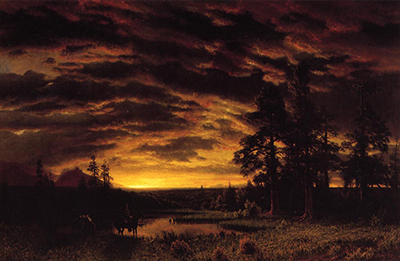
Evening on the Prairie by Albert Bierstadt
A strip of yellow light opens beneath a heavy ceiling of clouds. Dark trees interrupt it at the right, while a small mounted figure occupies the near ground. In Albert Bierstadt's Evening on the Prairie, the sky supplies the spectacle and the low landscape gives that spectacle its scale.
The Museo Nacional Thyssen-Bornemisza catalogues this oil painting as Near the Black Hills, dating it to about 1870.[1] The familiar prairie title remains useful for recognising the painting reproduced here. Its evening light suggests a moment passing, but the arrangement holds that moment open for prolonged looking.
At a Glance
Where this painting sits in Bierstadt’s career
Dates refer to the paintings, rather than to the journeys behind them. Approximate dates and ranges retain the qualifications in the collection records.
Lake Lucerne
1858Mountain Brook
1863Evening on the Prairie
About 1870Street in Nassau
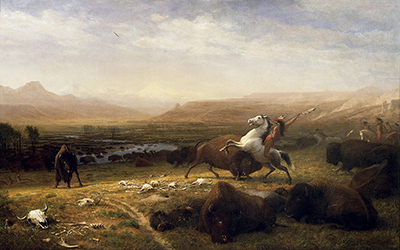
c. 1877–1880The Last of the Buffalo
1888–1889The Golden Gate
1900Contents
Travel, memory and the finished canvas
Paloma Alarcó tentatively relates the painting to Bierstadt's 1870 railway journey with his wife, while connecting its scenery with a description in his earlier letter to The Crayon.[1] That account allows travel experience and remembered scenery to enter the discussion together. It does not establish the precise spot from which this canvas was painted, or identify a surviving preparatory study for every part of it.
The picture offers a recognisable landscape situation: low ground, trees, a traveller and the last light of day. Yet its strongest contrasts appear carefully concentrated. The foreground darkens the approach to the view; the trees interrupt the brightness; the illuminated distance remains just open enough to draw the eye past them. Those decisions make the scene persuasive even when its exact topography remains uncertain.
A finished canvas can organise impressions gathered at different times. Here, the arrangement is available to us more directly than the sequence of its making. The approximate date leaves room for that uncertainty.
A low horizon beneath a large sky
The foreground is comparatively dark. Patches of grass catch warmer colour, but their individual marks remain subordinate to the sky. Near the left, horse and rider break the line of the open ground. They are small enough to be absorbed into the landscape, yet distinct enough to give its spaces a human measure. The figure encourages us to imagine moving through the scene rather than simply looking across a vacant expanse.
The trees at the right rise high into the clouds. Narrow trunks establish vertical accents, while foliage spreads in uneven masses against the warm background. Some branches can be followed; others disappear into the darkness. This alternation keeps the group from becoming a flat silhouette. The trees occupy real foreground space while also forming a screen through which the distance can be glimpsed.
The clouds are more complicated than a simple band of sunset. Dark red-brown masses cross the upper sky, with orange edges and small openings between them. Lower down, these openings widen towards yellow light. The brightest zone sits close to the horizon, so the eye descends through successive layers rather than stopping at one isolated patch of colour.
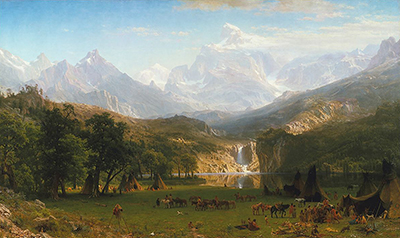
Neither the rider nor the trees explains the whole view. The rider anchors its scale; the trees interrupt its openness; the clouds extend it beyond the foreground. Unlike Lander's Peak, this picture does not rely on a summit dominating the composition. Its grandeur comes from the amount of air above the low land and from the contrast between near darkness and distant illumination.
A German landscape inheritance
Alarcó, following Elizabeth Garrity Ellis, associates the low horizon and silhouetted rider with Andreas Achenbach's landscape tradition.[1] The Pinakotheken biography places Achenbach's work in relation to Dutch painting, particularly Jacob Ruisdael, and identifies turbulent skies among his preferred subjects.[2] This gives the comparison a more precise basis than the fact that both artists had connections with Düsseldorf.
Such a tradition could make atmosphere the organising force of a landscape. A low horizon leaves room for cloud masses to develop, while small figures establish the relationship between human movement and a much larger setting. Bierstadt's rider is effective because the surrounding space is so extensive. Enlarging the figure would change the scene's balance, bringing the traveller's actions forward and reducing the sky's command.
The comparison does not identify a particular Achenbach painting as the model. In Bierstadt's canvas, the strong yellow horizon is partly concealed by the evergreen group, creating a tension between the sky's openness and the foreground's solidity.
Church's sunset: a useful comparison
Alarcó also compares the painting's light effects with Frederic Edwin Church's Twilight in the Wilderness.[1] Cleveland's record dates Church's canvas to 1860 and identifies it as an oil painting measuring 101.6 × 162.6 cm.[3] Its blazing sky makes an illuminating comparison, but the two landscapes organise their foregrounds differently.
In Church's picture, a lake carries the red light down into the land. Twisting trees frame the basin, while distant mountains form a broken boundary beneath the illuminated air. Bierstadt keeps the ground comparatively subdued. The mounted figure and the more solid tree group stand against the light, making the opening at the horizon seem both accessible and distant. Church's reflected colour joins sky and water; Bierstadt's contrast separates the foreground from the brightest distance.
Mark Cole's Cleveland essay explains that Church painted the work in his New York studio, partly using Maine studies, and notes that its exact setting may be composite. He discusses readings of its twilight as an image of impending Civil War or environmental vulnerability.[4] These interpretations belong to Church's painting and its historical circumstances. They help show how a sunset can attract meanings beyond the weather, without proving the same political intention in Bierstadt's canvas.
The Black Hills as inhabited country
The museum title brings a regional history into view. In 1868, the Treaty of Fort Laramie recognised the Black Hills within the Great Sioux Reservation. Article II protected the designated Indigenous occupants and restricted unauthorised entry. The National Archives account describes the subsequent 1874 expedition seeking gold and the United States' seizure of the land in 1877.[5] The painting's approximate date falls before those later events.
That history makes it misleading to treat the country named by the title as empty territory awaiting discovery. The Aktá Lakota Museum's account of a 2026 tipi project describes the Black Hills as a birthplace and continuing spiritual home, incorporating their forms into the design.[6] This contemporary cultural account speaks to the enduring significance of the region. It does not identify the rider or locate the painted scene within a particular community's territory.
The distinction matters for looking. A small figure can be a compositional measure without supplying a complete account of the people who inhabit a region. Bierstadt's concentrated sunset gives the view an absorbing atmosphere; historical context asks us to consider what that atmosphere alone cannot tell us about the land.
Titles, reproductions and critical reception
A wood engraving titled Near the Black Hills appears beside Bierstadt's chapter in G. W. Sheldon's American Painters of 1879. It shows a different arrangement, including several mounted figures and a different pattern of trees.[7] The shared title therefore cannot establish that every historical reproduction refers to the Thyssen canvas. A title is a useful lead, but the actual composition must also be compared.
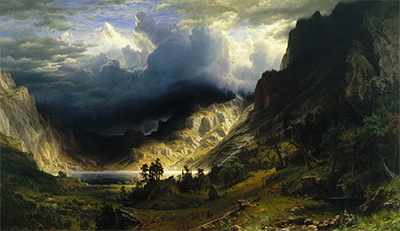
Sheldon's chapter presents Bierstadt as a painter whose emotional force and technical resources could produce an overwhelming impression. It also raises the role of scale and artifice, quoting a London review of Storm in the Rocky Mountains.[7] That is evidence of contemporary discussion around Bierstadt's broader practice, rather than a documented review of this particular sunset. The distinction preserves the value of the criticism without inventing an exhibition history for the canvas.
Another route through the light
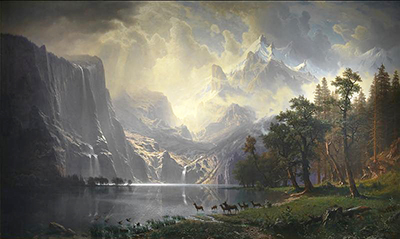
Compare the painting with Sacramento River Valley. Both place foreground trees against glowing distance. In the California scene, a slope and winding river give the eye a route down through the landscape. Here, the low ground and mounted figure let the sky take precedence. The near land establishes our position, while the greatest movement happens overhead.
The prairie title foregrounds openness; Near the Black Hills adds a regional association. Neither exhausts the painting's effect. Its force depends on how Bierstadt makes darkness substantial and distant light compelling, keeping the traveller small within a view whose sky seems to continue beyond the canvas.
Watch: Albert Bierstadt
Five perspectives on his paintings and their historical setting.
American Landscape Painting: Albert Bierstadt and the American Land
A Museum of Fine Arts, Boston presentation on American Landscape Painting: Albert Bierstadt and the American Land.
Explore Bierstadt’s artworks
Discussion
How does the low horizon give the sunset more space than the ground and rider beneath it?
Reader Insights
Find the mounted figure against the open ground. How does that small silhouette affect the sky’s apparent immensity?
Follow the bright interval below the heavy cloud layer. Where does the sky seem most open, and where does it feel enclosed?
Compare the water reflecting Church’s sky with Bierstadt’s subdued ground. How does each painting connect the foreground with the brightest distance?
Join the Conversation
Share a specific observation, documented connection or comparison from Evening on the Prairie.
References
- Paloma Alarcó; Museo Nacional Thyssen-Bornemisza. Near the Black Hills, inventory 468 (1981.56). Object record and signed essay; tentative travel association and attributed comparisons. View source text
- Bayerische Staatsgemäldesammlungen, Die Pinakotheken. Andreas Achenbach. Museum biography: Dutch landscape tradition and turbulent skies. View source text
- Cleveland Museum of Art. Twilight in the Wilderness, Frederic Edwin Church, 1860, accession 1965.233. Comparator object record and reproduction. View source text
- Mark Cole; Cleveland Museum of Art. Twilight in the Wilderness: A closer look at an American masterpiece. Studio studies, uncertain setting and interpretive possibilities. View source text
- National Archives. Treaty of Fort Laramie (1868). Introductory history and selected primary transcript, Article II; regional context. View source text
- Aktá Lakota Museum & Cultural Center. Bringing Tradition to Life, 21 April 2026. Museum account of the Black Hills in a contemporary tipi design. View source text
- G. W. Sheldon. American Painters: With Eighty-three Examples of Their Work Engraved on Wood. New York: D. Appleton, 1879. Bierstadt chapter, pp. 146–149, and adjacent different-composition Near the Black Hills engraving. View source text