by Tom Gurney
Tom Gurney BSc (Hons) is an art history expert with over 20 years experience
Published on June 19, 2020 / Updated on October 12, 2026
Email: tomgurney1@gmail.com / Phone: +44 7429 011000
Mountain Brook by Albert Bierstadt
A narrow waterfall slips between heavy boulders in Albert Bierstadt’s Mountain Brook. Above it, a kingfisher perches on a pale, broken piece of wood. Light catches the bird, the fractured face of the largest rock and the peeling bark of a birch, while the surrounding forest remains deep in shadow. The scene rewards the kind of attention usually given to a small discovery on a woodland walk: first the sound or sparkle of water, then the things around it.
Bierstadt painted Mountain Brook in 1863. The oil on canvas measures 111.8 × 91.4 cm (44 × 36 inches) and belongs to the Art Institute of Chicago, accession 1997.365.[1] Its upright format brings the viewer close to a stream and its banks. Although intimate beside his broad western panoramas, it is more than a metre high—a substantial exhibition painting whose subject is a confined piece of woodland.
At a Glance
Annotated Details from Mountain Brook
Use the numbered details to explore how Bierstadt builds this scene from light, scale and overlapping forms. Image: Public domain reproduction via Rawpixel (CC0). Image source.
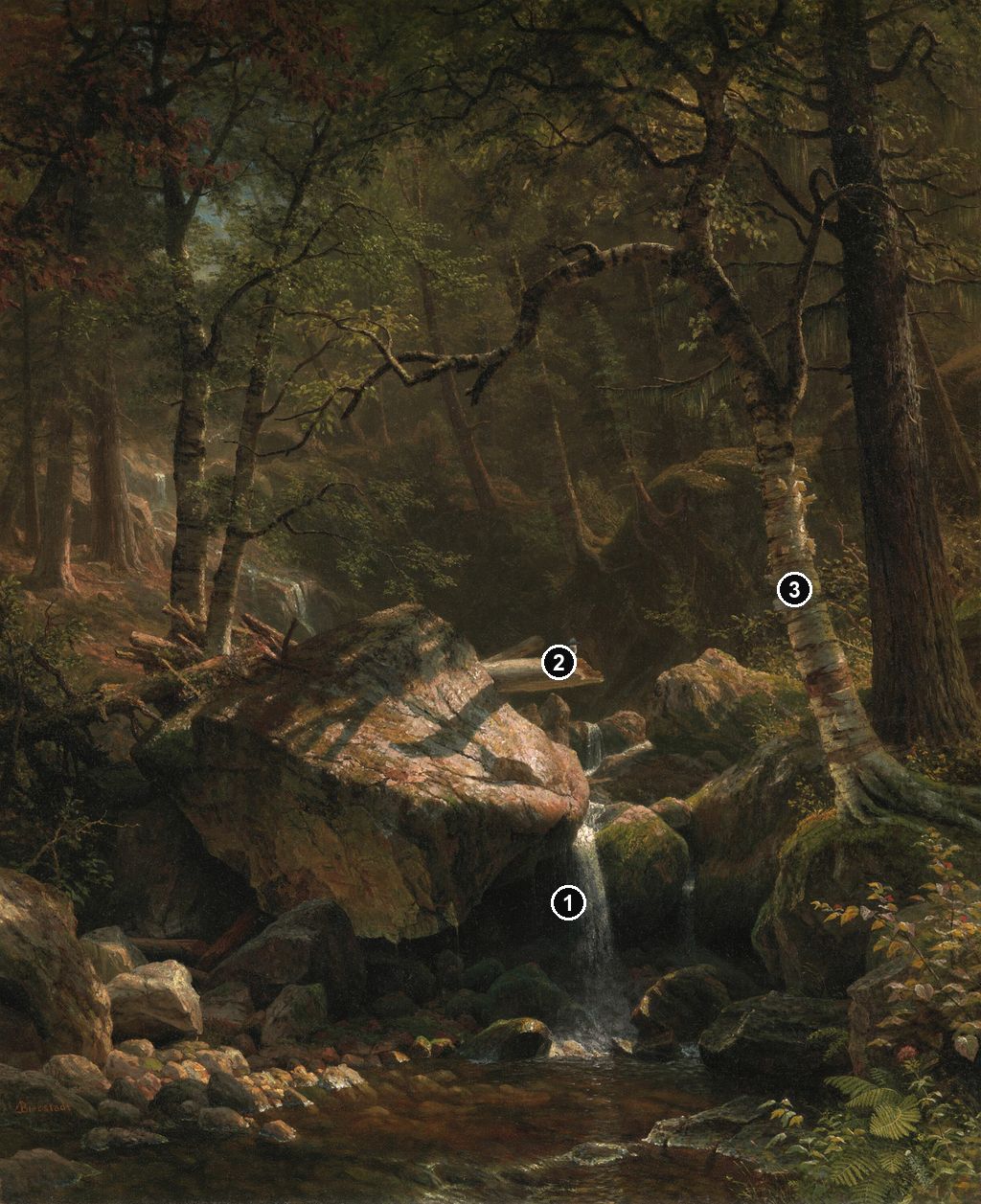
Details from MOUNTAIN BROOK
Compare these enlarged passages with their positions in the full painting.
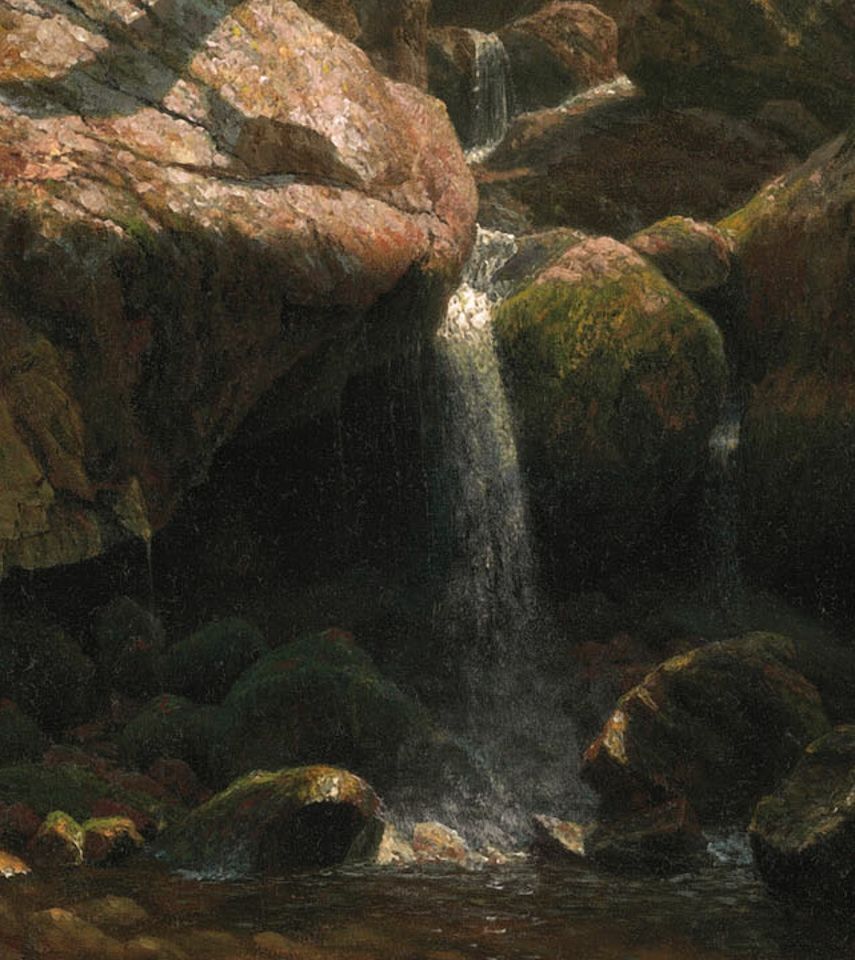
Water falling between rocks
Trace the narrow stream down through successive drops. Small white passages guide the eye between the much larger, darker rocks.
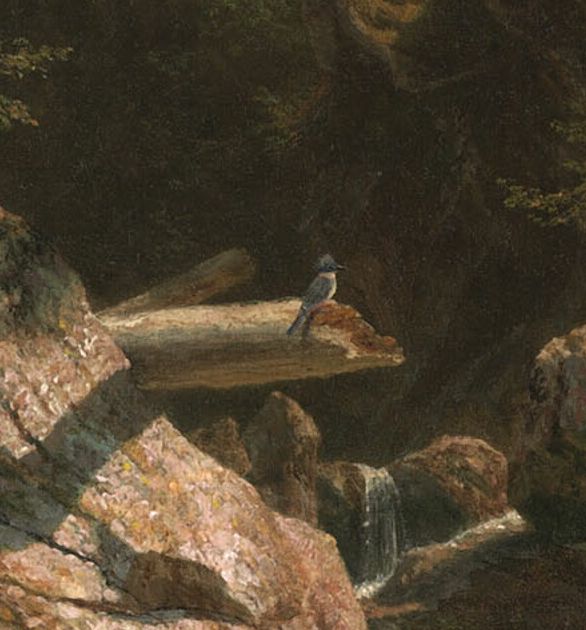
A bird beside the pool
Find the small bird on the ledge above the water. Its compact silhouette brings a moment of living activity into the quiet woodland.
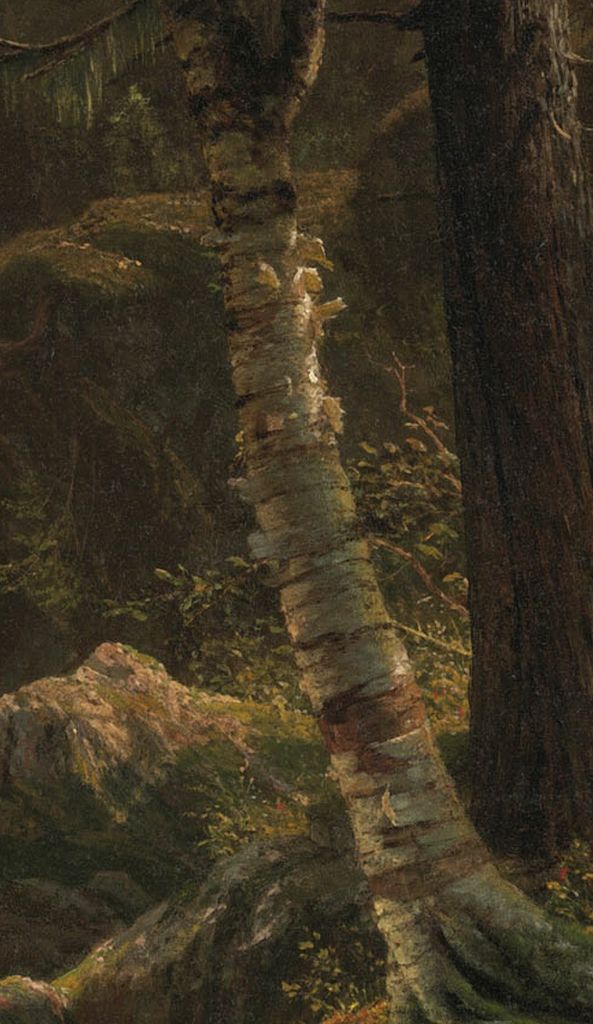
Pale bark in the shade
Compare the pale, banded trunk with the dark tree behind it. The contrast of surfaces makes the woodland feel dense and varied.
Where this painting sits in Bierstadt’s career
Dates refer to the paintings, rather than to the journeys behind them. Approximate dates and ranges retain the qualifications in the collection records.
Lake Lucerne
1858Mountain Brook
1863Street in Nassau
c. 1877–1880The Last of the Buffalo
1888–1889The Golden Gate
1900Contents
A White Mountains landscape
The Art Institute identifies the subject with New Hampshire’s White Mountains and suggests that Bierstadt combined elements of the Flume in an imaginary composition.[1] The connection locates his sources without fixing a single viewpoint.
The mountains themselves are hidden. There is no distant summit to orient the viewer, and only a small opening of blue sky breaks through the canopy towards the upper left. Bierstadt gives the woodland enough depth to explore while withholding the larger view that would explain where we stand. This enclosure is central to the picture’s atmosphere.
Following the water
The stream enters the foreground as a shallow, brown-gold surface broken by stones. Pale flecks interrupt the darker water, and submerged forms remain visible beneath it. Just above, the main fall descends through a narrow gap between rocks. Its white thread stands out against a recess so dark that the surrounding boulders appear to project towards us.
Farther back, another small cascade emerges among the stones. To the left, a more distant fall catches light through the trees. These separated glimpses allow the brook to be traced upstream even where its course disappears. The water opens a route into a scene otherwise crowded with solid objects.
The great boulder at centre-left almost blocks that route. Its upper face tilts towards the light, exposing warm pinkish and ochre patches, grey streaks and deep cracks. Below, its bulk drops into shade. Smaller stones crowd around its base, some rounded, some sharply broken. The differences make the rock mass feel accumulated and irregular, while its bright upper surface gives the eye a firm place to rest.
Vegetation softens the edges without concealing them. Moss spreads over rocks; fern fronds open near the lower right; small yellow and reddish leaves catch scattered light beside the stream. Across the foreground, stones, plants and water have different rhythms. The angular rock faces interrupt the flow, while the finer leaves and fronds offer more delicate patterns to examine.
The birches provide another kind of texture. The prominent trunk on the right inclines towards the centre, its light bark marked by dark bands and curls of peeling surface. A thinner birch rises on the left. Between them, crooked branches extend across the woodland, making a loose overhead arch. The thick, dark tree at the right edge gives the pale birch a forceful contrast and holds the composition’s boundary.
The small kingfisher is easily missed on a first look. Its blue-grey body and pale underside distinguish it from the wood on which it sits, immediately above the central rocks. Once found, it changes the scale of the scene: the boulders seem larger, and the narrow waterfall becomes a place an individual creature inhabits. Its stillness also provides a pause above the moving water.
Detail organised into a whole
The forest contains abundant detail, yet the light determines which parts come forward. The boulder, white birch and little falls emerge from much darker surroundings. The background trees become less distinct as they recede, and the branches weave in and out of shadow. Bierstadt lets some forms remain difficult to separate, preserving the impression of a dense interior.
Angela Miller places this coherence within the picturesque tradition: irregular forms and contrasting textures are composed into a connected experience. Her reading helps explain how close attention to natural particulars can coexist with an arrangement that directs the viewer.[2]
The composition’s strongest accents form a compact sequence. The exposed boulder leads towards the narrow fall, and the birch draws attention upwards before its branch turns back into the forest. Small glimpses of water keep this sequence from becoming a rigid diagram. A viewer can discover a fern or a patch of moss, then find the brook again. The picture accommodates wandering attention while retaining its larger structure.
Painting beside photography
There is a more specific context for Bierstadt’s woodland observation. In its account of the 2017 exhibition East of the Mississippi, the National Gallery of Art describes Charles and Edward Bierstadt’s collaboration with Albert on White Mountains albumen photographs before he painted Mountain Brook.[3] This places the painting within a family practice involving two ways of recording landscape. It also helps explain why the Art Institute’s geographical identification turns to photographs as well as paintings.
A surviving print makes the comparison tangible. Below the Flume Looking Down, Franconia Notch, New Hampshire, dated 1860, belongs to the Nelson-Atkins Museum of Art. Its image measures 40.16 × 32.54 cm; the mount credits the Bierstadt Brothers as photographers and bears an 1860 copyright inscription. The museum records it as an albumen print, object 2005.27.541.[4] The upright proportions bring it reasonably close to the canvas’s format, although the painted work is much larger.
In the museum’s reproduction, fallen trunks and crossing branches interrupt a rocky stream. Pale water divides around stones in the lower half, while a bright opening through the foliage occupies the upper left. Dense vegetation prevents an unrestricted view into the distance. The photograph and painting both turn an enclosed forest into a subject through contrasts between solid forms, running water and openings of light.
Their differences are equally instructive. In the photograph, a fallen trunk cuts across the lower left, and the brook occupies a comparatively broad foreground channel. Numerous stones break up its course. In the canvas, one great angular boulder dominates the lower middle and funnels attention towards a slender, conspicuous waterfall. The pale birch and small bird provide accents that the photographic scene lacks. The painting offers a sequence of distinct things to discover within its darkness; the photograph presents a more tangled network of obstacles and openings.
This is a comparison of two surviving images, rather than evidence that Bierstadt copied that particular negative. Their resemblance makes a shared interest in forest interiors visible, while the different arrangements preserve the painting’s character as a composed scene. The print supplies a useful check on what the term White Mountains landscape can include: not only mountain summits, but the small, crowded spaces beneath the trees.
The National Gallery’s exhibition checklist included the canvas and this photograph as entries 82 and 83, together with another 1860 Bierstadt Brothers print, Pool, Franconia Mountains, N.H.[5] That selection gives the photographic relationship a documented place in the painting’s later exhibition history. The checklist credits Charles and Edward; the Nelson-Atkins collection groups Charles, Edward and Albert under the Bierstadt Brothers name. Neither record establishes which brother operated the camera for this image.
Woodland and the tourist’s route
The Flume could be experienced through a visit or through a portable representation. An illustrated volume, Gems of American Scenery, published by Harroun & Bierstadt and copyrighted in 1878, paired stereoscopic views with descriptive text. Its introduction presents the book as a lasting souvenir of mountain scenery. The section on the Flume describes a walk from the Flume House beside the stream, followed by crossings on rustic bridges and planks laid between rocks. Small cascades continued above and below the gorge.[6]
This later publication documents how a wooded stream could become a repeatable excursion and a souvenir. It cannot establish Bierstadt’s sources in 1863. The canvas makes a different invitation: it shows no tourists or prepared crossings, and offers no named destination. Its route is found through patches of water and light. The viewer’s feeling of private discovery sits alongside the region’s history as scenery sought out and circulated for pleasure.
There is also a reason to treat present-day views of the Flume cautiously. New Hampshire State Parks records that a storm in June 1883 swept a suspended boulder from the gorge and formed Avalanche Falls.[7] The physical attraction changed twenty years after the canvas was painted. A modern photograph may help explain the region, but resemblance to today’s falls cannot establish which cascade Bierstadt represented. His central painted boulder should not be identified with the former hanging stone simply because both make rock a dramatic feature.
What the first critics saw
Mountain Brook appeared in New York’s National Academy of Design exhibition in 1863, catalogue number 6. The Art Institute records critics’ admiration for its light and shade.[1]
Miller traces reviewers’ admiration for the natural details and their combined effect, particularly the pale birch and its curling bark.[2] That response draws attention to a conspicuous achievement of the painting: its most delicate surfaces remain legible beside its heaviest forms.
There was disagreement, too. Conservators Lance Mayer and Gay Myers cite an April 18, 1863 New York Leader review, transmitted through Anderson and Ferber’s 1990 Art & Enterprise catalogue, which found the central boulder insufficiently convincing as stone. The critic felt too strongly the presence of paint.[8] It is a revealing objection to a picture whose large rock is both a physical obstacle and a major centre of visual interest. The question was how successfully painted marks could convey the substance of the object.
Mayer and Myers place such criticism within a wider comparison of nineteenth-century painting methods. In sections 3.1–3.3, they distinguish Bierstadt’s varied studies from his finished paintings and describe largely opaque, straightforward handling in the examined In the Yosemite Valley. They contrast his surfaces with the more visibly mobile brushwork of Thomas Cole.[8] These findings concern the works they examined; they provide context for the debate around Mountain Brook, rather than a technical examination of this canvas. Here, the visible effect is clear: delicate vegetation, fissured rock, pale bark and falling water ask paint to describe markedly different materials within one continuous scene.
A forest interior in wartime
The picture’s exhibition date places its peaceful woodland within the Civil War. Miller compares it with John Quincy Adams Ward’s The Freedman, also shown at the National Academy in 1863. She interprets Bierstadt’s contained, harmonious forest as offering wartime viewers an imaginative retreat from historical conflict.[2] This is a later critical interpretation, rather than a recorded statement of Bierstadt’s intention.
The painting remained in Oliver Kelly’s family from before 1900 until 1989, according to the Art Institute’s provenance record. After passing through dealers and a private collection in Los Angeles, it entered the museum in 1997.[1]
Watch: Albert Bierstadt
Five perspectives on his paintings and their historical setting.
American Landscape Painting: Albert Bierstadt and the American Land
A Museum of Fine Arts, Boston presentation on American Landscape Painting: Albert Bierstadt and the American Land.
Explore Bierstadt’s artworks
Discussion
Which detail first draws you into this enclosed woodland: the falls, the birch, the rock or the kingfisher?
Reader Insights
Trace the water through the gap in the boulders and towards the foreground. How does a narrow passage organise the surrounding detail?
Compare the 1860 photograph with the canvas. Which differences in the stream, rocks and branches most change how your eye moves?
The later souvenir book describes bridges and a visitor route at the Flume. How does the absence of visible visitors or crossings shape your encounter with this painting?
Join the Conversation
Share a specific observation, documented connection or comparison from Mountain Brook.
References
- Art Institute of Chicago. “Mountain Brook,” artwork 146701, accession 1997.365; “About this artwork,” date, medium, dimensions, “Exhibition History” and “Provenance.” View source text
- Angela Miller. “Albert Bierstadt, Landscape Aesthetics, and the Meanings of the West in the Civil War Era,” Art Institute of Chicago Museum Studies 27, no. 1 (2001), pp. 40–59, 101; picturesque, birch reception and wartime interpretation. View source text
- National Gallery of Art. “Earliest Photographs of Eastern American Landscapes Featured in Exhibition at the National Gallery of Art, Washington,” January 5, 2017; “Exhibition Highlights,” Bierstadt family collaboration. View source text
- Nelson-Atkins Museum of Art. Below the Flume Looking Down, Franconia Notch, New Hampshire, Bierstadt Brothers, 1860, object 2005.27.541; collection record, inscriptions and image. Visual comparison based on the museum’s reproduction. View source text
- National Gallery of Art. East of the Mississippi: Nineteenth-Century American Landscape Photography, exhibition checklist, updated February 22, 2017, p. 14, entries 82–84. View source text
- Harroun & Bierstadt. Gems of American Scenery, Consisting of Stereoscopic Views among the White Mountains, New York, copyright 1878; title and copyright leaves, introduction, and “The Flume,” p. 10. Getty Research Institute copy. View source text
- New Hampshire State Parks. “Flume Gorge,” “More About Flume Gorge” and “Avalanche Falls”; changes caused by the 1883 storm. View source text
- Lance Mayer and Gay Myers. “Bierstadt and Other 19th-Century American Painters in Context,” Journal of the American Institute for Conservation 38, no. 1 (1999), pp. 55–67, sections 3.1–3.3; Mountain Brook criticism in section 3.2, citing the New York Leader, April 18, 1863, through Anderson and Ferber (1990), p. 193. View source text