by Tom Gurney
Tom Gurney BSc (Hons) is an art history expert with over 20 years experience
Published on June 19, 2020 / Updated on October 12, 2026
Email: tomgurney1@gmail.com / Phone: +44 7429 011000
California Redwoods by Albert Bierstadt
Tall trees divide a golden sky from the shaded ground below. In Albert Bierstadt's California Redwoods, the sun appears beside the descending edge of a wooded ridge, while three prominent foreground trunks hold the eye close to the forest. Light opens the distance without removing that near enclosure.
The museum-source reproduction of this composition is identified with Saint Louis Art Museum accession 735:1991.[1] It provides a secure visual distinction from Bierstadt's other redwood subjects, including another painting of the same name discussed in Los Angeles County Museum of Art research.
At a Glance
Where this painting sits in Bierstadt’s career
Dates refer to the paintings, rather than to the journeys behind them. Approximate dates and ranges retain the qualifications in the collection records.
Lake Lucerne
1858Mountain Brook
1863Street in Nassau
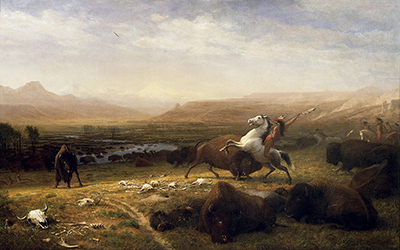
c. 1877–1880The Last of the Buffalo
1888–1889The Golden Gate
1900California Redwoods
Not verifiedContents
Three trees before the ridge
The foreground trees have individual outlines. The pair on the left rise close together, with foliage spreading across much of the upper-left corner. One presents a slender trunk, the other a broader sequence of branches and needles. Their overlapping forms make this side of the picture relatively dense.
The more isolated tree near the centre has an uneven crown and a partly bare top. Its dark branch tips stand clearly against the bright sky, while lower boughs extend towards both sides. The irregular silhouette gives the eye a way to distinguish this particular tree from the surrounding mass of vegetation.
Its trunk also separates two kinds of space. To the left, the trees overlap the darker ridge; to the right, branches are visible against a more open, luminous sky. The same tree changes in emphasis according to what lies behind it. It is both part of the shaded foreground and an outline within the light.
Near its base, the ground opens into a relatively low, gently sloping area. Patches of vegetation interrupt the surface, while smaller trees lead towards the wooded rise beyond. The scene offers several distances rather than a single wall of trunks.
Light beside the hill
The sun lies low near the ridge's right-hand edge. The brightest area is confined to that meeting of land and sky, with a broader golden glow around it. Small clouds break up the sky without overwhelming the circular light source.
The ridge descends diagonally towards the right. Its trees are silhouetted close to the sun, while farther left the wooded mass becomes darker and more continuous. A warmer exposed rock face interrupts that mass near the upper part of the slope. It catches attention as a separate surface among the greens and browns.
Across the foreground, shade has a different function. It allows the illuminated grass and warmer bark to register as accents, while keeping the bases of the trees rooted in substantial ground. The picture does not ask us to look only at the sun. Its effect depends on the surrounding surfaces that receive, interrupt or resist the light.
The position of the sun suggests a changing hour, but the composition alone does not record the date, exact viewing direction or duration of the depicted moment. The golden atmosphere is an organised pictorial effect as well as an apparent condition of weather and time.
A traveller’s account of studying the big trees
Fitz Hugh Ludlow accompanied Bierstadt on his 1863 western journey. In The Heart of the Continent, published in 1870, he describes their stop near Mariposa and the artists making colour studies among the big trees. He emphasises their attention to bark colour and characteristic forms, while arguing that a framed picture struggled to convey the trees' overwhelming scale.[2]
This is useful testimony about a particular journey and the tasks of looking and recording. It does not establish that California Redwoods was painted during that visit or identify a preparatory sheet for this composition. Ludlow's account also combines observation with literary exaggeration; his historical height and age estimates should not simply become measurements of the trees painted here.
The trees here are tall within the upright frame, but no tiny person provides a dramatic comparison with an immense trunk. Separate crowns, shaded ground and low sunlight make the wooded place legible through other relationships. Height is one element of this encounter, rather than its entire purpose.
Field visits, photographs and studio work
LACMA's research on a different work, The Grizzly Giant Sequoia, Mariposa Grove, California, connects Bierstadt's 1863 visit with his later studio practice. It dates that painting to about 1872–73 and discusses its use of a subject and viewpoint found in a Watkins photograph. It also distinguishes the size of the later studio work from the smaller studies made on the journey.[3]
Direct experience and photography could both contribute to a picture. This documented example concerns LACMA's painting, rather than the sources of the composition discussed here.
The distinction matters when discussing a familiar-looking landscape. Detailed trees may encourage us to imagine the painter standing before them, but a convincing scene cannot disclose its entire working history. Observation on a journey, remembered impressions, drawings, oil studies and photographs are separate kinds of evidence that must be connected to an object through records.
A title shared by different paintings
LACMA proposes that its Grizzly Giant picture may have served as a study for a ten-foot-high California Redwoods painted about 1875. That proposed relationship concerns another object.[3] The shared title supplies no reason to transfer its size, date or preparatory history to this composition.
The museum-source reproduction used here shows the three foreground trees, wooded ridge and low sun.[1] Those visual features establish which picture is being discussed more securely than the generic title alone. They also distinguish it from Giant Redwood Trees of California, with its enormous nearby trunks, water and small figures.
Keeping the paintings separate allows their different purposes to emerge through comparison. A forest interior that encloses people beneath massive trunks asks different questions of scale from a scene in which separate trees are set before a distant ridge. Their common subject does not erase their compositional differences.
Studies and independent paintings
Conservators Lance Mayer and Gay Myers distinguish different kinds of Bierstadt studies. Their account ranges from records of individual details to highly finished small paintings. In discussing South Dome, Yosemite Valley, they show how careful paint application and a developed composition can make a study function as an independent picture.[4]
That finding encourages care with the word sketch. A smaller work need not be an incomplete stage on the way to a monumental canvas. Equally, its apparent immediacy does not prove that it was executed quickly or entirely outdoors. Materials, inscriptions and examination of the original can provide evidence that a reproduction cannot.
Trees and botanical names
Sandra Knapp's Natural History Museum account distinguishes the coast redwood, Sequoia sempervirens, from the giant sequoia, Sequoiadendron giganteum, of the Sierra Nevada. It also traces changes in the botanical naming of California's big trees.[5] The historical word redwood can therefore require more explanation than a simple appeal to height.
The title identifies the subject in broad terms, while the image presents a mixed wooded setting. The smaller trees and the three prominent trunks should not all be assigned one species from this reproduction. Neither the distant ridge nor the golden light establishes a precisely named grove.
Bierstadt's attention to differing outlines remains important without such identifications. The partly bare upper branches of the central tree, the fuller foliage at the left and the smaller trees beyond create variety within the scene. The woodland becomes a collection of distinct forms rather than a uniform backdrop.
A close view with an open horizon
Compare Dogwood, where a small bright tree concentrates attention within a darker interior. California Redwoods makes the sky more conspicuous and separates its nearer trees against different backgrounds. Both use an upright format, but the relationship between enclosure and opening changes.
The ridge supplies enough distance to keep this scene from becoming entirely enclosed. The foreground trunks remain near and individually legible, while the sun and sky suggest space beyond them. Much of the picture's character lies in sustaining both experiences at once.
California Redwoods draws attention to the organisation of a wooded landscape through light. Its trees interrupt the view, yet their different silhouettes make the distance more interesting. The golden sky is inseparable from the shaded forms through which we see it.
Watch: Albert Bierstadt
Five perspectives on his paintings and their historical setting.
American Landscape Painting: Albert Bierstadt and the American Land
A Museum of Fine Arts, Boston presentation on American Landscape Painting: Albert Bierstadt and the American Land.
Explore Bierstadt’s artworks
Discussion
How do the three prominent trees hold the viewer near the forest while the sky opens beyond it?
Reader Insights
Compare the partly bare central crown with the fuller trees at the left. How does their variety organise the near space?
Keep the Saint Louis composition separate from the other redwood paintings discussed in the article. Which visual and collection details make identification secure?
Read the botanical distinction between coast redwood and giant sequoia beside the image. What can the title establish, and what would require more detailed evidence?
Join the Conversation
Share a specific observation, documented connection or comparison from California Redwoods.
References
- Wikimedia Commons. California Redwoods, Saint Louis Art Museum source reproduction identified with accession 735:1991 and linked object 18867. Used for composition identity; current museum display and detailed object metadata are not established by the image record. View source text
- Fitz Hugh Ludlow. The Heart of the Continent, Hurd and Houghton, 1870, pp. 420–424. The Mariposa stop, colour studies and the difficulty of representing tree scale; original book digitised by BYU. View source text
- Los Angeles County Museum of Art. The Grizzly Giant Sequoia, Mariposa Grove, California, about 1872–73, accession 53.30. Curatorial research on the journey, photography, studio study and a separately identified monumental California Redwoods. View source text
- Lance Mayer and Gay Myers. “Bierstadt and Other 19th-Century American Painters in Context,” Journal of the American Institute for Conservation 38, no. 1, 1999, §3.1. Different kinds of studies and the developed South Dome painting. View source text
- Sandra Knapp. “The giant sequoia, Sequoiadendron giganteum: The biggest tree in the world,” Natural History Museum. Coast redwood/giant sequoia distinction and botanical naming history. View source text