by Tom Gurney
Tom Gurney BSc (Hons) is an art history expert with over 20 years experience
Published on June 19, 2020 / Updated on October 12, 2026
Email: tomgurney1@gmail.com / Phone: +44 7429 011000
Oregon Trail by Albert Bierstadt
The destination is written on the wagon, but the journey has stopped for the night. In Albert Bierstadt’s Oregon Trail, travellers gather around a fire beneath spreading trees while a moon shines through the branches. The painted words “FOR OREGON” turn an otherwise secluded woodland camp into a scene of westward migration. Bierstadt brings that immense historical movement down to the scale of a few people, a horse, a wagon and the work of keeping a fire alive.
Christie’s offered this undated night scene on 20 May 2009, lot 31. Signed at the lower right, it is oil on canvas tacked over board, 75.6 × 111.8 cm.[1]
At a Glance
Where this painting sits in Bierstadt’s career
Dates refer to the paintings, rather than to the journeys behind them. Approximate dates and ranges retain the qualifications in the collection records.
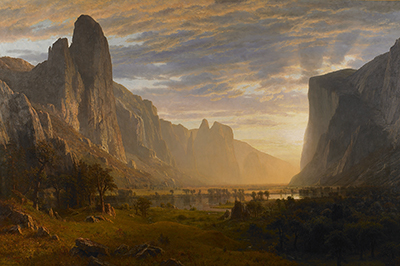
Lake Lucerne
1858Mountain Brook
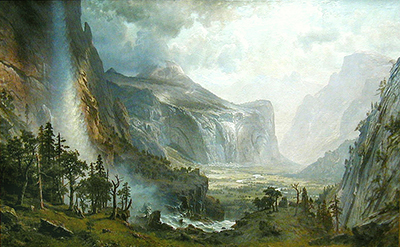
1863Street in Nassau
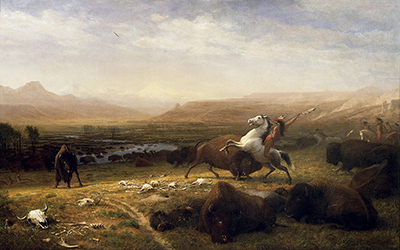
c. 1877–1880The Last of the Buffalo
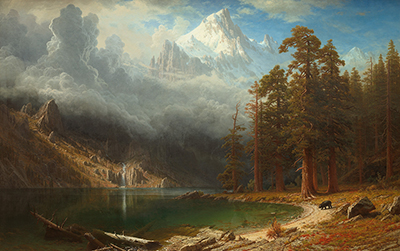
1888–1889The Golden Gate
1900Oregon Trail
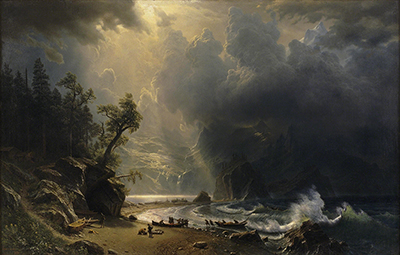
UndatedContents
A camp made visible by fire
The fire lies low in the composition, just to the right of the great central tree. Its light travels upward, transforming the trunk and the undersides of the branches into orange shapes against the darkness. Those branches spread well beyond the group of travellers. They give the small camp a broad canopy, making the tree both a shelter and the principal structure of the picture.
The moon offers a different kind of illumination. High on the left, it appears as a pale disc surrounded by a cooler glow. It reveals something of the depth of the wood and catches the upper surface of the wagon cover, but leaves much of the ground obscure. Firelight makes the nearest objects warm and legible; moonlight suggests a world extending beyond them. Between the two, Bierstadt can show a night that feels dark without making its human activity disappear.
At the left, the wagon’s rounded cover and large wheels provide a compact set of recognisable forms. Its rear opening glows orange, while the lettering along its side remains subdued. A horse stands nearby. A traveller carrying an armful of wood crosses the interval between the wagon and the fire, linking the means of travel with the evening’s immediate task. The movement is modest but essential: fuel must be brought before anyone can settle into the warmth.
Around the flames, some figures stand and others sit. Hats, legs and shoulders emerge as silhouettes or catch small patches of light. Their different positions suggest the informal gathering of people at the end of a day’s travel. A seated man in the foreground remains apart from the brighter group, close to the water at the bottom of the picture. His separation gives the camp a quieter edge. The eye can move from collective activity to an individual at rest, then down to the small reflections that carry the fire’s colour into the water.
This arrangement rewards slow looking. The first impression is of an almost continuous darkness broken by orange light. Gradually, the wagon, wood carrier, scattered figures and uneven banks become clearer. The travellers occupy only the lower portion of the scene; above them, the tree spreads across a much larger space. Their temporary shelter feels substantial, yet the people remain small within it.
Experience shaped into a studio scene
Christie’s describes a studio composition developed from studies made during Bierstadt’s late-1850s western travels.[1]
The distinction matters because the picture is so persuasive in its details. The wagon lettering, the firewood and the different degrees of illumination make the camp seem observed. Yet the available record identifies no individual camper or precise location. Experience has become a scene that can stand for many evenings on the trail, with its separate incidents arranged around the central source of light.
The composition allows room for numerous small incidents without spreading them across the vast distances of Bierstadt’s mountain panoramas. The sweep of the branches and the gestures beneath them remain parts of one enclosed space. Its intimacy comes from the gathering of figures and the surrounding darkness.
An account by his travelling companion Fitz Hugh Ludlow helps explain the appeal of such a subject. In The Heart of the Continent, Ludlow describes camping with the artist beside the Republican River, near its junction with White Rock Creek. They secured their horses and built a fire of old logs, using a hollow cottonwood as a chimney. Their companions and provisions had stopped farther upstream; unwilling to return, they went to bed without supper.[2]
Ludlow then turns the inconvenience into a spectacle of light. The flames made the pale trunks and twisted branches above the stream flicker, while the river reflected the purple twilight and sparks from the fire. His attention shifts from the missing meal to the movement of brightness across trees and water. The passage records a traveller seeing a potentially pictorial subject in an ordinary night outdoors.[2]
The affinities with Oregon Trail are clear: a tree dominates the camp, the flame colours its branches, and water extends the light below the figures. This does not identify the painting’s location or establish Ludlow’s episode as its source. It shows that effects central to the finished picture also caught the attention of someone travelling alongside Bierstadt. It also complicates the apparent comfort of a campfire. In Ludlow’s account, visual pleasure and an empty stomach belong to the same evening.
The work behind an evening’s rest
For overland travellers, stopping meant a change of tasks. The National Park Service describes evening camps as places for cooking, caring for livestock, mending clothes and repairing wagons. The familiar circle of wagons served substantially as a livestock corral. On stretches of prairie without wood, dried buffalo dung could supply fuel.[3]
The wood carrier in Bierstadt’s painting brings one of those necessities into the foreground. His arms hold the material that will sustain the brightest part of the scene. The canopy overhead and the fire at its base make this particular stop look well supplied with shelter and warmth. Nothing in the image tells us how easily the travellers found it, how far they have come, or what supplies remain in their wagon. The moment is complete as a composition even though the journey is unresolved.
Amelia Stewart Knight’s diary offers a different measure of an evening camp. On 14 April 1853, she recorded a stop on a cold prairie without wood: others searched for fuel while illness prevented her preparing supper. On 23 April, cooking continued amid rain, mud and wet belongings. Her 5 May entry described rotating watches over the stock, with so much noise that sleep was difficult. On 28 August, willow was available to burn but the water was poor.[4]
These selected entries describe a different journey; Knight is not an identified figure or source for the painting. They reveal how fragile the conjunction of fire, water, animals and rest could be. Bierstadt has brought those elements close together and held them in equilibrium. The diary makes that equilibrium more noticeable, because comfort required repeated work and favourable circumstances. A seated figure can suggest repose without representing everyone’s experience of the stop.
Knight also recorded buying salmon from Indigenous people on 17 August.[4] Her account places the caravan within a country of encounters and exchange. The painting centres the illuminated company, leaving such relationships outside its immediate narrative. Its limited view can be appreciated for the closeness it creates while still being recognised as a selection from the much wider history of migration.
Related paintings, separate identities
Related works include Mead Art Museum’s Campfire (1863) and Butler Institute’s The Oregon Trail (1869).[1] Those dates identify separate paintings.
The Butler picture opens out into a valley through which wagon trains advance. Angela Miller discusses its combination of towering cliffs, a river valley, travellers and a Native American village as a constructed vision of migration. That 1869 landscape, reproduced as figure 11 in her essay, gives the subject a panoramic setting quite different from this woodland enclosure.[5]
Emigrants Crossing the Plains offers another useful comparison. The National Cowboy & Western Heritage Museum’s lesson plan dates that large canvas to 1867 and distinguishes it from the 1869 Oregon Trail. It represents the larger spectacle of travel across the landscape. In the night camp, the sign on one wagon supplies the destination while the enclosing trees and darkness concentrate attention on a pause along the way.[6]
These pictures share a subject world without being versions of one interchangeable image. The open migration scenes invite the eye to follow a route across space. Here, the strongest movement circles back towards the fire.
Migration within a sheltered landscape
The camp’s quietness is part of its historical meaning. Miller argues that Bierstadt’s western landscapes could make a region undergoing profound change appear harmonious and available to the imagination of eastern audiences. She relates his organisation of scenery to ideas of national expansion, settlement and visual possession. In her reading of the Butler Oregon Trail, the composition contains conflicts that the surface narrative softens.[5]
That wider argument provides a useful context for looking at this painting, although Miller is not analysing this particular camp. The woodland is presented through the travellers’ needs: shelter overhead, water nearby, a clearing in which to stop. The wagon’s inscription places those needs within a continuing movement west. The picture gives us access to the migrants’ evening, rather than a full account of the lands through which they travel or the consequences of settlement.
The appeal of the scene rests in that narrowed view. A long journey has become a shared fire and a few practical gestures. The darkness retains its depth around the camp, while the illuminated tree gives the people beneath it a temporary sense of enclosure. Looking from the pale moon to the glowing trunk, and then to the man seated near the water, we experience the pause as much as the destination.
Ownership and the documented record
Christie’s provenance begins with the artist, his wife Mary, a gift to an Ossining collection and descent. Later dealers and collectors extend the record to Wyoming in 2005. It also lists Kennedy Galleries’ 1980 exhibition and Baigell’s 1988 illustration, page 77, plate 31.[1]
These later appearances establish the picture’s documented circulation. They do not date its production or identify its original audience. Nor does the published auction entry name a present owner. The visual narrative is unusually legible, but its early history remains less complete than the scene itself.
Watch: Albert Bierstadt
Five perspectives on his paintings and their historical setting.
American Landscape Painting: Albert Bierstadt and the American Land
A Museum of Fine Arts, Boston presentation on American Landscape Painting: Albert Bierstadt and the American Land.
Explore Bierstadt’s artworks
Discussion
What does the inscription FOR OREGON add to an otherwise secluded night camp?
Reader Insights
Compare the warm light around the camp with the cooler light above it. How do the two sources organise the scene?
Look at the relationship between tree, wagon and travellers. How does the sheltering composition affect your sense of the journey beyond this moment?
How do Ludlow’s firelight passage and Knight’s accounts of camp work affect your reading of this quiet scene?
Join the Conversation
Share a specific observation, documented connection or comparison from Oregon Trail.
References
- Christie’s. Oregon Trail, sale 2171, lot 31, 20 May 2009. Details, Provenance, Literature, Exhibited, Specialist note. View source text
- Fitz Hugh Ludlow. The Heart of the Continent (1870), pp. 100–101, Republican River camp and firelight. Original edition. View source text
- National Park Service. “Traveling the Emigrant Trails,” sections “A Typical Day,” “Leisure Time” and “Food on the Trail.” View source text
- Amelia Stewart Knight. 1853 diary, selected entries 14 and 23 April, 5 May, 17 and 28 August; educational transcription in Northern Virginia Community College, U.S. History, Part I. View source text
- Angela Miller. “Albert Bierstadt, Landscape Aesthetics, and the Meanings of the West in the Civil War Era,” Art Institute of Chicago Museum Studies 27, no. 1 (2001), pp. 40–59. Western landscape and expansion, pp. 47–49; Butler The Oregon Trail, pp. 53–55 and fig. 11. View source text
- National Cowboy & Western Heritage Museum. Emigrants Crossing the Plains: Lesson Plan, Grades 6–12, pp. 2–3, especially “About the Artwork.” View source text