by Tom Gurney
Tom Gurney BSc (Hons) is an art history expert with over 20 years experience
Published on June 19, 2020 / Updated on October 12, 2026
Email: tomgurney1@gmail.com / Phone: +44 7429 011000
Yosemite Valley, Glacier Point Trail by Albert Bierstadt
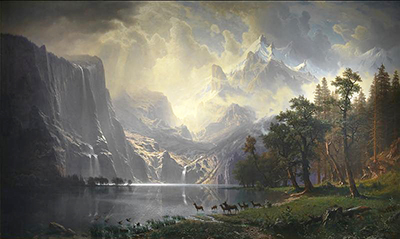
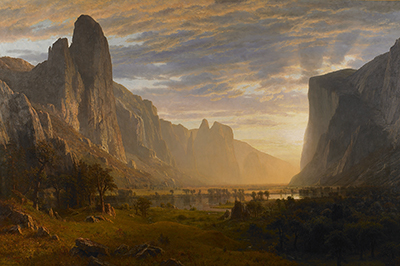
The Merced River winds towards a golden opening between distant cliffs, while a steep wooded ledge occupies the nearer left side. Albert Bierstadt's Yosemite Valley, Glacier Point Trail places the viewer above the valley, close to a route along its edge and far from the bright water below. The view feels expansive, but the small travellers on the trail make it an experience reached from a particular place.
Yale University Art Gallery dates this oil on canvas to about 1873. It measures 137.2 × 215.3 cm and entered the collection as the gift of Mrs. Vincenzo Ardenghi, accession 1931.389. In his audio guide, curator Mark D. Mitchell identifies the westward view and the setting sun over the Merced.[1] Evening gives the painting its golden atmosphere, bringing the trail, trees and horse riders into the same late-day encounter.
At a Glance
Where this painting sits in Bierstadt’s career
Dates refer to the paintings, rather than to the journeys behind them. Approximate dates and ranges retain the qualifications in the collection records.
Lake Lucerne
1858Mountain Brook
1863Yosemite Valley, Glacier Point Trail
About 1873Street in Nassau
c. 1877–1880The Last of the Buffalo
1888–1889The Golden Gate
1900Contents
A ledge from which to look
The near cliff rises along the left edge, with rocks, trunks and foliage piled into an uneven wall. Its heavy, irregular surface gives the eye something close to grasp before the composition opens into distance. Beneath the trees, a narrow path carries small figures along the rock face. They occupy the transition between the spectator's near space and the valley beyond.
The trail is important because it supplies a plausible position for looking. Without it, the prospect might seem detached from any journey through the landscape. Here, visitors can stop along the mountainside and look out. Their route lets us imagine following them towards a viewpoint, while the enormous drop prevents that imaginary movement from becoming entirely comfortable.
Foreground rocks have distinct edges, and nearby branches can be followed individually. Far below, the forest becomes a broad, darker expanse in which the trees are difficult to separate. This change of resolution is one of Bierstadt's strongest means of conveying height. He makes the nearer ledge available to inspection while letting the valley floor retreat into a scale beyond close acquaintance.
The left-hand wall also determines how the panorama unfolds. It withholds part of the landscape, then releases the eye past the tall tree towards the open centre. We do not receive a uniformly distant view across the whole canvas. The proximity of one side makes the other side feel farther away, and the trail provides a human connection between those unequal spaces.
Sunset over the Merced
At the right, the great face of El Capitan answers the nearer wall across the valley.[1] Its broad dark mass helps hold the composition together. Light catches portions of the cliff's edges and fissures, but the illuminated sky remains the largest opening. The painting balances stone against atmosphere without letting either become a complete enclosure.
The sun is small beside the extent of its glow. Warm colour spreads through the sky and reaches down between the distant cliffs. Ridges become successively paler, so their outlines appear suspended within the light. The dark foreground forest makes this recession easier to perceive. Distance is built through changes in colour and clarity as well as through the diminishing size of objects.
The Merced is a particularly efficient link between foreground and horizon. Its pale, winding course stands out against the wooded valley floor. Rather than following a straight line to the sun, it changes direction, briefly disappears and returns to view. Those turns give the lower part of the panorama a rhythm that answers the changing profiles of the cliffs above.
A thin, bare trunk rises near the middle foreground. Its angular branches cut across the luminous distance, making a close form conspicuous against a soft background. The trunk helps join two kinds of looking: attention to an individual tree and attention to a landscape extending beyond it.
The broad canvas allows the river, cliff and sky to be apprehended together. Its smaller details then invite a different pace. Once the first impression of golden space has registered, the spectator can return to the riders, the rock ledges and the trunks. Bierstadt gives the large prospect a near world to explore, rather than leaving all its interest at the horizon.
A route created for visitors
The painting's approximate date places it within a changing history of access. The National Park Service records that the Four Mile Trail was completed in 1872. Its account of Union Point, partway up that route, notes the westward prospect with El Capitan to the right. Carleton Watkins had carried photographic equipment there for an 1866 view before the trail existed.[2]
That chronology distinguishes a spectacular viewpoint from the means of reaching it. The mountain was available to earlier travellers, but a constructed trail could organise an encounter for a different visitor experience. Bierstadt's title and foreground make a route through the landscape part of the work's identity. The visitors are not simply placed on an abstract platform above a beautiful valley.
The foreground path leads the eye into the panorama while giving the view a relationship with the development of Yosemite tourism. The apparent remoteness of the distance is presented from ground that people have made accessible.
Yale's interpretation connects the work with the eastern audience for western landscape and with tourism following the transcontinental railroad's completion in 1869.[1] The rail journey and the mountain trail belonged to different stages of access. One helped visitors cross a continent; the other shaped their movements within the valley's surroundings. The small horseback party makes the final stage of that experience visible.
Their scale should not make their importance seem equally small. They are the figures through whom the prospect becomes an outing. The painting offers viewers elsewhere a related experience: a chosen position, a wide view and enough near detail to imagine occupying the place. Its appeal to distant spectators depends partly on that invitation.
A small study and a large canvas
A historical Christie's catalogue documents an oil-on-board Study for Yosemite Valley, Glacier Point Trail, measuring 25.5 × 35.6 cm, signed with Bierstadt's initials on the front and with his name and “Yosemite” on the reverse. The auction house lists the Yale canvas as the related finished work and emphasises the closeness of their relationship.[3]
This is a useful addition to the painting's history because it gives the composition a documented counterpart at a much smaller scale. The study and canvas differ in support and dimensions. They should remain separate objects in any account of the work: the small board's inscriptions and measurements do not describe the Yale painting.
The catalogue connection also moves the discussion beyond the familiar statement that Bierstadt made outdoor sketches. It identifies a particular study associated with a particular finished composition. Such a relationship allows us to understand the panoramic view as something developed across more than one object, even though the auction entry alone cannot tell us every stage of its making.
The change in scale would also change the spectator's encounter. On a small board, the valley's broad masses can be taken in at close range. A canvas more than two metres wide gives those masses a different physical presence and creates room for the trail figures and foreground textures to command attention. Scale contributes to the work's effect as surely as the painted height of the cliffs.
Botanical detail within the spectacle
Yale returned to the painting in its 2016 exhibition Yosemite: Exploring the Incomparable Valley. The display connected art with the university's natural-history collections. Curators matched plants identified in Bierstadt's landscape—ponderosa pine, sugar pine, white fir and greenleaf manzanita—with specimens from the Yale University Herbarium.[4]
That comparison changes the way we can regard the foreground. The trees are compositional devices, but they also reward more specific attention. A large landscape can gather recognisable features of vegetation into an arrangement designed to produce awe. Botanical detail and a dramatic prospect are compatible parts of the painting's appeal.
The exhibition also included a stereocard showing women on horseback climbing the Glacier Point Trail in 1900.[4] This later record supplies a comparison with actual visitors encountering the route. It is not a source for a canvas painted decades earlier. Seen alongside the painting, it makes the riders' activity less abstract: looking at Yosemite could be a social excursion involving horses, paths and shared stopping places.
These comparisons widen the work's interests beyond monumental geology. The nearby plants introduce the character of a living environment; the later stereocard introduces the experience of travelling through it. Both bring us back to details already present in the picture, instead of replacing the painting with a general account of the park.
The landscape beyond the painted view
Yosemite's valley floor was also a place of work and alteration. The National Park Service's account of Watkins's 1866 photograph from Glacier Point identifies a corral and split-rail fences, with what may be haystacks.[2] Such records show activities that can be difficult to perceive within a broad, elevated landscape.
The comparison does not prove that Bierstadt removed particular structures from this exact composition. Different viewpoints and different media organise what can be seen. It does, however, help prevent a sweeping prospect from being mistaken for evidence that the valley had no working economy. At this distance, forest, meadow and river can merge into a beautiful pattern while the uses of the ground become less conspicuous.
Yale's 2016 exhibition also brought Miwok baskets from around the turn of the twentieth century into its account of tourism, showing Indigenous artisans' engagement with visitors.[4] The baskets belong to a later period than the painting, but their inclusion resists an account in which Yosemite's history begins and ends with visiting artists. The panoramic image represents one encounter within a much longer human history.
The riders on the trail are therefore a productive place to begin asking what the painting brings forward. They make visitor access visible, yet they cannot represent everyone connected with the valley. Its beauty is concentrated around a selected position and a particular hour of light. The canvas is compelling partly because Bierstadt gives that selection such coherence.
Comparing Yosemite viewpoints
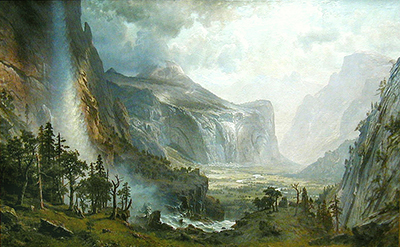
Cho-looke, the Yosemite Fall places an artists' camp beneath a towering waterfall. Its upright format directs attention towards the cliff above the figures. Glacier Point Trail spreads the prospect laterally and places visitors high along its edge. Both give people a visible relationship with a formidable setting, but the bodily experience they suggest is different: looking upwards from shelter versus looking out from a ledge.
Looking Down Yosemite Valley, California offers another luminous distance. In the Yale work, however, the visible trail makes the choice of vantage point especially explicit. The panorama is something visitors have travelled towards, and the foreground gives them a place to occupy while they look.
Those differences help explain why Glacier Point Trail remains more than a collection of impressive cliffs. Its river connects the distances, its trees hold the near ground, and its riders make the landscape accessible to the imagination. Sunset unifies these elements without removing their separate interests. The spectator can enjoy the expanse and then return to the smaller things that give this particular encounter its character.
Watch: Albert Bierstadt
Five perspectives on his paintings and their historical setting.
American Landscape Painting: Albert Bierstadt and the American Land
A Museum of Fine Arts, Boston presentation on American Landscape Painting: Albert Bierstadt and the American Land.
Explore Bierstadt’s artworks
Discussion
A narrow ledge carries travellers above the broad Merced valley. How does their position make the elevated prospect feel like an experience reached by a route?
Reader Insights
Which near rocks, trees and figures make the path feel close while the river remains far below?
How does Watkins’s view before the Four Mile Trail’s completion change your understanding of the relationship between a scenic prospect and visitor access?
What does Yale’s comparison with herbarium specimens add to the painting’s broader effects of evening light and distance?
Join the Conversation
Share a specific observation, documented connection or comparison from Yosemite Valley, Glacier Point Trail.
References
- Yale University Art Gallery; Mark D. Mitchell. Yosemite Valley, Glacier Point Trail, accession 1931.389. Collection metadata, label and curator's audio-guide transcript; viewpoint and tourism. View source text
- National Park Service, Yosemite National Park. Explorers and Recorders. Sections “Yosemite Valley from Glacier Point, 1866” and “The View from Union Point, 1866”; trail chronology and historical photographs. View source text
- Christie's. Albert Bierstadt: Study for Yosemite Valley, Glacier Point Trail, historical lot 349973. Object details and catalogue discussion of the relationship with the Yale canvas. View source text
- Mike Cummings, Yale News. ‘Synergy of art and science’ at Yosemite highlighted in Yale Art Gallery exhibit. 11 October 2016; botanical comparisons, later stereocard and Miwok baskets. View source text