by Tom Gurney
Tom Gurney BSc (Hons) is an art history expert with over 20 years experience
Published on June 19, 2020 / Updated on October 12, 2026
Email: tomgurney1@gmail.com / Phone: +44 7429 011000
Light in the Forest by Albert Bierstadt
Three animals stand beside a narrow stretch of water beneath tall, branching trees. Beyond them, golden light fills an opening in the woodland, while pink clouds and blue sky appear above the canopy. Albert Bierstadt's Light in the Forest draws attention through the trees towards this luminous distance, then returns it to the small group near the bank.
Sotheby's catalogued the work as oil on canvas, 132 × 107 centimetres, signed at the lower right. Its essay proposes a date in the mid-to-late 1870s and describes Light in the Forest as a modern title.[1] The date remains an attribution rather than an exact year established by a dated signature. A current owner has not been confirmed.
At a Glance
Where this painting sits in Bierstadt’s career
Dates refer to the paintings, rather than to the journeys behind them. Approximate dates and ranges retain the qualifications in the collection records.
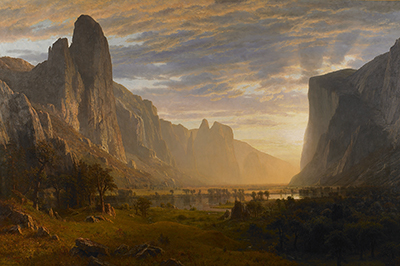
Lake Lucerne
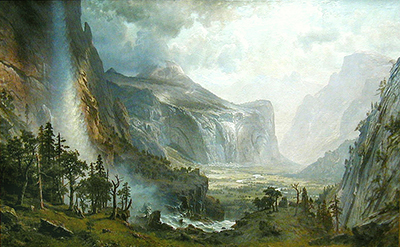
1858Mountain Brook
1863Street in Nassau
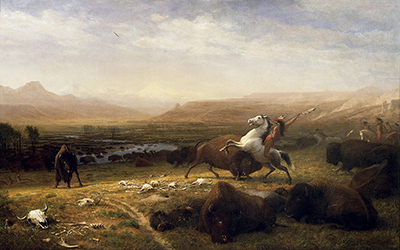
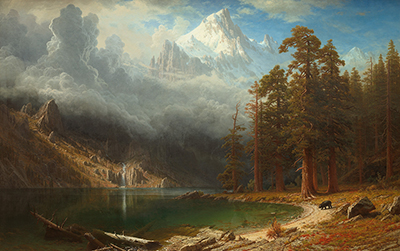
c. 1877–1880The Last of the Buffalo
1888–1889The Golden Gate
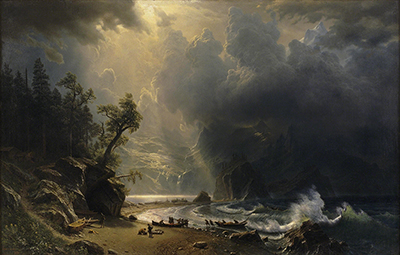
1900Light in the Forest
Probably mid-to-late 1870sContents
A tall view enclosed by trees
The vertical format makes the nearest trunks substantial presences. The large tree on the left rises from a rocky, shaded bank and divides into branches reaching across the upper part of the scene. Its dark foliage partly closes the top edge, providing a sheltered foreground through which to look.
A slimmer trunk stands on the right. Its branches extend towards the centre at a different height, while smaller trees continue behind it. These forms balance the heavier left side without repeating it exactly. The woodland therefore encloses the view unevenly, leaving a central opening that widens towards the light.
The trees also connect different levels of the painting. Roots and rocks establish the near ground; trunks carry the eye upwards; smaller branches divide the sky into irregular shapes. Their forms remain legible even where foliage and atmosphere reduce the distinction between one tree and another.
Closer to the centre, the trees become thinner and less sharply defined. A tall, slender form rises beyond the animals, and a group of smaller crowns appears farther right. This recession allows the painting to suggest an extensive woodland without presenting every part of it with equal clarity.
The animals beside the water
The largest foreground animal stands upright on the right of the group. Its antlers make a delicate silhouette against the hazy ground beyond, while its darker neck contrasts with its warmer body. Two smaller animals stand nearer the water: one raises its head, and the other lowers its muzzle towards the bank.
Their different postures prevent the group from becoming a repeated decorative pattern. The antlered animal offers an alert vertical shape, the raised head beside it creates a smaller upright accent, and the lowered head directs attention towards the ground. Together they make the foreground feel occupied rather than merely ornamented.
The Sotheby's essay identifies the animals as elk, citing the darker, longer hair around their necks. The National Park Service's account of elk also describes their contrasting neck and body colouring, and explains that they graze on grasses and other herbaceous plants while also browsing shrubs.[2]
That natural history gives context to the animals' placement in a grassy opening. It does not determine the exact behaviour of the lowered head or establish the painting's geographical setting. The image supplies a visible group; it does not reveal a complete account of their movement, feeding or relationships.
Fainter animal forms appear beyond the foreground group, where the land and light are less distinct. They extend the impression of wildlife into the distance, but the clearest points of attention remain the three bodies beside the near water.
A small waterway within the larger scene
The water enters from the left beneath the shaded bank and passes behind the foreground animals. Its smooth-looking surface carries warmer reflections near the centre, while the portion below the rocks appears darker. The difference brings the strongest illumination close to the group without placing every part of the foreground in full light.
A large angular rock rests near the lower centre. Its rough, dark faces interrupt the finer texture of the surrounding grass. It also forms a nearer, more solid point of reference than the hazy shapes beyond the water.
The water’s boundaries disappear behind the animals and vegetation, leaving its wider extent unresolved. Within the composition, it creates an interval between the rocky left bank and the grassy ground occupied by the animals.
Gold light and a cooler sky
The brightest passage lies behind the large tree on the left. Light spreads across the central opening and softens the distant ground into yellow and orange tones. Nearby shrubs remain visible as small interruptions within that glow.
Higher up, the colour changes. Pink clouds cross a cooler blue-green sky, and the upper foliage becomes darker. This contrast prevents the warm centre from extending uniformly across the whole painting. The canopy, sky and ground each retain a different character.
The visible effect is suggestive of sunset, as the auction essay also interprets it. Yet the scene's appeal depends on more than an implied hour. The dark trunk, broken foliage and small animal silhouettes allow the broad area of light to remain intense while giving the eye individual forms to examine.
Woodland and nineteenth-century preservation
Sotheby's reads the painting as carrying a preservationist sentiment, relating its woodland imagery to Bierstadt's later The Last of the Buffalo. This is an interpretation of the scene, rather than a documented statement by the artist about this particular canvas.
Concern for forests was nevertheless an active part of the period's public discussion. The National Agricultural Library's account of Franklin Benjamin Hough records his 1873 address advocating forest preservation and renewal. It also explains that Congress funded a federal forestry expert in 1876 and that Hough took up that work.[3]
This history places forest scenery beside contemporary questions about the uses and future of woodland. It does not prove that Bierstadt knew Hough or painted the work in response to his address. The historical connection is broader: trees could be valued for their appearance, their resources and their relationship to water and climate within the same period.
Another landscape imagined through golden light
A useful comparison is Bierstadt's The Falls of St. Anthony, which the Museo Nacional Thyssen-Bornemisza dates circa 1880–1887. The museum interprets that work as an imagined recovery of the falls' earlier grandeur, painted after the surroundings had been transformed by the growth of Minneapolis.[4]
Its actual composition differs substantially from Light in the Forest. A dark group of trees occupies the left, while a broad waterfall and river stretch across the horizontal view. Human figures appear near the foreground shore. Golden atmospheric light joins these forms without concealing the main expanse of moving water.
The comparison shows how illumination and foreground trees can organise very different subjects. In the forest painting, the opening leads towards a quieter, less specifically identified distance. At St. Anthony, the panorama centres on a named waterfall whose environmental history forms part of the museum's interpretation.
Looking at the two together makes Bierstadt's choices more apparent: how much space he gives to the distance, how strongly trees enclose it, and where animals or people provide a point of entry.
Returning to the near bank
Begin with the antlers against the hazy centre, then follow the right-hand branches upwards towards the cooler sky. Across the top, the darker canopy brings attention back towards the large left trunk and its rocky base. The painting offers this circuit as well as a direct passage into the light.
The luminous opening may be its most immediate attraction, but the animals, water and rough foreground rock sustain closer looking. They give the woodland a particular arrangement of bodies and surfaces, holding the distant glow within a scene that can be explored detail by detail.
Watch: Albert Bierstadt
Five perspectives on his paintings and their historical setting.
American Landscape Painting: Albert Bierstadt and the American Land
A Museum of Fine Arts, Boston presentation on American Landscape Painting: Albert Bierstadt and the American Land.
Explore Bierstadt’s artworks
Discussion
How does the glowing woodland opening return your attention to the animals beside the water?
Reader Insights
Follow the large animal’s silhouette into the warm distance. How does its outline give the near bank a sense of scale?
Compare the darker water beneath the rocks with the warmer reflections nearby. How does that transition organise the foreground?
Compare the woodland opening with The Falls of St. Anthony. How do trees frame the light in each scene?
Join the Conversation
Share a specific observation, documented connection or comparison from Light in the Forest.
References
- Sotheby's. Light in the Forest, 2011 auction catalogue, lot 90. Object description and catalogue essay prepared with the assistance of Gerald Carr; proposed date and interpretation attributed. View source text
- National Park Service. Watching Elk, Rocky Mountain National Park. Elk appearance and feeding ecology used as general context. View source text
- USDA National Agricultural Library. Franklin Benjamin Hough Papers, MS0263. Finding aid and biographical account of nineteenth-century forest preservation work. View source text
- Museo Nacional Thyssen-Bornemisza. The Falls of St. Anthony, circa 1880–1887, CTB.1980.8. Separate collection record and curatorial interpretations. View source text