by Tom Gurney
Tom Gurney BSc (Hons) is an art history expert with over 20 years experience
Published on June 19, 2020 / Updated on October 12, 2026
Email: tomgurney1@gmail.com / Phone: +44 7429 011000
Cho-looke, the Yosemite Fall by Albert Bierstadt
Two white falls descend through a wall of grey granite, while a much smaller gathering occupies the grass beneath the trees. Albert Bierstadt's Cho-looke, the Yosemite Fall makes height its governing effect: the cliff extends into cloud, beyond the scale of the people, animals and equipment below. Yet the campsite is more than a convenient measure of the mountain. It introduces the people who came to study Yosemite and the means by which their experience could become a picture for others.
Painted in 1864, this oil on canvas measures 87 × 68.9 cm and belongs to the Putnam Foundation at the Timken Museum of Art, San Diego, accession 1966:001.[1] Its combination of waterfall and working camp joins two experiences of landscape: the immediate encounter with a formidable place and the patient business of carrying its appearance away. The painting can be enjoyed as a spectacle, but its history also opens questions about observation, photography, travel and the authority of a visitor's view.
At a Glance
Where this painting sits in Bierstadt’s career
Dates refer to the paintings, rather than to the journeys behind them. Approximate dates and ranges retain the qualifications in the collection records.
Lake Lucerne
1858Mountain Brook
1863Street in Nassau
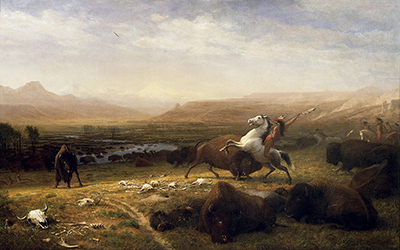
c. 1877–1880The Last of the Buffalo
1888–1889The Golden Gate
1900Contents
- A waterfall built for the upright canvas
- Light, mist and the weight of stone
- The artists' camp
- From the 1863 journey to the 1864 painting
- Ludlow and the exchange between words and pictures
- What photography contributes
- Visitors in a valley already inhabited
- Protection and the public landscape
- Ownership, titles and renewed attention
- Comparisons within Bierstadt's Yosemite paintings
A waterfall built for the upright canvas
The waterfall gives the composition a strong vertical line without making it mechanically symmetrical. Its upper descent is placed left of centre, beside an enormous rock face that occupies much of the upper right. Trees and the camp weigh the lower right, while a brighter opening stretches across the lower left. Our attention moves between those unequal areas rather than remaining fixed on a central axis.
The upper fall appears as a narrow, nearly continuous white line. Beneath it, spreading mist interrupts the water before a lower descent becomes visible. The eye has to connect these passages across a considerable interval of stone. That interruption helps convey distance: a single uninterrupted stripe would announce height, but the broken descent asks us to imagine water travelling through parts of the landscape that cannot be seen clearly.
The cliff also extends beyond a readily grasped outline. Near its summit, rock and cloud approach the same cool grey, and atmospheric softness obscures the boundary between them. The falling water remains legible where the mountain itself becomes uncertain. Bierstadt allows us a clear subject within an incompletely resolved setting, a balance that makes the view imposing without reducing it to a diagram of the falls.
At the bottom, the stream of brightness meets a more horizontal world of meadow, trees and camp. This change matters to the spectator's bodily sense of the scene. We first recognise ground that could be occupied, then look up into a height that greatly exceeds it. The upright format makes that shift especially concentrated. Yosemite's breadth is still suggested by the meadow and overlapping rocks, but height determines the experience.
Light, mist and the weight of stone
The granite is divided by long fissures, ledges and changes of colour. Some planes catch yellow-grey light; others fall into cooler, darker passages. These variations prevent the cliff from becoming a blank wall behind the waterfall. They give the rock an internal structure against which the white water can be measured.
Light is strongest through the central rock passages and across parts of the open ground. It does not illuminate the whole foreground equally. The camp sits beside a dark wood whose depth makes the nearby equipment and figures less immediately conspicuous. A visitor can therefore encounter the painting in stages: the falls attract attention first, and the inhabited foreground becomes clearer as looking slows.
Mist has a different function from cloud. Near the water it softens the meeting of cliff and descent, suggesting something mobile and dispersed. Higher up, cloud partly conceals the great mass of the mountain. The two forms of obscurity connect the painting's upper and middle zones, but they do not erase the visible distinctions between solid rock, moving water and air.
The artists' camp
The foreground contains pack animals, baggage and a gathering beneath the trees. Pale and dark animals occupy the lower middle, while the people are grouped farther right. Cloth and equipment lie close to the bottom edge. The Timken identifies a sketching umbrella and colour-box among the objects brought on the journey.[1] They make the campsite a place of artistic work as well as shelter.
The camp is arranged so that the practical world of travel lies nearest the spectator. Before reaching the waterfall, our eye passes animals that carry supplies, things set down on the grass and figures who have stopped moving through the valley. The monumental subject is approached through the ordinary requirements of staying there. This is a landscape whose beauty has to be reached with baggage.
Several tree trunks and branches lean into the open view. Their irregularity differs from the long descending water and the broad cliff planes. They frame the gathering without sealing it away. The camp belongs to a sheltered margin, close enough to the meadow to look out but dark enough to suggest a retreat from the exposed landscape.
Gerald L. Carr, writing in American Paradise, reads the camp as an evening gathering and considers Bierstadt likely to be among the men.[2] The small figures offer little facial detail. Equipment, shelter and the group’s position beneath the trees tell us more about their activity than about individual likenesses.
From the 1863 journey to the 1864 painting
Bierstadt visited Yosemite during his second western journey in 1863.[1] The date of the visit and the date of the canvas describe successive parts of its making. The journey supplied experience and studies; the finished picture belongs to the work that followed. A traveller's camp inside the image should not lead us to imagine this substantial canvas simply being completed beside the falls.
Carr’s newspaper evidence places the travellers’ return to New York in December 1863, with oil studies but no advanced studio canvases. Cho-looke was reported in progress on 9 June 1864.[2] The distinction gives the journey and the developed painting separate places in its chronology.
That interval helps explain the picture's double character. It preserves the sense of an encounter with a place, while its tall format, carefully balanced light and strategically placed foreground have the coherence of a developed composition. Experience is being reorganised for another setting and another audience. The painted camp makes observation visible, but the whole arrangement is also a demonstration of the painter's ability to give that observation a compelling form.
The relationship between study and finished picture is especially important in Bierstadt's Yosemite work. The studies were resources for more than one composition, and a remembered place could be explored through different formats and scales. The valley did not produce one definitive painted response. Here he chose the waterfall and the artists' temporary base; elsewhere a river, a sweeping prospect or a distant sunset would govern the canvas.
Ludlow and the exchange between words and pictures
The association with Ludlow places the canvas within a shared project of making western travel intelligible to readers and spectators. In Carr's account, the artists' Yosemite days involved sketching excursions followed by gatherings at camp, where the day's work could be seen and discussed. The campsite was therefore part of the creative process, a place where private observations could become a shared view.[2]
An engraving of the composition later illustrated Ludlow's The Heart of the Continent, published in 1870.[2] Reproduction allowed the picture's arrangement to travel with a written account. The full effect of oil colour and luminous water could not pass unchanged into a printed illustration, but the relationship between camp and mountain could remain recognisable. A studio canvas thus acquired another role as a visual companion to the journey's narrative.
The connection also gives the painting an interesting sequence of audiences. The party experienced the valley; a viewer of the canvas encountered Bierstadt's organised version of that experience; a reader encountered the composition within a book. Each setting changes the emphasis. In the museum, colour, light and the upright format demand attention. In a travel narrative, the camp can help connect an extraordinary landscape with the people describing how they reached it.
What photography contributes
Bierstadt's first encounter with Yosemite imagery preceded his arrival in the valley. The Smithsonian American Art Museum relates Cho-looke to Carleton Watkins's photographs, which the painter saw in a New York gallery in 1862, and identifies Watkins's view of Yosemite Falls as a basis for the composition.[3] The picture belongs to an exchange among media as well as an exchange between field and studio.
This helps us look more closely at the qualities of the finished canvas. The waterfall and cliff present a striking, recognisable relationship, but the painting gives that relationship colour, a changing atmosphere and an inhabited foreground. Photographic information could help establish a view while leaving ample room for decisions about illumination, emphasis and the viewer's route into it.
A photograph's connection with a particular viewpoint does not make every painted detail an equivalent record of a single instant. Equally, recognising artistic arrangement does not require us to dismiss the mountain as an invention. The useful question is how Bierstadt made observed or recorded forms serve the painting's experience. Here, the camp and trees provide a nearby world from which to apprehend a distant fall, while mist prevents that distance from becoming wholly measurable.
Visitors in a valley already inhabited
The campsite is easy to read as a first encounter with untouched wilderness. Yosemite's history makes that impression incomplete. In its 2025 reconsideration of the painting, the Timken emphasised that the valley was inhabited by Indigenous people long before Bierstadt arrived. The museum identifies Cho-looke as the Ahwahneechee name for Yosemite Falls.[4] The title itself preserves a connection that a narrow focus on the visiting artists might overlook.
The economic landscape was changing too. The National Park Service records toll routes, lodging and competing land claims in Yosemite before the painting was made. By 1862, claims covered nearly all the valley floor, despite the land not being officially open to private claims. Travel remained difficult and expensive, and the anticipated crowds were slow to arrive.[5] A temporary camp could coexist with a growing visitor economy.
These facts alter the questions we bring to the foreground. We see a particular party occupying a particular clearing, rather than all the people and activities of the valley. The absence of buildings from this composition cannot stand for the absence of accommodation elsewhere. Nor can the small gathering represent an exhaustive history of the place. The picture concentrates attention on the artists' experience and on the view that made their journey worthwhile.
Protection and the public landscape
The painting's date coincides with a decisive change in Yosemite's governance. The 1864 Yosemite Grant placed the valley and Mariposa Grove under California's management for public recreation. The National Park Service explains that the grant permitted leases, with income supporting preservation and improvements such as roads.[5] Protection and access were linked from the outset.
The Smithsonian interprets Bierstadt's and Watkins's Yosemite images within the nation's cultural aspirations.[3] This places the dramatic landscape within a public history of what scenery could mean, beyond a private appreciation of beautiful rock and water. Yet the association is broader than proof that this particular canvas caused legislation. The documented painting and the documented grant can be considered together without assigning the work an influence the evidence does not establish.
Ownership, titles and renewed attention
The Timken traces the painting from an 1864 gift by the American Insurance Company of Boston to John Ingersoll Bowditch, through his son Charles in 1889 and grandson Harold in 1919, to the Putnam Foundation in 1966. During its history it lost its original title and was described as Yosemite Scene of Bridal Veil Falls and Camping in the Yosemite.[1]
Those titles emphasise different things. One makes the landmark decisive, although it identifies a different waterfall; the other directs attention to the foreground activity. The current title unites a specific fall with the painting's historical identity. The differences show how a work's subject can remain visible while its documentary understanding changes. A recognisable scene does not guarantee an uninterrupted title history.
A newer encounter extended this process of interpretation. In 2025 the Timken paired Cho-looke with Cree artist Kent Monkman's The Fourth World of 2012. The museum presented their relationship as a reconsideration of the explorers' privileged viewpoint and of the land's stewardship.[4] The encounter brought a contemporary Indigenous response into the painting's continuing reception.
The pairing suggests a way to return to Bierstadt's canvas with fuller attention. Its beauty is immediately accessible, but the campsite defines a position within the landscape. The falls tower above that position, while the figures, equipment and shelter tell us whose encounter the picture foregrounds. The painting can sustain admiration and historical questioning together because the visitors have been made an integral part of the view.
Comparisons within Bierstadt's Yosemite paintings
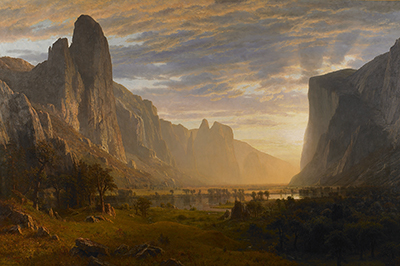
Compare the upright arrangement with Looking Down Yosemite Valley, California. In that broader prospect, a river and receding valley carry the eye into the distance. Here, the interrupted line of the falls leads it upwards. The difference is more than format: one opens a route through the landscape, while the other makes us confront a height from below.
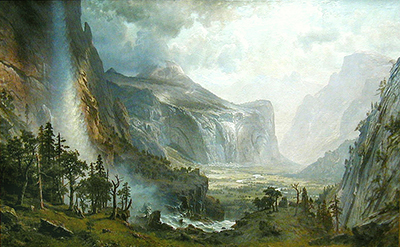
Looking Up Yosemite Valley offers another useful comparison. Carr links its depiction of artists in the valley with the themes of Cho-looke.[2] Both bring human observation into the landscape, but the Timken canvas compresses the working party beneath a much more dominant cliff. Its wooded margin feels like a temporary refuge beside the spectacle.
Together these works show how Bierstadt could vary the spectator's relationship with the same celebrated valley. A distant prospect, an inhabited meadow and a camp below the falls invite different forms of imaginative entry. Cho-looke is especially compelling because its scale is never only geological. It measures the mountain against the daily work of people who wished to represent it, and lets us see that work within the scene it helped carry to a wider public.
Watch: Albert Bierstadt
Five perspectives on his paintings and their historical setting.
American Landscape Painting: Albert Bierstadt and the American Land
A Museum of Fine Arts, Boston presentation on American Landscape Painting: Albert Bierstadt and the American Land.
Explore Bierstadt’s artworks
Discussion
How does the artists’ camp beneath the waterfall change your understanding of this upright Yosemite view?
Reader Insights
Consider the sketching umbrella, colour-box and pack animals. How do these objects connect travel with the making of pictures?
Read Ludlow’s account beside the connection with Watkins’s photograph. What different kinds of evidence contribute to understanding the composition?
Consider the Ahwahneechee name and the valley’s continuing history alongside the visitors’ camp. Whose relationships with the falls become visible through the title and research?
Join the Conversation
Share a specific observation, documented connection or comparison from Cho-looke, the Yosemite Fall.
References
- Timken Museum of Art. Cho-looke, the Yosemite Fall. Collection record, accession 1966:001; metadata, equipment, provenance and title history. View source text
- Gerald L. Carr. Bierstadt entries in American Paradise: The World of the Hudson River School. Metropolitan Museum of Art, 1987, pp. 288–290; Yosemite journey, studio chronology, camp, Ludlow reproduction and comparisons. View source text
- Smithsonian American Art Museum. Albert Bierstadt: Cho-Looke, The Yosemite Fall. Alexander von Humboldt and the United States: Art, Nature, and Culture; Watkins and national cultural context. View source text
- Timken Museum of Art. Timken Museum of Art Presents Contemporary, First Nation Artist, Kent Monkman, and His Painting “The Fourth World”. 19 March 2025; historical exhibition and curatorial framing. View source text
- National Park Service, Yosemite National Park. Concessions History. Early visitors, land claims and the Yosemite Grant. View source text