 by Tom Gurney
Tom Gurney BSc (Hons) is an art history expert with over 20 years experience
Published on June 19, 2020 / Updated on October 12, 2026
Email: tomgurney1@gmail.com / Phone: +44 7429 011000
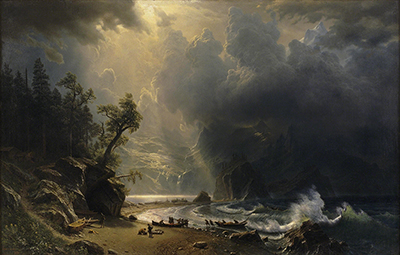
Puget Sound on the Pacific Coast by Albert Bierstadt
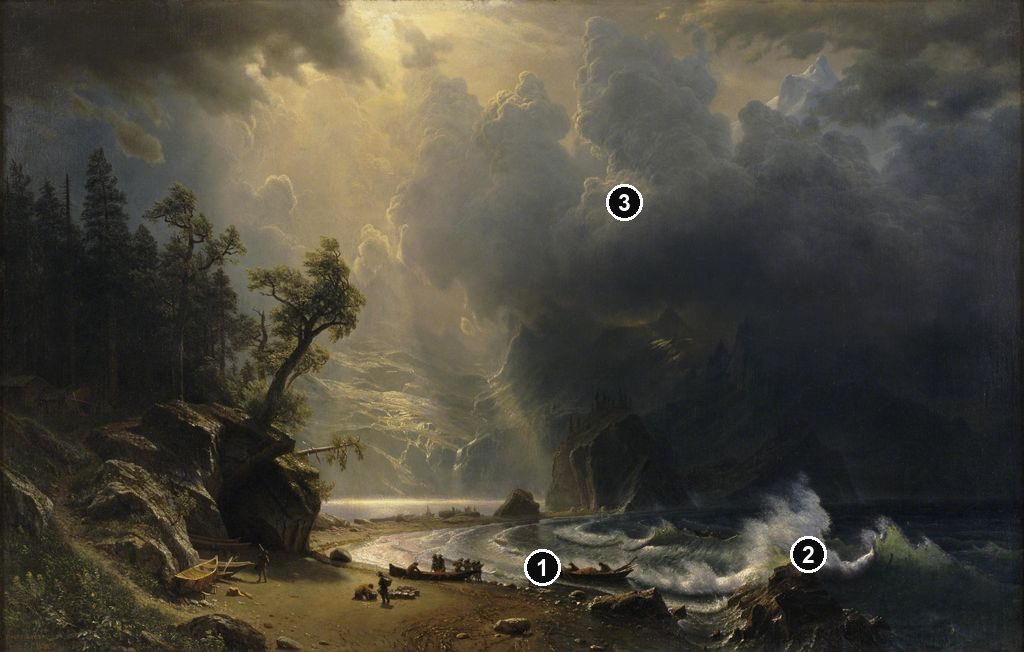
Albert Bierstadt’s Puget Sound on the Pacific Coast brings an inhabited shore into the path of an enormous storm. Canoes gather along a narrow beach, waves strike the foreground rocks, and a snowy summit briefly emerges through the clouds. Painted in 1870, this oil on canvas belongs to Seattle Art Museum.[1] Its scale and extraordinary light promise an encounter with a remote place. The boats suggest knowledge of a working coast; the storm makes that coast into a spectacle.
At a Glance
Annotated Details from Puget Sound on the Pacific Coast
Use the numbered details to explore how Bierstadt builds this scene from light, scale and overlapping forms. Image: Seattle Art Museum, Gift of the Friends of American Art at the Seattle Art Museum, with additional funds from General Acquisition Fund. Image source.
Details from PUGET SOUND ON THE PACIFIC COAST
Compare these enlarged passages with their positions in the full painting.
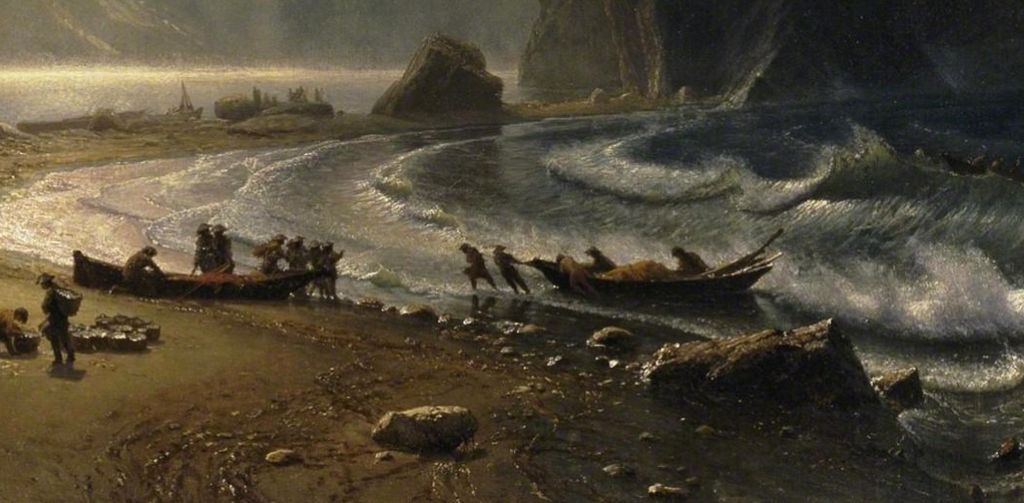
Canoes at the water’s edge
Follow the people and canoes along the beach. Their small silhouettes give the shore an inhabited scale beneath the huge sky.
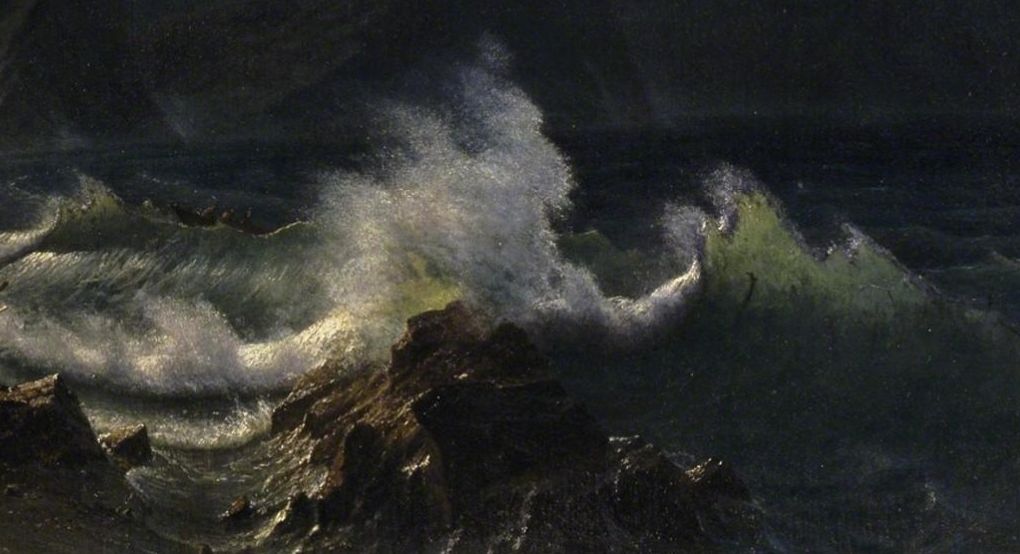
Surf breaking against rocks
Compare the bright foam with the dark water between the waves. Broken curves and sharply lit edges bring the sea close to the viewer.
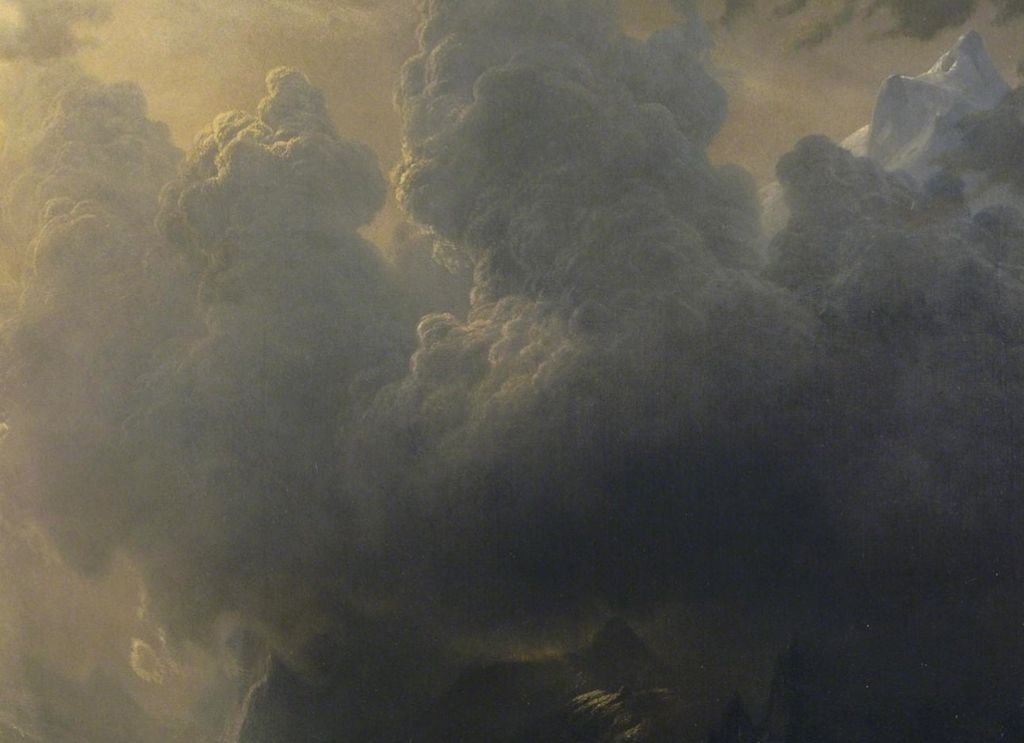
Clouds and the distant summit
Find the small pale summit within the much larger cloud formation. The mountain’s angular outline interrupts the rounded masses of weather.
Where this painting sits in Bierstadt’s career
Dates refer to the paintings, rather than to the journeys behind them. Approximate dates and ranges retain the qualifications in the collection records.
Lake Lucerne
1858Mountain Brook
1863Street in Nassau
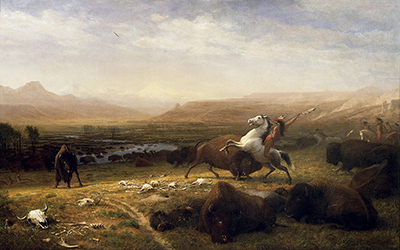
c. 1877–1880The Last of the Buffalo
1888–1889The Golden Gate
1900Contents
Surf, shelter and a break in the clouds
The shore curves from the shadowed left foreground toward a thin band of light in the distance. At the left, large rocks and trees provide a sheltered edge to the beach. One tree leans out from the rock face, its irregular branches silhouetted against the bright sky. Its trunk draws the eye upward from the people and boats into the weather above them.
Most of the canvas belongs to that weather. Clouds tower above the shore in dense, rounded masses, illuminated along their upper edges but dark underneath. The mountain peak at upper right is small within this great cloud formation. Its pale, angular shape interrupts the billowing sky, offering a glimpse of the range before the clouds close around it.
Below, Bierstadt gives the water a different kind of motion. White surf rises against the rocks at the right, falls into dark troughs and curls toward the beach. The brightest foam lies close to the viewer, where its broken contours make the water feel restless and immediate. Farther away, a horizontal ribbon of light settles across the water at the foot of the mountains. These two passages hold the picture together: the near surf is turbulent, while the distant opening seems almost still.
The people occupy the strip between land and water. Around the central canoes, small groups bend, stand or move along the water’s edge; a boat nearer the surf brings human activity close to the waves. Other canoes rest beneath the rocks on the left. The figures are tiny beside the clouds, but they give the beach a purpose: work, landing and habitation.
The contrasts make the scene both inviting and difficult to enter. Light reaches the beach and the distant water, yet the right side remains heavily shadowed. The canoes suggest a means of passage through this environment, while the surf makes its demands visible. Bierstadt’s coast offers shelter without losing the force of the sea.
How Bierstadt assembled Puget Sound
Seattle Art Museum connects the picture to Columbia River studies and collected Northwest Coast objects from Bierstadt’s 1863 travels. It proposes a possible illustration source in James Gilchrist Swan’s 1857 The Northwest Coast. Bierstadt had not visited the precise setting.[1]
Studies, objects and printed imagery could lend specificity to individual details while the landscape’s overall arrangement served the large canvas. His title gathers those elements under the name Puget Sound. It encourages a viewer to treat the painted world as geographically coherent, even when its ingredients came through different kinds of observation.
Collecting objects was part of Bierstadt’s wider practice. The Smithsonian American Art Museum describes his New York studio as a place where visitors encountered paintings alongside animal skins and Native American objects.[2] Such material could support his reputation as a traveller and help him build detailed scenes in the studio. It also reminds us that an apparently immediate encounter with the West could reach the viewer through collecting, display and artistic rearrangement.
The enormous mountain walls, open surf and theatrical clouds belong to this act of assembly. Bierstadt makes them convincing through the way light travels across the scene: a bright opening connects the sky, distant water and inhabited beach, drawing disparate elements into one expansive view. The title gives that view a geographical identity, even though its features do not supply a reliable map of a particular shoreline.
Canoes, knowledge and the printed Northwest
Swan’s book helps explain the kinds of regional information a painter could find in print. Its illustrations on pages 79–80 distinguish several canoe forms, including a vessel he had purchased from Kape, a Vancouver Island and Clallam canoe, and a Cowlitz canoe. The accompanying text relates different shapes to coastal water and inland rivers. These are useful examples of the book’s specificity; they do not establish which illustration Bierstadt consulted or identify any painted boat’s community.[3]
The difference between the printed cuts and the canvas is instructive. Swan isolates each hull in profile so that a reader can examine its outline. Bierstadt turns his boats into participants in an unfolding scene. One lies close to the beach, another meets the surf, and figures stand between them. Their low horizontal forms contrast with the trees and great rising clouds. Regional detail contributes to the setting, while position, light and gesture make the boats carry the picture’s drama.
Swan also describes watching a canoe being made near his house. His account follows the selection and shaping of a cedar log, the carving of its interior, and the use of heated water to spread its sides before finishing and painting. He emphasizes the maker’s trained eye and the prolonged work involved.[3] Read beside the canvas, this account gives weight to objects that might otherwise seem like picturesque accessories. Each boat implies skilled production and knowledge of water, even though the painting cannot tell us who made it or how it was used.
Swan’s admiration sits within a settler’s account of the region. His comparisons repeatedly measure Indigenous expertise against the achievements of white mechanics, and his language carries the hierarchies of that viewpoint.[3] The book can preserve valuable observations while framing their makers through an outsider’s judgments. Treating it as a possible artistic source therefore calls for attention to both its information and its assumptions.
The Burke Museum makes a related distinction in its account of Coast Salish art. Familiar images of northern Northwest Coast carving have often obscured the different traditions of western Washington and southwestern British Columbia. Its collection connects historical material with contemporary practice.[4] That regional diversity matters when looking at Bierstadt’s assembled coast. “Northwest Coast” provides a broad geographical connection; it does not make every object interchangeable or authorize a tribal identification from a small painted figure.
Indigenous presence and the promised seaport
The canoes and shore community make Indigenous presence essential to the composition. The figures move at the water’s edge, gather around boats and occupy sheltered ground. Their activity establishes an inhabited coast, although the assembled scene limits its value as a record of a particular community or local custom.
Seattle Art Museum interprets the picture against the proposed Northern Pacific railroad and eastern investors’ anticipation of a modern Puget Sound seaport.[1] No industrial port appears on this beach. The contrast between the named coast and its painted appearance invites us to ask whose future the scene offered its viewers.
Commercial expectations already shaped Swan’s earlier book. In its closing discussion of Washington Territory, he presents harbours, timber and access to the Pacific as advantages for development, drawing on Governor Isaac Stevens’s reports and the northern railroad survey.[3] This precedes Bierstadt’s canvas by thirteen years. It shows that a coast inhabited and navigated by Indigenous people was also being described to outsiders through the opportunities it might provide for commerce.
Angela Miller’s study of Bierstadt’s western landscapes provides a broader framework for this tension. She argues that panoramic views could encourage a sense of visual possession and make the West appear available for settlement and investment. She also examines how his Indigenous figures helped authenticate western subjects while the paintings often suppressed the disruptive effects of expansion on Indigenous life.[5] Applied to Puget Sound, her argument helps explain how attention to canoes and figures can coexist with a landscape imagined for distant audiences.
A different history emerges from the Suquamish Tribe’s own account of central Puget Sound. Canoes connected seasonal harvesting places, communities and ceremonial relationships. By the 1850s, settlement and sawmills were transforming the region. The tribe’s history records the destruction of the communal Old Man House in 1870, the year of Bierstadt’s painting, and the community’s continued residence on its grounds until forced relocation to individual allotments in 1904.[6] This regional context does not identify Bierstadt’s beach as Suquamish territory or its figures as Suquamish people. It establishes that his apparently timeless shore belongs to a period of concrete upheaval in Indigenous lives.
The juxtaposition changes what the peaceful activity beneath the storm can communicate. People occupy the foreground, but the canvas supplies no account of land policy, communal housing or conflicts over settlement. Those histories require testimony beyond the painted view. The picture’s dramatic weather can dominate our response so thoroughly that the social changes occurring in its named region become harder to see.
Canoe culture also continues beyond the historical frame of the painting. The Suquamish Tribe’s 2026 account of Tribal Canoe Journey describes families travelling between host communities and sharing songs, stories and gifts. It traces the modern movement’s renewal to the 1989 Paddle to Seattle.[7] That living practice gives a contemporary reader another way to understand the importance of boats and shore gatherings. It does not explain a specific painted gesture, but it helps resist treating Indigenous maritime life as a picturesque world confined to Bierstadt’s century.
Titles and early reception
Seattle’s record transmits an 1870 Evening Mail reviewer’s uncertainty about the view’s extraordinary appearance. It also records Abiel Abbot Low’s ownership by March 1872, a 1916 Cleveland exhibition as The Storm, and acquisition by Seattle in 2000.[1]
The two titles lead the eye differently. The Storm emphasizes clouds and surf: the forces occupying most of the surface. Puget Sound on the Pacific Coast adds a claim about place, making the small foreground community part of a named regional world. The distinction matters because the painting’s strongest visual evidence concerns the relationships Bierstadt designed—between light and shadow, shelter and exposure, people and weather. Its authority as a history of the coast depends on sources that can explain the lives and circumstances beyond those relationships.
Watch: Albert Bierstadt
Five perspectives on his paintings and their historical setting.
American Landscape Painting: Albert Bierstadt and the American Land
A Museum of Fine Arts, Boston presentation on American Landscape Painting: Albert Bierstadt and the American Land.
Explore Bierstadt’s artworks
Discussion
How does knowing that Bierstadt assembled this coast from other Northwestern material change the view?
Reader Insights
Follow the canoes, beach and leaning tree into the sky. Where does the composition offer shelter, and where does it expose people to the weather?
Compare the named location with the museum’s account of the painting’s sources. Which details can be observed, and which geographical claims need documentary evidence?
Read the regional history and continuing canoe journeys alongside the shore gathering. What can the painting show, and what needs testimony beyond it?
Join the Conversation
Share a specific observation, documented connection or comparison from Puget Sound on the Pacific Coast.
References
- Seattle Art Museum. Puget Sound on the Pacific Coast, 1870, object 26759, accession 2000.70. Collection record, labels, provenance and exhibition history; the Evening Mail response is consulted through its transcription. View source text
- Smithsonian American Art Museum. “Albert Bierstadt.” Artist record, “Luce Artist Biography,” for the display of paintings, animal skins and Native American objects in his New York studio. View source text
- James Gilchrist Swan. The Northwest Coast; or, Three Years’ Residence in Washington Territory. New York: Harper & Brothers, 1857. Original illustrated volume, pp. 79–82 on canoe forms and construction; pp. 398–399 on maritime commerce and railroad prospects. Selected passages only; the museum’s proposed illustration source remains unconfirmed. View source text
- Burke Museum. “Coast Salish Art.” Regional distinctions and the relationship between historical collections and contemporary practice. View source text
- Angela Miller. “Albert Bierstadt, Landscape Aesthetics, and the Meanings of the West in the Civil War Era.” Art Institute of Chicago Museum Studies 27, no. 1 (2001), pp. 40–59, notes pp. 101–102. See pp. 46–47 on Indigenous figures, authentication and the suppression of expansion’s effects; pp. 48–49 on visual possession, settlement, patrons and capital. View source text
- Suquamish Tribe. “History & Culture.” Sections “Early Contact,” “Assimilation Period” and “Canoes.” Regional history, maritime relationships, Old Man House and continued residence after its destruction. View source text
- Suquamish Tribe. “Paddles Up: Your guide to the people, traditions, and protocols of Tribal Canoe Journey.” July 6, 2026. Canoe families, hosting, shared culture and the 1989 renewal. View source text