by Tom Gurney
Tom Gurney BSc (Hons) is an art history expert with over 20 years experience
Published on June 19, 2020 / Updated on October 12, 2026
Email: tomgurney1@gmail.com / Phone: +44 7429 011000
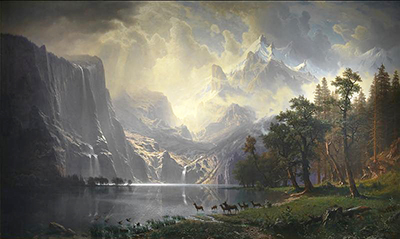
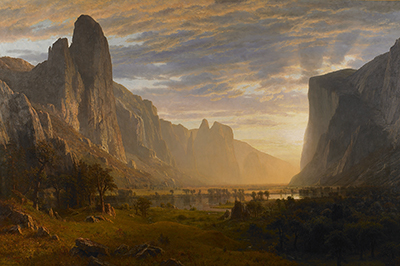
Sunset in the Yosemite Valley by Albert Bierstadt
The river catches a narrow path of gold beneath a dark, cloud-filled sky. In Albert Bierstadt's Sunset in the Yosemite Valley, the brightest distance lies between towering cliff masses, while the near woods remain deep in shadow. The sunset is powerful partly because so much of the landscape resists its light.
The Haggin Museum records this oil on canvas as 1868, measuring 36¼ × 52¼ inches. Its essay places the painting during Bierstadt's European stay of 1867–1869 and considers a Rome studio origin possible.[1] Yosemite had become a subject he could develop far from California. The canvas brings western scenery and a carefully organised light effect together for spectators elsewhere.
At a Glance
Where this painting sits in Bierstadt’s career
Dates refer to the paintings, rather than to the journeys behind them. Approximate dates and ranges retain the qualifications in the collection records.
Lake Lucerne
1858Mountain Brook
1863Street in Nassau
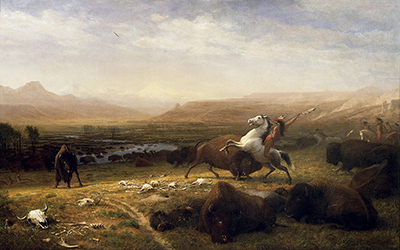
c. 1877–1880The Last of the Buffalo
1888–1889The Golden Gate
1900Contents
Darkness gives the sunset its force
The left-hand cliffs receive isolated touches of light. Narrow bright edges stand out against much larger shadowed areas. Trees rise in front of the rock, overlapping it and introducing branching outlines beside the stone's vertical forms. The landscape is not evenly revealed: the spectator has to distinguish the parts that the light makes available.
The right-hand wall is especially dark. Its steep outline descends towards the glowing opening and holds the edge of the composition. Opposing cliff masses keep the sunset enclosed without entirely closing the valley. Their darkness makes the central light seem more concentrated than it would in a uniformly warm landscape.
Clouds occupy the upper space in broad, heavy bands. Orange and red appear around their edges, with the richest glow lower down. The sky combines a large obscured area with a brilliant opening. This gives the light an eventful character: it seems to emerge through a formidable atmosphere rather than simply rest above the ground.
The difference between the sharp cliff edges and the softer cloud forms reinforces their separate roles. Stone defines the valley's boundaries; cloud alters how much of it can be seen. Light passes across both, joining the lasting setting with a condition that will change. The sunset's intensity depends on that meeting of fixed masses and mobile atmosphere.
The foreground trees make another boundary. Their dark trunks and foliage are close enough for some individual forms to register, yet they remain difficult to penetrate as a group. This nearer darkness gives the spectator a sheltered position from which to look towards the distance. It also prevents the golden centre from becoming an unrestricted invitation to walk straight into the scene.
The river carries light towards us
The river repeats the central glow in a sequence of bends. Gold spreads across some passages and disappears behind trees or darker ground in others. Its interrupted course gives the eye a way to follow the valley without making the whole lower canvas equally bright.
Those reflections are essential to the painting's structure. If the sunset remained confined to the sky, the dark foreground might seem cut off from it. The river brings its colour lower into the picture. Light is glimpsed close to the spectator and then followed backwards through successive openings.
Trees partly obstruct that route, making the eye work around them. The sunset remains accessible as something to look towards, but the valley never becomes completely transparent. Bierstadt's arrangement joins attraction with separation: we can follow the light while recognising how much ground remains in shadow.
Yosemite developed in Europe
The Haggin's suggestion of a Rome origin is a qualified one. Its record notes an inscription connecting the painting with Bierstadt's European stay and a visitor's report of a Yosemite picture in his Rome studio.[1] The possibility is historically useful without fixing a precise place of execution beyond the evidence.
It changes how we understand the painting's relation to observation. Bierstadt's western journey supplied material he could retain and reconsider. A finished scene produced abroad would depend on that accumulated knowledge, studies and compositional decisions rather than on the valley being immediately outside the studio.
This distance does not turn the picture into an arbitrary fantasy. Its setting remains a recognisable Yosemite subject, and its rock, water and vegetation are organised convincingly. What the European context makes clear is the difference between seeing a place and developing a canvas from it. The finished work has an audience, a scale and an internal balance that belong to painting as well as to travel.
The sunset is especially suited to that process. It alters how the landscape appears without changing the underlying valley into another place. Bierstadt can choose an hour that emphasises contrast, intensify the relation between dark masses and bright openings, and connect the river with the sky through reflected colour. The subject is both the scenery and its transformation by light.
Fine detail and the surface of rock
The Haggin distinguishes fine brushwork from thicker strokes suggesting the rugged granite on the left.[1] This is a more useful account of the picture's handling than a blanket claim that every passage is painted with the same meticulous finish. Different surfaces and distances can require different kinds of mark.
The contrast is consistent with what the composition asks us to notice. Rock planes need enough variation to suggest their uneven weight. Near trees and small illuminated passages offer opportunities for more precise description. The sky and glowing distance depend on broader relations of colour and tone.
A reproduction can show those relationships, although it cannot reproduce all the physical differences between thin and thick paint. The museum's surface observation adds a material dimension to the dramatic image. The cliff's ruggedness is suggested not only by its outline but also by how paint is laid on the canvas.
What the sublime explains
The Haggin interprets the work through nineteenth-century ideas of the sublime and landscape's possible religious significance.[1] Those ideas help explain why a view could aim for more than topographical recognition. A landscape might invite astonishment, reverence or a sense of forces beyond the spectator's scale.
The painting's structure makes such responses understandable. Large areas of darkness surround an intensely bright distance. The cliffs exceed the size of any nearby object; the clouds make the atmosphere seem active and heavy. The spectator occupies a small near position while looking towards a setting that cannot be grasped all at once.
In MoMA's 1976 catalogue The Natural Paradise, Barbara Novak's “On the Sublime” section distinguishes the older emphasis on overwhelming force from a quieter nineteenth-century sublimity associated with silence and stillness. The Haggin sunset is reproduced within that discussion.[2] The placement supplies a later scholarly context for its combination of grandeur, darkness and radiance.
Novak's selection includes Edmund Burke's account of astonishment and John Ruskin's broader understanding of sublimity through greatness of matter, space, power or beauty. These were different accounts of an effect, not a single code for interpreting every landscape. The sunset can be examined through them without assuming Bierstadt illustrated one philosophical passage exactly.[2]
A changing history of interpretation
The MoMA catalogue also lists the canvas in its exhibition checklist.[2] Its inclusion shows the painting entering a broad survey of American landscape and the romantic tradition in the twentieth century. Bierstadt's scene was being considered alongside a longer history of artists' responses to nature, rather than only as a record of one western destination.
A different perspective appears in a 2026 artist statement published by the Haggin. Jonas Kulikauskas names this sunset among the museum's Yosemite paintings that prompted his Yosemite Bark Houses project. He proposes painted bark houses on transparent panels placed before the landscapes, inviting viewers to consider Indigenous dwellings absent from the monumental views. The museum announced the installation for November 2026.[3]
The proposed installation identifies a limit within an apparently expansive landscape. The canvas can make the valley feel immense while selecting only part of its human history for representation.
The response also asks whose experiences the composition brings into view. The painting's beauty remains visible, but an account of Yosemite cannot be exhausted by cliffs, trees and light. Contemporary interpretation extends the work's history by asking what kinds of life its celebrated view leaves outside the frame.
Comparing the smaller Sundown
The title should be distinguished from Sundown at Yosemite, the smaller canvas in the Carmen Thyssen Collection. Elizabeth Garrity Ellis discusses that painting among the 1863 colour studies and includes the Haggin work in her account of sunset imagery.[4] The two works share an interest in warm light while giving it different compositional roles.
In Sundown, orange extends through much of the sky, cliffs and reflective water. Three cattle provide dark, familiar shapes at the shore. The light feels pervasive. In the Haggin canvas, larger areas of darkness surround a more concentrated opening, and the river carries isolated gleams into the near landscape.
The larger size makes that contrast more physically imposing. It allows dark rock and trees to occupy substantial areas before the spectator reaches the glow. The smaller work gathers its colour relationships into a compact whole. Comparing them shows how a repeated subject could generate different experiences, rather than a single sunset formula.
Yosemite Valley, Glacier Point Trail offers another contrast. Its visible route and horseback visitors supply a chosen position above the valley. Here, the shadowed woods and broken river reflections organise entry into the view. Bierstadt gives the spectator a near place while keeping the most luminous distance beyond easy reach.
The Haggin sunset's force lies in that balance. Light draws attention, darkness gives it intensity, and water links its separate appearances. The painting makes Yosemite memorable through an atmospheric event, while its production and later interpretation show how that event could carry the valley's image far beyond California.
Watch: Albert Bierstadt
Five perspectives on his paintings and their historical setting.
American Landscape Painting: Albert Bierstadt and the American Land
A Museum of Fine Arts, Boston presentation on American Landscape Painting: Albert Bierstadt and the American Land.
Explore Bierstadt’s artworks
Discussion
A broken path of gold follows the river beneath a dark sky. How does the painting hold the brightest distance beyond the shadowed woods?
Reader Insights
Where does the river reveal the glow, and where do trees or darker ground conceal its course?
How does the qualified evidence of a possible Rome studio origin change your understanding of a landscape developed from western experience?
Compare the Haggin canvas with the smaller Sundown. How do concentrated light and pervasive orange produce different experiences?
Join the Conversation
Share a specific observation, documented connection or comparison from Sunset in the Yosemite Valley.
References
- Haggin Museum. Sunset in the Yosemite Valley. Collection metadata and essay; European production, possible Rome origin, paint handling and sublime interpretation. View source text
- Barbara Novak; Museum of Modern Art. “On Divers Themes from Nature,” especially “On the Sublime,” and exhibition checklist, in The Natural Paradise: Painting in America, 1800–1950. Edited by Kynaston McShine, 1976; Haggin painting reproduced and listed. View source text
- Jonas Kulikauskas; Haggin Museum. Yosemite Bark Houses. Published artist statement and announced November 2026 installation; a contemporary response to the museum's Bierstadt landscapes. View source text
- Elizabeth Garrity Ellis; Museo Nacional Thyssen-Bornemisza. Sundown at Yosemite. Collection essay relating the smaller sunset study to broader sunset imagery and the Haggin work. View source text