Albert Bierstadt.jpg)
 by Tom Gurney
Tom Gurney BSc (Hons) is an art history expert with over 20 years experience
Published on June 19, 2020 / Updated on October 12, 2026
Email: tomgurney1@gmail.com / Phone: +44 7429 011000
Rocky Mountains, Lander’s Peak (1863): the Harvard painting
Albert Bierstadt’s Harvard Rocky Mountains, Lander’s Peak draws the eye through a wooded gorge toward a bright mountain basin. Its upright format makes the cliffs seem to rise around the viewer, while the distant peaks disappear into cloud. Painted in 1863 in oil on linen, it belongs to the Fogg Museum collection at Harvard Art Museums, accession 1895.698. It is a separate painting from the broad, same-year The Rocky Mountains, Lander’s Peak in New York’s Metropolitan Museum of Art.[1]
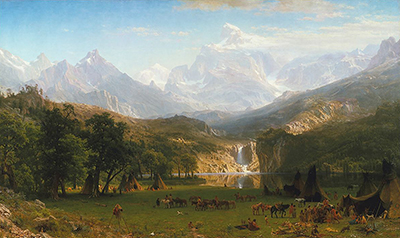
In the Harvard picture, the passage from dark forest to illuminated water and high mountains carries the composition. The Met painting gives much more space to a lake shore and a Shoshone encampment.[2] Seeing the two together reveals how differently Bierstadt could organize a Rocky Mountain landscape around the same title.
At a Glance
Where this painting sits in Bierstadt’s career
Dates refer to the paintings, rather than to the journeys behind them. Approximate dates and ranges retain the qualifications in the collection records.
Lake Lucerne
1858Mountain Brook
1863Street in Nassau
c. 1877–1880The Last of the Buffalo
1888–1889The Golden Gate
1900Contents
Looking through the gorge
The Harvard painting begins close to the ground. Mossy rocks, fallen wood and irregular vegetation spread across the foreground; dark evergreens crowd the hollow below. At the left, a sheer rock face projects into the picture. Trees stand along its upper edge, making the drop beneath them more abrupt. Across the gorge, the wooded slope at the right descends toward a dark strip of water. These enclosing masses give the viewer an elevated position, looking into a landscape whose lower reaches remain partly concealed.
A leaning tree near the centre interrupts that downward view. Its angled trunk and rounded crown cut across the opening toward the distant basin. Around it, the near foliage is dense and dark enough to register as a substantial obstacle. Bierstadt makes the brightest part of the valley feel discovered through a break in the forest.
Beyond this screen, the narrow band of light on the water is startling. Green ground and pale reflections form a horizontal pause in an otherwise strongly ascending picture. Above them, a waterfall drops through the middle distance. Its light vertical streak connects the mountain walls to the basin, while the shadowed gorge partly conceals the river’s course.
The mountains gain height through successive changes in clarity. Close cliffs have sharp edges and dark recesses. Farther slopes soften into grey and blue, with small warm highlights marking the surfaces that catch the light. The remote summits almost dissolve into the cloud-filled sky. This atmospheric perspective gives the distance its depth: the most imposing forms are also the least graspable.
Light contributes just as much as altitude. Heavy clouds press across the top of the painting, while pale openings illuminate selected rock faces below. The eye moves between these isolated bright areas, the falling water and the shining basin. No single even light explains everything. The scene feels changeable, as though the mountains are being revealed in portions while the forest remains in shade.
A landscape assembled from views
The title points toward the Rocky Mountains, but it does not guarantee a single identifiable viewpoint. In Sy Boles’s August 2026 Harvard Gazette article, the Harvard painting is described as a composite of different Rocky Mountain views. Curator Horace D. Ballard draws attention to the uncertainties surrounding what Bierstadt saw, selected and added.[3]
That account helps explain the picture’s combination of convincing particulars and concentrated drama. The trees and rocks provide a strong sense of physical terrain, while the opening between them gathers water, waterfall, mountain walls and cloud into one ascending view. We can recognize the landscape’s persuasive construction without treating each feature as evidence of a visit to one exact spot.
Bierstadt’s western experience supplies a relevant context. The Met’s account records his participation in Frederick W. Lander’s government survey expedition in 1859 and the party’s arrival in the Wind River Range, in present-day Wyoming.[2] That journey belongs to the background of his Rocky Mountain painting. It does not, by itself, establish when each element of the Harvard composition was sketched or how the finished oil was developed. The shared date and title likewise leave the exact order of work on the Harvard and Met pictures unresolved.
Recording mountain experience
A composite view raises a practical question: what could a traveller bring back from terrain of this scale? In a Museum of the Mountain Man essay, artist Sue Sommers discusses Bierstadt’s July 10, 1859 letter to The Crayon. He compared the Rockies with the Swiss Alps and reported taking fewer stereoscopic mountain views than he wished because of difficulties with the process.[4] The letter is consulted here through Sommers’s account; it does not identify the studies behind Harvard’s painting.
Sommers also describes her own efforts to sketch and photograph the Wind River Range. Altering a view could help convey a sensation of depth that literal transcription failed to communicate.[4] That contemporary comparison gives a useful way to approach Bierstadt’s assembled terrain. A convincing experience of height may depend on how forms are placed together, as well as on the accuracy of each individual form.
The Harvard canvas concentrates those problems in one opening. The basin establishes distance across the picture, while the waterfall gives a vertical measure within it. Above both, the cloud-veiled peaks extend a height whose upper limit remains indistinct. Different measures combine to suggest more terrain than the viewer can fully inspect.
The two Lander’s Peak paintings
The Met picture, accession 07.123, is a large horizontal oil on canvas acquired through the Rogers Fund in 1907.[2] Its broad foreground opens across the lake shore, allowing the encampment to become an extensive part of the scene. The Harvard painting’s upright frame concentrates the view between enclosing cliffs and gives more of its height to the rising mountain landscape. It is more than a reduced or cropped version of the panorama: the organization of the viewer’s approach has changed.
The human presence has changed too. Boles’s Harvard account notes that Bierstadt encountered and sketched Shoshone people during his travels but omitted them from this landscape.[3] The absence directs attention toward forest, rock and water. It should not be taken as evidence that the country represented was uninhabited. Comparison with the Met painting makes that distinction especially clear: people appear in one composition and disappear from the other, while the mountains continue to dominate both.
Gerald L. Carr identifies a black bear and its killed deer in the foreground, and interprets the painting as a challenge to Gifford’s eastern gorge landscapes.[5]
A western gorge beside Gifford’s Catskills
Carr’s comparison becomes more specific when Harvard’s painting is set beside Gifford’s A Gorge in the Mountains (Kauterskill Clove), dated 1862. The Met records that work as accession 15.30.62. Its interpretation identifies a hunter and dog near the lower left and notes Gifford’s omission of the tourist industry surrounding the Catskill setting.[6] Both artists make a deeply inhabited region appear available for solitary contemplation.
The two upright compositions begin from projecting ground above a hollow. In Gifford’s museum reproduction, a tall tree rises from the left ledge and bends towards an immense field of pale sky. Below it, the gorge forms a broad, rounded depression. Warm haze spreads across the distant ridges, reducing their differences in colour and definition. The bright air occupies much of the picture’s upper half and seems to bathe the whole valley.
Bierstadt gives the space a more interrupted character. His near cliffs remain strongly dark, while separate bands of light catch the basin, waterfall and higher rocks. Cloud takes the place of Gifford’s largely open sky. Instead of allowing light to spread gently across a continuous recession, he lets the mountains appear through alternating concealment and revelation. The eye has to work past barriers to reach them.
Small living forms also change the encounter. Gifford’s hunter and dog place a person on the viewer’s side of the chasm. Carr’s identification of the bear and dead deer in Bierstadt’s foreground introduces a different kind of activity.[5] The mountain retreat can contain violence that its distant light initially makes easy to overlook. Neither painting’s scale of human or animal detail determines the whole composition, but those details complicate the first impression of tranquillity.
Upright format, wooded ledges and luminous depth form a shared pictorial problem. Bierstadt’s cliffs, broken weather and rising peaks give that problem a different force. The comparison supports looking at the Harvard picture alongside eastern gorge painting without establishing that a particular Gifford canvas supplied its model.
Collection and early history
The Smithsonian’s Inventory of American Paintings identifies the Harvard work by its date, oil-on-linen medium and accession number. Its bibliography points to American Paintings at Harvard, volume two, catalogue number 21, giving a further catalogue reference for this particular object.[1]
Carr’s illustration credits the gift of Mrs. William Hayes Fogg. In note 41, he suggests that this may be the mountainous landscape Bierstadt showed at the Tenth Street Studio Building reception on 4 February 1864. The newspaper descriptions he cites mention mountains, waterfalls, clouds and sunlight without supplying a title, leaving the identification uncertain.[5]
The painting’s later museum context is more securely documented. Harvard’s announcement for Harvard Collects American Art, held in 2003–2004, names the Bierstadt among works selected to represent important moments in the Fogg’s collecting history. It connects Mrs. William Hayes Fogg’s gift with the bequest that founded the museum in 1895.[7] The landscape thus became part of an institutional history of American art, alongside the geographical and artistic comparisons its subject invites.
Watch: Albert Bierstadt
Five perspectives on his paintings and their historical setting.
American Landscape Painting: Albert Bierstadt and the American Land
A Museum of Fine Arts, Boston presentation on American Landscape Painting: Albert Bierstadt and the American Land.
Explore Bierstadt’s artworks
Discussion
How does the Harvard painting’s upright gorge differ from the Met’s broad Lander’s Peak panorama?
Reader Insights
Follow the leaning tree, dark cliffs and bright basin. Where does the picture let the eye pass through the forest, and where does it hold it back?
Compare this composition with the village in the Met painting. What changes when people are omitted from a landscape of the same region and title?
Compare the broken light and clouds here with Gifford’s sunlit Catskill gorge. How does each painting make the distant landscape available to the viewer?
Join the Conversation
Share a specific observation, documented connection or comparison from Rocky Mountains, Lander’s Peak (1863): the Harvard painting.
References
- Smithsonian American Art Museum, Inventories of American Painting and Sculpture. “Rocky Mountains, ‘Lander’s Peak,’ (painting),” control number IAP 20780302, accession 1895.698; Catalog Data, especially Medium, Owner/Location, Date and Notes. The record cites American Paintings at Harvard, volume two (2008), no. 21. View source text
- The Metropolitan Museum of Art. “The Rocky Mountains, Lander’s Peak,” 1863, accession 07.123; introductory interpretation and Artwork Details. Used for the separate Met painting and the 1859 expedition context. View source text
- Sy Boles, Harvard Gazette. “America the beautiful,” 12 August 2026, section “The Rocky Mountains, Lander’s Peak,” including the comments of Harvard Art Museums curator Horace D. Ballard. View source text
- Sue Sommers / Museum of the Mountain Man. “Albert Bierstadt in the Wind River Range: 1859,” Part Two, July 2026. Artist’s scale comparisons and the 1859 Crayon letter consulted through this account. View source text
- Gerald L. Carr. “Sanford Robinson Gifford’s Gorge in the Mountains Revived,” Metropolitan Museum Journal 38 (2003), pp. 213–230; discussion p. 223, Harvard illustration and credit p. 224, fig. 11, and proposed early exhibition identification p. 229, note 41. Newspaper descriptions are consulted through Carr’s account. View source text
- The Metropolitan Museum of Art. A Gorge in the Mountains (Kauterskill Clove), Sanford Robinson Gifford, 1862, accession 15.30.62. Object details, interpretation and museum reproduction. View source text
- Harvard University Art Museums. “Harvard Collects American Art,” 2003 exhibition announcement, reproduced by Resource Library Magazine. Specific Bierstadt selection and Fogg gift history. View source text