by Tom Gurney
Tom Gurney BSc (Hons) is an art history expert with over 20 years experience
Published on June 19, 2020 / Updated on October 12, 2026
Email: tomgurney1@gmail.com / Phone: +44 7429 011000
Indian Sunset, Deer by a Lake by Albert Bierstadt
Three deer occupy a grassy bank beneath arching trees. Beyond them, the lake reflects a wooded shore, with red and gold foliage becoming softer towards the pale distance. Albert Bierstadt's Indian Sunset: Deer by a Lake places its animals within a landscape whose quiet appearance rewards close attention.
A published conservation study by Dare Myers Hartwell identifies the painting as oil on canvas, circa 1880–1890, in the Yale University Art Gallery, accession 1971.111.1. Its dimensions are approximately 77.2 × 113 centimetres.[1] The dating is approximate, and the title does not identify a particular lake.
At a Glance
Where this painting sits in Bierstadt’s career
Dates refer to the paintings, rather than to the journeys behind them. Approximate dates and ranges retain the qualifications in the collection records.
Lake Lucerne
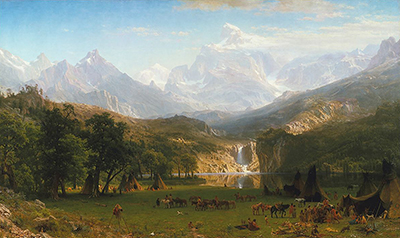
1858Mountain Brook
1863Street in Nassau
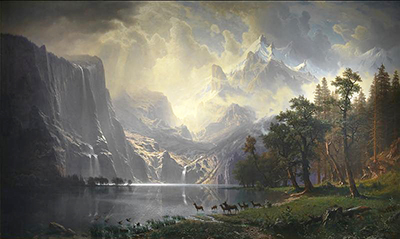
c. 1877–1880Indian Sunset, Deer by a Lake
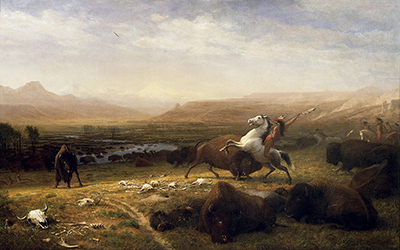
About 1880–1890The Last of the Buffalo
1888–1889The Golden Gate
1900Contents
Three deer, three positions
The antlered deer at the left stands with its head raised. Its silhouette is easy to follow against the lighter water and distant haze: a dark body, thin legs and branching antlers. It supplies an upright accent within the low strip of ground beside the lake.
The animal in the middle rests close to the grass, with its head visible above its body. At the right, another deer lowers its head towards the bank. These different positions give the small group variety without creating a clearly identifiable dramatic event.
Their spacing also matters. The standing deer is slightly separated from the other two, while all three occupy a relatively narrow part of the composition. There is enough room around their outlines to distinguish them, even though the surrounding woodland is much larger and more complex.
They are small beside the trees, but their placement makes them prominent. The nearest vegetation is dark, and the lake beyond provides a lighter background. Bierstadt turns the deer into a point of concentration through contrast and position rather than through size alone.
Looking from the shade towards the lake
A broad trunk rises near the left edge, with smaller trunks and foliage gathering behind it. Across the upper half, branches extend towards the centre. Trees at the right lean and divide into irregular limbs, creating another boundary around the open water.
The two sides are unequal. The left is dominated by a heavy, relatively upright trunk, while the right contains more exposed branching forms. Their crowns approach each other above the lake but leave an opening through which the sky remains visible.
The grassy foreground stretches across the entire lower edge. Small red and pale marks interrupt its darker greens, while denser plants gather near the tree bases. These details give the nearest ground a surface to examine before the eye reaches the more distant shore.
Behind the deer, the water creates a broad horizontal interval. Reflections of trees and warm foliage gather most strongly beneath the right bank. They are softer and less sharply divided than the forms above, so the lake repeats the woodland without becoming an exact second image of it.
The farther shore recedes towards the left, where trees lose definition in golden haze. This sequence of dark foreground, identifiable animals, reflecting water and softened woodland makes the scene feel deeper than its enclosed tree frame initially suggests.
Autumn colour and evening illumination
Red foliage hangs beneath darker crowns at the left and appears again across the far bank. Gold and brown passages lie between it and areas of remaining green. The painting's autumnal character comes from these differences, with the warm light adding another layer of colour to the leaves and water.
Plant scientist Isabel B. Emanuel explains that deciduous plants reduce chlorophyll production as autumn light and temperatures decline. Other pigments then become more prominent: carotenoids contribute yellow and orange, anthocyanins red and purple, and tannins brown.[2]
This account helps distinguish seasonal colour from illumination. Leaves can change colour through processes within the plant, while light affects how those colours appear. In Bierstadt's scene, the reds of the foliage and the golden distance work together without needing to be explained by sunset alone.
The painted leaves do not establish the exact species of every tree or a precise date within the season. Their distribution is also part of a composition: concentrated red passages enliven darker foliage, while greener areas prevent the woodland from becoming uniformly warm.
The title invites an evening reading, but the sun itself is not a clearly isolated disk. Light appears through the opening beyond the trees, spreading across the distant water and hazier shore. Its effect is carried through relationships between coloured areas rather than a single sharply defined source.
Graphite beneath the painted landscape
Hartwell's 1999 study identifies a graphite-containing ground beneath this painting, among a small group of Bierstadt works examined through samples. The coloured paint was applied over the dark preparation without the intervening white layer found in the Cody version of The Last of the Buffalo. Graphite was also applied to the reverse of the canvas.[1]
Graphite here is a preparation beneath the image, rather than evidence of pencil drawing.
Hartwell proposes that Bierstadt may have experimented with graphite coatings to protect canvas, drawing on contemporary claims for their durability. She presents this as an explanation for consideration, not a securely documented motive for this particular work.[1]
Transparent paint and an unusual stretcher
Conservators Lance Mayer and Gay Myers reported that, when they treated the painting, some areas of its paint were unusually transparent and glaze-like compared with Bierstadt's earlier work. Both the paint and graphite-containing ground were highly sensitive to solvents.[3]
This finding complicates a general description of Bierstadt as always applying paint in the same straightforward way. The particular canvas has a documented technique that differs in some respects from earlier examples. Its visual effects belong to a material object, as well as to the artist's arrangement of trees, water and animals.
Mayer and Myers also recorded an original panelled stretcher with spring corners, a Wright and Gardner design patented in 1875.[3]
These are findings from the published examination, rather than a present condition assessment. They cannot diagnose every dark passage visible in a reproduction.
A comparison with Cropsey's autumn panorama
Jasper Francis Cropsey's Autumn—On the Hudson River, dated 1860, provides another nineteenth-century treatment of warm foliage and water. The National Gallery of Art explains that Cropsey made the painting in London from memory, and displayed North American leaves to persuade British viewers of its autumn colours.[4]
Cropsey's view opens far beyond the foreground trees into a broad river valley. Its stream leads past meadow and small signs of human occupation towards distant water. Bierstadt's deer painting keeps the viewer closer to the bank, with the lake enclosed by nearer trunks and a comparatively continuous wooded shore.
Both use differently coloured foliage to divide space and animate the scene. Their differences in viewpoint are equally revealing: Cropsey offers a high panorama, while Bierstadt places the animals near the viewer's apparent level. The comparison describes two approaches to autumn scenery without establishing that one painting was a source for the other.
Returning to the near bank
Look again at the resting deer between the two standing animals. Its lower position is easy to miss beside the more conspicuous antlers, yet it helps give the group its varied rhythm. The small interruption of that head above the grass brings attention back from the distant colour to the occupied foreground.
Then follow the far shore from its stronger red passages into the pale left-hand distance. The painting balances recognisable forms with places where detail becomes difficult to separate. Its quiet effect grows from that movement between close observation and atmospheric breadth, while the conservation research reveals the less visible complexity beneath the view.
Watch: Albert Bierstadt
Five perspectives on his paintings and their historical setting.
American Landscape Painting: Albert Bierstadt and the American Land
A Museum of Fine Arts, Boston presentation on American Landscape Painting: Albert Bierstadt and the American Land.
Explore Bierstadt’s artworks
Discussion
How do the three deer connect the shaded bank with the lake’s autumn colour?
Reader Insights
Compare the antlered standing deer with the resting animal. How do their different heights organise the near ground?
Read the documented graphite ground and unusually transparent paint beside the view. Why does this particular work complicate a general description of Bierstadt’s technique?
Compare Cropsey’s broad Hudson panorama with this enclosed lakeshore. How does warm foliage work differently in those two arrangements?
Join the Conversation
Share a specific observation, documented connection or comparison from Indian Sunset, Deer by a Lake.
References
- Dare Myers Hartwell. “Bierstadt's Late Paintings: Methods, Materials, and Madness.” Journal of the American Institute for Conservation 38, no. 1 (1999), pp. 33–44. Object caption and graphite-ground study. View source text
- Isabel B. Emanuel, United States Botanic Garden. To Defoliate or Not to Defoliate, That is the Question, 13 December 2024. Chlorophyll and autumn leaf pigments. View source text
- Lance Mayer and Gay Myers. “Bierstadt and Other 19th-Century American Painters in Context.” Journal of the American Institute for Conservation 38, no. 1 (1999), pp. 55–67, selected technique section. Treatment observations and stretcher construction. View source text
- National Gallery of Art. Jasper Francis Cropsey, Autumn—On the Hudson River, 1860, oil on canvas, Gift of the Avalon Foundation, 1963.9.1. Owner record and account of its London reception. View source text