by Tom Gurney
Tom Gurney BSc (Hons) is an art history expert with over 20 years experience
Published on June 19, 2020 / Updated on October 12, 2026
Email: tomgurney1@gmail.com / Phone: +44 7429 011000
Surveyor’s Wagon in the Rockies by Albert Bierstadt
A covered wagon and several animals occupy a narrow strip of open country, with blue mountains extending behind them. There is little to direct the eye towards a destination. Instead, Albert Bierstadt makes a pause in travel conspicuous within a landscape that continues beyond the picture's edges.
Matthew Baigell discusses Surveyor’s Wagon in the Rockies as a small western sketch dating from about 1859.[1] Its interest lies partly in how differently it organises space from Bierstadt's better-known mountain panoramas. Here, the mountains supply a distant boundary while the wagon remains exposed on relatively level ground.
At a Glance
Where this painting sits in Bierstadt’s career
Dates refer to the paintings, rather than to the journeys behind them. Approximate dates and ranges retain the qualifications in the collection records.
Lake Lucerne
1858Surveyor’s Wagon in the Rockies
Circa 1859Mountain Brook
1863Street in Nassau
c. 1877–1880The Last of the Buffalo
1888–1889The Golden Gate
1900Contents
The wagon within an open plain
The wagon stands slightly to the right of centre. Its covered top rises above the animals and figures around it, giving the small group a compact vertical presence. Wheels, shafts and the darker openings beneath the cover distinguish it from the much less definite ground stretching away on either side.
The surrounding animals are separated rather than crowded into one mass. Their spacing extends the occupied area horizontally, while the wagon's greater height concentrates attention near the centre of that arrangement. A small human figure farther away introduces another scale, but does not establish a clearly marked route through the land.
The difference between these recognisable forms and the open ground is important. We can distinguish the wagon and the individual animals more easily than we can judge the distance from them to the mountains. The near group provides familiar sizes, yet the interval beyond remains extensive and difficult to measure.
Vegetation appears in low patches and scattered marks across the foreground. It breaks up the surface without forming the large framing trees found in many of Bierstadt's other landscapes. Nothing comparable to a dark wooded bank encloses the viewer's position. The picture leaves us facing the plain with little protection from its openness.
Mountains that remain at a distance
The mountains are organised through overlapping blue and grey shapes. Their contours are legible, but the distant surfaces are less individually described than the wagon. Successive ridges become lighter and less distinct, while the broad sky allows their profiles to remain visible without supplying a dramatic cloud display.
Warm tones in the ground help separate it from those cooler forms. The contrast is relatively direct: the occupied plain lies before a distant range, with few large intervening objects to connect them. The transition gives the scene a different rhythm from a valley picture in which a river, road or sequence of wooded slopes guides the eye towards a summit.
That difference should not be treated automatically as a failure of ambition. An open plain presents a different compositional problem. The painter can make its continuity visible by resisting the temptation to fill it with convenient foreground landmarks. Sparse organisation may be a way of describing an experience of distance, rather than simply evidence that the artist had not learned to arrange a landscape.
Baigell’s reading of spatial uncertainty
Baigell interprets the scene through spatial disorientation: the wagon, animals and rider occupy an expanse whose distances are difficult to estimate. Colour separates near from far, while the mountains supply a broad boundary.[1] This remains a critic's reading, not a record of Bierstadt's stated feelings.
Looking again at the reproduction, the group is easy to locate, but the ground lacks a strongly framed sequence of spaces. Vegetation interrupts its surface without making the interval measurable. We know the group's position within the picture more readily than its location in a named landscape.
Travel as a shared undertaking
Bierstadt's first western journey took place in 1859, when he accompanied Frederick W. Lander's expedition. Nancy K. Anderson's National Gallery of Art biography places that journey after his European education and return to New Bedford.[2] The painting's conventional approximate date therefore connects it with a period when travel supplied new western subjects, although it does not identify a particular day or campsite.
Alan Fraser Houston and Jourdan Moore Houston reconstruct the expedition through documentary and artistic evidence, including Henry Hitchings's dated drawings. Their account describes a party containing artists and other workers, with movement affected by wet weather, delays and the availability of grazing. Daily progress could vary according to where the animals could feed.[3]
That practical context gives a stopped wagon more significance than a picturesque accessory. Animals needed rest and food; equipment had to be carried; a party's progress depended on conditions that could not be represented by distance alone. An apparently quiet pause belonged to the work of travelling.
The painting does not identify the depicted people as Lander, Bierstadt or a particular member of the expedition. Nor does an animal's posture establish why the group has stopped. The broader travel history helps us recognise the importance of such pauses without turning this scene into an illustration of a specific incident described elsewhere.
What a survey road involved
The National Park Service describes the Lander Road as a government-sponsored route intended to improve emigrant travel towards Oregon and California. Survey and construction began before Bierstadt's journey, with most building undertaken in 1858 and further improvements in 1859. Workers moved rock and soil, removed vegetation and built bridges. The route also used existing Native American trails.[4]
This history complicates an easy idea of exploration across empty land. Travelling through a region, surveying a route and constructing a wagon road were different activities. They involved labour, earlier knowledge of the terrain and decisions about where future traffic would pass.
The title Surveyor’s Wagon in the Rockies invites that context, but the reproduction reveals no clearly identifiable surveying instrument. Its wagon, animals and small figures should not be assigned precise technical tasks merely because of the title. We can discuss the expedition's road-building setting while retaining the difference between a historical framework and what the image itself establishes.
A small painting and a larger body of work
The sketch's relatively spare arrangement also belongs within the variety of Bierstadt's smaller paintings. Conservators Lance Mayer and Gay Myers distinguish quickly executed studies from small oils developed with considerable care. They show that a work's modest size does not, on its own, disclose its purpose or entire sequence of making.[5]
That distinction matters here. Calling the picture a sketch need not mean that it was an incomplete exercise awaiting a larger version. Nor can a reproduction demonstrate that it was painted in one sitting outdoors. Those are questions about an object's working history, requiring evidence beyond the scene's apparent simplicity.
Compare Nooning on the Platte, another Bierstadt subject centred on a wagon at rest. There, the relationship between equipment, animals and surrounding ground offers another way to consider a pause within a journey. The pictures need not be preparatory stages for one another to make their shared attention to travel useful.
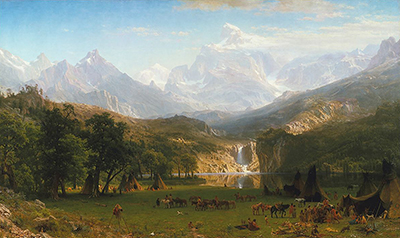
The Rocky Mountains, Lander’s Peak supplies a different comparison. In that large panorama, a village, water and rising mountains organise a more elaborate experience of scale and recession. The open wagon scene demonstrates that Bierstadt could make western space visible through restraint as well as through the accumulation of spectacular features.
The surviving study and its collection history
The Saint Louis Art Museum catalogues this painting as dating from about 1859, with oil on paper mounted on Masonite. It measures 20.3 × 33.3 centimetres, excluding the frame, and carries object number 158:1953.[6] The intimate scale matters: the broad plain and mountain horizon occupy a surface small enough to be examined closely. Their apparent extent comes from the relationships within the picture rather than from a physically imposing canvas.
The museum associates the study with Bierstadt’s government survey journey. Its provenance places the work with the dealer M. Knoedler & Co. and then J. Lionberger Davis by 1948; Davis gave it to the museum in 1953.[6] The catalogue cites museum records and correspondence for that history. It describes the painting’s later passage into a public collection, without identifying the people represented beside the wagon or the precise place where Bierstadt stopped to paint.
A pause without a fixed destination
Much of the picture's force comes from what the familiar wagon cannot explain. It gives the eye a recognisable object and suggests a journey, but does not provide the journey's destination, its remaining distance or the identities of its travellers. The mountains remain a broad horizon rather than a securely named endpoint.
The calm atmosphere likewise leaves practical uncertainties outside the frame. It shows a moment of relative stillness, not the full difficulty of keeping a party moving through changing weather and terrain. Looking at the wagon alongside the expedition and road history allows the quiet scene to retain those larger circumstances.
Surveyor’s Wagon in the Rockies brings human movement into view by stopping it. The small group is defined against a country that resists easy measurement. Its openness is more than an absence of dramatic detail: it is the condition through which the wagon, animals and distant mountains acquire their relationship.
Watch: Albert Bierstadt
Five perspectives on his paintings and their historical setting.
American Landscape Painting: Albert Bierstadt and the American Land
A Museum of Fine Arts, Boston presentation on American Landscape Painting: Albert Bierstadt and the American Land.
Explore Bierstadt’s artworks
Discussion
A covered wagon supplies a familiar object within an open expanse. How does that small group give you a sense of travel while leaving its destination unresolved?
Reader Insights
Which details make the wagon legible against ground that offers few markers of distance?
How do overlapping blue-grey ridges define the horizon without becoming a clear endpoint for the travellers?
How does the account of surveying, clearing, bridge building and existing Native trails broaden the journey suggested by the wagon?
Join the Conversation
Share a specific observation, documented connection or comparison from Surveyor’s Wagon in the Rockies.
References
- Matthew Baigell. Albert Bierstadt, excerpt on Surveyor’s Wagon in the Rockies, reprinted in Resource Library. Approximate dating and the interpretation of open space. View source text
- Nancy K. Anderson. Albert Bierstadt biography in American Paintings of the Nineteenth Century, Part I, National Gallery of Art, 1996, p. 31 onward. Early career and first western journey. View source text
- Alan Fraser Houston and Jourdan Moore Houston. “The 1859 Lander Expedition Revisited: ‘Worthy Relics’ Tell New Tales of a Wind River Wagon Road,” Montana: The Magazine of Western History, summer 1999, especially pp. 60–63. Travelling party, dated drawings and conditions of movement. View source text
- National Park Service. “The Lander Road, California National Historic Trail.” Survey, construction, improvements and earlier Native American trails. View source text
- Lance Mayer and Gay Myers. “Bierstadt and Other 19th-Century American Painters in Context,” Journal of the American Institute for Conservation 38, no. 1, 1999, §3.1. Different kinds of small studies. View source text
- Saint Louis Art Museum. Surveyor’s Wagon in the Rockies, circa 1859, accession 158:1953. Current materials, dimensions, expedition interpretation and published provenance; the underlying letters and accession records were not independently inspected. View source text