 by Tom Gurney
Tom Gurney BSc (Hons) is an art history expert with over 20 years experience
Published on June 19, 2020 / Updated on October 12, 2026
Email: tomgurney1@gmail.com / Phone: +44 7429 011000
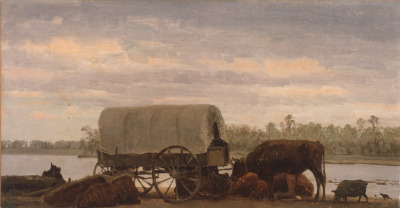
Nooning on the Platte by Albert Bierstadt
A covered wagon stands beside a broad river, surrounded by cattle resting or feeding on the bank. In Albert Bierstadt's Nooning on the Platte, travel has paused. The sky occupies much of the small painting, leaving the wagon and animals gathered along its lower edge.
The Saint Louis Art Museum dates the work to about 1859 and identifies it as oil on paper mounted on canvas, 17.8 × 33 cm. It entered the collection as a gift of J. Lionberger Davis in 1953, accession 157:1953.[1] Its modest dimensions bring a working stop on a journey into close view.
At a Glance
Where this painting sits in Bierstadt’s career
Dates refer to the paintings, rather than to the journeys behind them. Approximate dates and ranges retain the qualifications in the collection records.
Lake Lucerne
1858Nooning on the Platte
About 1859Mountain Brook
1863Street in Nassau
c. 1877–1880The Last of the Buffalo
1888–1889The Golden Gate
1900Contents
The wagon and the resting animals
The canvas cover forms a long, rounded shape above the wagon's angular wooden body. Its soft folds contrast with the sharply outlined spokes of the nearest wheel. A dark opening at the end gives depth to an otherwise pale, solid-looking cover.
The nearest wheel is particularly prominent. Its large circle reaches from the wagon body down to the ground, where it overlaps the animals and equipment around it. The wheel's open spaces let us see through the vehicle, preventing this large foreground object from closing off the river behind.
Several cattle gather tightly around the wagon. One lies low at the left; others are partly hidden within the group at the right. A standing animal's dark back and lowered head interrupt the lighter river. Their bodies create a broad, uneven band across the foreground, with changes in pose giving the cluster its variety.
A smaller dark pig appears at the lower right, with a bird farther along the bank. Animals and transport occupy the same narrow strip of ground. The pause in travel has its own activity, even though the wagon remains still.
A wide river beneath a low sky
The water runs almost horizontally across the painting. Its pale surface offers a clear contrast with the dark animals and wagon wheels. Beyond it, a low tree line stretches from one side to the other, rising slightly at the right without becoming a dramatic mountain barrier.
Clouds spread in loose bands above this low horizon. Grey and muted peach colours soften the sky, while the strongest darks remain near the ground. The sky's large area gives the small foreground gathering room to breathe. It also makes the scene feel open despite the closely grouped animals.
The museum connects the painting with Bierstadt's participation in a government survey party travelling towards the Rocky Mountains in 1859. Its account emphasises the practical support such expeditions supplied and the importance artists placed on having witnessed the places they painted.[1] Here that journey appears through its material necessities: shelter, wheels, animals and a riverside stopping place.
The government road behind the journey
The expedition's destination gives this quiet scene a larger historical setting. Frederick W. Lander's road project was designed to improve emigrant travel between Wyoming and Idaho. The National Park Service describes construction beginning in 1858 and further improvements in 1859: crews cleared vegetation, shifted earth and rock, built bridges and used existing Native American trails. The route shortened the journey and improved access to grass and water for travellers and their livestock.[2]
These practical concerns make the painting's cattle and river more than incidental scenery. A journey by wagon depended on the condition of animals as well as people. The halted vehicle, grazing or resting bodies and nearby water allow us to see the material basis of movement, rather than only its heroic destination. The painting does not show road construction, and the museum does not identify this stopping place as a particular site on Lander's cutoff. Its subject belongs to the broader journey that made the survey possible.
The Native trails incorporated into the road also complicate the idea of an empty frontier waiting to be explored. The expedition moved through a landscape with established routes and existing knowledge. The riverbank picture leaves those networks outside its immediate frame; knowing about them changes the historical meaning of its apparently isolated wagon.
Oil studies and public paintings
Its scale can be misleading when Nooning is set beside Bierstadt's later panoramic canvases. Nancy K. Anderson's National Gallery of Art catalogue records his successful exhibition of Lake Lucerne at the National Academy of Design in 1858, followed within weeks by honorary membership.[3] Before the western journey, he had already demonstrated that he could construct a large mountain landscape for public exhibition. The compact wagon scene belongs to an artist able to move between intimate observation and a much larger public spectacle.
The support matters too. This is a painting on paper subsequently mounted on canvas, not simply a reduced version of a large canvas painting.[1] Conservators Lance Mayer and Gay Myers emphasise the variety of Bierstadt's studies: some were quickly painted, while others were highly finished. In their examination of Italian Costume Studies, exposed coloured paper participates in the image; their discussion of South Dome, Yosemite Valley describes a much more complete painted surface.[4] Those examples demonstrate why “study” does not identify one uniform method or degree of finish.
For Nooning, the current collection entry supplies the support and journey context but no examination establishing exactly how long he worked on it or which passages were completed outdoors. The details of spokes, folds and animals can be appreciated without inventing a single sitting. Its value lies partly in the way a compact painted surface carries both a specific grouping and an expansive sky.
Wagons in painting and photography
Alan Fraser Houston and Jourdan Moore Houston's study of the expedition shows that the artists' presence was part of a coordinated undertaking. Bierstadt, Francis Seth Frost and Henry Hitchings travelled with the party, and the authors trace a letter of introduction from Secretary of War John B. Floyd to Bierstadt through Emanuel Leutze. Their account connects artistic opportunity with political introductions and practical expedition support.[5] A quiet riverside image emerged from a journey sustained by a much larger network than its solitary wagon suggests.
Bierstadt's travelling imagery was also photographic. The Nelson-Atkins Museum preserves an albumen stereograph catalogued as St. Joseph, Missouri (Lander Expedition), about 1859, credited to the Bierstadt Brothers. The museum describes a man beside horses and a carriage, with other vehicles outside shops advertising provisions. Its mount bears the firm's New Bedford imprint.[6]
The comparison is useful because it places wagons within a system of supply and commerce. The photograph records a built-up stopping place; Nooning brings transport and animals into a riverside landscape. Neither subject requires a distant mountain to make the western journey visible. The photograph is a separate object, not an established source for this painting, and the collective firm credit does not identify who operated the camera for that particular exposure.
The two media also offer different encounters with space. A stereograph presents paired views for a viewer to combine into an illusion of depth. In this oil, depth is organised through overlap and colour: dark animals cross the pale river, the wheel exposes fragments of the scene behind it, and the distant tree line loses the foreground's strong contrasts. Both ask an audience far from the journey to look closely at its ordinary equipment.
From a halted wagon to the panoramic West
Compare the concentrated wagon scene with Emigrants Crossing the Plains. That larger composition turns travel into a procession moving across a broad landscape. In Nooning on the Platte, the vehicle remains near enough for its cover, wheel and wooden body to be inspected separately.
The absence of a towering peak allows these everyday forms to carry the picture. The river and expansive sky give a sense of distance, while the resting cattle anchor the view to a particular patch of ground. The broader history of the expedition explains what enabled this scene, while its composition preserves an experience much smaller than the territory through which the party travelled.
Watch: Albert Bierstadt
Five perspectives on his paintings and their historical setting.
American Landscape Painting: Albert Bierstadt and the American Land
A Museum of Fine Arts, Boston presentation on American Landscape Painting: Albert Bierstadt and the American Land.
Explore Bierstadt’s artworks
Discussion
A halted wagon brings the river landscape close to everyday travel. Which details make this pause feel different from a grand emigrant procession?
Reader Insights
How do the wagon, cattle and riverbank establish the needs and scale of a journey at rest?
How does the account of trails, crossings and the Lander road change your understanding of the setting around the wagon?
Compare this concentrated stop with the larger procession discussed above. What becomes more visible when the composition narrows its attention?
Join the Conversation
Share a specific observation, documented connection or comparison from Nooning on the Platte.
References
- Saint Louis Art Museum. Nooning on the Platte, accession 157:1953. Collection record: date, material, unframed measurements, gift and provenance; curatorial note on the 1859 survey journey and expedition support. View source text
- National Park Service. The Lander Road, California National Historic Trail. Historical account, updated 16 November 2023: road construction, existing Native trails, route improvements and water and grazing provisions. This describes the expedition's wider context, not an identified site in the painting. View source text
- Nancy K. Anderson. Albert Bierstadt biography, in American Paintings of the Nineteenth Century, Part I. National Gallery of Art, 1996, printed pp. 31–32: 1858 Academy exhibition and honorary election. View source text
- Lance Mayer and Gay Myers. “Bierstadt and Other 19th-Century American Painters in Context.” Journal of the American Institute for Conservation 38, no. 1 (1999), pp. 55–67, §3.1: variations among oil studies and their supports. The technical findings concern the named comparison objects, not a treatment examination of Nooning. View source text
- Alan Fraser Houston and Jourdan Moore Houston. “The 1859 Lander Expedition Revisited: ‘Worthy Relics’ Tell New Tales of a Wind River Wagon Road.” Montana: The Magazine of Western History, Summer 1999, relevant discussion printed pp. 52, 56–57 and 60: artists, artistic networks and Floyd’s introduction. The underlying letters are discussed through this scholarship. View source text
- Nelson-Atkins Museum of Art. St. Joseph, Missouri (Lander Expedition), Bierstadt Brothers, about 1859, accession 2005.27.3713. Collection record: albumen stereograph, firm imprint and description of horses, carriages and provision shops. View source text