by Tom Gurney
Tom Gurney BSc (Hons) is an art history expert with over 20 years experience
Published on June 19, 2020 / Updated on October 12, 2026
Email: tomgurney1@gmail.com / Phone: +44 7429 011000
San Francisco Bay by Albert Bierstadt
A low shore curves around still-looking water beneath a broad, pale sky in Albert Bierstadt's San Francisco Bay. Rocks, grasses and lengths of wood occupy the foreground. Across the bay, a narrow band of buildings and open ground lies below darker hills. The picture gives considerable space to water and atmosphere, while its smaller details suggest a shoreline already shaped by human use.
The Smithsonian American Art Museum dates the painting to 1871–1873 and records its medium as oil on paperboard mounted on paperboard. Measuring 35.0 × 48.5 centimetres, it entered the collection through the bequest of Frank McClure and bears the accession number 1979.98.440.[1]
At a Glance
Where this painting sits in Bierstadt’s career
Dates refer to the paintings, rather than to the journeys behind them. Approximate dates and ranges retain the qualifications in the collection records.
Lake Lucerne
1858Mountain Brook
1863San Francisco Bay
1871–1873Street in Nassau
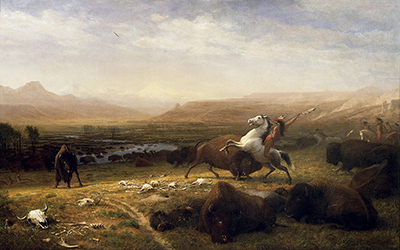
c. 1877–1880The Last of the Buffalo
1888–1889The Golden Gate
1900Contents
California during the early 1870s
The date range places the painting within a documented period of Bierstadt's California work. The Smithsonian's biography records an earlier journey to San Francisco and Yosemite in 1863, followed by a return to California in 1871 and a stay of two years.[2]
This history gives the bay view a place within his continuing engagement with the state. Its modest dimensions and low horizon offer a different experience from the monumental mountain landscapes with which he is often associated. A viewer can take in the entire arrangement quickly, then discover how much depends on small shifts in colour and the shape of the shore.
The collection record does not identify an exact viewpoint or describe the circumstances of execution. The date range should therefore remain a range: it does not establish a particular day's visit, a season, or whether Bierstadt painted the whole image outdoors.
A horizon that gives the sky room
The distant land sits below the middle of the picture, leaving the sky as a broad, largely uninterrupted field. Its greys, pale blues and warmer streaks vary gently rather than gathering into sharply defined cloud masses. The horizon is also low in relief: rounded hills descend towards flatter ground on the right.
This arrangement distributes attention across the picture. There is no single towering summit to pull the eye upwards. Instead, the long hill profile and shoreline encourage a lateral movement, while the sky provides space above them.
The nearest bank enters from the lower right and curves away along the water. Its sweep gives direction to an otherwise open surface. The foreground grasses form a darker edge beside the pale exposed ground, creating a close point of reference before the eye moves towards the farther shore.
The water and its few interruptions
The water is painted in muted blue-grey passages. Slight tonal variations suggest a surface rather than a blank area, but they do not create the strong bands of white spray or sharply crested waves found in a rough seascape.
Several thin upright posts stand within the bay. Their reflections and adjoining dark marks introduce small lines into the broad field of water. They are easy to miss in a reduced reproduction, yet become distinctive once noticed: their narrow forms contrast with the wide horizontals of shore and sky.
The posts indicate an intervention in the waterscape, although the image alone does not securely identify their purpose. Treating them simply as visible structures avoids assigning an unverified fishing method, landing place or boundary to the scene.
Along the nearest bank, dark stones and pieces of wood interrupt the lighter shore. These irregular forms supply detail without becoming a dramatic foreground subject. They help the water feel accessible from a specific patch of ground, giving the viewer somewhere to stand within the composition.
A calm view of a changing estuary
San Francisco Bay is an estuary whose waters are influenced by rivers, tides and wind. The US Geological Survey's published abstract for a 1985 study by T. J. Conomos, R. E. Smith and J. W. Gartner describes the bay as broad and shallow, with differing circulation patterns in its northern and southern reaches. It explains that wind and tidal movement can stir sediment from shallow areas.[3]
That general setting adds substance to the painted water without supplying a measurement of conditions on Bierstadt's day. The subdued surface is a chosen view of a changing environment. Its appearance does not establish tidal height, depth or water quality, and its quietness should not be mistaken for a permanently motionless bay.
The curved margin is particularly useful to examine in this context. Land and water meet along a low, irregular boundary, with exposed ground extending beside the foreground. Bierstadt gives that meeting place enough attention to make it an important part of the image, even though the exact location remains unresolved.
Buildings on the farther shore
The distant settlement is small in relation to the surrounding sky and water. Pale vertical forms rise above a low band of warm-coloured ground, while darker shapes gather at intervals along the shore. Some individual structures can be distinguished, but their identities are not established by the museum's catalogue.
Their presence prevents the picture from being read as an entirely uninhabited landscape. The foreground posts and distant buildings belong to different scales of human intervention: one lies close within the water, the other occupies the far bank. Together they connect the open bay with places of use and settlement.
Bierstadt keeps these forms subordinate to the larger arrangement. The distant buildings do not crowd into a dense urban panorama. They instead become small accents along a narrow strip of land, encouraging the viewer to look closely after taking in the broader scene.
A region with a much longer human history
The bay's human history extends beyond its nineteenth-century buildings. The National Park Service describes Ohlone homelands around the peninsula and East Bay, and Coast Miwok homelands north of the Golden Gate. Its account discusses shoreline villages, seasonal fishing and gathering, and the devastating effects of Spanish colonisation, including disease and forced labour. It also records continuing cultural preservation and revitalisation by descendants.[4]
A separate Park Service interpretation includes Coast Miwok speaker Angela Hardin, who describes ancestral villages near marshes and streams and the materials and food provided by land and sea.[5] Her contribution places these shores within a lived homeland rather than an empty scenic resource.
This is regional context, not an identification of a particular community at Bierstadt's painted viewpoint. It matters because the scarcity of visible figures in a landscape cannot establish an absence of human history. The painting presents a selected prospect; it does not contain the whole story of the bay.
Comparing another work from this California period
LACMA dates Bierstadt's The Grizzly Giant Sequoia, Mariposa Grove, California to about 1872–1873 and identifies its medium as oil on paper mounted on board.[6] The museum considers it probably connected with his San Francisco residence and discusses it as a study for later use, while qualifying proposed links to other pictures.
Its image offers a striking comparison with San Francisco Bay. Tall trunks divide a vertical forest view, and a massive reddish tree rises against blue sky. Smaller trees recede between the larger forms, creating depth through overlap and differences in scale.
The bay view creates depth through a low horizon, the curving bank and the separation between near objects and distant land. Both works direct attention to a particular arrangement of natural forms, but their compositions offer very different ways of looking. The comparison also cautions against transferring the documented purpose of one painting to another: LACMA's interpretation of its study does not prove that the Smithsonian's bay picture was preparation for a larger canvas.
Looking closely at a restrained landscape
Start with the dark foreground stones and the pale shore, then trace the bank towards the right-hand distance. The small buildings carry attention across the farther land, while the posts bring it back to the water.
Returning to the sky reveals how much of the painting is carried by quiet variations rather than conspicuous incidents. Its interest lies in the relationship between a few distinct objects and large, restrained fields of colour. The open bay, inhabited shore and close ground remain connected throughout that movement.
Watch: Albert Bierstadt
Five perspectives on his paintings and their historical setting.
American Landscape Painting: Albert Bierstadt and the American Land
A Museum of Fine Arts, Boston presentation on American Landscape Painting: Albert Bierstadt and the American Land.
Explore Bierstadt’s artworks
Discussion
A broad sky and muted water surround a low shoreline. Which small details make this restrained bay view feel inhabited?
Reader Insights
How do the rounded hills and narrow settlement leave room for the sky to dominate?
How does the account of tides, wind and sediment complicate the apparent quiet of the painted surface?
What questions do the Ohlone and Coast Miwok histories raise beyond identifying the distant nineteenth-century buildings?
Join the Conversation
Share a specific observation, documented connection or comparison from San Francisco Bay.
References
- Smithsonian American Art Museum. San Francisco Bay, 1871–1873, 1979.98.440. Medium, dimensions, McClure bequest and collection identity; museum reproduction inspected. View source text
- Smithsonian American Art Museum. Albert Bierstadt. Biography recording the 1863 journey and 1871–1873 California stay. View source text
- T. J. Conomos, R. E. Smith and J. W. Gartner, US Geological Survey. Environmental Setting of San Francisco Bay, 1985. Published abstract describing estuarine circulation and sediment movement. View source text
- National Park Service. Ohlones and Coast Miwoks, Golden Gate National Recreation Area. Regional homelands, colonial disruption and cultural continuity. View source text
- National Park Service. What Was This Place Like 250 Years Ago? Fort Baker interpretation including Coast Miwok speaker Angela Hardin. View source text
- Los Angeles County Museum of Art. The Grizzly Giant Sequoia, Mariposa Grove, California, circa 1872–1873, 53.30. Medium and qualified studio-study interpretation; reproduction of this separate work inspected. View source text