by Tom Gurney
Tom Gurney BSc (Hons) is an art history expert with over 20 years experience
Published on June 19, 2020 / Updated on October 12, 2026
Email: tomgurney1@gmail.com / Phone: +44 7429 011000
Western Trail, the Rockies by Albert Bierstadt
A covered wagon follows a narrow track beneath a steep, wooded slope. Above it, an enormous grey mountain fills most of the view, with pale snow lying between its broken ridges. Albert Bierstadt's Western Trail, the Rockies makes the travellers a small presence within a landscape whose scale is immediately apparent.
Christie's catalogue identifies the work as oil on paper, measuring 35.6 × 48.5 centimetres, and records Bierstadt's signature at the lower right.[1] It gives no execution date. Its provenance includes a private New England collection and a sale at Christie's in New York on 3 December 1993, lot 73. The work was subsequently exhibited at the Forbes Magazine Galleries in 200 Years of American Art from the Forbes Magazine Collection in 1999. That historical record does not establish its present owner or availability for public viewing.
At a Glance
Where this painting sits in Bierstadt’s career
Dates refer to the paintings, rather than to the journeys behind them. Approximate dates and ranges retain the qualifications in the collection records.
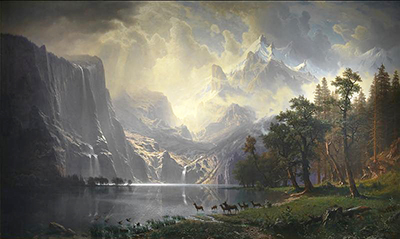
Lake Lucerne
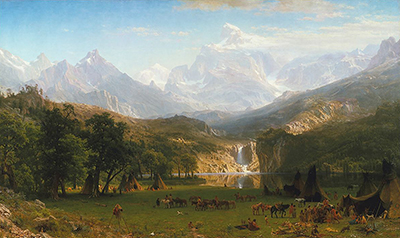
1858Mountain Brook
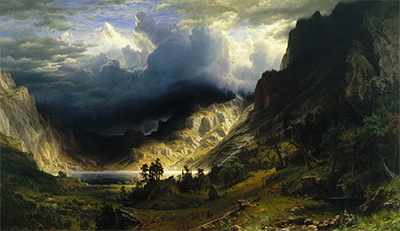
1863Street in Nassau
c. 1877–1880The Last of the Buffalo
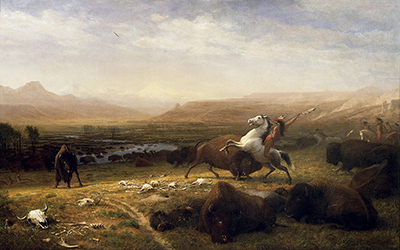
1888–1889The Golden Gate
1900Western Trail, the Rockies
Not dated in the cited recordContents
- The mountain occupies the larger world
- A diagonal hillside shapes the foreground
- The tall tree between wagon and mountain
- The wagon as a compact point of attention
- Covered wagons and overland travel
- Bierstadt's experience of the mountain west
- A landscape of travel and displacement
- Comparing a larger mountain composition
The mountain occupies the larger world
The central mountain rises almost to the upper edge. Its highest point sits above a succession of ridges, while the lower slopes extend behind the foreground trees. Little open sky remains around the summit, reinforcing the landform's prominence.
Its surface contains many different directions. Some rock faces appear nearly vertical; others step sideways or descend at a gentler angle. Pale areas of snow lie across ledges and between darker divisions, making the mountain more complex than a single triangular outline.
Towards the right, a broad light slope leads down into the valley. It separates the higher rock from the dark forest below, creating another interval of depth. The viewer can follow the mountain from summit to base through a sequence of changes in colour and structure.
The wagon is therefore placed beneath a setting whose larger forms can be understood before its small details. Travel takes place within the mountain world rather than commanding the entire composition.
A diagonal hillside shapes the foreground
The nearer hill descends from the left towards the lower centre. Its diagonal cuts across the mountain's lower mass and gives the foreground a strong direction. Green and brown vegetation covers much of its surface, interrupted by darker tree shapes.
The slope appears close and comparatively distinct. Against it, the farther mountain has paler, softer passages, particularly around the snow and grey rock. This difference helps separate the two landforms even where their outlines overlap.
A line of low growth follows the hill's upper edge. Elsewhere, scattered upright trees break its descending surface. Their irregular spacing keeps the hillside from looking like an unbroken band of colour.
The track sits near the lower end of this diagonal. Its small pale strip offers a route through the scene while the slope above limits the available space. The traveller's passage feels constrained by the terrain visible around it.
The tall tree between wagon and mountain
A prominent tree rises near the centre-right, with a dark, uneven trunk and widely spaced branches. Its silhouette is clear against the paler mountain behind it. The upper branches bend in different directions, leaving openings through which the distant rock remains visible.
This tree connects several levels of the picture. Its lower trunk stands close to the wagon; its crown reaches into the mountain field; its dark foliage echoes the surrounding forest. It serves as a point of orientation between the immediate path and the heights beyond.
The tree also changes the way the mountain is seen. Instead of meeting an uninterrupted rock face, the eye moves past a nearer branching form. The overlap makes the distance between tree and mountain more convincing.
The reproduction shows an irregular silhouette, but does not establish that a particular storm caused its shape. Its compositional function is clearer than any proposed history of damage.
The wagon as a compact point of attention
The pale wagon cover stands out against the brown and green surroundings. Its curved top provides one of the few rounded forms within a view dominated by angular rocks and narrow trees. Darker marks beneath it indicate the body and wheels.
Animals and small human forms accompany the vehicle, but they occupy very little space. Their reduced scale makes close inspection useful, while limiting how confidently individual actions can be described. The image does not identify the travellers, their starting point or destination.
The wagon's brightness is essential to its visibility. Without that pale cover, much of the group would merge into the shadowed foreground. The light area catches attention and then leads the viewer towards the track extending beside it.
This arrangement gives movement a local focus. The path and vehicle suggest a journey continuing through the mountains, while the surrounding landscape remains comparatively still. The picture supplies a passage, rather than the complete story of the people making it.
Covered wagons and overland travel
The National Park Service explains that nineteenth-century emigrant wagons varied in construction and came from different manufacturers. Mules and oxen commonly supplied their power, and the familiar large Conestoga was particularly associated with freight transport.[2]
These distinctions help place the painted vehicle within a wider history without labelling it as a specific model. Its pale cover alone cannot establish a manufacturer, load weight or exact team arrangement. Nor can the picture prove that it belongs to a family emigrating permanently rather than another kind of overland party.
The visible relationship between track and steep ground is more secure. Bierstadt places the vehicle within a narrow portion of the landscape, allowing the mountain to express the scale of the terrain through which travel must occur.
Bierstadt's experience of the mountain west
Bierstadt's first western journey took place in 1859. The Metropolitan Museum of Art's account of the separate The Rocky Mountains, Lander's Peak describes his participation in a government survey expedition headed by Frederick W. Lander, reaching the Wind River Range that summer.[3]
That experience provides a historical setting for his mountain subjects. It does not date Western Trail, the Rockies or prove that the wagon represents the survey party. The catalogue supplies no securely identified preparatory study linking this particular composition to a named stage of the journey.
The distinction matters because an artist's travel and a painting's execution are different events. The scene can draw on experience of western terrain without becoming a record of one known day's passage.
A landscape of travel and displacement
Overland routes were not simply paths into empty country. In its Oregon Trail interpretive themes, the National Park Service describes older Indigenous use of trail corridors and the later migration's effects on homelands, resources and political independence. It also emphasises that water, forage, terrain and weather shaped travel.[4]
This wider history complicates the apparently isolated wagon. Its small size can make human activity seem almost absorbed into the mountains, yet the larger movement represented by overland travel brought substantial changes to the region and its peoples.
The painting does not identify a particular Indigenous homeland or depict an encounter. Those details should not be invented from its title. It can nevertheless be viewed within the historical context of migration, rather than treated as evidence that the surrounding land was unoccupied or untouched.
Comparing a larger mountain composition
The Met's Lander's Peak, painted in 1863, measures 186.7 × 306.7 centimetres and presents a broad foreground encampment beneath mountains and water. The museum explains that its expansive scene participated in the ideology of Manifest Destiny.
Western Trail, the Rockies offers a different distribution of activity. The small travelling group occupies a narrow track, and the foreground hillside blocks much of the lower view. There is less space to move among separate human actions; attention returns repeatedly to the contrast between the vehicle and the mountain above it.
The comparison also corrects an assumption that Bierstadt's mountain subjects were always enormous canvases. Here, oil on paper and modest dimensions carry a strong sense of scale. The effect depends on the relationship between the small wagon, nearby trees and distant rock, as much as on the object's physical size.
Watch: Albert Bierstadt
Five perspectives on his paintings and their historical setting.
American Landscape Painting: Albert Bierstadt and the American Land
A Museum of Fine Arts, Boston presentation on American Landscape Painting: Albert Bierstadt and the American Land.
Explore Bierstadt’s artworks
Discussion
A wagon follows a narrow track beneath an enormous mountain. How do the foreground slope and central tree mediate between travellers and distant rock?
Reader Insights
How does the descending hill establish movement while the mountain fills nearly the entire background?
What makes the rounded wagon cover noticeable within the surrounding trees and broken ridges?
How does the history of Indigenous trail use and migration’s effects change your reading of this small travelling group?
Join the Conversation
Share a specific observation, documented connection or comparison from Western Trail, the Rockies.
References
- Christie's. Albert Bierstadt: Western Trail, The Rockies, lot 106. Object details, provenance and recorded Forbes exhibition; execution date unspecified. View source text
- National Park Service. Wagons on the Emigrant Trails. General vehicle and transport history; no identification of the painted wagon model. View source text
- The Metropolitan Museum of Art. The Rocky Mountains, Lander's Peak, 1863, 07.123. Expedition context and separate comparison painting; original comparison image visually inspected. View source text
- National Park Service. National Historic Trail Interpretive Themes, Oregon section, 2010 themes. Selected section on route conditions, Indigenous homelands and migration's consequences. View source text