by Tom Gurney
Tom Gurney BSc (Hons) is an art history expert with over 20 years experience
Published on June 19, 2020 / Updated on October 12, 2026
Email: tomgurney1@gmail.com / Phone: +44 7429 011000
The Buffalo Trail by Albert Bierstadt
Dark bison move through shining water towards a grassy bank. Their bodies are small beneath the sky, but their passage holds the landscape together: the animals make a route through what might otherwise seem an expanse of reflected light. The Buffalo Trail, dated about 1867 by the Museum of Fine Arts, Boston, belongs to Bierstadt's sustained attention to bison following his western journeys of 1859 and 1863.[1]
This is the Boston painting, distinct from Buffalo Trail: The Impending Storm of 1869 in the National Gallery of Art.[2] Keeping the two apart matters. The Boston herd advances into grass beneath a break in the clouds; the later painting places its animals beneath a more imposing cloud mass and rocky heights. A shared subject does not make the pictures interchangeable.
The MFA's museum-contributed AMICA catalogue records the Boston canvas as accession 47.1268, oil on canvas, measuring 80.96 × 121.92 centimetres. Its credit line names Martha C. Karolik's gift for the M. and M. Karolik Collection of American Paintings, 1815–1865.[3] These details identify the object; they do not establish its current gallery placement.
At a Glance
Where this painting sits in Bierstadt’s career
Dates refer to the paintings, rather than to the journeys behind them. Approximate dates and ranges retain the qualifications in the collection records.
Lake Lucerne
1858Mountain Brook
1863The Buffalo Trail
About 1867Street in Nassau
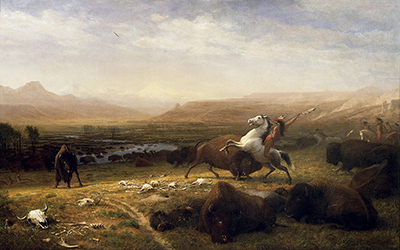
c. 1877–1880The Last of the Buffalo
1888–1889The Golden Gate
1900Contents
Following the herd
The crossing unfolds across the lower part of the canvas. Animals farther away at the left lead the eye towards the heavier silhouettes in the stream and the bison reaching the bank at the right. Differences in spacing prevent the procession from becoming a decorative row. Each body interrupts the water separately, while the repeated backs and heads give the group a common direction. We can follow a collective movement without losing its individual steps.
Water does more than provide a setting. Its pale surface separates dark bodies from the darker vegetation beyond, making the crossing readable at a distance. Beneath the animals, broken reflections disturb the brightness. The herd is neither resting within a landscape nor arranged before it for inspection: its bodies are passing through a surface that registers their presence. The bank gives that passage a visible destination, even though the painting does not tell us where the journey began or how far it continues.
The large trees at the right make arrival feel different from transit. Their dark canopy encloses the bank, while the thinner trees beyond the water leave more sky visible. As the animals approach this enclosure, they move from exposure towards cover. Yet the shadow is not simply threatening. It belongs to the same landscape as the open grass and luminous water, giving the crossing a rhythm of shelter and openness.
Above this measured procession, the sky operates on another scale. Dark cloud at the left, the central opening and the blue towards the right resist a single, settled reading of the weather. The herd supplies continuity below this shifting atmosphere. Rather than making one animal the hero of the scene, Bierstadt makes passage itself the event: bodies move on while light and cloud change around them.
Sketching within the hunt
The MFA interprets the subject as seasonal movement between feeding grounds and salt licks and connects it with Bierstadt's observation and sketching on his two western journeys.[1] This provides a basis for understanding the trail as purposeful travel. It does not establish that the whole composition reproduces a particular witnessed crossing.
Fitz Hugh Ludlow's retrospective account of the 1863 journey makes the fieldwork more troubling than a simple turn from hunting to observation. He describes Bierstadt taking his colour box, stool and umbrella to a hunt, preferring the opportunity to study bulls. Later, a companion held a repeatedly wounded bull at bay for him. Horsemen provoked charges so that the artist could record its action; once the study was complete, Bierstadt asked them to kill the animal.[4]
In that account, sketching relied on violence organised around the painter's needs. The episode supplies no demonstrated source for this canvas, but it changes how we understand the experience behind its apparently undisturbed herd. Ludlow's dramatic literary narration also requires care: it is a later account, not an unmediated record of every action. The peaceful crossing should not erase the coercion that could accompany close study.
A landscape sustained by movement
The relationship between herd, water and grass has an ecological dimension. The National Park Service explains that bison move in response to food, water, weather and threats, with herd composition varying by season, age and sex. Grazing and wallowing alter vegetation and soils; seeds carried in their coats and nutrients returned through dung help shape other life.[5] These facts do not identify the painted animals' ages or the season, but they make their journey more than an attractive arrangement of wildlife.
The grass at the destination can therefore be understood as part of a continuing relationship between animals and habitat. Bison occupy this terrain and help make such landscapes over time. The picture shows only a brief passage, yet its connection of bodies, water and grazing ground invites that longer view. Its apparent abundance rests on access to resources and space through which the herd can keep moving.
That access was already under pressure. The National Park Service's history of the Southern Plains describes drought beginning around 1846, disturbance from trail traffic and expanding robe markets. It also relates the later hide slaughter to federal efforts to subdue Plains nations during the conflicts of the 1860s and 1870s.[6] This regional history does not locate the Boston scene. It does show why an image made about 1867 cannot safely stand for a West untouched by commerce, displacement or violence. The calm is a pictorial effect, not evidence that these pressures were absent.
Promise, loss and continuing relationships
Peter H. Hassrick reads the Boston painting as a healthy herd crossing the Platte into lush grass, an image of regeneration and promise. The Platte identification is his reading. He places the work within a developing sequence: the peril of The Impending Storm, the somber procession of Western Kansas (1876), and the catastrophic The Last of the Buffalo of about 1888. He also interprets Bierstadt's bison as surrogates for Plains peoples.[2] This is an art historian's account of the series, rather than a surviving statement of the artist's intentions.
That sequence makes the Boston crossing seem vulnerable without requiring every cloud to predict destruction. Here, water, cover and grass remain connected by the herd's movement: the promise lies in that continuing relationship.
Nor should a story of loss end by placing Native peoples entirely in the past. The InterTribal Buffalo Council's own history describes nineteen Tribes gathering in the Sacred Black Hills in 1991 to restore buffalo to Tribal lands for cultural and spiritual preservation.[7] That continuing Tribal agency extends the relationship beyond Bierstadt's imagery. His paintings preserve one artist's vision of bison and the West; they cannot contain the whole history of the peoples whose relationships with buffalo endure.
Watch: Albert Bierstadt
Five perspectives on his paintings and their historical setting.
American Landscape Painting: Albert Bierstadt and the American Land
A Museum of Fine Arts, Boston presentation on American Landscape Painting: Albert Bierstadt and the American Land.
Explore Bierstadt’s artworks
Discussion
How does the herd connect the shaded banks with the bright strip of water?
Reader Insights
Follow the animals from the far shore towards the near bank. Where does their movement become most legible?
Compare the dark bodies with the reflective stream. How much of their presence depends on the light behind them?
Read Ludlow’s account beside this peaceful crossing. How does the process of gathering animal studies complicate the finished image?
Join the Conversation
Share a specific observation, documented connection or comparison from The Buffalo Trail.
References
- Museum of Fine Arts, Boston. The Buffalo Trail, about 1867, MFA Boston Custom Prints. Museum-authored “About the Artwork”: dating, western journeys, observation and seasonal movement. Authorised reproduction commentary. View source text
- Peter H. Hassrick / Buffalo Bill Center of the West. “Albert Bierstadt: Witness to a Changing West.” Points West, Fall/Winter 2017; online 18 May 2018. Narrative and captions, especially figures 5–6 and the interpreted bison sequence. View source text
- Museum of Fine Arts, Boston, via the AMICA Library. The Buffalo Trail, about 1867, BMFA.47.1268. Museum-contributed catalogue record, library year 1998: medium, dimensions, accession and gift credit. View source text
- Fitz Hugh Ludlow. The Heart of the Continent (1870), printed pages 62–69, PDF pages 82–89. Selected passage describing the hunt, sketching equipment, staged charges and killing of the wounded bull. View source text
- National Park Service. “Basic Facts,” Bison. Ecological role and behaviour: movement, herd variation, grazing, wallowing, seed dispersal and nutrient cycling. View source text
- National Park Service. “What Happened to the Bison?” Updated 26 January 2021. Southern Plains history of drought, trail traffic, markets and federal conflict; regional context, not identification of this painting's location. View source text
- InterTribal Buffalo Council. “History.” The Council's account of the 1991 gathering and the mission to restore buffalo to Tribal lands for cultural and spiritual preservation. View source text