by Tom Gurney
Tom Gurney BSc (Hons) is an art history expert with over 20 years experience
Published on June 19, 2020 / Updated on October 12, 2026
Email: tomgurney1@gmail.com / Phone: +44 7429 011000
Giant Redwood Trees of California by Albert Bierstadt
A forest can convey enormous scale without opening onto a distant mountain range. In Giant Redwood Trees of California, Albert Bierstadt places the viewer close to massive trunks, small human figures and running water. The largest trees extend beyond the upper edge, making the visible scene part of a much taller world.
The Smithsonian American Art Museum's record for its 2011 exhibition The Great American Hall of Wonders dates this oil painting to about 1874. Its lender credit identifies the Berkshire Museum and the gift of Zenas Crane.[1] That dated record establishes a historical collection association, rather than the painting's present whereabouts.
At a Glance
Annotated Details from Giant Redwood Trees of California
Use the numbered details to explore how Bierstadt builds this scene from light, scale and overlapping forms. Image: Public domain Google Art Project reproduction via Wikimedia Commons. Image source.
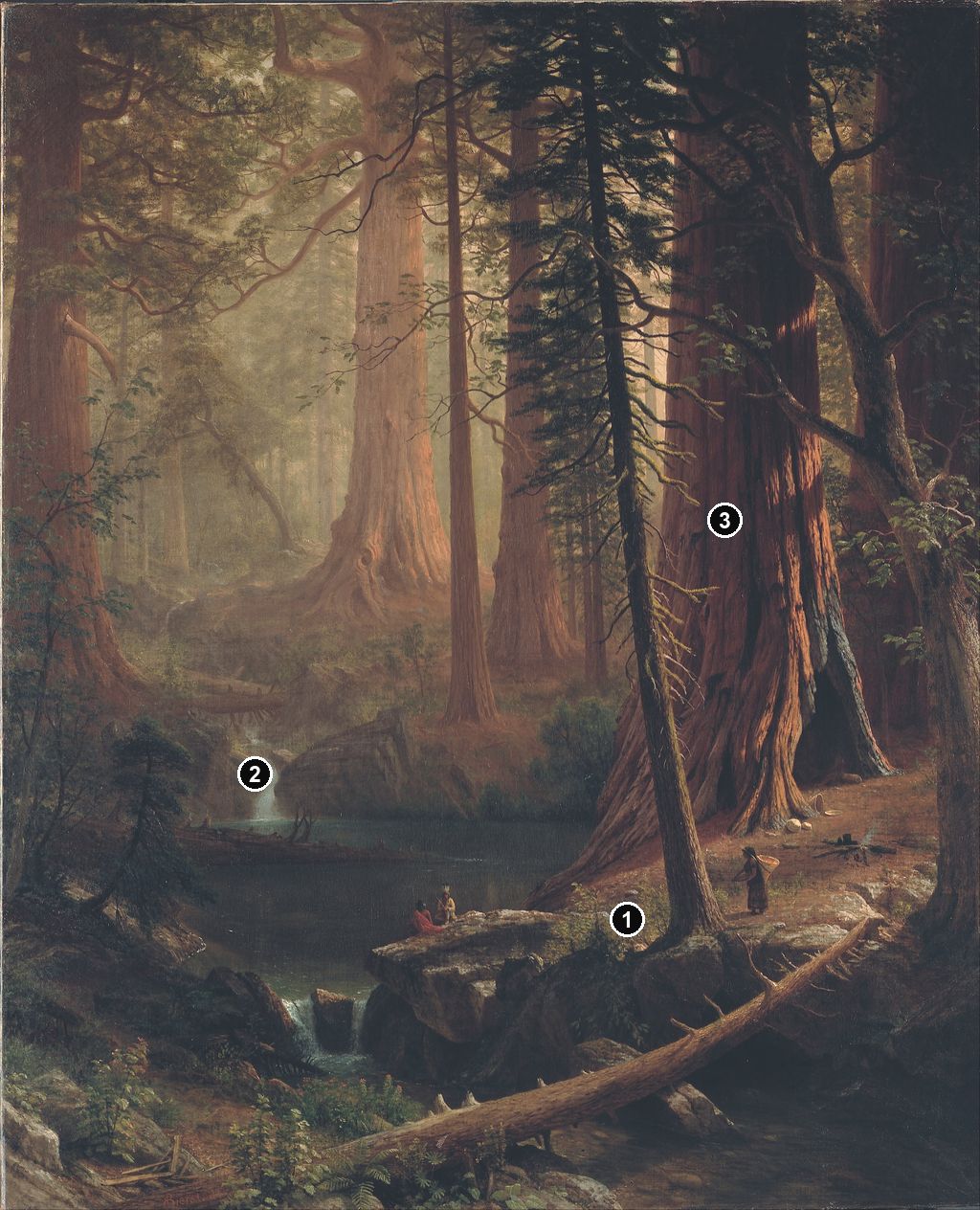
Details from GIANT REDWOOD TREES OF CALIFORNIA
Compare these enlarged passages with their positions in the full painting.
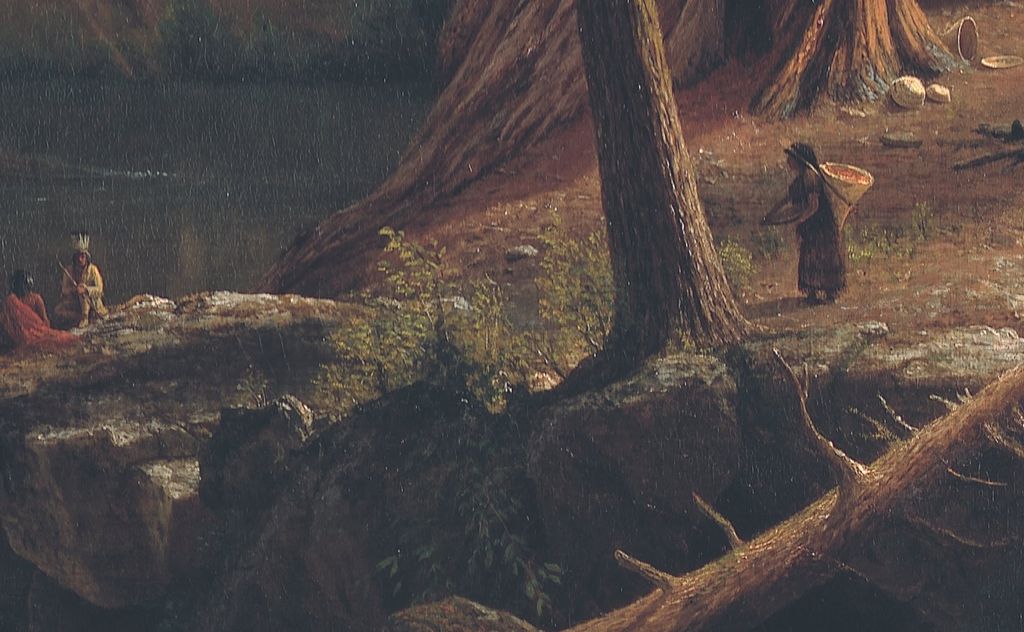
People beneath the trees
Compare the people with the nearby trunks. The figures provide a human measure for the extraordinary height and breadth of the trees.
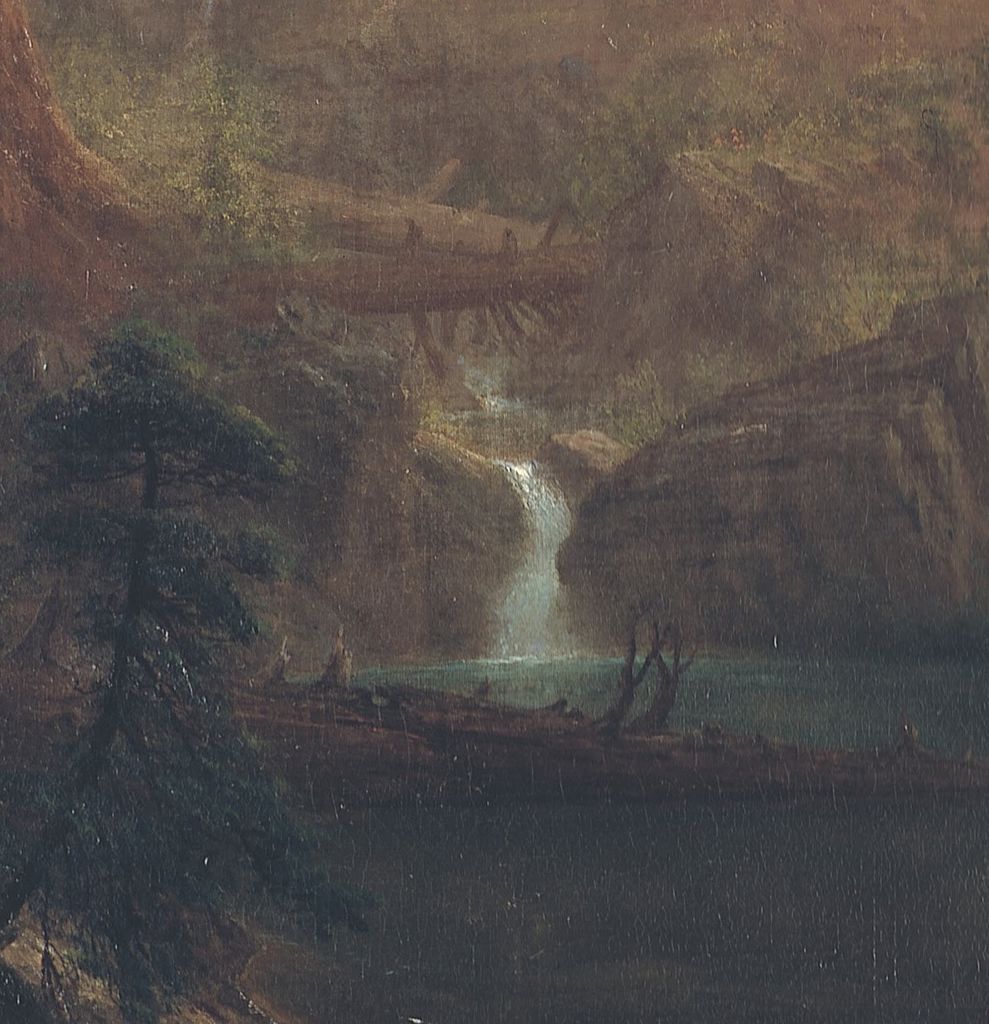
The waterfall behind the forest
Find the narrow waterfall between the trees. Its pale vertical passage opens a view beyond the dense foreground forest.
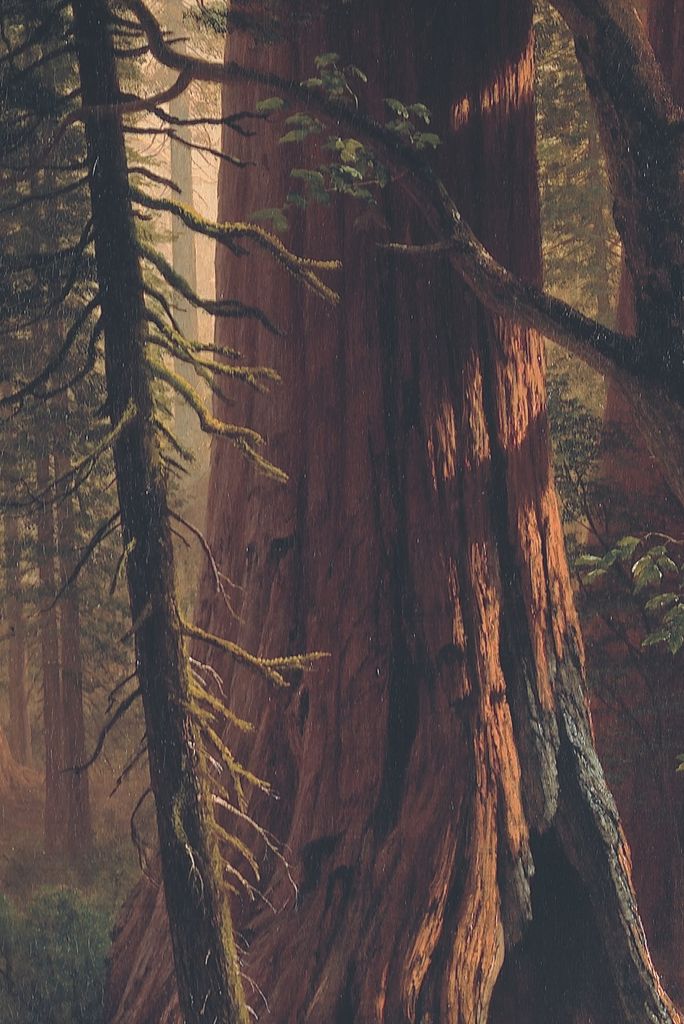
The surface of a great trunk
Follow the long ridges of bark up the trunk. Repeated vertical marks give the tree both texture and a strong upward movement.
Where this painting sits in Bierstadt’s career
Dates refer to the paintings, rather than to the journeys behind them. Approximate dates and ranges retain the qualifications in the collection records.
Lake Lucerne
1858Mountain Brook
1863Giant Redwood Trees of California
About 1874Street in Nassau
c. 1877–1880The Last of the Buffalo
1888–1889The Golden Gate
1900Contents
- Annotated close reading
- A forest measured from the ground
- Water across the forest floor
- What the title means by redwood
- An inviting scene, and a critical reading
- Indigenous knowledge within grove history
- Natural wonder and national abundance
- A collection history that needs a date
- Grandeur within a close view
A forest measured from the ground
The nearest great trunk rises on the right. Its broad base occupies a substantial part of the clearing, and its deeply marked surface catches warm light along the ridges of bark. Darker recesses make the trunk seem thick and irregular, rather than a flat vertical column.
Behind it, another large trunk stands nearer the centre; farther away, a brighter one rises within a hazier part of the forest. Their bases occur at different levels in the picture. Their separation allows the eye to register successive distances, while their repeated vertical forms keep the scene firmly enclosed by trees.
Much thinner trunks complicate this progression. The slender tree near the centre-right has a narrow outline and widely separated branches. Against the mass beside it, its relative delicacy makes the larger trunk's breadth more apparent. Different tree sizes supply comparisons within the forest itself, before we look for a human measure.
The human figures offer that further measure. A standing person in the clearing is tiny beside the nearest trunk, while other figures occupy the projecting ground near the water. Bierstadt does not need to show a tree's complete height to convey its magnitude. The relationship between a familiar human body and the visible base already exceeds ordinary expectations of woodland scale.
Water across the forest floor
The water gives the lower part of the picture a different organisation. A pale cascade enters the shaded pool from farther back; another bright passage appears below the projecting bank in the foreground. Their light accents punctuate darker water and vegetation, making the stream noticeable without turning it into the picture's largest feature.
The pool creates an interval between the viewer and the trees beyond. Its smooth, dark surface differs from the rough roots, rocks and bark. The contrast makes the wooded ground feel substantial, while the pale moving water introduces a more changeable element.
A fallen trunk crosses the foreground diagonally. Its long horizontal reach interrupts the standing trees' upward movement. Branches and small vegetation break up its outline, so that the near ground feels intricate rather than an empty platform for admiring the giants.
The picture continually alternates these directions. Standing trunks pull the eye upwards; the fallen tree carries it sideways; the water brings attention back towards the forest floor. Its upright format supports the height of the subject while leaving enough room below for people and movement.
What the title means by redwood
The word redwood needs care here. Botanist Sandra Knapp, writing for the Natural History Museum, distinguishes the giant sequoia of the Sierra Nevada, Sequoiadendron giganteum, from the coast redwood, Sequoia sempervirens. The two differ in several features, including their cones and seed maturation. She also explains that their botanical classification and names changed over time.[2]
The title therefore belongs to a longer history of describing California's big trees, rather than providing a modern identification of every tree visible in the painting. The large trunks and the accompanying conifers should not all be treated as one species. Nor does the canvas allow us to measure the age, diameter or height of its individual trees.
An inviting scene, and a critical reading
Alex Nemerov's 1991 Smithsonian teacher guide, The West as America, reads this painting as an inviting woodland in which Native figures appear sheltered by immense trees. It also interprets the foreground fallen tree as a possible imaginative crossing into the scene.[3] This reading directs attention to how the composition makes a seemingly overwhelming place available to the viewer.
The guide contrasts this idealised forest with tourism and commercial exploitation. That distinction asks us to consider the activities excluded from the view. The absence of a hotel or logging crew from a painted scene does not establish their absence from the region.
The people depicted here should also be distinguished from identifiable historical individuals. Their small scale and placement make them part of the painted forest, but neither the reproduction nor the title securely names their community or records a particular encounter. The image gives them a compositional role; other sources are needed to understand the history of people living in and using such groves.
Indigenous knowledge within grove history
National Park Service research on the Mariposa Grove documents Indigenous uses of giant sequoias and deliberate burning to maintain grove conditions, trails and valued plants. Its 2013 study also records continuing cultural connections despite severe disruption to access and ways of life.[4]
This history complicates a division between untouched nature and human influence. Forests could have histories of care without resembling commercial logging. The older guide's suggestion that tourists had simply replaced Indigenous people should not be accepted as a complete account of grove communities.
The park evidence supplies regional context. It neither locates this composition exactly nor identifies its figures. It does help us recognise a quiet woodland as a place within human history.
Natural wonder and national abundance
The painting appeared in a different interpretive framework in The Great American Hall of Wonders, held at the Smithsonian in 2011–12. That exhibition placed giant sequoias alongside buffalo and Niagara Falls as subjects through which Americans imagined abundant natural resources; clocks, guns and railroads provided a parallel account of technological ingenuity.[1]
Such a grouping shows how the forest picture can participate in questions beyond scenery. Large trees may be admired for their age and scale while also being imagined as resources. The same magnitude that produces wonder can provoke calculations about what a tree might yield or how it could be displayed. Those possibilities are part of the work's later interpretation, rather than a recovered statement of Bierstadt's intentions.
A collection history that needs a date
The painting's association with the Berkshire Museum belongs to a dated collection history. The 2011 Smithsonian credit records its association with that institution, but a 2018 court judgment authorised a limited sale of designated museum works. Giant Redwood Trees of California appears in the attached list.[5]
Authorisation is distinct from a completed transaction and does not identify a buyer. These records therefore support a historical collection account, without establishing a current owner or display location. Treating an old lender credit as present visiting advice would obscure the painting's subsequent collection history.
Grandeur within a close view
Compare Dogwood, another upright forest scene by Bierstadt. Its small bright tree concentrates attention within a sheltering opening; this picture distributes attention across massive trunks, human figures and water. The shared woodland setting allows different kinds of grandeur: one depends strongly on a concentrated colour accent, the other on repeated relationships of size.
Mountain Brook offers a further comparison through rocks, vegetation and running water. Here, the stream remains part of a larger wooded enclosure. The immense standing trees command the scale, while water and figures bring the eye back to an environment that can be occupied.
Giant Redwood Trees of California holds those experiences together. The forest exceeds the people within it, yet the scene invites sustained attention to their surroundings. Its monumentality arises from a close encounter: bark, roots, water and human bodies make the height beyond the frame imaginable.
Watch: Albert Bierstadt
Five perspectives on his paintings and their historical setting.
American Landscape Painting: Albert Bierstadt and the American Land
A Museum of Fine Arts, Boston presentation on American Landscape Painting: Albert Bierstadt and the American Land.
Explore Bierstadt’s artworks
Discussion
How do the trees, people and water make an enclosed forest feel immense?
Reader Insights
Compare the nearby figures with the great tree bases. Which relationship most strongly conveys the scale beyond the frame?
Consider Nemerov’s interpretation of the fallen tree and sheltered figures. How does the foreground make a daunting forest appear approachable?
Read the Indigenous grove-management evidence beside the scene. What work and continuing relationships can a seemingly natural forest view leave outside its frame?
Join the Conversation
Share a specific observation, documented connection or comparison from Giant Redwood Trees of California.
References
- Smithsonian American Art Museum. The Great American Hall of Wonders, 2011–12. Painting dated about 1874, oil on canvas, historical Berkshire Museum lender/gift credit and exhibition framework. View source text
- Sandra Knapp. “The giant sequoia, Sequoiadendron giganteum: The biggest tree in the world,” Natural History Museum. Distinction between giant sequoias and coast redwoods, and changing botanical names. View source text
- Alex Nemerov. The West as America: A Guide for Teachers, Smithsonian Institution, 1991, lesson 4, pp. 22–25. An attributed reading of composition, idealisation and commercial forest use. View source text
- National Park Service. Restoration of the Mariposa Grove of Giant Sequoias, Final Environmental Impact Statement, October 2013, chapter 3, pp. 3-137–3-138. Traditional uses, deliberate burning and continuing cultural connections. View source text
- Massachusetts Supreme Judicial Court for Suffolk County. Trustees of the Berkshire Museum v. Healey, April 5, 2018, judgment and Exhibit A, in the museum counsel's August 15, 2018 filed letter. Sale authorisation and the designated-object list. View source text